Chindia Alert: You’ll be Living in their World Very Soon
aims to alert you to the threats and opportunities that China and India present. China and India require serious attention; case of ‘hidden dragon and crouching tiger’.
Without this attention, governments, businesses and, indeed, individuals may find themselves at a great disadvantage sooner rather than later.
The POSTs (front webpages) are mainly 'cuttings' from reliable sources, updated continuously.
The PAGEs (see Tabs, above) attempt to make the information more meaningful by putting some structure to the information we have researched and assembled since 2006.
Defence spending could show the effect of economic headwinds but is still expected to increase
PLA’s modernisation and strategic priorities demand spending is maintained even after GDP’s first contraction since records began, observers say
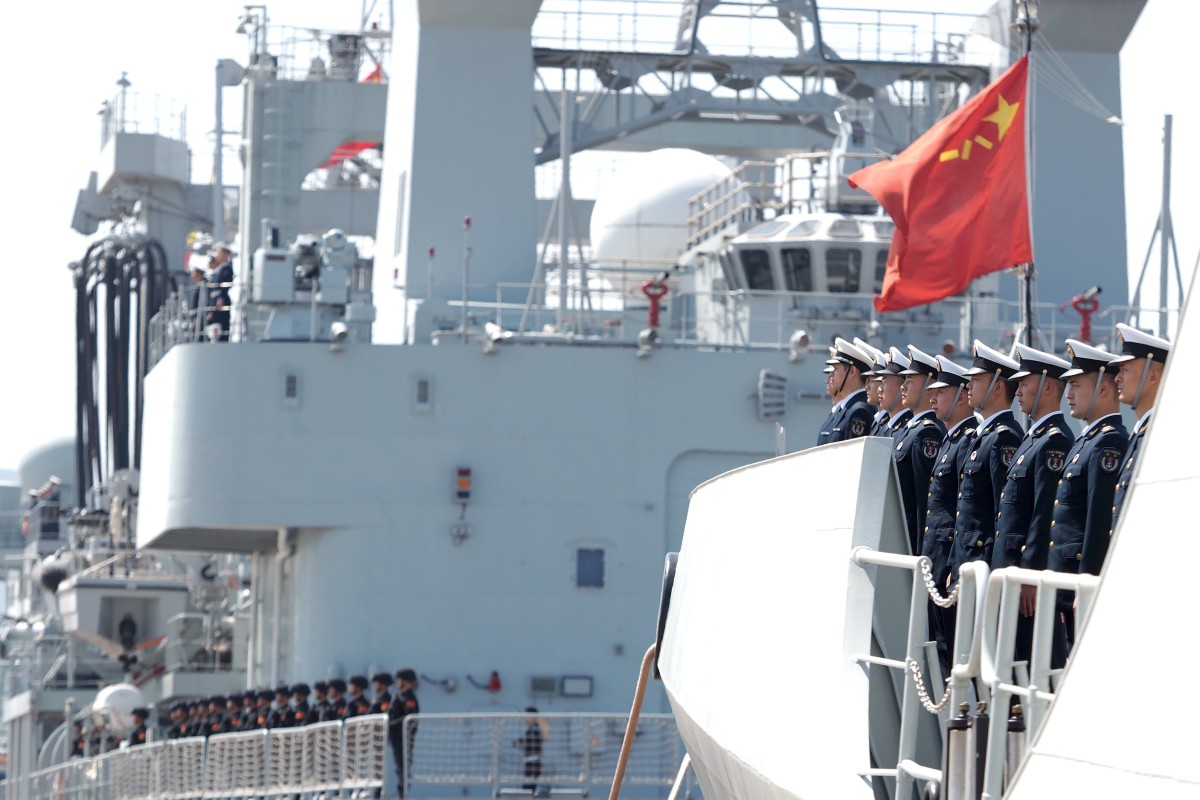
China has made modernising its military and expanding its weaponry a priority. Photo: Xinhua
China’s upcoming defence budget will be only slightly hit by the economic downturn that followed the coronavirus outbreak, and a modest increase is still expected as it continues to develop its military capability, analysts said.
The government’s military budget is expected to be revealed, as is the norm, at this year’s session of the National People’s Congress (NPC), China’s legislative body. Delayed by over two months because of the pandemic, it will finally be convened on May 22.
Last year the defence expenditure announced at the NPC session was
China has said its military expenditure has always been kept below 2 per cent of its GDP over the past 30 years, although its official figures have long been described by Western observers as opaque, with significant omissions of important items.
The South China Sea dispute explained
In a report earlier this week, the Stockholm International Peace Research Institute estimated that China’s actual military spending in 2019 was US$261 billion, the world’s second highest, after the United States’ US$732 billion.
John Lee, adjunct professor at the University of Sydney and senior fellow at the Hudson Institute in Washington, estimated that this year the Chinese defence budget would remain roughly the same or increase modestly, in line with growth levels of recent years.
“In the current environment, Beijing is keen to emphasise that China has recovered substantially from Covid-19 and that its power trajectory is unaffected by recent events,” Lee said. “At the same time, it would be aware of the anger towards the Communist Party for allowing the virus to become a pandemic.
“Regardless of what the reality might be, I would be surprised if there were a dramatic increase or a significant cut.”
First made-in-China aircraft carrier, the Shandong, enters service
China’s GDP suffered a 6.8 per cent decline in the first quarter, the first contraction since quarterly records began in 1992, after an extensive shutdown while it contained its coronavirus outbreak. However, the official increases in the military budget have since 2011 always exceeded overall GDP growth.
The Chinese government may focus more on job creation, social welfare and poverty alleviation, but not at the expense of military investment, according to Collin Koh, research fellow from the S Rajaratnam School of International Studies at Singapore’s Nanyang Technological University in Singapore.
“I tend to think it will be more or less the same,” Koh said. “To reduce [the budget] may send the wrong signal to would-be adversaries, both domestic and external: that Beijing has lost the will to keep up its military modernisation to assert core national interests.”
PLA flexes military muscle near Taiwan ‘in show of Covid-19 control’
15 Apr 2020
The People’s Liberation Army (PLA) began a massive – and costly – reform in 2015, with a personnel reshuffle, change in structure, upgraded equipment and enhanced training to better resemble battle scenarios. That was supposed to be complete this year.
Given the deteriorating relationship with the United States and rising tensions in the Taiwan Strait and South China Sea, the PLA faces challenges requiring a steady increase in investment, according to Hong Kong-based military commentator Song Zhongping.
Taiwan shows off its military power after presidential election
Macau-based military expert Antony Wong Dong predicted there would still be about 6-7 per cent growth in the budget “no matter what”.
“The PLA played an important role in the fight against the contagion, so a decrease in spending would not be accepted,” Wong said.
That role included the deployment of more than 4,000 military medics to help treat Covid-19 patients, and helping to transport medical supplies.
Wong said it would be a crucial year for the PLA in completing its preparation for potential military action against Taiwan, which would be so strategically important that “[President] Xi Jinping himself would never allow it to be affected by a shortage of funding”.
China’s military draws on 6G dream to modernise its fighting forces
18 Apr 2020
But a slight increase in budget would be sufficient to meet defence needs and maintain a deterrence against potential threats, including preventing self-ruled Taiwan taking the opportunity to declare independence, naval expert Li Jie said.
Beijing views Taiwan as a breakaway province to be reunified with the mainland, by force if necessary. Its relationship with Taipei has been strained, and dialogue halted, since Tsai Ing-wen, of the pro-independence Democratic Progressive Party, was elected the island’s president in 2016. Tsai was re-elected for a second term in January.
Li estimated that the budget would probably be kept at the same level or show a “slight” increase from last year.
“It would feed the ‘China threat’ theory and raise international concerns if the Chinese government expands military spending too much,” he said.
WINDHOEK, May 1 (Xinhua) — China’s poverty eradication policy and deliberate attempts to improve the lives of the rural population is a model for Namibia and Africa in general to follow in dealing with inequality in society, experts have said.
University of Namibia social and political analyst Ndumbah Kwamwayah said China has laid a strong foundation in dealing with poverty and emancipating its people since the days of Mao Zedong.
“Chinese literature especially the life journey of Chairman Mao is a good benchmark for developing countries that want to find ways of creating equal societies. If you check here in Namibia inequality and rural poverty are there despite our economy being agro-based.
“We need to take a cue from countries like China who have created better societies through improving agriculture production and mechanization through investing heavily in local people,” he said.
According to Kamwayah, China continues to value its agro-based economy as well as investment in rural development.
“China through its leaders in the past and present has come up with strong policies of decentralizing key services and also curbing rural urban drift through developing villages. Chinese literature also strongly captures the aspect of local development.
“In Namibia there are many regions including the Kunene, Zambezi and Kavango which are heavily affected by poverty. These need deliberate policies to be improved,” he said.
Political analyst from University of Namibia, Hoze Riruako said poverty eradication remains one of the biggest challenges confronting Namibia in contemporary times.
“What is more important is not to reproduce the Chinese way of doing things but to pick certain traits that can dent poverty and rural development from them,” he said.
SEOUL (Reuters) – South Korean officials are calling for caution amid reports that North Korean leader Kim Jong Un may be ill or is being isolated because of coronavirus concerns, emphasising that they have detected no unusual movements in North Korea.
At a closed door forum on Sunday, South Korea’s Unification Minister Kim Yeon-chul, who oversees engagement with the North, said the government has the intelligence capabilities to say with confidence that there was no indications of anything unusual.
Rumours and speculation over the North Korean leader’s health began after he made no public appearance at a key state holiday on April 15, and has since remained out of sight.
South Korea media last week reported that Kim may have undergone cardiovascular surgery or was in isolation to avoid exposure to the new coronavirus.
Unification minister Kim cast doubt on the report of surgery, arguing that the hospital mentioned did not have the capabilities for such an operation.
Still, Yoon Sang-hyun, chairman of the foreign and unification committee in South Korea’s National Assembly, told a gathering of experts on Monday that Kim Jong Un’s absence from the public eye suggests “he has not been working as normally”.
“There has not been any report showing he’s making policy decisions as usual since April 11, which leads us to assume that he is either sick or being isolated because of coronavirus concerns,” Yoon said.
North Korea has said it has no confirmed cases of the new coronavirus, but some international experts have cast doubts on that claim.
On Monday, North Korean state media once again showed no new photos of Kim nor reported on his whereabouts.
However, they did carry reports that he had sent a message of gratitude to workers building a tourist resort in Wonsan, an area where some South Korean media reports have said Kim may be staying.
“Our government position is firm,” Moon Chung-in, the top foreign policy adviser to South Korean President Moon Jae-in, said in comments to news outlets in the United States.
“Kim Jong Un is alive and well. He has been staying in the Wonsan area since April 13. No suspicious movements have so far been detected.”
Satellite images from last week showed a special train possibly belonging to Kim at Wonsan, lending weight to those reports, according to 38 North, a Washington-based North Korea monitoring project.
Though the group said it was probably the North Korean leader’s personal train, Reuters has not been able to confirm that independently, or whether he was in Wonsan.
A spokeswoman for the Unification Ministry said on Monday she had nothing to confirm when asked about reports that Kim was in Wonsan.
Last week China dispatched a team to North Korea including medical experts to advise on Kim Jong Un, according to three people familiar with the situation.
Reuters was unable to immediately determine what the trip by the Chinese team signalled in terms of Kim’s health.
On Friday a South Korean source told Reuters their intelligence was that Kim Jong Un was alive and would likely make an appearance soon.
Experts have cautioned that Kim has disappeared from state media coverage before, and that gathering accurate information in North Korea is notoriously difficult.
North Korea’s state media last reported on Kim’s whereabouts when he presided over a meeting on April 11.
Kim, believed to be 36, vanished from state media for more than a month in 2014 and North Korean state TV later showed him walking with a limp.
SHANGHAI (Reuters) – China’s smog-prone northern province of Hebei met its air quality targets by a big margin over the winter after concerted efforts to tackle emissions, a local official said on Sunday, without mentioning coronavirus-related factory shutdowns.
Average PM2.5 concentrations over the October-March period dropped 15% from a year earlier to 61 micrograms per cubic metre, while sulphur dioxide also fell by a third, said He Litao, vice-head of the provincial environmental bureau.
Most experts have attributed the significant decline in air pollution throughout China in the first quarter to the coronavirus outbreak and tough containment measures, which saw cities and entire provinces locked down and sharply reduced traffic and industrial activity throughout the country.
With millions staying at home, concentrations of lung-damaging PM2.5 particles fell by nearly 15% in more than 300 Chinese cities in the first three months of 2020.
Shanghai saw emissions fall by nearly 20% in the first quarter, while in Wuhan, where the pandemic originated, monthly averages dropped more than a third compared to last year.
However, He of the Hebei environmental bureau attributed the local decline in pollution to the “conscientious implementation” of government decisions even in the face of unfavourable weather conditions.
According to a winter action plan published last year, 10 cities in Hebei were expected to cut lung-damaging small particles known as PM2.5 by 1%-6% compared to the previous year.
Despite the decline, average PM2.5 was still much higher than China’s official standard of 35 micrograms, and the recommended World Health Organization level of 10 micrograms.
SHENYANG, April 23 (Xinhua) — With trucks standing bumper to bumper and large cranes loading containers on the train, work returned to normal at a logistics base in northeast China’s Liaoning Province.
The base, where the China-Europe freight trains are set to depart in Shenyang, the provincial capital, has seen stable departures since early April as the novel coronavirus epidemic ebbs away.
With the global supply chain being affected by restrictions in air, land, and port travel due to the global pandemic, China-Europe railway has been playing a more important role, experts say.
“The train was operated by staff in different sections, which means it does not require cross-border personnel health inspections, giving it advantages during the pandemic,” said Shan Jing, an industry insider who wrote a book on China-Europe freight trains.
In March, a total of 809 China-Europe freight trains carrying 73,000 containers were sent across China. Both numbers hit a monthly record.
At the Shenyang logistics base, trains depart to travel through Russia, Belarus, Poland and finally reach Germany in around 18 days. As of April 13, a total of 130 trains carrying 11,200 standard containers had departed from the base.
“The province sends a stable number of five trains each week,” said He Ruofan, a business manager with the Shenyang branch of China Railway Container Transport Corp., Ltd, operator of the trains.
The stable operation has made the route a top choice for many Chinese enterprises, said Yao Xiang, a manager with logistics group Sinotrans’s northeast company.
“Many shipping routes have been canceled, and the rest are more and more expensive amid the epidemic,” said Yao, noting the price for air cargo surged 5 to 10 times the normal price as flights decreased from China to Europe.
With increasing departing trains, returning trains on the route have also been increasing, Yao said.
Among the 130 trains that have been sent from the Shenyang base so far this year, 33 returned, carrying construction materials, car parts, mechanical equipment, and daily products.
“These goods provide supplies to large companies like BMW and Michelin’s Shenyang factories,” Yao said.
Medical supplies have also been sent to hard-hit Europe to fight against the coronavirus pandemic.
As of April 18, a total of 448,000 pieces of medical supplies weighing 1,440 tonnes had been sent to European countries via the route, according to China State Railway Group Company, Ltd.
“China-Europe freight trains have shown great service capabilities during the epidemic,” said Shan, the industry insider. “It serves as a new choice for European enterprises, and I believe more people will come to realize the importance of the route.”
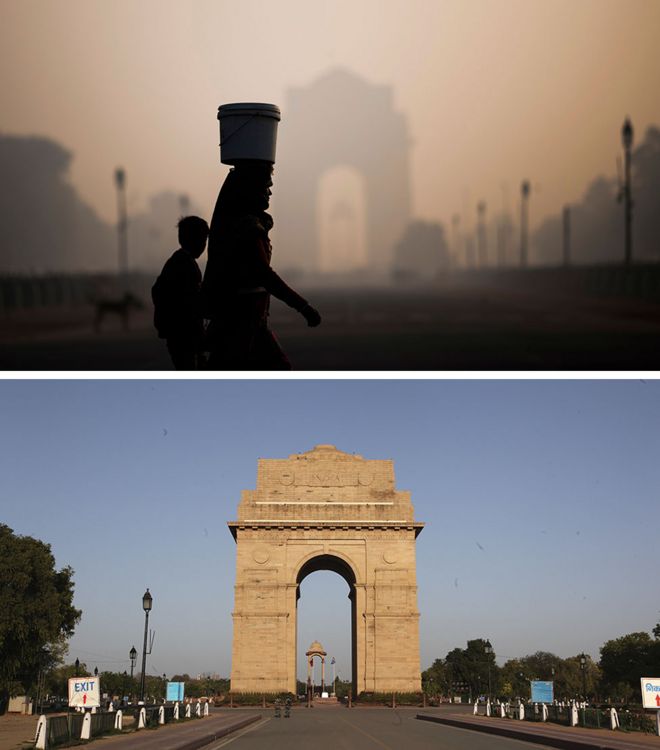
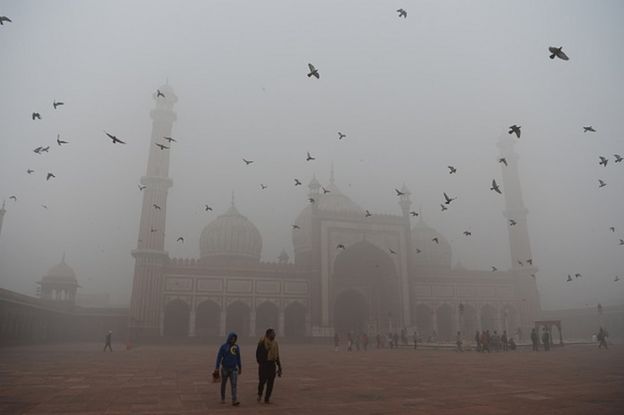
Image copyright GETTY IMAGESImage caption Delhi’sair quality has improved remarkably during the shutdown
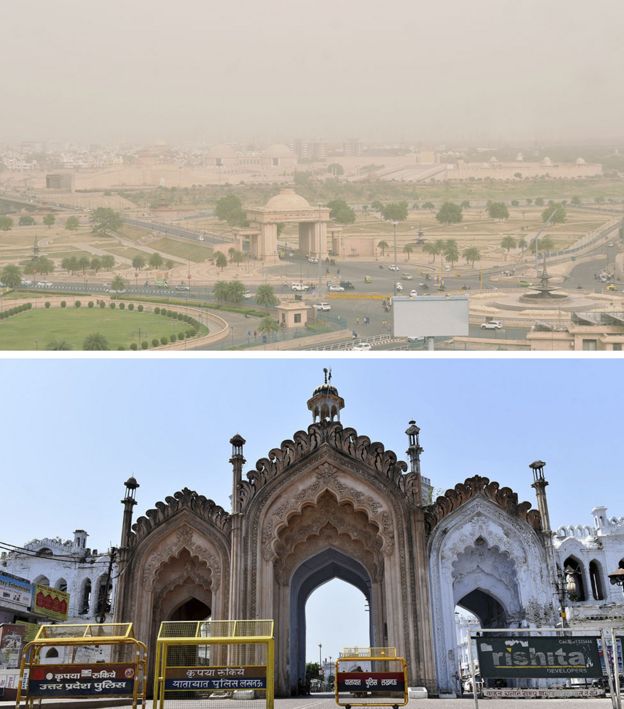
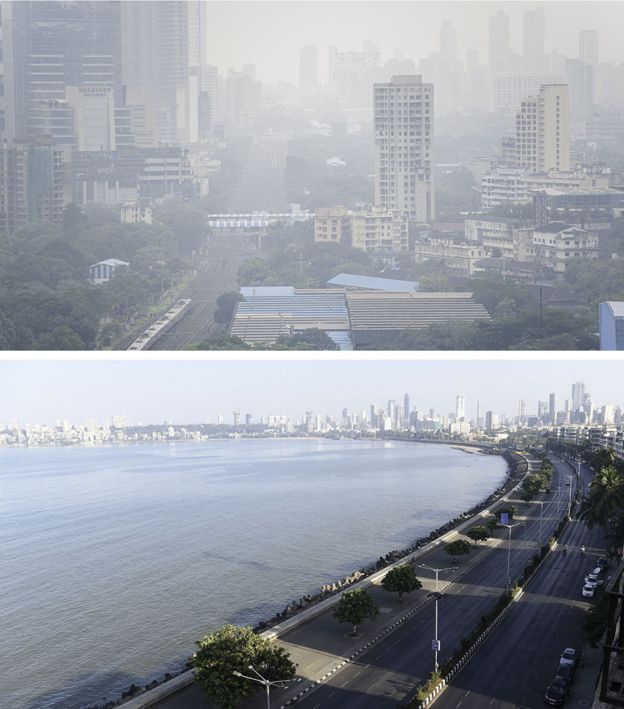
When India shut down last month and suspended all transport to contain the spread of coronavirus, the skies over its polluted cities quickly turned an azure blue, and the air, unusually fresh.
As air pollution plummeted to levels unseen in living memory, people shared pictures of spotless skies and even Himalayan peaks from cities where the view had been obscured by fog for decades.
On one social messaging group, a resident of the capital, Delhi, which regularly records some of the foulest air in the world, celebrated the city’s “alpine weather“. Politician and author Shashi Tharoor wrote that the “blissful sight of blue skies and the joy of breathing clean air provides just the contrast to illustrate what we are doing to ourselves the rest of the time”.
Media caption India coronavirus lockdown cleans up Ganges river
Less than six months ago, Delhi was gasping for breath. Authorities said air quality had reached “unbearable levels”. Schools were shut, flights were diverted, and people were asked to wear masks, avoid polluted areas and keep doors and windows closed.
Delhi and 13 other Indian cities feature on a list of the world’s 20 most polluted. It is estimated that more than a million Indians die every year because of air pollution-related diseases. Industrial smoke, vehicular emissions, burning of trash and crop residue, and construction and road dust are the major contributors.
As urban Indians gazed at the skies and breathed clean air inside their homes, researchers hunkered down to track data on how the grinding lockdown – now extended to 3 May – was impacting air pollution across the country.
Image copyright GETTY IMAGESImage caption Lucknow is another city on the top 20 world’s most polluted list
“This was an unprecedented opportunity for us to take a close look at how air pollution levels have responded to an extraordinary development,” Sarath Guttikunda, who heads Urban Emissions, an independent research group that provides air quality forecasts, told me.
Dr Guttikunda and his team of researchers looked at the data spewed out by the 100-odd air quality monitoring stations all over India. They decided to concentrate on the capital Delhi and its suburbs – a massive sprawl called the National Capital region, where more than 20 million people live. Last winter, air pollution here had reached more than 20 times the World Health Organization’s safe limit.
Image copyright HINDUSTAN TIMESImage caption The financial capital Mumbai also seems very different
The deadliest particle in Delhi’s foul air is the tiny but deadly PM 2.5, which increases the likelihood of respiratory and cardiovascular diseases. They primarily come from combustion – fires, automobiles and power plants.
Urban Emissions found the levels of PM 2.5 in Delhi during the lockdown plummeted to 20 micrograms per cubic metre with a 20-day average of 35.
To put this into context, between 2017 and 2019, the monthly average of PM 2.5 in the capital was up to four times higher. (The national standard is set at 40, and the WHO has an annual average guideline of just 10 micrograms per cubic metre.)
“If 35 is the average lowest available PM2.5 with limited local emissions, it means that at least 70% of the pollution is locally generated,” Mr Guttikunda told me.
Media caption India coronavirus lockdown cleans up Ganges river
His study also found a marked dip in PM 10, caused mainly by road and construction dust, and nitrogen dioxide, which comes mainly from vehicular emissions, and nearly 90% of vehicles are off the road.
“The current crisis has shown us that clear skies and breathable air can be achieved very fast if concrete action is taken to reduce burning of fossil fuels,” says Sunil Dahiya, of the Centre for Research on Energy and Clean Air, which has also been tracking air pollution levels during the lockdown.
But will this prompt change? After all, urban Indians’ and the media’s panic and outrage during the deadly winter pollution every year soon gets lost in the fog of summer heat and concerns over monsoon rains and droughts.
“We don’t yet have a democratic demand for clean air,” Arunabha Ghosh, Chief Executive Officer of the Council on Energy, Environment and Water, a leading climate think tank, told me. Orders to clean up the air have almost always come from the courts, responding to pleas by NGOs.
Image copyright GETTY IMAGESImage caption Pollution in Delhi peaks during winter
However, Dr Ghosh still hopes that “the experience of blue skies and fresh air could be a trigger to create a democratic demand for clean air in India”.
Crises often trigger life changing reforms. A fatal four-day “pea-souper” that engulfed London in 1952 and killed thousands provoked the passing of the Clean Air Act to reduce the use of smoky fuels.
China tried to clean up its air several times before hosting marquee international events – like the Beijing Olympics in 2008, the World Expo in Shanghai and the Guangzhou Asian Games in 2010 – before sliding back to grey, smoky skies.
But many believe the 2014 Apec meeting in Beijing, when China hosted 21 heads of Asia-Pacific economies, was a turning point. The rare blue skies over Beijing spawned the phrase ‘Apec blue‘. In a rush to clean its air, China introduced a set of far-reaching measures. Over the next four years, this resulted in a 32% drop in average pollution across major Chinese cities.
So could a lockdown to prevent the spread of a pandemic, which has imperilled the health and livelihoods of millions, trigger similar policy changes to clean up India’s air?
Image copyright GETTY IMAGESImage caption The movement for clean air has been sporadic and mainly pushed by NGOs
Could it move to a shift in reducing traffic on the road by asking people to work from home in shifts now that millions have experienced clean air for the first time in years? (Facing energy shortages after the loss of the Fukushima nuclear power plant, Japan unleashed a Cool Biz campaign to cut down air conditioning in workplaces and reduce carbon emissions by asking office workers to shed their suits.)
Or can India use some of the money from an inevitable stimulus to help kick-start the economy go towards helping green industries? Renewables, experts say, creates more jobs than coal: India has already created nearly 100,000 jobs in solar and wind energy firms.
Can the country use the windfall revenues accruing from the steep decline in oil prices – most of India’s oil is imported – to provide rebates to polluting factories to set up much-needed emission control equipment?
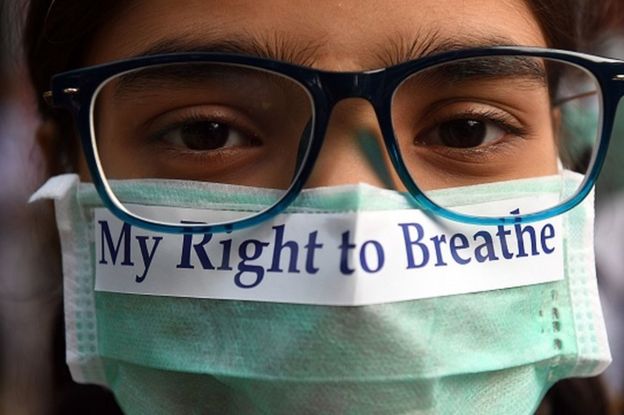
“We have to learn lessons to deploy the economic recovery from the pandemic. We need growth, jobs and sustainable development,” says Dr Ghosh. Cleaning up the air could be the key. For too long, India – and Indians – have ignored their right to breathe easy.
What’s more, if China can reduce air pollution by 32% in four-and-a-half years, why can’t India pledge to reduce pollution by 80% in 80 cities by 2027, which is our 80th anniversary of Independence? asks Dr Ghosh.
URUMQI, April 18 (Xinhua) — A medical team of eight experts who aided Pakistan’s fight against COVID-19 returned Friday night to Urumqi, capital of northwest China’s Xinjiang Uygur Autonomous Region.
The team, consisting of experts in various fields including respiratory, critical care and traditional Chinese medicine (TCM), arrived in Pakistan on March 28 and visited cities of Islamabad, Lahore and Karachi.
The Chinese experts communicated with the Pakistani federal government, national and local health authorities, hospitals and medical schools, as well as the Red Crescent.
The team members shared their experience through several video conferences and offered practical, specific suggestions to their Pakistani peers concerning the diagnosis, clinical treatment and epidemiologic study of COVID-19, and the application of TCM, hospital infection control and the construction of temporary hospitals.
The team also assisted with improving Pakistan’s guidelines on diagnosis and treatment of COVID-19 to help build an efficient epidemic prevention and control system in Pakistan and enhance its screening and testing capabilities.
Meanwhile, the experts carried out epidemic prevention guidance and popular science education for the Chinese embassy in Pakistan, Chinese enterprises, overseas Chinese and Chinese students in the country.
Experts to visit Beijing, Guangdong and Sichuan but no word on whether Hubei is on the itinerary
Specialists say visit must include a trip to the outbreak’s epicentre to get a full picture
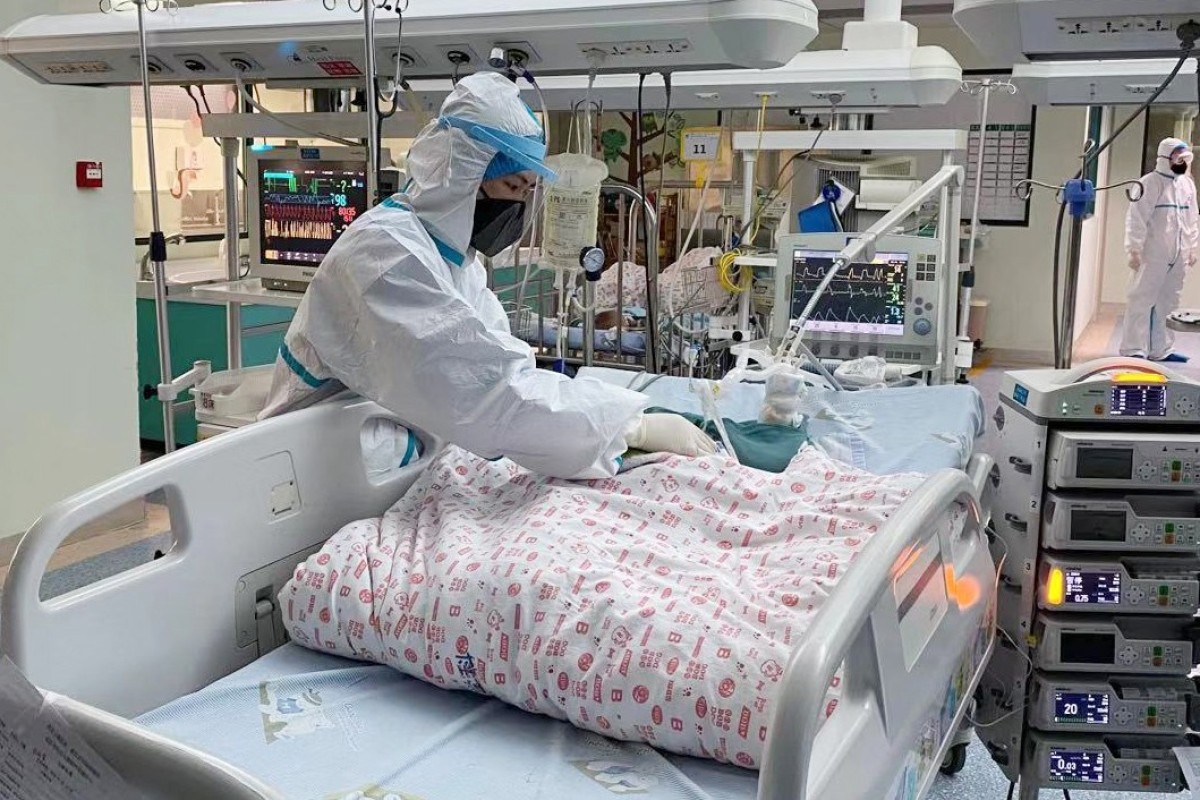
A nurse cares for a 14-month-old baby infected with the novel coronavirus in an ICU isolation ward of Wuhan Children’s Hospital in Wuhan, at the epicentre of the outbreak. Photo: Xinhua
A team of medical experts from the World Health Organisation (WHO), including specialists from the US, will visit Beijing and the Chinese provinces of Guangdong and Sichuan from Monday to assess the country’s efforts to contain the spread of a deadly coronavirus, according to the Chinese foreign ministry.
The death toll from the coronavirus had risen to 1,770 on mainland China as of Sunday, infecting 70,548 people, including more than 1,700 medical workers. Most of those confirmed with the disease, now known as Covid-19, are in Wuhan.
On Monday, the Ministry of Foreign Affairs said the WHO delegation would include Americans, but gave no further details.
The announcement came as a commentary in Communist Party mouthpiece People’s Daily accused Washington of dragging its feet on a funding pledge to help with the epidemic, saying it had a “dark mentality and taken dangerous action” during the outbreak.
WHO director general Tedros Adhanom Ghebreyesus said on Friday that the mission to China included 12 international medical specialists, and they would, with 12 Chinese experts, learn more about the transmission of the virus and the effectiveness of the measures in a bid to work out the next containment steps for China and the world.
An advance team of WHO medical experts arrived in Beijing last Monday, led by Canadian emergency expert Bruce Aylward, Tedros said.
China’s National Health Commission (NHC) said all of the delegation’s members arrived in Beijing over the weekend, and held talks with Chinese medical experts, public health officials and other government departments.
They exchanged views on virus containment, wildlife management and vaccine development, the NHC said.
Experts said the international team would be left with an “incomplete picture” of the outbreak if it did not go to Wuhan or Hubei.
“Unfortunately, this feeds into a narrative that China is trying to hide the true nature of the outbreak, so it would seem to be shortsighted and counterproductive to China’s efforts to say to the world that it is doing everything it can to contain this outbreak,” said Adam Kamradt-Scott, a specialist in global health security and international relations at the University of Sydney.
“We have seen in the past when we have external teams, they are often able to identify areas for improvement or to make recommendations for measures that national authorities may not have thought of – we’ve seen that through other examples where external expertise can be valuable in times of crisis.”
He said any impression of a cover-up would likely further strengthen the resolve of countries that had taken strict measures, including travel bans, to keep them in place or tighten them further.
“China has got a public relations campaign that it also needs to be mindful of in engaging with the international community, so there are the actual measures that the government needs to take in order to control the outbreak, but the government also needs to be seen to be doing everything that it can,” he said.
BEIJING/SINGAPORE (Reuters) – China reported on Wednesday its smallest number of coronavirus cases since January, lending weight to a prediction by its top medical adviser for the outbreak to end by April, but a global infectious diseases expert warned of the spread elsewhere.
Financial markets took heart from the outlook of the Chinese official, epidemiologist Zhong Nanshan, who said on Tuesday the number of new cases was falling in some provinces, and forecast the epidemic would peak this month, even as the death toll in China rose to more than 1,100 people.
World stocks, which had seen rounds of sell-offs over the virus, surged to record highs on hopes of a peak in cases. The Dow industrials, S&P 500 and Nasdaq all hit new highs, and Asian shares nudged higher on Wednesday.
But the World Health Organization (WHO) has warned that the epidemic poses a global threat akin to terrorism and one expert coordinating its response said while the outbreak may be peaking at its epicentre in China, it was likely to spread elsewhere in the world, where it had just begun.
RELATED COVERAGE
Chess, squabbles aboard cruise ship cast away by coronavirus fears
Singapore’s DBS evacuates 300 staff after employee contracts coronavirus
See more stories
“It has spread to other places where it’s the beginning of the outbreak,” the official, Dale Fisher, head of the Global Outbreak Alert and Response Network coordinated by the WHO, said in an interview in Singapore.
“In Singapore, we are at the beginning of the outbreak.”
Singapore has reported 47 cases and worry about the spread is growing. Its biggest bank, DBS (DBSM.SI), evacuated 300 staff from its head office on Wednesday after a confirmed coronavirus case in the building.
Hundreds of cases have been reported in dozens of other countries and territories around the world, but only two people have died outside mainland China – one in Hong Kong and another in the Philippines.
WHO chief Tedros Adhanom Ghebreyesus said on Tuesday the world had to “wake up and consider this enemy virus as public enemy number one” and the first vaccine was 18 months away.
In China, total infections have hit 44,653, health officials said, including 2,015 new confirmed cases on Tuesday. That was the lowest daily rise in new cases since Jan. 30.
The number of deaths on the mainland rose by 97 to 1,113 by the end of Tuesday.
But doubts have been aired on social media about how reliable the figures are, after the government last week amended guidelines on the classification of cases.
‘STAY HOPEFUL’
The biggest cluster of cases outside China is aboard the Diamond Princess cruise ship quarantined off Japan’s port of Yokohama, with about 3,700 people on board. Japanese officials on Wednesday said 39 more people had tested positive for the virus, taking the total to 175.
One of the new cases was a quarantine officer.
Thailand said it was barring passengers from another cruise ship, MS Westerdam, from disembarking, the latest country to turn it away amid fears of the coronavirus, despite no confirmed infections on board.
“We try to stay hopeful,” American passenger Angela Jones told Reuters in a video recording. “But each day, that becomes a little bit more difficult, when country after country rejects us.”
Echoing the comparison with the fight against terrorism, China’s state news agency Xinhua said late on Tuesday the epidemic was a “battle that has no gunpowder smoke but must be won”.
The epidemic was a big test of China’s governance and capabilities and some officials were still “dropping the ball” in places where it was most severe, it said, adding: “This is a wake-up call.”
The government of Hubei, the central province at the outbreak’s epicentre, dismissed the provincial health commission’s Communist Party boss, state media said on Tuesday, amid mounting public anger over the crisis.
China’s censors had allowed criticism of local officials but have begun cracking down on reporting of the outbreak, issuing reprimands to tech firms that gave free rein to online speech, Chinese journalists said.
The pathogen has been named COVID-19 – CO for corona, VI for virus, D for disease and 19 for the year it emerged. It is suspected to have come from a market that illegally traded wildlife in Hubei’s capital of Wuhan in December.
The city of 11 million people remains under virtual lockdown as part of China’s unprecedented measures to seal infected regions and limit transmission routes.
Travel restrictions that have paralysed the world’s second-biggest economy have left Wuhan and other Chinese cities resembling ghost towns.
Even if the epidemic ends soon, it has taken a toll of China’s economy, with companies laying off workers and needing loans running into billions of dollars to stay afloat. Supply chains for makers of items from cars to smartphones have broken down.
ANZ Bank said China’s first-quarter growth would probably slow to 3.2% to 4.0%, down from a projection of 5.0%.
The likely slowdown in China could shave 0.1 to 0.2 percentage points off both euro zone and British growth this year, credit rating agency S&P Global estimated.
The Lunar New Year’s Eve in Wuhan, ground zero of the novel coronavirus outbreak in central China, is nothing but special. Behind the seemingly quiet streets, people in all walks of life are racing against time to fight against the invisible enemy.
WUHAN, Jan. 25 (Xinhua) — There were far fewer cars on the streets and bustling crowds were not seen in the shopping malls in the central Chinese city of Wuhan on Jan. 24 — the Eve of the Chinese Lunar New Year.
The scene was quite different from the occasion in the previous years because of the novel coronavirus that has claimed over 40 lives and infected over a thousand nationwide. With a population of over 10 million, Wuhan, the capital city of Hubei Province, is the center of the epidemic.
Photo taken on Jan. 24, 2020 shows a medical aid team of Army Medical University leaving for Wuhan in southwest China’s Chongqing. On the Chinese Lunar New Year’s Eve, a group of 150 medical workers from the Army Medical University left for Wuhan, the center of the novel coronavirus (2019-nCoV) outbreak, to provide medical aid. (Xinhua)
Yang Yingchen, a volunteer of the Red Cross Society of China’s Wuhan branch, had a busy day answering calls.
“People from across the nation called to check on accounts and addresses to make donations,” said Yang. “Many would say ‘Come on, Wuhan’ to us, which makes me feel especially warm and deeply moved.”
Chen Li, a doctor in a Wuhan hospital, spent the Chinese Lunar New Year’s Eve at home to quarantine herself. She is a little bit worried about having had contact with infected patients, but luckily she has no signs of symptoms for the time being.
“Before joining the fight against the epidemic, I had sent my four-year-old son to my parents. I has disinfected all the articles in my house,” she said.
Chen’s husband is at the forefront of the fight against the epidemic. “We haven’t seen each other for over a week,” said Chen. On Saturday morning, she put on protective clothing again and returned to work.
“Actually, I can’t be isolated for too long. There’s still a lot of work to be done,” she said. “I just don’t know when I can see my boy again.”
Aerial photo taken on Jan. 24, 2020 shows mechanical equipment working at the construction site of a special hospital in the Caidian District of western suburb of Wuhan, central China’s Hubei Province. The central China metropolitan of Wuhan will follow Beijing’s SARS treatment model to build a special hospital for admitting patients infected in the outbreak of pneumonia caused by the novel coronavirus. (Xinhua/Xiao Yijiu)
The virus had resulted in 41 deaths in China by the end of Friday, mostly in Wuhan, according to the National Health Commission. Nationwide, a total of 1,287 cases were confirmed, including 237 in critical condition.
Confirmed cases were also reported in China’s Hong Kong, Macao and Taiwan, as well as Thailand, Japan, the Republic of Korea, the United States, Vietnam, Singapore, Nepal and France.
Wuhan is following Beijing’s SARS treatment model in 2003 to build a makeshift hospital with a capability of 1,000 beds for admitting infected patients. Construction on the facility began Thursday night. It will be completed and put into use prior to Feb. 3, less than 10 days away.
“It’s going to be another all-nighter. We need to speed up work and complete the hospital as soon as possible,” said Lyu Jun, a young truck driver at the construction site. This is his first Spring Festival away from home.
For ordinary people, this year’s Lunar New Year’s Eve lacks some gatherings but is still a time to extend greetings and wishes.
Yin Yeqiong, from Hunan Province, refunded her tickets back home after much debate. “I had it in my mind to still go home, but finally decided to stay in Wuhan,” she said. “Our stay will help reduce panic in other places.”
Liu Jie, a dough sculptor, put on a New Year costume and watched the Spring Festival Gala with his family. “We’re now at a critical period, so I texted New Year wishes to friends and relatives this year. I believe this is the best way,” he said.
Liu Jiapeng, a children’s book editor, stayed in Wuhan during the Spring Festival for the past four decades. “I always stayed with my family, and we would have every meal together,” said Liu. “But this year, I haven’t had one meal with them.”
On the day of the Lunar New Year’s Eve, he and his wife bought some goods for their parents, brought them to their house and briefly chatted. As they were waiting for the elevator, Liu looked back and saw his father standing at the windowsill, watching them leave.
Medical workers of Army Medical University assemble before leaving for Wuhan in southwest China’s Chongqing, Jan. 24, 2020. On the Chinese Lunar New Year’s Eve, a group of 150 medical workers from the Army Medical University left for Wuhan, the center of the novel coronavirus (2019-nCoV) outbreak, to provide medical aid. (Xinhua)
China is mobilizing medical resources nationwide to aid Wuhan and control the epidemic. Doctors, nurses and experts from across the nation have been selected to join the battle, and manufacturers have restarted their plants to produce medical consumables that have been running short in many places.
A national research team of 14 experts, headed by renowned respiratory scientist Zhong Nanshan, has been set up to help prevent and control the outbreak on Friday.
“This is going to be an unforgettable Spring Festival,” said Chen Ying, a writer. “Because I feel that at this moment, there are so many families that I do not know, in every corner of this city, praying for our home.”
“My New Year wish is simple,” said Liu Jie. “I hope the virus will soon be conquered and everyone in Wuhan and the whole nation would be safe and healthy.”







 CHINDIA ALERT: You'll be living in their world, very soon
South Korean officials call for caution amid reports that North Korean leader Kim is ill
SEOUL (Reuters) – South Korean officials are calling for caution amid reports that North Korean leader Kim Jong Un may be ill or is being isolated because of coronavirus concerns, emphasising that they have detected no unusual movements in North Korea.
At a closed door forum on Sunday, South Korea’s Unification Minister Kim Yeon-chul, who oversees engagement with the North, said the government has the intelligence capabilities to say with confidence that there was no indications of anything unusual.
Rumours and speculation over the North Korean leader’s health began after he made no public appearance at a key state holiday on April 15, and has since remained out of sight.
South Korea media last week reported that Kim may have undergone cardiovascular surgery or was in isolation to avoid exposure to the new coronavirus.
Unification minister Kim cast doubt on the report of surgery, arguing that the hospital mentioned did not have the capabilities for such an operation.
Still, Yoon Sang-hyun, chairman of the foreign and unification committee in South Korea’s National Assembly, told a gathering of experts on Monday that Kim Jong Un’s absence from the public eye suggests “he has not been working as normally”.
“There has not been any report showing he’s making policy decisions as usual since April 11, which leads us to assume that he is either sick or being isolated because of coronavirus concerns,” Yoon said.
North Korea has said it has no confirmed cases of the new coronavirus, but some international experts have cast doubts on that claim.
On Monday, North Korean state media once again showed no new photos of Kim nor reported on his whereabouts.
However, they did carry reports that he had sent a message of gratitude to workers building a tourist resort in Wonsan, an area where some South Korean media reports have said Kim may be staying.
“Our government position is firm,” Moon Chung-in, the top foreign policy adviser to South Korean President Moon Jae-in, said in comments to news outlets in the United States.
“Kim Jong Un is alive and well. He has been staying in the Wonsan area since April 13. No suspicious movements have so far been detected.”
Satellite images from last week showed a special train possibly belonging to Kim at Wonsan, lending weight to those reports, according to 38 North, a Washington-based North Korea monitoring project.
Though the group said it was probably the North Korean leader’s personal train, Reuters has not been able to confirm that independently, or whether he was in Wonsan.
A spokeswoman for the Unification Ministry said on Monday she had nothing to confirm when asked about reports that Kim was in Wonsan.
Last week China dispatched a team to North Korea including medical experts to advise on Kim Jong Un, according to three people familiar with the situation.
Reuters was unable to immediately determine what the trip by the Chinese team signalled in terms of Kim’s health.
On Friday a South Korean source told Reuters their intelligence was that Kim Jong Un was alive and would likely make an appearance soon.
Experts have cautioned that Kim has disappeared from state media coverage before, and that gathering accurate information in North Korea is notoriously difficult.
North Korea’s state media last reported on Kim’s whereabouts when he presided over a meeting on April 11.
Kim, believed to be 36, vanished from state media for more than a month in 2014 and North Korean state TV later showed him walking with a limp.
Source: Reuters
Posted in "unusual", 11, 15, 2014, 36, 38 North, absence, alive and well, amid, anything, appearance, April, area, arguing, assume, avoid, because, began, being isolated, belonging, Building, call for, calling, capabilities, cardiovascular, cast, caution, Chairman, China, claim, closed door, comments, concerns, confidence, confirmed cases, coronavirus, detected, disappeared, dispatched, doubt, emphasising, engagement, experts, exposure, firm, foreign and unification committee, foreign policy adviser, forum, Friday, gathering, Government, gratitude, health, Hospital, ill, including, independently, indications, intelligence, international experts, isolation, key, Kim, Kim Jong Un, last week, leaders, lending weight, limp, media, medical experts, meeting, mentioned, message, minister, Monday, monitoring project, month, movements, National Assembly, new coronavirus, news outlets, Normally, North, North Korea, North Korean leader, North Korean state TV, officials, operation, out of sight, oversees, personal train, photos, policy decisions, presided, President Moon Jae-in, public appearance, public eye, remained, reported, reports, Resort, Reuters, Rumours, Seoul, showed, sick, signalled, since, South Korea’s, South Korean, South Korean President, special train, speculation, spokeswoman, state holiday, State media, staying, suggests, Sunday, surgery, team, tourist, Uncategorized, undergone, unification, Unification minister, Unification Ministry, United States, unusual, vanished, walking, Washington-based, whereabouts, Wonsan, workers, working | Leave a Comment »