Archive for ‘experts’

23/01/2020

WHO expert panel to decide whether new virus is an emergency

GENEVA (Reuters) – A World Health Organisation panel of experts on the new coronavirus met on Thursday to evaluate whether the outbreak, which has spread from China to several countries, constitutes an international emergency.

The 16 independent experts in disease control, virology, epidemiology and vaccine development were holding a second closed-door meeting at the U.N. agency’s headquarters in Geneva after not reaching a decision on Wednesday.

Didier Houssin, an adviser to France’s national health security agency, is serving as chair. Chinese health authorities made a presentation by teleconference and have allowed a WHO team into the country who are due to report back to the panel.

A news conference was expected later in the day.

Here are some facts about WHO Emergency Committees:

– Director general Tedros Adhanom Ghebreyesus announced on Monday that the WHO had called an Emergency Committee to assess the outbreak of the novel coronavirus (2019-nCoV) that began in the Chinese city of Wuhan at the end of last year.

– Declaration of a Public Health Emergency of International Concern – known as a “PHEIC” in WHO jargon – is rare.

– The WHO panel’s recommendations, after assessing any evidence of human-to-human transmission and other factors, would be put to Tedros, who would decide whether to declare an emergency.

– Only five emergencies have been declared in the past decade: the H1 virus that caused an influenza pandemic (2009), West Africa’s Ebola outbreak, polio (2014), Zika virus (2016), and the ongoing Ebola outbreak in the Democratic Republic of Congo (2019).

– The WHO’s criteria, laid out in the 2005 International Health Regulations, define a PHEIC as “an extraordinary event which is determined to constitute a public health risk to other states through the international spread of disease and to potentially require a coordinated international response”.

– Such situations are “serious, sudden, unusual or unexpected”, carry cross-border implications and may require immediate international action, its rules say.

– A declaration would lead to boosting public health measures, funding and resources to prevent and reduce international spread.

– It could include recommendations on trade and travel, including airport screening of passengers, although the WHO generally aims to avoid disruptive trade restrictions.

Source: Reuters

19/11/2019

China needs to divert more water to north to fight risk of drought, says premier

  • Li Keqiang tells senior officials to step up efforts to channel water from Yangtze River to arid regions
  • Impact of pollution and rising population has prompted increased efforts to improve efficiency and supply
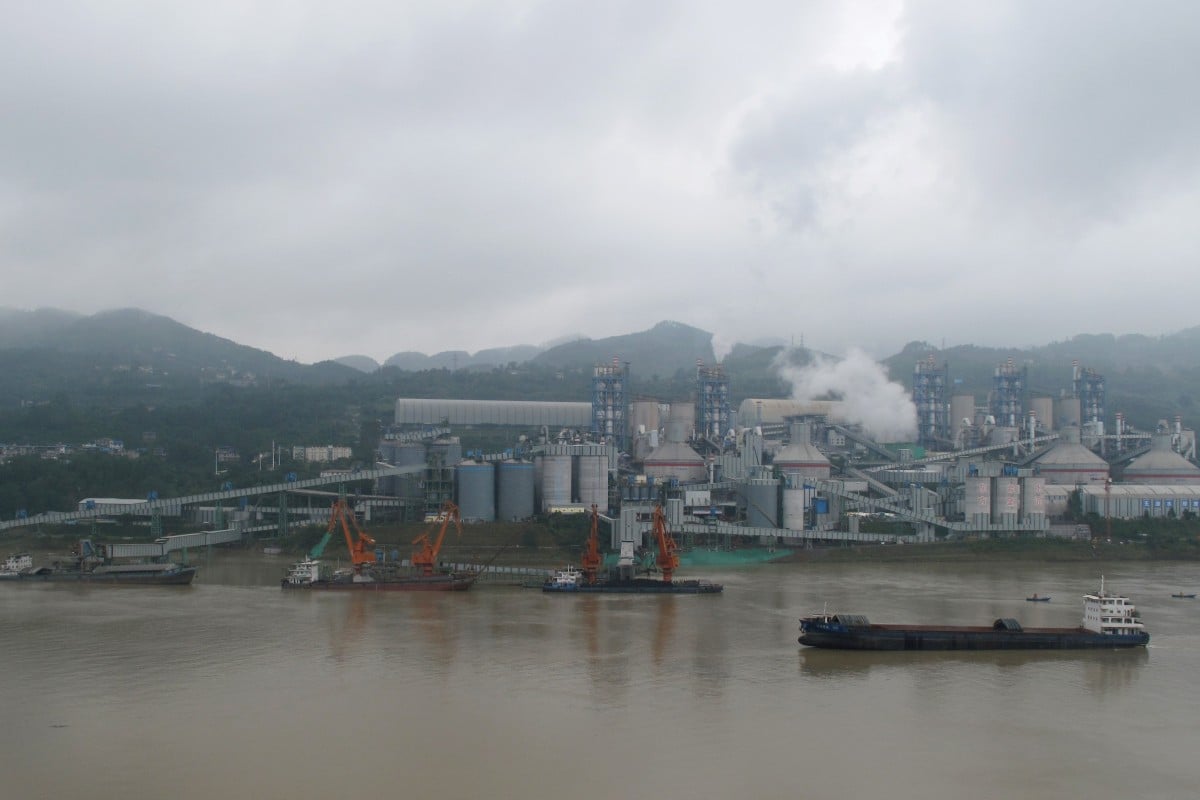
A cement plant on the banks of the Yangtze in Chongqing. The authorities are now trying to stop further development along the river. Photo: Reuters

China needs to divert more water to its arid northern regions and invest more in water infrastructure as shortages get worse because of pollution, overexploitation and rising population levels, Premier Li Keqiang has said.

China’s per capita water supplies are around a quarter of the global average. With demand still rising, the government has sought to make more of scarce supplies by rehabilitating contaminated sources and improving efficiency.

Water remained one of China’s major growth bottlenecks, and persistent droughts this year underlined the need to build new infrastructure, Li told a meeting of senior Communist Party officials on Monday. An account of the meeting was published by China’s official government website.

Local government bonds should be “tilted” in the direction of water infrastructure, he said, and innovative financing tools were also needed.

He also called for research into new pricing policies to encourage conservation.

Li said China’s water supply problems had been improved considerably as a result of the South-North Water Diversion Project, a plan to divert billions of cubic metres of water to the north by building channels connecting the Yangtze and Yellow rivers.

World ‘woefully unprepared’ for climate change’s effects on drinking water supplies drawn from mountains

He said opening up more channels to deliver water to regions north of the Yangtze River Delta would support economic and social development and optimise China’s national development strategy, according to a summary of the meeting on the government website.

China is in the middle of a wide-reaching programme to clean up the Yangtze River, its biggest waterway, and put an end to major development along its banks.

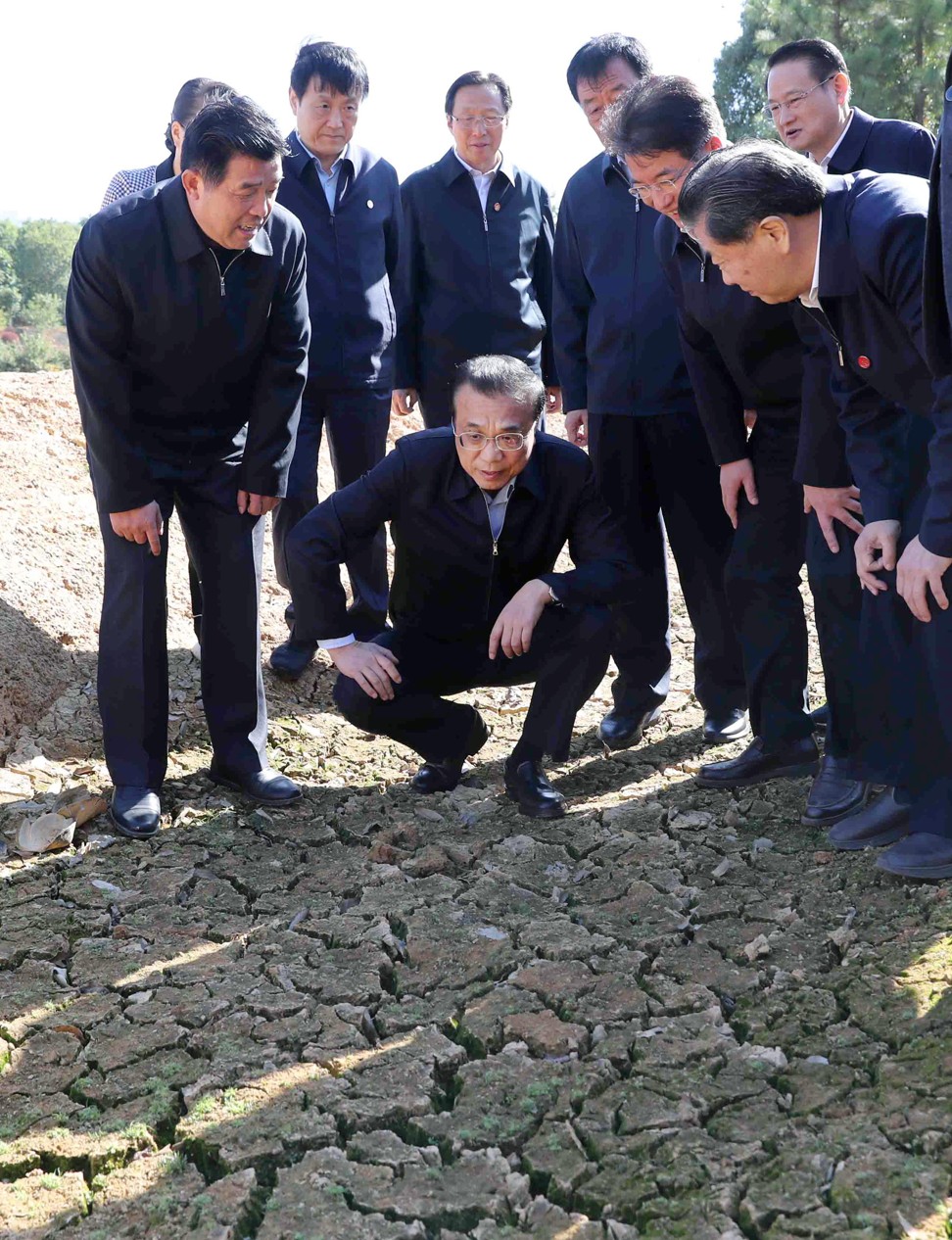
Chinese Premier Li Keqiang inspects an empty reservoir during a visit to Jiangxi province last week. Photo: Xinhua

Local governments have been under pressure to dismantle dams, relocate factories and even ban fishing and farming in ecologically fragile regions.

But experts say the ongoing campaign to divert the course of the Yangtze to other regions is still causing long-term damage to the river’s environmental health.

Many cities that had polluted their own water sources had drawn replacement supplies from the Yangtze, exceeding the river’s environmental capacity, said Ma Jun, founder of the Institute of Public and Environmental Affairs, which monitors water pollution.

Beijing already relied on diversion channels from the Yangtze to supply 70 per cent of its water, but had done little to improve conservation or reduce per capita consumption, which was higher than many Western countries, he said.

“[Diversion] has caused so much suffering and needs so many dams to keep up supply, and that has impacted biodiversity,” he said.

Source: SCMP

29/07/2019

Experts accuse U.S. of using Xinjiang to interfere in China’s domestic affairs

URUMQI, July 28 (Xinhua) — A group of Chinese experts have criticized the United States for adopting double standards on counterterrorism and deradicalization and using Xinjiang-related issues as a tool to interfere in China’s domestic affairs.

The experts, who specialize in studies in the fields of human rights, international relations and anti-terrorism, made the remarks at a seminar held recently in Urumqi, capital of Xinjiang Uygur Autonomous Region.

Wang Yu, an associate researcher with the Institute of Chinese Borderland Studies, said China’s anti-terror measures implemented in Xinjiang in recent years have provided a new solution to the global fight against terrorism.

For some time China’s Xinjiang has seen frequent incidents of terrorist attacks, but over the past nearly three years, there have been no such incidents in the region, Wang noted.

Gu Liyan, a researcher with the Xinjiang Academy of Social Sciences, accused the United States of using human rights issues to erode public trust in governments of some other countries and create social conflict and unrest there, so as to attain its global hegemony.

“Whatever measures or policies China implements on counterterrorism and deradicalization will never accord with the so-called human rights standards of the U.S.,” she said.

Li Wei, a researcher with the China Institute of Contemporary International Relations, said education and training centers were established in Xinjiang in order to prevent trainees from falling victim to terrorism and extremism.

China’s measures on deradicalization offer a successful case study to the international community and have won widespread recognition and acclaim, said Li.

Shu Hongshui, an anti-terror expert at Northwest University of Political Science and Law, said the U.S. adoption of double standards on counterterrorism and deradicalization is intended to curb China’s development.

The propaganda warfare waged by the United States and some other Western countries against China on Xinjiang-related issues is unable to conceal their strategic anxiety and predicament, Shu said

Source: Xinhua

24/02/2019

China’s military build-up just starting – a lot more to come, expert warns

  • Military watchers can expect ‘something new’ at this year’s National Day parade in October, Professor Jin Canrong tells forum in Hong Kong
  • As tensions rise over Taiwan, Beijing is building a naval and missile force as powerful as any in the world, he says

Beijing’s military build-up just starting – a lot more to come, expert warns

24 Feb 2019

Submarine arms race seen heating up in Indo-Pacific amid China ‘threat’

16 Feb 2019

The US could send more nuclear attack submarines, such as the Virginia-class, to the region. Photo: AFP
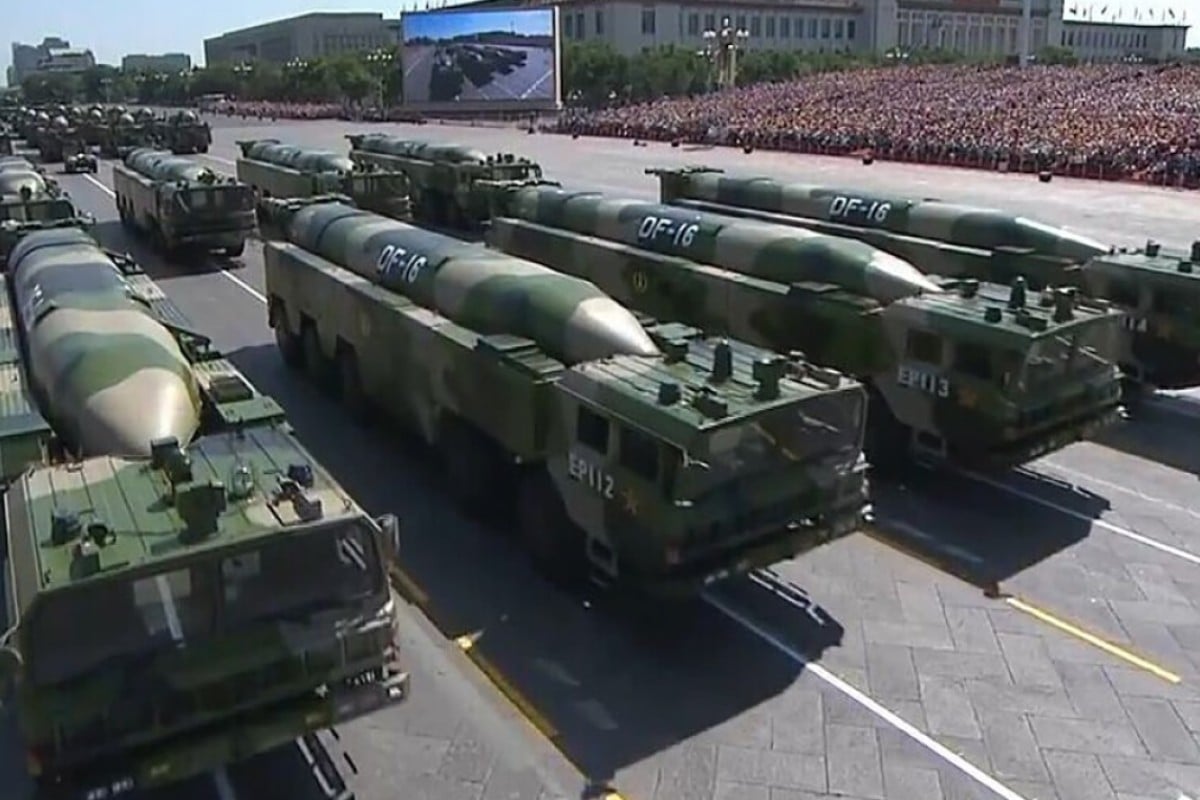
Military vehicles carrying DF-16 ballistic missiles take part in China’s National Day parade. Taiwan says Beijing has such missiles trained on the self-ruled island. Photo: Handout

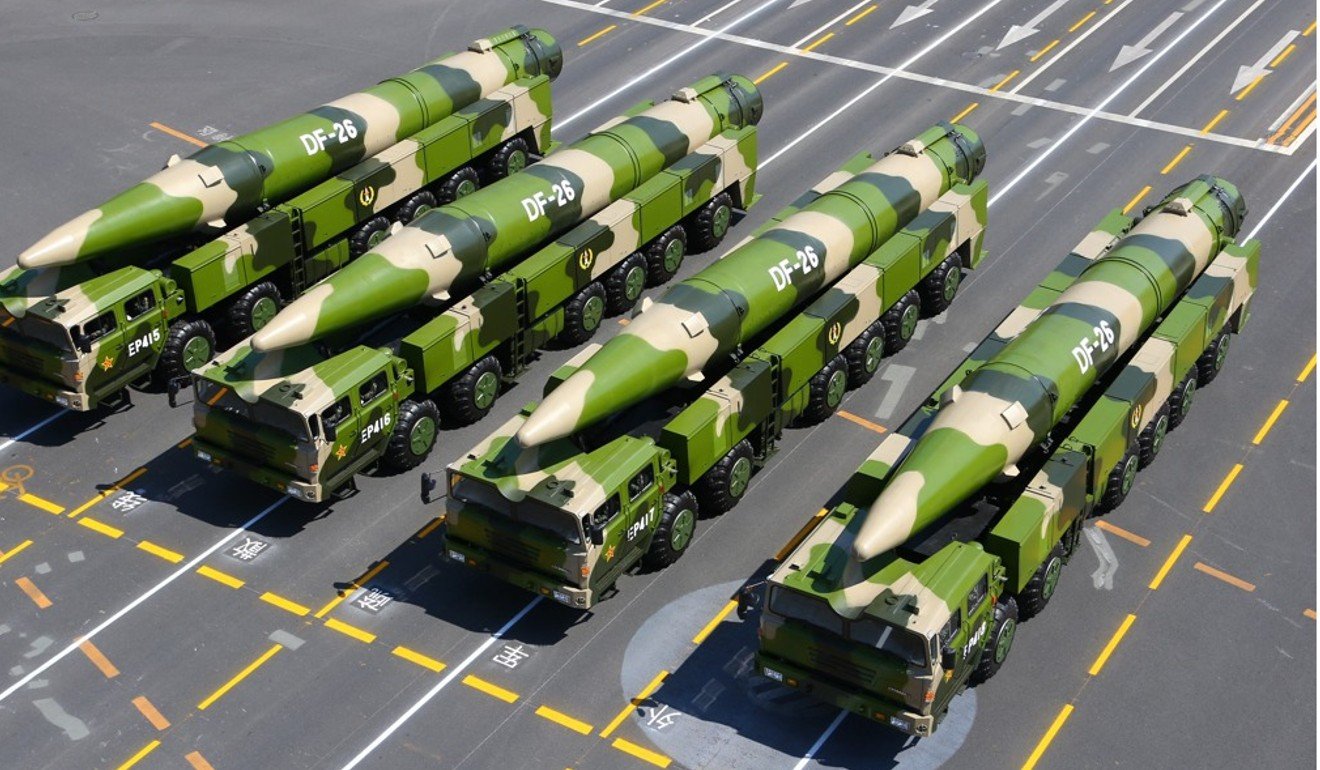
Beijing will show the world “something new” when it rolls out its arsenal of short- to medium-range ballistic missiles at its National Day military parade in October, according to a Chinese expert on international relations.

Speaking at a seminar at the University of Hong Kong on Saturday, Professor Jin Canrong, associate dean of the school of international studies at Renmin University in Beijing, said China had made great strides in expanding its military capability, but there was a lot more to come.

US commander pushes for more funding to counter China’s influence in Indo-Pacific

While he did not elaborate on what the “something new” might be, he said the country was gearing up for a possible conflict over Taiwan, the self-ruled island that Beijing regards as a wayward province awaiting reunification.

Over the next five or 10 years, Taiwan could provide the “biggest uncertainty” for Beijing, he said, especially if the United States decided to “ignite” the situation.

Known for being outspoken on sensitive issues, Jin said that while Beijing wanted a peaceful reunification, it was wary of “pro-independence factions [on the island] and right-wing American [politicians] creating trouble”.

In a speech on January 2 to mark the 40th anniversary of Beijing’s call to end military confrontation across the Taiwan Strait, Chinese President Xi Jinping said that “the political division across the strait … cannot be passed on from generation to generation”, apparently signalling his determination to bring it to an end.

Xi said China would not abandon the use of force in reunifying Taiwan, but stressed the military would target only external elements and those seeking independence for the island.

In 2017, Taipei said that it had detected the deployment of DF-16 ballistic missiles on the mainland that were aimed at Taiwan.

Jin said China was rapidly expanding its missile capabilities. The People’s Liberation Army had already stockpiled about 3,000 short- and medium-range missiles, he said, even though it had been using just 15 per cent of its production capacity.

“Just imagine if we were running at 100 per cent,” he said.

Beijing will show the world “something new” when it rolls out its ballistic missiles at its National Day military parade in October, an expert says. Photo: Xinhua

Under its plan for military modernisation China had achieved “great advancements in space, electronics and cyberwarfare”, the academic said, but its achievements to date were only the beginning.

As well as the expansion of its missile force, Beijing was investing heavily in its navy, he said.

Is China about to abandon its ‘no first use’ nuclear weapons policy?

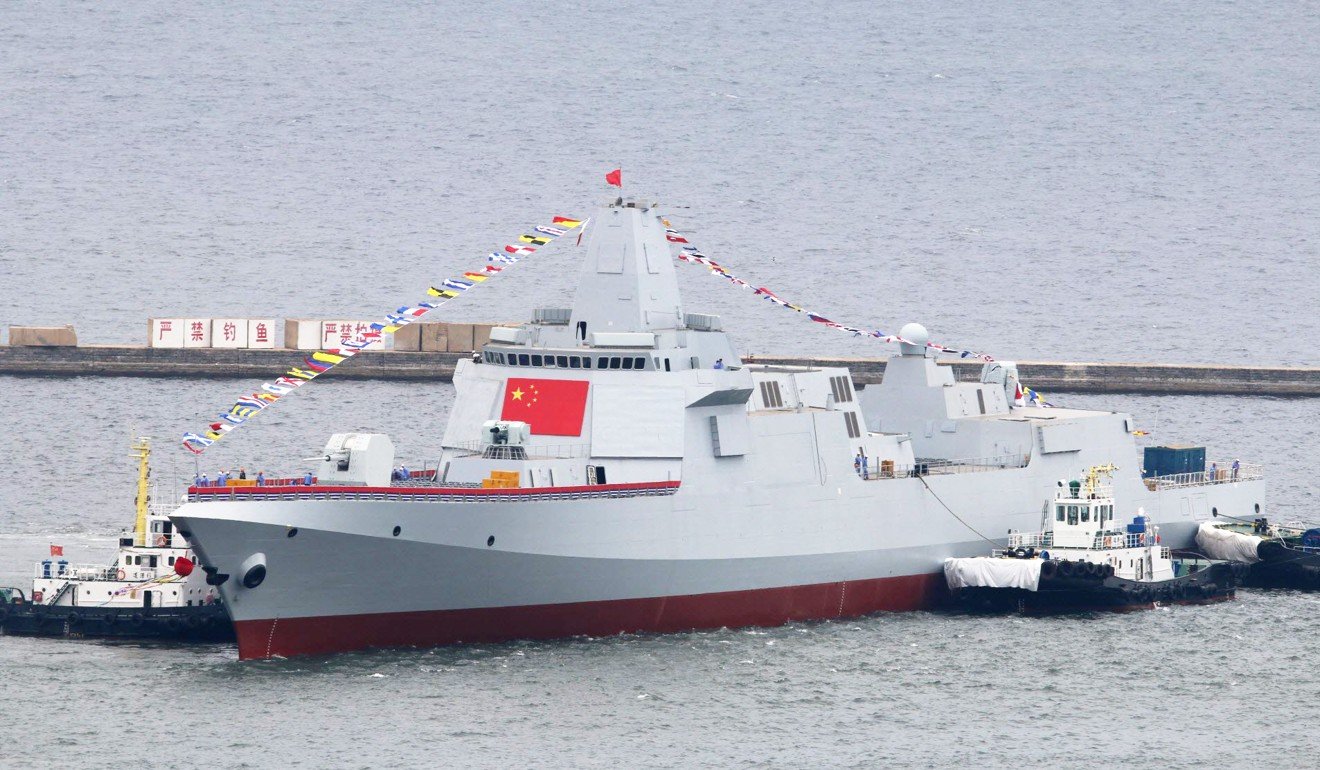
With the deployment of the new Type 055 guided-missile destroyer – which some Chinese military experts have said is as good as anything in the US Navy – the balance of power was shifting, he said.

“For the first time in 500 years, the East has combat equipment that is at least as good as the West’s.”

With the deployment of the new Type 055 guided-missile destroyer, the balance of power between China and the US is shifting, according to Jin Canrong. Photo: Handout

And as the navy continued to modernise and expand, the US might be forced to rethink its position in the region, he said.

“When we have dozens of destroyers and four or five [aircraft] carriers the US will not be able to meddle in Taiwan.”

China’s first aircraft carrier may become test bed for electromagnetic warplane launcher

Jin said that China would also soon have all the scientific, academic and research personnel it needed to achieve its military ambitions.

“China had nearly 30 million university students in 2018, which is twice as many as the US. More than half of them are studying science or engineering,” he said.

“Every year we produce about 4 million science and engineering graduates, while America produces just 440,000.”

Professor Jin Canrong speaks at a forum in Hong Kong. Photo: Handout

Beijing also had the money to support its plans, Jin said. Based on his own calculations, he said China allocated about 1.4 per cent of its gross domestic product to military spending, which was lower than “Germany’s 1.5 per cent”, and less than half the “3 per cent in Britain and France”.

“The tax paid by Chinese smokers is more than enough to cover [the country’s] military expenses,” Jin said.

According to figures from Nato, Britain spent 2.1 of its GDP on defence in 2017, France 1.8 per cent and Germany 1.2 per cent. Both the World Bank and the United Nations put China’s military spending in 2017 at 1.9 per cent of its GDP.

Source: SCMP

19/12/2018

World experts hail China’s miracle-like achievements over 40 years

BEIJING, Dec. 18 (Xinhua) — As China celebrated the 40th anniversary of its reform and opening-up policy on Tuesday, the achievements it has made over the last four decades were hailed as a miracle.

Experts said that China’s reform and opening-up not only is a milestone in the country’s history but also holds global significance.

RIGHT PATH

Addressing a grand gathering Tuesday to celebrate the 40th anniversary, Chinese President Xi Jinping said that the past 40 years eloquently prove the correctness of the path, theory, system and culture of socialism with Chinese characteristics.

Robert Lawrence Kuhn, a leading American expert on China who was honored with China Reform Friendship Medal on Tuesday, said China’s direction is clear, that is, socialism with Chinese characteristics, the leadership of the Communist Party of China (CPC) in all areas, putting people and their well-being and happiness first, and the need to further implement and deepen reforms.

Russian Communist Party leader Gennady Zyuganov said the reform and opening-up policy enacted by the CPC at the third plenary session of the 11th CPC Central Committee in 1978 planned China’s development and raised China to heights unimaginable at that time.

“All the achievements that China has made is inseparable from the country’s adherence to the leadership of the CPC and taking the socialist path,” he told Xinhua in a recent interview.

Manoranjan Mohanty, former chairperson of the Institute of Chinese Studies in Delhi, said the reform and opening-up was a great revolution.

At one time it was called a “New Long March,” which has two things in common with the Long March of the Red Army – one is the determination to unite maximum popular forces and the other is to innovate a strategy of revolution, he said.

QUANTUM LEAP

Describing the reform and opening-up as “a great revolution in the history of the Chinese people and the Chinese nation,” Xi said a quantum leap has been made in the cause of socialism with Chinese characteristics.

Stephen Perry, chairman of Britain’s business networking organization 48 Group Club, said China has undergone incredible transformation since its reform and opening-up in 1978 and the country is sure to achieve its long-term target.

Perry, also recipient of the China Reform Friendship Medal, said that he had seen China turning from a backward country where most of the population lived in countryside into a country where nearly 60 percent of the population now dwell in towns and cities.

During the period, China’s grain output has doubled to over 600 million tons and modern technology is being developed in various industries, Perry noted.

William Jones, Washington bureau chief of the U.S. publication Executive Intelligence Review, told Xinhua in an interview that the 40th anniversary of the reform and opening-up is extremely important and is a pivotal moment.

China has moved from a relatively impoverished country to one of the most important economic powers in the world today, Jones said.

What is done has shown that the policy that was laid out in terms of the reform and opening-up has been a resounding success, he added.

China’s reform and opening-up over the past 40 years has proven to be the “golden key” to reviving its society, said Jin Jianmin, a senior fellow at the Fujitsu Research Institute in Tokyo, believing that the ongoing process will never stop.

Shadrack Gutto, a political analyst at the University of South Africa, recalled that when talking about China 40 years ago, people would think of the “kingdom of bicycle.”

But now automobiles made by China have been exported to the world market, said Gutto, adding that both in material and spiritual terms, Chinese people’s standard of living has been significantly improved.

PROPELLING GLOBAL PROSPERITY

The 40 years of reform and opening-up has benefited both China and the world, said Jin, emphasizing that the great demand created by China’s rapid economic growth has offered opportunities to the international community.

Farooq Sobhan, president of Bangladesh Enterprise Institute, said the China International Development Cooperation Agency, along with the Asian Infrastructure Investment Bank and the New Silk Road Fund, represents the country’s “firm commitment to promote and support economic growth, both globally and regionally.”

These institutions will “benefit Bangladesh and other developing countries to meet their growing development and infrastructure requirements,” said Sobhan.

Appreciating the China-proposed concept of a community with a shared future for mankind, Mohanty believed that “people all over the world wish the people of China even greater successes in pursuing the path of equitable and sustainable development.”

(Xinhua reporters Hu Xiaoguang, Zhang Jianhua, Zhao Xu, Wang Huihui, Jin Jing, Gui Tao, Zhu Dongyang, Hu Yousong, Liu Chen, Jiang Qiaomei, Yang Ting, Jing Jing, Liu Chuntao, Yang Shilong contributed to the story)

Law of Unintended Consequences

continuously updated blog about China & India

ChiaHou's Book Reviews

continuously updated blog about China & India

What's wrong with the world; and its economy

continuously updated blog about China & India