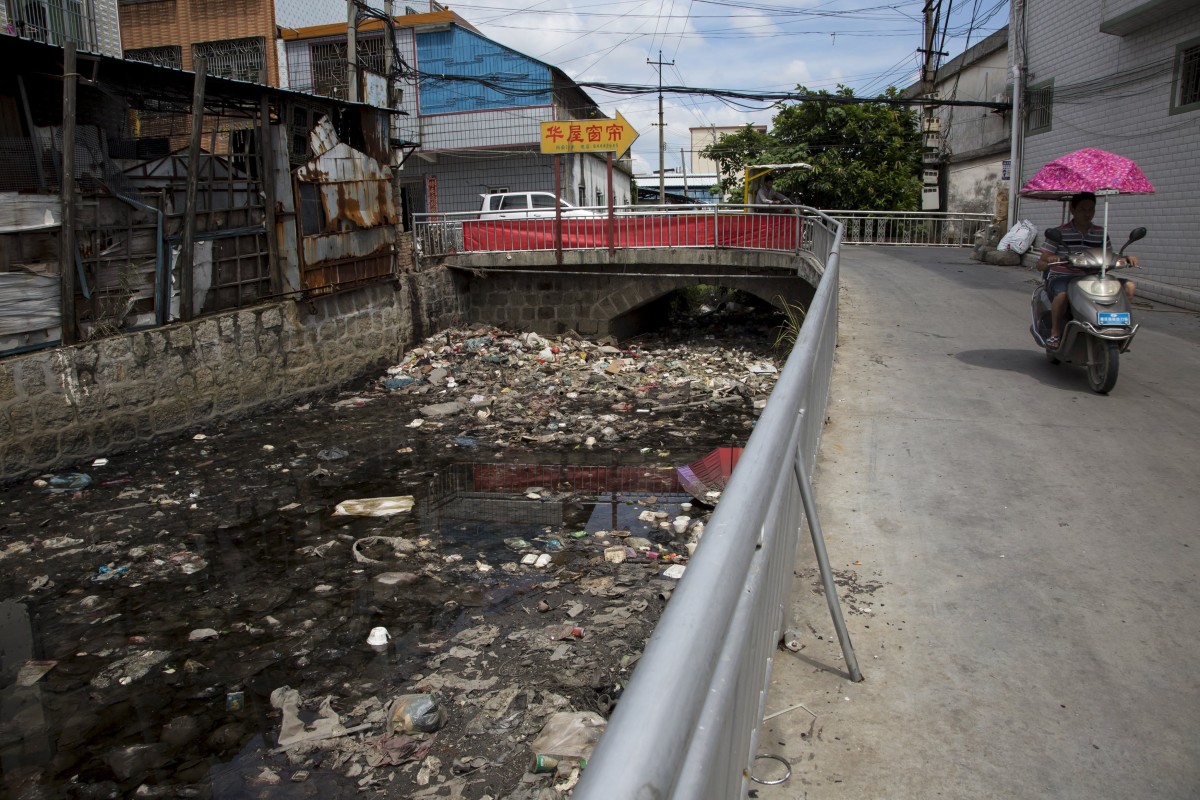
ANYANG/SANGPO, China (Reuters) – For years, China’s industrial heartland has been cloaked in smog, its waterways choked with pollution pumped from enormous clusters of factories churning out the mountains of cement and steel needed to build the Chinese economy.
Aiming to tackle what has become a huge public health problem, the authorities have cracked down on polluting industries, targeting provinces like Henan, which has a population of 100 million people and hundreds of factory towns.
According to interviews with factory and business owners, and consumers and workers across Henan, that crackdown – conducted with often heavy-handed local enforcement – is crippling the economies of towns and cities that depend on polluting industries.
Manufacturers across Henan have been particularly hard hit by the new environmental regulations, compounding the pressures the province faces from China’s slowing economy and a grinding trade war with the United States.
It also highlights the trade-off China faces between providing a healthier environment for its citizens and maintaining economic growth in a province whose climb from poverty has lagged that of coastal regions.
China does not provide statistics on the costs of the environmental crackdown, but it has said that short-term pain will lead to long-term growth through an economic “upgrade”.
The information office of the State Council, China’s cabinet, did not respond to a faxed request for comment on the economic effects of the new restrictions.
It’s difficult to get a full picture of Henan’s economy from unreliable official figures, as it is for the whole country. Henan’s official growth rate was 7.6% in 2018, higher than the national rate and down 0.2 of a percentage point from 2017.
But the interviews conducted by Reuters across Henan suggest consumers are spending less, cities are struggling to retool their economies and the pollution crackdown is hurting businesses and employment.
STEEL TOWN PAIN
The steel-producing centre of Anyang, which has long had some of the worst air in China, is one place that has been hit hard by the anti-pollution campaign.
The city of more than 5 million people, dominated by the infrastructure and insignia of the state-owned Anyang Iron and Steel Group, has forced local industry to upgrade equipment and curb pollution, and shut down companies that were unwilling or unable to comply.
Li Huifeng, president of Baoshun High-Tech Corporation, a coking coal company founded by his parents in 1983, said the cost of compliance had been painful.
Baoshun’s huge plant, built in the hills in the west of Anyang, was forced to implement production cuts last winter even though it had installed low-emissions equipment that exceeded required standards.
“Last year, business was really good but this year it is full of uncertainties,” said Li. He added that new efficiency guidelines were likely to result in the closure of many producers of coking coal, which is used in steel production.
Li Xianzhong, the owner of the Xinyuan Steel Mill in Anyang’s western outskirts, said he was facing curbs on production as well as spiralling costs because of the new environmental regulations.
According to industry estimates, environmental costs per tonne of steel produced have risen to around 150 yuan per tonne, up from less than 50 yuan per tonne when the war on pollution was launched in 2014.
“All this equipment needs a lot of capital, and after you’ve invested, the operation costs are also higher,” said Li. “If you don’t meet the standards, you aren’t allowed to operate.”
Near the sprawling Anyang steel plant in the city centre, residents and workers complained that the new environmental inspection rules had made it harder to make a living.
Many small workshops, which often use small metalworking furnaces, have also been targeted.
“Before we would just give them a pack of cigarettes or treat them to a meal and you’d then be fine for a year, but now it’s no use,” said a bicycle repairman, identifying himself by his surname Zhang, whose workshop near the plant was shut by inspectors.
Over the past years, Anyang has tried encouraging new and cleaner forms of economic growth. It has shut hundreds of small polluters in sectors like ceramics and cement, and tried to attract industries like solar panels and electric vehicles by offering incentives and building sprawling new industrial parks.
However, it has struggled to compete with numerous Chinese cities making similar bets, especially as China’s economy slows.
And the results of the anti-pollution efforts have been mixed.
Steel still accounts for more than half of Anyang’s economy – unchanged from a decade ago – and the environment is still bad. The taste of brimstone hangs in the air, and the fairy lights festooned on hundreds of cranes on the city’s skyline could only be dimly seen during a recent visit.
Part of the problem, according to Liu Bingjiang, who heads the Ministry of Ecology and Environment’s air pollution office, is that smog is also blowing in from neighbouring industrial regions, undermining local cleanup efforts.
“All these measures, all these plans are in place, but it still can’t solve the smog,” said Li, the steel mill owner.
SHUTTING DOWN THE BOOTMAKERS
The anti-pollution campaign is also hitting much smaller industrial centres.
Sangpo, a dusty two-street village in northeast Henan, used to live off scores of sheepskin processing factories cranking out winter boots modelled on UGG, the American brand with Australian roots.
While the industry was the main employer in the village, that came with a heavy environmental cost: treating the raw sheepskin consumed copious amounts of water and contaminated the local water supply.
Last July, the government moved to close most of the factories, sending dozens of police cars into Sangpo with sirens wailing to enforce the shutdown.
Government inspectors were installed to keep watch at each factory to ensure compliance with the order. Three factory owners were arrested for violating environmental regulations.
During a visit to Sangpo by Reuters, most factories were idle during what should have been peak production season. Hundreds of workers had left town in search of work elsewhere, leaving behind shuttered shopfronts and deserted roads.
“The village is at a tipping point,” said a former factory owner who only wanted to be identified by his surname, Ding. Most businesses were mostly “more dead than alive,” he added.
Before the factories were shut, the village of 6,500 people, mainly from the Hui Muslim minority, had been punching well above its weight.
It achieved national recognition as a thriving model of e-commerce, winning glowing write-ups in national newspapers after it was named in 2015 by the tech giant Alibaba as central China’s very first “Taobao village” – a designation for top rural sellers on the company’s internet retailing platform.
But that all changed last year as China’s pollution crackdown intensified. The top county-level official, factory owners said, held a town hall meeting and threatened to shut everyone down permanently. A deal was made for 19 of the 135 factories to remain.
Those wanting to stay open agreed to upgrade their businesses and invest in equipment to ensure they met water treatment standards. Factories that opted out were shut, their boilers and processing equipment destroyed.
The government of Mengzhou, which oversees Sangpo, declined to comment when reached by phone. But Mengzhou’s mayor said last year that the crackdown was necessary and in accordance with the popular will, according to a statement on the Mengzhou government website.
Sangpo village’s party chief declined to comment when reached via the Chinese messaging app WeChat. Calls to his cellphone went unanswered.
The county government’s plan is to corral remaining factories into a new industrial zone by the end of the year. But remaining business owners are worried about the slow pace of construction and fear they will be forced to shut.
Ding, the former factory owner, said business owners didn’t expect the crackdown – which has also discouraged lending from banks – to be so harsh.
“Everyone in the village was moaning and sighing but no one thought it would be this extreme,” Ding said. “We are at our wits’ end.”
Source: Reuters



 CHINDIA ALERT: You'll be living in their world, very soon