23/12/2019
BEIJING/SHANGHAI (Reuters) – U.S. electric vehicle maker Tesla Inc (TSLA.O) and a group of China banks have agreed a new 10 billion yuan (1.08 billion pounds), five-year loan facility for the automaker’s Shanghai car plant, three sources familiar with the matter said, part of which will be used to roll over an existing loan.
China Construction Bank (0939.HK) (601939.SS) (CCB), Agricultural Bank of China (1288.HK) (601288.SS) (AgBank), Industrial and Commercial Bank of China (601398.SS) (1398.HK) (ICBC) and Shanghai Pudong Development Bank (600000.SS) (SPDB) are among the banks which have agreed to give Tesla the financial support, one source with direct knowledge said.
The Chinese banks earlier this year already offered Tesla a 12-month facility of up to 3.5 billion yuan, which is due to be repaid on March 4, 2020, according to a filing the automaker made to the U.S. Securities and Exchange Commission.
That new loan will be partially used to roll over the previous 3.5 billion yuan debt, according to the first source. The second source said the rest will be used on the factory and Tesla’s China operations.
The new loan’s interest rate will be pegged at 90% of China’s one-year benchmark interest rate, the same as the 3.5 billion yuan loan, the first source said. This is a rate that China banks offer to their best clients.
Tesla, CCB, AgBank, ICBC and SPDB did not immediately respond to Reuters’ requests for comment.
Tesla broke ground on the factory in January and has started producing vehicles from its Shanghai plant. It aims to build at least 1,000 Model 3 cars a week by the end of this year.
The factory, which is Tesla’s first car manufacturing site outside the United States, is the centerpiece of its ambitions to boost sales in the world’s biggest auto market and avoid higher import tariffs imposed on U.S.-made cars.
The Shanghai government has also thrown its support behind the Tesla project, which would be China’s first wholly foreign-owned car plant and a reflection of the government’s broader shift to open up its car market.
($1 = 7.0119 Chinese yuan)
Source: Reuters
Posted in Chinese banks, Factory, Industrial and Commercial Bank of China, Loan, Shanghai, Shanghai Pudong Development Bank, Tesla, U.S. Securities and Exchange Commission, Uncategorized |
Leave a Comment »
02/12/2019
(Reuters) – Asian companies dominate the market for electric vehicle (EV) batteries and they are expanding their production capacity in Europe, China and the United States in a fight to win lucrative contracts from global automakers.
Some carmakers worry, however, there won’t be enough batteries for all the EVs they plan to launch in the coming years and a bitter row between South Korea’s SK Innovation and LG Chem risks exacerbating the potential shortfall.
Below are details of the world’s leading EV battery makers with details of their customers and expansion plans:
CATL
China’s Contemporary Amperex Technology (CATL), the world’s biggest EV battery maker, counts BMW (BMWG.DE), Volkswagen (VOWG_p.DE), Daimler (DAIGn.DE) – which makes Mercedes cars – Volvo, Toyota Motor Corp (7203.T) and Honda Motor Co (7267.T) among its customers.
The company emerged as a major force partly thanks to Beijing’s policy of only subsidising vehicles equipped with Chinese batteries in the world’s biggest EV market. Beijing is phasing out EV subsidies next year.
CATL, which operates factories in China, is building its first overseas plant in Germany and is considering a U.S. factory.
PANASONIC CORP (6752.T)
Japan’s Panasonic, a supplier of U.S. EV pioneer Tesla (TSLA.O), said it has installed equipment to ramp up production at Tesla’s Nevada plant to 35 GWh from its current production of around 30 GWh as of late October. Panasonic has said it is investing about $1.6 billion in the factory.
Panasonic also produces EV batteries in Japan, China and plans to shift some of its plants to a new joint venture with Toyota. Panasonic’s clients also include Honda and Ford Motor Company (F.N).
For a graphic of expansion plans: tmsnrt.rs/35tFmOL
BYD CO LTD (002594.SZ)
China’s BYD, which is backed by U.S. investor Warren Buffett, is also one of the world’s biggest EV battery makers. It mainly uses them in-house for its own cars and buses. BYD said last year it is was considering cell production in Europe.
LG CHEM LTD (051910.KS)
The South Korean firm was an early industry mover, winning a contract to supply General Motor’s (GM.N) Volt in 2008. It also supplies Ford, Renault (RENA.PA), Hyundai Motor (005380.KS), Tesla, Volkswagen and Volvo.
It is investing 3.3 trillion won ($2.8 billion) to build and expand production facilities near Tesla’s plant in Shanghai. It has a joint venture (JV) in China with Geely Automobile Holdings (0175.HK), which makes Volvos, and is in talks with other carmakers about JVs in major markets.
The firm is considering building a second U.S. factory in addition to its facility in Michigan and is expanding its plant in Poland.
SAMSUNG SDI CO LTD (006400.KS) Samsung SDI an affiliate of South Korean tech giant Samsung Electronics (005930.KS), has EV battery plants in South Korea, China and Hungary, which supply customers such as BMW (BMWG.DE), Volvo and Volkswagen. Samsung SDI is investing about 1.2 billion euros ($1.3 billion) to expand its factory in Hungary though the EU is investigating whether Budapest’s financial support complies with the bloc’s state aid rules.
Samsung started production last year on the Hungary plant, which will produce batteries for 50,000 EVs a year.
SK INNOVATION CO LTD (096770.KS) LG Chem’s cross-town rival SK Innovation supplies batteries to Volkswagen, Daimler and Kia Motors (000270.KS), as well as Jaguar Land Rover [TAMOJL.UL] and Ferrari (RACE.MI).
An oil refiner that came to the battery industry late, SKI is investing about $3.9 billion to build three plants in the United States, China and Hungary, with a goal of expanding its annual production capacity to 33 GWh by 2022.
SKI currently operates one battery factory in South Korea, with a capacity of 4.7 GWh annually.
It set up a joint venture with Beijing Automotive Industry Corporation (BAIC) of China in August 2018 and another Chinese partner. It is in talks with Volkswagen about another battery JV and is building a $1.7 billion factory in the U.S. state of Georgia, not far from Volkswagen’s Chattanooga plant.
Source: Reuters
Posted in automakers, batteries, battery, Beijing Automotive Industry Corporation (BAIC), Beijing’s, biggest, BMW, BMW (BMWG.DE), Budapest’s, BYD, BYD CO LTD (002594.SZ), Chattanooga, China alert, Chinese, Contemporary Amperex Technology (CATL), contracts, Daimler, Electric vehicle, equipped, Europe, EV pioneer, Factory, Ferrari (RACE.MI), firm, Ford, Ford Motor Company (F.N), Geely Automobile Holdings (0175.HK), General Motor’s (GM.N), Georgia, Germany, global, Honda Motor Co (7267.T), Hungary, Hyundai Motor (005380.KS), industry mover, Japan, Japan’s, Kia Motors (000270.KS), LG Chem, LG CHEM LTD (051910.KS), Makers, Mercedes, Michigan, Nevada, Panasonic, PANASONIC CORP (6752.T), Plant, Poland, policy, Renault (RENA.PA), Rover [TAMOJL.UL], Samsung Electronics (005930.KS), SAMSUNG SDI CO LTD (006400.KS), Shanghai, SK Innovation, SK INNOVATION CO LTD (096770.KS), South Korea, South Korean, subsidising, Tesla (TSLA.O), Toyota Motor Corp (7203.T), U.S., U.S. investor, Uncategorized, United States, vehicles, Volkswagen, Volkswagen (VOWG_p.DE), Volt, Volvo, Warren Buffett, world's |
Leave a Comment »
19/10/2019
- ‘Only when China is good, can the world get better,’ president says in congratulatory letter read out at launch of event to promote global trade
- Summit opens two weeks after South Korean giant Samsung closes its last factory in mainland China with the loss of thousands of jobs
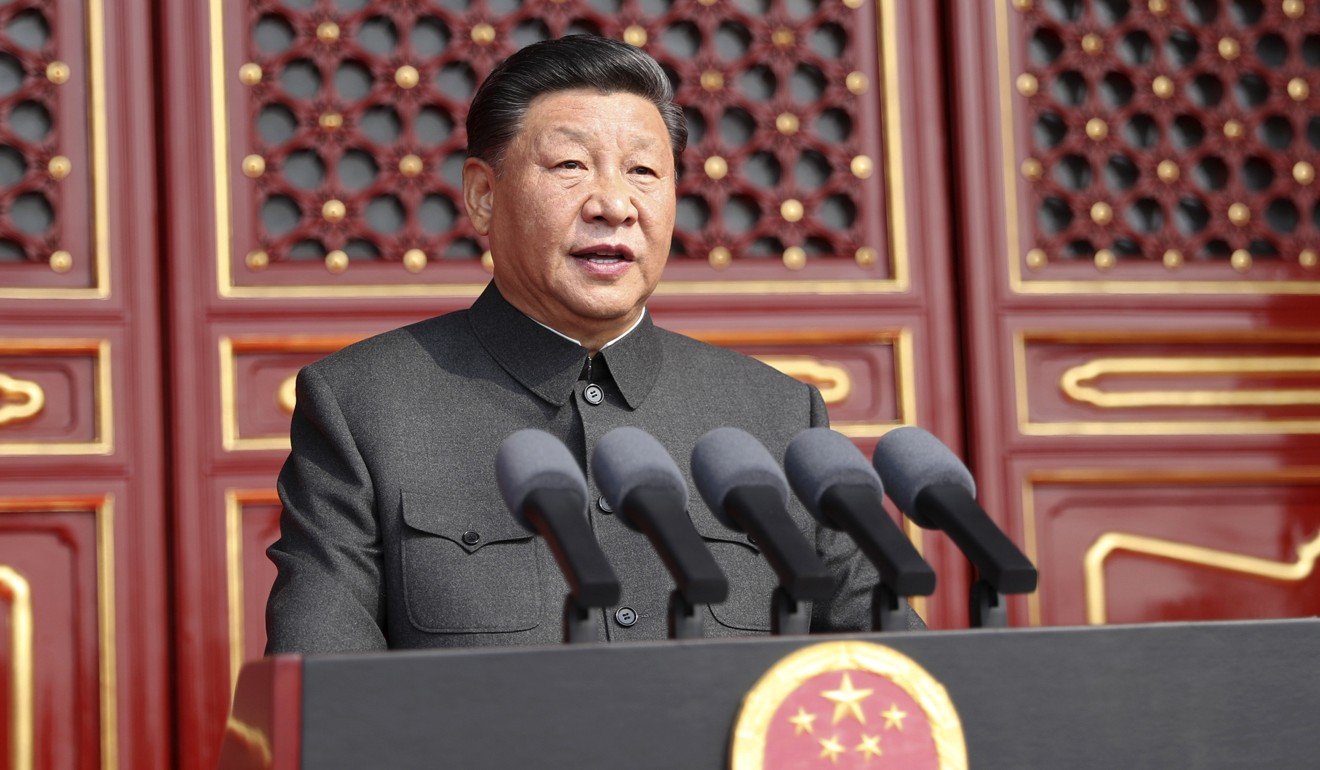
Xi Jinping has praised multinational companies for the role they have played in China’s opening up over the past four decades. Photo: AFP
Just a day after China reported its slowest ever quarterly economic growth,
on Saturday reiterated his promise to keep opening up the nation’s markets to companies and investors from around the world.
“The door of China’s opening up will only open wider and wider, the business environment will only get better and better, and the opportunities for global multinational companies will only be more and more,” he said in a congratulatory letter read out by Vice-Premier Han Zheng at the inaugural Qingdao Multinationals Summit in the east China city.
The two-day event, which ends on Sunday, was organised by China’s commerce ministry and the provincial government of Shandong with the aim, according to its website, of giving multinational companies “the opportunity to articulate their business values and vision” and “promote cooperation with host countries”.
In his letter, Xi praised multinational companies for the role they had played in China’s opening up and reform over the past four decades, describing them as “important participants, witnesses and beneficiaries”.
China was willing to continue opening up to benefit not only itself but the world as a whole, he said.
“Only when the world is good, China is good. Only when China is good, can the world get better.”
Despite its upbeat tone, Xi’s message comes as Beijing is facing intense scrutiny from the international business community over its state-led economic model – one of the main bones of contention in its trade war with the US – and its attempts to prevent foreign firms from speaking out on issues it deems too sensitive, from
Hong Kong to
human rights.
Foreign firms have also long complained about the barriers they face when trying to access China’s markets and the privileged treatment it gives to state-owned enterprises. Even though Beijing has promised to reform its state sector, foreign businesses have complained of slow progress, and just last month the
European Union Chamber of Commerce urged the EU to take more defensive measures against China’s “resurgent” state economy.
Xi promised “more and more” opportunities for global firms. Photo: AP
Sheman Lee, executive director of Forbes Global Media Holding and CEO of Forbes China, said at the Qingdao summit that foreign firms were facing a difficult trading environment in the world’s second-largest economy.
“Multinationals have seen their growth in China slow in recent years because of the growing challenge from local firms, a gradually saturating market and rising operation costs,” he said.
Craig Allen, president of the US-China Business Council, said that many multinational companies were reluctant to release their best products in China out of fear of losing their intellectual property.
China still not doing enough to woo foreign investment
In his letter, Xi said that over the next 15 years, the value of China’s annual imports of goods would rise beyond US$30 trillion, while the value of imported services would surpass US$10 trillion a year, creating major opportunities for multinational companies.
China would also reduce tariffs, remove non-tariff barriers and speed up procedures for customs clearance, he said.
Commerce Minister Zhong Shan said at the opening ceremony that China would also continue to improve market access and intellectual property protection.
The country supported economic globalisation and would safeguard the multilateral trade system, he said, adding that it was willing to work with the governments of other countries and multinational corporations to promote economic globalisation.
Xi Jinping says the value of China’s annual goods imports will rise beyond US$30 trillion over the next 15 years. Photo: Bloomberg
The promise to continue to open up China’s markets came after the
State Council
– the nation’s cabinet – made exactly the same pledge at its weekly meeting on Wednesday.
After the latest round of trade war negotiations in Washington, Beijing said it had achieved “substantive progress” on intellectual property protection, trade cooperation and technology transfers, all of which have been major bones of contention for the United States.
Despite its pledge to welcome multinational companies into its market, China is in the process of creating a list of “unreliable foreign entities” it considers damaging to the interests of Chinese companies. The roster, which is expected to include FedEx, is seen as a response to a similar list produced earlier by the United States.
Xi’s gesture would also appear to have come too late for South Korean multinational
, which announced on October 4 it had ended the production of smartphones at its factory in Huizhou, Guangdong province – its last in China – with the loss of thousands of jobs.
Source: SCMP
Posted in barriers, Beijing, bones of contention, CEO, Chamber of Commerce, China’s door, China’s State Council, closes, Commerce Minister Zhong Shan, complained, customs clearance, delegates, EU, European Union, Factory, FedEx, Forbes China, Forbes Global Media Holding, Foreign firms, guangdong province, Hong Kong, Huizhou, Huizhou City, Human rights, Intellectual property, intellectual property protection, mainland, Mainland China, Multinationals Summit, nation’s cabinet, only open wider, President Xi Jinping, procedures, Qingdao, Samsung, Samsung Electronics, smartphones, South Korean giant, South Korean multinational, speed up, technology transfers, trade cooperation, Uncategorized, United States, US-China Business Council, Washington |
Leave a Comment »
04/10/2019
- ‘Difficult decision to cease operations’ at plant in Huizhou taken to ‘enhance efficiency’, company says
- Firm’s market share in China has dwindled to near insignificance as competitors like Huawei and Xiaomi have taken upper hand
Samsung said operations at its last factory in China ended last month. Photo: Reuters
said on Friday it has ended the production of smartphones in its last factory in China.
Operations at the plant in the south China city of
Huizhou, Guangdong province, ended last month, it said in an email.
The company made “the difficult decision to cease operations of Samsung Electronics Huizhou” in order “to enhance efficiency” in its manufacturing, it said.
Samsung’s market share in China has dwindled to near insignificance as competitors like
Huawei and
Xiaomi have taken the upper hand. It once had 15 per cent of China’s smartphone market.
Samsung once had a 15 per cent share of China’s smartphone market. Photo: AFP
The South Korean giant has moved a large share of its
smartphone production to Vietnam and closed a factory in northeastern China’s Tianjin last year.
“The production equipment will be reallocated to other global manufacturing sites depending on our global production strategy based on market needs,” the statement said.
Samsung is the world’s biggest manufacturer of semiconductors and smartphones and a major producer of display screens. But the flagship of
South Korea’s largest conglomerate is currently weathering a spell of slack demand for computer chips.
Like other South Korean electronics makers, it also is facing the impact of tightened Japanese controls on exports of hi-tech materials used in semiconductors and displays.
On Wednesday, Sony said it was closing its Beijing smartphone plant and would only make smartphones in Thailand.
But Apple still makes major products in China.
“In China, people buy low-priced smartphones from domestic brands and high-end phones from Apple or Huawei,” Park Sung-soon, an analyst at Cape Investment & Securities, said.
“Samsung has little hope there to revive its share.”
Samsung’s factory in Huizhou was built in 1992, according to the company. South Korean media said it employed 6,000 workers and produced 63 million units in 2017.
Samsung manufactured 394 million handsets around the world in 2107, according to its annual report.
Source: Reuters
Posted in Apple, Beijing, Cape Investment & Securities, China alert, closes, computer chips, conglomerate, display screens, Factory, guangdong province, hi-tech materials, Huawei, Japanese controls, last, manufacturer, Samsung, Semiconductors, smartphone, Sony, South Korea, Thailand, Tianjin, Uncategorized, Vietnam, Xiaomi |
Leave a Comment »
08/09/2019
German Chancellor Angela Merkel visits Wuhan Yangtze River Bridge in Wuhan, capital city of central China’s Hubei Province, Sept. 7, 2019. German Chancellor Angela Merkel visited Wuhan on Saturday. (Xinhua/Xiao Yijiu)
WUHAN, Sept. 7 (Xinhua) — Angela Merkel Saturday visited central China’s Wuhan during her 12th trip to the country as German Chancellor since 2005.
Before Wuhan, capital city of Hubei province, Merkel had visited a number of cities besides Beijing during her China trips in the past.
When talking with students of Huazhong University of Science and Technology, Merkel highlighted the importance of international cooperation in the era of globalization, and called on the students to be participants.
Saying that a nation’s prosperity is part of the prosperity of the whole world, she voiced her hope that students should shoulder common responsibilities to combat global challenges.
In the speech, Merkel reviewed her past trips to China. In Shenyang, she witnessed economic upgrading. In Chengdu she learned about development of western China. In Shenzhen she saw remarkable progress brought by the reform and opening-up.
She said quite a few noted German companies including Siemens, and small and medium-sized innovation enterprises are operating business in Wuhan. Wuhan and Duisburg became the first pair of sister cities between China and Germany in 1982.
Merkel exchanged views with students on internet, artificial intelligence, intelligent manufacturing, and environmental protection.
Before wrapping up her trip, Merkel also visited a local hospital and a factory of the German company Webasto.
Source: Xinhua
Posted in Angela Merkel, Artificial intelligence, artificial intelligence (AI), Beijing, Chengdu, Duisburg, Environmental protection, Factory, German Chancellor, German companies, German company, globalization, Hospital, Huazhong University of Science and Technology, hubei province, intelligent manufacturing, Internet, Shenyang, Siemens, Uncategorized, Webasto, Wuhan |
Leave a Comment »
04/09/2019
LANZHOU, Sept. 3 (Xinhua) — Bound by lower education levels, traditions and household responsibilities, most ethnic minority women in China’s impoverished regions have never dared to think of ways other than farming to help their families gain a better life.
However, with the government campaign to eradicate poverty gathering steam, small manufacturing workshops are bringing jobs to their doorsteps and empowering the women to take new roles in their families.
Ma Xiuping, living in a village in Linxia Hui Autonomous Prefecture, northwest China’s Gansu Province, could not hide her excitement when recalling the first time she was paid by the factory she started working in.
“I could barely read, and I never imagined I could get a salary like urban workers,” said Ma, who is in her 50s.
The rural cooperative Ma works at makes traditional cloth shoes and employs more than 50 impoverished women workers.
In Gansu Province, such poverty-alleviation factories have created jobs for more than 8,000 women who were once trapped working on farms and taking care of all the family chores, and for them, a different life has started.
“Now I don’t have to ask my husband for money, which makes me more confident,” said the 28-year-old Ma Fatumai who worked at the same workshop with Ma Xiuping. For her first month of work, she earned 1,350 yuan (about 190 U.S. dollars).
For Huang Ayingshe, who works in another poverty-reduction workshop in the prefecture, a job also means more association with the outside world, which she says is “much more fun” than staying at home.
As the deadline to eradicate absolute poverty by 2020 approaches, China is focusing efforts on the nation’s poorest people, and Gansu Province is one of the major battlefields.
Answering the central leadership’s call for “precision poverty alleviation,” which demands tailored policies to suit different local situations, the province seeks to tap the power of women in the battle to wipe out absolute poverty by 2020.
In July, the All-China Women’s Federation held a meeting in the Linxia Hui Autonomous Prefecture, which stressed women’s roles in fighting poverty and called on them to contribute their strength.
Official data showed that China lifted 13.86 million people in rural areas out of poverty in 2018, with the number of impoverished rural residents dropping from 98.99 million in late 2012 to 16.6 million by the end of last year.
Source: Xinhua
Posted in All-China Women's Federation, ethnic minority women, Factory, Gansu Province, Lanzhou, Linxia Hui Autonomous Prefecture, new life, Poverty-reduction workshops, rural cooperative, Salary, traditional cloth shoes, Uncategorized, urban workers |
Leave a Comment »
02/09/2019
NEW DELHI (Reuters) – At least 12 people were killed and around 50 injured after a series of explosions at a chemical factory in the western Indian state of Maharashtra on Saturday, hospital officials and police said.
An official at Shirpur’s sub-district hospital in Dhule district said that 12 people had died in the explosion. “There are around 37 injured admitted here, and we have transferred another 12 patients,” D.N. Wagh told Reuters.
The first explosion at the factory took place around 9.30 a.m. (0400 GMT), police officer Sanjay Ahire said. Videos from the incident on local news channels showed thick black smoke billowing out of the factory.
“There was a 200 litre chemical barrel that exploded first, then the fire spread to other parts of the factory and there were more blasts,” Ahire said.
Source: Reuters
Posted in billowing, black smoke, blast, chemical barrel, chemical factory, dead, Dhule district, exploded, Factory, Fire, hospital officials, injured, Maharashtra, news channels, Police officer, Shirpur’s sub-district hospital, Uncategorized, videos, western India |
Leave a Comment »




 CHINDIA ALERT: You'll be living in their world, very soon