Chindia Alert: You’ll be Living in their World Very Soon
aims to alert you to the threats and opportunities that China and India present. China and India require serious attention; case of ‘hidden dragon and crouching tiger’.
Without this attention, governments, businesses and, indeed, individuals may find themselves at a great disadvantage sooner rather than later.
The POSTs (front webpages) are mainly 'cuttings' from reliable sources, updated continuously.
The PAGEs (see Tabs, above) attempt to make the information more meaningful by putting some structure to the information we have researched and assembled since 2006.
Pou Chen makes footwear for the likes of Nike and Adidas, but says it has suffered from a lack of orders as global value chains strain under the impact from the virus
Chinese workers moved to Vietnam to help set-up new factories as the company expand its production, but have now become expendable
With the likes of Nike and Adidas closing retail stores around the world to comply with social distancing requirements, analysts also said orders plummeted 50 per cent in the second quarter, although the company declined to comment on the media reports. Photo: Bloomberg
A group of 150 Chinese workers believe the world’s largest maker of trainers used the coronavirus as an excuse to fire them, having helped Taiwanese firm Pou Chen successfully expand its production into Vietnam for more than a decade.
Pou Chen, which makes footwear for the likes of Nike and Adidas, informed the group in late April that they would no longer be needed as they were unable to return to
from their hometowns in China due to the coronavirus lockdowns.
“We believe we contributed greatly to the firm’s relocation process, copying the production line management experience and successful model of China’s factories to Vietnamese factories,” said Dave Zhang, who started working for Pou Chen in Vietnam in 2003.
“Now, when the factories over there have matured, and there is a higher automation level in production, our value has faded in the management’s eyes and we got laid off, in the name of the automation level.”
Rush hour chaos returns to Vietnam’s streets as coronavirus lockdown lifted
The group claims the firm began to fire Chinese employees several years ago, with the total number dropping from over 1,000 at its peak to around 400 last year.
“We 150 employees were the first batch of Chinese employees to be laid off this year. We are all pessimistic and expect more will be cut,” added Zhang.
In its email on April 27, Pou Chen said it was forced to terminate the contracts of the Chinese employees across five of its factories due to an unprecedented decline in orders and financial losses.
The Chinese employees, many of whom have been working for the shoemaker for decades, said the compensation offered was unfair and below the levels required by labour law in both Vietnam and China.
In a further statement to the South China Morning Post, Pou Chen stood by the move as the coronavirus pandemic had reduced demand for footwear products and so required an “adjustment of manpower.”
“[The dismissals were] in accordance with the relevant labour laws of the country of employment … and employee labour contracts,” added the statement from Pou Chen, which employs around 350,000 people worldwide.
Company data showed Pou Chen’s first quarter revenues tumbled 22.4 per cent year-on-year to NT$59.46 billion (US$1.99 billion), the weakest in six years.
With the likes of Nike and Adidas closing retail stores around the world to comply with social distancing requirements, analysts also said orders plummeted 50 per cent in the second quarter, although the company declined to comment on the media reports.
Last month, the company was also mulling pay cuts and furloughs that would affect 3,000 employees in Taiwan and officials based in its overseas factories, according to the Taipei Times.
Andy Zeng, who had worked for the firm since 1995, said the group were “very upset” when they received the news last month as the impact of the coronavirus pandemic began to reverberate around the world, disrupting global value chains.
“Most of us joined Pou Chen in the 1990s when we were in our late teens or early 20s, when the Taiwan-invested company started investing and setting up factories in mainland China. Now more than two decades have passed,” he said.
Zeng was among the first generation of skilled workers in China as Pou Chen developed rapidly, enjoying the benefits of cheap labour, although the workers themselves were rewarded with regular pay rises.
The company needed a group of skilled Chinese workers to go to its new factories in Vietnam. I said yes because I thought it was a good opportunity to see the outside world – Andy Zeng
“I worked at the Dongguan branch of Pou Chen for 11 years from 1995.” Zeng added “In the 1990s and early 2000s, the company expanded rapidly in Dongguan with a growing number of large orders, and every worker had to work hard around the clock. I remember I earned 300 yuan (US$42) a month in 1995, and my monthly salary rose to 1,000 yuan (US$141) in 1998.”
Zeng’s salary eventually rose to over 3,000 yuan in 2005 as China’s economy boomed, leading Pou Chen to seek alternative production sites in Vietnam and Indonesia where labour and land were even cheaper. However, in the early 2000s, the new locations lacked skilled shoe manufacturing workers like Zeng.
“The company needed a group of skilled Chinese workers to go to its new factories in Vietnam. I said yes because I thought it was a good opportunity to see the outside world and the offer of US$700 per month was not bad.” Zeng said.
“We actively cooperated with their plans. Over the past decade, we have been away from our families and hometowns, and followed the company’s strategy to work hard in Vietnam.
With no deaths and cases limited to the hundreds, Vietnam’s Covid-19 response appears to be working
“In 2005, the company sent me to its newly-built factory in Vietnam. This year was my 14th year in Dong Nai in Vietnam. I have witnessed the company’s production capacity in Vietnam become larger and larger. When I arrived, there were only a few production lines, and now there are at least dozens of them, employing more than 10,000 workers in each factory.”
According to a report in the Taipei Times on April 14, citing both Reuters and Bloomberg, Pou Chen was ordered to temporarily shut down one of its units in Vietnam over coronavirus concerns, according to Vietnamese state media.
The company was forced to suspend production for two days after failing to meet local rules on social distancing, Tuoi Tre newspaper reported.
“We Chinese employees actually were pathfinders for the company’s relocation from China to Vietnam,” said Zhang, who was in charge of a 1,700-worker factory producing 1.7 million shoe soles per month.
What our Chinese employees have done in Vietnam for more than a decade can be said to be very simple but very difficult – Dave Zhang
“We were sent to resolve any ‘bottlenecks’ in the production lines that were slowing down the rest of the plant, because during the launch of every new production line, Vietnamese workers would strike and get into disputes. As far as I know, there were over a thousand Chinese employees managing various aspects of the production lines in the company’s Vietnamese factories.
“In fact, what our Chinese employees have done in Vietnam for more than a decade can be said to be very simple but very difficult. That is to teach Vietnamese workers our experience of working on a production line, improve the productivity of the Vietnamese workers, and help the factories become localised.”
Overall, Pou Chen says it produces more than 300 million pairs of shoes per year, accounting for around 20 per cent of the combined wholesale value of the global branded athletic and casual footwear market.
“Because of cultural shock and great pressure to expedite orders, Vietnamese workers were not used to the management style of Taiwan factories,” Zhang added.
“Many of our Chinese employees were beaten by Vietnamese workers [due to cultural differences about work]. During anti-China protests in Vietnam, we were still under great pressure to keep the local production lines operating.”
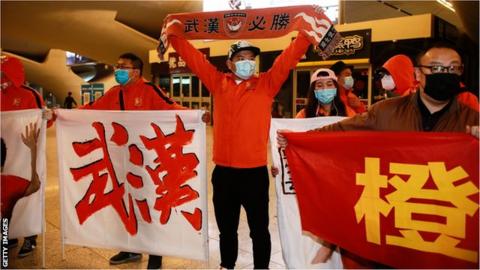
Fans greeted the team as they arrived in Wuhan via train
Chinese Super League team Wuhan Zall made an emotional homecoming after being unable to return for three months because of the coronavirus pandemic.
Players had initially stayed at their winter training camp in Spain when the virus peaked in Wuhan in January.
After a prolonged transit in Germany, they landed in Shenzhen on 16 March and underwent three weeks’ quarantine.
They were greeted by fans when they arrived in Wuhan by train on Saturday evening.
“After more than three months of wandering, the homesick Wuhan Zall team members finally set foot in their hometown,” the team said on the Twitter-like Weibo.
Fans, dressed in the team’s orange colours, sang and gave the players flowers as they arrived home for the first time in 104 days.
Players will now spend time with their families before training resumes.
The team had first left Wuhan in early January to start preparing for the Super League season.
By the time they arrived in Malaga, residents in Wuhan were living under strict lockdown measures, and there were no planes or trains in or out of the capital.
Coach Jose Gonzalez told Spanish media at the time that the players “are not walking viruses, they are athletes” and asked for them not to be demonised.
The Chinese Super League was set to begin on 22 February but it has been postponed.
Zeng Zhenguo (L), a member of the medical assistance team supporting the virus-hit Wuhan in Hubei Province, hugs his wife after 14-day quarantine at the Xianghu area of the First Affiliated Hospital of Nanchang University in Nanchang, east China’s Jiangxi Province, April 15, 2020. The 141 members of the medical assistance team reunited with their families on Wednesday after 14-day quarantine. (Xinhua/Wan Xiang)
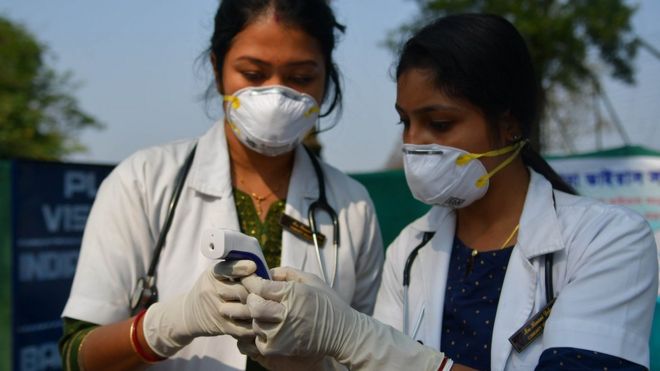
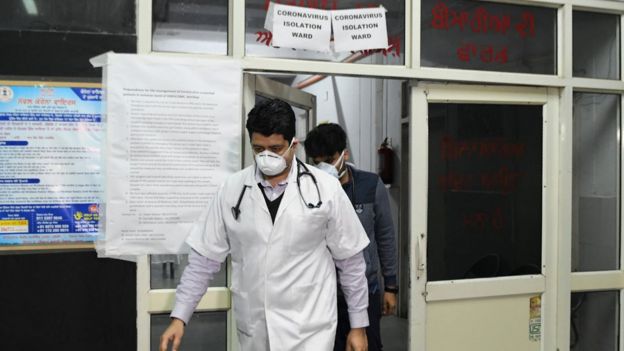
Image copyright MAJORITY WORLDImage caption Indian doctors have been working extra hours to halt the spread of the coronavirus
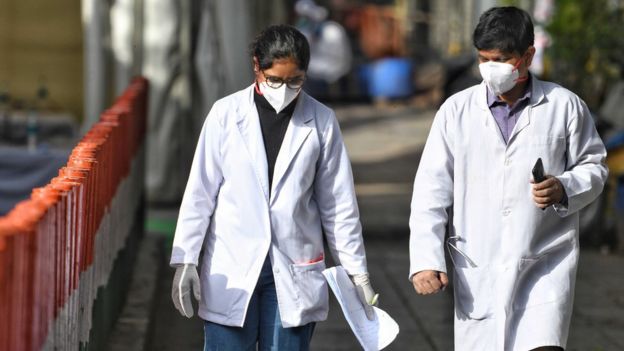
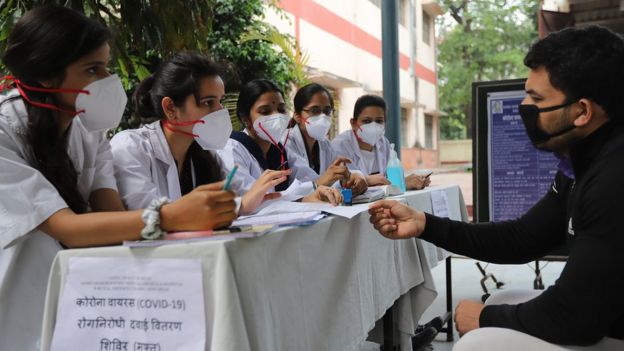
Several healthcare workers in India have been attacked as they battle to stop the spread of the coronavirus.
Reports say doctors have been spat at and chased away from homes, and that in one case patients directed abusive and vulgar language towards female nurses.
Some physicians and their families have also been ostracised by their neighbours because of their exposure to patients infected with Covid-19.
India has reported more than 2,300 cases and at least 50 people have died.
One video, which has gone viral, showed a mob throwing stones at two female doctors wearing personal protective equipment in the central city of Indore.
The doctors had gone to a densely-populated area to check on a woman suspected of having Covid-19 when they came under attack.
Despite being injured, one of the doctors seen in the video, Zakiya Sayed, said the incident “won’t deter me from doing my duty”.
“We were on our usual round to screen suspected cases,” she told the BBC. “We never thought that we would be attacked.”
“I had never seen scenes like that. It was frightening. We somehow fled from the mob. I am injured but not scared at all.”
Dr Sayed added: “We had no reason to suspect that people would be agitated against medical teams.”
“We are working to keep people safe. We had information about a person coming in contact with a Covid-19 patient. We were talking to the person when residents got agitated and attacked us.”
Image copyright HINDUSTAN TIMESImage caption Doctors have been abused and attacked in different parts of India
Seven people have been arrested in connection with the incident.
Dr Anand Rai, who is also a part of the Covid-19 taskforce in Indore, told the BBC: “Nothing can justify the attack against medical team. But it happened in a Muslim-dominated area where there is general distrust against the government.”
“So that anger spilled over and took the form of this attack. But whatever maybe the reason, nothing can justify violence, especially against doctors during a national health emergency,” he added.
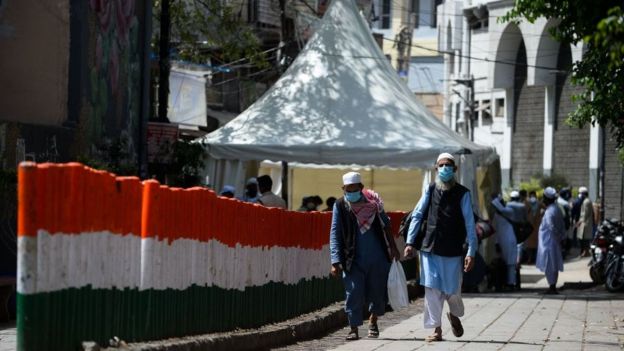
Thousands who attended the gathering in Delhi, organised by Islamic preaching group Tablighi Jamaat, have been put in quarantine, and authorities are still tracing others. It is believed that the infections were caused by preachers who attended the event from Indonesia.
At the Ghaziabad hospital, some of the quarantined attendees allegedly used abusive and vulgar language against members of staff.
Image copyright GETTY IMAGESImage caption Almost 400 cases of Covid-19 have been traced to a Tablighi Jamaat event in Delhi
“Some were walking naked in the hospital ward and harassing women doctors and nurses,” a doctor who works at the hospital told the BBC. “They kept asking for cigarettes and tobacco.”
A senior police officer in the city told the BBC that cases had been registered against some people after doctors filed a complaint.
“Registering cases was the last resort. Police are still trying to make them understand the severity of the situation,” he said.
Image copyright SOPA IMAGESImage caption Doctors and nurses have asked people to follow their advice and not panic
Similar incidents have been reported in neighbouring Delhi.
Some attendees of the Tablighi Jamaat event who are being held in a quarantine facility run by the railways are said to have spat at doctors and misbehaved.
Deepak Kumar, spokesman for Northern Railways, said the situation there was now under control.
“The attendees have been counselled and they are now co-operating with the staff,” he said.
Delhi’s state government has reportedly written to the police, requesting more security for medical staff.
Reports of attacks on doctors and nurses have also come from the southern city of Hyderabad and the western city of Surat.
A doctor who was treating coronavirus patients is Hyderabad’s Gandhi Hospital was attacked on Wednesday.
Police have promised the doctor that “strict action will be taken against the culprits”.
Image copyright NARINDER NANUImage caption Prime Minister Narendra Modi has said that doctors are “front-line soldiers”
But it is not just a work where medical workers are facing discrimination. It has followed them home.
One doctor, who did not wish to be identified, said she felt “extremely disheartened when I learnt that even my neighbours think that me and my family shouldn’t be allowed to live in the building”.
“We want our families to be safe. But we are being discriminated for doing our job.”
“A number of doctors have tested positive across India and that shows how tough our job is at the moment. And that is why we need everybody’s support to win this war against coronavirus.”
She added: “We are following all safety protocols. We are not meeting even our families and that is stressful.”
“But seeing this open discrimination just breaks my heart. But we will go on because there is really no other option.”
Matriarchal and matrilineal communities centred around women have existed for centuries in China, India and Indonesia
But a recent influx of tourism, technology and mainstream patriarchal ideas is rapidly changing their way of life
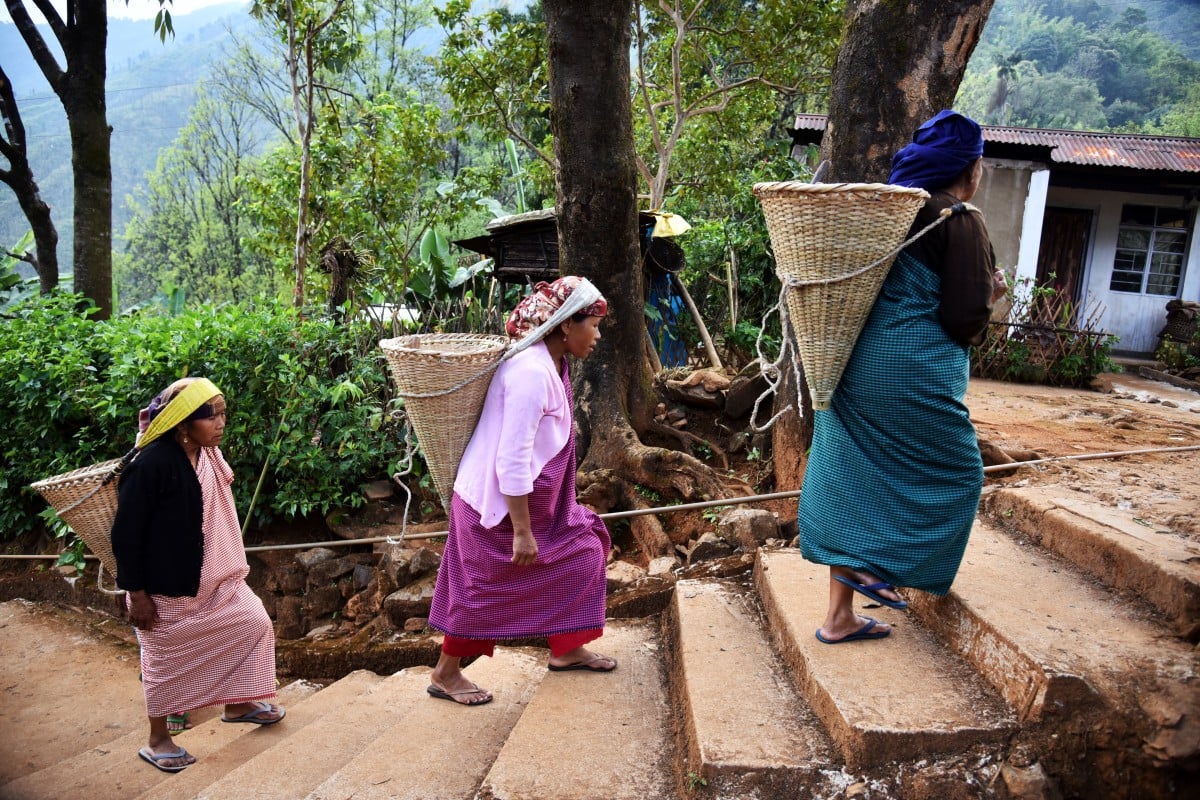
Khasi women leave their village of Nongtraw in India’s northeastern Meghalaya state to collect herbs from the fields. Photo: AFP
While women’s rights may have become a major topic of discussion around the world in recent years, there are female-centric communities that for centuries have distinguished themselves by carving out their own feminist traditions in places such as China, India
and Indonesia.
But many of these matriarchal and matrilineal societies are now struggling to survive, amid threats posed by the modern world such as mass tourism, technology and the infiltration of ideas from mainstream patriarchal society.
In China, for instance, there is a small Mosuo tribe known as the “kingdom of women”.
“Key to the Mosuo culture is their matrilineal family structure, with a basic building block of only members sharing the same female bloodline making up the family … Any male bloodline is not taken into account,” says Choo Waihong, a former Singaporean corporate lawyer who has researched the community for the past decade.
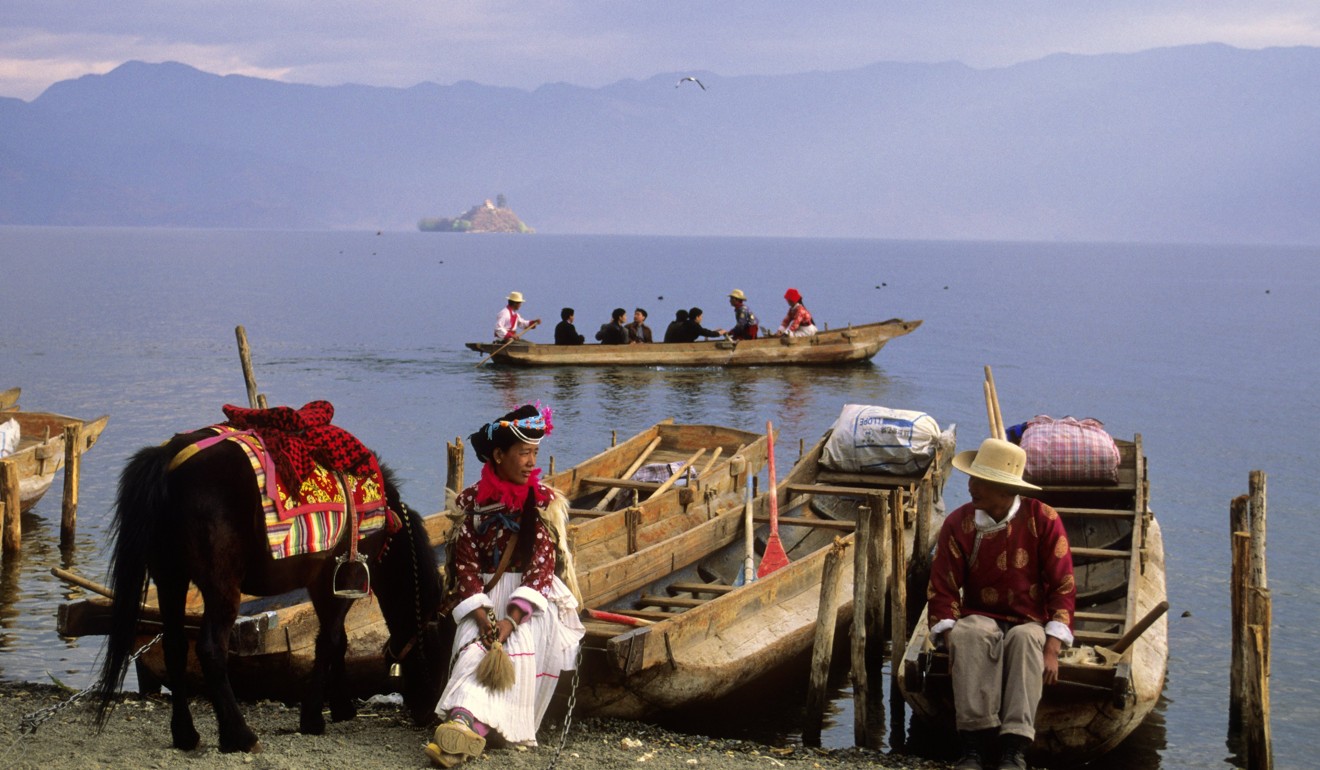
Lugu Lake in China’s Yunnan province is home to the Mosuo tribe. Photo: hemis.fr
At the top of the hierarchy is the grandmother, who is the head of the household. “Her daughters run the home and look after all the children of the female siblings … The sons and grandsons are expected in their supporting role to shoulder the manual tasks required to maintain the farmstead,” Choo says.
Researchers say that there are about 30,000 to 40,000 Mosuo people – most of whom live in the far eastern foothills of the Himalayas in Yunnan, southwest China. This unique community has come together in a series of villages dotted around a mountain and Lugu Lake, while growing numbers have moved out to work in larger towns and cities elsewhere in the country.
According to Choo, author of the book The Kingdom of Women: Life, Love and Death in China’s Hidden Mountains, the most distinctive facet of this community that sets it apart from mainstream society is the absence of formal marriage arrangements between men and women. Instead, they have “walking marriages”, where the man goes to the woman’s home, spends the night with her and then leaves the following morning.
The Kingdom of Women: China’s ‘lost tribe’ of matriarchs, the Mosuo
15 Mar 2017
The couple can choose to have a temporary or even a permanent arrangement as partners, but they are not bound by marriage ties. If they have children, the baby belongs to the woman’s household. “In fact, the man is not considered part of the matrilineal family and his ties to the baby do not determine the social place of the baby,” the researcher says.
Such a society, where women are not subjected to men and sexual freedom is an intrinsic part of their culture, is so radically different from mainstream patriarchal family structures that the Mosuo tribe has been examined and studied over time. More recently, its unique features have also become an eye-catching selling point for the local tourism industry.
TOURISM INDUSTRY
The Mosuo tribe used to live off the land by farming, herding and hunting. But many families now rely on tourism after the tribe’s culture and Lugu Lake became more popular and widely known.
“Tour buses on fancy freeways and planes arriving at a new airport bring more and more tourists daily to turn the whole area into a busy travel playground,” Choo says. “Every household around the lake is involved one way or another with the hotel, restaurant and tour guide industries.”
While the tourism industry has brought money and better food for most families as well more access to educational opportunities for their children, it is also posing a serious threat to their culture and traditional ways of life.
“The greatest challenge for the tribe is their rapid transition from living a rudimentary subsistence farming way of life right into a burgeoning modern middle-class existence within a short span of 20 or so years,” Choo says.
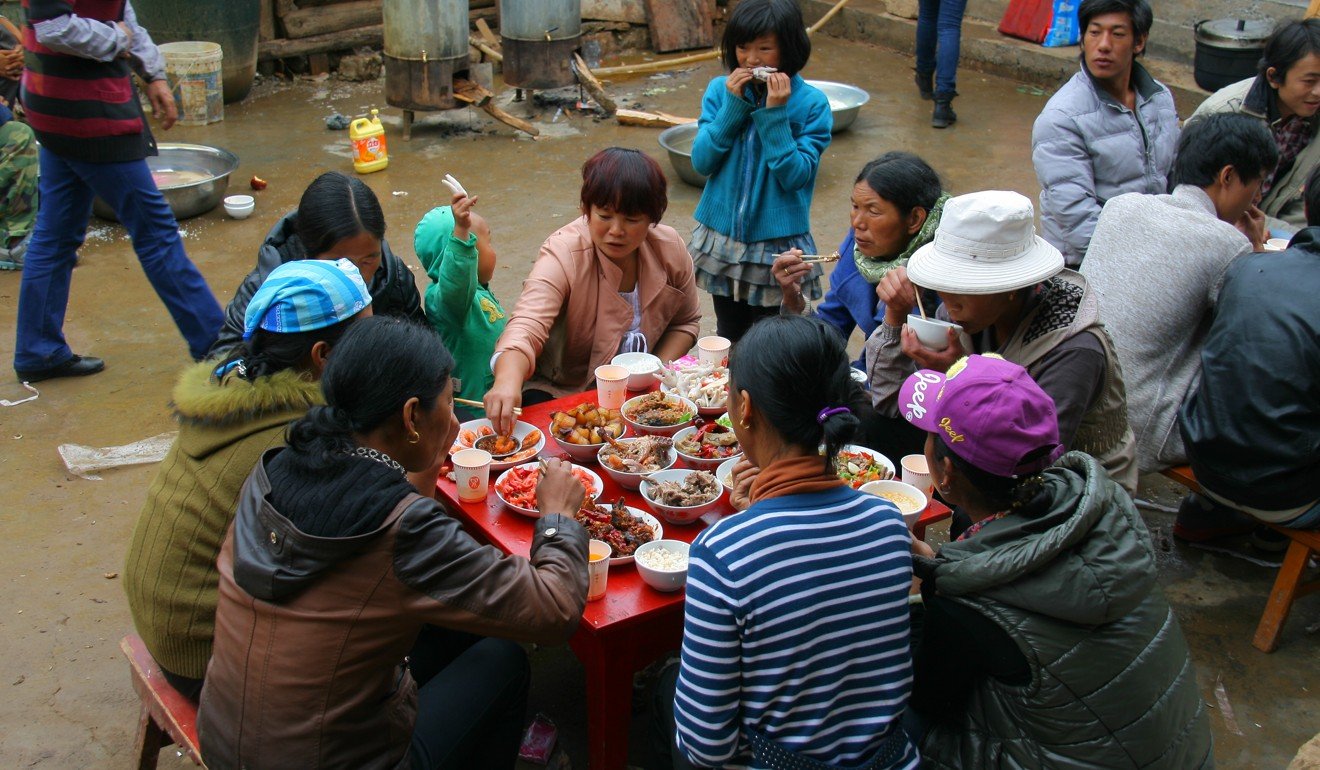
Mosuo people pictured at a wedding ceremony with an all-meat feast in 2013. Photo: Shutterstock
The Mosuo are now being bombarded not only by mainstream traditional Chinese values, but also by new economic values connected to money and the digital economy. “That is a lot to take in for people who had no writing to support their oral language … and only had primary schools for their children not so long ago,” she says.
Older Mosuo are now being pushed to learn Mandarin in order to keep up with the younger generations.
At the same time, the researcher says, “their long-held cultural beliefs and principles are evolving as the young generation gets exposed to the outside world and start to question the old ways of doing things.”
How life is changing for Thailand’s Karen tribe
17 Mar 2017
Walking marriages are not as common, with more youngsters getting married and forming nuclear families. “Large matrilineal families which were the norm are now breaking up into smaller nuclear families. All this dilutes the traditional matrilineal Mosuo family structure,” Choo says.
“The central place of the female in old Mosuo society is slowly being affected, as the male Mosuo are beginning to entertain some patriarchal outlook in the face of outside cultural influences.”
China may have radically reinvented itself in recent decades, but the changes to the Mosuo tribe have been nearly as dramatic. “The world of the Mosuo when I first ventured into their midst 12 years ago is a distant past as I look [today in 2020] at how they have changed,” Choo says.
PATRIARCHY IN DISGUISE
There are dozens of female-centric communities scattered around the world. The Garo and Khasi tribes, which are also traditionally matrilineal societies, can be found mostly in India.
In a Khasi family, the youngest daughter inherits the ancestral property, while in the Garo community, women also inherit property, but don’t necessarily have to be the youngest daughter of the family.
Caroline Marak, former head of the Garo Department at the North Eastern Hill University in India, says that the Garo are female-oriented, but not female-dominated. Women “have no part in the field of administration decision-making”, she wrote in an academic paper.
In recent years, the husbands of Garo women who are property owners have had a greater say over land deals, such as with government. “We are now trying to reclaim our rights from the males,” says Sume Sangma, secretary of the Garo Mothers Union NGO. “Women in the community are self-reliant and we are fighting for their real power.”
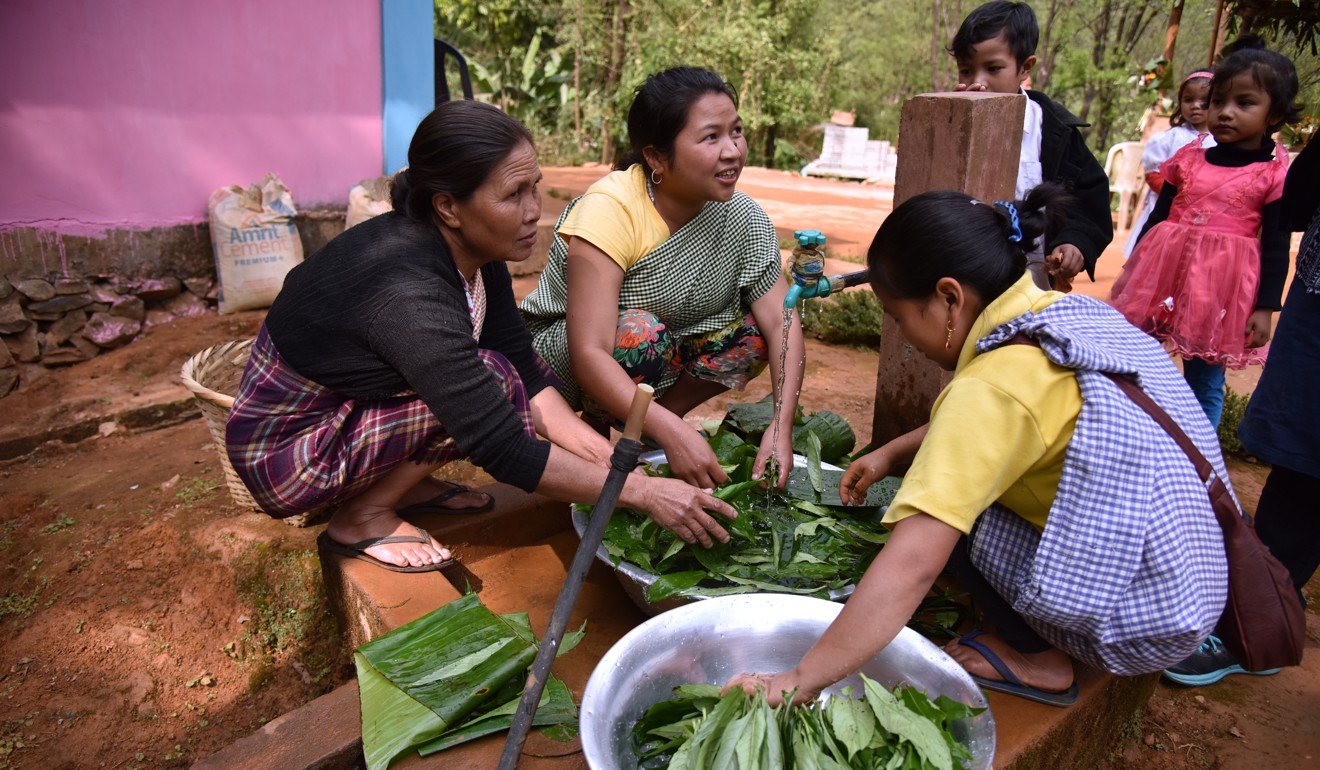
Khasi women wash leaves for cooking in the village of Nongtraw in India’s north-eastern Meghalaya state. Photo: AFP
Tiplut Nongbri, from the Centre for North East Studies and Policy Research at the Jamia Millia Islamia in New Delhi, also says women don’t have much authority in Garo and Khasi societies. “Patriarchy is in disguise in both the communities. The societies are matrilineal only as far as descent, residence and inheritance of property are concerned,” she says. “Women are not allowed to take part in politics.”
RG Lyngdoh, former home minister of Meghalaya – the hilly state in north-eastern India where both communities are based – says inward migration and the presence of Christian missionaries in the state have affected traditional lifestyles. “The old practices of equity between males and females have eroded,” Lyngdoh says.
“This has led to a perception of inadequacy among the males, [creating] discord within the family, which found expression in many negative ways, such as domestic violence and abandonment of wives, which never existed within the Khasi community.”
Gertrude Lamare, a member of the Khasi-Jaintia community now pursuing her PhD in anthropology at the London School of Economics and Political Science, argues that “with families becoming more nuclear, women do have a huge role in the decision-making process”.
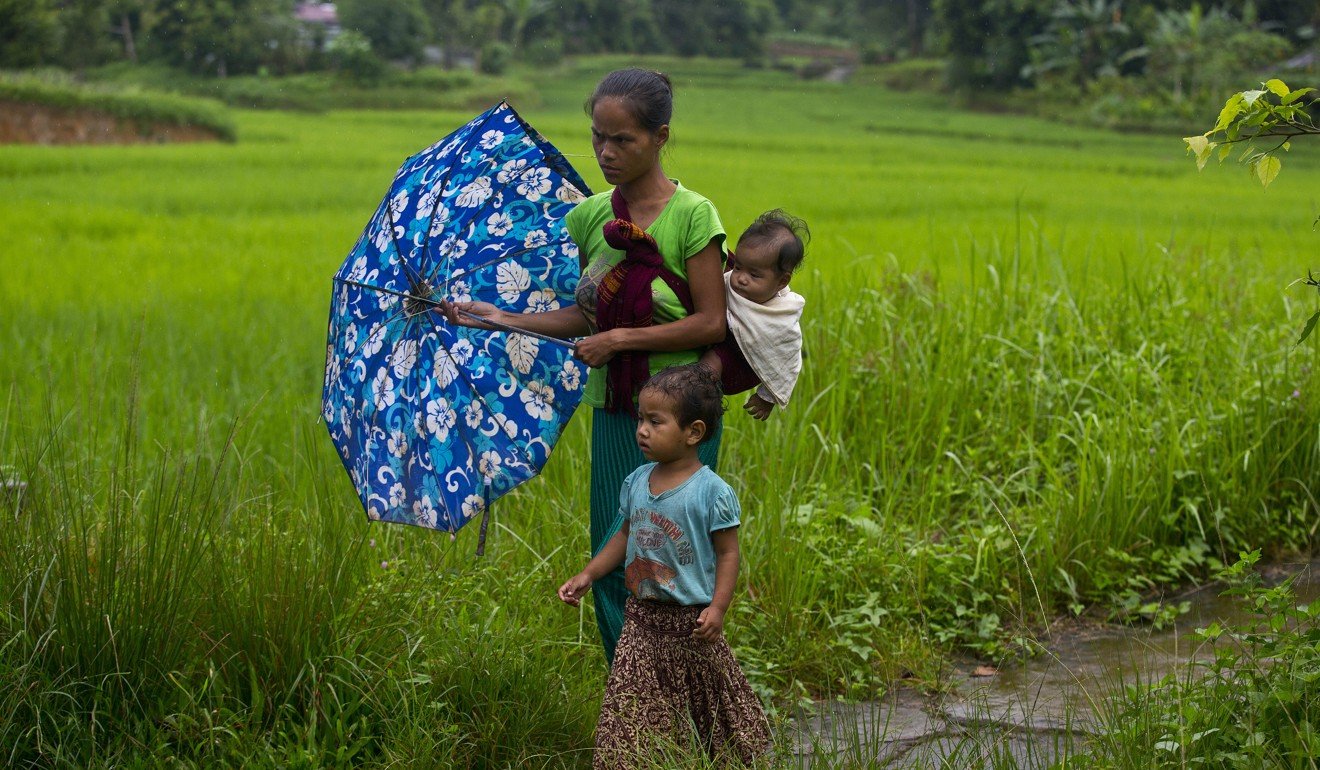
A Khasi woman walks in the rain with children past a paddy field along the Assam-Meghalaya state border in India. Photo: AP
Researchers have estimated that there are 1 million Garo in India and
, and 1.7 million Khasi in the Khasi and Jaintia Hills.
Some of them have become increasingly wary of outsiders preying on their natural resources, which are dwindling, thanks to deforestation and climate change.
Another challenge these communities are facing has to do with the growing trend of mixed marriages. “In recent years, children of a Khasi or Garo mother and non-tribal father [have] not [been] welcomed. The males in the family want their women to marry within the tribal community,” researcher Nongbri says, noting that younger generations are going through an identity crisis.
STILL PROUD
The world’s largest known matrilineal society today is believed to be in Indonesia: the Minangkabau, also known as Minang. Their community of about 8 million is scattered around the world, but most are in Indonesia’s West Sumatra province. While traditionally animist, they were later influenced by Hinduism and Buddhism, and most have since embraced Islam.
But much like the others, their community is also changing.
Nursyirwan Effendi, dean of the Faculty of Social and Political Science at Andalas University, says that many of those who remain in villages and rural areas still hold tight to the tribe’s values.
“Women are central in the distribution of assets, such as rice fields, gardens and [houses], from their ancestors,” he says.
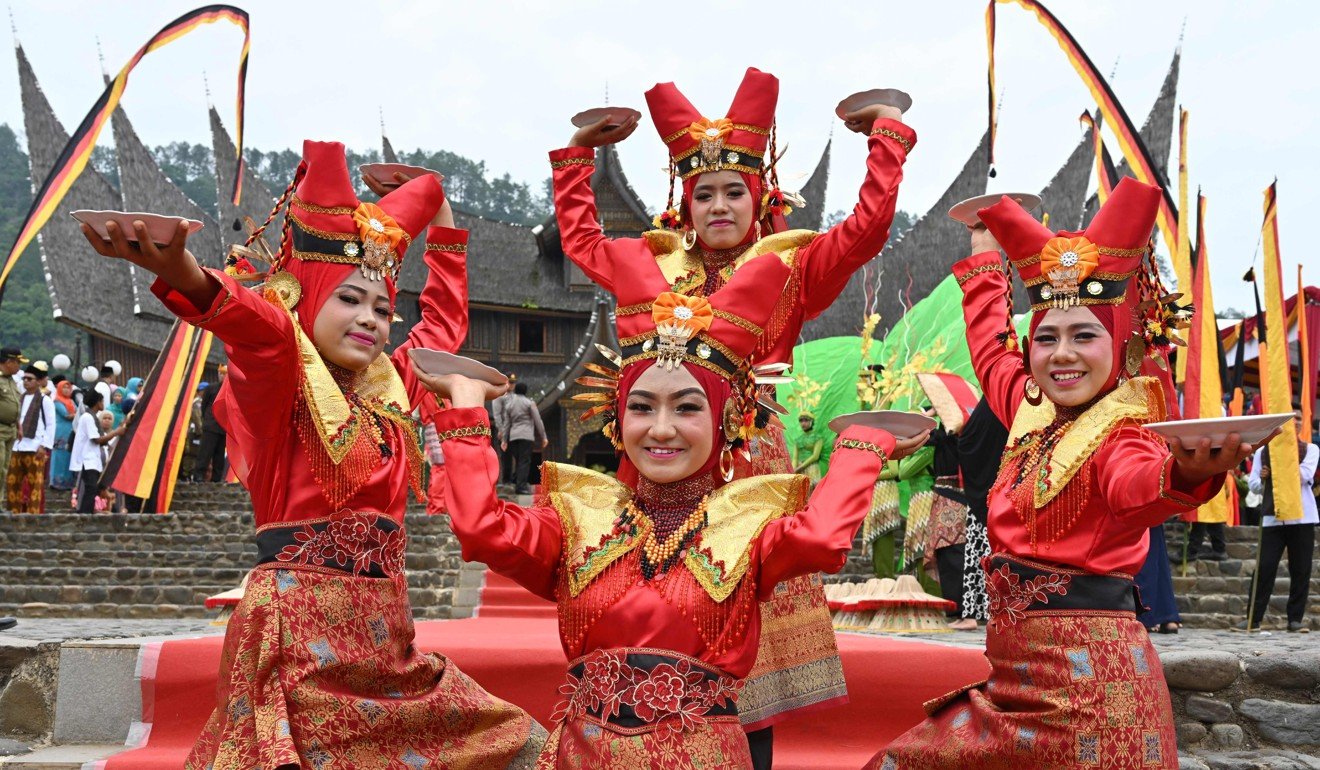
Dancers pose during the 2018 Minangkabau art and culture festival in Batusangkar, West Sumatra. Photo: AFP
Traditionally, Minangkabau women play an essential role in their children’s education and hold inheritance rights, while men are expected to take jobs elsewhere and occupy political and religious positions. When they do get married, the man moves to the woman’s house.
But Nursyirwan, who is of Minangkabau descent, notes that many have left for bigger cities, where they do not closely follow the community’s traditions.
An example of this is Afrianto Sikumbang, a 53-year-old businessman who was born to Minangkabau parents in West Sumatra province but now lives in the capital, Jakarta. Although he married a Minangkabau woman, he says they “don’t really apply” the tribe’s values in their daily life.
Sonya Anggraini, 35, who also works in the capital, has got used to city life, but remains proud of her ancestral roots and hopes that Minangkabau culture will persist for years to come.
“I am a member of my mother’s family, not of my father’s,” she says. ■
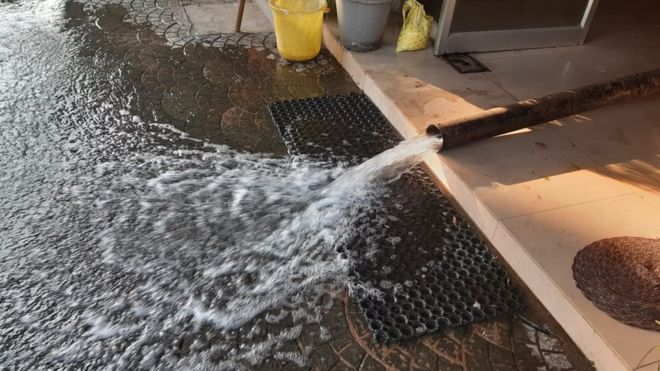
Image copyright JOSHY MALIYEKKALImage caption Drinking water reeking of alcohol started flowing out of the apartment taps
Residents of an apartment building in southern India were left in shock after a mix of beer, brandy and rum started gushing out of their taps.
The smelly, brown liquid began flowing from kitchen taps in the block of flats, in Kerala, on Monday morning.
Bemused residents then contacted the authorities for help, and discovered their water well had been contaminated by officials – albeit accidentally.
It emerged 6,000 litres of confiscated alcohol had been buried nearby.
The alcohol, which officials had placed in a pit after it was seized on court orders, had seeped through the soil and into a well – the same well which supplied the residents of the 18 flats in Thrissur district with drinking water.
“We were so shocked,” Joshy Malyiekkal, owner of the apartment complex, told BBC Hindi’s Imran Qureshi.
Luckily, the strong smell put people off consuming the water. However, the discovery meant there was not only no drinking water for the families, but they were also unable to wash.
“The children couldn’t go to school and even their parents couldn’t go to work,” Mr Malyiekkal said.
Image copyright JOSHY MALIYEKKALImage caption The contaminated water from the well being pumped out
After residents complained, officials acted to rectify the mistake.
But the process of pumping the well clean is likely to take a month, according to residents, leaving them reliant on deliveries from authorities.
“They’ve been supplying about 5,000 litres of water daily but it is not enough to cover all the families in our building,” Mr Malyiekkal said, pointing out the well was their main source of water.
Officials from the department did not respond to questions from the BBC.
The state of Kerala has the highest consumption of alcohol in the country.
The decision, which follows a similar move by the US this week, came as the death toll from the outbreak soared to 259
Health officials on Friday confirmed the first cases in the UK after two people tested positive for the virus
A coach carrying British nationals evacuated from Wuhan arrives at the Arrowe Park Hospital in Wirral, near Liverpool in northwest England. Photo: AFP
Britain on Saturday said it was temporarily withdrawing some staff and their families from its diplomatic sites in China, as Beijing struggles to contain the nationwide new
The decision, which follows a similar move by the United States this week, came as the death toll from the outbreak soared to 259 and the total number of cases neared 12,000 within China.
The Sars-like virus has also begun to spread around the world, with more than 100 infections reported in more than 20 countries.
“We are committed to ensuring the safety and well-being of our staff and their families,” a spokesman for the British Foreign Office said.
“We are therefore temporarily withdrawing some UK staff, and their dependents from our embassy and consulates in China.”
He added that Britain’s ambassador in Beijing and staff needed to continue critical work will remain, and that British nationals in China would still have access to constant consular assistance.
The US, which on Friday temporarily banned the entry of foreign nationals, who had travelled to China over the past two weeks, has also made similar changes.
Two people in UK test positive for coronavirus
31 Jan 2020
On Wednesday, it authorised the departure of non-emergency government employees and their family members from its offices in Beijing, Chengdu, Guangzhou, Shanghai, and Shenyang.
And on Friday, it ordered all relatives of staff members under the age of 21 to leave China immediately.
A spokesman for the US Embassy in Beijing said it made the decision “out of an abundance of caution related to logistical disruptions stemming from restricted transportation and overwhelmed hospitals related to the novel coronavirus”.
Coronavirus outbreak: global businesses shut down operations in China
British health officials on Friday confirmed the first cases in the UK, after two members of the same family tested positive for the virus.
One of the two individuals is a student at the University of York, a university spokesman said on Saturday.
Also on Friday, 83 British citizens returned on a UK government-chartered flight from Wuhan, the Chinese city at the centre of the epidemic.
They were immediately taken to a hospital in northwest England for a two-week quarantine.
BEIJING, Aug. 12 (Xinhua) — “A spring breeze blew into Sijiqing.”
This is how seniors at the Beijing-based nursing home recalled a visit in 2013 by President Xi Jinping, also general secretary of the Communist Party of China Central Committee and chairman of the Central Military Commission.
During the visit to the Sijiqing Home for the Elderly, Xi chatted with senior citizens, asked them about their health, families and lives.
Xi stressed the need to improve the management and service quality of elderly care institutions to ensure that every senior citizen can live a carefree, healthy, comfortable and happy life.
More than five years on, Liu Jinwen, a member of the elderly fashion models team at Sijiqing, said the visit had a great impact on them.
“Senior citizens should maintain a positive outlook on life and spend their old age gracefully,” Liu said. “To that end, we set up the models team to make our lives more ‘beautiful!'”
Liu is just one of the growing number of happy seniors in China.
Under Xi’s leadership, the country has over the past few years formulated a series of measures to boost elderly care and witnessed a marked improvement of the lives of the senior citizens.
BETTER NURSING HOMES
The services at nursing homes are related to the happiness of more than 200 million old people in China, especially the 40 million of them who have lost the ability in full or in part to take care of themselves.
In 2017, a four-year campaign was launched nationwide to boost nursing homes’ service quality. More rules and regulations on the management of elderly care institutions have also been drawn up.
At Sijiqing, a lot of cultural activities were organized. A “Silver Age” college was set up. And the nursing home teamed up with a local hospital to provide fast access for senior citizens to quality medical treatment.
“It’s really convenient now,” said Zhang Jin, a Sijiqing nursing home resident.
IMPROVED COMMUNITY-LEVEL SERVICES
Another field of senior care that has benefited a lot from policy support is community-level services.
Community-based elderly care is important to China’s old-age care system. About 90 percent of the Chinese elderly prefer to spend their later years at home, 6 percent at community-level elderly care centers and only 4 percent at nursing homes, according to statistics.
But community-level elderly care centers also play a key role in providing food and medical services to senior citizens who opt to stay at home.
Liu Jianguo, 86, and his wife are among the people who benefit.
The couple, living in the southeastern city of Fuzhou, go to the community elderly daycare center almost every day.
“My wife and I usually spend the whole day here,” Liu said, praising the center for its environment, facilities and staff.
Across China, all urban communities and more than half of rural communities had established community-based old-age service facilities as of the end of 2018.
In China, a comprehensive elderly care service system is taking shape, meeting the needs of the elderly who prefer to spend later years at home, community-level centers or nursing homes.
China is deliberately separating Muslim children from their families, faith and language in its far western region of Xinjiang, according to new research.
At the same time as hundreds of thousands of adults are being detained in giant camps, a rapid, large-scale campaign to build boarding schools is under way.
Based on publicly available documents, and backed up by dozens of interviews with family members overseas, the BBC has gathered some of the most comprehensive evidence to date about what is happening to children in the region.
Records show that in one township alone more than 400 children have lost not just one but both parents to some form of internment, either in the camps or in prison.
Formal assessments are carried out to determine whether the children are in need of “centralised care”.
Alongside the efforts to transform the identity of Xinjiang’s adults, the evidence points to a parallel campaign to systematically remove children from their roots.
Image caption The Hotan Kindness Kindergarten, like many others, is a high security facility
China’s tight surveillance and control in Xinjiang, where foreign journalists are followed 24 hours a day, make it impossible to gather testimony there. But it can be found in Turkey.
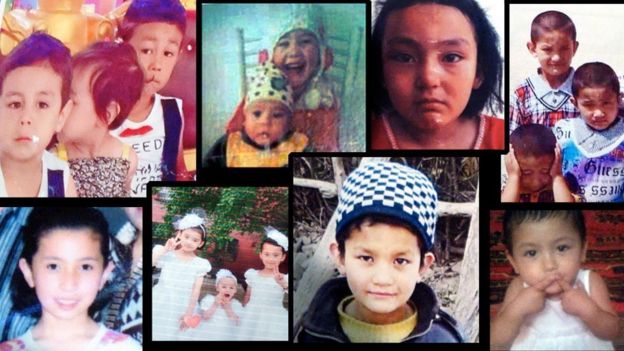
In a large hall in Istanbul, dozens of people queue to tell their stories, many of them clutching photographs of children, all now missing back home in Xinjiang.
“I don’t know who is looking after them,” one mother says, pointing to a picture of her three young daughters, “there is no contact at all.”
Another mother, holding a photo of three sons and a daughter, wipes away her tears. “I heard that they’ve been taken to an orphanage,” she says.
In 60 separate interviews, in wave after wave of anxious, grief-ridden testimony, parents and other relatives give details of the disappearance in Xinjiang of more than 100 children.
They are all Uighurs – members of Xinjiang’s largest, predominantly Muslim ethnic group that has long had ties of language and faith to Turkey. Thousands have come to study or to do business, to visit family, or to escape China’s birth control limits and the increasing religious repression.
But over the past three years, they have found themselves trapped after China began detaining hundreds of thousands of Uighurs and other minorities in giant camps.
The Chinese authorities say the Uighurs are being educated in “vocational training centres” in order to combat violent religious extremism. But evidence shows that many are being detained for simply expressing their faith – praying or wearing a veil – or for having overseas connections to places like Turkey.
For these Uighurs, going back means almost certain detention. Phone contact has been severed – even speaking to relatives overseas is now too dangerous for those in Xinjiang.
With his wife detained back home, one father tells me he fears some of his eight children may now be in the care of the Chinese state.
“I think they’ve been taken to child education camps,” he says.
New research commissioned by the BBC sheds light on what is really happening to these children and many thousands of others.
Dr Adrian Zenz is a German researcher widely credited with exposing the full extent of China’s mass detentions of adult Muslims in Xinjiang. Based on publicly available official documents, his report paints a picture of an unprecedented school expansion drive in Xinjiang.
Campuses have been enlarged, new dormitories built and capacity increased on a massive scale. Significantly, the state has been growing its ability to care full-time for large numbers of children at precisely the same time as it has been building the detention camps.
And it appears to be targeted at precisely the same ethnic groups.
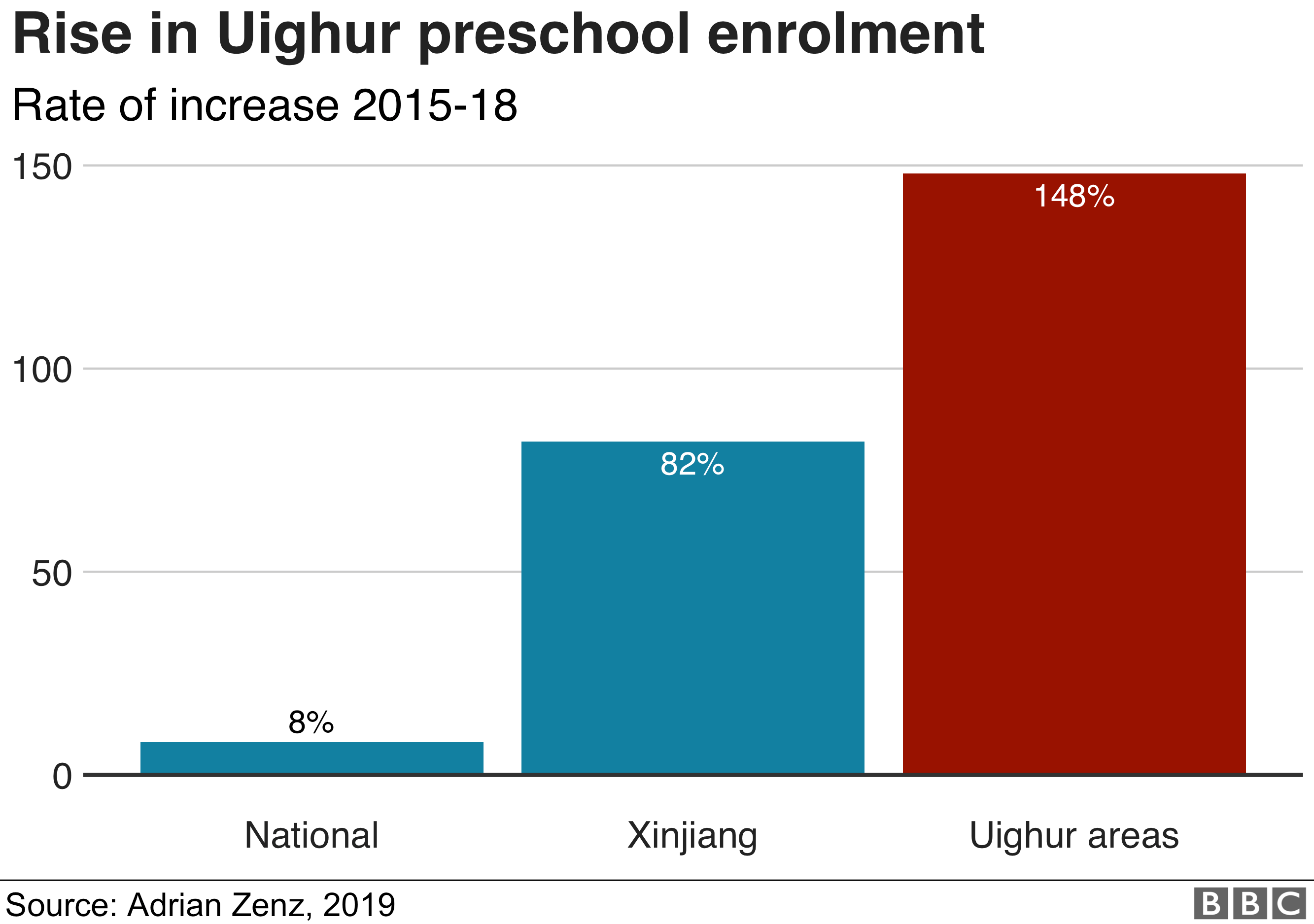
In just one year, 2017, the total number of children enrolled in kindergartens in Xinjiang increased by more than half a million. And Uighur and other Muslim minority children, government figures show, made up more than 90% of that increase.
As a result, Xinjiang’s pre-school enrolment level has gone from below the national average to the highest in China by far.
In the south of Xinjiang alone, an area with the highest concentration of Uighur populations, the authorities have spent an eye watering $1.2bn on the building and upgrading of kindergartens.
Mr Zenz’s analysis suggests that this construction boom has included the addition of large amounts of dormitory space.
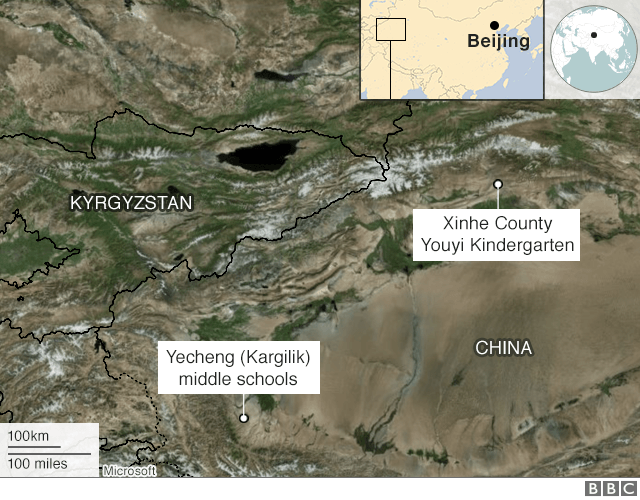
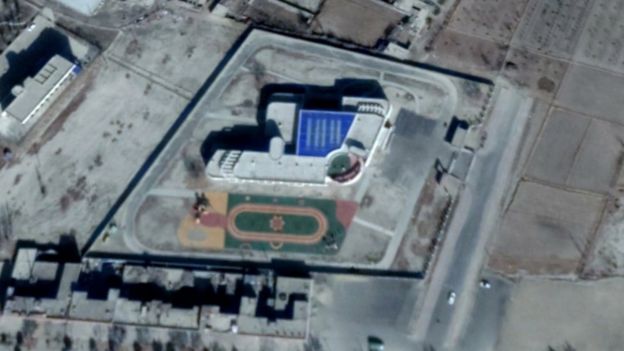
Image caption Xinhe County Youyi Kindergarten has space for 700 children, 80% of whom are from Xinjiang’s minority groups
Xinjiang’s education expansion is driven, it appears, by the same ethos as underlies the mass incarceration of adults. And it is clearly affecting almost all Uighur and other minority children, whether their parents are in the camps or not.
In April last year, the county authorities relocated 2,000 children from the surrounding villages into yet another giant boarding middle school, Yecheng County Number 4.
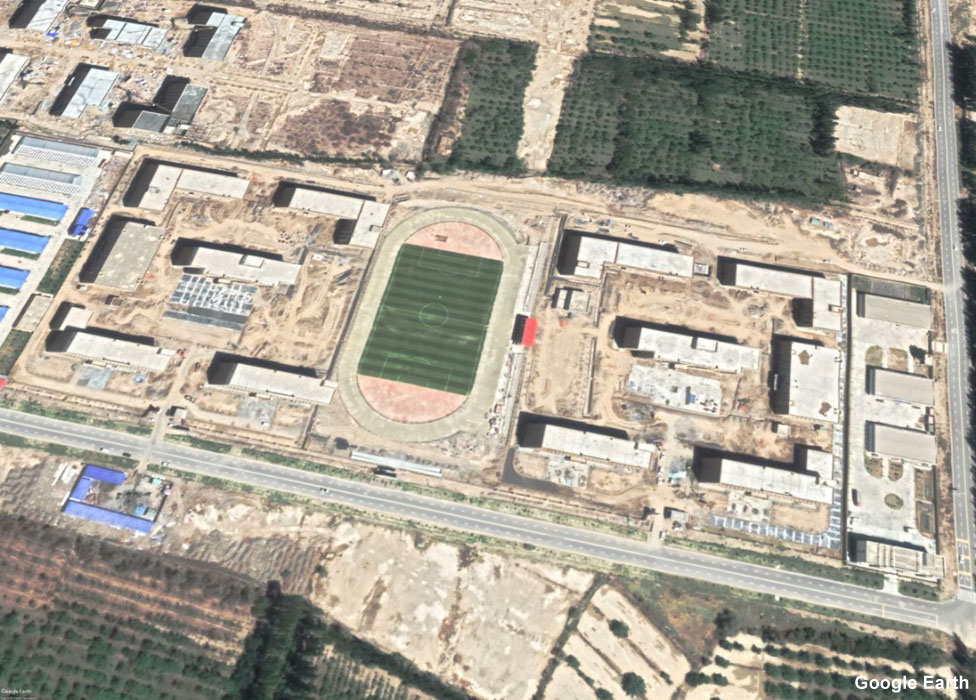
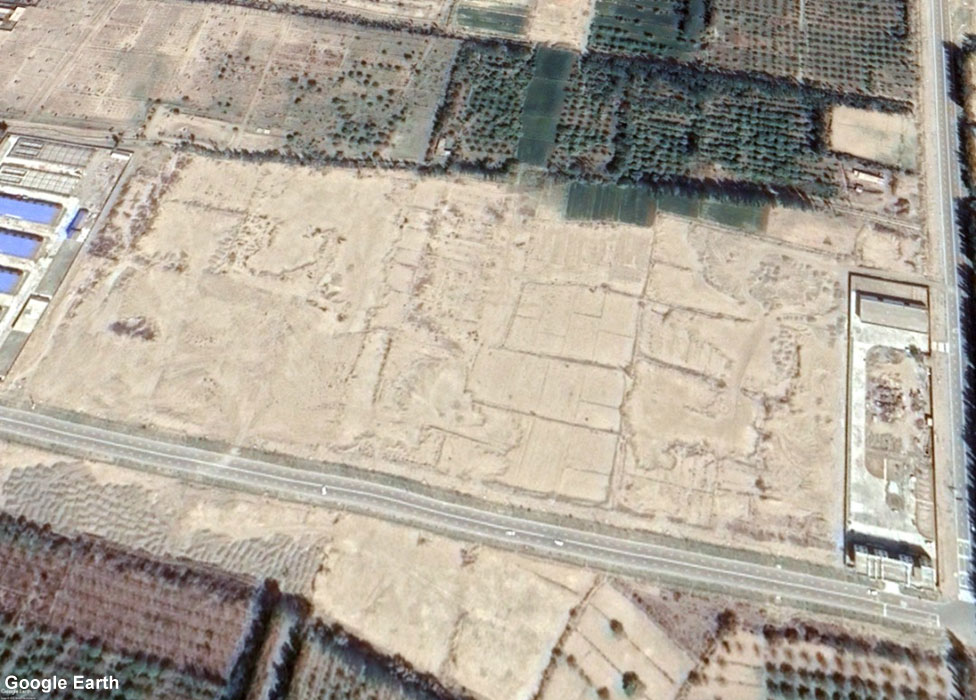
INTERACTIVE Use the slider button to see how the school has developed
May 2019
April 2018
Yecheng County Middle Schools 10 and 11
The image above shows a site being prepared for two new boarding schools in Xinjiang’s southern city of Yecheng (or Kargilik in Uighur).
Dragging the slider reveals the pace of construction – the two middle schools, separated by a shared sports field, are each three times larger than the national average and were built in little more than a year.
Government propaganda extols the virtues of boarding schools as helping to “maintain social stability and peace” with the “school taking the place of the parents.” And Mr Zenz suggests there is a deeper purpose.
“Boarding schools provide the ideal context for a sustained cultural re-engineering of minority societies,” he argues.
Just as with the camps, his research shows that there is now a concerted drive to all but eliminate the use of Uighur and other local languages from school premises. Individual school regulations outline strict, points-based punishments for both students and teachers if they speak anything other than Chinese while in school.
And this aligns with other official statements claiming that Xinjiang has already achieved full Chinese language teaching in all of its schools.
Media caption The BBC visits the camps where China’s Muslims have their “thoughts transformed”
Speaking to the BBC, Xu Guixiang, a senior official with Xinjiang’s Propaganda Department, denies that the state is having to care for large numbers of children left parentless as a result.
“If all family members have been sent to vocational training then that family must have a severe problem,” he says, laughing. “I’ve never seen such a case.”
But perhaps the most significant part of Mr Zenz’s work is his evidence that shows that the children of detainees are indeed being channelled into the boarding school system in large numbers.
There are the detailed forms used by local authorities to log the situations of children with parents in vocational training or in prison, and to determine whether they need centralised care.
Mr Zenz found one government document that details various subsidies available to “needy groups”, including those families where “both a husband and a wife are in vocational training”. And a directive issued to education bureaus by the city of Kashgar that mandates them to look after the needs of students with parents in the camps as a matter of urgency.
Schools should “strengthen psychological counselling”, the directive says, and “strengthen students’ thought education” – a phrase that finds echoes in the camps holding their parents.
It is clear that the effect of the mass internments on children is now viewed as a significant societal issue, and that some effort is going into dealing with it, although it is not something the authorities are keen to publicise.
Media caption The BBC has found new evidence of the increasing control and suppression of Islam in China
Some of the relevant government documents appear to have been deliberately hidden from search engines by using obscure symbols in place of the term “vocational training”. That said, in some instances the adult detention camps have kindergartens built close by, and, when visiting, Chinese state media reporters have extolled their virtues.
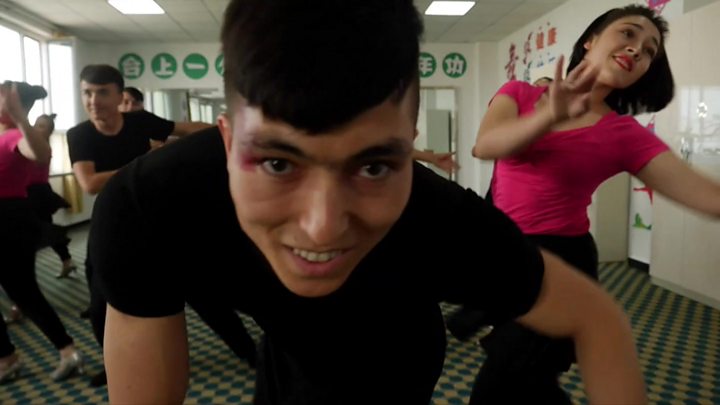
These boarding schools, they say, allow minority children to learn “better life habits” and better personal hygiene than they would at home. Some children have begun referring to their teachers as “mummy”.
We telephoned a number of local Education Bureaus in Xinjiang to try to find out about the official policy in such cases. Most refused to speak to us, but some gave brief insights into the system.
We asked one official what happens to the children of those parents who have been taken to the camps.
“They’re in boarding schools,” she replied. “We provide accommodation, food and clothes… and we’ve been told by the senior level that we must look after them well.”
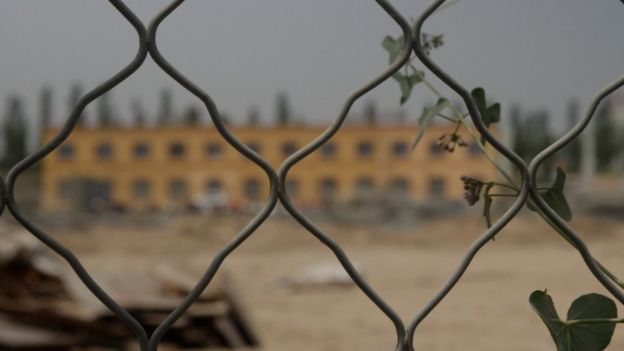
Image caption Hotan Sunshine Kindergarten, seen through a wire fence
In the hall in Istanbul, as the stories of broken families come tumbling out, there is raw despair and deep resentment too.
“Thousands of innocent children are being separated from their parents and we are giving our testimonies constantly,” one mother tells me. “Why does the world keep silent when knowing these facts?”
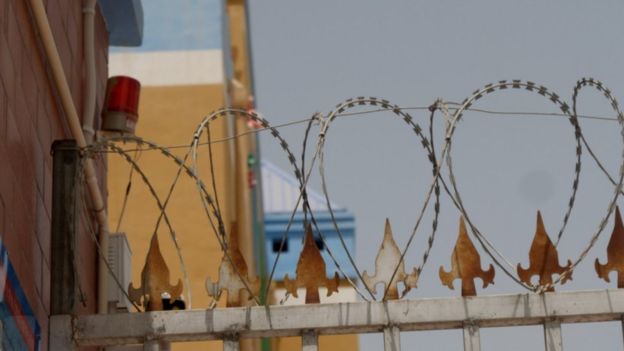
Back in Xinjiang, the research shows that all children now find themselves in schools that are secured with “hard isolation closed management measures.” Many of the schools bristle with full-coverage surveillance systems, perimeter alarms and 10,000 Volt electric fences, with some school security spending surpassing that of the camps.
The policy was issued in early 2017, at a time when the detentions began to be dramatically stepped up. Was the state, Mr Zenz wonders, seeking to pre-empt any possibility on the part of Uighur parents to forcibly recover their children?
“I think the evidence for systematically keeping parents and children apart is a clear indication that Xinjiang’s government is attempting to raise a new generation cut off from original roots, religious beliefs and their own language,” he tells me.
“I believe the evidence points to what we must call cultural genocide.”










 CHINDIA ALERT: You'll be living in their world, very soon
Coronavirus: Chinese workers in Vietnam cry foul after being fired by Taiwanese firm making shoes for Nike, Adidas
A group of 150 Chinese workers believe the world’s largest maker of trainers used the coronavirus as an excuse to fire them, having helped Taiwanese firm Pou Chen successfully expand its production into Vietnam for more than a decade.
Pou Chen, which makes footwear for the likes of Nike and Adidas, informed the group in late April that they would no longer be needed as they were unable to return to
from their hometowns in China due to the coronavirus lockdowns.
“We 150 employees were the first batch of Chinese employees to be laid off this year. We are all pessimistic and expect more will be cut,” added Zhang.
In its email on April 27, Pou Chen said it was forced to terminate the contracts of the Chinese employees across five of its factories due to an unprecedented decline in orders and financial losses.
The Chinese employees, many of whom have been working for the shoemaker for decades, said the compensation offered was unfair and below the levels required by labour law in both Vietnam and China.
“[The dismissals were] in accordance with the relevant labour laws of the country of employment … and employee labour contracts,” added the statement from Pou Chen, which employs around 350,000 people worldwide.
Company data showed Pou Chen’s first quarter revenues tumbled 22.4 per cent year-on-year to NT$59.46 billion (US$1.99 billion), the weakest in six years.
With the likes of Nike and Adidas closing retail stores around the world to comply with social distancing requirements, analysts also said orders plummeted 50 per cent in the second quarter, although the company declined to comment on the media reports.
Andy Zeng, who had worked for the firm since 1995, said the group were “very upset” when they received the news last month as the impact of the coronavirus pandemic began to reverberate around the world, disrupting global value chains.
“Most of us joined Pou Chen in the 1990s when we were in our late teens or early 20s, when the Taiwan-invested company started investing and setting up factories in mainland China. Now more than two decades have passed,” he said.
Zeng was among the first generation of skilled workers in China as Pou Chen developed rapidly, enjoying the benefits of cheap labour, although the workers themselves were rewarded with regular pay rises.
The company needed a group of skilled Chinese workers to go to its new factories in Vietnam. I said yes because I thought it was a good opportunity to see the outside world – Andy Zeng
What our Chinese employees have done in Vietnam for more than a decade can be said to be very simple but very difficult – Dave Zhang
Posted in 50 per cent, accordance, Adidas, adjustment of manpower, around the world, automation level, below the levels, Bloomberg, boomed, bottlenecks, Chaos, cheaper, China, China’s economy, Chinese employees, Chinese workers, closing, comment, Company, compensation, comply, contributed, cooperated, coronavirus, coronavirus lockdowns, Covid-19 response, cry foul, cultural shock, deaths, decade, decline, declined, dismissals, disputes, Dong Nai, Dongguan, employee labour contracts,, expand, expendable, factories, families, financial losses, fired, footwear, furloughs, higher, hometowns, impact, Indonesia, Labour law, lack of orders, land, Mainland China, making, management experience, management style, media reports, Nike, opportunity, orders, pay cuts, pessimistic, plans, plummeted, Pou Chen, production, production line, relocation process, requirements, retail stores, returns, Reuters, Rush hour, second quarter, set up, shoe manufacturing, shoes, skilled, Social distancing, south china morning post, strain under, streets, strike, Taipei Times, Taiwan, Taiwan-invested, Taiwanese firm, Uncategorized, unfair, unprecedented, Vietnam, Vietnamese, Virus, workers, world’s largest maker of trainers | Leave a Comment »