Chindia Alert: You’ll be Living in their World Very Soon
aims to alert you to the threats and opportunities that China and India present. China and India require serious attention; case of ‘hidden dragon and crouching tiger’.
Without this attention, governments, businesses and, indeed, individuals may find themselves at a great disadvantage sooner rather than later.
The POSTs (front webpages) are mainly 'cuttings' from reliable sources, updated continuously.
The PAGEs (see Tabs, above) attempt to make the information more meaningful by putting some structure to the information we have researched and assembled since 2006.
KUNMING, March 3 (Xinhua) — China’s social endowment insurance for rural and urban residents has covered over 523 million people by the end of 2018, according to the Ministry of Human Resources and Social Security (MOHRSS).
Over 49 million people in poverty have benefited from the insurance program directly, MOHRSS data showed.
The unemployment insurance premium has allocated 1.82 billion yuan (about 272 million U.S. dollars) of living subsidies to 402,000 migrant workers who had lost their jobs, the ministry said.
The social endowment insurance program covers groups including the self-employed, rural migrant workers and farmers, providing pensions for their retirement.
China faces the challenge of building a more sustainable pension system as its population ages.
By 2018, China had 249 million people aged 60 and above, accounting for 17.9 percent of its total population, becoming a country with the largest and fastest-growing aged population in the world.
Image copyrightGETTY IMAGES (ALLISON JOYCE)Image captionCow vigilantes in Ramgarh in 2015
A Muslim dairy farmer was stopped late one night last July as he led two cows down a track in rural Rajasthan, south of the Indian capital, Delhi. Within hours he was dead, but who killed him, asks the BBC’s James Clayton – the “cow vigilantes” he met on the road, or the police?
It’s 4am and Dr Hassan Khan, the duty doctor at Ramgarh hospital, is notified of something unusual.
The police have brought in a dead man, a man they claim not to know.
“What were the police like when they brought him in? Were they calm?” I ask him.
“Not calm,” he says. “They were anxious.”
“Are they usually anxious?” I ask.
“Not usually,” he says, laughing nervously.
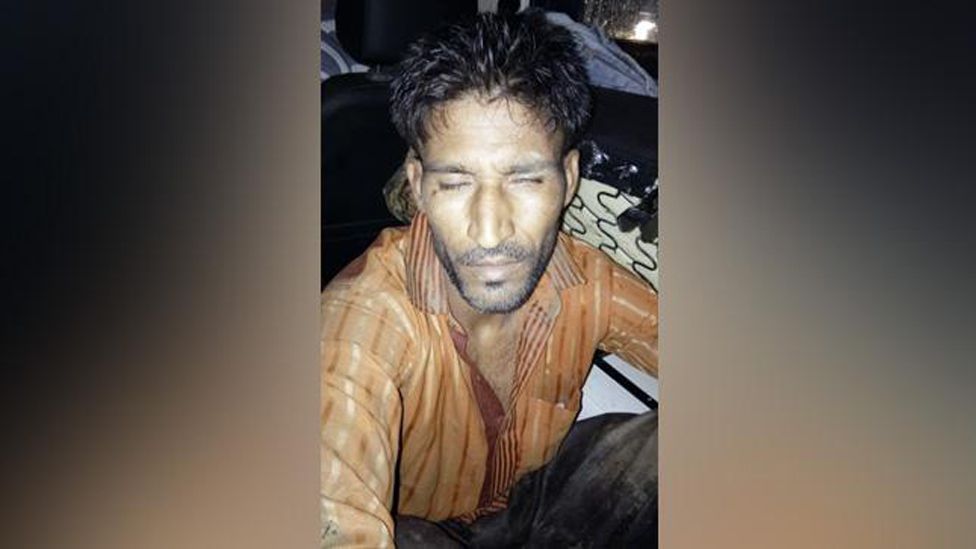
The dead man is later identified by his father as local farmer Rakbar Khan.
This was not a random murder. The story illustrates some of the social tensions bubbling away under the surface in India, and particularly in the north of the country.
And his case raises questions for the authorities – including the governing Hindu nationalist BJP party.
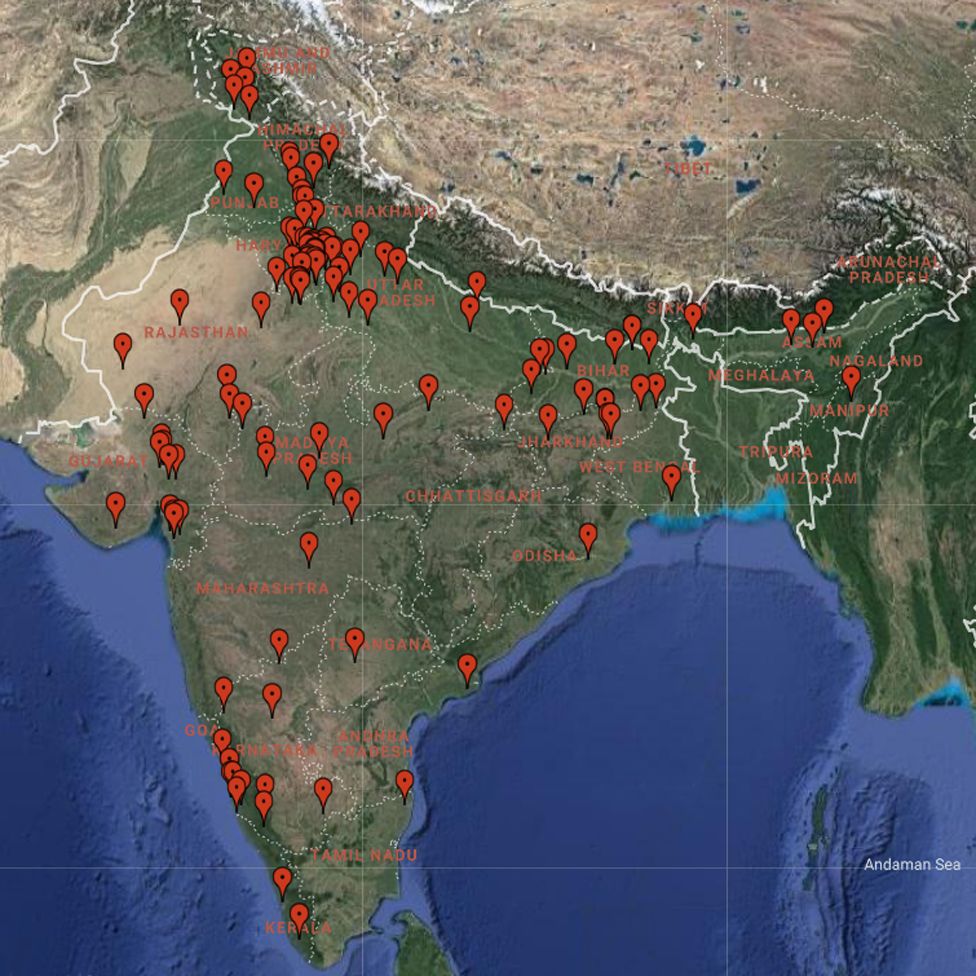
Cow-related violence – 2012-2019
Image copyrightINDIASPENDRakbar Khan was a family man. He had seven children.
He kept cows and he also happened to be a Muslim. That can be a dangerous mix in India.
“We have always reared cows, and we are dependent on their milk for our livelihood,” says Rakbar’s father, Suleiman.
“No-one used to say anything when you transported a cow.”
That has changed. Several men have been killed in recent years while transporting cows in the mainly Muslim region of Mewat, not far from Delhi, where Rakbar lived.
“People are afraid. If we go to get a cow they will kill us. They surround our vehicle. So everyone is too scared to get these animals,” says Suleiman.
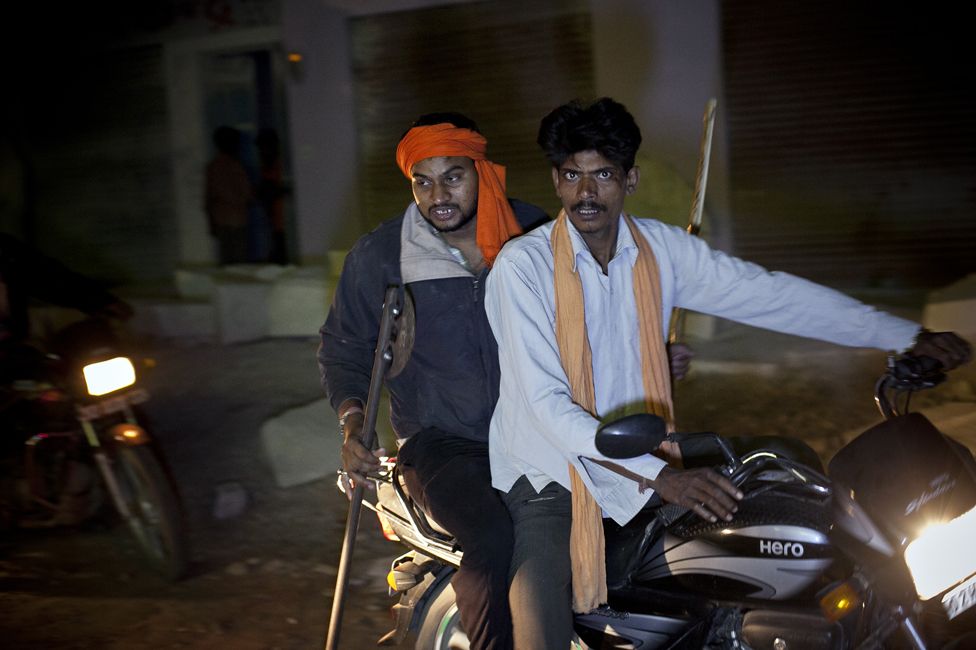
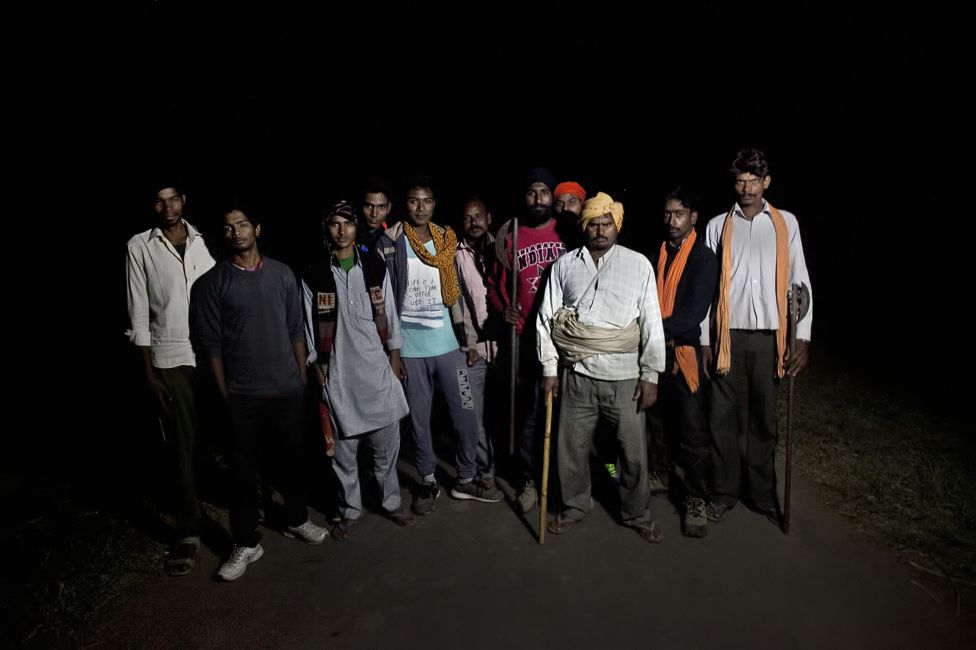
Everyone I speak to in the village where the Khans live is afraid of gau rakshaks – cow protection gangs.
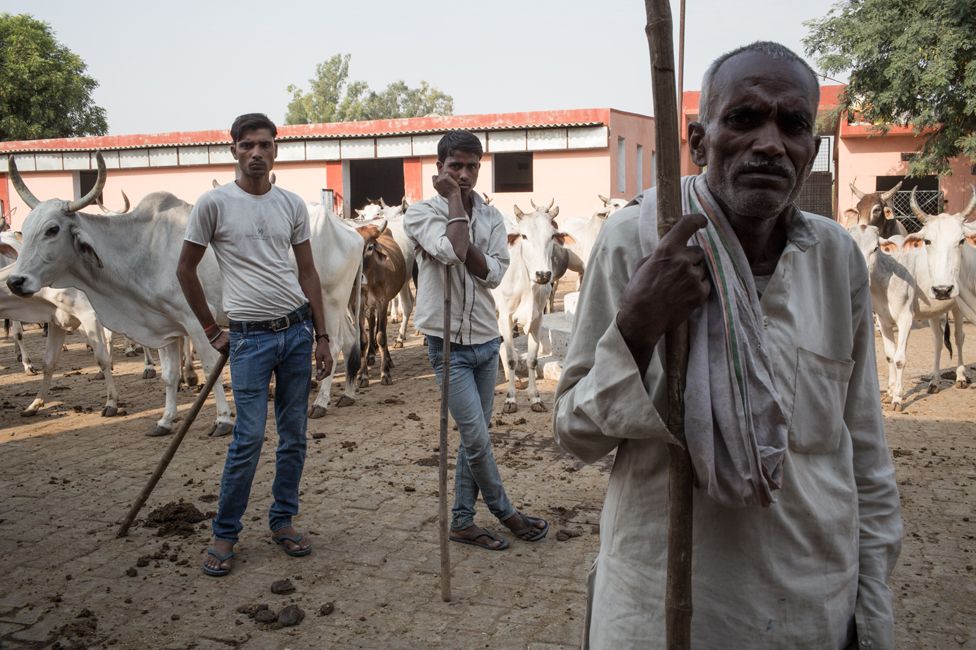
Image copyrightGETTY IMAGES (ALLISON JOYCE)Image captionNawal Kishore Sharma’s cow protection group in 2015The gangs often consist of young, hardline Hindus, who believe passionately in defending India’s holy animal.
They believe that laws to protect cows, such as a ban on slaughtering the animals, are not being fully enforced – and they hunt for “cow smugglers”, who they believe are taking cows to be killed for meat.
Often armed, they have been responsible for dozens of attacks on farmers in India over the last five years, according to data analysis organisation IndiaSpend, which monitors reports of hate crimes in the media.
On 21 July 2018, Rakbar Khan met the local gau rakshak.
There are some things we know for certain about what happened that night.
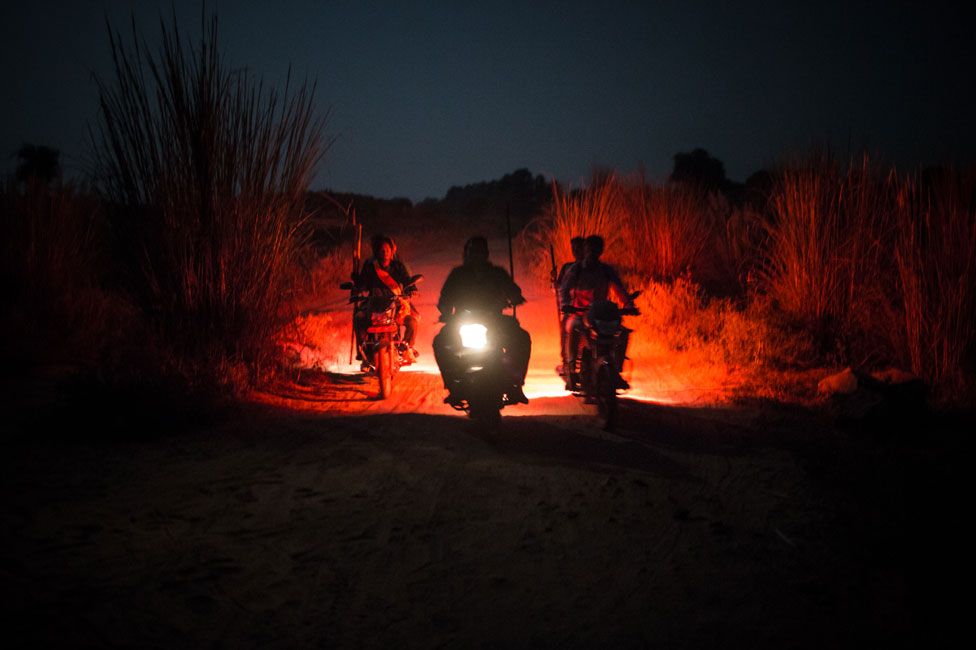
Rakbar was walking down a small road with two cows. It was late and it was raining heavily.
Then, out of the dark, came the lights of motorbikes. We know this, because Rakbar was with a friend, who survived.
Image copyrightGETTY IMAGES (ENRICO FABIAN)At this point the details become a little sketchier. There are three versions of the story.
The gang managed to catch Rakbar, but his friend, Aslam, slipped away. He lay on the ground, in the mud and prayed he wouldn’t be found.
“There was so much fear inside me, my heart was hurting,” he says.
“From there I heard the screams. They were beating him. There wasn’t a single part of his body that wasn’t broken. He was beaten very badly.”
The documentary India’s Cow Vigilantes can be seen on Our World on BBC World Newsand on the BBC News Channel (click for transmission times)
Aslam says that Rakbar was killed then and there.
But there is evidence that suggests otherwise.
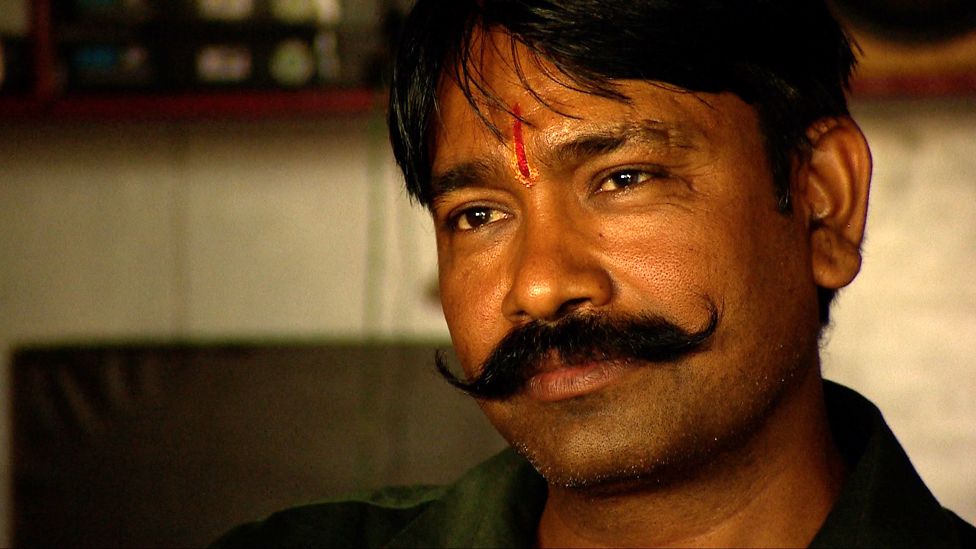
Much of what happened next focuses around the leader of the local cow vigilante group, Nawal Kishore Sharma.
Aslam claims he heard the gang address him by name that night, but when I speak to Sharma, he denies he was there at all.
Image captionNawal Kishore Sharma
“It was about 00:30 in the morning and I was sleeping in my house… Some of my group phoned me to say they’d caught some cow smugglers,” he says.
According to Nawal Kishore Sharma, he then drove with the police to the spot. “He was alive and he was fine,” he says.
But that’s not what the police say.
In their “first incident report” they say that Rakbar was indeed alive when they found him.
“Nawal Kishore Sharma informed the police at about 00:41 that some men were smuggling two cows on foot,” the report says.
“Then the police met Nawal Kishore outside the police station and they all went to the location.
“There was a man who was injured and covered in mud.
“He told the police his name, his father’s name, his age (28) and the village he was from.
“And as he finished these sentences, he almost immediately passed out. Then he was put in the police vehicle and they left for Ramgarh.
“Then the police reached Ramgarh with Rakbar where the available doctor declared him dead.”
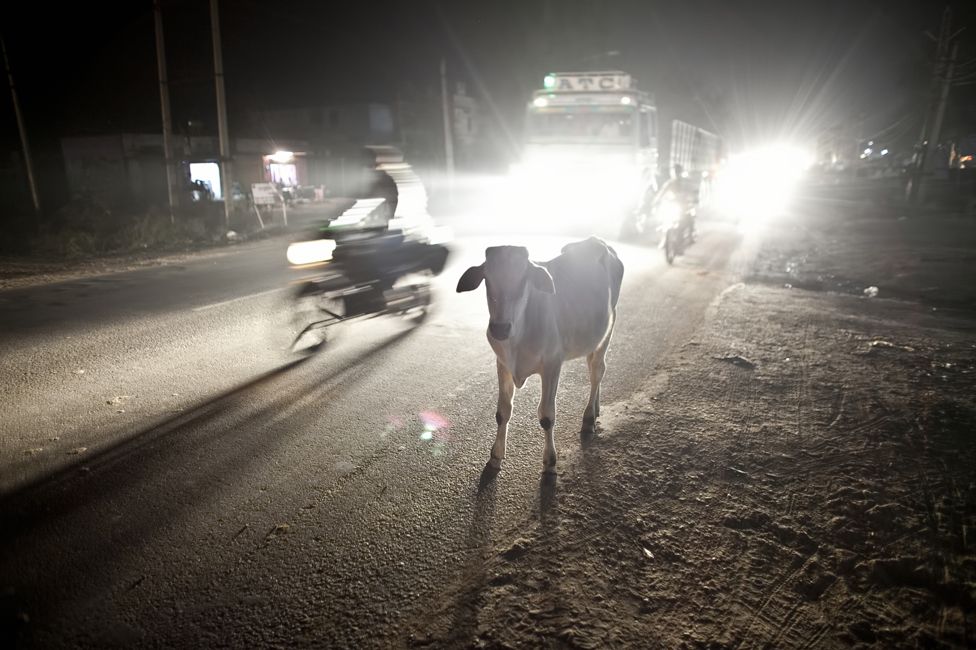
Image copyrightGETTY IMAGES (ALLISON JOYCE)Image captionRamgarh at nightBut this version of events is highly dubious.
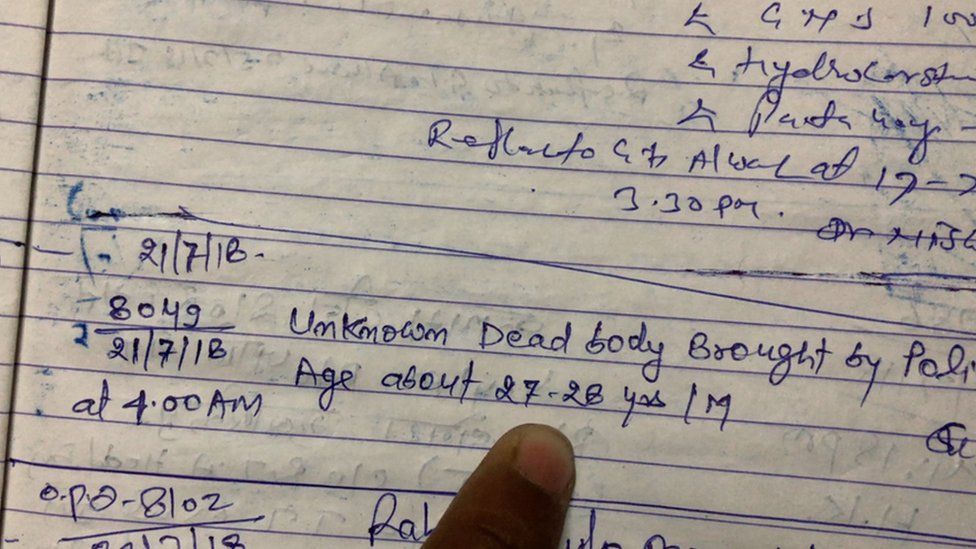
I go to the hospital in Ramgarh, where Rakbar was taken. Hospital staff are busily going through bound books of hospital records – looking for Rakbar’s admission entry.
And then, there it is. “Unknown dead body” brought in at 04:00 on 21 July 2018.
It’s not a long entry, but it contradicts the police’s story, and raises some serious questions.
For a start, Rakbar was found about 12 minutes’ drive away from the hospital. Why did it take more than three hours for them to take him there?
And if the police say Rakbar gave them his name, why did they tell the hospital they didn’t know who he was?
Nawal Kishore Sharma claims to know why. He paints a very different picture of what happened to Rakbar.
He tells me that after picking up Rakbar, they changed his clothes.
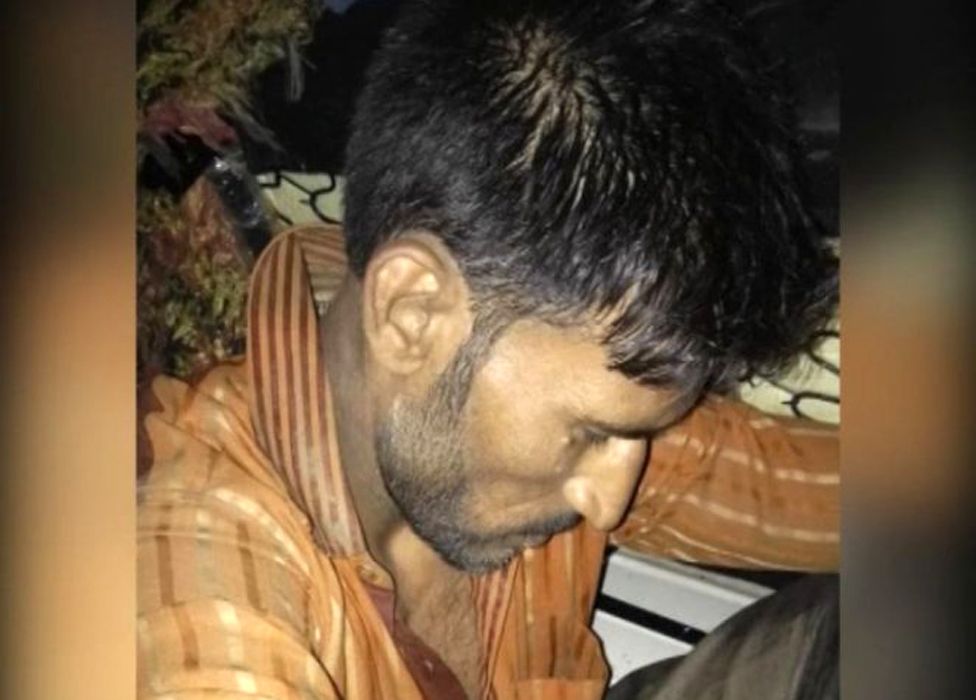
He then claims to have taken two photos of Rakbar – who at this point was with the police.
Sharma says that he went to the police station with the police. He claims that’s when the beating really began.
“The police injured him badly. They even beat him with their shoes,” he says.
“They kicked him powerfully on the left side of his body four times. Then they beat him with sticks. They beat him here (pointing at his ribs) and even on his neck.”
At about 03:00 Nawal Kishore Sharma says he went with some police officers to take the two cows to a local cow shelter. When he returned, he says, the police told him that Rakbar had died.
Rakbar’s death certificate shows that his leg and hand had been broken. He’d been badly beaten and had broken his ribs, which had punctured his lungs.
According to his death certificate he died of “shock… as a result of injuries sustained over body”.
I ask the duty doctor at the hospital whether he remembers what Rakbar’s body was like when the police brought it in.
“It was cold,” he says.
I ask him how long it would take for a body to become cold after death.
“A couple of hours,” he replies.
“I don’t want to talk about Rakbar’s case,” says Rejendra Singh, chief of police of Alwar district, which includes Ramgarh.
Since Rakbar’s murder several police officers have been suspended. I want to know why.
He looks uneasily at me.
“There were lapses on the police side,” he says.
I ask him what those lapses were.
“They had not followed the regular police procedure, which they were supposed to do,” he says. “It was one big lapse.”
Three men from Nawal Kishore Sharma’s vigilante group have been charged with Rakbar’s murder. Sharma himself remains under investigation.
The vigilante group and the police blame each other for Rakbar’s death, but neither denies working together that night.
The way Sharma describes it, the police cannot be everywhere, so the vigilantes help them out. But it’s the police that “take all the action” he says.
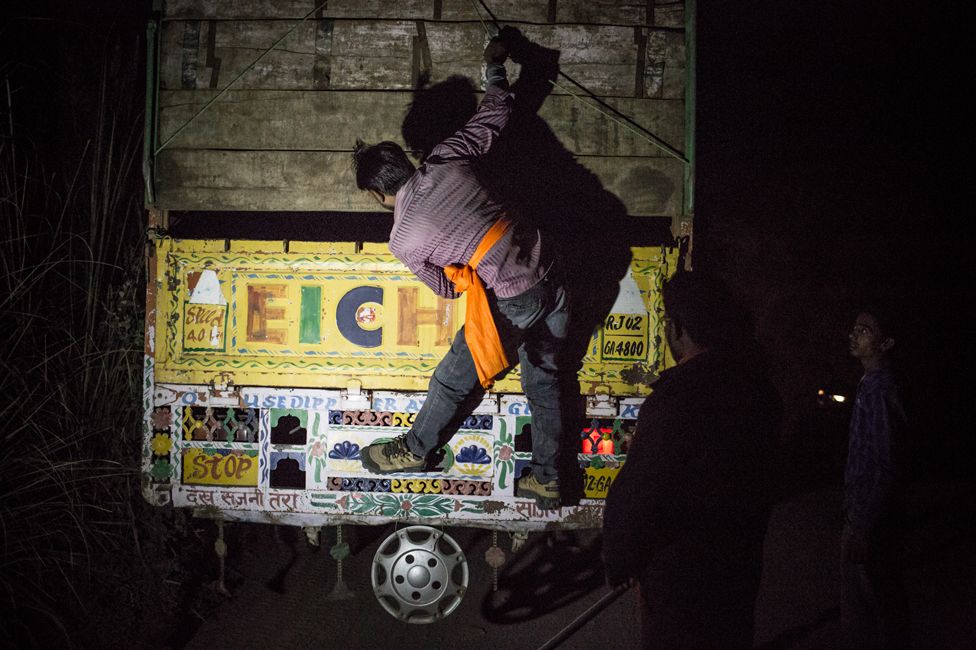
Image copyrightGETTY IMAGES (ENRICO FABIAN)Image captionNawal Kishore Sharma inspects a lorry transporting cows (October 2015)Much police activity in Rajasthan is focused on stopping cow slaughter.
Across the state there are dozens of formal cow checkpoints, where police stop vehicles looking for smugglers who are taking cows to be killed.
I visited one of the checkpoints. Sure enough police were patiently stopping vehicles and looking for cows.
The night before officers had had a gun battle with a group of men after a truck failed to stop.
These checkpoints have become common in some parts of India. Sometimes they are run by the police, sometimes by the vigilantes, and sometimes by both.
This gets to the heart of Rakbar’s case.
Human rights groups argue that his murder – and others like his – show that in some areas the police have got too close to the gangs.
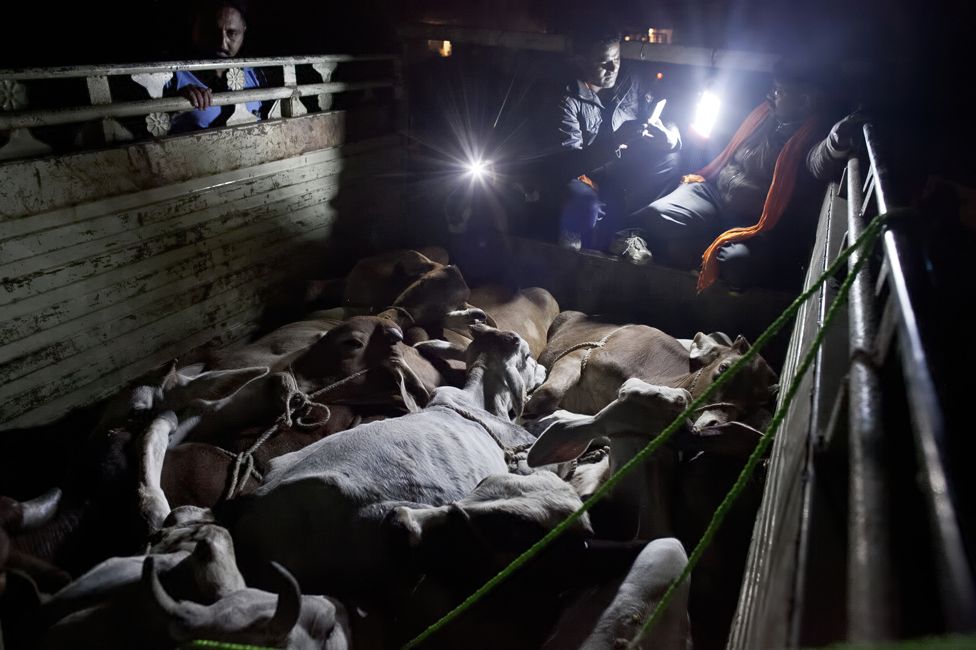
Image copyrightGETTY IMAGES (ALLISON JOYCE)Image captionThe vigilantes find what they are looking for (November 2015)“Unfortunately what we’re finding too often is that the police are complicit,” says Meenakshi Ganguly of Human Rights Watch, which published a 104-page report on cow-related violence in India this week.
In some areas, police have been reluctant to arrest the perpetrators of violence – and much faster to prosecute people accused of either consuming or trading in beef, he says.
Human Rights Watch has looked into 12 cases where it claims police have been complicit in the death of a suspected cow smuggler or have covered it up. Rakbar’s is one of them.
But this case doesn’t just illustrate police failings. Some would argue that it also illustrates how parts of the governing BJP party have inflamed the problem.
Gyandev Ahuja is a larger-than-life character. As the local member of parliament in Ramgarh at the time when Rakbar was killed he’s an important local figure.
He has also made a series of controversial statements about “cow smugglers”.
After a man was badly beaten in December 2017 Ahuja told local media: “To be straightforward, I will say that if anyone is indulging in cow smuggling, then this is how you will die.”
After Rakbar’s death he said that cow smuggling was worse than terrorism.
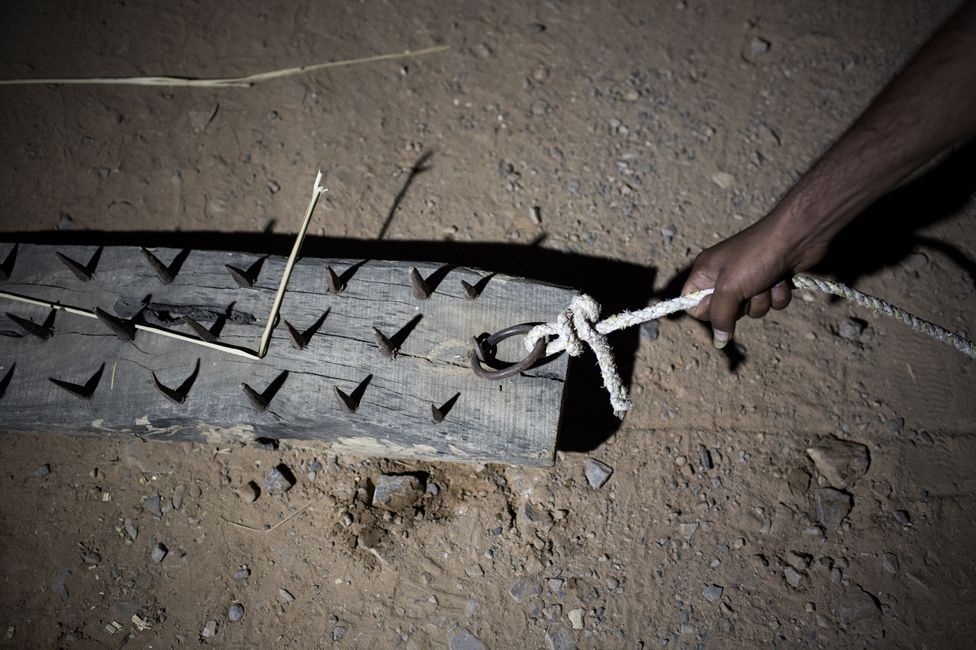
Image copyrightGETTY IMAGES (ENRICO FABIAN)Image captionNails used by the vigilantes to force lorries to stopGyandev Ahuja is just one of several BJP politicians who have made statements that are supportive of the accused in so-called “cow lynchings”.
One of Prime Minister Narendra Modi’s ministers was even photographed garlanding the accused murderers in a cow vigilante case. He has since apologised.
Meenakshi Ganguly of Human Rights Watch says it is “terrifying” that elected officials have defended attackers.
“It is really, at this point of time, something that is a great concern, because it is changing a belief into a political narrative, and a violent one,” he says.
The worry is that supportive messages from some of the governing party’s politicians have emboldened the vigilantes.
No official figures are kept on cow violence, but the data collected by IndiaSpend suggests that it started ramping up in 2015, the year after Narendra Modi was elected.
IndiaSpend says that since then there have been 250 injuries and 46 deaths related to cow violence. This is likely to be an underestimate because farmers who have been beaten may be afraid to go to the police – and when a body is found it may not be clear what spurred the attack. The vast majority of the victims are Muslims.
Image copyrightGETTY IMAGES (ENRICO FABIAN)Image captionA cow shelter in RamgarhA BJP spokesman, Nalin Kohli, emphatically rejects any connection between his party and cow violence.
“To say the BJP is responsible is perverse, inaccurate and absolutely false,” he tells me.
“Many people have an interest in building a statement that the BJP is behind it. We won’t tolerate it.”
I ask him about Gyandev Ahuja’s inflammatory statements.
“Firstly that is not the party’s point of view and we have very clearly and unequivocally always said an individual’s point of view is theirs, the point of view of the party is articulated by the party.
“Has the BJP promoted him or protected him? No.”
But a month after this interview, Ahuja was made vice-president of the party in Rajasthan.
Shortly afterwards, Prime Minister Narendra Modi visited Rajasthan – publicly slapping Ahuja on the back and waving together at crowds of BJP supporters.
In Mewat I speak to Rakbar’s wife, Asmina.
“Show me how you raise seven children without a husband. How will I be able to raise them?” she says, wiping away tears.
“My youngest daughter says that my father went to God. If you ask her, ‘How did he go to God?’ she says, ‘My father was bringing a cow and people killed him.’
“The life of an animal is so important but that of a human is not.”
The trial of the three men accused of his murder has yet to take place, but perhaps we will never know what really happened to Rakbar.
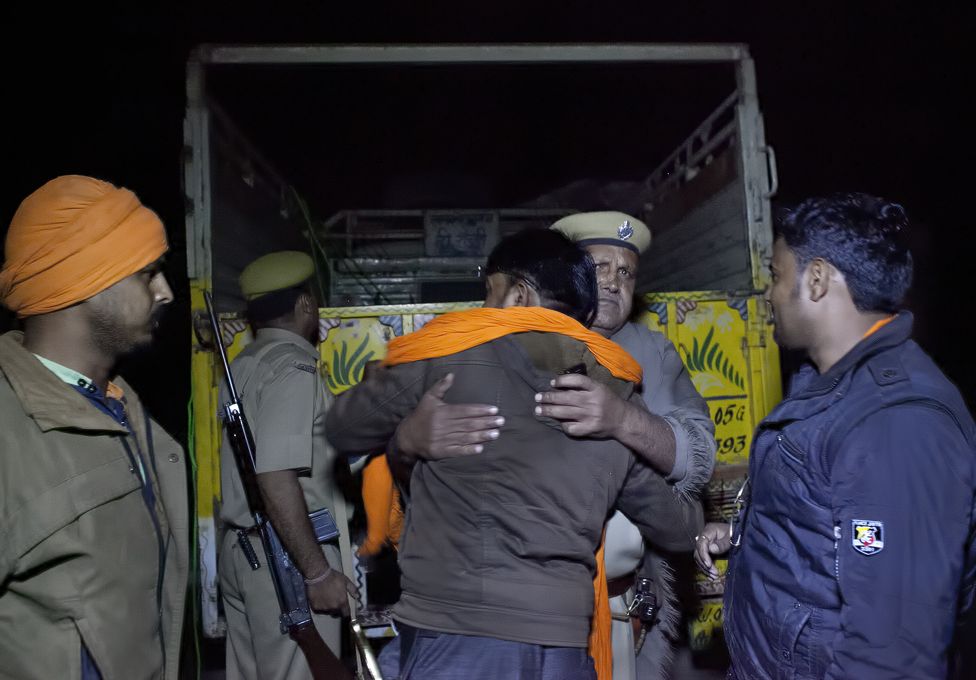
In November 2015, photographer Allison Joyce spent a night following Nawal Kishore Sharma’s vigilantes in the countryside near Ramgarh. One of her photographs shows a police officer embracing Sharma after a shootout between the vigilantes and a suspected cow smuggler.
Though the police now accuse the cow vigilantes of killing Rakbar Khan, and the vigilantes accuse the police, the photograph illustrates just how closely they worked together.
Image copyrightGETTY IMAGES (ALLISON JOYCE)In the Indian media there have been claims that the police took the two cows that Rakbar had been transporting to a cow shelter, as Rakbar lay dead or dying in a police vehicle.
There are also claims that the police stopped and drank tea instead of taking Rakbar to hospital.
Whatever they did, they did not take Rakbar to hospital immediately.
Policy statement outlines broad goals including plan to revive domestic soybean production
A farmer picks tea leaves in Mianxian county, Shaanxi province. Beijing’s policy document reiterated a strategy to improve income levels and living standards in China’s countryside. Photo: Xinhua
China will deepen reforms of its agriculture sector to promote its rural economy, the government said in its first policy statement of 2019, as it seeks to bolster growth and offset trade challenges.
Beijing’s statement, released late on Tuesday, comes after the world’s second-largest economy saw its weakest growth in 28 years in 2018 and remains entangled in a trade war with Washington.
“Under the complicated situation of increasing downward pressure on the economy and profound changes in the external environment, it is of special importance to do a good job in agriculture and rural areas,” the government said in the document issued by the State Council and published by official news agency Xinhua.
The biggest winners in Shenzhen, ‘China’s Silicon Valley’? Pig and chicken farmers
Known as the “No 1 document”, this year’s policy reiterated a rural rejuvenation strategy first laid out in 2017 to improve income levels and living standards in China’s countryside.
It also highlighted a plan to boost domestic soybean production but did not offer further details.
Chinese President Xi Jinping visits a farm in northeastern Heilongjiang province during an inspection tour in September. Photo: Xinhua via AP
Industry analysts said on Wednesday they were eagerly awaiting further details to assess the impact of the plan, which had already been flagged by Agriculture Minister Han Changfu earlier this month.
China has been overhauling its crop structure in recent years, reducing support for corn after stocks ballooned, and seeking to promote more planting of oilseeds that it mostly imports.
That goal has become increasingly important since a trade war with the United States, which led China to slap tariffs on soybean imports, tightening domestic supplies.
Han has previously urged authorities in China’s northeast to support soybean production through subsidies and called for rotating of soybeans with other crops including corn and wheat.
Beijing also aims to support the production of rapeseed in the Yangtze River Basin, according to the document.
The garlic case that foreshadowed the US-China trade war
As in previous years, it also called for stable grain production, but also an increase in imports of agriculture products where there are shortages in the domestic market.
“The focus now is on retaining production capacity, in the form of high quality farmland, and using the international market to make up production shortfalls,” said Even Rogers Pay, an agriculture analyst at China Policy, a Beijing-based consultancy.
The reference to imports is positive for trade partners like the United States, said Cherry Zhang, analyst with Shanghai JC Intelligence, who said it raised the likelihood that China will buy more US agriculture products.
China’s DJI turns its eye to enterprise uses like agriculture after conquering global commercial drone market
Shares of Chinese livestock companies, along with pig and poultry breeders, rose on Wednesday following the release of the policy paper.
The document also outlines plans to accelerate development of a new farm subsidy policy system and further crack down on the smuggling of agriculture products.
Additionally, the government said it plans to strengthen the monitoring and control of African swine fever outbreaks, after more than 100 cases were reported in China since August.
Other plans include continuing to tackle rural pollution and promoting recycling of agricultural waste such as manure and agricultural film.
BEIJING, Feb. 7 (Xinhua) — Wang Xin, 33, is a landscape designer by profession and farmer in practice. The strawberries coming from his organic plantation in the southern outskirts of Beijing are believed by his clients to be “the best of China.”
Every day in Beijing, when men and women of his age are sucked in heavy traffic and endless meetings, Wang lives a life in the countryside, far from the maddening crowd.
He rises with the sun, works all day in the field or goes to farmers’ market to sell fresh produce. At the end of the day, he goes to bed with sore muscles and falls into a deep sleep.
He does not take the time to consider whether it is hard work, preferring to get on with the job. “It has become a lifestyle. This is the life I chose to live.”
In a country where food is so central to the culture, many well-educated city dwellers like Wang have returned to the countryside to dedicate themselves to fresher, healthier food.
RESEARCH FARMERS
Every Tuesday, Saturday and Sunday, Wang brings freshly-picked strawberries to the organic farmers’ market in Beijing. The fruits are grown naturally in nutrient-rich soil, without use of fertilizers, pesticides, growth hormones or chemicals.
“I don’t plan to be filthy rich, or I wouldn’t have gone for organic farming,” Wang said. With his firm athletic build and healthy tan, it is hard to imagine him the designer who used to spend days and nights in front of a computer screen.
Majoring in landscape botany, Wang has always been a plant lover. When he was 25, he realized his sedentary life made him put on weight, and he could no longer stand being an office drone. He quit his job, rented two plantation sheds in the suburbs and started his career from scratch.
On Tuesday, Wang presented this winter’s first batch of fruit he planted in September. But work had begun in July, when he prepared all-natural organic matter to enrich the soil.
The formula has been perfected through years of research in collaboration with Beijing University of Agriculture, to simulate the formation of the fertile dark forest soil in Northeast China, known for its high crop productivity.
Logically, the true foundation of organic farming lies in soil content: if the soil is right – as a living organism with a complex organic structure – the outcome is safe and tasty food farmed without the need for fertilizing chemicals, according to Wang.
But quality produce is not the only objective. Wang hopes to build a production model that rehabilitates the soil itself – in regular plantations, the soil can degrade within a matter of years after being over-exploited.
Wang’s work on the farm has not always been a smooth ride. But after a rough start he believes he has learned valuable lessons. He has gone back to the university and visited his colleagues in Tochigi Prefecture, Japan, to study the most modern organic farming techniques.
“For the organic farming to become truly sustainable, to revitalize the soil is key. I am certain that in three to four years, the soil that I have been reviving will keep getting healthier and healthier,” he said.
Wang is not alone.
In Araxan, a semi-arid region located in northwest China’s Inner Mongolia Autonomous Region, Ma Yanwei has spent years reinvigorating saline soil by applying water-saving methods to cultivate fruit and crops suitable for local conditions.
Sweet melon is the best-selling produce on Ma’s farm. The sweetness of the melons comes from many years of study, experiment and hard work in the desert. Ma aims to find an ideal organic farming methodology to maximize the utilization of scarce water resources and mend the soil. “As long as the soil improves, it is natural to harvest healthy produce,” Ma said.
In the last six years, he has seen more and more young people returning to the countryside to take on farming. In 2017 Ma set up a network for these new farmers to communicate, exchange experience and help each other. “So we could avoid longer detours and mistakes previously made by others,” he said.
AN IDYLLIC FARM REBUILT
For 18 years, Zhang Zhimin, a former foreign trade expert, has been building an idyllic farm in the far southwestern end of Beijing to produce food and preserve biodiversity.
Zhang speaks several languages, so was designated to work in food imports and exports when China opened its market to the world outside. She believes that “agriculture is the art of man and nature working together.”
On her bio-farm, the nature rules over man. Instead of eliminating weeds and pests, the wholesome biosphere works on its own to render seasonal harvests.
“Agriculture is the management of life, and life should be nourished by life itself,” she said. On her farm Heaven’s Blessings, trees, bushes, grass, insects, birds and cattle coexist in harmony. It is more like a habitat than a farm. In early summer she chops tender leaves and branches of weed under peach trees to feed the cattle and make room for the gramineous crops to thrive. In early autumn, she let cows roam free to finish the weeding.
In Wang’s vegetable shed, the natural ecosystem works for the harvest to be healthy while no intervention from the outside is necessary.
“I have observed that the grass that coexists with the crops functions as a regulating factor of the microclimate by keeping the soil humid,” Wang said.
Also, a native breed of spiders that leaves webs among the vegetables, feeds on the whiteflies that are usually hard to detect due to their miniscule size, preventing the need for harmful insecticides.
Wang has also gone back to ancient Chinese agricultural traditions to find inspiration to better coordinate human actions with nature, after learning the latest farming models in Japan, Germany and Israel.
At a “Farmers’ Assembly” held in China Agricultural University (CAU) last month, Professor Meng Fanqiao with CAU’s College of Resources and Environmental Sciences said organic/ecological farming is an important measure to improve the quality and safety of agricultural products.
“Organic/ecological farming is of vital significance for economic development as well as environmental protection in rural areas, for which it should play an imperative role in China’s rural revitalization and the building of an ‘ecological civilization,'” Meng said.
“The green development of the countryside is a strategy that goes hand-in-hand with the food supply security and the income level improvement,” said Jin Shuqin with the Ministry of Agriculture’s Research Center for Rural Economy. “To revivify ecology constitutes a crucial aspect of overall rural revitalization.”
“It is our hope to promote healthy eating to become a mainstream choice, as well as the organic way to produce healthy foods,” said Ma Xiaochao, project officer with Know Your Food, a self-publishing community focused on food sustainability.
KAKRIPUR/MAHABAN, India (Reuters) – As night fell on the bucolic northern Indian hamlet of Mahaban, Gopi Chand Yadav gathered blankets and a flashlight to spend the night sitting on a wooden platform in his field. His task: to use bamboo sticks to ward off stray cattle from intruding and eating a maturing mustard crop.
Like Yadav, many thousands of farmers stay awake to guard their farms over a cold winter or face losing their crops to the cattle – a double whammy for growers already reeling from a plunge in Indian crop prices.
While stray cows ambling around towns and villages have always been a feature of life in rural India, farmers say their number has increased sharply in recent years to the extent that they have become a menace, and blame the policies of Prime Minister Narendra Modi’s Hindu nationalist government.
Protecting cows – considered sacred to Hindus – was one of the measures meant to shore up support in the heavily populated, Hindi-speaking belt across northern India that has been a heartland of the ruling Bharatiya Janata Party’s (BJP). Instead, it is creating a backlash, even among Hindu farmers.
“We already had enough problems and now the government has created one more,” said octogenarian farmer Baburao Saini from Kakripur village, about 85 kilometres (50 miles) from New Delhi. “For the first time, we’ve been forced to stay in the fields to protect our crops.”
More than 50 farmers Reuters spoke to in Mahaban and nine other villages in Uttar Pradesh state said they would think twice before voting for Modi’s BJP in the next general election, due by May. The cattle issue and low farm prices are major reasons behind their disillusionment with a party that most say they voted for in the last election in 2014.
Modi swept Uttar Pradesh at that poll, winning 73 of 80 seats in India’s most populous state, with rural voters swayed by a promise of higher crop prices, and as Hindu farmers supported the BJP amid tensions with the minority Muslim community.
COW PROTECTION
Modi is trying hard to claw back support among India’s 263 million farmers and their many millions of dependents after the BJP lost power in December to the opposition Congress in three big northern states where agriculture is a mainstay.
Indian farmers keep cows to produce milk, cheese and butter, but to harm or kill a cow, especially for food, is considered taboo by most Hindus.
Most states in India have long outlawed cow slaughter, but after coming to power in 2014 the BJP ratcheted up its distaste for trade in cattle, launching a crackdown on unlicensed abattoirs in Uttar Pradesh and on cattle smuggling nationwide.
At the same time, a wave of attacks on trucks carrying cattle by Hindu vigilante groups has scared away traders, most of whom are Muslims, bringing to a halt the trade even in bullocks, which are not considered sacred. Rising sales of tractors and increasing mechanisation mean that more animals are redundant for use in farming.
The farmers Reuters spoke to said they revered cows as most devout Hindus would, but a sudden halt in the trade of cattle had hit the rural economy. In their view, the government should come up with more cow shelters and let cattle traders deal in other animals without fear of attack.
“The government has only enforced the laws by closing down unlicensed abattoirs and cracking down on cattle smuggling,” said BJP spokesman Gopal Krishna Agarwal, who added that he runs a cow shelter of 1,300 cattle. “We’re not trying to hurt either any community or the rural economy.”
CROP TRAMPLED
Fodder prices have gone up by more than a third in the past year and most farmers cannot afford to keep cows after they stop producing milk, said farmer Rajesh Pahalwan as he smoked a hookah pipe in the village of Manoharpur. Six farmers sitting with him mainly nodded in agreement.
In India, the world’s biggest milk producer, about 3 million cattle become unproductive every year. In the past, Hindu farmers would sell unproductive cows to Muslim traders and about 2 million of these would end up smuggled to Bangladesh for meat and leather. But that trade has now been throttled by the government crackdown, trade and industry officials say.
That has led to many unproductive cattle being abandoned, farmers said, but governments – both state and federal – have failed to construct new shelters, leaving rising numbers of stray cattle that are feeding on crops, or even garbage.
“The government clearly did not think of alternatives before putting these curbs in place,” said farmer Deepak Chaudhary, who grows wheat on the outskirts of Mathura, considered to be the birthplace of the Hindu God Krishna. “As Hindus, we treat cows as sacred but these unwarranted measures have upended the economics of farming.”
Vietnamese-style reforms might work for North Korea
The government did provide some relief in its interim budget last week as it announced a cow welfare programme costing 7.50 billion rupees (80.79 million pounds) in the year beginning April.
But there are hardly any “adequate measures to rehabilitate” cattle, said Fauzan Alvi, vice-president of the All India Meat and Livestock Exporters Association.
“Forget about cows, we cannot sell even a single animal to even our relatives thanks to cow vigilante groups which are aided and abetted by the BJP,” said the wheat farmer Chaudhary.
Modi has in the past condemned violence by cow vigilantes, but critics and opposition politicians say some of the right-wing Hindu groups involved have links to his party, a charge the BJP denies.
Nearly 85 percent of India’s farmers own less than 2 hectares (5 acres) of land, so even a relatively small area damaged has a big impact on their livelihood.
Only two weeks ago, some cattle ravaged an acre of wheat grown by farmer Chandra Pal in the Mathura district of Uttar Pradesh.
“My investment went down the drain after some stray cattle trampled and ate up the crop,” he said.
Many farmers in Uttar Pradesh are now using barbed wire to stop animals from entering their farms, but that is expensive.
“We have been at the receiving end of anti-farmer policies of the government and the problem of stray cattle is just another blow to us,” said farmer Amar Chand, from Maholi village who voted for Modi in 2014. “Unlike the previous general election, farmers are not solidly behind Modi, who’s on shaky ground this time round.”
West Bengal Chief Minister Mamata Banerjee continued her dharna against the Central Bureau of Investigation (CBI) move against the Kolkata police commissioner Rajeev Kumar in connection with ponzi scam cases.
SNS Web | New Delhi | February 4, 2019 1:31 pm
West Bengal Chief Minister Mamata Banerjee during a sit-in (dharna) protest over the CBI’s attempt to question Kolkata Police Commissioner Rajeev Kumar in connection with a ponzi scheme scam, near the Metro Channel in Kolkata on Feb 4, 2019. (Photo: Kuntal Chakrabarty/IANS)
West Bengal Chief Minister Mamata Banerjee continued her dharna against the Central Bureau of Investigation (CBI) move against the Kolkata police commissioner Rajeev Kumar in connection with ponzi scam cases.
Accusing Prime Minister Narendra Modi and BJP chief Amit Shah of unleashing a state of “emergency” in the country, Banerjee, the chief of Trinamool Congress (TMC), said on Monday that her protest is a Satyagraha and she will continue till the country is saved.
Banerjee has been on a sit-in at a makeshift dais at Dharamtala area near Metro Channel of the city since 9 pm on Saturday.
“The nation can see but they can’t speak out of fear,” she said, further accusing the Centre of playing vendetta politics.
“The Modi govt has taken away the democratic rights of the people,” Banerjee said, adding, “Centre is targeting opposition.”
Banerjee, who was scheduled meet farmers today at the Netaji Indoor Stadium, addressed them from the protest site over Facebook Live.
“The Modi government has sucked the blood of the farmers. Around 12,000 farmers have committed suicide,” she alleged.
Banerjee said that her government works for farmers’ welfare.
Commenting on crop insurance schemes for the farmers, Banerjee claimed that the state government has done more than the Modi government in this regard.
“Modi says he has sent money. He hasn’t. Eighty per cent of the money contributed into the scheme is of the state government. We pay the share of both the state government and that of the farmers. We have given Rs 600 crores. We have given Kisan credit card to 70 lakh farmers,” Banerjee said.
Further hitting at the Modi government, Banerjee said that the Modi government, after 5 years, says that farmer income will double by 2022.
“I say with pride, we have tripled the income already. The West Bengal govt is way ahead,” she told the gathering and the farmers.
“Those who try to insult Bengal should know that we consider work as dharma and karma. Doing lip-service is not enough. I will appeal to the farmer brothers and sisters to not allow anyone to exploit your weaknesses for political gains,” she said.
Opposition support
Banerjee’s sit-in, now dubbed ‘Save The Constitution’, received wide support from anti-BJP parties except a few from across the country.
Samajwadi Party (SP) chief Akhilesh Yadav said that Banerjee is right when she says that the BJP is using CBI to target political opponents.
“Besides West Bengal, such things have been heard from other states too. BJP and Centre have started misusing CBI as elections are approaching. Not only I, not only Samajwadi Party, but all political parties are saying this,” he said on Monday.
“There was CBI row, centre was scared of a CBI director, now they are trying to scare everyone using CBI. Who has misused? The institutions. If someone has politicised the institutions, it is BJP,” Yadav said.
The former Uttar Pradesh Chief Minister recently formed an alliance with the Bahujan Samaj Party (BSP) to take on the BJP in the upcoming Lok Sabha elections. He was also among the leaders present at the mega anti-BJP rally organised by Mamata Banerjee in Kolkata on 19 January.
Extending support of the National Conference (NC), Farooq Abdullah said, “Her (Mamata Banerjee) allegation is right. This country is in danger as its becoming dictatorial. They (Central govt) are not masters of this country, people are.”
Delhi Chief Minister Arvind Kejriwal, Andhra Pradesh Chief Minister N. Chandrababu Naidu, National Conference leader Omar Abdullah RJD leader Tejashwi Yadav and DMK leader M K Stalin were among leaders who expressed their solidarity with Banerjee in tweets.
Kejriwal called Modi-Shah duo’s action is against democracy.
“Spoke to Mamta didi and expressed solidarity. Modi-Shah duo’s action is completely bizarre and anti-democracy,” Kejriwal said.
Yadav, who also spoke to Banerjee, extended RJD’s support, “BJP has not only venomous and nefarious agenda against opposition leaders but Indian Administrative Service and Police Officers. Might visit Kolkata tomorrow,” he said on Sunday night.
Stalin said he stood with Banerjee in her fight to protect the federal structure of this country and to save democracy. “The independence of every institution has been compromised under this fascist BJP Government.”
Congress president Rahul Gandhi too threw his weight behind Banerjee.
Sitaram Yechury, CPI(M) general secretary, said that corruption cases against TMC government in chit fund scam have been public for years but the Modi government chose to stay quiet as the top mastermind of the scam joined BJP.
“It does a drama to act now, after 5 years, and TMC leadership responds by staging a drama to protect its corrupt. This drama in Kolkata by BJP and TMC is not a fight for any principle but only to save their corrupt and hide their corruption. CPI(M) has fought both these undemocratic, corrupt, communal and dictatorial regimes in the Centre and the state and will continue to do so,” he said.
CBI vs Kolkata Police: How it began
The showdown began when CBI officials reached official residence of the police commissioner in the evening to question him in connection with the ponzi scam cases. Reports indicate that the probe agency sleuths were spotted in the vicinity in the afternoon, alerting the police who reached the Commissioner’s residence immediately.
Kolkata Police officials inquired if the 40-odd CBI officers had the documents required to question the CP.
After preventing the CBI officials from entering the residence of Commissioner Kumar, the police whisked away some of the sleuths to the Shakespeare Sarani police station for further discussions.
More CBI men arrived at the Loudon Street home of Rajeev Kumar and a commotion ensued. Some CBI men were then bundled into police jeeps and taken to the police station.
It was after this incident that Mamata Banerjee began a sit-in in front of the Metro Cinema to protest “insults” faced at the hands of Prime Minister Narendra Modi and BJP chief Amit Shah. She accused both the BJP leaders of organising a “coup” on West Bengal.
The CBI on Monday moved the Supreme Court seeking directions to Kolkata Police Commissioner Rajeev Kumar to cooperate with the investigation.
Representing CBI, Solicitor General Tushar Mehta sought directions to Kumar to cooperate with the investigation and surrender all the evidence related to the chit fund case, stating that the top cop was a “potential accused”.
The CBI has claimed that Kumar has been instrumental in causing destruction of evidence and obstructing justice.
Meanwhile, on Monday, Home Minister Rajnath Singh told the Lok Sabha that the CBI action was initiated after the Supreme Court ordered an investigation into Saradha chit fund case.
“The Police Commissioner was summoned many times but he did not appear. West Bengal Governor Keshari Nath Tripathi has summoned Chief Secretary and Director General of Police and has asked them to take immediate action to resolve the situation,” Singh told the House.
Banerjee is expected to hold a scheduled cabinet meeting at the protest venue itself. The events were expected to cast a shadow on the Budget Session of Parliament on Monday with the opposition expected to vociferously raise the issue.
2019 Budget Summary: Finance minister Piyush Goyal announced relief in income tax and proposed a Rs 75,000-crore fund for assured income of around 12 crore farmers.
Finance Minister Piyush Goyal during his budget speech in the Lok Sabha on Friday.(Photo: Twitter/@ANI)
Finance Minister Piyush Goyal rolled out the government’s last budget ahead of this year’s national elections, announcing no tax on income up to Rs 5 lakh, a Rs 75,000 crore assured income scheme for small farmers and a mega pension scheme for workers in the unorganised sector. The initiatives are designed to woo the middle class, address farm distress and boost private investment in an effort to shore up the political base of ruling BJP-led national coalition that has been accused by the opposition of not delivering on its promises to the poor.
“India is solidly back on track and marching towards growth and prosperity,” Piyush Goyal said early in his budget speech, asserting that the government had succeeded in “we have broken the back of back-breaking inflation”.
He said the Narendra Modi government’s success in controlling inflation had put more money in the hands of people. “Inflation is a hidden and unfair tax, from 10.1 per cent during 2009-14,” he said.
Goyal announced exemption from tax on income of up to Rs 5 lakh per annum, which goes up to Rs 6.5 lakh if the individual tax payers invest Rs 1.5 lakh in provident fund and prescribed equities. He also proposed to increase the standard deduction from the existing Rs 40,000 to Rs 50,000. The proposal will benefit 3 crore middle class tax payers.
The TDS (tax deduction at source) threshold on interest from bank, post office deposits has been raised from Rs 10,000 to Rs 40,000. The finance minister further proposed to increase the TDS threshold on rental income from Rs 1.8 lakh to Rs 2.4 lakh.
The BJP-led ruling National Democratic Alliance (NDA) is facing discontent over depressed farm incomes and doubts over whether his policies are creating enough jobs. The interim budget allocates Rs 600 billion for a rural jobs programme and Rs 190 billion for building of roads in the rural areas.
Goyal said Rs 6,000 per year assured income support will be given to small and marginal farmers having less than two hectares of land. He announced a new fund, ‘Pradhan Mantri Kisan Samman Nidhi’ for disbursement of cash to “vulnerable farmers”.
Around 12 crore farmers will receive Rs 6,000 per annum under the PM Kisan scheme. The money will be transferred into bank accounts of farmers in three equal instalments. The finance minister said Rs 20,000 crore have been provided for current fiscal, 2018-19 under PM Kisan scheme.
The government proposed to set up a national commission, the Rashtriya Kamdhenu Aayog with the initial capital of Rs 500 crore for the welfare of cows. “Happy to announce setting up of Rashtriya Kamdhenu Aayog. Government will never step back from protection of the Gau Mata,” said Goyal.
The government unveiled a mega pension scheme for the unorganised sector workers with an aim to benefit 10 crore people. Goyal said the beneficiaries will get assured monthly pension of Rs 3,000 after reaching the age of 60 years.
“We are launching Pradhan Mantri Shram Yogi Mandhan today. The scheme will provide assured monthly pension of Rs 3,000, with contribution of 100 rupees per month, for workers in unorganised sector after 60 years of age,” Goyal said.
The fiscal deficit would be 3.4 per cent of gross domestic product (GDP), slightly higher than the targeted 3.3 percent, said Goyal, who presented the budget as Union minister Arun Jaitley is undergoing medical treatment in the United States.
Goyal told the Lok Sabha that direct tax collections increased from Rs 6.38 lakh crore in year 2013-14 to almost Rs 12 lakh crore this year with a growth of 80 per cent in tax base. The number of income tax returns filed increased from 3.79 crore to 6.85 crore over the same period, he said.
On job creation, the finance minister said, “EPFO shows two crore accounts in two years. This shows formalisation of the economy. When there is such a high growth, jobs are created.” The government is facing sharp criticism from the opposition over a ‘leaked report’ claiming that unemployment rate is at a 45-year high.
The interim budget is likely to be followed by a full one in July after the Lok Sabha elections. The interim budget projected the economic growth for the fiscal year 2019-20 to be around 7.5 per cent.
Reminding the UP CM, Akhilesh said the farmers need to be saved first. (Photo by Subhankar Chakraborty/ Hindustan Times)(HT Photo)
Samajwadi Party president Akhilesh Yadav on Sunday criticised Uttar Pradesh chief minister Yogi Adityanath for his remarks that if the Supreme Court is unable to give a verdict on the Ram Temple issue, it should “hand it over to us” and it will be resolved within 24 hours.
Reminding the UP CM, Akhilesh said the farmers need to be saved first.
“I would like to tell CM that people have given him 90 days, do something to save the crops from the bulls. Farmers need to be saved first. We have just celebrated 26 January, if a CM says such things on 26 January you can imagine what kind of CM he must be,” Akhilesh said.
On Saturday, in an interview to India TV, the Uttar Pradesh chief minister said that the people’s “patience” on the Ram Temple issue is running out.
“The unnecessary delay… is causing a crisis so far as people’s patience and trust are concerned. I want to say that the court should give its verdict soon, and if it is unable to do so, it should hand over the issue to us. We will resolve the Ram Janmabhoomi dispute within 24 hours. We won’t take 25 hours,” Yogi Adityanath said.
When asked why the Centre had not brought an ordinance on the issue, he said it could not be done since Parliament can’t discuss matters that are sub judice.
Saying that they were leaving it to the court, he said, “Had the court given justice based on the 1994 affidavit filed by the then central government, a good message could have gone to the country. It would have been a nice example. But this unnecessary delay is causing a situation where people’s patience is fast running out.”
AIMIM chief Asaduddin Owaisi took to Twitter to criticise the Uttar Pradesh CM’s remarks.
“I am sure you will in an hour by destroying Constitution,& Rule of Law, by Closing all Courts of Law, if needed by Encounters also as this is your way of doing JUSTICE, but fortunately in India Ambedkars Constitution is still relevant and we are celebrating it today,” Owaisi tweeted.
The Chief Justice of India Ranjan Gogoi on Friday reconstituted the bench hearing the Ramjanmabhoomi-Babri Masjid dispute. The new five-judge bench will hear the case on January 29.
Earlier, Justice Lalit recused himself from hearing the case after it was pointed out that he had appeared in a related case in 1997. The reasons for Justice Ramana’s exclusion are not known yet.
The case has been pending before the Supreme Court since 2010. The top court was scheduled to hear the case in October last, but put it off to January 2019 after rejecting the UP government’s plea for speedy hearings with CJI Gogoi saying the court has its “own priorities”.
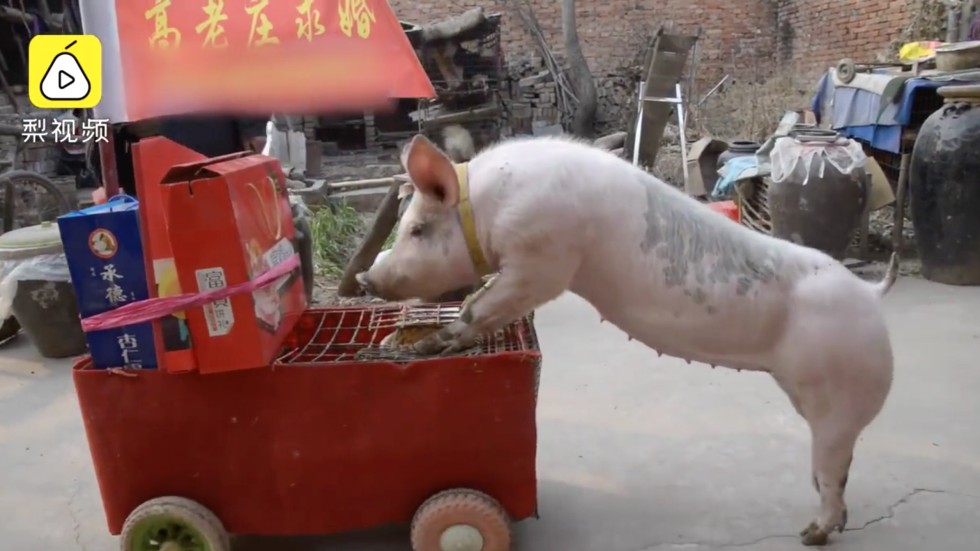
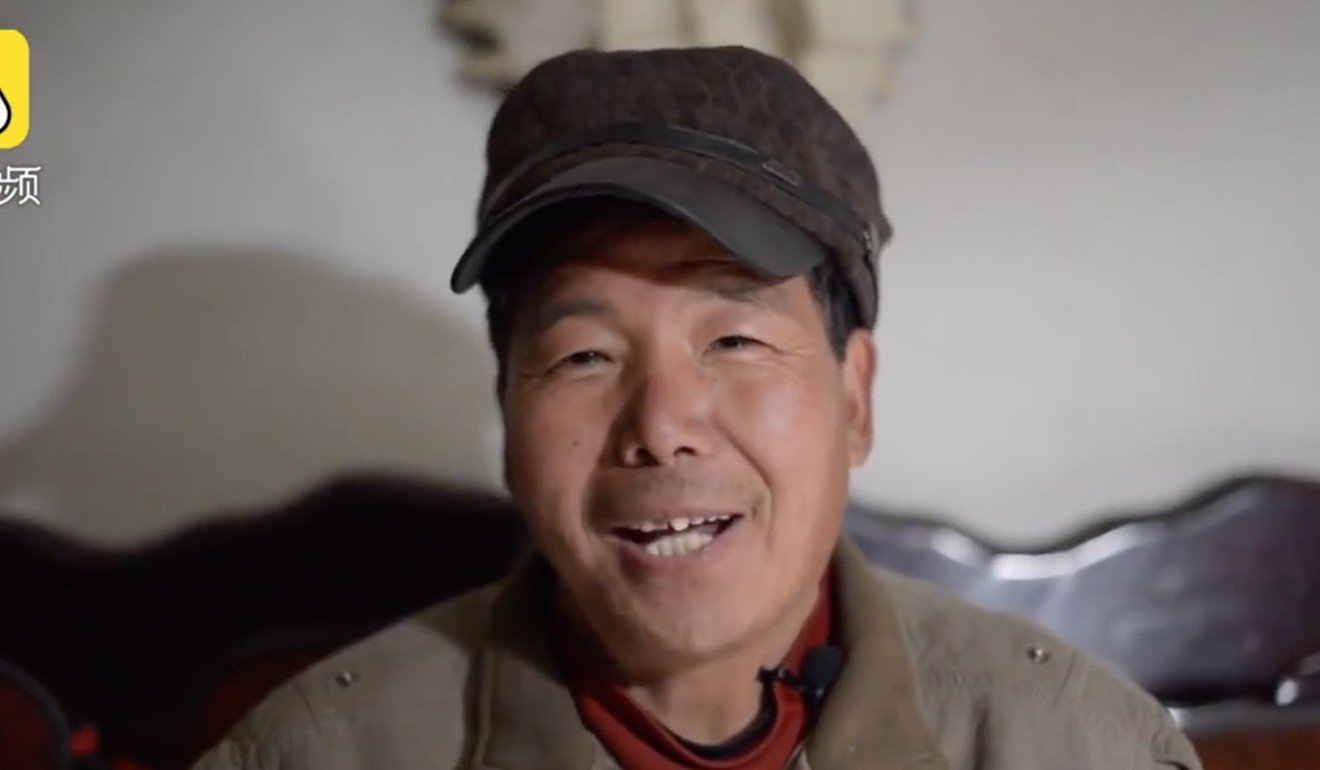
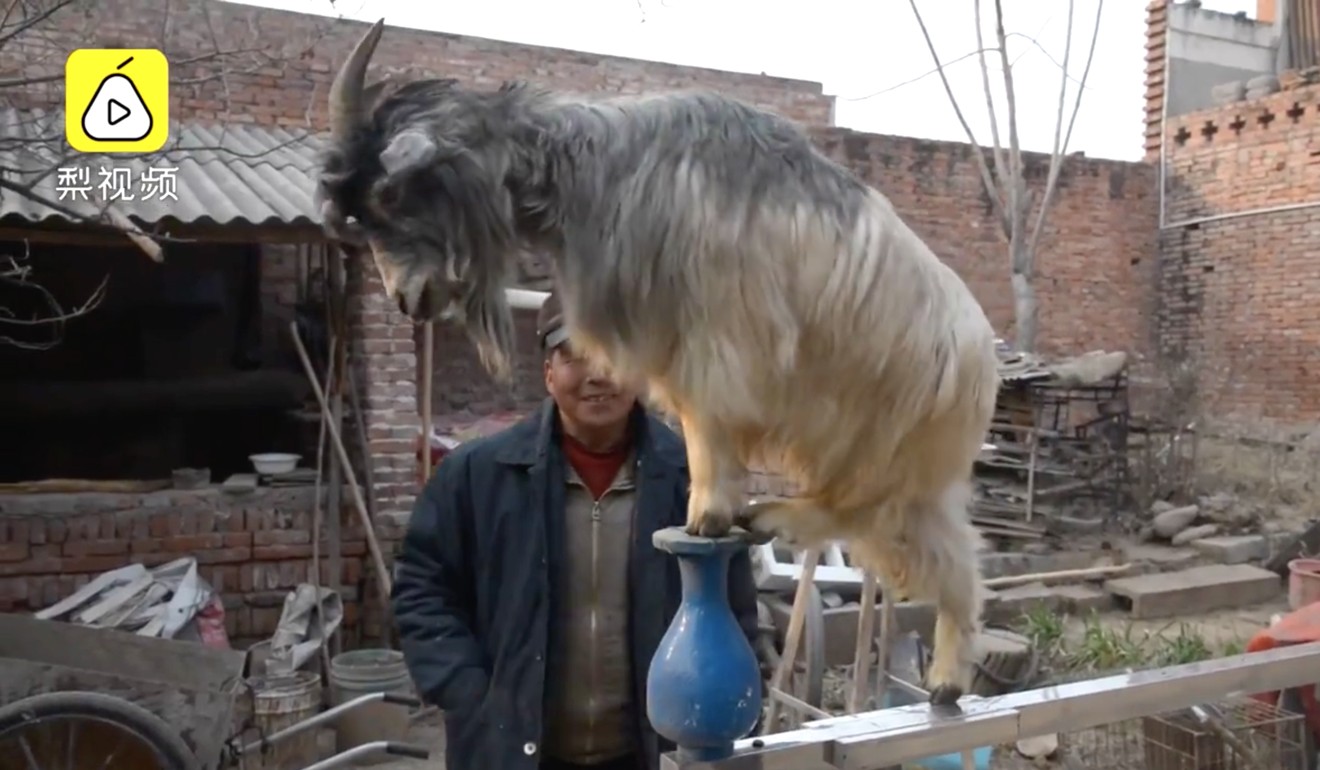
Wang Dingxuan, 54, said his star performer was a pig that he had trained to jump over hurdles and pull wedding carts – in return for a handful of treats.
Over the years, Wang has built up a strong bond with his animals, he said in an interview published on Pearvideo.com.
“I let the pig live in my house,” he said. “We’ve developed a close relationship.”
The farmer, from the city of Yanshi in Henan province, said he had always loved animals and decided to start training them after seeing a dog perform tricks on a Western television show.
After practising for several years, Wang set up the Yanshi City Happy Everyday Pet Performance Group in 2007.
The show features a number of animals, including a pig, dog, goat and pigeon. Footage of a goat walking along a narrow plank became a hit on social media.
“A man from Shandong saw my animals and wanted to buy my pig for more than 10,000 yuan (US$1,450),” Wang said. “I turned him down, but said we were willing to perform for him.”
Although he is now a big hit, Wang said his family was not supportive in the early days.
“They said I should be working in the daytime rather than playing with my animals,” he said. “So I trained my animals at night.”
His persistence worked, and his 75-year-old mother can now often be seen riding the pig on the streets of Yanshi.
Prime Minister Narendra Modi accused the Congress governments in Madhya Pradesh, Rajasthan and Karnataka of making hollow promises to the people before elections for political gains.
SNS Web | New Delhi | December 29, 2018 4:27 pm
Prime Minister Narendra Modi addresses at the foundation stone laying ceremony of Medical College in Ghazipur, Uttar Pradesh on Dec 29, 2018. (Photo: IANS/PIB)
Prime Minister Narendra Modi accused the Congress governments in Madhya Pradesh, Rajasthan and Karnataka of making hollow promises to the people before elections for political gains.
In a public meeting in Ghazipur in eastern Uttar Pradesh, the PM said that the alliance government in Karnataka led by Congress and Janata Dal (Secular) had promised to waive off loans of lakhs of farmers but has only done so for 800.
“They gave the lollipop of a farm loan waiver, votes were stolen but so far only… the loans of 800 farmers have been waived off,” Modi said while exhorting people to understand “such games”.
“Long queues for urea, fertilizers can be seen in Madhya Pradesh and Rajasthan. Black-marketeers are now back on the field,” the PM said hitting out at the Congress governments in the two states.
He also said that the Congress, when it was in the Centre, had similarly made false promises.
“Congress had promised waiver of Rs 6 lakh crore loans of farmers. The waiver was of just Rs 60 thousand crore. And the CAG report revealed that of the persons whose ‘loans’ were waived, 35 lakh people were not farmers, they had no loans and neither were they eligible for waivers,” the PM said.
Asking the gathering to be wary of Congress’ promises, the PM said that the grand old party was trying to fool the people with such announcements.
“These people are trying to lure you by short-term benefit announcements and promises but all this will not help,” he said, adding, “Announcements made for instant benefits won’t be successful in the long run.”
Modi, who was in Ghazipur to lay the foundation stone of a medical college, said that people of the region will immensely benefit from the medical college.
“The medical college will not only provide Ghazipur with advanced medical facilities but also produce new and meritorious doctors,” he said, adding, “When this college is ready, the district hospital in Ghazipur will become a 300-bed facility.”
At the event, the PM also released a commemorative postal stamp in honour of Maharaja Suheldev in the presence of Uttar Pradesh Governor Ram Naik, Chief Minister Yogi Adityanath.
Praising the 11th century ruler semi-legendary king, the PM said that Maharaj Suheldev is among those bravehearts who struggled for the honour of India.
“Remembering Maharaja Suheldev, from whom every deprived and oppressed draws inspiration, strengthens the ‘Sabka Saath, Sabka Vikas’ mantra,” he said underlining the political significance of the king in today’s times.
The PM said that unlike the previous governments, his government is showing respect to every brave son and daughter of the country.
Ironically, the Suheldev Bharatiya Samaj Party (SBSP), an NDA ally, decided to stay away from all the events attended by the PM Saturday.
The SBSP, which has four legislators in the 403-member state assembly, announced that it will “boycott” Prime Minister’s programmes. The party claims that the name of its chief, state Minister for Backward Classes Welfare Om Prakash Rajbhar, has been “deliberately omitted from the invitation card”.
Rajbhar has been a bitter critic of the BJP government in the state and the Centre over a host of issues.
SBSP was not the only ally to boycott the PM’s events. The powerful Apna Dal, too, stayed away to protest the “arrogant attitude” of the BJP leaders in the state.
Ashish Patel, the state unit chief of Apna Dal, charged the BJP leaders of “insulting leaders and the weaker sections of the society”.
He also announced that till the matter between the two allies was not settled, Apna Dal will not attend any government programmes and demanded Modi’s intervention in sorting out the matter.
The Apna Dal has two Lok Sabha MPs, including MoS Health and Family Welfare Anupriya Patel, and 9 seats in the UP Assembly.








 CHINDIA ALERT: You'll be living in their world, very soon
COMMENTS: