Chindia Alert: You’ll be Living in their World Very Soon
aims to alert you to the threats and opportunities that China and India present. China and India require serious attention; case of ‘hidden dragon and crouching tiger’.
Without this attention, governments, businesses and, indeed, individuals may find themselves at a great disadvantage sooner rather than later.
The POSTs (front webpages) are mainly 'cuttings' from reliable sources, updated continuously.
The PAGEs (see Tabs, above) attempt to make the information more meaningful by putting some structure to the information we have researched and assembled since 2006.
Tsai Ing-wen visited exiled Hong Kong bookseller a day after NPC voted in favour of legislation
Lam Wing-kee said fleeing Hongkongers saw Taiwan as a step towards applying for asylum in the West
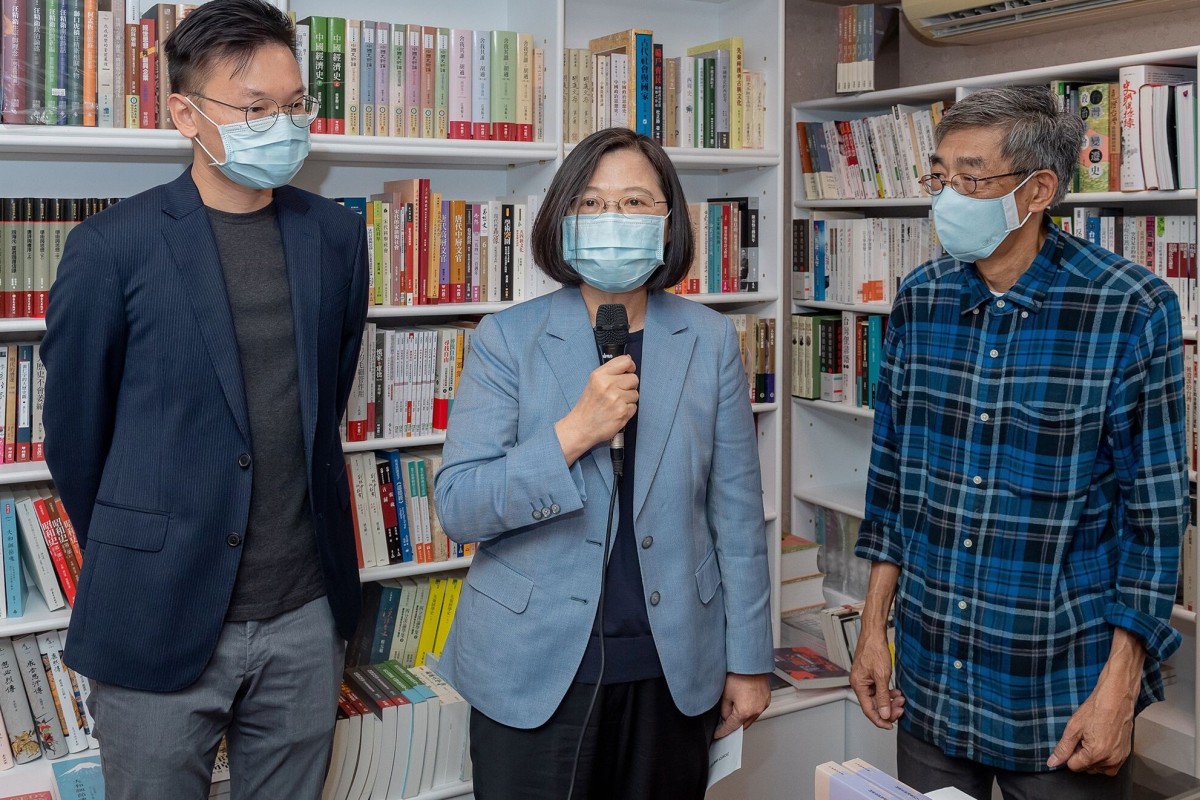
President Tsai Ing-wen (centre) shows her support for Hong Kong bookseller Lam Wing-kee (right) with Lin Fei-fan, deputy secretary general of the ruling Democratic Progressive Party. Photo: Taiwan presidential office/AFP
Her visit came a day after China’s legislature, the National People’s Congress, voted in favour of a resolution to initiate the legal process for a national security law to be imposed on Hong Kong, despite concerns from the United States, the European Union and elsewhere that the move would erode human rights, freedom and autonomy in the city.
Tsai said on behalf of all Taiwanese people, she welcomed Lam to stay in Taiwan where he could bolster the island’s efforts to further freedom and democracy.
Hongkongers who want to flee to Taiwan ‘will go through strict screening’
28 May 2020
Lam, one of the five shareholders and staff at Hong Kong’s Causeway Bay Books, fled to Taiwan in April last year after he was detained by Chinese agents for eight months in 2015 for selling books critical of the Chinese leadership.
between October and December that year and it emerged they had been detained on the Chinese mainland.
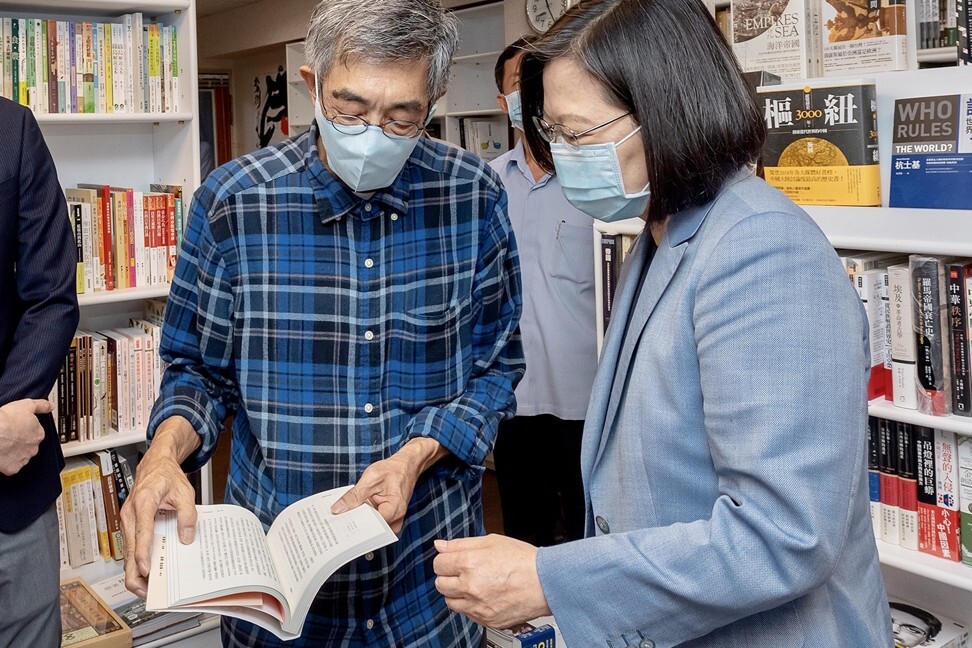
President Tsai Ing-wen looks at a book while visiting Lam Wing-kee on Friday. Photo: Taiwan presidential office/AFP
Lam later said he had been detained and blindfolded by police after crossing the border into mainland China from Hong Kong in October 2015.
The case triggered a huge controversy and raised fears of growing Chinese control in the city.
Seeing Lam as a representative of Hongkongers fleeing to Taiwan to avoid political persecution, Tsai said she wanted to understand what challenges these exiles faced and what help they needed during their stay on the self-ruled island.
“I want to tell Boss Lam [Wing-kee] and our Hong Kong friends that the government here has set up an ad hoc committee to offer help to them very soon,” she said.
On Wednesday, Tsai called for the government to set up an ad hoc committee to work out a “humanitarian help action plan” for Hong Kong people seeking to live in Taiwan or immigrate to the island. It was borne out of concern they would be arrested or prosecuted for taking part in months of anti-government protests triggered last year by the now-shelved extradition bill.
Chen Ming-tong, head of the Mainland Affairs Council, the island’s top mainland policy planner, said on Thursday his council would draft the measures for cabinet’s approval in a week.
Under the plan, the Mainland Affairs Council would issue special measures and coordinate with the island’s authorities on how to help Hongkongers relocate to Taiwan and take care of them.
Bookseller Lam told Tsai what Hongkongers needed most was to have their stay in Taiwan extended.
Lam said that currently, because of the absence of a political asylum law, Hongkongers could only apply to live in Taiwan through study, work, investment, their professional skills or close relatives.
He said fleeing Hongkongers usually came to Taiwan on tourist permits, which at most allowed them to stay for up to six months, giving them not enough time to apply for long-term residence in Taiwan.
“It would be better if they can stay for nine months and preferably one year,” he said.
Lam said some fleeing Hongkongers saw Taiwan as an intermediary base as they hoped to apply for asylum in the West, but it took a long time for Western countries to screen and approve their asylum requests.
Meanwhile, Premier Su Tseng-chang said Article 18 of the Laws and Regulations Regarding Hong Kong and Macau Affairs was good enough to deal with the current crisis in the absence of a political asylum law in Taiwan.
That article states that “necessary help shall be provided to Hong Kong or Macau residents whose safety and liberty are immediately threatened for political reasons”.
The plight of these workers, many of whom have been walking for days without adequate food and water, has caused widespread anger in the country.
Train and bus services were shut during the lockdown and even though some have been restarted for migrants, many say they cannot afford the fare and are unsure if they will be accommodated on them due to social distancing norms.
Several have died in making the journey, including 16 migrants who were run over by a train while they were sleeping on the railway tracks.
Media caption Coronavirus: Heartbreaking scenes as India lockdown sparks mass migration
Ms Sitharaman also announced that workers would be able to use ration cards – usually only valid at village level – anywhere in the country regardless of where it was issued.
The ration cards usually entitle holders to subsidised food.
She added that the move towards portable cards would benefit nearly 670 million people and will be completed by March next year.
The government will also provide affordable housing for migrant labour by converting existing vacant government funded housing complexes, among other things.
The announcements on Thursday – the second tranche of a series of economic stimulus measures – were aimed at migrant workers, street hawkers, small traders and small farmers.
The full details of the economic package, which is equivalent to 10% of India’s gross domestic product, will be known in some days as the government is announcing a different tranche every day.
Ms Sitharaman’s announcements also included details of “special credit” to be provided to five million street hawkers who have been forced to cease working over the last month and a half.
To help farmers, the government also announced an emergency $4bn “working capital funding” which would benefit some 30 million small farmers to meet crop requirements in May and June
In March, India said it would provide around 1.7 trillion rupees in direct cash transfers and food security measures, mainly for the poor.
However, Mr Modi’s administration had been accused in some quarters of not having done enough.
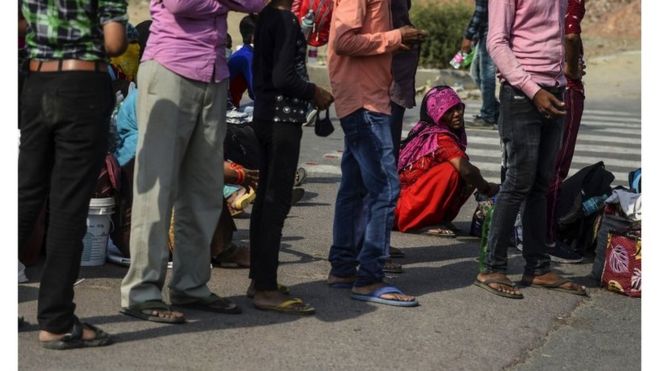
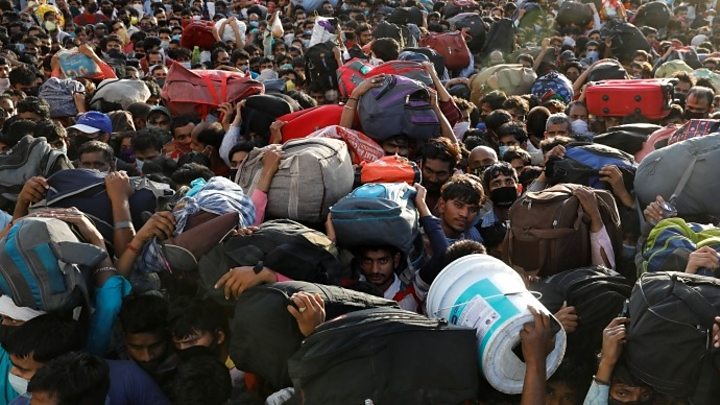
Image copyright GETTY IMAGESImage caption Millions are workers are defying a curfew and returning home
When I spoke to him on the phone, he had just returned home to his village in the northern state of Rajasthan from neighbouring Gujarat, where he worked as a mason.
In the rising heat, Goutam Lal Meena had walked on macadam in his sandals. He said he had survived on water and biscuits.
In Gujarat, Mr Meena earned up to 400 rupees ($5.34; £4.29) a day and sent most of his earnings home. Work and wages dried up after India declared a 21-day lockdown with four hours notice on the midnight of 24 March to prevent the spread of coronavirus. (India has reported more than 1,000 Covid-19 cases and 27 deaths so far.) The shutting down of all transport meant that he was forced to travel on foot.
“I walked through the day and I walked through the night. What option did I have? I had little money and almost no food,” Mr Meena told me, his voice raspy and strained.
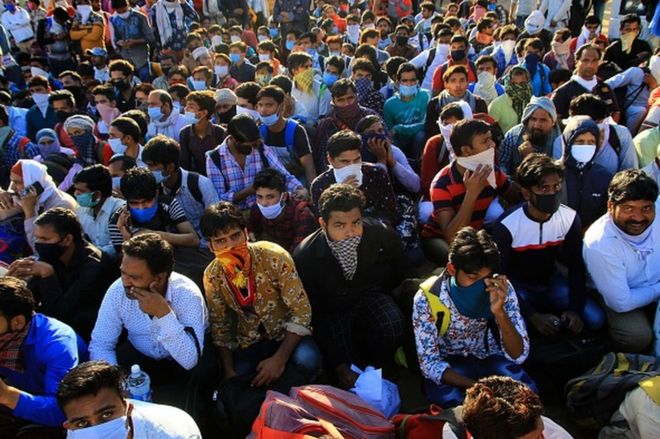
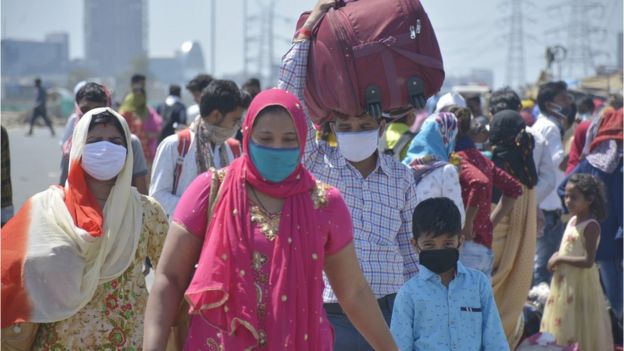
He was not alone. All over India, millions of migrant workers are fleeing its shuttered cities and trekking home to their villages.
These informal workers are the backbone of the big city economy, constructing houses, cooking food, serving in eateries, delivering takeaways, cutting hair in salons, making automobiles, plumbing toilets and delivering newspapers, among other things. Escaping poverty in their villages, most of the estimated 100 million of them live in squalid housing in congested urban ghettos and aspire for upward mobility.
Image copyright GETTY IMAGESImage caption Informal workers are the backbone of India’s big city economies
Last week’s lockdown turned them into refugees overnight. Their workplaces were shut, and most employees and contractors who paid them vanished.
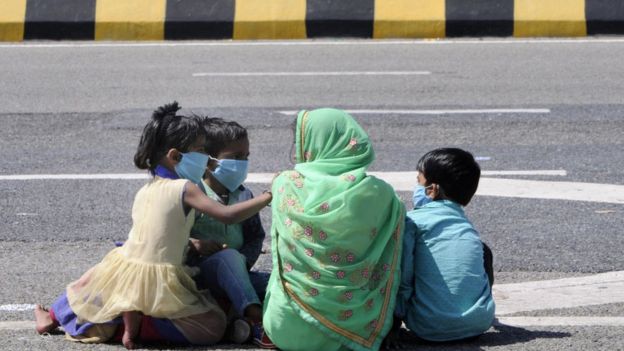
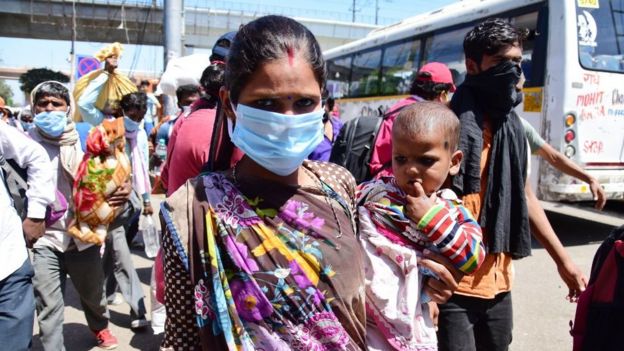
Sprawled together, men, women and children began their journeys at all hours of the day last week. They carried their paltry belongings – usually food, water and clothes – in cheap rexine and cloth bags. The young men carried tatty backpacks. When the children were too tired to walk, their parents carried them on their shoulders.
They walked under the sun and they walked under the stars. Most said they had run out of money and were afraid they would starve. “India is walking home,” headlined The Indian Express newspaper.
The staggering exodus was reminiscent of the flight of refugees during the bloody partition in 1947. Millions of bedraggled refugees had then trekked to east and west Pakistan, in a migration that displaced 15 million people.
Image copyright GETTY IMAGESImage caption Migrant labourers feel they have more social security in their villages
This time, hundreds of thousands of migrant workers are desperately trying to return home in their own country. Battling hunger and fatigue, they are bound by a collective will to somehow get back to where they belong. Home in the village ensures food and the comfort of the family, they say.
Clearly, a lockdown to stave off a pandemic is turning into a humanitarian crisis.
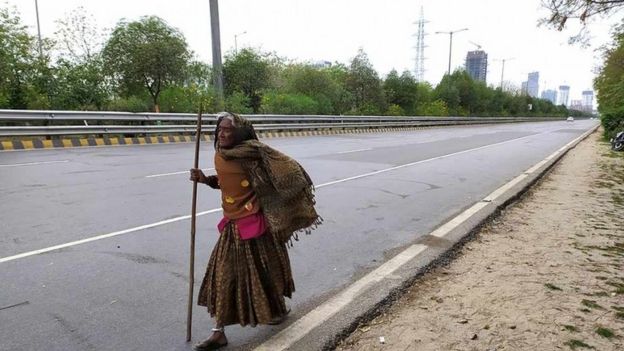
Among the teeming refugees of the lockdown was a 90-year-old woman, whose family sold cheap toys at traffic lights in a suburb outside Delhi.
Kajodi was walking with her family to their native Rajasthan, some 100km (62 miles) away. They were eating biscuits and smoking beedis, – traditional hand-rolled cigarettes – to kill hunger. Leaning on a stick, she had been walking for three hours when journalist Salik Ahmed met her. The humiliating flight from the city had not robbed her off her pride. “She said she would have bought a ticket to go home if transport was available,” Mr Ahmed told me.
Others on the road included a five-year-old boy who was on a 700km (434 miles) journey by foot with his father, a construction worker, from Delhi to their home in Madhya Pradesh state in central India. “When the sun sets we will stop and sleep,” the father told journalist Barkha Dutt. Another woman walked with her husband and two-and-a-half year old daughter, her bag stuffed with food, clothes and water. “We had a place to stay but no money to buy food,” she said.
Then there was Rajneesh, a 26-year-old automobile worker who walking 250km (155 miles) to his village in neighbouring Uttar Pradesh. It would take him four days, he reckoned. “We will die walking before coronavirus hits us,” the man told Ms Dutt.
He was not exaggerating. Last week, a 39-year-old man on a 300km (186 miles) trek from Delhi to Madhya Pradesh complained of chest pain and exhaustion and died; and a 62-year-old man, returning from a hospital by foot in Gujarat, collapsed outside his house and died. Four other migrants, turned away at the borders on their way to Rajasthan from Gujarat, were mowed down by a truck on a dark highway.
As the crisis worsened, state governments scrambled to arrange transport, shelter and food.
Image copyright SALIK AHMED/OUTLOOKImage caption Ninety-year-old Kajodi Devi is walking from Delhi to her village
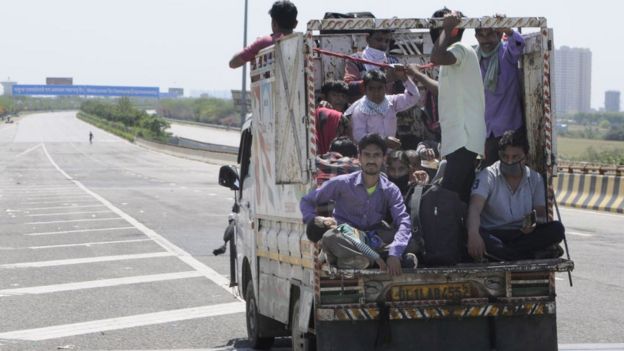
But trying to transport them to their villages quickly turned into another nightmare. Hundreds of thousands of workers were pressed against each other at a major bus terminal in Delhi as buses rolled in to pick them up.
Delhi chief minister Arvind Kejriwal implored the workers not to leave the capital. He asked them to “stay wherever you are, because in large gatherings, you are also at risk of being infected with the coronavirus.” He said his government would pay their rent, and announced the opening of 568 food distribution centres in the capital. Prime Minister Narendra Modi apologised for the lockdown “which has caused difficulties in your lives, especially the poor people”, adding these “tough measures were needed to win this battle.”
Whatever the reason, Mr Modi and state governments appeared to have bungled in not anticipating this exodus.
Mr Modi has been extremely responsive to the plight of Indian migrant workers stranded abroad: hundreds of them have been brought back home in special flights. But the plight of workers at home struck a jarring note.
“Wanting to go home in a crisis is natural. If Indian students, tourists, pilgrims stranded overseas want to return, so do labourers in big cities. They want to go home to their villages. We can’t be sending planes to bring home one lot, but leave the other to walk back home,” tweeted Shekhar Gupta, founder and editor of The Print.
Image copyright GETTY IMAGESImage caption There is a precedent for this kind of exodus during crisis
The city, says Chinmay Tumbe, author of India Moving: A History of Migration, offers economic security to the poor migrant, but their social security lies in their villages, where they have assured food and accommodation. “With work coming to a halt and jobs gone, they are now looking for social security and trying to return home,” he told me.
Also there’s plenty of precedent for the flight of migrant workers during a crisis – the 2005 floods in Mumbai witnessed many workers fleeing the city. Half of the city’s population, mostly migrants, had also fled the city – then Bombay – in the wake of the 1918 Spanish flu.
When plague broke out in western India in 1994 there was an “almost biblical exodus of hundreds of thousands of people from the industrial city of Surat [in Gujarat]”, recounts historian Frank Snowden in his book Epidemics and Society.
Half of Bombay’s population deserted the city, during a previous plague epidemic in 1896. The draconian anti-plague measures imposed by the British rulers, writes Dr Snowden, turned out to be a “blunt sledgehammer rather than a surgical instrument of precision”. They had helped Bombay to survive the epidemic, but “the fleeing residents carried the disease with them, thereby spreading it.”
More than a century later, that same fear haunts India today. Hundreds of thousands of the migrants will eventually reach home, either by foot, or in packed buses. There they will move into their joint family homes, often with ageing parents. Some 56 districts in nine Indian states account for half of inter-state migration of male workers, according to a government report. These could turn out to be potential hotspots as thousands of migrants return home.
Image copyright GETTY IMAGESImage caption The fleeing migrants could spread the disease all over the country
Partha Mukhopadhyay, a senior fellow at Delhi’s Centre for Policy Research, suggests that 35,000 village councils in these 56 potentially sensitive districts should be involved to test returning workers for the virus, and isolate infected people in local facilities.
In the end, India is facing daunting and predictable challenges in enforcing the lockdown and also making sure the poor and homeless are not fatally hurt. Much of it, Dr Snowden told me, will depend on whether the economic and living consequences of the lockdown strategy are carefully managed, and the consent of the people is won. “If not, there is a potential for very serious hardship, social tension and resistance.” India has already announced a $22bn relief package for those affected by the lockdown.
The next few days will determine whether the states are able to transport the workers home or keep them in the cities and provide them with food and money. “People are forgetting the big stakes amid the drama of the consequences of the lockdown: the risk of millions of people dying,” says Nitin Pai of Takshashila Institution, a prominent think tank.
“There too, likely the worst affected will be the poor.”
Lotte, Kia and Hyundai are also gradually winding down their China business due to political risks, tariffs and losing market share
Western companies fleeing Donald Trump’s tariffs may not have luxury of a managed exit, but should look at the South Korean case studies closely, experts say
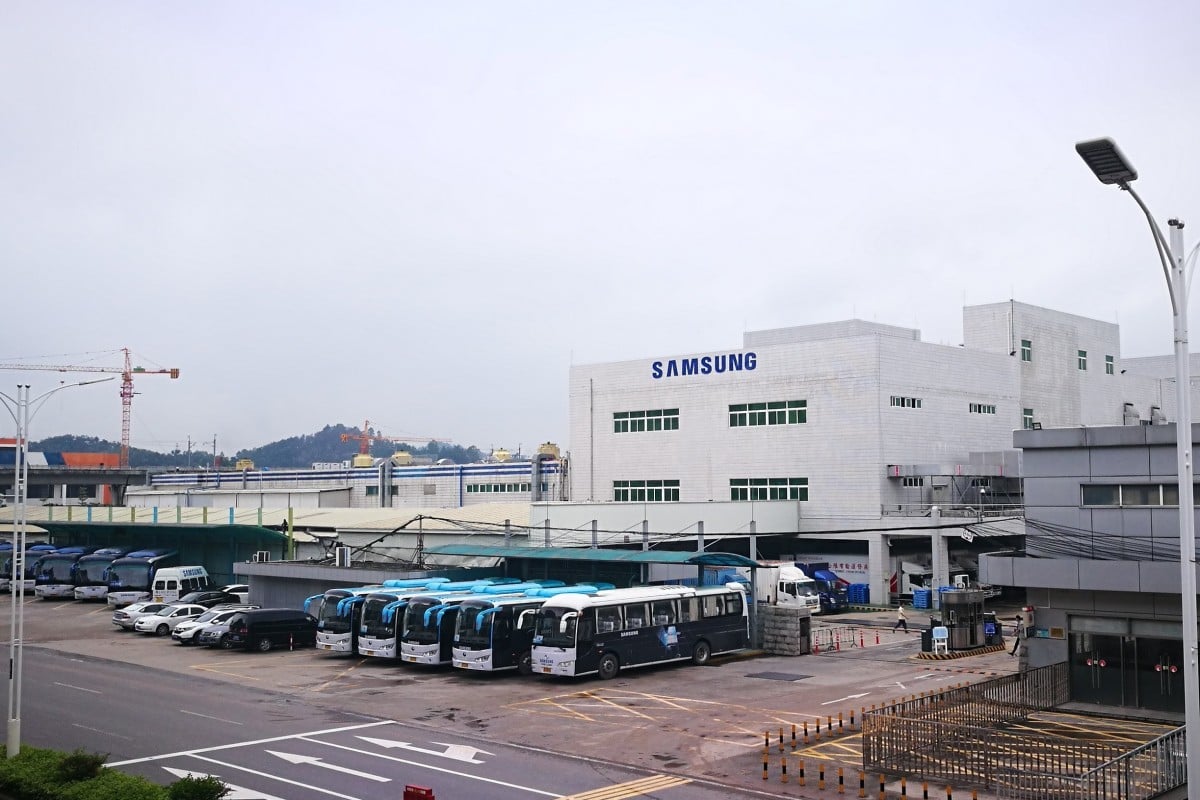
Samsung’s last mobile phone production line remaining in China in Huizhou is winding down, implementing a voluntary retirement programme. Photo: He Huifeng
Upon landing in Australia in 2017 to attend a seminar, a senior politician with South Korea’s parliamentary defence committee was greeted by Julie Bishop, then Australia’s foreign minister, who had a burning question: “How are you dealing with the China threat?”
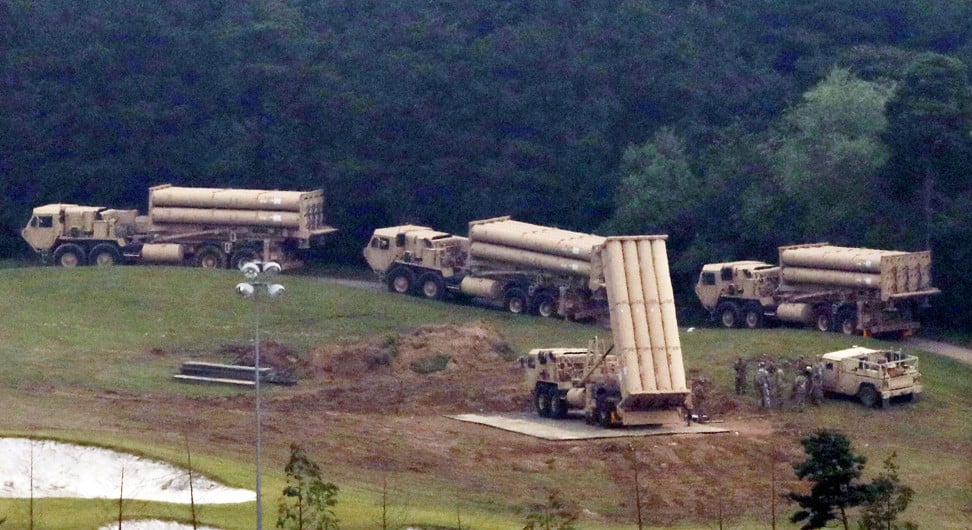
Bishop was referring to the treatment of South Korean firms in China, which escalated after Seoul agreed in 2016 to a long-standing request from the United States to allow the deployment of the Terminal High Altitude Area Defence system (THAAD) on South Korean soil.
Lotte Corporation, one of Korea’s chaebol conglomerates that dominate its economy, had sold a plot of land in Seongju county to the South Korean government, on which the system’s radar and interceptor missiles were set up. While both Washington and Seoul said it was meant to counter threats from North Korea, Beijing viewed THAAD as a security risk, since its radar had the range to monitor China’s nearby military facilities.
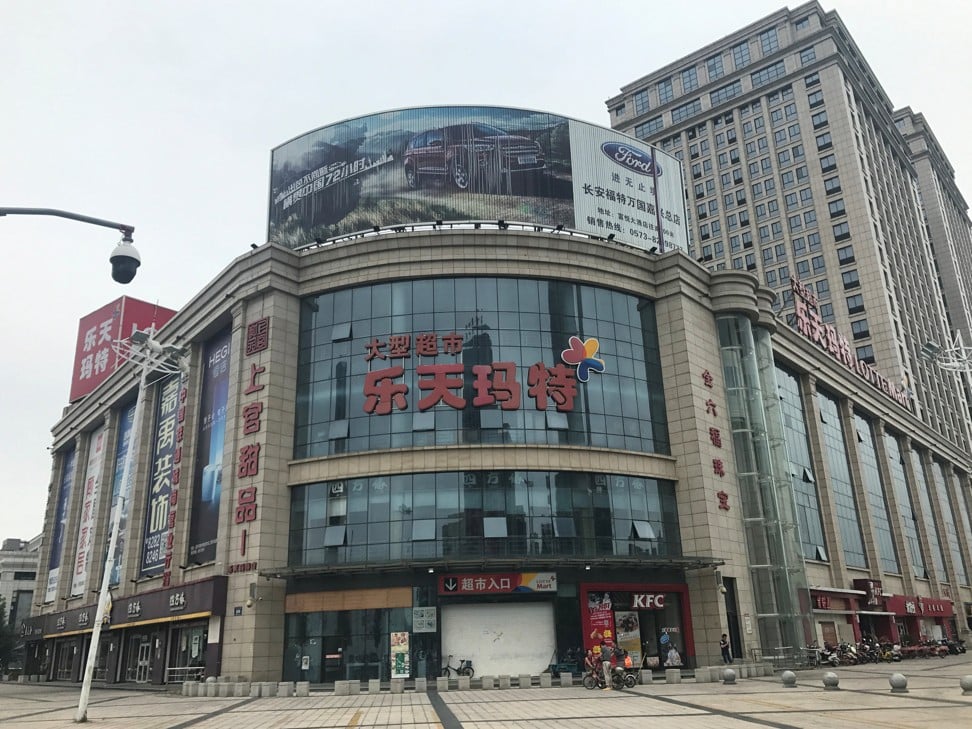
After it was deployed in 2017, THAAD triggered widespread boycotts of Lotte’s retail operations in China, with the state-owned media acting as aggressive cheerleaders. The company was sanctioned by Beijing, with its expansion plans in China grinding to a halt on the orders of the Chinese government.
The Terminal High Altitude Area Defence (THAAD) arrived in Seongju in September 2017. Photo: Reuters
Australia – like South Korea – is heavily dependent on trade with China, but is also closely bound to the US in defence and political terms, and Bishop feared that should Australia fall out of favour with Beijing, Australian companies could face similar risks, and so she sought the counsel of the politician, who asked not to be named.
The case of Canadian canola and meat exports being banned from China, reportedly in retaliation for the arrest of Huawei chief financial officer Meng Wanzhou, also known as Sabrina Meng and Cathy Meng, is an example of how third nations can be drawn into the modern day superpower rivalry.
Many analysts say the efforts of South Korean firms in China should be essential study material for Western governments and businesses about the political risks of doing business in the mainland, which are growing as the US-China trade war threatens to draw in other nations and expand into a broader geopolitical struggle.
But large South Korean firms have been gradually withdrawing from China for a number of years – even before the THAAD crisis – and have been able to leave on a managed basis. They are leaving to avoid a repeat of the political crisis that ruined Lotte’s China business, and to avoid tariffs on exports of their China-made products to the US.
Lotte have been forced to close retail operations in China. Photo: Reuters
Share:
But they are also leaving because Chinese firms have become much more competitive in the domestic market that South Korean companies had found so fruitful for more than a decade – a fate that could easily befall Western companies that are eyeing China’s burgeoning middle-class consumer market. Now, while American firms are considering exiting China and setting up in nations that have lower tariff access to the US, South
Korean competitors have had a few years’ head start.
“In a way, all the problems that some South Korean companies had since 2017 might be a blessing in disguise. It meant that they started all of this [supply chain shift] two years before all the other companies,” said Andrew Gilholm, Seoul-based director of analysis for China and Korea at political risk advisory, Control Risks.
Another chaebol, Samsung Electronics, opened its first plant in Vietnam in 2008 and this long-term presence has enabled it to build a supply chain of South Korean companies, which in turn makes it easier for other South Korean firms to establish a base in the Southeast Asian nation.
We have experienced some of the worst situations in China over the past few years and learnt that the political risk there wouldn’t just simply go away overnight Ex-Lotte Shopping manager
As a result, South Korean investment into Vietnam climbed to US$1.97 billion in the first half of 2018, exceeding the country’s investment in China of US$1.6 billion over the same period for the first time, according to the Export-Import Bank of Korea.
Overall in 2018, South Korea’s total investment to the Southeast Asian country totalled US$3.2 billion. Its exports to Vietnam also increased to US$48.6 billion, 121 times that of 1992, when the two countries established diplomatic relations, and the trend is expected to continue.
“We have experienced some of the worst situations in China over the past few years and learnt that the political risk there wouldn’t just simply go away overnight,” said a former manager of Lotte Shopping, the chaebol’s retail arm, who spoke on condition of anonymity.
“China may pass all the legislation ensuring the safety of foreign investments and the rights of multinational companies, but the chance of it swinging away again when there is another political confrontation is just too high … we cannot afford to take any more risk.”
China eventually lifted its economic sanctions on Lotte in April, and the municipal government of Shenyang, the capital of Liaoning province in Northeastern China, gave the company permission in May to resume work on the US$2.6 billion Lotte Town shopping and leisure development.
But according to a person close to the project, Lotte is considering selling the complex after its completion, as it does not wish to continue its retail business in China. A Lotte spokesman declined to comment, saying the situation is “complicated”.
On one hand, its eagerness to leave China reflects the volatility in the market, but on the other, its decision to complete the construction of project before leaving suggests an unwillingness to burn bridges in the process, analysts said.
Samsung is another South Korean giant downsizing its Chinese manufacturing presence after it closed its Shenzhen production line in May 2018, followed by its Tianjin factory in December.
Samsung has been very aware of the potential issues around those closuresJason Wright
Its last remaining mobile phone production line in
implementing a voluntary retirement programme. Samsung is also considering moving some television manufacturing from China to Vietnam, according to a company insider.
However, it too, is carefully managing its exit strategy, said Jason Wright, founder of Hong Kong-based intelligence firm Argo Associates, who is advising a growing number of South Korean companies seeking to leave China. Samsung is still a large supplier of microchips to Chinese companies like Huawei, and to exit on negative terms could disrupt its ongoing business.
“Samsung has been quite generous in the packages that have been offered [to workers in the factories that it has closed],” Wright said. “Samsung has been very aware of the potential issues around those closures.”
As well as the political risks and tariffs, Samsung has seen its mainland market share in several product queues shrink dramatically due to competition from Chinese rivals. Its share of China’s smartphone market, for example, fell from 20 per cent in 2013 to just 0.8 per cent last year, according to Strategy Analytics, a market research firm.
Over the same period, it has been moving its supply chain out of China in a “subtle and imperceptible” way, according to Julien Chaisse, a professor of trade law at City University of Hong Kong who has advised, among others, Lotte on its plans to relocate to Vietnam.
Samsung Electronics opened its first plant in Vietnam in 2008. Photo: Cissy Zhou
As stories emerged in June that Apple was considering a partial exit of China, it was impossible not to see parallels. iPhone sales in China fell 30 per cent in the first quarter of 2019, according to research firm Canalys, while smartphones will be among those facing a potential tariff of up to 25 per cent, although this has been at least delayed after the trade war truce agreed by
Meanwhile, South Korean car companies Kia and Hyundai’s combined market share in China fell to 2.7 per cent last year, from about 10 per cent at the beginning of the decade. Both companies, which have shared ownership, are downsizing their Chinese operations.
“In the past, China was just a great market, but for Korea, now China has become a competitor. So that is really a change in the dynamic over the last five years. China was not really able to compete with Korea in most areas,” said Wright from Argo Associates.
City University of Hong Kong professor Chaisse traces the exodus of South Korean firms back to 2014, before THAAD and before the trade war, and highlighted an arcane arbitration case at the United Nations’ dispute settlement courts as a turning point. After that case, South Korean companies in China faced an increasingly hostile environment.
Filed in 2014 and settled in 2017, the case emerged after South Korean company Ansung Housing had been forced to sell a golf resort it was developing in Eastern China after a change in the country’s real estate legislation.
Ansung took the case to an arbitration panel, claiming it breached a Sino-Korean investment treaty. The company won – only the second defeat for China in two decades of participation in the court, but this ushered in a “change in atmosphere” for South Korean firms.
“My take is that while the Korean case is unique for a number of reasons, it highlights what is going to happen to many other foreign companies operating in China,” Chaisse said.
“I think very soon even European companies will be reconsidering their businesses in China. Every time it will be a different story: different countries, different companies, in different economic sectors will have different reaction times and the magnitude of their withdrawal may vary.”
But for those now fleeing trade war tariffs, they may not have the luxury of long-term planning that companies like Samsung and Lotte have had, said Gilholm from Control Risks.
“Long term, I think the Korean firms that are moving out of China have had it easier because they haven’t had to do it under quite such pressured and scrutinised circumstances as a company which starts to move things now,” he said.
International schools and companies offering extracurricular services have sprung up to prepare children to study overseas
Families disenchanted with exam-based classes and intense competition for tertiary places look offshore for alternatives
A group of young Chinese students tour the University of Cambridge in England. Photo: Alamy
On a sunny summer’s day, 24 schoolchildren head off on a four-day field trip to Guizhou province in southwestern China.
The children, aged eight to 16, have gone into the far reaches of the mountainous province not to see its picturesque Huangguoshu waterfall or to meet people from the ethnic Miao minorities. Instead, they are there to see the Five-hundred-metre Aperture Spherical Telescope, or Fast – the world’s biggest radio telescope, built in 2016.
The trip was organised by All in One Education, a Shenzhen-based company offering extracurricular classes and educational trips for Chinese students who aim to study abroad.
The agency has organised similar trips to Hebei and Yunnan provinces, catering to parents who want to expand their children’s horizons.
“This kind of experience is not usually available to students who follow the traditional Chinese education model, but it does appeal to those who go to international schools and schools that emphasise exploration,” Zhang Yong, the teacher leading the field trip, said.
Zhang said other agencies in China arranged educational trips abroad, including to universities such as Harvard and Oxford.
Many Chinese parents want their children to have a broader education than they get in the public schools system. Photo: Reuters
The companies are part of an industry targeting an ever-growing market of parents who have high expectations for their children and who are anxious to ensure their children go to the best schools they can afford.
The services are also aimed at parents who see studying abroad as a way to avoid the intense competition and discipline of the Chinese education system.
Crunch time as gaokao exam season starts for China’s university hopefuls
An overseas education has long been reserved for the privileged few in China but it is becoming more of an option as people become more affluent and more services open up to cater to the demand to give the best to the next generation.
According to the Ministry of Education, 662,100 people studied abroad last year, 53,700 more than in 2017.
For Shanghai parent Iris Wang the best means a Western university. She said that not only were Western universities better than their Chinese equivalents but she had also lost faith in China’s secondary education system.
With her daughter starting at an international middle school in September, Wang is now planning for the child to go overseas for experience and study.
She said that although the teachers working in public schools in China were responsible, the system itself was too rigid.
“In summer, the pupils have to take naps at noon, and teachers write down the names of those who don’t sleep and tell their parents,” she said. “And even if you don’t want to take nap, you are not allowed to take a walk or talk; you must rest your heads and arms on the table.”
Many middle-class Chinese parents are seeking alternatives to the public education system. Photo: AP
Such rules are common in Chinese public schools and meant to instil a sense of discipline among the pupils.
“But educating kids is not the same as making a product on an assembly line,” Wang said.
By withdrawing her daughter from the public system, Wang has forfeited her child’s chance to go to a Chinese high school or university.
It’s a route more Chinese parents are taking, according to a report released in April by the Social Sciences Academic Press and the 21st Century Education Research Institute, a Beijing-based think tank. In 2018, there were 821 international schools in China, up 12 per cent from a year earlier.
Wang has not just sent her daughter to an international school but has also begun researching the next steps, convinced that her daughter should leave China early to better adapt to university abroad.
“She will need to learn the language, develop a different learning mindset, as well as adapt to the lifestyle there,” Wang said.
China’s infamous gaokao university entrance exam
Shenzhen mother Yao Li has also decided that an early exit from the Chinese education system would be good for her daughter, who is still in primary school.
Yao plans to send her daughter to an international secondary school so she can receive a Western education and eventually apply to schools abroad.
Compared with the traditional Chinese education, which focused on exams as measures of excellence, an international education could give a child more possibilities, she said.
“The competition in China for a good education is so fierce that my child will not have sufficient room for development if she stays here,” she said. “We hope that she can become more international and have more diverse abilities as well.”
Why did one of China’s elite universities need to offer big money to get the best students?
Yao has already signed her daughter up for extracurricular classes such as English, art and public speaking, hoping that she can develop a diverse set of skills instead of focusing on academic results alone.
Zhang, the teacher at All In One Education, said there was a huge market in China catering to parents who are interested in such classes.
“The reason is simple, the university entrance examination in China is very difficult,” Zhang said. “So parents in areas like Shenzhen who are doing well will send their children abroad to study instead.”
But making the decision to send a child to an international school is just the start. For the middle-class parents who are preparing their children early, there are many more decisions to make, many more classes to attend and many more tests to take.
“We will have to think about which country to send her to in a year or so,” Wang from Shanghai said. “The options are different and so are the preparations – even the language tests required are different, one is TOEFL, one is IELTS.”







 CHINDIA ALERT: You'll be living in their world, very soon