22/04/2020
SEOUL/BEIJING (Reuters) – China has allowed 200 employees from South Korea’s Samsung Electronics Co Ltd (005930.KS) to enter the country to work on an expansion of the firm’s NAND memory chip factory, the company said on Wednesday.
The move came after China said on Tuesday that it was in talks with some countries to establish fast-track procedures to allow travel by business and technical personnel to ensure the smooth operation of global supply chains.
China said it has reached a consensus on such an arrangement with South Korea, without elaborating on the terms, including whether individuals entering China will be subject to quarantine.
China, where the virus first emerged late last year, blocked entry last month for nearly all foreigners in an effort to curb risks of coronavirus infections posed by travellers from overseas. After bringing the local spread under control with tough containment measures, it is trying to restart its economic engines after weeks of near paralysis.
A chartered China Air Ltd (601111.SS) plane flew in the Samsung Electronics employees on Wednesday, a company spokeswoman said.
Samsung said its employees will follow the local government’s policy upon arrival, without elaborating.
Shaanxi province, where Samsung’s NAND memory chip plant is located, requires people travelling from overseas to undergo a 14-day quarantine, according to South Korea’s foreign ministry.
“Samsung employees will not be exempted from the 14-day quarantine rule imposed by the Shaanxi province. They will get coronavirus tests at the airport upon arrival and will be transported to a local hotel designated by Chinese authorities,” an official at the Consulate General of South Korea in Xi’an told Reuters.
Samsung Electronics in December increased investment at its chip factory in China by $8 billion to boost production of NAND flash memory chips.
Source: Reuters
Posted in $8 billion, 14-day quarantine, 200, according, after, Airport, allow, allowed, allows, Arrangement, arrival, Beijing, billion, blocked, boost, bringing, Business, came, chartered, China, China Air Ltd, chinese authorities, chip factory, Company, consensus, Consulate General, containment, control, coronavirus infections, coronavirus tests, countries, Country, curb, December, designated, economic engines, effort, elaborating, emerged, employees, ensure, enter, entering, entry, establish, exempted, expansion, Factory, fast-track, firms, flash memory chips, flew, Foreign Ministry, Foreigners, from, from overseas, global supply chains, including, increased, individuals, Investment, last month, late last year, local governments, local hotel, local spread, located, measures, memory chip, move, NAND, near, nearly, Official, operation, overseas, paralysis, People, personnel, plane, Plant, policy, posed, procedures, production, quarantine, reached, requires, restart, Reuters, Risks, rule, Samsung Elec, Seoul, shaanxi province, smooth, South Korea, South Korea’s, spokeswoman, staff, subject, talks, technical, terms, tough, transported, travel, travellers, travelling, trying, Tuesday, Uncategorized, undergo, upon, Virus, Wednesday, weeks, whether, without, work, Xi'an |
Leave a Comment »
31/10/2019
- The deaths of three airmen in a helicopter crash and a second accident days later point to problems with training and equipment
- The crashes happened within a span of 10 days, amid an increased number of intensive drills
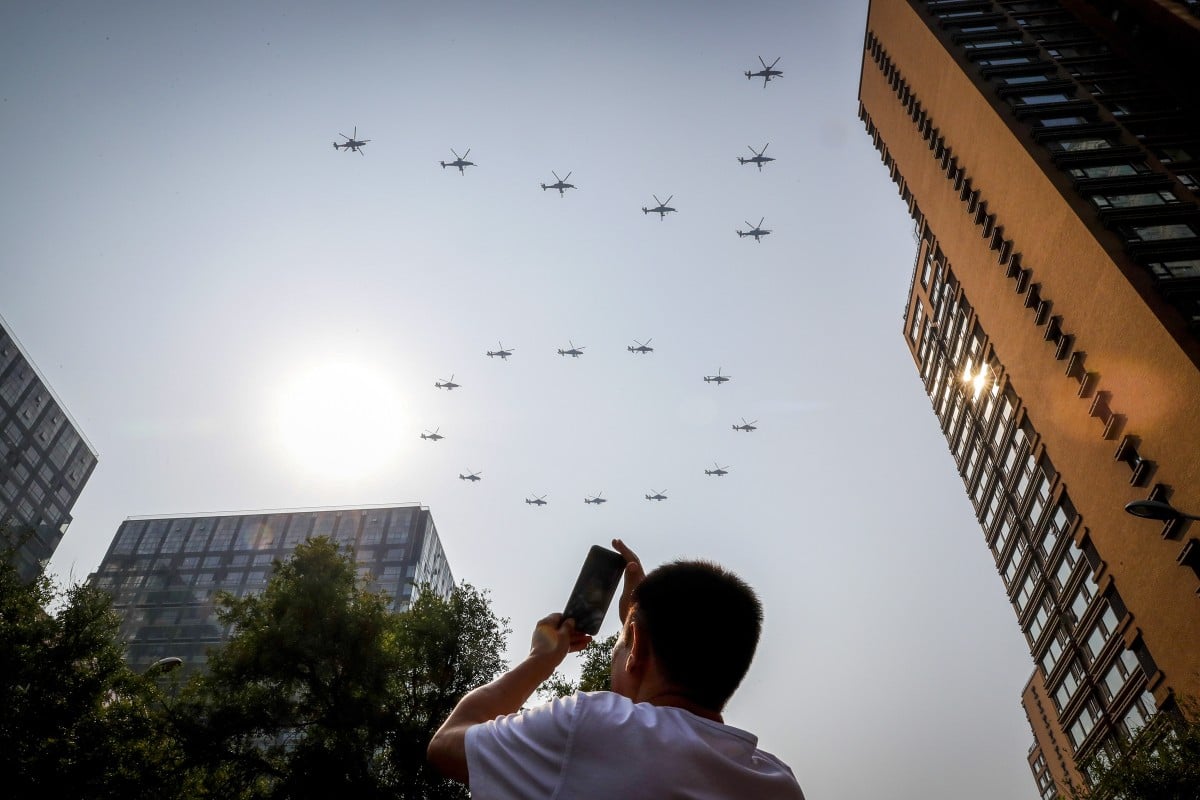
Chinese military helicopters form the number 70 as part of the National Day parade in Beijing. Photo: AP
Engine flaws and a lack of training have been identified as the likely causes of two accidents that hit the Chinese air force in the space of little over a week – one of which claimed the lives of three airmen.
Deaths from the crashes, which happened within a span of 10 days, included a helicopter pilot who took part in the National Day grand parade at the start of the month.
A number of military sources said that as the air force stepped up its exercises – part of President Xi Jinping’s call to strengthen the “combat readiness” of the military – more accidents would happen as increased drills exposed technical problems and inadequate training.
“[If these problems are not resolved], it is foreseeable that more accidents will happen because the top brass is pushing for more drills and exercises across the military,” said one source close to the air force.
The fatal accident happened about three weeks ago in central Henan province, when a transport helicopter crashed, killing all three people on board.
Gong Dachuan, 33, was one of the airmen killed in the crash. Photo: Handout
Local television reports named pilot Gong Dachuan, 33, and 37-year-old engineer Wen Weibin, as two of this killed in the crash. The third victim was later named as Luo Wei, from Luzhou in Sichuan, by an online mourning website.
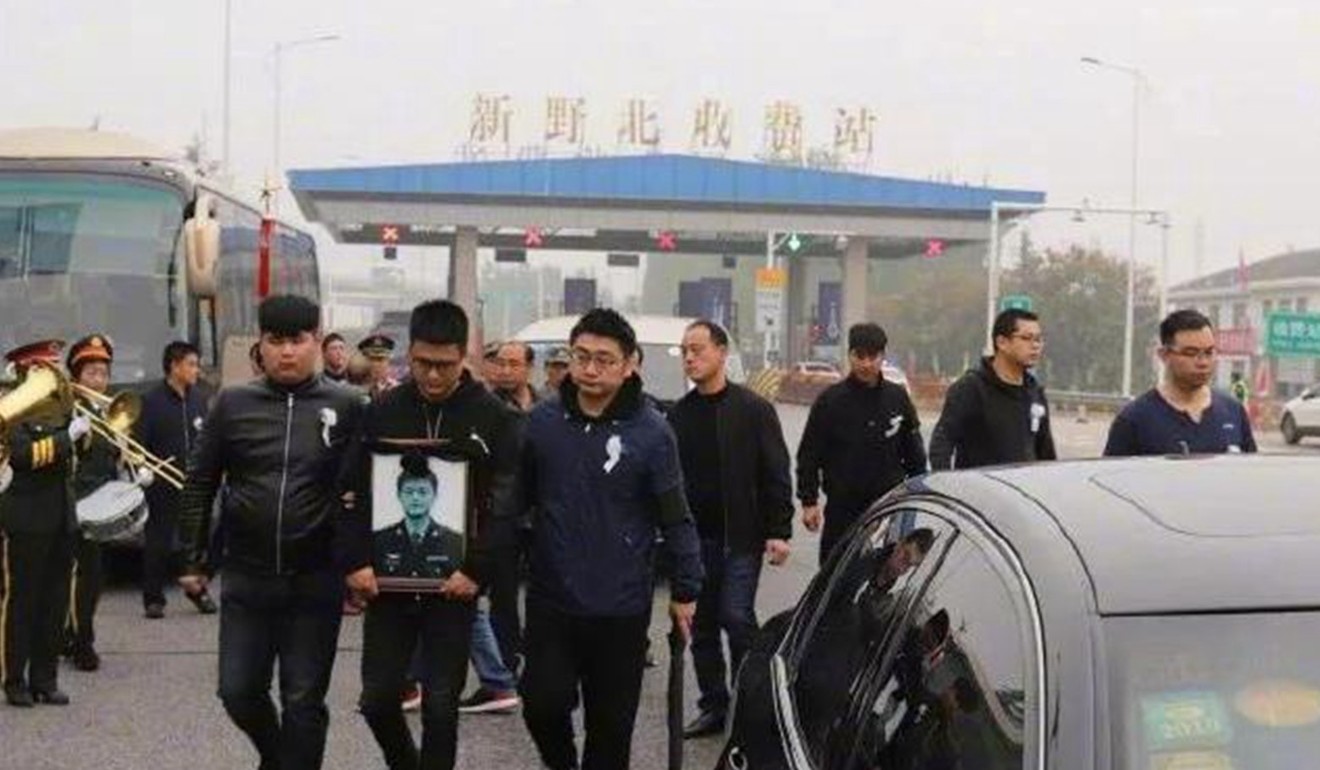
A memorial for Gong was held by the local government in Xinye County last Tuesday.
“The three people were conducting some tests on the helicopter,” said a local source who declined to disclose where the crash happened and the nature of the test.
Xinye county government in Henan province held a memorial to honour the dead pilot. Photo: Handout
Media reports said that Gong had flown in this year’s National Day parade in Beijing, while Wen had been decorated for his participation in the 2015 parade in Beijing to mark the 70th anniversary of victory over Japan in World War II.
The three dead airmen have been designated as martyrs, the reports added.
The second accident happened eight days later on the Tibetan Plateau where a J-10 fighter jet on a low-altitude flying drill crashed into the mountain.
“Fortunately, the pilot ejected safely in time, but the J-10 crashed into the mountain,” said an informed source, who requested anonymity since no official announcement about the accident has been made.
“Preliminary investigations indicated that the accident had something to with the Russian-made AL-31 engine on board the J-10,” the source said.
Military analysts said the air force needs to improve the durability of its aircraft and training for pilots.
Hong Kong-based military expert Song Zhongping suggested that problems with engines and flight control systems were also key reasons behind some of the fatal crashes.
Wen Weibin, 37, also died in the crash. Photo: Handout
Two J-15 fighter jets crashed in April 2016, resulting in one death and one serious injury. Investigations into the two crashes pointed to problems with the flight control system.
A source from the Chinese air force said that, unlike their American counterparts, PLA pilots generally lack training in avionics engineering and had little flying experience before enlistment.
“PLA pilots may be strong and courageous, and they are motivated to make sacrifices,” the air force source said. “But they don’t have as much experience as American pilots – many of [whom] have a lot of experience in flying civilian aircraft before they join the air force.”
Posted in 70th anniversary, accident, air force, AL-31 engine, avionics engineering, Chinese air force, civilian aircraft, deaths, drill and equipment problems, enlistment, equipment, flaws, flew, flight control system, helicopter crash, Henan province, highlights, implicated, J-10 fighter jet, J-15 fighter jets, Luzhou, military parade, National Day, pilot, PLA pilots, point, President Xi Jinping, problems, sichuan province, Tibetan Plateau, training, Uncategorized, victory over Japan, World War II, Xinye County |
Leave a Comment »





 CHINDIA ALERT: You'll be living in their world, very soon