Archive for ‘fly’

26/03/2020

U.S. playing dangerous game, China says, after warship sails through Taiwan Strait

TAIPEI (Reuters) – China accused the United States on Thursday of playing a dangerous game with its support for Taiwan, after a U.S. warship passed through the sensitive Taiwan Strait following heightened military tension between China and Taiwan.

China has been angered by the Trump administration’s stepped-up support for the island it considers its own, such as more arms sales, U.S. patrols near Taiwan and last month’s visit to Washington by Taiwan Vice President-elect William Lai.

Anthony Junco, a spokesman for the U.S. Seventh Fleet, said the guided-missile destroyer USS McCampbell conducted “a routine Taiwan Strait transit” on March 25, in line with international law.

“The ship’s transit through the Taiwan Strait demonstrates the U.S. commitment to a free and open Indo-Pacific,” he added. “The U.S. Navy will continue to fly, sail and operate anywhere international law allows.”

Taiwan’s defence ministry said the ship sailed north through the waterway and was monitored by Taiwan’s armed forces, on what it called an “ordinary mission”, adding there was no cause for alarm.

In Beijing, Chinese defence ministry spokesman Ren Guoqiang denounced “continued negative actions” by the United States on Taiwan, including sailings through and flights over the Taiwan Strait.

“U.S. moves have seriously interfered in China’s internal affairs, severely harmed peace and stability in the Taiwan Strait and poisoned Sino-U.S. military ties,” Ren told a monthly news conference.

The actions were “extremely dangerous”, he added.

Taiwan is China’s most sensitive territorial and diplomatic issue and Beijing has never ruled out the use of force to bring the island under its control. The narrow Taiwan Strait that separates the island from China is a frequent source of tension.

In recent weeks China’s air force has conducted several exercises close to Taiwan, prompting its mostly U.S.-equipped military to scramble fighters to intercept and warn away the Chinese aircraft.

Taiwan has called the drills provocative, and urged China to pay more attention to fighting a coronavirus pandemic, rather than menace it.

The United States, like most countries, has no official relations with Taiwan, but is the island’s most important international supporter and main source of arms.

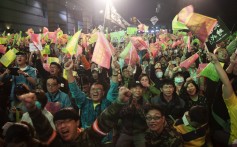
In January another U.S. warship sailed through the Taiwan Strait less than a week after President Tsai Ing-wen won re-election by a landslide on a platform of standing up to China.

Source: Reuters

23/01/2020

Chinese military aircraft fly close to Taiwan, island’s defence ministry says

  • H-6 bomber, early warning and control plane part of long-haul exercise that bypassed island’s southern tip en route to western Pacific, Taipei says
  • Taiwan’s military will remain on high alert over Lunar New Year holiday, ministry says
A KJ-500 early warning and control aircraft was among the PLA military planes that staged an exercise close to Taiwan on Thursday. Photo: Weibo
A group of military aircraft from mainland China flew close to the southernmost tip of

Taiwan

on Thursday, just a week after President Tsai Ing-wen angered Beijing by saying the island was an independent country.

According to Taiwan’s defence ministry, the formation, which included a KJ-500 early warning and control aircraft and an H-6 bomber, passed through the Bashi Channel near Taiwan’s Orchid Island en route to the western Pacific Ocean.
It did not say how many aircraft were involved but said they had taken off from different airbases in southern China.
“They returned to their airbases from their morning flight path after a long-haul exercise,” the ministry said in a statement.
The ministry urged the public not to be alarmed by the aircraft’s presence, saying it constantly monitored the activities of the People’s Liberation Army (PLA), both in the air and at sea.
Taiwan’s armed forces would also remain on high alert over the Lunar New Year
holiday, which starts on Friday, it said.

“There is no holiday for national security,” it said.

The PLA exercise came just a week after Tsai said on January 15 that Beijing needed to face the reality of Taiwan’s independence.

“We don’t have a need to declare ourselves an independent state,” she said in an interview with the BBC. “We are an independent country already and we call ourselves the Republic of China, Taiwan.”

Tsai urges mainland China to review strained ties

21 Jan 2020

Tsai’s comments came just days after she secured a second term as president with a record 8.2 million votes.

In her victory speech, she promised to continue to stand up to Beijing’s intimidation, while also strengthening Taiwan’s defences, partly by developing more home-grown military equipment, including submarines.

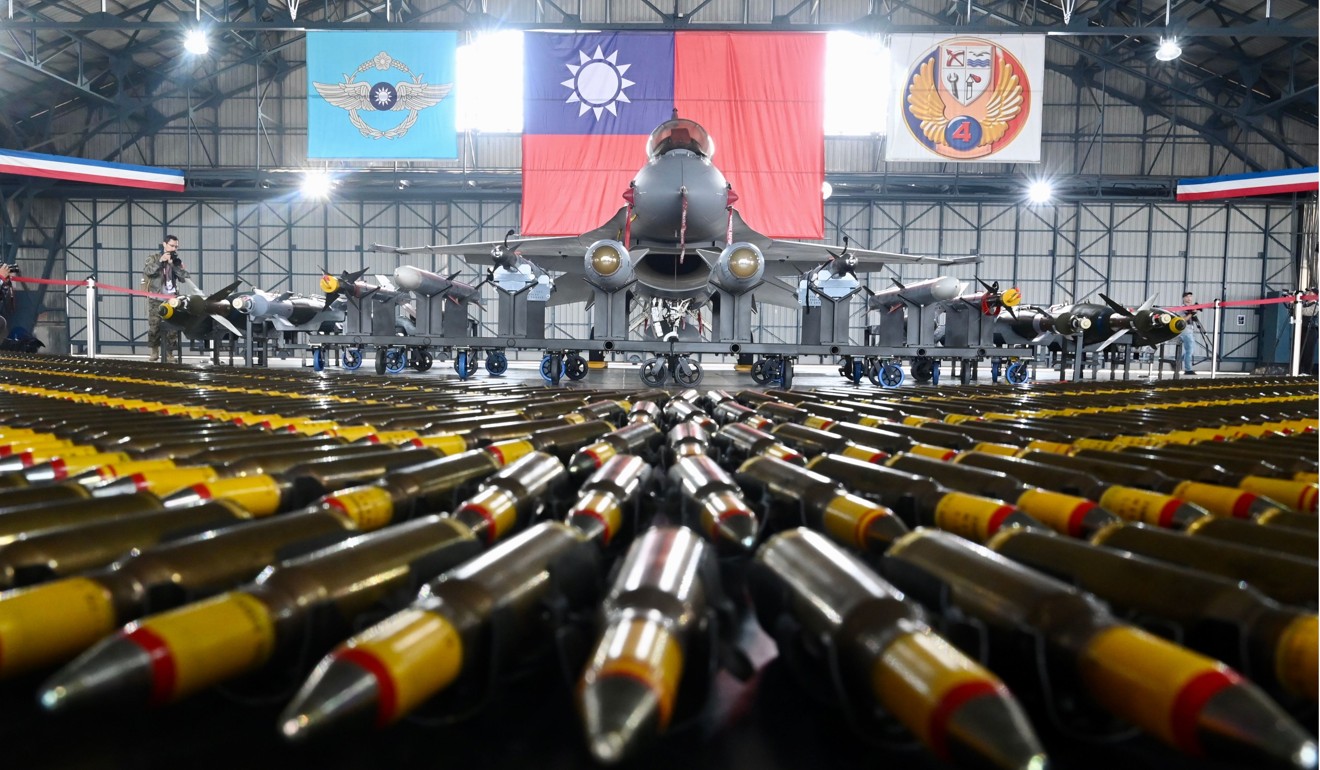
US-made F-16V fighters took part in a show of Taiwan’s military might last week. Photo: AFP
In response to Tsai’s “independent country” comments, Ma Xiaoguang, a spokesman for the mainland’s Taiwan Affairs Office, said: “We firmly attack and counter various forms of Taiwan independence and separatist activities to maintain overall peace and stability in the Taiwan Strait.”
Beijing regards Taiwan as part of its territory awaiting reunification, by force if necessary. Official ties between the two sides have been suspended since Tsai took office in 2016 and refused to accept the one-China principle – the political understanding that there is only one China with ambiguity over whether it is governed by Taipei or Beijing.

Over the past four years Beijing has ramped up the pressure on the island, by poaching its diplomatic allies and staging military drills.

Taiwanese Minister of National Defence Yen Te-fa said earlier that the mainland staged about 2,000 bomber patrols a year near the Taiwan Strait.

For their part, Taiwan’s army and air force last week gave two demonstrations of their readiness to defend the island against attack.

Source: SCMP
14/08/2019

Chinese engineers follow the Sea Dragon with new submersible that can ‘fly’ through water like a plane in the air

  • Developers say their prototype craft could dive to 1,000 metres in five minutes
  • Liu Kaizhou, who also worked the Jiaolong submersible, says ‘We are in uncharted water’
Professor Liu Kaizhou, who developed the autopilot for China’s manned Jiaolong submersible, says his team has designed a vessel that can move through water like a plane moves through the air. Photo: Xinhua
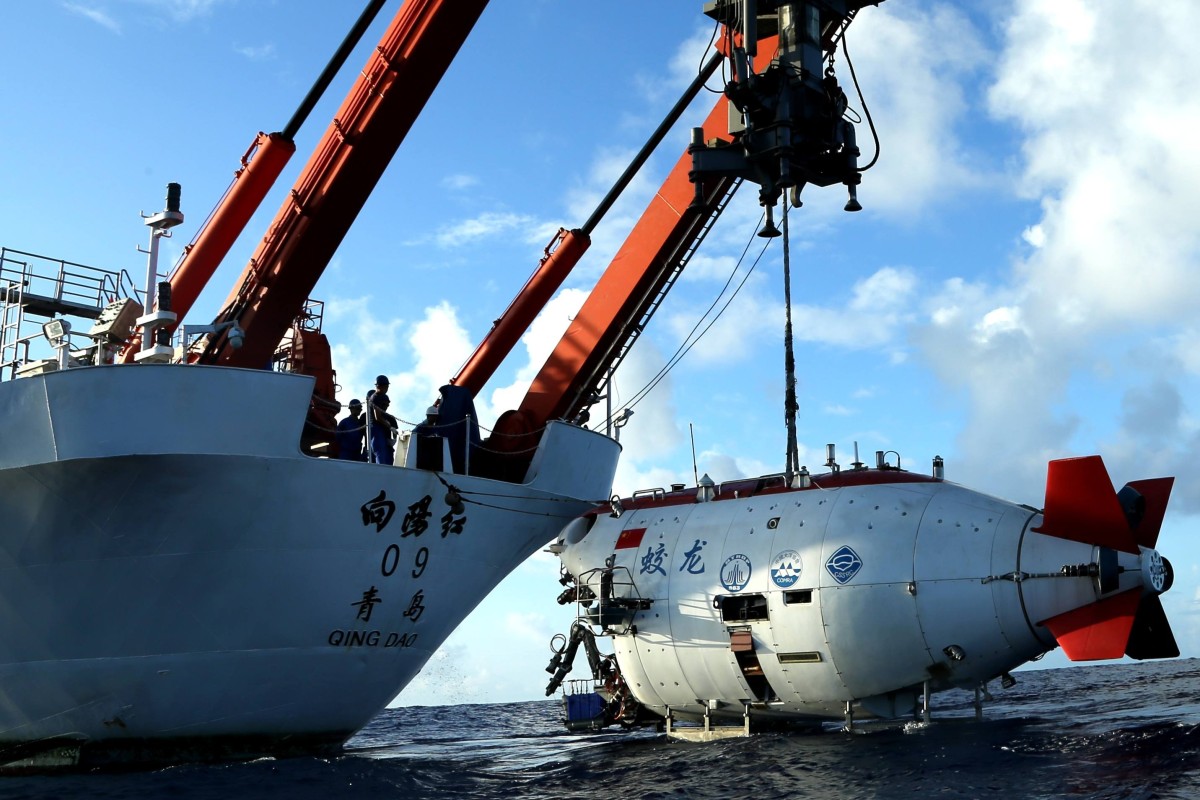
Chinese engineers say they are developing a radical design for a super-fast robot submersible which the project leader, who worked on the manned deep-sea vessel Jiaolong, or Sea Dragon, claims can “fly” in water like a plane travels through the air.

At 3 metres (9.8ft) long, the prototype consists of a cigar-shaped body, with a guidance system in the bow and a jet plane style rudder and a propeller in the stern.

Outriggers house batteries and two more propellers. These are attached to the body by wing-like planes that the developers said will give the vessel the kind of lift in water that takes an aeroplane into the air and back to the earth.

Developers said the prototype will be capable of 10 knots and could dive to a depth of 1,000 metres (3,281 feet) – or surface from that depth – at about three metres a second, taking about 5½ minutes.

Professor Liu Kaizhou, lead scientist of the project at the Shenyang Institute of Automation, part of the Chinese Academy of Sciences in Liaoning province, said the design had great potential.

If a traditional submarine was like an air balloon, he said, the prototype was like an aircraft. “It is technically flying, fast and freely, like a plane for the water.”

The prototype has 20 major components on board, including a computer, and communications and surveillance equipment. These were all developed and tested by the team, but getting them to work together posed some unexpected challenges, Liu said, meaning the transition to operations in a tough marine environment was some time away.

Underwater station could be a game changer, Chinese scientist says

“We aim to make the first open sea test in about a year,” he said.

The submersible can be powered by conventional batteries or a chemical engine that mixes lithium and sulphur hexafluoride to produce heated steam for electrical generators – an energy source often used by torpedoes.

Funded by the Ministry of Science and Technology from 2017, the project was driven by China’s growing ambition to become a superpower in the world’s oceans.

The team said their submersible had the potential to become the backbone of China’s search-and-rescue operations at sea, naval intelligence gathering, high-precision sea floor mapping, or to transport minerals from the seabed to the surface.

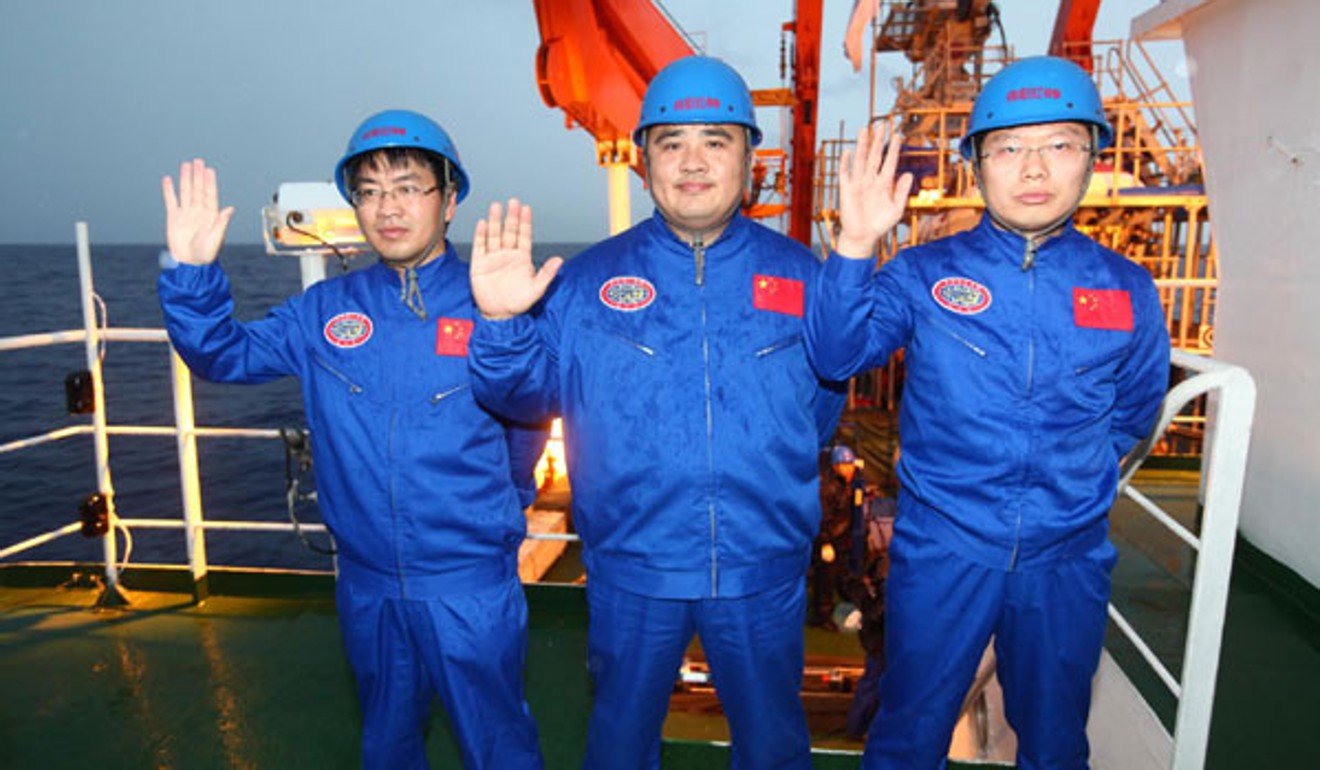
Professor Liu Kaizhou (left) with colleagues Ye Cong and Yang Bo, was instrumental in the success of China’s Jiaolong manned submersible. Photo: Xinhua

Professor Du Tezhuan, a researcher in fluid dynamics at the Institute of Mechanics of the Chinese Academy of Sciences in Beijing, said the design was a bold one but it posed the research team many hard questions.

The density of water was much higher than that of air, he said, which meant the vessel would encounter more drag and would need a strong power source.

“Without sufficient speed, the lift will be weak, and to reach high speeds, lots of energy will be needed. Flying in water is not as easy as flying in the air,” said Du, who was not involved in the project.

Why Beijing is speeding up underwater drone tests in the South China Sea

“But in theory it should work. It is worth a try.”

Liu – who led the design of the autopilot system that can take the Jiaolong to depths of more than 7,000 metres (23,000 ft) – said that after tests on the prototype were complete, other innovations were possible. These included covering the vessel with air bubbles to reduce friction.

“This technology is brand new,” he said. “We are in uncharted water and we are excited by the challenges.”

Source: SCMP

Law of Unintended Consequences

continuously updated blog about China & India

ChiaHou's Book Reviews

continuously updated blog about China & India

What's wrong with the world; and its economy

continuously updated blog about China & India