Chindia Alert: You’ll be Living in their World Very Soon
aims to alert you to the threats and opportunities that China and India present. China and India require serious attention; case of ‘hidden dragon and crouching tiger’.
Without this attention, governments, businesses and, indeed, individuals may find themselves at a great disadvantage sooner rather than later.
The POSTs (front webpages) are mainly 'cuttings' from reliable sources, updated continuously.
The PAGEs (see Tabs, above) attempt to make the information more meaningful by putting some structure to the information we have researched and assembled since 2006.
BEIJING, April 7 (Xinhua) — A Chinese Foreign Ministry spokesperson said Tuesday that China opposes all forms of discrimination and prejudice.
Spokesperson Zhao Lijian made the remarks in a press briefing when responding to media reports that since China tightened immigration control measures to contain imported cases of COVID-19, some foreigners have complained about discrimination and rising xenophobia in China.
“China always attaches great importance to the safety and health of foreign nationals in China and protects their legitimate rights and interests in accordance with the law,” Zhao stressed.
Since the COVID-19 outbreak, relevant departments and local governments in China have made every effort to meet the living, epidemic control and medical needs of the foreign citizens, Zhao said, adding that foreign nationals infected with COVID-19 in China are provided timely treatment.
“China opposes all forms of discrimination and prejudice,” Zhao noted, adding that in light of the development of the epidemic, China has promptly and dynamically adjusted the inspection, quarantine, prevention and control measures for foreign nationals entering into China.
“These are temporary measures that China has to take in response to the current situation by referring to the practices of many countries. China has to do so because we must be responsible for our own people and foreign citizens as well,” Zhao said.
“We always treat foreign nationals and Chinese citizens alike, implement measures without discrimination, give full consideration to the legitimate concerns of the persons concerned and respect their religions and customs. We do not increase or reduce certain regulations on someone just because they are foreign citizens,” Zhao said.
Zhao stressed that all foreigners in China should strictly abide by the Law of the People’s Republic of China on the Prevention and Treatment of Infectious Diseases, as well as other laws and local regulations on epidemic prevention and control.
“We hope foreign citizens in China will continue to fully understand and actively cooperate with China’s epidemic control measures to prevent risks and protect the health and safety of their own and others. That is the way to contribute to the final victory over the epidemic,” he added.
The new coronavirus has been declared a global emergency by the World Health Organization, as the outbreak continues to spread outside China.
“The main reason for this declaration is not what is happening in China but what is happening in other countries,” said WHO chief Tedros Adhanom Ghebreyesus.
The concern is that it could spread to countries with weaker health systems.
Meanwhile, the US has told its citizens not to travel to China.
The state department issued a level four warning – having previously urged Americans to “reconsider” travel to China – and said any citizens in China “should consider departing using commercial means”.
China has said it will send charter plans to bring back Hubei province residents who are overseas “as soon as possible”.
A foreign ministry spokesman said this was because of the “practical difficulties” Chinese citizens have faced abroad. Hubei is where the virus emerged.
At least 213 people in the China have died from the virus, mostly in Hubei, with almost 10,000 cases nationally.
The WHO said there had been 98 cases in 18 other countries, but no deaths.
Most international cases are in people who had been to Wuhan in Hubei.
However in eight cases – in Germany, Japan, Vietnam and the United States – patients were infected by people who had travelled to China.
Getty Coronavirus outbreak outside China
18 The number of countries with cases
14 Cases in Thailand and Japan
13 Singapore
11 South Korea
8 Australia and Malaysia
5 France and USA
Source: WHO and local authorities
Speaking at a news conference in Geneva, Dr Tedros described the virus as an “unprecedented outbreak” that has been met with an “unprecedented response”.
He praised the “extraordinary measures” Chinese authorities had taken, and said there was no reason to limit trade or travel to China.
The US Commerce Secretary, Wilbur Ross, has said the outbreak could “accelerate the return of jobs to North America”.
Preparing other countries
What happens if this virus finds its way into a country that cannot cope?
Many low- and middle-income countries simply lack the tools to spot or contain it. The fear is it could spread uncontrollably and that it may go unnoticed for some time.
Remember this is a disease which emerged only last month – and yet there are already almost 10,000 confirmed cases in China.
The 2014 Ebola outbreak in West Africa – the largest in human history – showed how easily poorer countries can be overwhelmed by such outbreaks.
And if novel coronavirus gets a significant foothold in such places, then it would be incredibly difficult to contain.
We are not at that stage yet – 99% of cases are in China and the WHO is convinced the country can control the outbreak there.
But declaring a global emergency allows the WHO to support lower- and middle-income countries to strengthen their disease surveillance – and prepare them for cases.
How unusual is this declaration?
The WHO declares a Public Health Emergency of International Concern when there is “an extraordinary event which is determined… to constitute a public health risk to other states through the international spread of disease”.
It has previously declared five global public health emergencies:
Swine flu, 2009 – The H1N1 virus spread across the world in 2009, with death toll estimates ranging from 123,000 to 575,400
Polio, 2014 – Although closer than ever to eradication in 2012, polio numbers rose in 2013
Zika, 2016 – The WHO declared Zika a public health emergency in 2016 after the disease spread rapidly through the Americas
Ebola, 2014 and 2019 – The first emergency over the virus lasted from August 2014 to March 2016 as almost 30,000 people were infected and more than 11,000 died in West Africa. A second emergency was declared last year as an outbreak spread in DR Congo
Media caption Inside the US laboratory developing a coronavirus vaccine
How is China handling the outbreak?
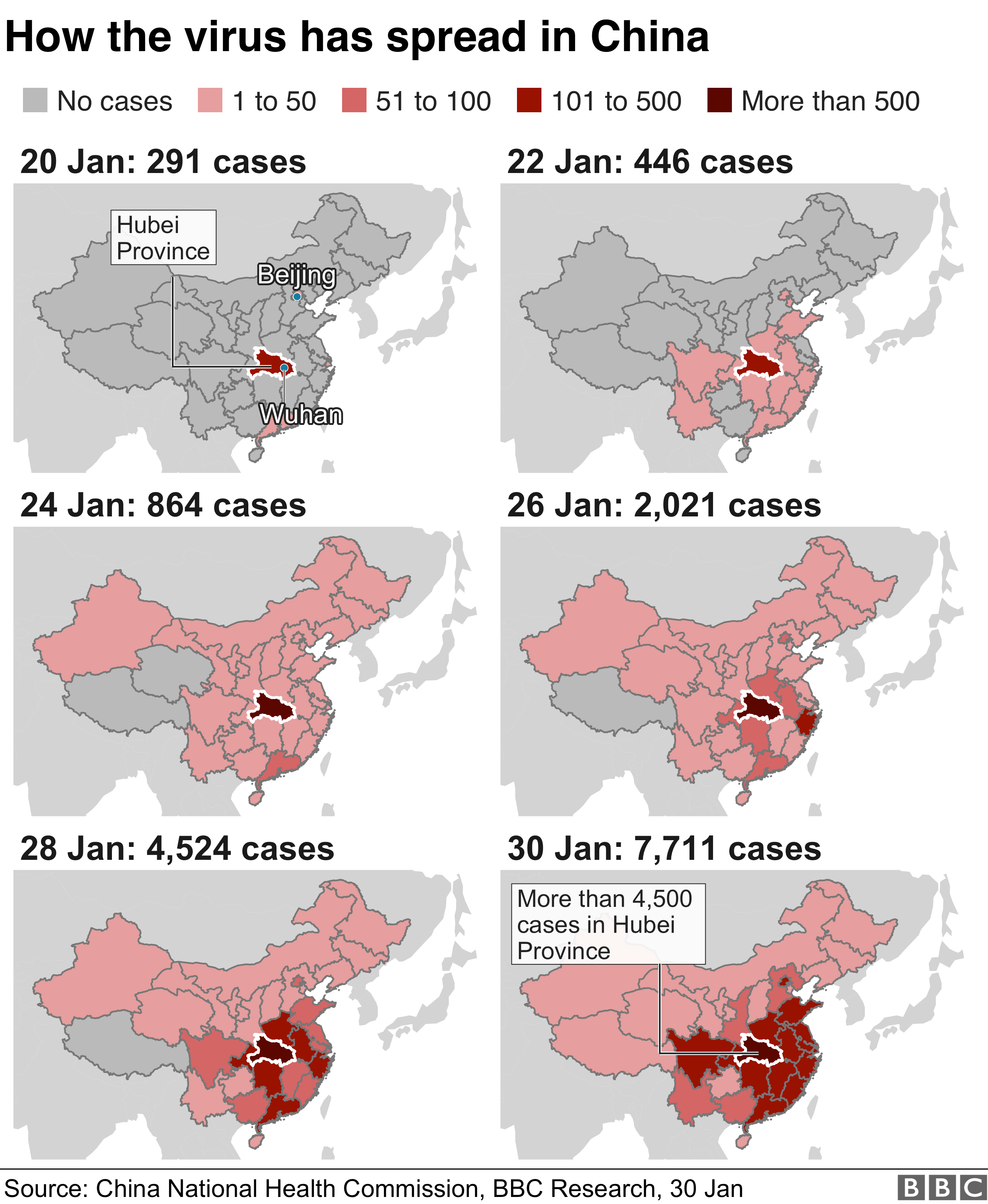
A confirmed case in Tibet means the virus has reached every region in mainland China. According to the country’s National Health Commission, 9,692 cases have tested positive.
The central province of Hubei, where nearly all deaths have occurred, is in a state of lockdown. The province of 60 million people is home to Wuhan, the heart of the outbreak.
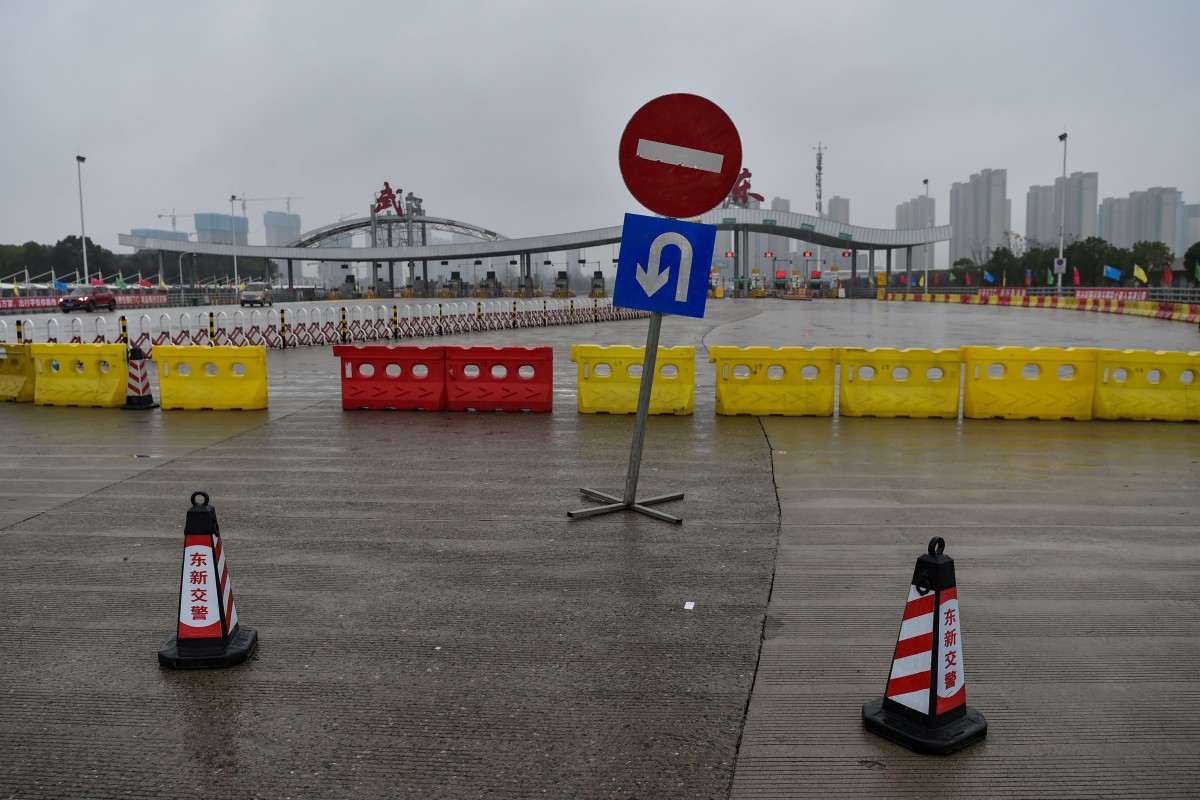
The city has effectively been sealed off and China has put numerous transport restrictions in place to curb the spread of the virus.
People who have been in Hubei are also being told to work from home until it is considered safe for them to return.
The virus is affecting China’s economy, the world’s second-largest, with a growing number of countries advising their citizens to avoid all non-essential travel to the country.
How is the world responding?
Voluntary evacuations of hundreds of foreign nationals from Wuhan are under way.
The UK, Australia, South Korea, Singapore and New Zealand are expected to quarantine all evacuees for two weeks to monitor them for symptoms and avoid contagion.
Australia plans to quarantine its evacuees on Christmas Island, 2,000km (1,200 miles) from the mainland in a detention centre that has been used to house asylum seekers.
In other recent developments:
Italy suspended flights to China after two Chinese tourists in Rome were diagnosed with the virus; earlier 6,000 people on board a cruise ship were temporarily barred from disembarking
In the US, Chicago health officials have reported the first US case of human-to-human transmission. Around 200 US citizens have been flown out of Wuhan and are being isolated at a Californian military base for at least 72 hours
Russia has decided to close its 4,300km (2,670-mile) far-eastern border with China
Two flights to Japan have already landed in Tokyo. Japan has now raised its infectious disease advisory level for China
Some 250 French nationals have been evacuated from Wuhan
India has confirmed its first case of the virus – a student in the southern state of Kerala who was studying in Wuhan
Israel has barred all flight connections with China
Papua New Guinea has banned all visitors from “Asian ports”
Evacuation plan outlined in email as diplomats look for ways to protect foreign nationals
Paris earlier reports three cases on its soil – the first to be identified in Europe
The French consulate in Wuhan is planning to evacuate French nationals from the city to escape the deadly coronavirus. Photo: AFP
Foreign diplomats in Wuhan are scrambling to assess the situation in the coronavirus
-plagued city, with French officials planning to evacuate French nationals trapped by the Chinese government’s lockdown.
The plan would allow French people who want to leave Wuhan, the capital of Hubei province, to travel by bus to Changsha in neighbouring Hunan province, according to an email seen by the South China Morning Post.
“The consulate general, in collaboration with local authorities, plans to set up a bus service to allow French nationals … and their Chinese and foreign spouses and children to travel from Wuhan to Changsha,” it said.
The email, sent by the French consulate, also asked anyone who received it to pass the notice on to other French nationals. It was not clear which bodies received the email and the date of the planned evacuation was not specified.
The consulate could not be reached for comment on Saturday.
France, the United States, Britain and South Korea all have consulates in Wuhan, according to China’s foreign ministry.
The South Korean consulate said in a post on its website that it would suspend all visa applications “indefinitely until further notice”.
A diplomatic source said several foreign embassies in China were considering plans to evacuate their nationals from Wuhan.
First coronavirus case ‘had no links to seafood market’
25 Jan 2020
It is not known how many foreigners remain in the city, which has a population of about 11 million and has been under a government-imposed lockdown since Thursday morning.
French Foreign Minister Jean-Yves Le Drian said in a statement on Friday that Paris was monitoring the crisis and “can increase the power [to respond] if necessary”.
There have so far been three confirmed cases of the new coronavirus in France, in Paris and Bordeaux.
French Foreign Minister Jean-Yves Le Drian said on Friday that Paris was monitoring the crisis in China. Photo: AFP
The US said earlier that most of its consulate staff and their families had been pulled out of Wuhan.
An emailed inquiry to the British consulate in the city received only an automated reply, saying: “Wuhan is now in crisis mode. We may not be able to answer your emails for some time.”
The consulate would be closed for the Lunar New Year holiday until January 31, it said.
Meanwhile, British citizen Kharn Lambert told the BBC on Thursday how he had been “trapped” in Wuhan.
The PE teacher said he was afraid to leave his house for fear of catching the deadly virus.
“If you saw the street behind me at night time where I normally live … if I show you out there now, it’s dead,” he said.
More than 1,280 confirmed cases have been reported across China, of which more than 700 were in Hubei, according to local government figures released on Saturday.
The death toll in Hubei stands at 39, with two other fatalities reported in the provinces of Hebei and Heilongjiang.
Tens of millions of people in Hubei are effectively on lockdown since a travel ban was imposed on most of the province.
Flights, trains, buses and ferries connecting Wuhan to other cities in Hubei have been suspended. Rail authorities in Wuhan, which is a hub for several major high-speed lines, said operations at 61 stations and more than 400 train services had been suspended until further notice.







 CHINDIA ALERT: You'll be living in their world, very soon