Archive for ‘foreign trade’

09/05/2020

Xinhua Headlines: World’s factory turns to domestic market amid global coronavirus recession

— As the continued global spread of COVID-19 is weighing on the world economy, China’s foreign trade is under considerable downward pressure.

— Many export-oriented companies in China are turning to the domestic market for a lifeline while grappling with dropping overseas orders as major markets remain in the grip of the pandemic.

by Xinhua writers Zhang Yizhi, Li Huiying, Hu Guanghe, Xu Ruiqing

FUZHOU, May 9 (Xinhua) — Walking back and forth between shelves of neatly stacked shoes, some 20 live streamers dashed at the instructions of their followers on the phone, grabbing a shoe now and then from the shelves for a close-up in front of the camera.

At around eight o’clock every night, the supply chain platform 0594 in the city of Putian, east China’s Fujian Province, springs to life as live streamers flock to the exhibition area to sell shoes produced by the local manufacturers, many of which are troubled by the cancellations or delays of overseas orders amid the global coronavirus pandemic.

“To get rid of the excess inventory, many manufacturers in Putian are turning to live streaming to explore the domestic market,” said Chen Xing, general manager of 0594. “We are now cooperating with over 40 manufacturers and there will be more of them joining us in the future.”

The platform is also building an internet celebrity incubator and has so far organized seven rounds of influencer training courses enrolling more than 200 attendees.

Huang Huafang, 39, signed up for the two-day crash course in late March and soon after started her first live streaming session. She works from around 2 p.m. to 10 p.m., attracting over 500 followers and selling more than 20 pairs of shoes every day.

Though she is not a well-known live streamer, she is optimistic about the future. “There is a long way to go, but I believe live streaming is a trend. It is an essential skill for anyone who wants to market online,” said Huang.

A staff sells shoes through live streaming at an e-commerce warehouse in Putian, southeast China’s Fujian Province, May 7, 2020. (Xinhua/Lin Shanchuan)

According to Chen, the platform 0594 sold almost 130,000 pairs of shoes in April alone. As the domestic economic outlook continues to pick up, the sales target of May has been set at 200,000 pairs.

Like manufacturers in Putian, a city with a large number of export-oriented enterprises, many Chinese factories are turning to the domestic market for a lifeline, while grappling with dropping overseas orders as major markets remain in the grip of the pandemic.

ADAPT OR DIE

With decades of experience in manufacturing and developing products for overseas clients, some export-oriented companies in China are rolling out products catering to the domestic market.

After months of gloomy business, Wu Songlin, general manager of Putian-based Hsieh Shun Footwear Co., Ltd., heaved a sigh of relief as trucks loaded with therapeutic shoes tailored to the home market left his factory.

It was the first shipment for the domestic market since Wu and his partners started the company in 2010. In the past, his company only had two clients, one from Europe and the other from Japan. Business used to run smoothly and life was good.

But his factory was on the brink of a shutdown in March when the coronavirus pandemic started to ravage the global economy. No new orders came in and shipments of existing orders were requested to be delayed until June.

People work in a footwear workshop in Putian, southeast China’s Fujian Province, April 27, 2020. (Xinhua/Lin Shanchuan)

“Orders were canceled after completion of production, and our capital flow is stuck in our inventory. The pressure is mounting to keep the factory running,” Wu said. “By the end of June, workers would be left with no work to do as soon as we complete the existing orders.”

After losing almost all their orders from overseas clients, the desperate shoemaker turned to the domestic market. He called one of his old business partners and secured an order for massage footwear, which is selling like hot cakes in the domestic market as health tops the agenda in the time of the novel coronavirus.

The factory produced 10,000 pairs of massage shoes in April, and the number is expected to reach 30,000 in May, enough to keep the production lines running.

Thanks to the company’s quick adaptation, about 200 workers kept their jobs in the factory, while 20 percent were furloughed and the remaining workers were arranged to work in other companies as part of the city’s employee sharing program.

“If domestic orders keep coming in, our operation will hopefully get back to normal by September when the monthly output of massage shoes will reach 90,000,” Wu said. “By then the company will live and thrive without any orders from overseas customers.”

A woman works in a workshop of Hsieh Shun Footwear Co., Ltd. in Putian, southeast China’s Fujian Province, May 7, 2020. (Xinhua/Lin Shanchuan)

But switching to another market is not easy, explained Wu. In the past, export-oriented factories were only in charge of manufacturing, while brands would take care of sales, promotion as well as customer support.

“If you are selling to the domestic market, you need to have your own brand and marketing capacity,” he said. “Working with e-commerce platforms could be one way out, but it’s more important to understand domestic consumers and meet their needs.”

CUSTOMIZE THE FUTURE

For years, many export-focused manufactures have been trying to climb up the value chain and tap the uncharted waters of the domestic market. As the pandemic continues to spread, there is a strong push for them to embrace customized manufacturing.

In an experience store located in downtown Putian, customers line up waiting to have their feet measured on a smart device. After a few seconds, they get their readings on the phone, and a few swipes and clicks later, they place their orders with unique features, colors, and shapes.

Adjacent to the experience store, there is a flexible manufacturing workshop, which gives quick responses to orders and produces shoes following the customized demands of individual buyers.

SEMS, a longstanding sports footwear manufacturer that has established a partnership with several international brands, started to adopt flexible manufacturing years ago in an effort to adapt to the evolving domestic market.

A customer has her feet measured on a smart device in sports footwear manufacturer SEMS in Putian, southeast China’s Fujian Province, May 8, 2020. (Xinhua/Lin Shanchuan)

Customization gives consumers the benefit of products that fit their needs, and at the same time allows factories to utilize improved workflows and technology to maintain high output and omit the process of inventory and distribution, said Zhu Yizhen, the executive vice president of the company.

“Currently we only sell over 100 pairs of customized shoes a day, but we are at the dawn of a new era,” Zhu said. “We hope more companies awaken to the developing trend and join in the practice of mass customization.”

Customer to manufacturer, or C2M, which allows consumers to place orders directly to factories for customized products, has become a buzzword among export-oriented manufacturers hoping to reach domestic consumers amid the pandemic.

Li Junjie, who runs a ceramic flowerpot plant in Fujian’s Dehua County, one of the manufacturing centers of ceramics in China, did not sell a single pot to his overseas customers since the coronavirus outbreak in late January.

The factory used to export 30 percent of its flowerpots to the United States and Spain, but Li managed to make up for the lost deals by selling on domestic e-commerce platforms. Instead of bulk orders placed by foreign clients, domestic consumers tend to purchase customized products in small amounts.

Photo shows the automatic production line of a customized workshop in sports footwear manufacturer SEMS in Putian, southeast China’s Fujian Province, May 8, 2020. (Xinhua/Lin Shanchuan)

With the big data provided by e-commerce platforms, Li can tell which items will be a hit so as to increase their production and develop new products based on a thorough analysis of different consumer groups.

“Our online sales almost doubled over the past year, and we have sold over 100,000 customized pots this year, thanks to the C2M business model,” Li said.

Li’s company is one of many Chinese small and medium-sized enterprises (SMEs) that have benefited from the e-commerce giant Alibaba’s Spring Thunder Initiative, which is aimed at helping export-focused SMEs expand into new markets.

The initiative will also help some SMEs to transform and develop their business in the Chinese market through measures such as resource support, fee reductions, and fast-track processing.

Source: Xinhua

25/04/2020

Coronavirus: China’s belt and road plan may take a year to recover from slower trade, falling investment

  • But trade with partner countries might not be as badly affected as with countries elsewhere in the world, observers say
  • China’s trade with belt and road countries rose by 3.2 per cent in the January-March period, but second-quarter results will depend on how well they manage to contain the pathogen, academic says
China’s investment in foreign infrastructure as part of its Belt and Road Initiative has been curtailed because of the coronavirus pandemic. Photo: Xinhua
The coronavirus pandemic is set to cause a slump in Chinese investment in its signature

Belt and Road Initiative

and a dip in trade with partner countries that could take a year to overcome, analysts say.

But the impact of the health crisis on China’s economic relations with nations involved in the ambitious infrastructure development programme might not be as great as on those that are not.
China’s total foreign trade in the first quarter of 2020 fell by 6.4 per cent year on year, according to official figures from Beijing.
Trade with the United States, Europe and Japan all dropped in the period, by 18.3, 10.4 and 8.1 per cent, respectively, the commerce ministry said.
By comparison, China’s trade with belt and road countries increased by 3.2 per cent in the first quarter, although the growth figure was lower than the 10.8 per cent reported for the whole of 2019.
China’s trade with 56 belt and road countries – located across Africa, Asia, Europe and South America – accounts for about 30 per cent of its total annual volume, according to the commerce ministry.

Despite the first-quarter growth, Tong Jiadong, a professor of international trade at Nankai University in Tianjin, said he expected China’s trade with belt and road countries to fall by between 2 and 5 per cent this year.

His predictions are less gloomy than the 13 to 32 per cent contraction in global trade forecast for this year by the World Trade Organisation.

“A drop in [China’s total] first-quarter trade was inevitable but it slowly started to recover as it resumed production, especially with Southeast Asian, Eastern European and Arab countries,” Tong said.

“The second quarter will really depend on how the epidemic is contained in belt and road countries.”

Nick Marro, Hong Kong-based head of global trade at the Economist Intelligence Unit, said he expected China’s total overseas direct investment to fall by about 30 per cent this year, which would be bad news for the belt and road plan.

“This will derive from a combination of growing domestic stress in China, enhanced regulatory scrutiny over Chinese investment in major international markets, and weakened global economic prospects that will naturally depress investment demand,” he said.

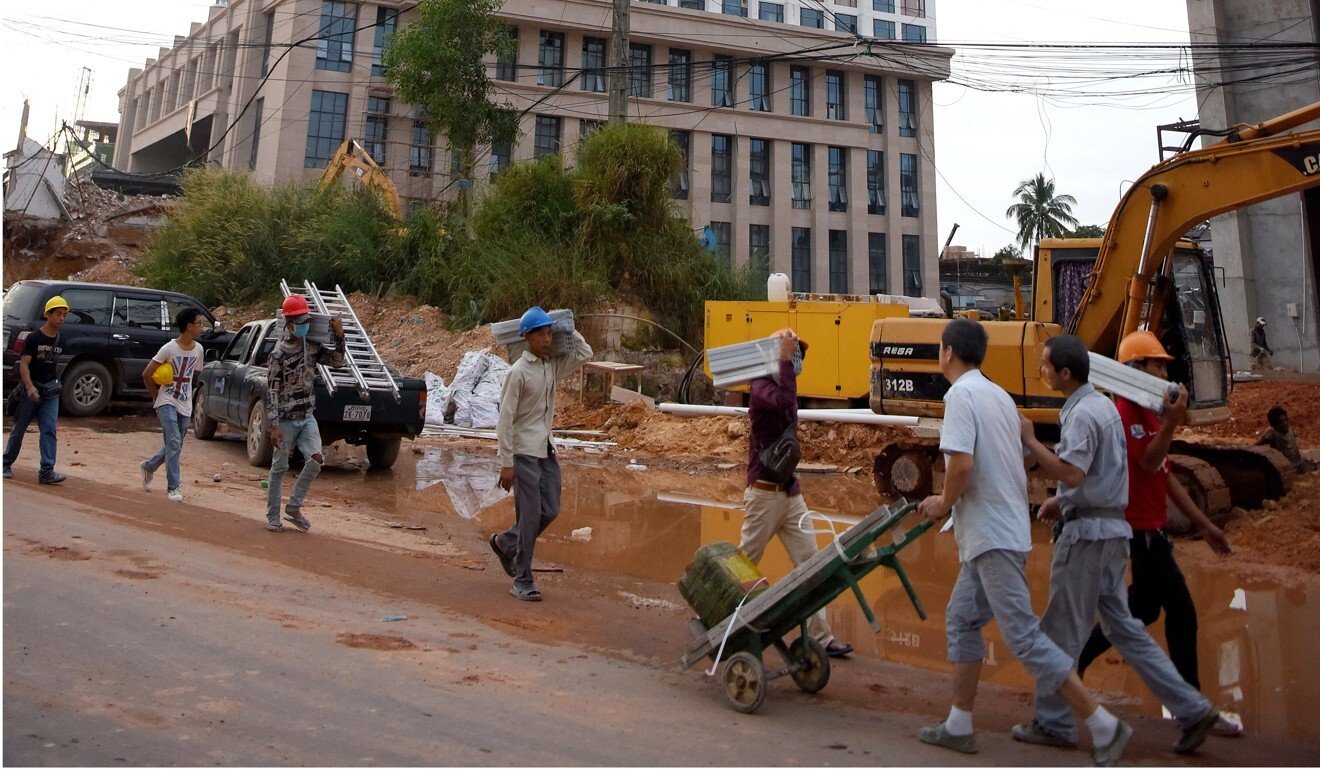
The development of the Chinese built and operated special economic zone in the Cambodian town of Sihanoukville is reported to have slowed, while infrastructure projects in Bangladesh, including the Payra coal-fired power plant, have been put on hold.

The development of the Chinese built and operated special economic zone in the Cambodian town of Sihanoukville is reported to have slowed. Photo: AFP
Marro said the reduction of capital and labour from China might complicate other projects for key belt and road partner, like Pakistan, which is home to infrastructure projects worth tens of billions of US dollars, and funded and built in large part by China.

“Pakistan looks concerning, particularly in terms of how we’ve assessed its sovereign and currency risk,” Marro said.

“Public debt is high compared to other emerging markets, while the coronavirus will push the budget deficit to expand to 10 per cent of GDP [gross domestic product] this year.”

Last week, Pakistan asked China for a 10-year extension to the repayment period on US$30 billion worth of loans used to fund the development of infrastructure projects, according to a report by local newspaper Dawn.

China’s overseas investment has been falling steadily from its peak in 2016, mostly as a result of Beijing’s curbs on capital outflows.

Last year, the direct investment by Chinese companies and organisations other than banks in belt and road countries fell 3.8 per cent from 2018 to US$15 billion, with most of the money going to South and Southeast Asian countries, including Singapore, Vietnam, Indonesia and Pakistan.

Tong said the pandemic had made Chinese investors nervous about putting their money in countries where disease control measures were becoming increasingly stringent, but added that the pause in activity would give all parties time to regroup.

“Investment in the second quarter will decline and allow time for the questions to be answered,” he said.

“Past experience along the belt and road has taught many lessons to both China and its partners, and forced them to think calmly about their own interests. The epidemic provides both parties with a good time for this.”

Dr Frans-Paul van der Putten, a senior research fellow at Clingendael Institute in the Netherlands, said China’s post-pandemic strategy for the belt and road in Europe
might include a shift away from investing in high-profile infrastructure projects like ports and airports.
Investors might instead cooperate with transport and logistics providers rather than invest directly, he said.
“Even though in the coming years the amount of money China loans and invests abroad may be lower than in the peak years around 2015-16, I expect it to maintain the belt and road plan as its overall strategic framework for its foreign economic relations,” he said.
Source: SCMP
15/04/2020

China’s foreign trade shows signs of stabilizing in March

#CHINA-JIANGSU-LIANYUNGANG-TRADE (CN)Photo taken on April 14, 2020 shows containers at the Lianyungang Port in Lianyungang City, east China’s Jiangsu Province. China’s foreign trade showed signs of stabilizing in March with export and import both beating bearish market expectations, official data showed Tuesday. (Photo by Geng Yuhe/Xinhua)

Source: Xinhua

10/04/2020

China encourages export goods sales domestically as virus batters global trade

BEIJING (Reuters) – China will promote the sales of export products in domestic markets, as foreign trade faces unprecedented challenges due to the coronavirus pandemic, an assistant commerce minister said on Friday.

As the coronavirus spreads to almost all of China’s trading partners, the world’s second-largest economy is set to reach a grim milestone for full year growth, with the pace of expansion likely to be the slowest since the Cultural Revolution ended in 1976. And, the export sector is facing millions of job losses and factory shutdowns.

“Due to the rapid spread of the epidemic in the world, foreign demand has slumped and the biggest difficulty facing foreign trade companies is the plunge in orders,” said Ren Hongbin, the assistant minister at the Ministry of Commerce.

He said firms across the board have had their orders cancelled or delayed, and new orders are “very hard to sign”.

“The uncertainty about the pandemic has become the biggest uncertainty for foreign trade development.”

Forecasters expect China’s 2020 growth could be nearer the 2.0% mark – the slowest in over 40 years – due to the sweeping impact of the pandemic both at home and overseas. The economy grew 6.1% last year.

China’s overseas shipments fell 17.2% in January-February from the same period a year earlier, marking the steepest fall since February 2019. Imports sank 4% from a year earlier.

Among the government measures to support the sector, China is accelerating efforts to build online trade fairs and guiding exporters to work with e-commerce retailers for sales in domestic markets and coordinating with its trading partners to stabilise supply chains, said Ren.

The Canton Fair, China’s oldest and biggest trade fair due to take place online, will feature live-streaming services for participants, Li Xingqian, another commerce ministry official, told the same briefing. The fair was originally scheduled to begin on April 15, but was postponed due to the coronavirus outbreak.

China is willing to boost trade relations with other countries, including the United States, under the new circumstances, said Ren, adding that Beijing hopes to work together with Washington to promote bilateral trade.

Both countries have been engaged in a near two-year long trade war with tit-for-tat tariffs on each other’s goods, before negotiators called a truce with an interim trade deal in January.

Source: Reuters

08/04/2020

China to set up new integrated pilot zones for cross-border e-commerce to stabilize foreign trade, investment

BEIJING, April 7 (Xinhua) — China will set up 46 new integrated pilot zones for cross-border e-commerce, as well as support processing trade with new steps and hold the Canton Fair online to keep foreign trade and investment stable amid the epidemic, according to the State Council’s executive meeting chaired by Premier Li Keqiang Tuesday.

Figures from the General Administration of Customs showed that the retail sales of China’s cross-border e-commerce businesses reached 186.21 billion yuan (about 26.25 billion U.S. dollars) in 2019.

The Tuesday meeting noted the massive impact of the fast-evolving outbreak worldwide on the global economy, trade and investment. The fast growth of cross-border e-commerce in recent years has become a new highlight in the country’s foreign trade. It is important to leverage the unique strength of cross-border e-commerce when the traditional sectors in foreign trade are hit hard in the COVID-19 outbreak, in order to drive foreign trade with new business forms in this trying time.

“Tackling the economic impact of the outbreak abroad is a pressing task. With the tight containment measures introduced across countries, foreign trade and investment are persistently going downward,” Li said.

The meeting decided to set up another 46 integrated pilot zones for cross-border e-commerce on top of the 59 existing ones. In addition to applying the practices proven effective in boosting the flow of commerce, firms in these zones will enjoy such support policies as exemption of value-added and consumption taxes on retail exports, and assessed levy of the corporate income tax.

Integrated pilot zones with proper conditions will be listed into the pilot program on retail imports of cross-border e-commerce. Companies will be supported to jointly build and share overseas warehouses.

“We must accelerate the development of cross-border e-commerce and other new models to boost foreign trade and investment. Competent departments must exercise sound quality supervision and ensure unimpeded logistic services,” Li said.

Measures to boost processing trade are also discussed at the meeting. With processing trade accounting for one fourth of the country’s foreign trade, the meeting stressed the need to coordinate domestic and foreign trade and help companies engaged in processing trade tackle their difficulties, as well as to stabilize foreign investment and employment.

“In a globalized world, countries all have a stake in each other’s future. The Chinese economy has been deeply integrated into the world economy. We must promptly analyze the outbreak’s impact on the industrial chains and work out our policy response accordingly. This is vitally important for stabilizing employment,” Li said.

It was decided at the meeting that interests of the deferred tax for the bonded materials or finished products in processing trade sold domestically will be temporarily waived till the end of this year. The pilot program where processing trade companies may pay duty for their domestic sales as either imported materials or finished goods will be extended to all the integrated bonded zones.

The category of industries where foreign investment is encouraged will be expanded, and the list of prohibited goods in processing trade will be shortened.

“We must take a holistic approach in developing domestic and foreign trade, and swiftly introduce support policies prioritizing the domestic sales by processing trade companies,” Li added.

It was also decided that given the serious outbreak situation globally, the 127th China Import and Export Fair, also known as Canton Fair, will be hosted online in mid- to late June.

Companies from home and abroad will be widely invited to exhibit their products online. Powered by advanced information technology, the Fair will provide around-the-clock services for online product promotion, matchmaking and business negotiations. It will be an Internet-enabled foreign trade platform of quality and specialty products where Chinese and foreign businesses may place orders and cut deals without the hassle of travel.

Source: Xinhua

11/03/2020

China unveils new measures to keep foreign trade, investment stable

BEIJING, March 11 (Xinhua) — China will take new measures to keep the foreign trade and investment stable, and help the enterprises tide over difficulties to mitigate the impact of the coronavirus outbreak.

Further steps will be taken to smooth the industrial and capital chain, and promote work and production resumption in coordination, according to a State Council executive meeting chaired by Premier Li Keqiang Tuesday.

Li urged continued efforts to give better play to the role of reloan and rediscount to ensure supply of materials for epidemic prevention and control and support firms in difficulty.

Source: Xinhua

02/03/2019

East China Fair opens in Shanghai

SHANGHAI, March 1 (Xinhua) — The 29th East China Fair, the largest regional trade fair in China, opened in Shanghai Friday.

More than 3,500 Chinese companies and over 450 overseas companies are taking part in the four-day event.

Over 5,800 booths, arranged under five categories from garments to modern lifestyle, cover an exhibition area of 126,500 square meters.

Customs data showed China’s foreign trade grew 9.7 percent year on year to a historic high of 30.51 trillion yuan (4.55 trillion U.S. dollars) in 2018.

The annual fair, established in 1991, is jointly held by nine provinces and cities in east China. It is regarded as an important barometer of China’s foreign trade.

Source: Xinhua

02/03/2019

China’s private business hub to increase trade with Africa

HANGZHOU, March 1 (Xinhua) — East China’s Zhejiang Province plans to increase its trade volume with Africa to 40 billion U.S. dollars by the end of 2022 to account for at least 20 percent of the total Sino-Africa trade.

Zhejiang’s department of commerce issued an action plan revealing the details on Friday as China’s first provincial-level plan on economic cooperation with African countries.

The 40-billion-dollar target will mark a significant rise from the 30.1-billion-dollar trade between Africa and Zhejiang, home to many of China’s most successful private businesses, in 2018.

The plan also promises to increase investments in Africa’s industries of textiles, garments, chemicals, equipment manufacturing and pharmaceuticals to meet the continent’s development needs.

The province, however, will bar investments that are polluting and highly energy-consuming from going to Africa, said the plan, which also calls for more agricultural investments and cooperation.

The document also said the province would expand goods imports from Africa, especially in the non-resources category.

According to China Customs, China’s foreign trade with Africa reached 204.19 billion dollars in 2018, up 19.7 percent year-on-year and 7.1 percentage points higher than the growth of China’s overall foreign trade during the same period.

Specifically, the country’s exports to Africa rose 10.8 percent to 104.91 billion dollars in 2018, while its imports from Africa surged 30.8 percent to reach 99.28 billion dollars.

Source: Xinhua

18/01/2019

China upbeat about 2019 foreign trade growth: MOC

BEIJING, Jan. 17 (Xinhua) — China is confident in its ability to keep foreign trade growth stable while improving its quality this year despite greater external uncertainties, the Ministry of Commerce (MOC) said Thursday.

“The development of China’s foreign trade remains on a strong and solid foundation,” MOC spokesperson Gao Feng told a news conference.

The confidence derives from deepening supply-side structural reform, improvement in the country’s foreign trade structure and increasing internal impetus to growth, Gao said.

The ministry has unveiled a list of 30 key markets for foreign trade expansion this year, which will see China actively tap into the potential of emerging and developing economies related to the Belt and Road Initiative while continuing to explore the traditional markets in developed countries.

Gao said the ministry will offer enterprises greater support including trade promotion, public information services and government institutional safeguards for trade market diversification.

“We will roll out more measures in a targeted and timely manner to help foreign trade firms turn challenges into opportunities and achieve innovational development,” Gao said.

Commenting on the decline of China’s foreign trade growth in December, Gao said the growth in the fourth quarter was still within reasonable range despite the monthly fluctuation.

“The fluctuation was mainly caused by weaker demand in the international market and a high basis the previous year,” he said.

China’s import and export volume hit a historic high of 30.51 trillion yuan (about 4.5 trillion U.S. dollars) in 2018, up 9.7 percent year-on-year, official data showed.

Source:Xinhua

16/01/2019

Economic Watch: Private enterprises show great confidence in foreign trade

GUANGZHOU, Jan. 15 (Xinhua) — China’s import and export volume in 2018 rose 9.7 percent year on year to more than 30 trillion yuan (4.4 trillion U.S. dollars), a record high amid the complex circumstances mainly thanks to the country’s robust ang resilient private sector.

“Private enterprises contributed more than half to China’s foreign trade growth in 2018, a bright spot of China’s foreign trade development,” said Li Kuiwen, spokesperson of the General Administration of Customs.

This indicates the private sector’s stronger presence in driving China’s foreign trade.

Song Ziqiang, head of the import and export department of Kingfa Technology Co., Ltd., said his company had achieved over 10 percent growth in both imports and exports in 2018.

“In particular, our exports of biodegradable plastics, a high value-added new material, rose 117 percent year on year, accounting for about a third of such products in the European market,” Song said.

As a private new material enterprise in the southern Guangdong Province, Kingfa uses more than 4 percent of the company’s annual sales revenue for research and development in high-performance new materials such as special plastics and carbon fiber.

“With high-tech innovation and government support for private companies and the real economy, we are confident to realize high-quality development this year,” said Song.

New trade forms and business models, including cross-border e-commerce, are showing greater vitality, according to Gu Xueming, head of the Chinese Academy of International Trade and Economic Cooperation under the Ministry of Commerce.

“The effect of China’s foreign trade transformation and structural adjustment will be further demonstrated,” Gu said.

The official data shows that China’s total retail imports and exports via cross-border e-commerce management platforms of customs increased by 50 percent in 2018.

“Tariff cuts have attracted more overseas quality commodities to China, and consumer goods for daily use have become one of the import priorities,” said Huang Hongying, vice president of Vipshop Holdings Ltd., a Chinese online discount retailer.

“The expanded imported consumer goods market brings new opportunities for e-commerce platforms. Our foreign purchases are estimated to exceed 10 billion yuan in the future,” Huang said.

China’s home appliance marker Galanz exported its products to more than 70 countries and regions along the Belt and Road in 2018. About 3 million microwave ovens were exported. Demands in Southeast Asia have increased significantly, according to Liang Zhaoxian, president of the company.

Domestic appliances are one of China’s major export products. Under the Belt and Road Initiative, the company plans to build more branches along the routes and bring more quality products and services to customers, he said.

China’s robust economy and improved services have also provided a strong impetus for foreign companies to invest in the country. More than 60,000 foreign-funded enterprises were set up in China last year, up 69.8 percent compared with 2017, according to the Ministry of Commerce.

In 2018, Guangdong, a major hub for foreign trade, attracted tens of billions of dollars of investment in petrochemical projects from Germany chemical company BASF SE and U.S. energy giant ExxonMobil. Foreign companies including Toyota, Shell and Hitachi also expanded their investment and production in the province.

“Our efforts in boosting foreign capital use and creating a better business environment have made a significant contribution to Guangdong’s stable development of foreign trade,” Yang Yong, deputy director of the Guangzhou Municipal Bureau of Commerce.

Source: Xinhua

Law of Unintended Consequences

continuously updated blog about China & India

ChiaHou's Book Reviews

continuously updated blog about China & India

What's wrong with the world; and its economy

continuously updated blog about China & India