Chindia Alert: You’ll be Living in their World Very Soon
aims to alert you to the threats and opportunities that China and India present. China and India require serious attention; case of ‘hidden dragon and crouching tiger’.
Without this attention, governments, businesses and, indeed, individuals may find themselves at a great disadvantage sooner rather than later.
The POSTs (front webpages) are mainly 'cuttings' from reliable sources, updated continuously.
The PAGEs (see Tabs, above) attempt to make the information more meaningful by putting some structure to the information we have researched and assembled since 2006.
The Legend of 1900 is taking more at the box office than the latest international and domestic blockbusters
An appetite for enhanced editions and 3D might have something to do with the surprise success of Giuseppe Tournatore’s forgotten flick
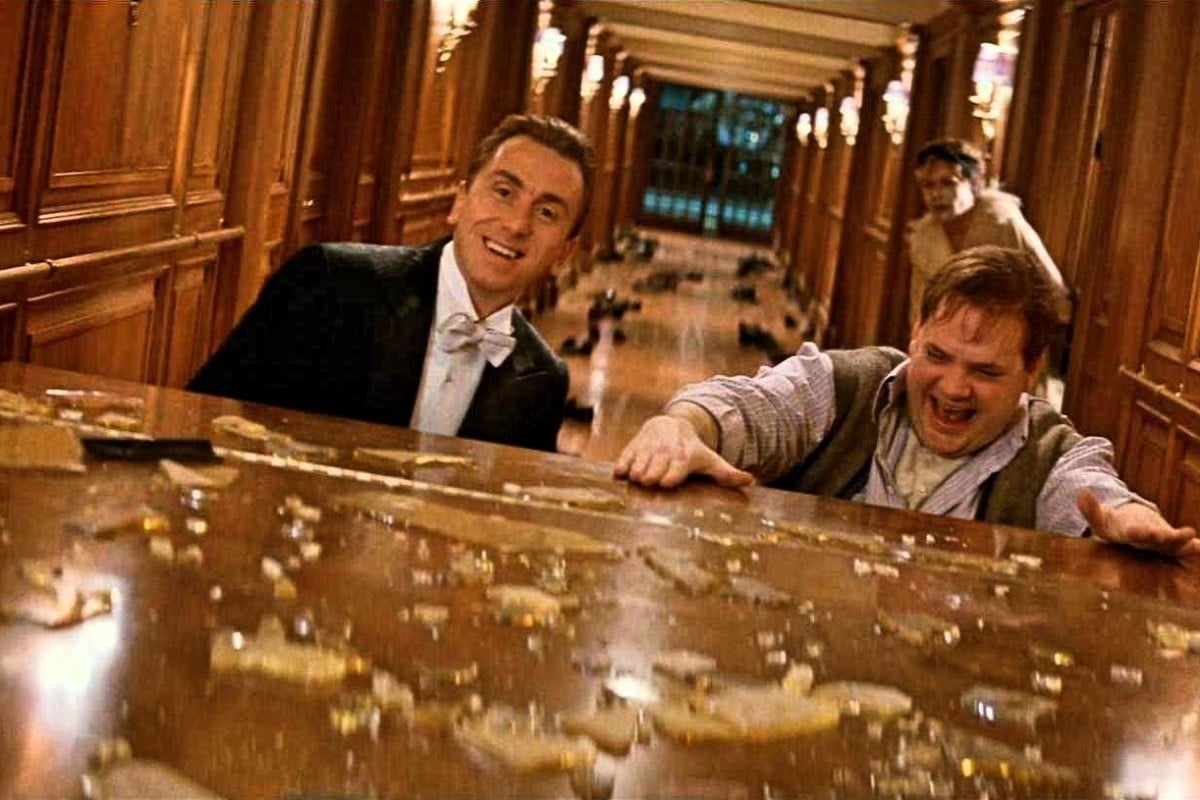
Tim Roth (left) stars in The Legend of 1900, the Giuseppe Tournatore that has taken Chinese cinema by storm.
China’s consumer class is always looking for the latest, most cutting-edge smartphone app or the most talked-about viral video. Who would have predicted, then, that a 21-year-old movie would take Chinese cinema by storm over the past few weeks?
What’s incredible is that The Legend of 1900 was hardly a classic in the first place.
Revolving around a piano prodigy (played by Tim Roth) who has spent his entire life on board an ocean liner, the movie received mixed reviews on its release in 1998, with disapproving critics lambasting it as “fragile” (Variety), “overwrought” (San Francisco Chronicle), schmaltz that “drowns in its own treacle” (Salon.com). The first English-language feature by Italian director Giuseppe Tornatore faded fast into obscurity, never reaching the heights of his revered Cinema Paradiso(1988).
And then Chinese audiences came to its rescue. Having never been released in China, Legend finally unspooled in mainland cinemas on November 15, alongside local romantic drama Somewhere Winter and Hollywood’s latest reboot, Charlie’s Angels.
Rather than becoming a sideshow to these two headlining blockbusters, the film broke out of the arthouse scene and crossed over to the mainstream: its opening weekend gross of 63.1 million yuan (HK$70.2 million) topped that of Angels, and its average of 13 viewers for each screening was higher than both Winter (11 viewers per screening) and Angels, which crashed with a mere eight.
A fortnight into its run, Legend had generated more than 130 million yuan, eclipsing its total takings of the past two decades. To put this into context, the film took in US$167,435 during its month-long release in the United States, in 1999. Adjusted for inflation, this figure would be about US$258,635 today, or 1.8 million yuan – that’s just 1.3 per cent of its gross during the first two weeks of its China run.
And it’s not just tills that are ringing: the rave online reviews must be music to Tornatore’s ears. On douban.com, China’s equivalent to Internet Movie Database, Legend secured an average rating of 9.3, far above those of current imports such as Knives Out
(8.5), Frozen II (7.3) and Midway (7.7), local blockbusters such as Better Days (8.4), or any of the flag-waving tub-thumpers that dominated Chinese cineplexes for weeks before and after National Day.
So the question is: why? One advantage Legend has over its box-office rivals is that it is a state-of-the-art 4K restoration of the original film. Chinese audiences have long been susceptible to enhanced editions of films: the 3D version of Titanic sailed into the record books with total takings of 946 million yuan during its two-month run in the country from April to June 2012.
The success of Legend could in part be attributed to young mainlanders’ pursuit of novelty: China is one of the few markets where 3D films, complete with their marked-up ticket prices, remain popular.
Chinese audiences have also embraced old films like never before, flocking to movies they could only hear or read about, or watch on pirated discs while the country lagged behind the rest of the world in the number of screens and foreign titles that could be shown on them.
There has also been a surge of interest in re-evaluating film heritage with festivals placing emphasis on introducing painstakingly restored films to viewers. In October, for example, the Pingyao International Film Festival hosted a programme of rarely seen titles from India’s socially conscious Parallel Cinema movement. The recent Hainan International Film Festival presented a more diverse offering, including classics such as Charlie Chaplin’s The Gold Rush (1925), Agnès Varda’s La Pointe Courte(1955) and Marc Webb’s (500) Days of Summer (2009).
It is in such programmes that legends are made and the old becomes the new.
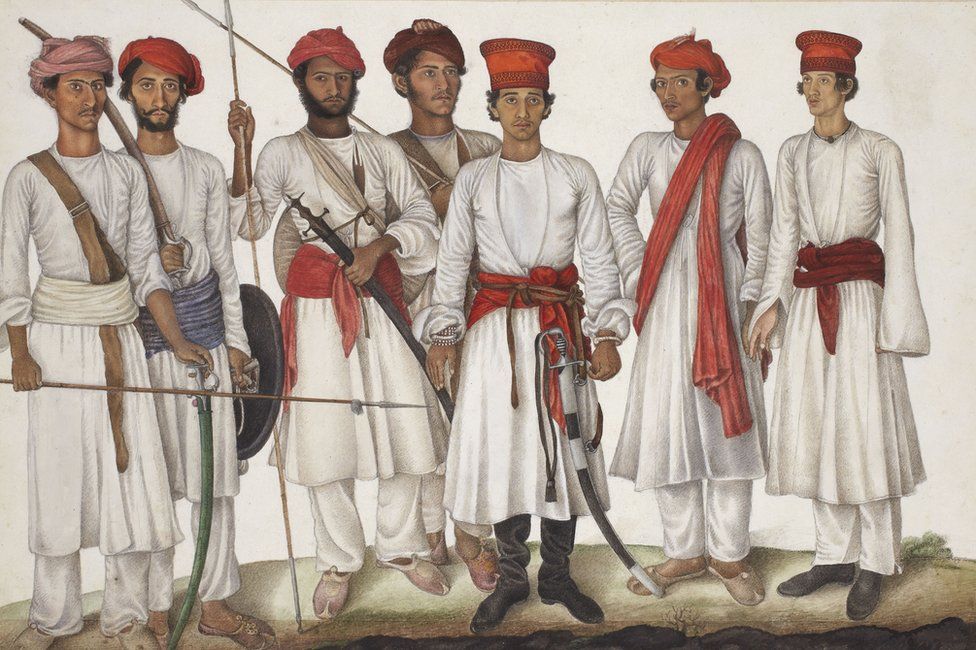
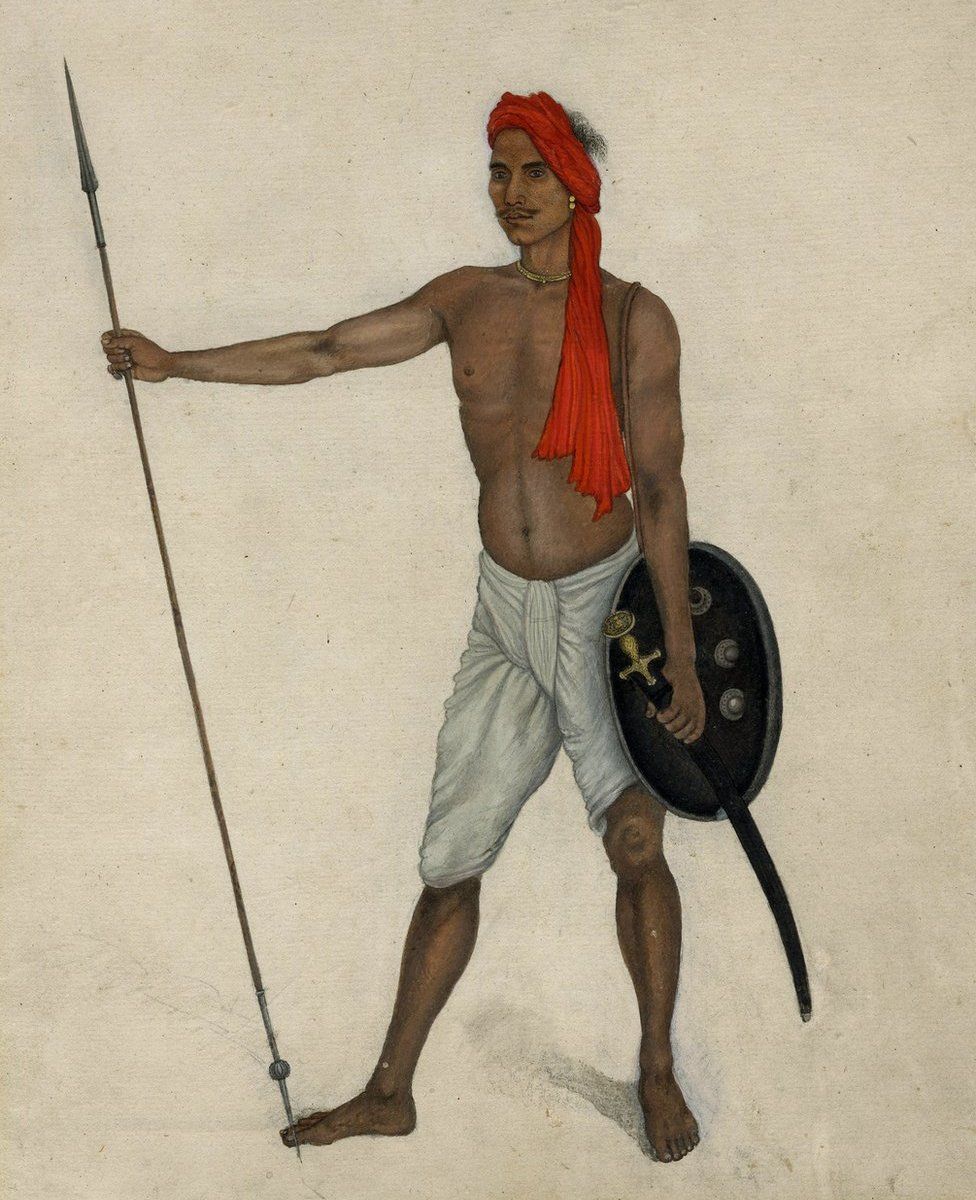
Image copyright PEMILLE KLEMPImage caption A group of Indian troopers who fought for the English, Ghulam Ali Khan, 1815-16
The English East India Company, founded in 1600, was established for trading. But as the powerful multinational corporation expanded its control over India in the late 18th Century, it commissioned many remarkable artworks from Indian painters who had previously worked for the Mughals. Writer and historian William Dalrymple writes about these hybrid paintings which explore life and nature.
Calcutta in the late 1770s was Asia’s biggest boom town: known as the City of Palaces, the East India Company’s bridgehead in Bengal had doubled in size to 400,000 inhabitants in a decade.
It was now unquestionably the richest and largest colonial city in the East – though certainly not the most orderly.
“It would have been so easy to turn it into one of the most beautiful cities in the world,” wrote the Count de Modave, a friend of Voltaire who passed through at this time. “One cannot fathom why the English allowed everyone the freedom to build in the most bizarre taste, with the most outlandish planning.”
Nor were visitors much taken by its English inhabitants. Most had come East with just one idea: to amass a fortune in the quickest possible time.
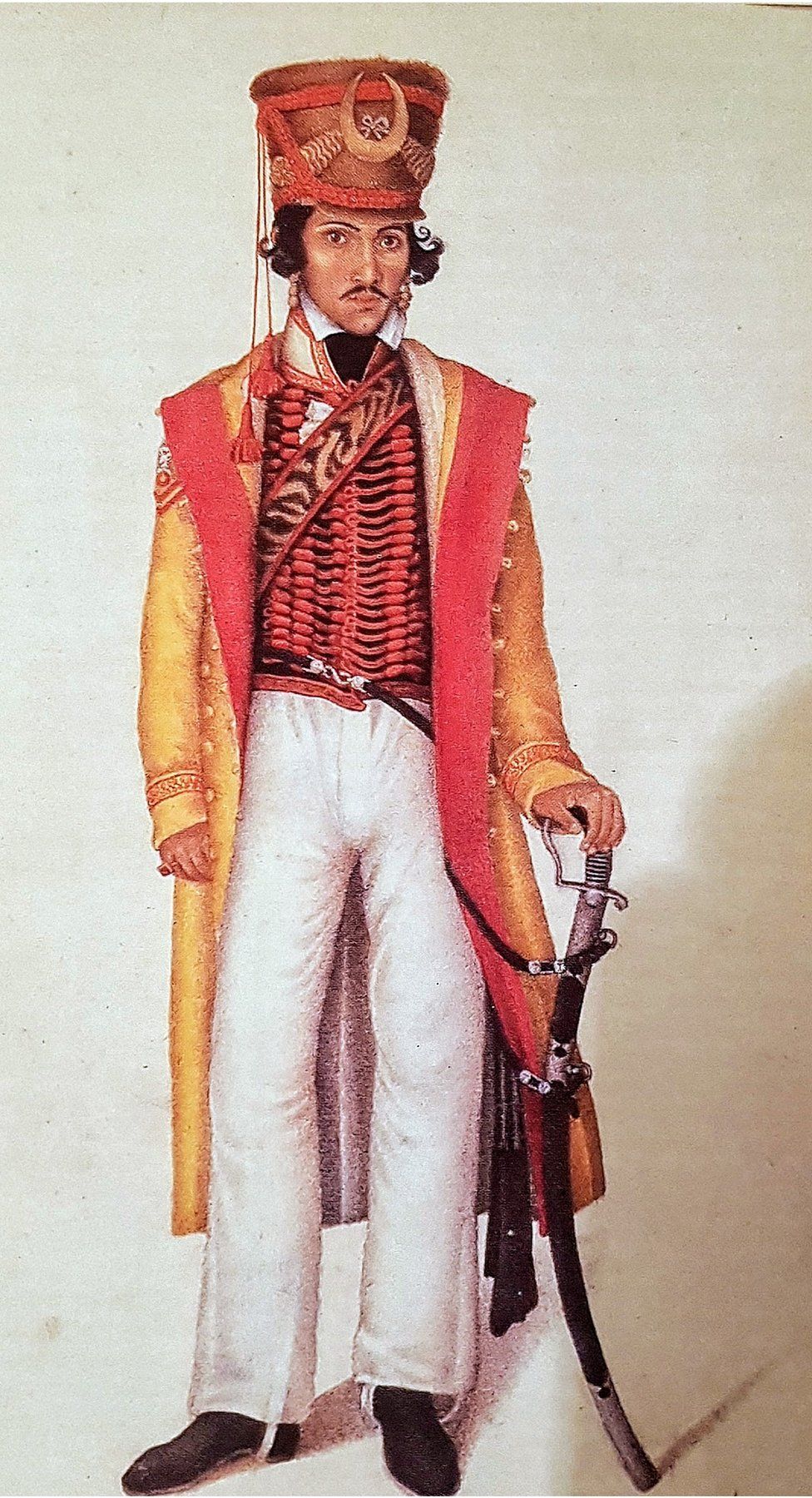
Image caption An Indian trooper who fought for the English, Ghulam Ali Khan, 1819Calcutta (now Kolkata) was a city where great wealth could be accumulated in a matter of months, then lost in minutes in a wager or at the whist table. Death, from disease or excess, was a commonplace, and the constant presence of mortality made men hard and callous.
Rising with Olympian detachment above the mercantile bawdiness of his contemporaries was the rotund figure of the chief justice of the new Supreme Court, Sir Elijah Impey.
A portrait of him by Johan Zoffany still hangs, a little lopsidedly, in the Kolkata High Court. It shows him pale and plump, ermine gowned and dustily bewigged.
Impey was, however, a serious scholar and unusual in taking a serious interest in the land to which he had been posted.
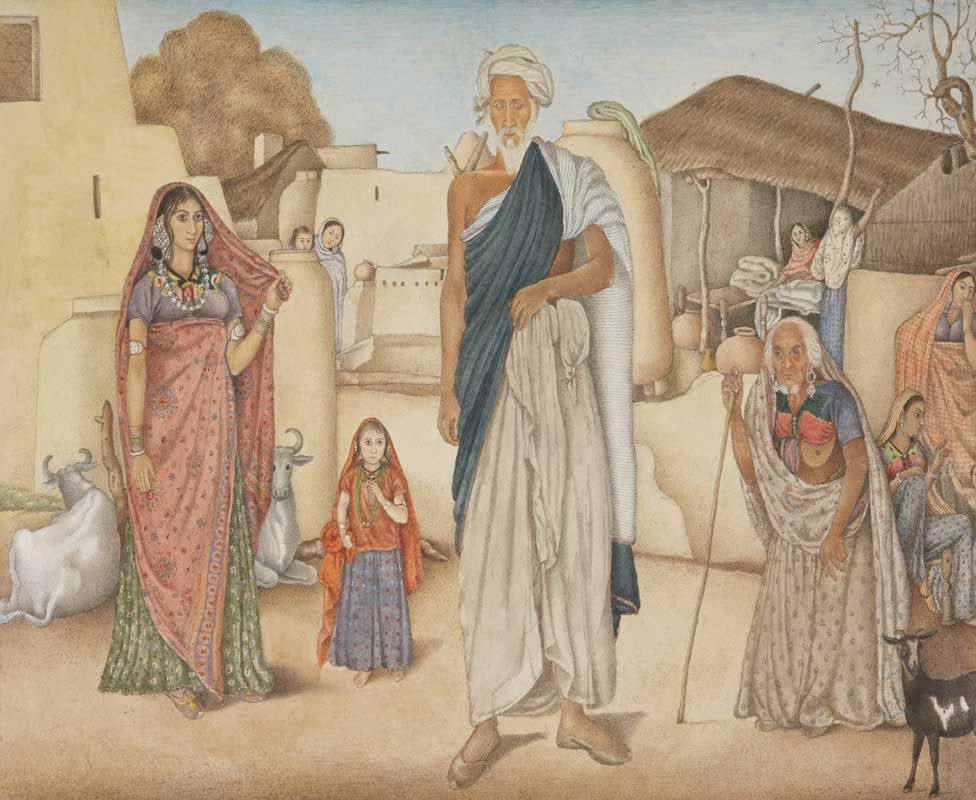
Image copyright PEMILLE KLEMPImage caption Indian villagers by Ghulam Ali Khan, 1815-16
On the journey out to India, a munshi (administrator) had accompanied him to teach him Bengali and Urdu, and on arrival the new chief justice began to learn Persian and collect Indian paintings. His house became a meeting place where the more cultured elements of Calcutta society could discuss history and literature.
Impey and his wife Mary were also greatly interested in natural history and began to collect a menagerie of rare Indian animals.
At some stage in the mid-1770s, the Impeys decided to bring a group of leading Mughal artists – Sheikh Zain ud-Din, Bhawani Das and Ram Das – to paint their private zoo.
It was probably not the first commission of Indian artists by British patrons. “The Study of Botany is of late Years become a very general Amusement,” noted one enthusiast, and we know that the Scottish nurseryman James Kerr was sending Indian-painted botanical drawings back to Edinburgh as early as 1773.
But the Impeys’ albums of natural history painting remain among the most dazzlingly successful of all such commissions: today, a single page usually reaches prices of more than £330,000 ($387,000) at auctions, and the 197 images from the Impey Album are now widely recognised as among the very greatest glories of Indian painting.
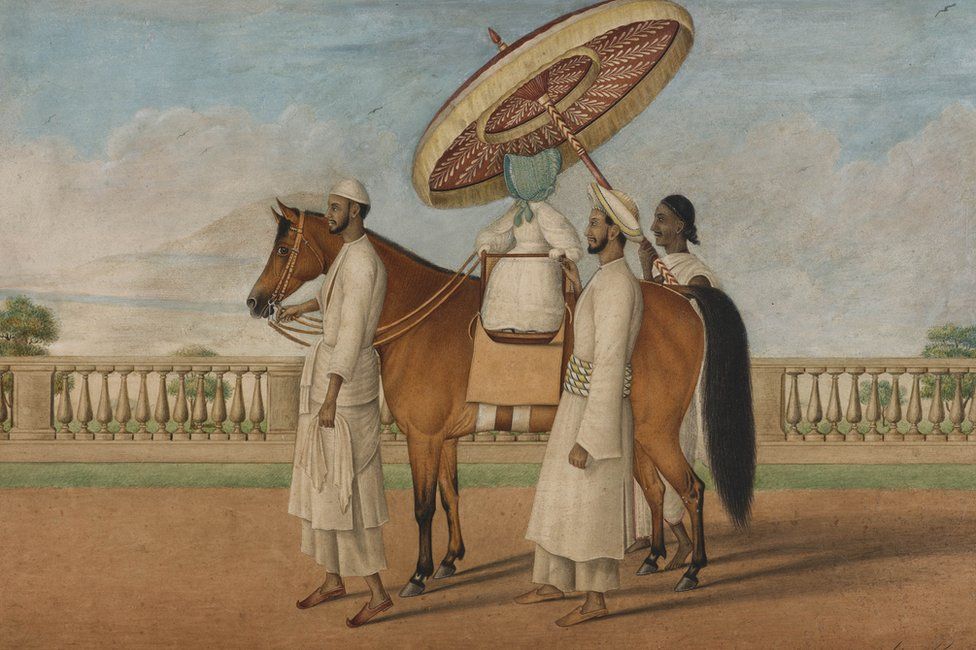
Image copyright FRANCIS WAREImage caption English child seated on a pony and surrounded by three Indian servants by Shaikh Muhammad Amir
This month, for the first time since the Impey Album was split up in the 18th Century, around 30 of its pages will be reassembled for a major exhibition in the Wallace Collection in London.
Forgotten Masters: Indian Painting for the East India Company celebrates some of the extraordinary work which resulted from commissions made by East India Company patrons from master Indian artists between the 1770s and 1840s.
It will be a unique chance to see some of the finest Indian paintings which are now scattered in private collections around the world.
The three artists who Impey summoned to his fine classical house in Middleton Street were all from Patna, 200 miles (320km) up the Ganges.
The most prolific was a Muslim, Shaikh Zain-al-Din, while his two colleagues, Bhawani Das and Ram Das, were both Hindus.
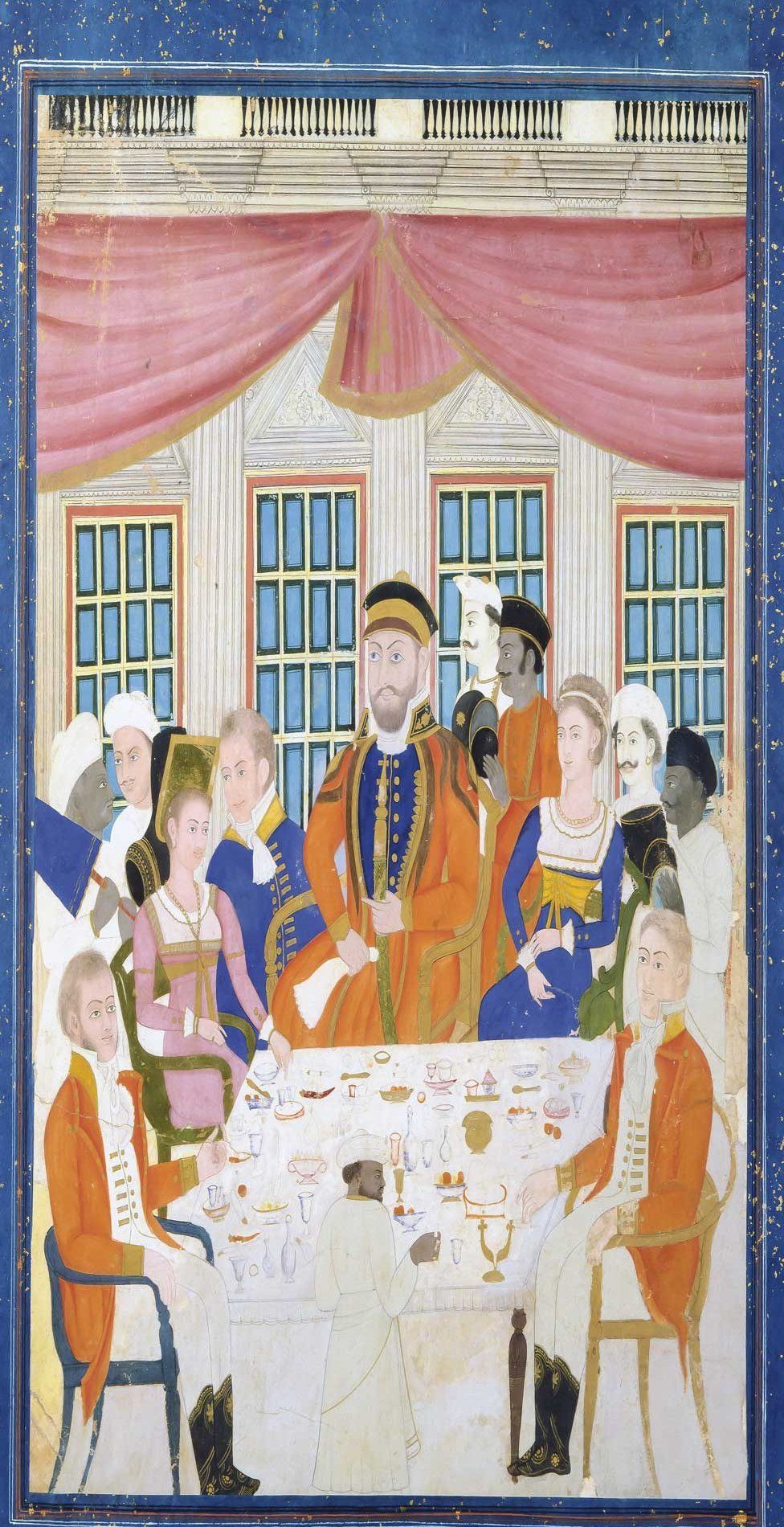
Image caption A finely painted miniature depicting four British officers with their wives taking refreshments at a table, artist unknown
Trained in the late Mughal style and patronised by the Nawabs of Murshidabad and Patna, they quickly learned to use English watercolours on English Watman watercolour paper, and take English botanical still lives as their models. In this way an extraordinary fusion of English and Mughal artistic impulses took place.
Zain ud-Din’s best works reveal a superb synthesis between a coldly scientific European natural history specimen illustration, warmed with a profoundly Indian sensibility and vital feeling for nature.
At his best – whether by instinct or inherited knowledge and training – he channels the outstanding Mughal achievement in natural history painting of 150 years earlier, when the great Mughal artist Mansur painted animals and birds for the Emperor Jahangir.
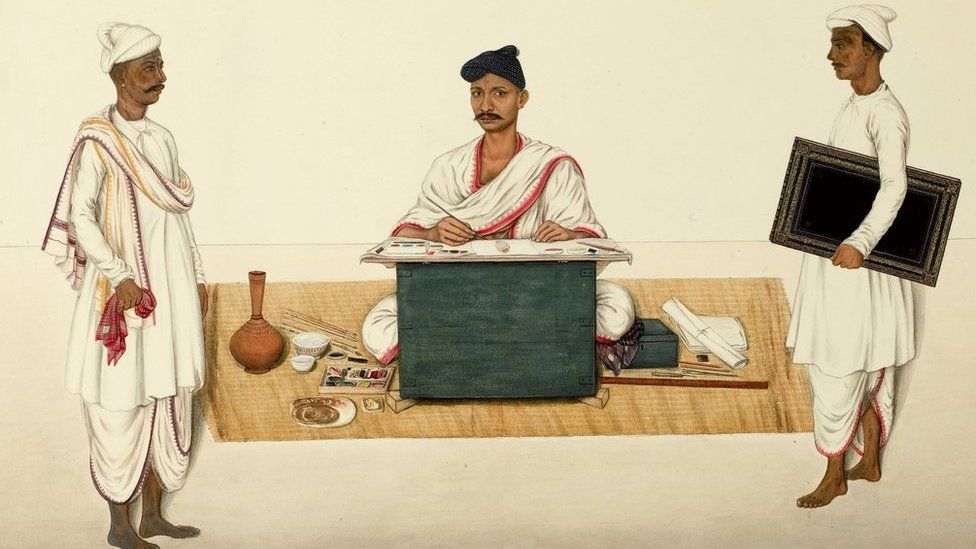
Image caption Portrait of a Mughal artist, by Yellapah Of Vellore, 1832-1835
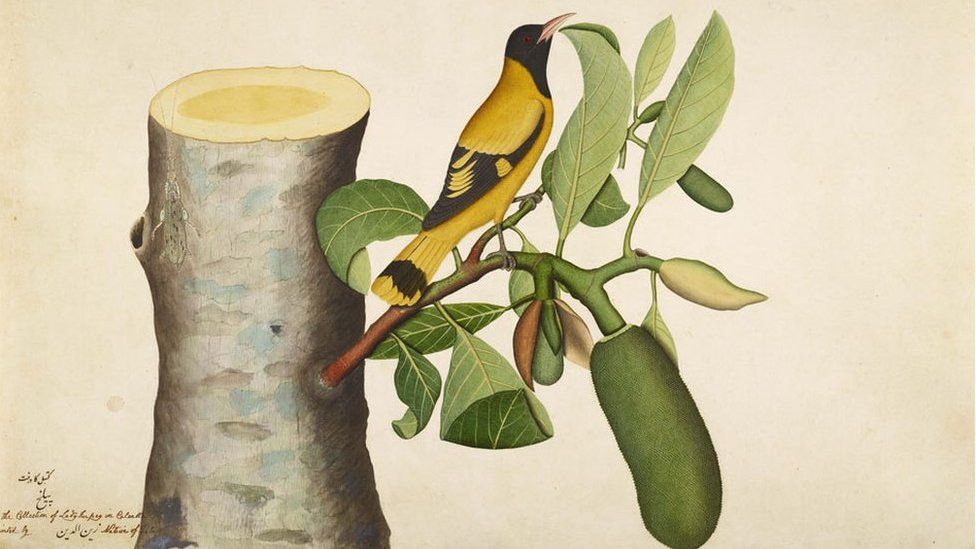
Nowhere are the merits of Company Painting better illustrated than in Zain ud-Din’s astonishing portrait of a Black Headed Oriole (No. 27).
At first glance, it could pass for a remarkably skilful English natural history painting. Only gradually does its hybrid origins become manifest.
The brilliance and simplicity of the colours, the meticulous attention to detail, the gem-like highlights, the way the picture seems to glow, all these point unmistakably towards Zain ud-Din’s Mughal training.
Image caption Portrait of a black headed oriole by Zain ud-Din
An idiosyncratic approach to perspective also hints at this background: the tree trunk is rounded, yet the grasshopper which sits on it is as flat as a pressed flower, with only a hint of outline shading to give it depth – the same technique used by Mansur.
Yet no artist working in a normal Mughal atelier would have placed his bird detached from a landscape against a white background, with the jackfruit tree on which its sits cut into a perfect, scientific cross-section.
Equally no English artist would have thought of painting the bark of that cross section the same brilliant yellow as the oriole; the tentative washes of a memsahib’s watercolour are a world away.
The two traditions have met head on, and from that blinding impact an inspirational new fusion has taken place.
Bhawani Das, who seems to have started off as an assistant to Zain ud-Din, is almost as fine an artist as Zain ud-Din.
Image caption Indian trooper holding a spear by Ghulam Ali Khan, 1815-186
He is acutely sensitive to shape, texture and expression, as for example in his celebrated study of a great fruit bat with the contrast between its soft, furry body with the angular precision of its blackly outstretched wings, as if it were some caped Commendatore ushering a woman into a Venetian opera rather than a creature in a colonial menagerie.
Now, for the first time, the work of these great Indian artists painting in this brilliantly hybrid Anglo-Indian style are beginning to get the attention they deserve.
The first-ever museum show of this work in the UK aims to highlight and showcase the work of a series of extraordinary Indian artists, each with their own style and tastes and agency. Indeed the greatest among them – such as Zain ud-Din- deserve to be remembered as among the most remarkable Indian artists of all time.
William Dalrymple is the author, most recently, of The Anarchy: The Relentless Rise of the East India Company and Forgotten Masters: Indian Painting for the East India Company (Bloomsbury)
Expensive presents are officially discouraged but have become the norm at many schools on day of appreciation for educators
Students at Yangzhou Technical Vocational College form the Chinese characters for “Hello Teacher” to mark China’s Teachers’ Day. Photo: Handout
Despite a decade of official discouragement, parents in China have been struggling with one of the biggest dilemmas of the school year – how to mark the country’s annual Teacher’s Day.
Ellen Yuan agonised for a day and a night before sending her son off to kindergarten on Tuesday with a 1,000 yuan (US$140) gift card in his bag for the teacher.
It was the boy’s second week of attendance and Yuan had given no thought to any Teacher’s Day obligations –until she learned that several of her friends had been busy over the weekend preparing gifts for their children’s teachers.
“It makes me feel that I am being a drag on my son if I don’t do so,” said Yuan, who works for a foreign company in Shanghai.
Respecting teachers has traditionally been a fundamental social norm in China but gift giving on the special day for educators has gone beyond an expression of appreciation by their students, as parents have taken over with ever more expensive gifts – and sometimes cash – which they hope will mean their kids are well taken care of while at school.
What gift, how expensive it should be, and how to deliver it have become the biggest questions for many parents in the run-up to September 10 each year, even though the education ministry and its subordinate bodies have repeatedly issued directives over the past decade to ban teachers accepting gifts.
Yuan said one of her friends had bought a body care set worth more than 600 yuan for each of her child’s three teachers, another had bought an 800 yuan gift card, while a third had given the head teacher a 1,000 yuan bottle of perfume.
Some parents had delivered the presents directly to the school, while others had asked their children to take the gifts to their teachers. Yuan’s plan was to message the teacher and tell her to take the gift card from her son’s bag.
“I know it’s bad. I don’t want my kid to know that,” Yuan said.
Hundreds of teachers protest in China over poor pay
The question of whether parents should give gifts on Teacher’s Day was one of the hottest topics on Weibo, China’s Twitter-like social media platform, attracting more than 15 million views as of Tuesday afternoon.
“Of course we should not, but I don’t dare to ignore it,” one user said, winning more than 10,000 likes.
Chu Zhaohui, a researcher at the National Institute of Education Sciences, said the gift-giving trend had been partly driven by a “keeping up with the Joneses” mentality.
“Everybody has given a gift. Would my child be specially treated if I don’t? This is a common concern,” Chu said. As a result, the purpose of gift giving on Teacher’s Day had become about protecting the children’s interests instead of a sincere expression of gratitude, he said.
But not every teacher gets presents – with gifts usually reserved for those teaching the “main subjects” of mathematics, Chinese and English, which count the most in high school and college entrance examinations.
Emily Shen, an English teacher from a middle school in Hangzhou, in the eastern province of Zhejiang, said she also prepared gifts for the teachers of her two kids. “Some chocolate for them to take to school. And I myself would give a gift card to each of those who teach the main subjects,” she said.
Zhuang Ke, a music teacher at a primary school in Jiaxing, also in Zhejiang province, admitted she was embarrassed by the parents’ different treatment of teachers of “less important” subjects like her’s. “It’s always nice to receive presents. But teachers who teach music, art and PE are often forgotten,” she said.
Chinese kindergarten teacher fired for hot sun punishment
State broadcaster CCTV said in a commentary on its website on Sunday that “all forms of behavior that attempt to ruin normal teaching order and interfere in equality by sending gifts should be resolutely abandoned”. A similar message was run by a series of official media outlets at local level.
“The most fundamental way to stop parents from sending gifts is to treat the students equally and fairly every day, so that parents conclude it makes no difference whether they give a gift,” Rednet.cn, the official news portal of Hunan province, said on Monday.
Although some teachers have made it explicit to students that they will refuse presents on Teacher’s Day, Yuan said her son’s teacher accepted the gift, as did the teachers of her three friends’ children.




 CHINDIA ALERT: You'll be living in their world, very soon
Chinese parents struggle with Teacher’s Day gift etiquette
Despite a decade of official discouragement, parents in China have been struggling with one of the biggest dilemmas of the school year – how to mark the country’s annual Teacher’s Day.
Ellen Yuan agonised for a day and a night before sending her son off to kindergarten on Tuesday with a 1,000 yuan (US$140) gift card in his bag for the teacher.
It was the boy’s second week of attendance and Yuan had given no thought to any Teacher’s Day obligations –until she learned that several of her friends had been busy over the weekend preparing gifts for their children’s teachers.
“It makes me feel that I am being a drag on my son if I don’t do so,” said Yuan, who works for a foreign company in Shanghai.
Respecting teachers has traditionally been a fundamental social norm in China but gift giving on the special day for educators has gone beyond an expression of appreciation by their students, as parents have taken over with ever more expensive gifts – and sometimes cash – which they hope will mean their kids are well taken care of while at school.
What gift, how expensive it should be, and how to deliver it have become the biggest questions for many parents in the run-up to September 10 each year, even though the education ministry and its subordinate bodies have repeatedly issued directives over the past decade to ban teachers accepting gifts.
Yuan said one of her friends had bought a body care set worth more than 600 yuan for each of her child’s three teachers, another had bought an 800 yuan gift card, while a third had given the head teacher a 1,000 yuan bottle of perfume.
Some parents had delivered the presents directly to the school, while others had asked their children to take the gifts to their teachers. Yuan’s plan was to message the teacher and tell her to take the gift card from her son’s bag.
“I know it’s bad. I don’t want my kid to know that,” Yuan said.
But not every teacher gets presents – with gifts usually reserved for those teaching the “main subjects” of mathematics, Chinese and English, which count the most in high school and college entrance examinations.
Emily Shen, an English teacher from a middle school in Hangzhou, in the eastern province of Zhejiang, said she also prepared gifts for the teachers of her two kids. “Some chocolate for them to take to school. And I myself would give a gift card to each of those who teach the main subjects,” she said.
Zhuang Ke, a music teacher at a primary school in Jiaxing, also in Zhejiang province, admitted she was embarrassed by the parents’ different treatment of teachers of “less important” subjects like her’s. “It’s always nice to receive presents. But teachers who teach music, art and PE are often forgotten,” she said.
Chinese kindergarten teacher fired for hot sun punishment
State broadcaster CCTV said in a commentary on its website on Sunday that “all forms of behavior that attempt to ruin normal teaching order and interfere in equality by sending gifts should be resolutely abandoned”. A similar message was run by a series of official media outlets at local level.
“The most fundamental way to stop parents from sending gifts is to treat the students equally and fairly every day, so that parents conclude it makes no difference whether they give a gift,” Rednet.cn, the official news portal of Hunan province, said on Monday.
Although some teachers have made it explicit to students that they will refuse presents on Teacher’s Day, Yuan said her son’s teacher accepted the gift, as did the teachers of her three friends’ children.
Source: SCMP
Posted in Art, bag, body care set, bottle of perfume, Chinese, chinese parents, Chocolate, college entrance examination, commentary, day of appreciation, discouraged, educators, English, Expensive presents, fired, foreign company, forgotten, fundamental way, gift card, gift etiquette, Hangzhou, High school, hot sun punishment, Hunan Province, Jiaxing, keeping up with the Joneses, kindergarten, mathematics, mentality, middle school, music, music teacher, National Institute of Education Sciences, norm, official news portal, officially, PE, poor pay, primary school, Protest, Rednet.cn, schools, Shanghai, sincere expression of gratitude, state broadcaster CCTV, struggle, teacher, Teacher’s Day, Uncategorized, website, Weibo, Yangzhou Technical Vocational College, zhejiang province | Leave a Comment »