Chindia Alert: You’ll be Living in their World Very Soon
aims to alert you to the threats and opportunities that China and India present. China and India require serious attention; case of ‘hidden dragon and crouching tiger’.
Without this attention, governments, businesses and, indeed, individuals may find themselves at a great disadvantage sooner rather than later.
The POSTs (front webpages) are mainly 'cuttings' from reliable sources, updated continuously.
The PAGEs (see Tabs, above) attempt to make the information more meaningful by putting some structure to the information we have researched and assembled since 2006.
LONDON (Reuters) – China has betrayed the people of Hong Kong so the West should stop kowtowing to Beijing for an illusory great pot of gold, said Chris Patten, the last governor of the former British colony.
Beijing is set to impose new national security legislation on Hong Kong after a sustained campaign of pro-democracy protests last year in the city, which enjoys many freedoms not allowed on mainland China.
“The Hong Kong people have been betrayed by China,” Patten was quoted as saying by The Times newspaper. Britain has a “moral, economic and legal” duty to stand up for Hong Kong, he said.
Patten watched as the British flag was lowered over Hong Kong when the colony was handed back to China in 1997 after more than 150 years of British rule.
Hong Kong’s autonomy was guaranteed under the “one country, two systems” agreement principle enshrined in the 1984 Sino-British Joint Declaration signed by then Chinese Premier Zhao Ziyang and British Prime Minister Margaret Thatcher.
But China’s plans to impose national security laws on Hong Kong risk destroying the Declaration, Patten said. The United States has branded the laws a “death knell” for the city’s autonomy.
“What we are seeing is a new Chinese dictatorship,” Patten said. “The British government should make it clear that what we are seeing is a complete destruction of the Joint Declaration.”
Hong Kong leader Carrie Lam said her government will “fully cooperate” with the Chinese parliament to safeguard national security, which she said would not affect rights, freedoms or judicial independence.
Patten said the West should stop chasing the illusory promise of Chinese gold.
“We should stop being fooled that somehow at the end of the all the kowtowing there’s this great pot of gold waiting for us. It’s always been an illusion,” Patten said.
“We keep on kidding ourselves that unless we do everything that China wants we will somehow miss out on great trading opportunities. It’s drivel.”
The British government did not immediately comment on Saturday.
Prime Minister Boris Johnson’s spokesman said on Friday the government was monitoring the situation and as a party to the Joint Declaration the UK was committed to the upholding Hong Kong’s autonomy and respecting the one country, two systems model.
China will not set an economic growth goal for this year as it deals with the fallout from the coronavirus pandemic.
It is the first time Beijing has not had a gross domestic product (GDP) target since 1990 when records began.
The announcement was made by Premier Li Keqiang at the start of the country’s annual parliament meeting.
The world’s second largest economy shrank by 6.8% in the first quarter from a year ago as lockdowns paralysed businesses.
“This is because our country will face some factors that are difficult to predict in its development due to the great uncertainty regarding the Covid-19 pandemic and the world economic and trade environment,” Premier Li said.
The country’s leadership has promised to boost economic support measures amid growing concerns that rising unemployment could threaten social stability.
The move comes as tensions between Beijing and Washington are becoming increasingly strained over the coronavirus pandemic, trade and Hong Kong.
On Thursday, President Donald Trump stepped up his attacks on China, suggesting that the country’s leader, Xi Jinping, is behind a “disinformation and propaganda attack on the United States and Europe.”
It came as Mr Trump and other Republicans have escalated their criticism of Beijing’s handling of the early stages of the outbreak.
Also on Thursday, China announced plans to impose new national security legislation on Hong Kong after last year’s pro-democracy protests.
The announcement was met with a warning from Mr Trump that the US would react “very strongly” against any attempt to gain more control over the former British colony.
Separately, two US senators have proposed legislation to punish Chinese entities involved in enforcing the planned new laws and penalise banks that do business with them.
Earlier this week, the US Senate unanimously passed a proposal to delist Chinese companies from American stock exchanges if they fail to comply with US financial reporting standards.
US-listed Chinese companies have come under increasing scrutiny in recent weeks after Luckin Coffee revealed that an internal investigation found hundreds of millions of dollars of its sales last year were “fabricated”.
TAIPEI (Reuters) – Taiwan cannot accept becoming part of China under its “one country, two systems” offer of autonomy , President Tsai Ing-wen said on Wednesday, strongly rejecting China’s sovereignty claims and likely setting the stage for an ever worsening of ties.
China responded that “reunification” was inevitable and that it would never tolerate Taiwan’s independence.
In a speech after being sworn in for her second and final term in office, Tsai said relations between Taiwan and China had reached an historical turning point.
“Both sides have a duty to find a way to coexist over the long term and prevent the intensification of antagonism and differences,” she said.
Tsai and her Democratic Progressive Party won January’s presidential and parliamentary elections by a landslide, vowing to stand up to China, which claims Taiwan as its own and says it would be brought under Beijing’s control by force if needed.
“Here, I want to reiterate the words ‘peace, parity, democracy, and dialogue’. We will not accept the Beijing authorities’ use of ‘one country, two systems’ to downgrade Taiwan and undermine the cross-strait status quo. We stand fast by this principle,” Tsai said.
China uses the “one country, two systems” policy, which is supposed to guarantee a high degree of autonomy, to run the former British colony of Hong Kong, which returned to Chinese rule in 1997. It has offered it to Taiwan, though all major Taiwanese parties have rejected it.
China’s Taiwan Affairs Office, responding to Tsai, said Beijing would stick to “one country, two systems” – a central tenet of Chinese President Xi Jinping’s Taiwan policy – and “not leave any space for Taiwan independence separatist activities”.
“Reunification is a historical inevitability of the great rejuvenation of the Chinese nation,” it said. “We have the firm will, full confidence, and sufficient ability to defend national sovereignty and territorial integrity.”
China views Tsai as a separatist bent on formal independence for Taiwan. Tsai says Taiwan is an independent state called the Republic of China, its official name, and does not want to be part of the People’s Republic of China governed by Beijing.
TAIWAN OPEN TO DIALOGUE
China has stepped up its military drills near Taiwan since Tsai’s re-election, flying fighter jets into the island’s air space and sailing warships around Taiwan.
Tsai said Taiwan has made the greatest effort to maintain peace and stability in the narrow Taiwan Strait that separates the democratic island from its autocratic neighbour China.
“We will continue these efforts, and we are willing to engage in dialogue with China and make more concrete contributions to regional security,” she added, speaking in the garden of the old Japanese governor’s house in Taipei, in front of a socially-distanced audience of officials and diplomats.
Taiwan has become a rising source of friction between China and the United States, with the Trump administration strongly backing Taiwan even in the absence of formal diplomatic ties.
U.S. Secretary of State Mike Pompeo sent his congratulations to Tsai on Tuesday, praising her “courage and vision in leading Taiwan’s vibrant democracy”, in a rare high-level message from Washington direct to Taiwan’s government.
China’s Foreign Ministry condemned Pompeo’s remarks, and said the government would take “necessary countermeasures”, though did not elaborate.
China cut off a formal talks mechanism with Taiwan in 2016 after Tsai first won election.
Yao Chia-wen, a senior adviser to Tsai, told Reuters the chance of talks with China were small given ongoing tensions.
“We are ready to engage with them any time, but China is unlikely to make concessions to Taiwan,” he said. “In the next four years there’s little chance for the cross-strait relationship to improve.”
HONG KONG (Reuters) – China’s People’s Liberation Army (PLA) soldiers in shorts and t-shirts made a surprising appearance in some Hong Kong streets on Saturday, briefly helping residents clean up debris after anti-government protests blocked roads, witnesses said.
The presence of PLA troops on the streets, even to help clean up roads near their base, could stoke further controversy over the Chinese-ruled territory’s autonomous status.
Hong Kong has been rocked by more than five months of demonstrations by protesters angry at perceived Communist Party meddling in the former British colony, which was guaranteed its freedoms when it returned to Chinese rule in 1997.
Beijing denies interfering and has blamed the unrest on foreign influences.
Clashes between protesters and police have become increasingly violent. China has warned that any attempt at independence for Hong Kong will be crushed, but troops have remained inside their base.
RELATED COVERAGE
China’s PLA soldiers seen helping clean up streets after Hong Kong protests – RTHK
Saturday’s clean up followed some of the worst violence seen this year, after a police operation against protesters at the Chinese University of Hong Kong on Tuesday.
The authorities have since largely stayed away from at least five university campuses that had been barricaded by thousands of students and activists who stockpiled petrol bombs, catapults, bows and arrows and other weapons.
Many protesters appeared to have left the campuses by late Saturday, though some remained behind to man makeshift barricades. Hong Kong’s Cross-Harbour Tunnel was still blocked by protesters occupying Polytechnic University.
Earlier, hundreds of pro-China demonstrators gathered by the city’s legislature and police headquarters, waving Chinese and Hong Kong flags. Some held up posters reading “Police we stand with you”, while others chanted “Support the police”.
Pro-China protests have so far attracted much smaller numbers than those angry at Beijing.
RARE TROOP PRESENCE
By late afternoon, the PLA soldiers had left the streets outside Baptist University, beside their barracks in leafy Kowloon Tong.
Chinese troops have appeared on local streets only once since the 1997 handover, to help with cleanup operations after a typhoon in late 2018. It was not immediately clear how many were involved on Saturday.
Calls to the PLA Hong Kong garrison office and a media liaison officer went unanswered.
Demosistō, a pro-democracy organisation, said Saturday’s cleanup operation could set a “grave precedent” if the city’s government invites the military to deal with internal problems.
In August, Beijing moved thousands of troops across the border into Hong Kong in what state news agency Xinhua described as a routine “rotation”.
Foreign envoys and security analysts estimate up to 12,000 troops are now based across Hong Kong — more than double the usual garrison number.
Standing beside a black flag with the slogan “Liberate Hong Kong, Revolution of our Times,” James Wong, 23, was among a handful of protesters still manning a bridge at Baptist University.
“We didn’t want to confront the people and the PLA troops directly,” he told Reuters. “We are not directly against the PLA, but rather the government. But the PLA should not leave their base because this is Hong Kong territory.”
Wong said even after the campus fortifications have been dismantled “Hong Kong will keep resisting until the government responds to our demands”.
Hundreds of residents moved in to help clear barricaded roads near several universities.
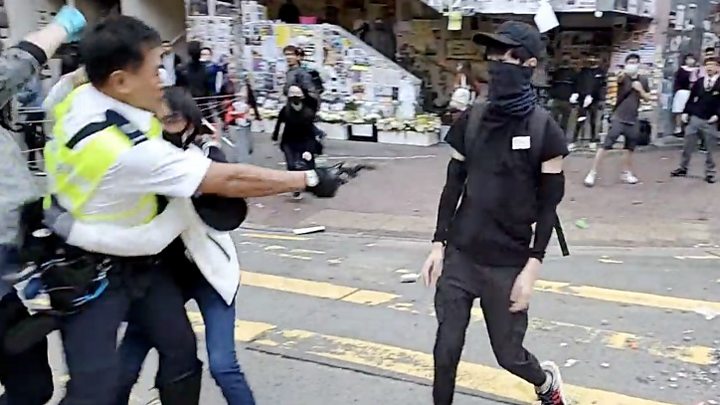
Clashes on Saturday saw at least one petrol bomb thrown before anti-government protesters at the campuses retreated. No soldiers appeared to have been involved in the confrontations.
“We just want our lives to continue,” said one resident who was helping clear streets near HKU. “There are many elderly who need to go the hospital and children who need to go to school. I am very sad to see what is happening in my community.”
PRO-POLICE DEMONSTRATION
Saturday’s rally to denounce the anti-government violence drew a mix of young and elderly.
“From the bottom of our hearts, we believe it is the correct thing to support the police in fighting the rioters for Hong Kong citizens,” said a 49-year-old housewife surnamed Kong.
“A lot of people keep silent, afraid of the rioters. It’s time for all the people who are silent to step up and say that’s enough.”
A 70-year-old street cleaner died on Thursday after being hit on the head by one of several bricks police said had been thrown by “masked rioters”. On Monday, police blamed a “rioter” for dousing a man in petrol and setting him on fire. The victim is in critical condition.
On the same day, police shot a protester in the abdomen. He was in a stable condition.
Many pro-police protesters laid white flowers outside the government office to pay their respects to the cleaner. Others applauded and cheered the police, some bowing and giving thumbs up as they walked past riot police on duty.
Authorities said on Saturday that a highway blocked by anti-government protesters on Friday had reopened after being cleared of debris and petrol bombs.
Train services suspended earlier in the week were gradually resuming, metro operator MTR Corp (0066.HK) said.
Hong Kong’s rule of law has been pushed to the “brink of total collapse” after more than five months of protests, police have warned.
The warning came as protesters clashed with police across the city on Tuesday.
At the Chinese University of Hong Kong, police fired tear gas and rubber bullets at protesters who built barricades on the campus.
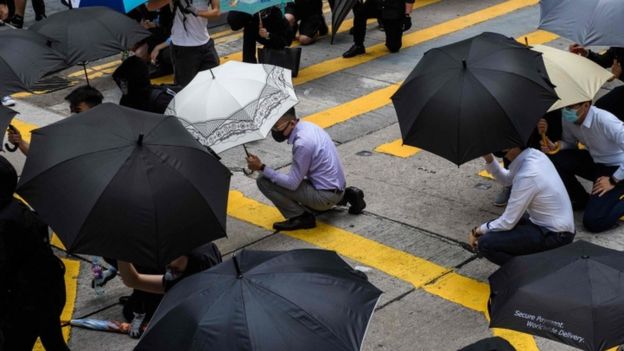
Earlier in the day, around 1,000 protesters rallied in central Hong Kong during the lunch hour blocking roads
Protesters, wearing office clothes, were seen chanting: “Fight for freedom, stand with Hong Kong!”
The demonstrations come just a day after the territory saw a marked escalation in violence, with police shooting one activist in the torso. A pro-Beijing supporter was set on fire by anti-government protesters.
The protests started in June against a now-withdrawn plan to allow extradition to mainland China, but have since morphed into wider demonstrations, with activists demanding greater democracy and police accountability in Hong Kong.
On Tuesday afternoon, police spokesman Kong Wing-cheung hit out at the protesters, saying they had “countless examples of rioters using random and indiscriminate violence against innocent” people.
“Hong Kong’s rule of law has been pushed to the brink of total collapse as masked rioters recklessly escalate their violence under the hope that they can get away with it,” he told reporters, adding that Monday’s attack on the pro-Beijing supporter was being investigated as attempted murder.
Image copyright AFPImage caption Protesters and office workers were seen blocking roads in Hong Kong’s financial district
Speaking at the same conference, Supt Li Kwai-wah defended the officer’s decision to shoot the protester on Monday.
“We found out that our colleague did not only face threat from one person, instead it was a group of people with an organised plan attempting to steal the gun,” he said.
“In a situation like this, we believe our police are reacting according to the guideline, to protect themselves as well as the people around them.”
Both the protester and the pro-Beijing supporter remain in hospital, with the latter in a critical condition.
What happened on Tuesday?
Clashes erupted at the Chinese University of Hong Kong, with police firing tear gas to disperse students, while at City University there was a standoff between students and riot police which continued into the evening.
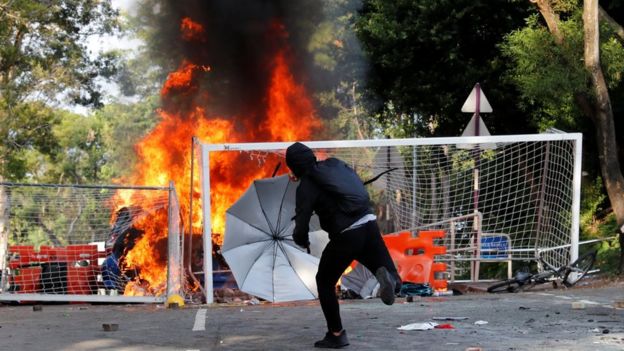
Police continued to use tear gas to try to disperse the protesters who responded with bricks and petrol bombs. Hundreds of protesters remain at the Chinese University of Hong Kong.
Image copyright REUTERSImage caption Students at Hong Kong’s Chinese University fought with police throughout the day
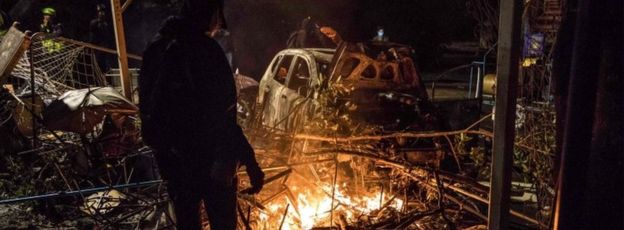
Students built roadblocks on streets in and around City University campus to stop police from entering. At one stage, a van used as part of a street barricade was set on fire.
Students at Hong Kong Polytechnic also tried to disrupt traffic near their campus.
In the morning, suspended railway services and road closures had already led to long traffic jams in the early rush hour. At noon, protesters moved into the city’s central business district for a flash mob protest.
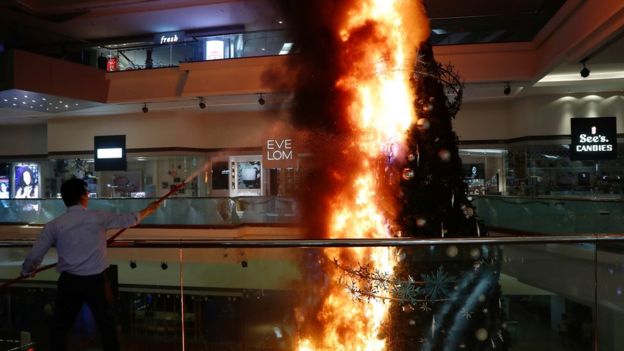
Image copyright REUTERSImage caption At Festival Walk shopping mall, a Christmas tree was set on fire
Protests continued to intensify throughout the day. A Christmas tree inside Festival Walk shopping mall was set on fire by protesters while others were seen smashing a glass railing with hammers.
Train stations were closed across the city.
Media caption This Hong Kong protester’s shooting was livestreamed on Facebook
Eight universities have announced they will suspend classes on Wednesday.
Monday’s protests saw 260 people arrested bringing the number to more than 3,000 since the protests began in June.
Students swear they will not surrender
Grace Tsoi, BBC World Service, at the Chinese University of Hong Kong
Image copyright AFPImage caption Hundreds of protesters remain at the university
The ground was strewn with bricks. The air was filled with the smell of tear gas. Fire was raging on campus. Hundreds of protesters, most of them clad in black, formed human chains to pass bricks and petrol bombs to the front line.
One of the best universities in Hong Kong has turned into a battlefield after another day of intense clashes between students, who have been at the forefront of anti-government protests, and police.
The Chinese University students have been putting up resistance since the morning. On Monday, police seemed to change strategy by deploying forces to campuses. Students told me they should not be allowed there.
The university’s management has tried to deescalate the situation. Vice-chancellor Rocky Tuan was also tear gassed as he was negotiating with police.
Dozens of students have been injured, including at least one hit in the eye by a projectile. The night is young and students swear they will not surrender.
Merkel makes the case on sensitive issues in Beijing without being offensive, observer says
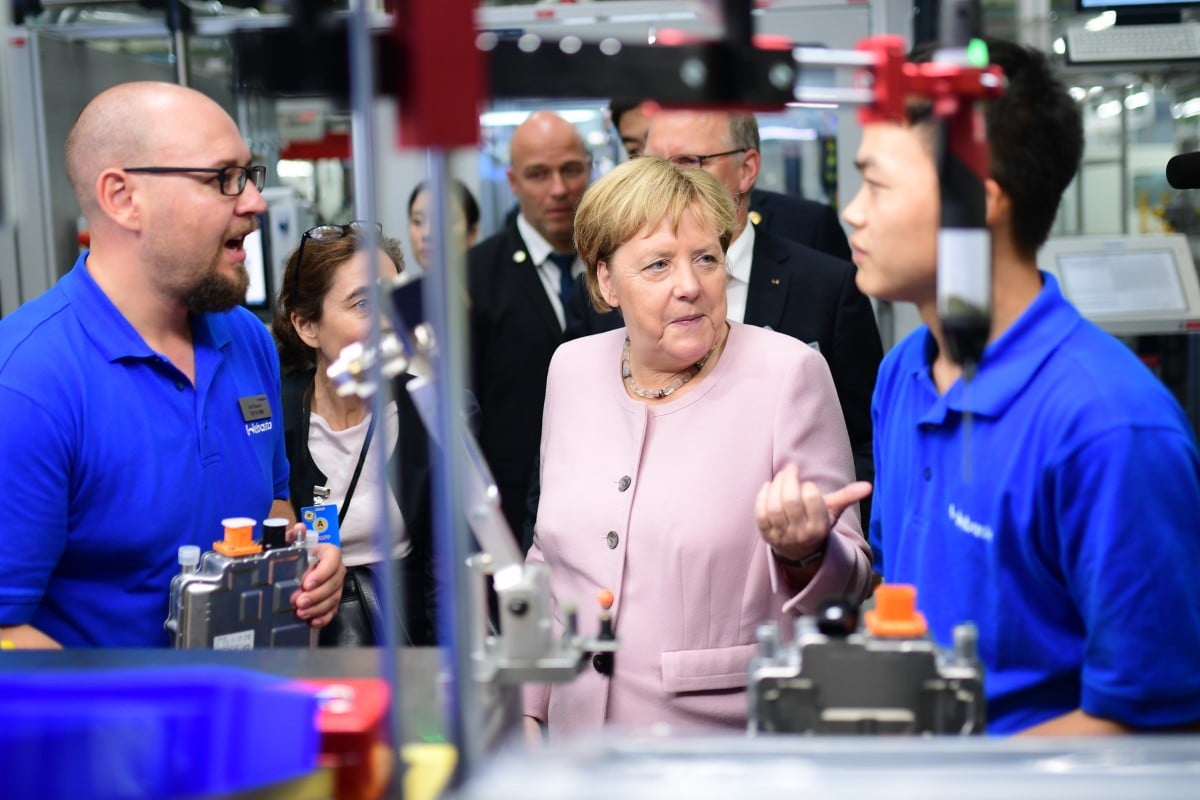
German Chancellor Angela Merkel (centre) talks to staff at manufacturer Webasto during a visit in Wuhan on Saturday. Photo: EPA-EFE
German Chancellor Angela Merkel may be slowly declining in influence in European politics but she remains the EU’s strongest voice in dealing with China, analysts said after her latest trip to China last week.
During the two-day visit, Merkel and Chinese President Xi Jinping discussed the sensitive topic of Hong Kong and the social credit system in China.
German diplomats also averted a plan by Chinese officials to scrap a joint press conference by Merkel and Chinese Premier Li Keqiang out of concerns that it could be dominated by questions about the escalating protests in Hong Kong.
Two sources told the South China Morning Post that the Chinese side initially suggested not letting journalists ask questions during the press conference. German diplomats persisted, saying that Merkel would hold her own press conference to take media questions, the sources said.
Germany’s Angela Merkel renews call for peaceful resolution to Hong Kong protests
After talks with the Chinese president and premier, Merkel said Beijing had listened to her views about resolving the Hong Kong conflict without violence, adding: “This is important.”
She said she also pressed the European Union’s position that the Sino-British Joint Declaration on Hong Kong remained effective, countering Beijing’s assertion that the 1984 document has ceased to be valid.
“Merkel navigated the narrow line to raise these sensitive issues without being overly offensive,” said Jan Weidenfeld, of the Berlin-based Mercator Institute for China Studies.
Joerg Wuttke, president of the EU Chamber of Commerce in China, said Merkel’s biggest achievement was to raise the issue about the social credit system in China, a policy that aims to rank every individual and corporate entity based on their compliance with state-stipulated social norms.
“It is important to us that she makes the Chinese leadership aware that the German business community would like to get better briefed and prepared for this major change in company compliance by the Chinese authorities,” Wuttke said. “Merkel was the first foreign leader to do so.”
Despite Merkel’s tough approach, China’s foreign ministry was full of praise for the German leader’s visit, saying both sides were “satisfied” with the outcomes.
“This is Chancellor Merkel’s 12th China visit, so she should be one of the Western leaders who visited China the most times and knows China the best,” ministry spokeswoman Hua Chunying said on Monday.
Hong Kong is a matter for China, Premier Li Keqiang tells Angela Merkel
Back home, however, German media and businesses remained sceptical about the future.
Bild, the country’s biggest-circulation newspaper, has been following closely the arrest of Hong Kong pro-democracy activist Joshua Wong Chi-fung, who was detained at Hong Kong airport on his way to Berlin at the newspaper’s invitation. Wong was later cleared to travel abroad.
Several newspapers have put pressure on Merkel to speak out for Hong Kong, with one calling on her to replace a stop in mainland China with one in the former British colony, which she refused.
On the business side, German businesses also urged Merkel to caution Beijing against sending troops to Hong Kong out of concerns that the lucrative Chinese market would become subject to international sanctions.
Another concern is the slow pace of structural reforms that would open up Chinese markets to foreign businesses.



 CHINDIA ALERT: You'll be living in their world, very soon