Archive for ‘fragile’

09/05/2020

Coronavirus: China offers to help North Korea fight pandemic

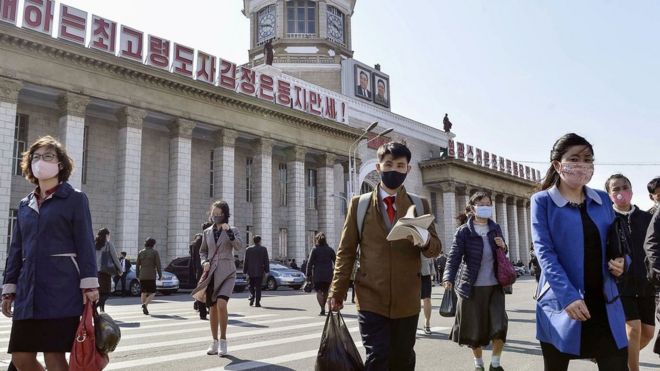
People wear face masks in front of Pyongyang Station in Pyongyang, North Korea (27 April 2020)Image copyright REUTERS
Image caption North Korea’s government maintains has not reported a single case of Covid-19 there

China’s president has expressed concern about the threat of the coronavirus to North Korea and offered help.

Xi Jinping was responding to a message that he received from the North Korean leader, Kim Jong-un.

Chinese state media reported that the message congratulated Mr Xi on China’s apparent success in fighting Covid-19.

North Korea’s government maintains that there has not been a single confirmed case there, though analysts have questioned whether that is possible.

North Korea was the first country to suspend tourism and to shut its borders in response to the virus, in the third week of January.

The country has a fragile health system, which experts fear would be quickly overwhelmed by even a small outbreak of Covid-19.

In his “verbal message of thanks”, Mr Xi said he highly appreciated Mr Kim’s support during China’s outbreak and “showed his personal attention to the situation of the pandemic and people’s health” in North Korea, according to state media.

Mr Xi called for more efforts to strengthen co-operation in preventing the spread of the coronavirus, and said China was “willing to continue to provide assistance within its own capacity for [North Korea] in the fight against Covid-19”.

On Friday, North Korean state media reported that Mr Kim had sent a verbal message to the president that “congratulated him, highly appreciating that he is seizing a chance of  victory in the war against the unprecedented epidemic”.
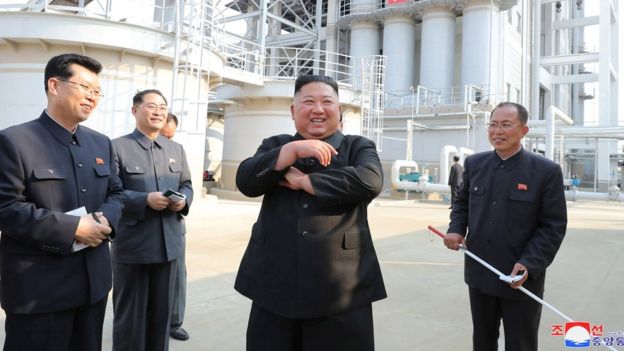
North Korean leader Kim Jong-un visits a fertiliser factory north of Pyongyang, reportedly on 2 May 2020Image copyright REUTERS
Image caption Kim Jong-un disappeared from public view for 20 days, before visiting a factory on 2 May

Mr Kim recently went 20 days without appearing in public, and missed the celebration of his grandfather’s birthday – one of the biggest events of the year.

Some media reports claimed he was “gravely ill”, or even dead.

But he then appeared at a fertiliser factory on 2 May – apparently in good health.

On Wednesday, South Korea’s National Intelligence Service told a parliamentary committee that there had been no signs the health rumours were true.

“He was performing his duties normally when he was out of the public eye,” a member of the committee, Kim Byung-kee, told reporters afterwards.

The lawmaker said the North Korean leader’s absence could have been down to a Covid-19 outbreak that the authorities in Pyongyang had not reported.

Presentational grey line

Analysis

By Celia Hatton, Asia Pacific Editor, BBC World Service

For months, North Korea-watchers have questioned Pyongyang’s claims that it has managed to isolate itself from Covid-19.

Admittedly, North Korea was the first country to suspend travel in response to the virus. There are unconfirmed reports that North Korean guards have been ordered to shoot at those who try to cross the lengthy border the North shares with China. However, it will be difficult to completely seal that dividing line for long. North Korea’s underground economy relies on illicit trade with Chinese entrepreneurs.

Beijing has a few good reasons for wanting to help North Korea. On a practical level, China needs to suppress a possible Covid-19 outbreak there if it wants to keep its own population healthy. Beijing also worries about what might happen inside North Korea if the virus takes hold. The North’s decrepit health system would quickly be overwhelmed by an outbreak of Covid-19, and that could threaten the fragile Kim Jong-un regime. Beijing has been Pyongyang’s biggest aid donor for decades, and it will continue to do what it can to keep Mr Kim in power. The alternatives to Kim Jong-un are much riskier for China, which does not want change on its doorstep.

China’s global political interests are also at play. Diplomatically, Mr Xi’s public exchange with Kim Jong-un underlines the seemingly close ties between China and North Korea. Pyongyang has been slow to accept public offers of help from the United States, and peace talks with Washington have stalled. If North Korea appeared to accept Beijing’s help, China would reassert itself as North Korea’s “true” ally in a time of need.

Presentational grey line

South Korea itself reported 18 new confirmed cases of Covid-19 on Saturday.

Seventeen of them are linked to a 29-year-old man who tested positive after spending time at five nightclubs and bars in Seoul’s Itaewon leisure district last weekend, the Yonhap news agency said.

Mayor Park Won-soon ordered nightclubs, bars and hostess venues across the capital to suspend business in response.

“Carelessness can lead to an explosion in infections – we clearly realised this through the group infections seen in the Itaewon club case,” Mr Park said.

Health officials have urged people who have visited the five venues in Itaewon to self-isolate and get tested to prevent additional transmissions. At least 1,500 people signed their entry logs, according to Yonhap.

The new infections brought the nationwide total to 10,840, while the death toll remained unchanged at 256.

Source: The BBC

28/05/2019

China gains, auto sector lift Asian shares, but sentiment fragile

SHANGHAI (Reuters) – Asian shares rose on Tuesday, lifted by gains in China and as auto firms climbed on merger news, but broad uncertainties over trade and economic growth kept investor enthusiasm in check.

European equity markets were expected to open higher. In early European trade, pan-region Euro Stoxx 50 futures were up 0.39% at 3,365, German DAX futures were up 0.39% at 12,112, FTSE futures were up 0.5% at 7,299.5, and France’s CAC 40 futures were up 0.41% at 5,319.

MSCI’s broadest index of Asia-Pacific shares outside Japan rose 0.38%, and U.S. S&P 500 e-mini futures rose 0.22% to 2,837.25, pointing to gains when U.S. markets reopen on Tuesday after a holiday.

Despite the day’s gains, Joanne Goh, Asia equity strategist at DBS in Singapore, said broad market sentiment remained uncertain ahead of a possible meeting between the Chinese and U.S. presidents at the G20 summit next month.

“There’s still a lack of direction in the markets in terms of all the different asset classes,” she said.

“You actually see Chinese bond yields are ticking up, but that shouldn’t be the case because we are expecting stimulus and bond yields should start to come off…there’s quite a lot of uncertainty in the markets right now.”

Chinese blue-chips climbed 0.61% a day after data showed Chinese industrial firms’ profits shrank in April, which could prompt more government stimulus to support the slowing economy.

A planned increase in the weighting of Chinese A-shares in MSCI indexes after the market close later on Tuesday also boosted shares.Seoul’s KOSPI added 0.37%, while Australian shares gained 0.45%. Japan’s Nikkei stock index finished 0.37% higher.

In China’s debt markets, 10-year government bond futures for September delivery, the most-traded contract, rebounded 0.34% on Tuesday having dropped as much as 0.71% the day before, after China’s takeover of a troubled bank sparked concerns of wider financial risks.

“With economic indicators mixed and trade war risks lingering, the bias is still tilted towards loose monetary policy to cushion growth. We think that the rise in longer-term (Chinese) govvie…yields is probably not warranted,” DBS analysts said in a note.

The equity market gains in Asia followed a relatively light session in Europe on Monday, with UK and U.S. financial markets closed for holidays.

European auto shares had rallied after Italian-American carmaker Fiat Chrysler confirmed it had made a “transformative merger” proposal to French peer Renault in a deal that would create the world’s third-biggest carmaker. That sector rally spilled into Asia with Mitsubishi Motors Corp in Japan adding 5.95% and Nissan Motor Co gaining 2.31%.

Shares in Hong Kong-listed Geely Automobile Holdings Ltd jumped 5.47%.​ Provisional results from EU elections also buoyed markets after pro-union parties kept a firm grip on power in elections to the European Parliament. The pan-European STOXX 600 added 0.22%.

“Although Eurosceptic and anti-establishment parties didn’t win as many seats as expected, their influence has increased significantly. This could have implications for the political colour of key EU positions,” said Rodrigo Catril, senior FX strategist at National Australia Bank.

“The Parliament composition is also likely to have implications on the priority agenda for future EU reform, particularly with respect to things like immigration, fiscal spending and fiscal union,” he added, noting a decrease in bond yields pointed to continued risk aversion.

The yield on benchmark 10-year German Bunds fell to -0.147% on Monday, its lowest since September 2016.

On Tuesday, U.S. yields were also lower. Benchmark 10-year Treasury notes yielded 2.3097%. The two-year yield touched 2.1724%.

Trade worries remain high on investors’ list of concerns. U.S. President Donald Trump said on Monday that Washington was not ready to make a deal with Beijing but he expected one in the future, while at the same time pressing Japanese Prime Minister Shinzo Abe to even out a trade imbalance with the United States.

The dollar was flat against the yen at 109.50, and fell 0.13% against the euro, with the common currency buying $1.1182.

The dollar index, which tracks the greenback against a basket of six major rivals, was 0.17% higher at 97.782.

In commodity markets, oil prices extended gains after rising more than 1% on Monday on tensions in the Middle East and OPEC-led supply cuts, as well as continuing Russian supply disruptions after a contamination problem discovered last month.

Brent crude 0.29% higher at $70.31 per barrel, having earlier dipped below the $70 mark, and U.S. West Texas Intermediate crude added 1.16% to $59.31 per barrel.

Spot gold was down 0.12% at $1,283.30 per ounce.

Bitcoin, which on Monday touched $8,939.18, its highest in more than a year, was down 0.55% at $8,722.61. The cryptocurrency topped $8,000 for the first time since July 2018 on May 13.

Source: Reuters

Law of Unintended Consequences

continuously updated blog about China & India

ChiaHou's Book Reviews

continuously updated blog about China & India

What's wrong with the world; and its economy

continuously updated blog about China & India