Chindia Alert: You’ll be Living in their World Very Soon
aims to alert you to the threats and opportunities that China and India present. China and India require serious attention; case of ‘hidden dragon and crouching tiger’.
Without this attention, governments, businesses and, indeed, individuals may find themselves at a great disadvantage sooner rather than later.
The POSTs (front webpages) are mainly 'cuttings' from reliable sources, updated continuously.
The PAGEs (see Tabs, above) attempt to make the information more meaningful by putting some structure to the information we have researched and assembled since 2006.
China’s economy shrank for the first time in decades in the first quarter of the year, as the virus forced factories and businesses to close.
The world’s second biggest economy contracted 6.8% according to official data released on Friday.
The financial toll the coronavirus is having on the Chinese economy will be a huge concern to other countries.
China is an economic powerhouse as a major consumer and producer of goods and services.
This is the first time China has seen its economy shrink in the first three months of the year since it started recording quarterly figures in 1992.
“The GDP contraction in January-March will translate into permanent income losses, reflected in bankruptcies across small companies and job losses,” said Yue Su at the Economist Intelligence Unit.
Last year, China saw healthy economic growth of 6.4% in the first quarter, a period when it was locked in a trade war with the US.
In the last two decades, China has seen average economic growth of around 9% a year, although experts have regularly questioned the accuracy of its economic data.
Its economy had ground to a halt during the first three months of the year as it introduced large-scale shutdowns and quarantines to prevent the virus spread in late January.
As a result, economists had expected bleak figures, but the official data comes in slightly worse than expected.
Among other key figures released in Friday’s report:
Factory output was down 1.1% for March as China slowly starts manufacturing again.
Retail sales plummeted 15.8% last month as many of shoppers stayed at home.
Unemployment hit 5.9% in March, slightly better than February’s all-time high of 6.2%.
Analysis: A 6% expansion wiped out
Robin Brant, BBC News, Shanghai
The huge decline shows the profound impact that the virus outbreak, and the government’s draconian reaction to it, had on the world’s second largest economy. It wipes out the 6% expansion in China’s economy recorded in the last set of figures at the end of last year.
Beijing has signalled a significant economic stimulus is on the way as it tries to stabilise its economy and recover. Earlier this week the official mouthpiece of the ruling Communist Party, the People’s Daily, reported it would “expand domestic demand”.
But the slowdown in the rest of the global economy presents a significant problem as exports still play a major role in China’s economy. If it comes this will not be a quick recovery.
On Thursday the International Monetary Fund forecast China’s economy would avoid a recession but grow by just 1.2% this year. Job figures released recently showed the official government unemployment figure had risen sharply, with the number working in companies linked to export trade falling the most.
China has unveiled a range of financial support measures to cushion the impact of the slowdown, but not on the same scale as other major economies.
“We don’t expect large stimulus, given that that remains unpopular in Beijing. Instead, we think policymakers will accept low growth this year, given the prospects for a better 2021,” said Louis Kuijs, an analyst with Oxford Economics.
Since March, China has slowly started letting factories resume production and letting businesses reopen, but this is a gradual process to return to pre-lockdown levels.
Media caption Why does China’s economy matter to you?
China relies heavily on its factories and manufacturing plants for economic growth, and has been dubbed “the world’s factory”.
Stock markets in the region showed mixed reaction to the Chinese economic data, with China’s benchmark Shanghai Composite index up 0.9%.
BEIJING (Reuters) – China reported on Saturday a rise in new coronavirus cases, as authorities try to head off a second wave of infections, particularly from imported and asymptomatic cases, as curbs on cities and travel are lifted.
The National Health Commission said 46 new cases were reported on Friday, including 42 involving travellers from abroad, up from 42 cases a day earlier.
In its statement the commission added that 34 new asymptomatic cases were reported, down from 47 the previous day.
Mainland China’s tally of infections now stands at 81,953. The death toll rose by three to 3,339.
Tough curbs imposed since January helped rein in infections sharply from the height of the pandemic in February. But policymakers fear a second wave triggered by arrivals from overseas or asymptomatic patients.
Northeastern Heilongjiang recently reported a spike in new cases because of Chinese nationals entering the province from Russia, which has seen a surge of cases.
Provincial health officials said it had 22 new imported cases on Friday, all Chinese nationals coming from Russia, and one new local case, in its capital of Harbin.
Inner Mongolia had a daily tally of 27 new imported cases by Saturday morning, all from Russia, the region’s health authority said.
The central province of Hubei, where the virus emerged late last year, reported no new cases for a seventh successive day.
A rise in virus infections has prompted authorities in Guangzhou to step up scrutiny of foreigners, ordering bars and restaurants not to serve clients who appear to be of African origin, the U.S. consulate in the southern city said.
Anyone with “African contacts” faces mandatory virus tests followed by quarantine, regardless of recent travel history or previous isolation, it said in a statement.
It advised African-Americans or those who feel they might be suspected of contact with nationals of African origin to avoid the city.
Since the epidemic broke out in the provincial capital of Wuhan, it has spread around the world, infecting 1.6 million people and killing more than 100,000.
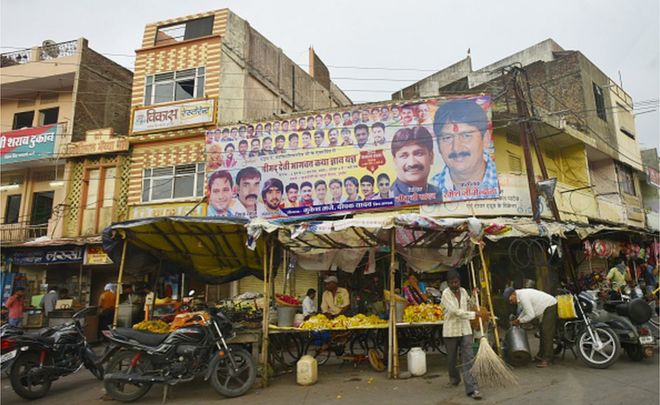
Image copyright GETTY IMAGESImage caption Indore is a bustling commercial city
In early March, 40-year-old Ravi Dosi, a chest specialist in India, saw a baffling surge in patients with respiratory problems at outpatient clinics.
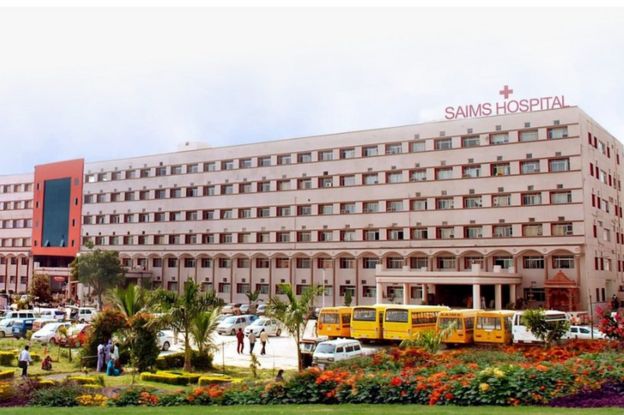
“There was almost a 50% jump in patients with upper respiratory issues and sore throat. They were not responding to antibiotics. Testing was still low and we didn’t really know what was going on,” Dr Dosi, who works at Sri Aurobindo Institute of Medical Sciences, a 1,156-bed private medical college in the central city of Indore, told me.
Less than a fortnight later, Dr Dosi began seeing an uptick in admissions of Covid-19 patients. Around the end of March, the hospital was receiving 28 infected patients every day.
They had dry cough, fever, and difficulty breathing. Their blood oxygen levels were low. They were reporting loss of taste and smell.
In the first wave of patients, nearly a dozen came from far-flung districts, more than 150km (93 miles) from Indore, a bustling commercial city in Madhya Pradesh state. The state has now become a hotspot, with nearly 400 confirmed infections out of the more than 6,400 infections and nearly 200 deaths across the country so far.
By the second week of April, Dr Dosi and his team of 100 doctors and nearly an equal number of nursing staff working 24/7 in three shifts, were treating 144 Covid-19 patients. (Thirty-one had been treated and sent home already.)
A total of 38 patients were in intensive care. Twenty-one of them were critical. There had been seven deaths. “We are handling the largest number of Covid-19 patients in India,” Vinod Bhandari, a surgeon and chairman of the hospital, told me.
Doctors now believe that the infection was spreading in the community long before the government admitted to it, and testing slowly ramped up. Until two weeks ago, Indian health authorities had been denying community transmission.
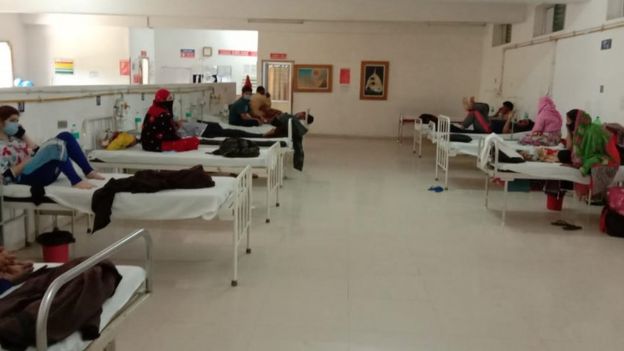
Image caption The hospital in Indore has more than 140 patients
Now a new study by Indian Council of Medical Research (ICMR) using surveillance data from 41 labs in the country has hinted at community transmission: 52 districts in 20 states and union territories reported Covid-19 patients. Some 40% of the cases did not report any history of international travel or contact with a known case. (The survey was based on swabs collected from nearly 6,000 patients who tested positive between 15 February and 19 March.)
Back in the hospital in Indore, the doctors are battling the surge in infections.
Three isolation wards spread over two floors floors are stacked with patients. (The hospital has earmarked 525 beds for Covid-19 patients.) Isolation wards have younger patients with mild infection, while elderly patients with more severe symptoms are in intensive care. The oldest patient is a 95-year-old man, and the youngest is a four-month-old boy.
The team of doctors handling patients includes chest specialists, anaesthetists, microbiologists, and dermatologists. There are patients with a lot of underlying medical conditions – diabetes, hypertension, even cancer – so all the specialists have been called in to help with the treatment.
Dr Dosi wakes up early, puts on protective gear – scrubs, face masks and shields, N95 masks, gowns, double gloves and shoe covers – before going on his rounds of the patients. Doctors say they are not facing a shortage of gear yet.
They are using 22 ventilators to help the critical patients breathe, and also providing oxygen supplies to others using nasal cannulas (nose prongs).
In the isolation wards, patients are given oral medication – antibiotics and hydroxychloroquine (commonly known as HCQ), an anti-malarial drug – and directed to maintain social distancing and wash their hands regularly.
Image caption The isolation wards are packed with patients
“I have never seen a challenge and crisis like this in my career. I have heard stories about an outbreak of plague in Surat [in 1994]. But this seems to be much bigger. The biggest challenge is to keep hopes alive and be positive,” says Dr Dosi.
Keeping hopes up for patients in isolation can be taxing. Three tests, say doctors, are being done for the infection – if the first test comes out positive, the patient remains in isolation for two weeks, and is tested twice on two days after the quarantine period. If the last two tests come back negative, the patient is discharged. If not, the patient has to stay in isolation for another two weeks. “It is a tough grind, mentally,” says one doctor.
For the last three weeks, Dr Dosi has been living in the hospital, away from his wife, two sons and parents. His father is a retired pathologist. They communicate via hurried video calls, between his frantic trips to the isolation wards and intensive care.
I ask him when does he expect this to “get over”, so that he can go home.
“In a couple of weeks,” he says. “The lockdown should have helped to slow down the infection.”
Dr Dosi is alluding to the strict 21-day lockdown India imposed on 24 March to halt the spread of the infection.
Image copyright GETTY IMAGESImage caption Health officials have been denying community transmission
Things are getting better, he says.
“I am getting 10 patients for admission in isolation wards, and two patients severe enough for intensive care every day now. Earlier this week, it was 50:50.”
It is possibly too early to hazard a guess about when admissions will slow down to single digits. As more people are tested, the number of patients can easily rise again.
It’s been unrelenting, Dr Dosi says.
Early, on Friday, I sent him a text to find out what was going on.
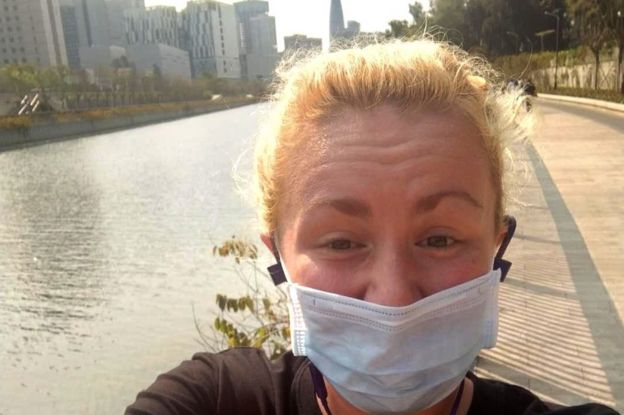
Image copyright JEN SMITHImage caption Jen Smith lives in Shenzhen, where it’s compulsory to wear a mask outside at all times
My Money is a series looking at how people spend their money – and the sometimes tough decisions they have to make. Here, Jen Smith, a children’s TV presenter from Shenzhen in southern China, takes us through a week in her life, as the country slowly emerges from the coronavirus pandemic.
Over to Jen…
Since being in lockdown I’ve been bingeing on Keeping Up With the Kardashians. It starts with one episode after dinner, blink, and suddenly it’s 3am. YouTube, Facebook, Google and Instagram are all banned here, so you’d think I’d be a binge-free socialite after a year and a half living in China. Well, those sites are banned unless you have a VPN – I pay $120 (£97) a year for mine, so Sunday was a late night, with a lie-in until 10.30 this morning.
I go for a run – mask and all, as it’s currently illegal to be outside without one. I make my coffee (bought in the UK), fruit smoothie (about 20 yuan, $2.82, £2.27) and cereal (80 yuan a packet) before cycling to work.
Today is a bit of a crazy day in the studio. I work as a children’s TV presenter. My company has profited from the lockdown as more children are watching the shows non-stop – meaning a rapid turnaround for us.
We shoot two shows from 2-6pm then “break” for a meeting. We discuss tomorrow’s shoot while I eat dinner – homemade aubergine curry. It is normal for the Chinese to eat breakfast, lunch and dinner at work. Normally the company gives all staff 25 yuan through a food-ordering app, and the whole company would eat together. However, because of the current social distancing, that social time is in the far distant past!
I make it home for 8pm, order some deep-fried cauliflower as a snack (45 yuan) and start the inevitable Kardashian binge.
Total spend: 65 yuan ($9.10, £7.37)
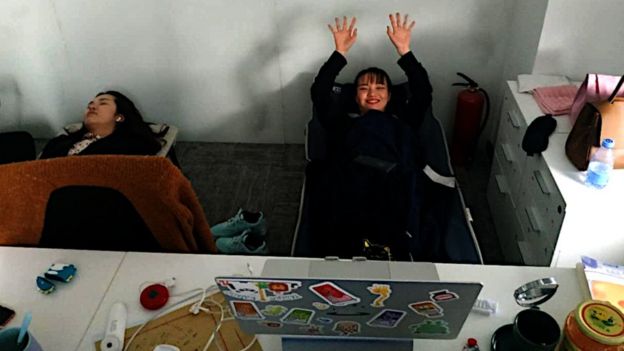
Image copyright JEN SMITHImage caption Workers often have a midday nap in the office
It’s a much earlier start (7.30am), but the same morning routine. On my cycle to work I notice that the traffic is almost back to normal – Shenzhen is inhabited by well over 12 million people, so as you can imagine rush hour is intense. This doesn’t change the fact that everywhere you go you have to scan a QR code – leaving my apartment, using the walkway by the river, and getting into the building I work in.
After a morning of shooting I eat homemade potato curry and settle down for a nap. Naptime is such a commonality in China that people store camp beds at the office. I order a coffee and banana chips (20 yuan) for a pick-me-up before the afternoon’s shooting.
It’s St Paddy’s Day so I head to the local pubs area, catch dinner at a French restaurant (222 yuan), then a few drinks (25 yuan – mainly bought by men at the bar for us) before a very tipsy cycle home.
Total spend: 242 yuan ($34, £25)
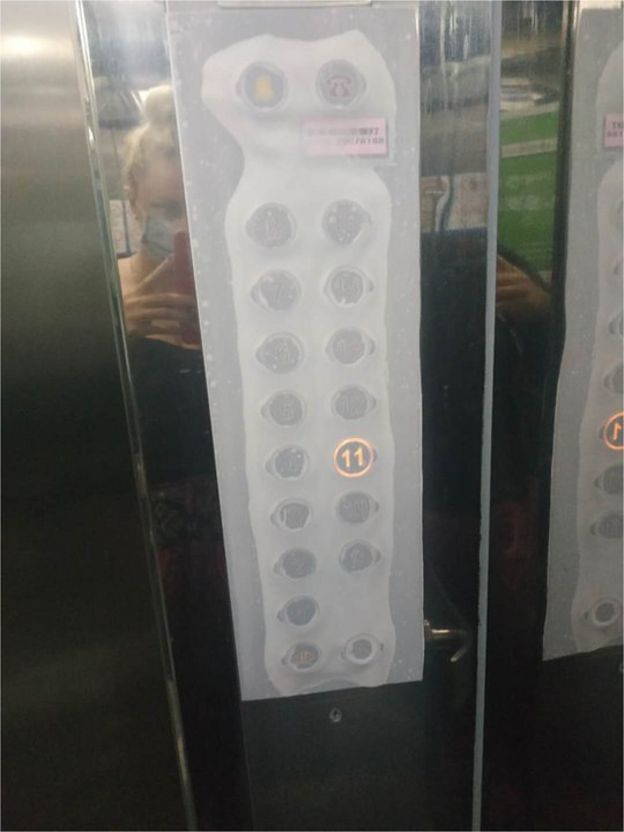
Image copyright JEN SMITHImage caption A disposable cover reduces the risk of transmitting the virus by touching lift buttons
The morning’s shoot (thankfully) was cancelled, so I nursed a hangover in bed until around 11am, at which point I had a phone meeting for a company that I do “plus-size” modelling for (for context I’m a UK size 12). I eat a bowl of cereal and order more cauliflower (45 yuan) while I watch a film.
At 2.30pm an intern picks me up, and we head to the government building to apply for a new work visa. Ironically, the image taken for my visa is Photoshopped to remove wrinkles, freckles and my frizzy hair. When I ask why this is being done for an identification document, the intern replies that the government wants it to be neat, and “the Chinese way” is to have altered photos.
I don’t argue, and have an interview before I hand in my passport. The whole process takes around two hours, so I order food to my house while on the way home (150 yuan for burger, salad and cake!) I take a taxi across town which ends up being 39.05 yuan.
The day starts at 8.30am with coffee and reading, before I get a manicure (280 yuan). My nail lady has been very worried about the state of my hands during the virus, so she spends a whopping two and a half hours treating them while I watch a film (0.99 yuan – bought by her). Because the manicure was so long I don’t have time to eat lunch before our fitness shoot, which runs from 2-5.30pm. I then have an appointment to sign into a building which I’ll shoot in tomorrow.
The building is near a supermarket called Ole (one of the only western supermarkets), and I pick up groceries for 183 yuan before heading home to cook, listen to podcasts and prep for the big day of shooting on Friday.
Total spend: 463 yuan ($64, £52.5)
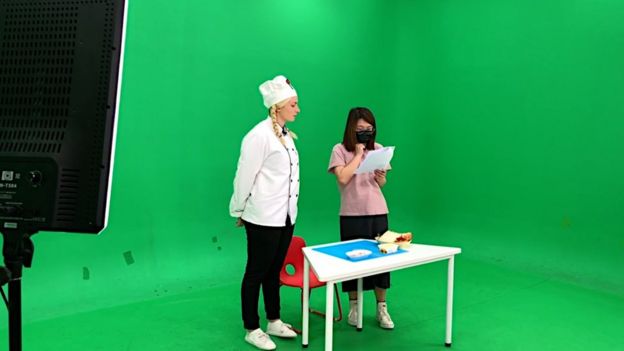
Image copyright JEN SMITHImage caption Jen filming in front of a green screen – a more colourful digital background will be added later in post-production
Fridays are generally my busiest day. The way the Chinese seem to function, is a boss will say “I want this done now” and then employees rush to finish it. Generally, they will write scripts on Monday and Tuesday, discuss Wednesday, then we shoot later in the week. The poor editors, despite mandatory office hours during the week, then have to work tirelessly through the weekend to achieve a Sunday evening deadline.
I start with mashed avocado and a hard-boiled egg before work. The morning shoot runs from 9.30-11.40am, and I have an early lunch – homemade curry again, before my regular nap time. The afternoon shoot is three hours, so I have time to pop home and shower before a live stream at 6pm. I take a taxi to and from the live stream which ends up being 28 yuan.
Total spend: 28 yuan ($3.92, £3.18)
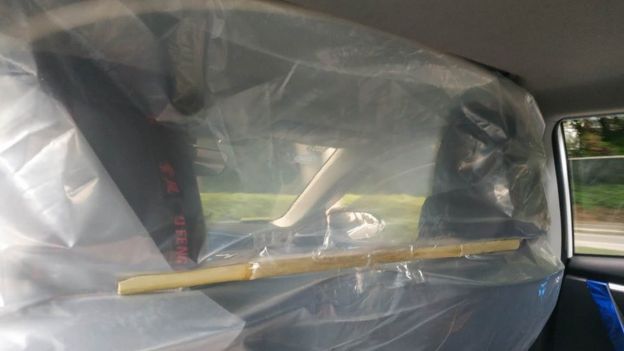
Image copyright JEN SMITHImage caption A taxi driver has improvised a screen to reduce the risk of picking up Covid-19 from a passenger
Finally the weekend! Although things are slowly getting better in China after the coronavirus outbreak, there’s still not too much to do. So I use this time to write, play my piano and generally chill inside. Around 3pm, I venture outside to the shops to pick up some snacks (159.60 yuan) before settling in to ring my family back in the UK with a homemade cocktail – a friend of mine in Canada is doing a daily live stream, “quarantinis” where he teaches you how to make cocktails!
What’s interesting is that a lot of people have started leaving their houses again, but it is still illegal to go outside without a mask on, and temperature checks are taken everywhere. I was even refused entry to a building due to being foreign. I imagine this is because recently the only new cases are being brought in by non-Chinese travelling back to China.
Total spend: 159.60 yuan ($22, £18)
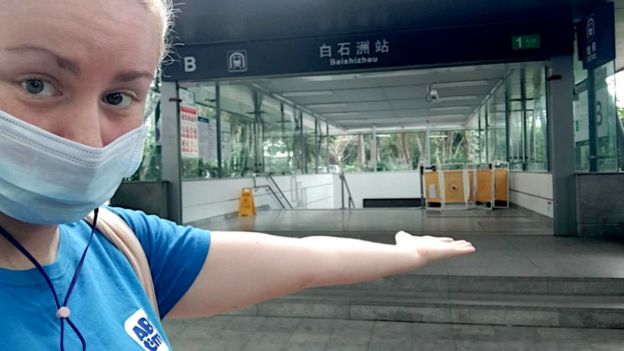
Image copyright JEN SMITHImage caption Shenzhen’s Metro system is still very quiet
It’s another slow day for me as many foreigners have not yet returned to China, so most of my friends are out of the country. I start the day by reviewing potential scripts.
This takes me to 1.30pm without realising I haven’t eaten. I decide to go for a quick run and I return to eat mashed avocado and a hard-boiled egg.
I home-bleach my hair with products bought in the UK, then head back to editing again. About half way through the afternoon I take a little break to practice Chinese. I use an app which is fantastic and free! Definitely worth everyone downloading this during social distancing so you can learn new skills!
For dinner I order online again, a three-dish meal for 160 yuan.


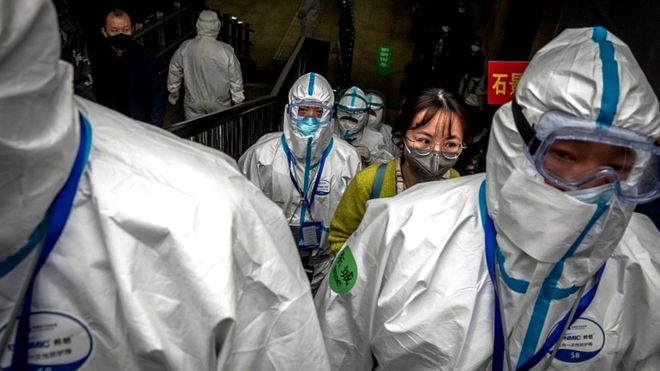 Image copyright EPA












 CHINDIA ALERT: You'll be living in their world, very soon