22/04/2020
SEOUL/BEIJING (Reuters) – China has allowed 200 employees from South Korea’s Samsung Electronics Co Ltd (005930.KS) to enter the country to work on an expansion of the firm’s NAND memory chip factory, the company said on Wednesday.
The move came after China said on Tuesday that it was in talks with some countries to establish fast-track procedures to allow travel by business and technical personnel to ensure the smooth operation of global supply chains.
China said it has reached a consensus on such an arrangement with South Korea, without elaborating on the terms, including whether individuals entering China will be subject to quarantine.
China, where the virus first emerged late last year, blocked entry last month for nearly all foreigners in an effort to curb risks of coronavirus infections posed by travellers from overseas. After bringing the local spread under control with tough containment measures, it is trying to restart its economic engines after weeks of near paralysis.
A chartered China Air Ltd (601111.SS) plane flew in the Samsung Electronics employees on Wednesday, a company spokeswoman said.
Samsung said its employees will follow the local government’s policy upon arrival, without elaborating.
Shaanxi province, where Samsung’s NAND memory chip plant is located, requires people travelling from overseas to undergo a 14-day quarantine, according to South Korea’s foreign ministry.
“Samsung employees will not be exempted from the 14-day quarantine rule imposed by the Shaanxi province. They will get coronavirus tests at the airport upon arrival and will be transported to a local hotel designated by Chinese authorities,” an official at the Consulate General of South Korea in Xi’an told Reuters.
Samsung Electronics in December increased investment at its chip factory in China by $8 billion to boost production of NAND flash memory chips.
Source: Reuters
Posted in $8 billion, 14-day quarantine, 200, according, after, Airport, allow, allowed, allows, Arrangement, arrival, Beijing, billion, blocked, boost, bringing, Business, came, chartered, China, China Air Ltd, chinese authorities, chip factory, Company, consensus, Consulate General, containment, control, coronavirus infections, coronavirus tests, countries, Country, curb, December, designated, economic engines, effort, elaborating, emerged, employees, ensure, enter, entering, entry, establish, exempted, expansion, Factory, fast-track, firms, flash memory chips, flew, Foreign Ministry, Foreigners, from, from overseas, global supply chains, including, increased, individuals, Investment, last month, late last year, local governments, local hotel, local spread, located, measures, memory chip, move, NAND, near, nearly, Official, operation, overseas, paralysis, People, personnel, plane, Plant, policy, posed, procedures, production, quarantine, reached, requires, restart, Reuters, Risks, rule, Samsung Elec, Seoul, shaanxi province, smooth, South Korea, South Korea’s, spokeswoman, staff, subject, talks, technical, terms, tough, transported, travel, travellers, travelling, trying, Tuesday, Uncategorized, undergo, upon, Virus, Wednesday, weeks, whether, without, work, Xi'an |
Leave a Comment »
22/07/2019
- Zhang Lin, a Beijing-based independent political economy commentator, questions why returnees are becoming ardent supporters of the government-directed model
- China’s economic boom offers returnees far more advantages than Western societies could upon their graduation
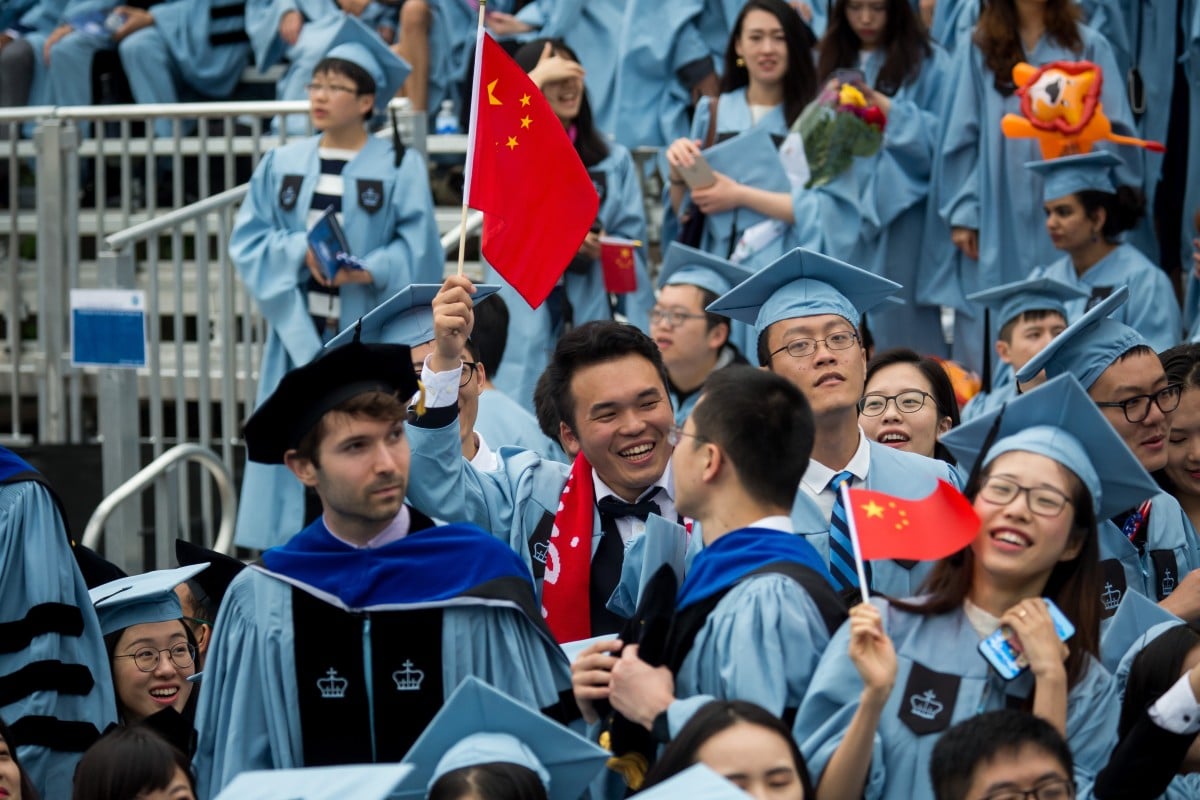
The number of Chinese students studying in the US and European schools soared, offering fresh hope that returnees with an overseas educational background would facilitate China’s transformation into a society that resembled the west. Photo: Xinhua
At the turn of the century, many people foresaw a “westernisation” process taking place in China – the development of a market economy and a freer society – especially after China joined the World Trade Organisation in 2001 with a clear commitment to reform its state-owned enterprises.
The number of Chinese students studying in the US and European schools soared, offering fresh hope that returnees with an overseas educational background would facilitate China’s transformation into a society that resembled the west.
But it has not turned out as expected, with more and more returnees who graduated from Western universities becoming ardent and vocal supporters of the Chinese government-directed model. It seems strange on the surface that young Chinese people, who have several years’ first-hand experience of Western democracy and freedom, would become big fans of an intrusive state.
One explanation is that the overseas students who worship the Western lifestyle never return to China.
In the 1980s and 1990s, Chinese students who studied abroad did not rely on wealth or family background, but excellent academic achievement, and most of the students who went abroad were funded by China’s Ministry of Education. After experiencing the huge gaps between China and the West at that time in terms of living standards and social development, many chose to stay after graduation.
China’s overseas study policy at that time dictated that these students needed to return back within five years, or else their families could have faced punishment. Despite this, according to statistics from 2002, 92 per cent of Chinese students who obtained doctorate degrees in the United States during the 1990s choose not to return to their homeland.
Things began to change in the late 1990s. China’s private businesses started to boom after Deng Xiaoping’s “southern tour” in 1992, with many government officials and local leaders quitting their public jobs to pursue private wealth, in a trend dubbed “smashing their and jumping into the sea”. Blessed by their connections to the state apparatus, many of them became filthy rich in the process.
These Chinese nouveau riche could suddenly afford foreign university tuition fees and started sending their children to study abroad. The Chinese government also relaxed its policy on overseas education, and most overseas Chinese students became “second generation” rich and powerful.
At the same time, western universities particularly in the US and Britain opened their arms to the flow of Chinese students who were willing to pay hefty tuition fees and sometimes willing to make sizeable donations.
Most of these returnees, whose families have made significant gains from China’s state-led market economy, were beneficiaries of the Chinese model
According to statistics from the “Report on the Survey of Overseas Students” covering the years 2000 to 2011, 1.9 million Chinese students studied abroad, with 91.3 per cent of them “self-funded”. By 2014, the proportion of overseas students who returned to China had risen to 51.4 per cent, according to the “2015 China Returnees Development Report”.
This report also pointed out that 32 per cent of returnees were willing to work for the government.
Most of these returnees, whose families have made significant gains from China’s state-led market economy, were beneficiaries of the Chinese model. The experience of studying abroad, ironically, only enhanced their understanding of their advantages and privileges back home.
China’s economic boom offered far more chances for this well-educated, and well-connected, group than Western societies could, upon their graduation. If they chose to stay in the Western country where they studied, they were faced with the prospect of starting from scratch, but if they chose to go back China, they could get a better job, probably earn more money, inherit the wealth of the previous generation and live as a member of the elite.
That China’s overseas returnees are supporters of the Chinese model indicates that the Western concept of freedom is not always a powerful incentive. If competition between countries is competition between elite groups, conflicts between the Chinese model and the US model may last for several generations and spread to more countries.
Posted in big fans, China’s Ministry of Education, China’s students, Chinese economic model, Chinese model, Deng Xiaoping, economic boom, Freedom, from overseas, Report on the Survey of Overseas Students, returning, southern tour, Uncategorized, US model, Western democracy, World Trade Organisation (WTO) |
Leave a Comment »



 CHINDIA ALERT: You'll be living in their world, very soon