05/09/2019
- Researchers will conduct tests at site in Gansu to see whether it will make a viable facility to store highly radioactive waste safely
- Scientists say China has the chance to become a world leader in this field but has to find a way to ensure it does not leak
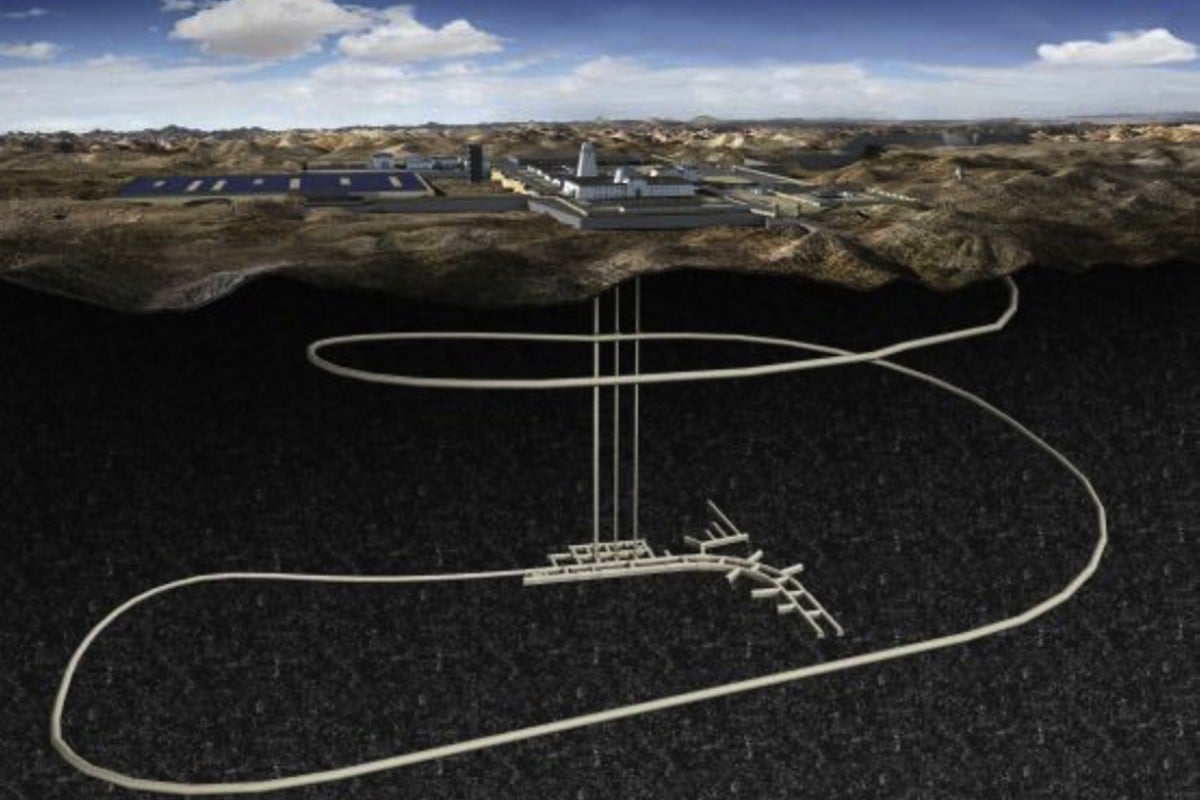
A preliminary design for the Beishan Underground Research Laboratory. Photo: Handout
China has chosen a site for an underground laboratory to research the disposal of highly radioactive waste, the country’s nuclear safety watchdog said on Wednesday.
Officials said work will soon begin on building the Beishan Underground Research Laboratory 400 metres underground in the northwestern province of Gansu.
Liu Hua, the head of the Chinese National Nuclear Safety Administration, said work would be carried out to determine whether it would be possible to build a repository for high-level nuclear waste deep underground.
“China sees radioactive waste disposal as a very important part [of the development nuclear energy],” said Liu. “To develop nuclear energy, we must have safe storage and disposal of nuclear waste.”
China condemns US blacklisting of nuclear firms and says American companies could be hurt as a result
The Chinese authorities see nuclear power an important source of energy that will help to curb carbon emissions and pollution as well as reducing its dependence on fuel imports.
But while the country has made great strides in the development of nuclear power, it needs to find a safe and reliable way of dealing with its growing stockpiles of nuclear waste.
Liu said the Gansu site had been identified as a possible location for a deep nuclear waste store after years of searching.
Once the laboratory is built, scientists and engineers will start experiments to confirm whether it will make a viable underground storage facility.
“Based on the data of the experiments, we can then decide if we are going to pick this as the final site,” he added.
China ‘actively promoting’ nuclear fuel processing plant with French Areva
Chinese officials usually stay tight-lipped about how nuclear waste is disposed of mainly because of fears that any discussion of the topic would trigger safety fears, although in recent years more efforts have been made to inform the public to win support.
Scientists say that nuclear waste can be divided into three categories depending on the level of radioactivity.
Low-level waste consists of minimally radioactive materials such as mop heads, rags, or protective clothing used in nuclear plants, while intermediate-level waste covers things such as filters and used reactor components.
High-level waste, however, is generated by the reprocessing of spent nuclear fuel and scientists generally agree that the safest way to dispose of it is to bury it deep underground in areas where the geology means it will have a minimal impact on the environment while it decays over thousands of years.
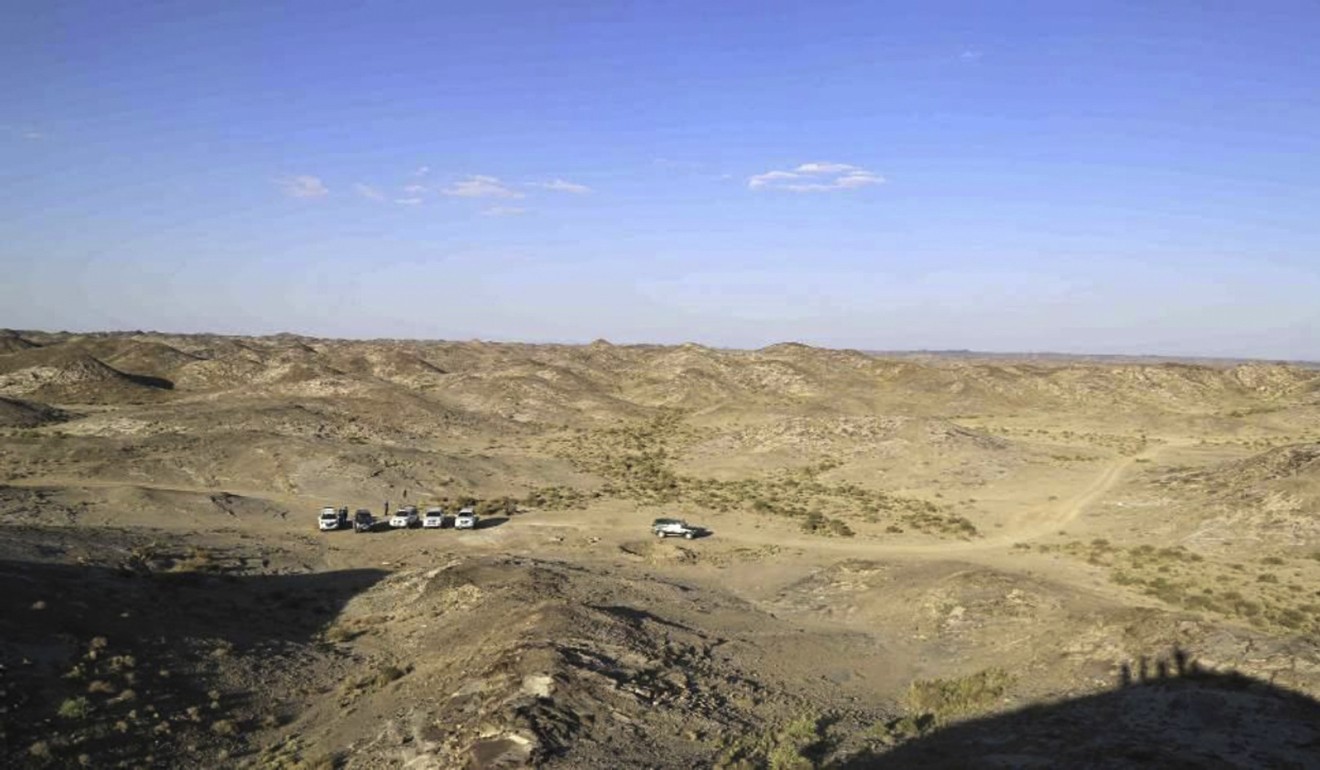
The facility will be built in a remote part of Gansu province. Photo: Handout
Some Chinese scientists said the country had the chance to lead the world in this area of research but others have expressed concerns about safety.
Jiang Kejun, a senior researcher at the Energy Research Institute of China’s National Development and Reform Commission, said that very few countries in the world are studying this form of nuclear waste disposal.
“It gives China an opportunity to be a leader in research in this area, plus China has the technology and financial means,” he said.
About a dozen countries including France, Switzerland, Japan, and the United States have carried out research in this area, but in recent years most have abandoned or scaled back their programmes.
At present there are storage sites operating in Finland and the US, but other countries such as Germany have abandoned plans to build similar facilities.
Washington blacklists Chinese nuclear firms for ‘helping military acquire US technology’
But despite broad scientific support for underground disposal, some analysts and many members of the public remain sceptical about whether it is really safe.
Lei Yian, an associate professor at the School of Physics at Peking University, said there was no absolute guarantee that the repositories would be safe when they are come into operation.
“Leakage has happened in [repositories] in the US and the former Soviet Union … it’s a difficult problem worldwide,” he said. “If China can solve it, then it will have solved a global problem.”
China is also building more facilities to dispose of low and intermediate level waste. Officials said new plants were being built in Zhenjiang, Fujian and Shandong, three coastal provinces that currently lack disposal facilities.
At present, two disposal sites for low and intermediate-level waste are in operation in Gansu and Guangdong provinces.
Source: SCMP
Posted in American companies, Beishan Underground Research Laboratory, blacklists, bury it deep, carbon emissions, China alert, chinese authorities, Chinese National Nuclear Safety Administration, Chinese nuclear firms, Chinese officials, coastal provinces, condemns, conduct, Country, deep underground, difficult problem, disposal facilities, earmarks, Energy Research Institute, Environment, filters, Finland, France, French Areva, fuel imports, Fujian, Gansu Province, geology, Germany, global problem, great strides, helping military acquire, High-level waste, highly radioactive waste, hurt, intermediate-level waste, Japan, lack, Leakage, Low-level waste, mop heads, National Development and Reform Commission, National Development and Reform Commission (NDRC), nuclear energy, nuclear firms, nuclear fuel processing plant, Nuclear power, nuclear safety watchdog, nuclear waste, Peking University, Pollution, protective clothing, rags, repositories, repository, reprocessing of spent nuclear fuel, researchers, result, safely, School of Physics, scientists, shandong province, site, source of energy, Soviet Union, stockpiles, store, Switzerland, tests, Uncategorized, underground, underground disposal, United States, US, US blacklisting, US technology, used reactor components, viable facility, Washington, world leader, worldwide, Zhenjiang |
Leave a Comment »
04/09/2019
LANZHOU, Sept. 3 (Xinhua) — Bound by lower education levels, traditions and household responsibilities, most ethnic minority women in China’s impoverished regions have never dared to think of ways other than farming to help their families gain a better life.
However, with the government campaign to eradicate poverty gathering steam, small manufacturing workshops are bringing jobs to their doorsteps and empowering the women to take new roles in their families.
Ma Xiuping, living in a village in Linxia Hui Autonomous Prefecture, northwest China’s Gansu Province, could not hide her excitement when recalling the first time she was paid by the factory she started working in.
“I could barely read, and I never imagined I could get a salary like urban workers,” said Ma, who is in her 50s.
The rural cooperative Ma works at makes traditional cloth shoes and employs more than 50 impoverished women workers.
In Gansu Province, such poverty-alleviation factories have created jobs for more than 8,000 women who were once trapped working on farms and taking care of all the family chores, and for them, a different life has started.
“Now I don’t have to ask my husband for money, which makes me more confident,” said the 28-year-old Ma Fatumai who worked at the same workshop with Ma Xiuping. For her first month of work, she earned 1,350 yuan (about 190 U.S. dollars).
For Huang Ayingshe, who works in another poverty-reduction workshop in the prefecture, a job also means more association with the outside world, which she says is “much more fun” than staying at home.
As the deadline to eradicate absolute poverty by 2020 approaches, China is focusing efforts on the nation’s poorest people, and Gansu Province is one of the major battlefields.
Answering the central leadership’s call for “precision poverty alleviation,” which demands tailored policies to suit different local situations, the province seeks to tap the power of women in the battle to wipe out absolute poverty by 2020.
In July, the All-China Women’s Federation held a meeting in the Linxia Hui Autonomous Prefecture, which stressed women’s roles in fighting poverty and called on them to contribute their strength.
Official data showed that China lifted 13.86 million people in rural areas out of poverty in 2018, with the number of impoverished rural residents dropping from 98.99 million in late 2012 to 16.6 million by the end of last year.
Source: Xinhua
Posted in All-China Women's Federation, ethnic minority women, Factory, Gansu Province, Lanzhou, Linxia Hui Autonomous Prefecture, new life, Poverty-reduction workshops, rural cooperative, Salary, traditional cloth shoes, Uncategorized, urban workers |
Leave a Comment »
26/08/2019
- Kunming tests support for new rules that demand travellers wear earphones when using noisy electronic devices
Cities across China are listening to the complaints of commuters and ordering owners of noisy mobile phones and music devices to turn them down and wear earphones. Photo: Shutterstock
Kunming, the capital of southwestern Yunnan province, plans to become the third mainland Chinese city to ban public transport users from listening to loud music, watching noisy videos or talking loudly on phones.
Acting on complaints from passengers, the city is testing public support for a change to its subway passenger code of conduct that would ban excessive noise, the municipal transport bureau said last week.
At least two other cities, Beijing and Lanzhou – the capital of northwestern Gansu province – have barred travellers from talking loudly or turning up their electronic devices on the underground.
Kunming’s proposed amendment includes a ban on loud conversation, with administrative penalties for people found breaking the rules. The public have until September 5 to give feedback on the proposal.
“Some passengers ignore other people and play their electronic devices with the sound on, causing a great disturbance to others. Such behaviour needs to be regulated,” the bureau said.
The proposal was popular on social media.
“I’d suggest operators of high-speed trains and civil aviation also adopt this ban,” one user of the Weibo microblogging service wrote. “Don’t you have the money to buy earphones?”
Some Hongkongers have phones checked for protest photos at mainland China border amid anti-government unrest
“I’m strongly in favour – the most effective way to improve our manners is to give clear rules,” another user said.
Lanzhou, which opened its first subway line in June, banned on passengers from playing devices without wearing headphones from the day the first train rolled.
Also in June, Beijing issued a code of conduct for public transport passengers that included a ban on excessive noise. Penalties there included personal credit system demerits, black marks that could be removed by working as a subway volunteer for an hour.
Source: SCMP
Posted in Beijing, Gansu Province, Hongkongers, Kunming, Lanzhou, subway line, Uncategorized, Yunnan Province |
Leave a Comment »
24/08/2019
Chinese President Xi Jinping, also general secretary of the Communist Party of China Central Committee and chairman of the Central Military Commission, inspects an air force base in northwest China’s Gansu Province, Aug. 22. 2019. (Xinhua/Li Gang)
LANZHOU, Aug. 23 (Xinhua) — Chinese President Xi Jinping has called on the air force to enhance its capability to win and greet the 70th anniversary of the founding of the People’s Republic of China (PRC) with great achievements.
Xi, also general secretary of the Communist Party of China Central Committee and chairman of the Central Military Commission, made the remarks Thursday when inspecting an air force base in northwest China’s Gansu Province.
At the combat command center, Xi used a tele-conferencing facility to inspect the troops including personnel at a radar station on a plateau over 3,600 meters above sea level and a transport and rescue regiment.
After listening to the work report of the base, Xi stressed the great significance of carrying out the Party education campaign themed “staying true to our founding mission” as the nation marks the 70th anniversary of the founding of the PRC.
Demanding a stronger sense of responsibility, Xi asked for persistent efforts in improving military preparedness to ensure that the air force can fight and emerge victorious when called upon.
The combat forces and support forces should be developed through military training under real combat conditions and joint operations, Xi said.
He also stressed the need to govern the military with strict discipline in every respect and make sure that the armed forces are highly centralized, unified, pure and solid, and that they stay secure and stable.
Source: Xinhua
Posted in 70th anniversary, air force, air force base, Chairman of the Central Military Commission, Chinese President Xi Jinping, founding of the People's Republic of China (PRC), Gansu Province, general secretary of the Communist Party of China Central Committee, Party education campaign, radar station, tele-conferencing facility, transport and rescue regiment, Uncategorized |
Leave a Comment »
22/08/2019
Chinese President Xi Jinping, also general secretary of the Communist Party of China Central Committee and chairman of the Central Military Commission, inspects the Babusha Forest Farm, an afforestation program in a desert area of Gansu, where he learns about the latest developments in desertification control and environmental protection, in Gulang County of Wuwei City, northwest China’s Gansu Province, Aug. 21, 2019. (Xinhua/Xie Huanchi)
LANZHOU, Aug. 21 (Xinhua) — Xi Jinping, general secretary of the Communist Party of China Central Committee, visited a rural community and an afforestation area in northwest China’s Gansu Province Wednesday.
Xi visited a new community in Gulang County, which is home to rural residents relocated out of ecological concerns, and inquired about their livelihoods and progress on poverty relief.
He also inspected an afforestation program in a desert area of Gansu, where he learned about the latest developments in desertification control and environmental protection.
Source: Xinhua
Posted in afforestation area, Chinese President Xi Jinping, desertification control, Environmental protection, Gansu Province, general secretary of the Communist Party of China Central Committee, Gulang County,, inspects, rural community, Uncategorized, Village, visited |
Leave a Comment »
22/08/2019
Chinese President Xi Jinping, also general secretary of the Communist Party of China Central Committee and chairman of the Central Military Commission, visits a Yellow River management point to learn about the management, protection and flood control project construction of the Yellow River in Lanzhou, northwest China’s Gansu Province, Aug. 21, 2019. (Xinhua/Wang Ye)
Source: Xinhua
Posted in Chairman of the Central Military Commission, Chinese President Xi Jinping, flood control, Gansu Province, general secretary of the Communist Party of China Central Committee, Lanzhou, Management, project construction, protection, Uncategorized, visits, Yellow River, Yellow River management point |
Leave a Comment »
21/08/2019
Chinese President Xi Jinping, also general secretary of the Communist Party of China Central Committee and chairman of the Central Military Commission, visits the Jiayu Pass, a famed part of the Great Wall in Jiayuguan City, during his inspection tour of northwest China’s Gansu Province, Aug. 20, 2019. Xi also listened to an introduction to the historical and cultural background of the Great Wall and the passes in the Hexi Corridor, part of the ancient Silk Road in northwest China. (Xinhua/Ju Peng)
Source: Xinhua
Posted in ancient silk road, Chairman of the Central Military Commission, Chinese President Xi Jinping, Gansu Province, general secretary of the Communist Party of China Central Committee, Great Wall, Hexi Corridor, Jiayu Pass, Jiayuguan City, Northwest China, Uncategorized |
Leave a Comment »
20/08/2019
Chinese President Xi Jinping, also general secretary of the Communist Party of China (CPC) Central Committee and chairman of the Central Military Commission, visits the Mogao Grottoes in Dunhuang, a key cultural heritage site under state-level protection, during his inspection tour of northwest China’s Gansu Province, Aug. 19, 2019. Xi inspected the work of cultural relics protection and study, as well as efforts to promote China’s great history and fine culture. (Xinhua/Xie Huanchi)
LANZHOU, Aug. 19 (Xinhua) — Xi Jinping, general secretary of the Communist Party of China Central Committee, on Monday visited the Mogao Grottoes in Dunhuang, a key cultural heritage site under state-level protection, during his inspection tour of northwest China’s Gansu Province.
Xi inspected the work of cultural relics protection and study, as well as efforts to promote China’s great history and fine culture.
Source: Xinhua
Posted in Chinese President Xi Jinping, cultural heritage site, Dunhuang, Gansu Province, Mogao Grottoes, Uncategorized, visits |
Leave a Comment »
19/08/2019
Artists perform during an event marking the conclusion of an activity that took journalists to retrace the route of the Long March, in Huining, northwest China’s Gansu Province, Aug. 18, 2019. The activity, held from June 11 to Aug. 18, was aimed at paying tribute to the revolutionary martyrs and passing on the traditions of revolution. The Long March was a military maneuver carried out by the Chinese Workers’ and Peasants’ Red Army from 1934 to 1936. During this period, they left their bases and marched through rivers, mountains and arid grassland to break the siege of Kuomintang forces and continue to fight Japanese aggressors. Many marched as far as 12,500 km. (Xinhua/Luo Xiaoguang)
Source: Xinhua
Posted in arid grassland, Artists, Chinese Workers' and Peasants' Red Army, conclude, Gansu Province, Huining, Japanese aggressors, journalists, Long March, mountains, perform, retracing, revolution, revolutionary martyrs, rivers, route, siege of Kuomintang forces, traditions, Uncategorized |
Leave a Comment »
18/08/2019
BEIJING, Aug. 17 (Xinhua) — The central government has offered financial support of 920 million yuan (about 131 million U.S. dollars) to local governments to help counter typhoon, flood control and drought relief.
An emergency relief fund of 600 million yuan has been offered to 11 provincial regions including Henan, Sichuan and Gansu to help them control flood and deal with drought, according to the Ministry of Finance and the Ministry of Emergency Management.
Another fund worth 320 million yuan was used to support Hebei, Liaoning, Jilin and Heilongjiang provinces in flood control and typhoon relief.
Typhoon Lekima landed in east China’s Zhejiang on Aug. 10, wreaking havoc as a super typhoon. About 13 provincial regions have been affected by the typhoon.
China announced the second-highest level in China’s four-level typhoon emergency response system to deal with Typhoon Lekima and minimize casualties and losses.
Source: Xinhua
Posted in Beijing, Central government, China alert, control flood, drought, emergency relief fund, financial support, flood, flood control, Gansu Province, Hebei province, Heilongjiang province, Henan province, Jilin, Liaoning province, local governments, Ministry of Emergency Management, Ministry of Emergency Management (MEM), Ministry of Finance, sichuan province, Typhoon, Typhoon Lekima, typhoon relief, Uncategorized, wreaking havoc, zhejiang province |
Leave a Comment »





 CHINDIA ALERT: You'll be living in their world, very soon