Archive for ‘Germany’s’

31/05/2020

Spotlight: Washington faces blast at home, abroad for “terminating” ties with WHO

BEIJING, May 31 (Xinhua) — The U.S. government has been slammed at home and abroad after announcing on Friday “terminating” its relationship with the World Health Organization (WHO).

U.S. health experts and lawmakers have expressed concern over the decision announced by President Donald Trump amid the COVID-19 outbreak.

Patrice Harris, president of the American Medical Association, described Trump’s move as a “senseless” action with “significant, harmful repercussions.”

“COVID-19 affects us all and does not respect borders; defeating it requires the entire world working together,” Harris was quoted by CNN as saying, urging Trump to reverse the course.

Lawrence Gostin, a professor of global health law and director of the O’Neill Institute for National and Global Health Law at Georgetown University, described the move as “foolish and arrogant” in his Twitter account.

“Trump’s action is an enormous disruption and distraction during an unprecedented health crisis,” said Gostin, also the director of the WHO collaborating center on national and global health law. “The President has made us less safe.”

Democratic Senator Joe Manchin of West Virginia said that “the United States cannot eliminate this virus on its own and to withdraw from the World Health Organization — the world’s leading public health body — is nothing short of reckless,” according to a CNN report.

Even within the Republican party, some Republicans also expressed their disagreement. Senate Health Committee Chairman Lamar Alexander reportedly said he disagreed with Trump’s decision, because, without U.S. funding, clinical trials to develop a COVID-19 vaccine might be hampered.

In addition, the European Union (EU) has urged the United States to reconsider its termination of ties with the WHO, warning that Trump’s move would erode global efforts to curb the spread of the virus.

“The WHO needs to continue being able to lead the international response to pandemics, current and future. For this, the participation and support of all is required and very much needed. In the face of this global threat, now is the time for enhanced cooperation and common solutions. Actions that weaken international results must be avoided,” Ursula von der Leyen, president of the European Commission, and Josep Borrell, the EU High Representative for Foreign Affairs and Security Policy, said in the statement on Saturday.

“In this context, we urge the U.S. to reconsider its announced decision,” the statement said.

German Health Minister Jens Spahn tweeted that Trump’s move was “a disappointing backlash for International Health.”

“The EU must take a leading role and engage more financially,” Spahn said, noting that this would be one of Germany’s priorities when it becomes the bloc’s rotating presidency on July 1.

British Prime Minister Boris Johnson’s spokesperson said earlier that Britain “has no plans to stop funding the WHO, which has an important role to play in leading the global health response.”

“Coronavirus is a global challenge and it is essential that countries work together to tackle this shared threat,” the spokesperson was quoted by The Guardian as saying.

Irish Minister for Health Simon Harris on Friday described Trump’s move as an “awful decision.”

“A global pandemic requires the world working together … We should unite in our fight against it (COVID-19) & not fight each other,” Harris tweeted.

Russian Foreign Ministry spokesperson Maria Zakharova told TASS news agency that Washington “dealt a blow” to the international framework for cooperation in healthcare at the moment when the world needed to join forces.

Source: Xinhua
18/03/2020

Coronavirus: Germany’s Angela Merkel plays down China’s providing medical supplies to hard-hit European countries

  • ‘What we are seeing here is reciprocity,’ the German leader says, referencing the EU’s aiding stricken China earlier this year
  • But critics dismissed China’s show of largesse as propaganda designed to deflect US claims that the contagion originated in China
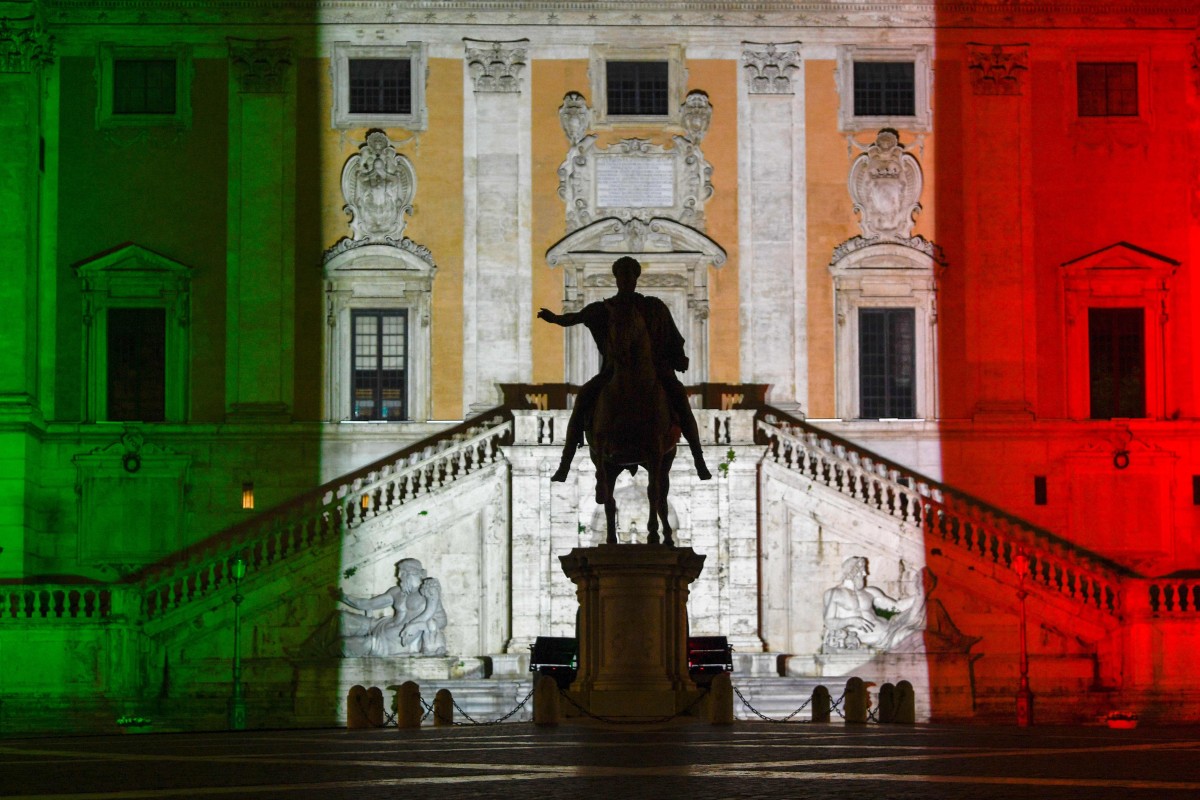
The colours of the Italian flag are projected onto the Palazzo Senatorio building on Capitoline Hill in Rome on Tuesday as a “sign of hope in this difficult and delicate moment”, Rome’s mayor stated. Photo: AFP

German Chancellor Angela Merkel has downplayed concerns over China’s provision of medical supplies to European countries hit hardest by the Covid-19 pandemic, calling the move a gesture of reciprocity.

The European Union continued to face criticism over its slow reaction to calls for medical supplies from Italy and Spain, amid the encouraging news that new cases in Italy were seeing their slowest rate of increase since the contagion came to light in late February.

“The European Union sent medical equipment to China [when] China asked for help at that time,” Merkel said at a Tuesday press conference, referring to the outbreak’s start earlier this year. “What we are seeing here is reciprocity.”

“As we are having a crisis at this time, we cannot expect everything to be provided in the framework of the EU. We are very pleased about [China’s provision],” Merkel said.

Chinese President Xi Jinping has guaranteed that China will provide Italy and Spain – the two most severely hit European countries – with medical equipment such as face masks, ventilators and protective equipment for medical professionals.

Critics, however, called China’s action part of a propaganda campaign designed to deflect US claims that the coronavirus originated in China.

Spanish Prime Minister Pedro Sanchez reached out to Xi for help obtaining medical supplies in a phone call on Tuesday.

Speaking to reporters, Sanchez confirmed that the matter had come up during the call, just days after the Spanish government had ordered an unprecedented national lockdown to halt the virus’ spread.

Chinese state media reported that Xi had told Sanchez that “China is willing to respond to the urgent needs of Spain and spare no effort to provide support and assistance, and share experience in prevention, control and treatment.”

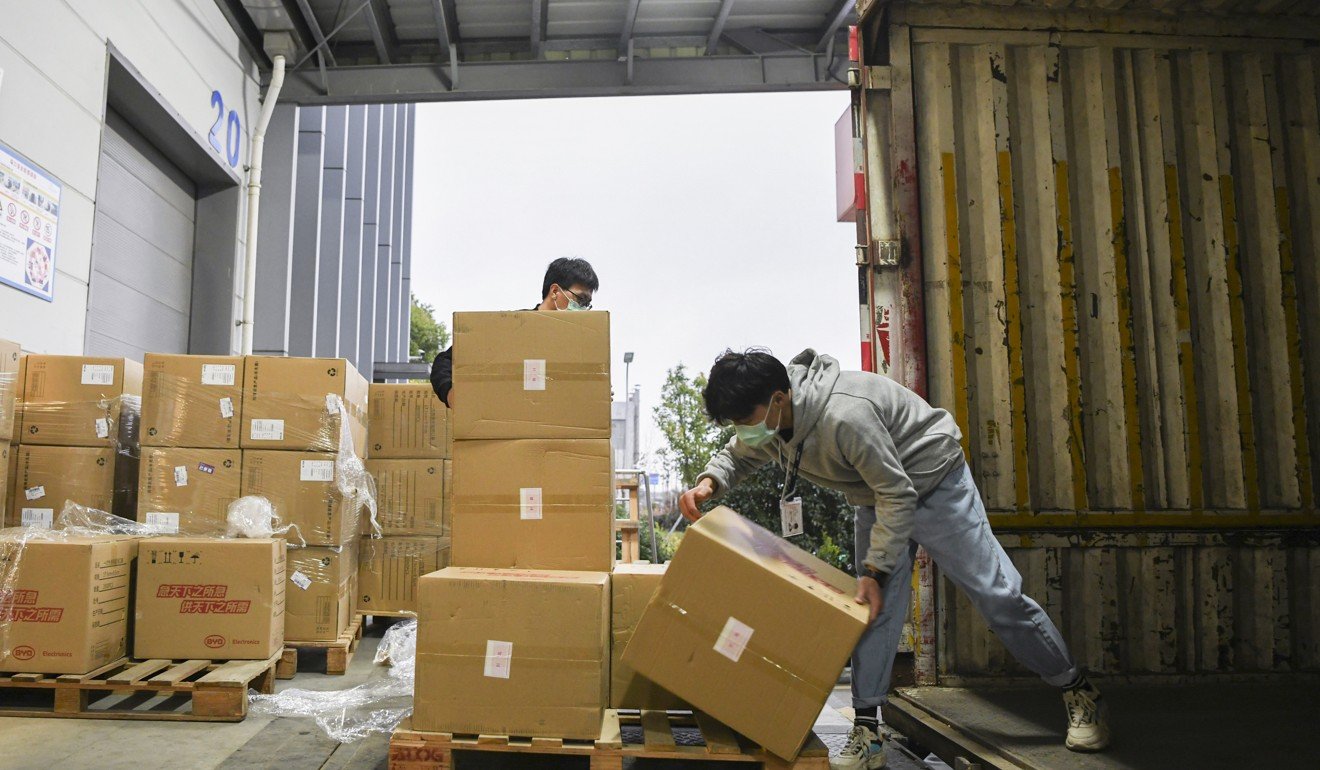
Workers loading boxes of surgical masks donated by China’s BYD, bound for the United States. Photo: Jack Ma Foundation
On Tuesday, a plane from Shanghai landed in the northern Spanish city of Zaragoza, carrying 500,000 masks donated by e-commerce giant Alibaba, AFP reported. (Alibaba owns the South China Morning Post.)

According to a statement, the delivery was part of a donation of 2 million masks and coronavirus test kits to certain countries from Alibaba’s Chinese billionaire founder Jack Ma.

Europe to shut border for month as France braces for 15-day coronavirus lockdown

17 Mar 2020

Xi’s call with Sanchez came a day after one with Italian Prime Minister Giuseppe Conte, in which the Chinese leader similarly pledged to provide Italy with medical support, including teams with expertise in treating Covid-19.

On Tuesday, Italy reported 345 new coronavirus deaths in 24 hours, taking its overall death toll to 2,503.

Spain registered 183 deaths, 53 per cent more than in the previous 24 hours, driving the total number of deaths to 524. More than 2,000 newly infected cases were reported, pushing the total to 11,681.

Elsewhere on Tuesday, France entered a national shutdown, while Belgium, where the EU is headquartered, announced a similar halt to public activities starting on Wednesday.

European Commission President Ursula von der Leyen said all 27 member states have agreed to ban non-EU citizens from visiting the region for the next 30 days. The method of enforcement will be determined by the individual countries, she said.

Source: SCMP

07/03/2020

China welcomes Russia-Turkey agreement on ceasefire in Idlib: envoy

UNITED NATIONS, March 6 (Xinhua) — China’s UN envoy on Friday said China welcomes the Russia-Turkey agreement on a ceasefire for Syria’s northwestern province of Idlib.

In a press encounter after a close-door Security Council meeting on Syria, China’s Permanent Representative to the UN Zhang Jun said “for China, we welcome the agreement signed by the Russian Federation and the Republic of Turkey, and we welcome the diplomatic efforts along this direction.”

He said the signing of the agreement is conducive to finding “what we have always longed … a comprehensive solution to the issue in Syria.”

It’s a step forward in promoting a Syrian-led and Syrian-owned political process, facilitated by the UN, he said, expressing the hope that the agreement will be fully implemented.

Zhang stressed that in the process of implementation, Syria’s sovereignty, territorial integrity and political independence should be fully respected.

He said China hopes the international community will continue to commit to the fight against terrorism in the process. “We do hope that we will see more encouraging progress.”

The Chinese envoy voiced support for the humanitarian effort made by the UN, pledging that China will do whatever it can to provide humanitarian aid. “We also hope that the comprehensive humanitarian situation in Syria will be taken care of by the international community.”

He also urged parties concerned to avoid any attack on the civilians in Idlib and in Syria as a whole.

Russia and Turkey agreed Thursday on a ceasefire in the de-escalation zone in Idlib, a development that could ease escalating conflicts and facilitate a peace process in the war-torn country.

The ceasefire became effective from 00:01 a.m. on Friday local time. Russia and Turkey also agreed to create a safety corridor 6 km to the north and 6 km to the south from the strategic M4 highway, which connects Aleppo in northern Syria with Latakia in the northwest.

Also in the press encounter, Russia’s Permanent Representative to the UN Vassily Nebenzia said the ceasefire does not “exempt” operations targeting terrorists in the area, and that he hopes the sporadic fighting after the ceasefire took effect will be put out.

Britain and Germany’s UN ambassadors also expressed hope that the fresh ceasefire will last.

In 2018, the two countries agreed on a deal in the southern Russian city of Sochi, which created a “de-escalation” zone in Idlib and allowed for the deployment of 12 Turkish observation posts. However, the “de-escalation” zone has been repeatedly violated.

More than 30 Turkish soldiers were killed last month around the area during an operation of the Syrian government, which Russia backs. The operation was attempting to regain control of the final rebel stronghold in the country after nearly nine years of war.

In response, Turkey targeted Syrian positions with aircraft, drones and artillery, raising fears of a direct military confrontation between Russia and Turkey.

Since March 2011, Syria has been in the throes of a conflict that has forced more than half of all Syrians to leave their homes.

According to The UN Office for the Coordination of Humanitarian Affairs, an estimated 5 million Syrians have fled the country, 6 million others are internally displaced, over 13 million people need assistance and an untold number of men, women and children are suffering greatly.

Source: Xinhua

23/11/2019

Germany’s BASF starts building $10-billion petrochemical project in China

BEIJING (Reuters) – German chemical giant BASF (BASFn.DE) has begun construction of its $10-billion (£7.8 billion) integrated petrochemicals project in China’s southern province of Guangdong, the company said in a statement on Saturday.
The project based in the city of Zhanjiang will be China’s first wholly foreign-owned chemicals complex, for which a framework agreement was signed in January.
It will primarily produce engineering plastics and thermoplastic polyurethane (TPU), and some petrochemical products widely used in automotive, electronics and new energy vehicles industries.
The project’s first phase is expected to be launched in 2022, with production capacity of 60,000 tonnes per year (tpy), taking BASF’s total capacity of engineering plastics and TPU to 290,000 tpy in the Asia-Pacific region.
The entire project is planned to be completed by 2030, the company said, making it the third-largest BASF site worldwide, following Ludwigshafen in Germany and Antwerp in Belgium.
BASF plans to employ a comprehensive smart manufacturing concept at the project, deploying automated packaging, high-tech control systems and automated guided vehicles, it added.
“(The project) will form a solid foundation for a world-class industrial cluster in Zhanjiang and establish stronger business connections between South China and other Asian countries,” Stephan Kothrade, a BASF regional official in China, said in the statement.
The project is “a signal showing China’s efforts of further opening-up are taking effect,” Chinese Premier Li Keqiang said, according to a central government website.
China would treat enterprises with all types of ownership structures, as well as domestic and foreign firms, equally and without discrimination, he added.
Source: Reuters
Law of Unintended Consequences

continuously updated blog about China & India

ChiaHou's Book Reviews

continuously updated blog about China & India

What's wrong with the world; and its economy

continuously updated blog about China & India