02/12/2019
- World’s largest coal consumer shows little sign of ending its dependency even though it is also the biggest market for renewable energy sources
- UN climate summit is meeting to discuss ways to limit future warming, but hopes are fading that China will commit to further curbs on emissions
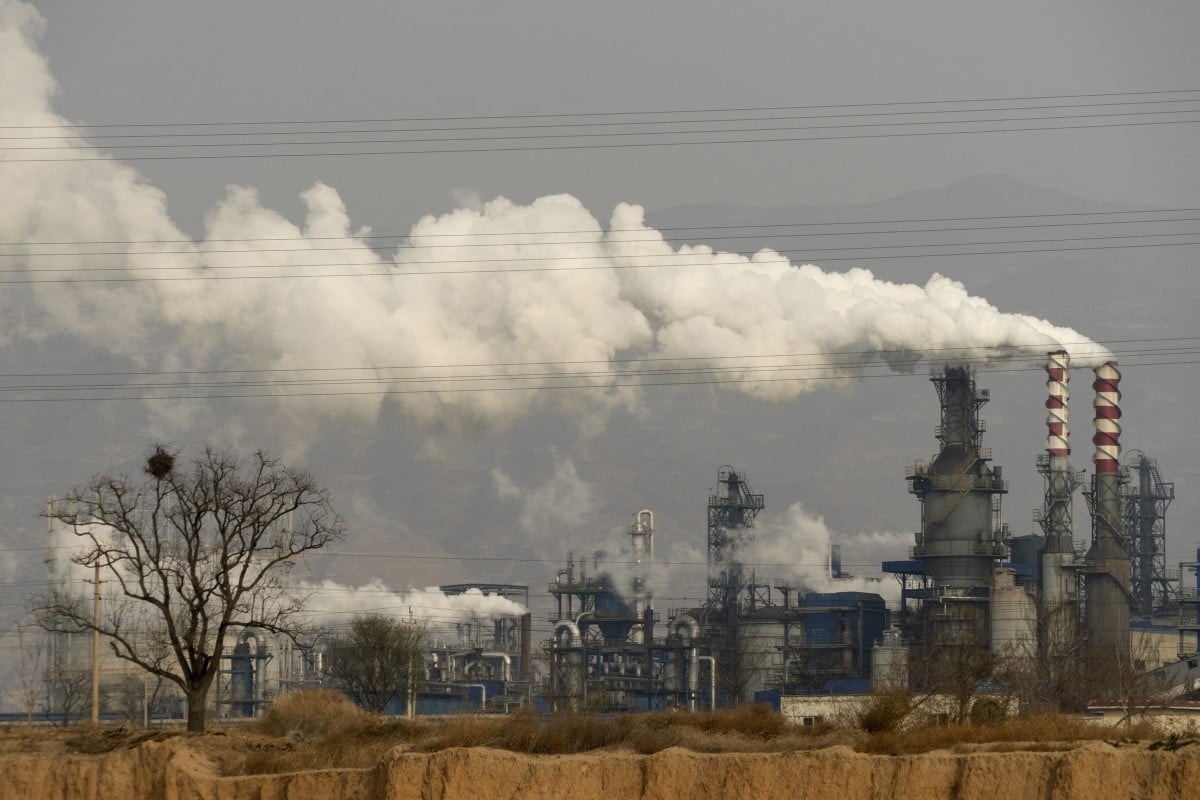
China now accounts for around 30 per cent of the world’s carbon emissions. Photo: AP
As world leaders gather in Spain to discuss how to slow the warming of the planet, the spotlight has fallen on China – the top emitter of greenhouse gases.
China burns about half the coal used globally each year. Between 2000 and 2018, its annual carbon emissions nearly tripled, and it now accounts for about 30 per cent of the world’s total.
Yet it is also the leading market for solar panels, wind turbines and electric vehicles, and it manufactures about two-thirds of solar cells installed worldwide.
“We are witnessing many contradictions in China’s energy development,” said Kevin Tu, a Beijing-based fellow with the Centre on Global Energy Policy at Columbia University. “It’s the largest coal market and the largest clean energy market in the world.”
That apparent paradox is possible because of the sheer scale of China’s energy demands.
Pollution alarm as tourism businesses contaminate home of China’s hairy crab
But as China’s economy slows to the lowest level in a quarter century – around 6 per cent growth, according to government statistics – policymakers are doubling down on support for coal and other heavy industries, the traditional backbones of China’s energy system and economy. At the same time, the country is reducing subsidies for renewable energy.
At the annual United Nations climate summit, this year in Madrid, government representatives will put the finishing touches on implementing the 2015 Paris Agreement, which set a goal to limit future warming to 1.5 to 2 degrees Celsius above pre-industrial levels.
Nations may decide for themselves how to achieve it.
China had previously committed to shifting its energy mix to 20 per cent renewables, including nuclear and hydroelectric energy.
Climate experts generally agree that the initial targets pledged in Paris will not be enough to reach the goal, and next year nations are required to articulate more ambitious targets.
Hopes that China would offer to do much more are fading.
Recent media reports and satellite images suggest that China is building or planning to complete new coal power plants with total capacity of 148 gigawatts – nearly equal to the entire coal-power capacity of the European Union within the next few years, according to an analysis by Global Energy Monitor, a San Francisco-based non-profit.
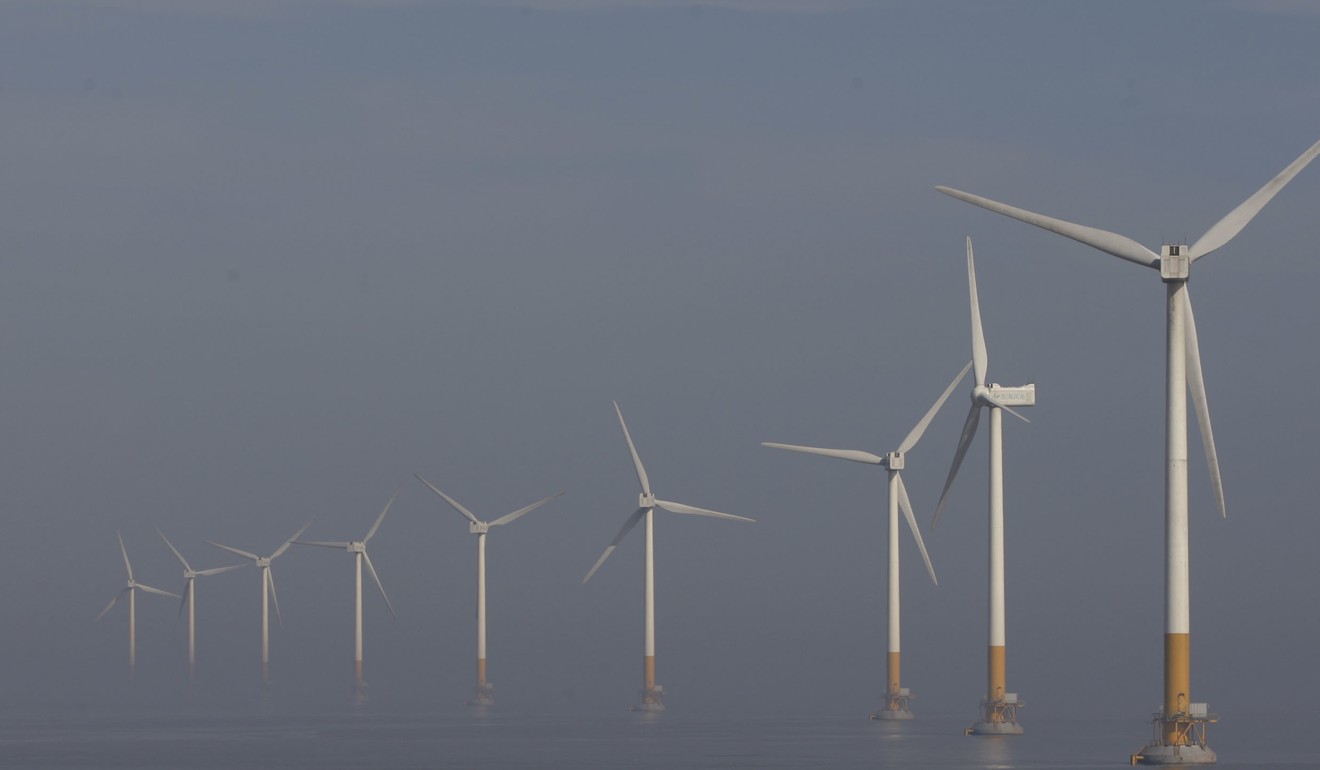
China is the world’s leading market for wind turbines and other renewables – but is still a major source of emissions. Photo: Chinatopix via AP
Meanwhile, investment in China’s renewable energy dropped almost 40 per cent in the first half of 2019 compared with the same period last year, according to Bloomberg New Energy Finance, a research organisation. The government slashed subsidies for solar energy.
Last week in Beijing, China’s vice-minister of ecology and environment told reporters that non-fossil-fuel sources already account for 14.3 per cent of the country’s energy mix. He did not indicate that China would embrace more stringent targets soon.
“We are still faced with challenges of developing our economy, improving people’s livelihood,” Zhao Yingmin said.
As a fast-growing economy, it was always inevitable that China’s energy demands would climb steeply. The only question was whether the country could power a sufficiently large portion of its economy with renewables to curb emissions growth.
Many observers took hope from a brief dip in China’s carbon emissions between 2014 and 2016. Today the country’s renewed focus on coal comes as a disappointment.
“Now there’s a sense that rather than being a leader, China is the one that is out of step,” said Lauri Myllyvirta, lead analyst at the Centre for Research on Energy and Clean Air in Helsinki.
He notes that several developed countries – including Germany, South Korea and the United States – are rapidly reducing their reliance on coal power.
After climbing sharply for two decades, China’s emissions stalled around 2013 and then declined slightly in 2015 and 2016, according to Global Carbon Budget, which tracks emissions worldwide.
This dip came as Chinese leaders declared a “war on pollution” and suspended the construction of dozens of planned coal power plants, including some in Shanxi.
Pollution scandal near China nature reserve at Tengger desert’s edge
At the same time, the government required many existing coal operators to install new equipment in chimneys to remove sulphur dioxide, nitrous oxide and other hazardous substances. About 80 per cent of coal plants now have scrubbers, said Alvin Lin, Beijing-based China climate and energy policy director for the Natural Resources Defence Council, a non-profit.
As a result, the air quality in many Chinese cities, including Beijing, improved significantly between 2013 and 2017. Residents long accustomed to wearing face masks and running home air-filter machines enjoyed a reprieve of more “blue sky days,” as low-pollution days are known in China.
In the past three years, China’s carbon emissions have begun to rise again, according to Global Carbon Budget.
The coming winter in Beijing may see a return of prolonged smog, as authorities loosen environmental controls on heavy industry – in part to compensate for other slowing sectors in the economy.
The UN Climate Change Conference is taking place in Madrid this month. Photo: AFP
Permits for new coal plants proliferated after regulatory authority was briefly devolved from Beijing to provincial governments, which see construction projects and coal operations as boosts to local economies and tax bases, said Ted Nace, executive director of Global Energy Monitor.
“It’s as though a boa constrictor swallowed a giraffe, and now we’re watching that bulge move through the system,” said Nace. In China, it takes about three years to build a coal plant.
The world has already warmed by 1 degree Celsius. All scenarios envisioned by the Intergovernmental Panel on Climate Change for holding planetary warming to around 1.5 degrees Celsius involve steep worldwide reductions in coal-power generation.
In that effort, other countries rely on Chinese manufacturing to hold down prices on solar panels. wind turbines and lithium-ion batteries.
“China has a really mixed record. On the one hand, it’s seen rapidly rising emissions over the past two decades,” said Jonas Nahm, an energy expert at Johns Hopkins University.
“On the other hand, it’s shown it’s able to innovate around manufacturing – and make new energy technologies available at scale, faster and cheaper.”
Source: SCMP
Posted in against, “blue sky days,, battle, Beijing, Bloomberg New Energy Finance, boa constrictor, boa constructor, Centre for Research on Energy and Clean Air, Centre on Global Energy Policy, China’s, coal, coal plants, Coal Power, Columbia University, Construction, demands, electric vehicles, emissions, energy, European Union, Germany, giraffe, global, Global Carbon Budget, Global Energy Monitor, global warming, greenhouse gases, heavy industry, Helsinki, Intergovernmental Panel on Climate Change, Johns Hopkins University, leading market, Madrid, Natural Resources Defence Council, new, paradox, plans, plants, Reliance, renewables, Risk, Shanxi, Solar Energy, solar panels, source, South Korea, suspended, swallowed, Tengger desert, top emitter, UN Climate Change Conference, UN climate summit, Uncategorized, undermining, United States, war on pollution, warming, wind turbines |
Leave a Comment »
27/06/2019
- Both individuals and businesses need to play their part in lowering carbon emissions, and increasing the city’s proportion of clean energy seems inevitable
-
With two-thirds of Hong Kong’s carbon emissions coming from power generation, increasing the proportion of clean energy seems inevitable.
Switching off all air conditioning to achieve zero carbon emissions may sound a little extreme. But it underlines the challenges in fighting global warming, a common goal that involves behavioural and institutional changes from all stakeholders.
As the threats loom larger and the clock for action ticks faster, it is time we made tough choices. The options for Hong Kong have been mapped out in the public consultation on the long-term decarbonisation strategy, with the focus being drawn to importing more nuclear energy from across the border.
The idea strikes a raw nerve, not just because it touches on the issue of nuclear safety, but also resistance arising from the perceived higher reliance on the mainland. The lack of information about the actual impact on electricity tariffs also makes discussion difficult.
With two-thirds of the city’s carbon emissions coming from power generation, increasing the proportion of clean energy seems inevitable.
Currently, nuclear power from the mainland accounts for about a quarter of our energy supply. As long as safety is not an issue, there is no reason why we cannot develop on that basis, along with more use of solar and other renewable energies.
In addition to other institutional options such as phasing out polluting fuels for vehicles and introducing more incentives for green buildings, a great deal can be achieved at both individual and corporate levels.
For example, air conditioning will be just as comfortable when set at 24 degrees Celsius instead of 21. Cutting down on fashion and plastic consumption helps, as can replacing business trips by video conferencing.
How far are you willing to go to save planet from climate change?
These changes are simple and easy to do, but they go a long way in saving our planet.
To combat climate change, the Paris Agreement has set a carbon reduction target to keep the increase in the global average temperature to well below 2 degrees Celsius.
A small city like ours may seem too little to make an impact on climate change. But as a responsible global citizen and a heavily developed world city, we have a duty to help mitigate the impact.
The consultation has put the relevant issues into perspective in a timely manner. For the sake of sustainable development and the well-being of future generations, tough choices will have to be made.
Source: SCMP
Posted in Air conditioning, business trips, carbon emissions, carbon reduction target, climate change, electricity tariffs, fashion and plastic consumption, future generations, global warming, green buildings, Hong Kong, lie ahead, Nuclear power, Paris Agreement, power generation, Sustainable development, Tough choices, Uncategorized, video conferencing, zero carbon emissions |
Leave a Comment »




 CHINDIA ALERT: You'll be living in their world, very soon