13/04/2020
- China’s famed Yiwu International Trade Market, a barometer for the health of the nation’s exports, has been hammered by the economic fallout from Covid-19
- Export orders have dried up amid sweeping containment measures in the US and Europe and restrictions on foreigners entering China have shut out international buyers
The coronavirus pandemic has severely dented wholesale trade at the Yiwu International Trade Market in China. Photo: SCMP
The Yiwu International Trade Market has always been renowned as a window into the vitality of Chinese manufacturing, crammed with stalls showcasing everything from flashlights to machine parts.
But today, as the coronavirus pandemic rips through the global economy, it offers a strikingly different picture – the dismal effect Covid-19 is having on the nation’s exports.
The usually bustling wholesale market, home to some 70,000 vendors supplying 1,700 different types of manufactured goods, is a shadow of its former self.
Only a handful of foreign buyers traipse through aisles of the sprawling 4-million-square-metre (43 million square feet) complex, while store owners – with no customers to tend to – sit hunched over their phones or talking in small groups.
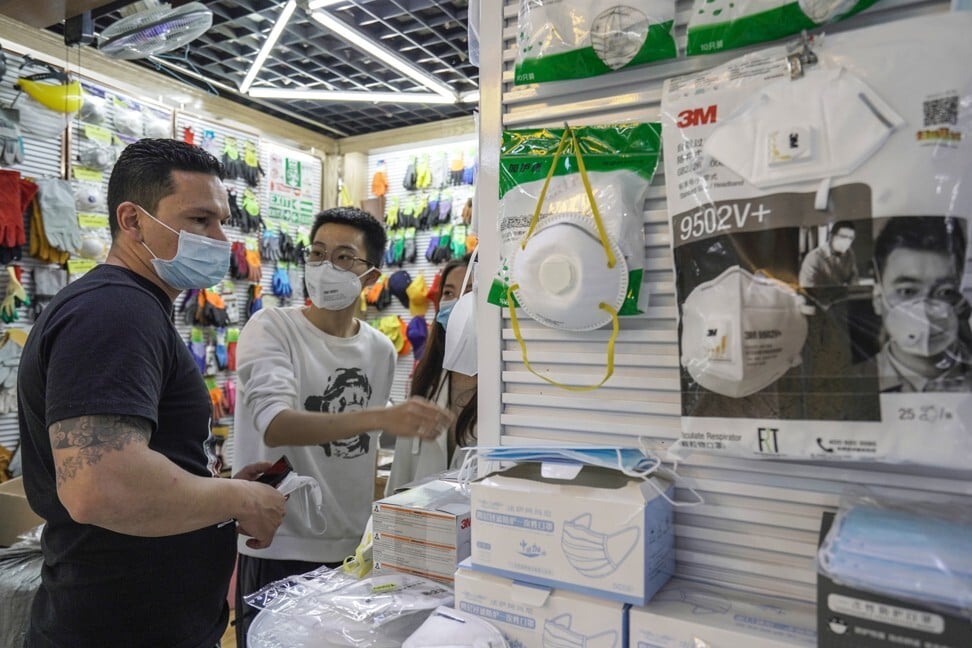
A foreign buyer visits a stall selling face masks. Photo: Ren Wei
“We try to convince ourselves that the deep slump will not last long,” said the owner of Wetell Razor, Tong Ciying, at her empty store. “We cannot let complacency creep in, although the coronavirus has sharply hampered exports of Chinese products.”
Chinese exports plunged by 17.2 per cent in January and February combined compared to the same period a year earlier, according to the General Administration of Customs. The figure was a sharp drop from 7.9 per cent growth in December.
After riding out a supply shock that shut down most of its factories, China is now facing a
second wave demand shock, as overseas export orders vanish amid sweeping containment measures to contain the outbreak around the globe.
Nowhere is that clearer to see than in Yiwu. The city of 1.2 million, which lies in the prosperous coastal province of Zhejiang, was catapulted into the international limelight as a showroom for Chinese manufacturing when the country joined the World Trade Organisation in 2001.
Coronavirus: Is the gig economy dead, and should the self-employed worry?
Before the pandemic, thousands of foreign buyers would flock to the mammoth trade market each day to source all manner of products before sending them home.
But the outbreak, which has claimed the lives of more than 113,000 people and infected more than 1.9 million around the world, is proving a major test for the market and the health of the trade dependent city.
Imports and exports via Yiwu last year were valued at 296.7 billion yuan (US$42.2 billion) – nearly double the city’s economic output.
Businesses, however, are facing a very different picture in 2020. Most traders at the market say they have lost at least half their business amid the pandemic, which was first detected in the central Chinese city of Wuhan last year.
Just take a look at the situation in Yiwu and you will understand the extent of the virus’ effect on China’s trade with foreign countries – Tianqing
“Yiwu is the barometer for China’s exports,” said Jiang Tianqing, the owner of Beauty Shine Industry, a manufacturer of hair brushes. “Just take a look at the situation in Yiwu and you will understand the extent of the virus’ effect on China’s trade with foreign countries.”
Jiang said his business was only just hanging on thanks to a handful of loyal customers placing orders via WeChat.
“I assume it will be a drawn-out battle against the coronavirus,” he said. “We are aware of the fact that developed economies like the US and Europe have been severely affected.”
The Yiwu market reopened on February 18 after a one-month long hiatus following the Lunar New Year holiday and the government’s order to halt commercial activities to contain the spread of the outbreak.
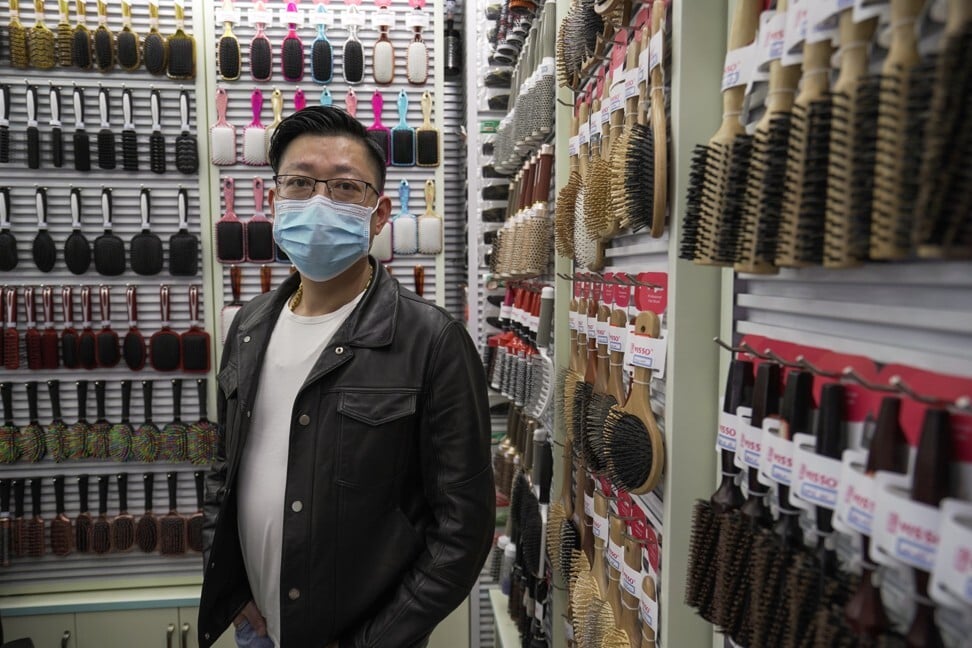
Jiang Tianqing, owner of hair brush company Beauty Shine Industry. Photo: Ren Wei
But facing the threat of a spike in imported cases, Beijing banned foreigners from entering the country in late March – shutting out potential overseas buyers.
Despite the lack of business, local authorities have urged stall owners to keep their spaces open to display Yiwu’s pro-business attitude, owners said.
“For those bosses who just set up their shops here, it would be a do-or-die moment now since their revenue over the next few months will probably be zero,” said Tong. “I am lucky that my old customers are still making orders for my razors.”
The impact of the coronavirus is just the latest challenge for local merchants, who normally pay 200,000 yuan (US$28,000) per year for a 10-square-metre (108 square feet) stall at the market.
Traders were hard hit by the
trade war between China and the United States when the Trump administration imposed a 25 per cent tariff on US$200 billion of Chinese imports last year.
At the time, some Chinese companies agreed to slash their prices to help American buyers digest the additional costs.
“But it is different this time,” said Jiang. “Pricing does not matter. Both buyers and sellers are eager to seal deals, but we are not able to overcome the barriers [to demand caused by the virus].”
Even when businesses can secure orders, it is a struggle to deliver them
Ma Jun, a manager with a LED light bulb trading company, said the only export destination for her company’s products was war-torn Yemen because it was the only country with ports still open.
It is a public health crisis that ravages not just our businesses, but the whole world economy – Dong Xin
Dong Xin, an entrepreneur selling stationery products, said he could not ship the few orders he had because “ocean carriers have stopped operations”.
“It is a public health crisis that ravages not just our businesses, but the whole world economy,” he said. “The only thing can do is to pray for an early end to the pandemic.”
Most wholesale traders in the Yiwu market run manufacturing businesses based outside the city, so a sharp fall in sales has a ripple effect on their factories, potentially resulting in massive job cuts.
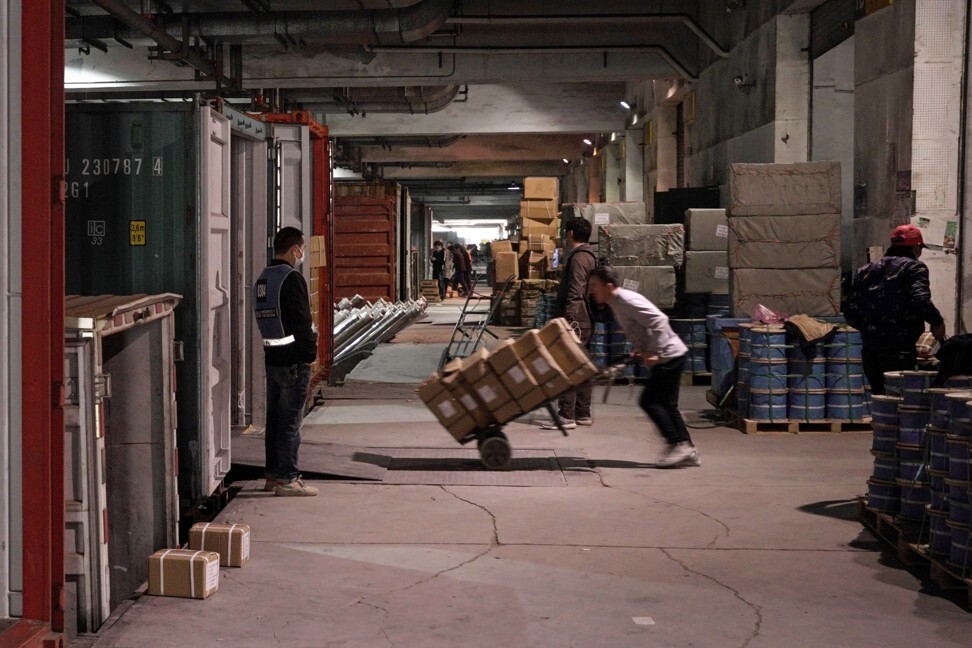
Workers pack containers at Yiwu Port, an inland port home to dozens of warehouses. Photo: Ren Wei
At Yiwu Port, an inland logistics hub full of warehouses where goods from the factories are unpacked and repacked for shipping abroad, container truck drivers joke about their job prospects.
“We used to commute between Shaoxing and here five times a week, and now it is down to twice a week,” said a driver surnamed Wang, describing the trip from his home to the shipping port, just over 100km away.
“At the end of the day, we may not be infected with the coronavirus, but our jobs will still be part of the cost of the fight against it.”
Source: SCMP
Posted in 2001, 25, abroad, aisles, banned, barometer, Beauty Shine Industry, Beijing, businesses, Buyers, catapulted, China, China’s, Chinese manufacturing, commute, complex, containers, containment, coronavirus, Coronavirus pandemic, Country, COVID-19, crammed, different picture, Dozens, dried up, economic fallout, entering, Entrepreneur, Europe, everything, export, export orders, face masks, factories, famed, February, flashlights, Foreigners, global, global economy, goods, grinds, hair brush company, halt, health, Home, imposed, infected, inland, international, International Trade Market, January, job cuts, jobs, joke, LED light bulb, limelight, logistics hub, Lunar New Year holiday, machine parts, mammoth, Manufacturing, March, massive, measures, ocean carriers, orders, outbreak, overseas, pack, pandemic, per cent, phones, Port, public health crisis, ravages, repacked, second wave, selling, Shaoxing, ship, shipping, shipping port, showcasing, Showroom, Stalls, stationery products, store owners, strikingly, sweeping, Tariff, trade war, traders, trading company, traipse, truck drivers, Trump administration, Uncategorized, United States, unpacked, vanish, vendors, warehouses, WeChat, whole, wholesale, workers, world economy., world trade organisation, Wuhan, Yemen, Yiwu Port, Zhejiang |
Leave a Comment »
10/04/2020
BEIJING, April 9 (Xinhua) — Chinese Vice Premier Hu Chunhua held a phone conversation on Thursday with British Chancellor of the Exchequer Rishi Sunak on advancing bilateral cooperation on epidemic prevention and economic development.
Hu, who leads the Chinese delegation to the China-UK Economic and Financial Dialogue (EFD), noted that Chinese President Xi Jinping and British Prime Minister Boris Johnson recently held two phone conversations and reached important consensus on jointly dealing with the pandemic and developing China-UK relations.
The Chinese side stands ready to work with the British side to implement the consensus reached by the two leaders, deepen practical cooperation in such fields as epidemic prevention and finance, and provide Britain with support and assistance within its capabilities in medical supplies and other fields, Hu said.
The vice premier expressed hope that the two sides will further strengthen cooperation under the framework of the United Nations and the Group of 20, promote macroeconomic policy coordination, cut tariff, remove barriers, and facilitate the flow of trade, so as to maintain the stability of the global industrial supply chain and promote sustainable growth of the world economy.
For his part, Sunak thanked China for its support and assistance, adding that Britain stands ready to strengthen bilateral cooperation in epidemic prevention, economy and finance through channels like the China-UK EFD, so as to continuously advance bilateral relations.
Source: Xinhua
Posted in advancing, bilateral cooperation, Britain, British Chancellor of the Exchequer, British Prime Minister, China-UK Economic and Financial Dialogue (EFD), China-UK EFD, China-UK relations, Chinese delegation, Chinese President Xi Jinping, Chinese Vice-Premier Hu Chunhua, cut tariff, Economic development, epidemic prevention, facilitate, flow of trade, global, Group of 20, industrial, macroeconomic policy coordination, phone conversation, Prime Minister Boris Johnson, promote, remove barriers, Rishi Sunak, stability, Supply chain, sustainable growth, Thursday, Uncategorized, United Nations, world economy. |
Leave a Comment »
10/04/2020
BEIJING (Reuters) – China will promote the sales of export products in domestic markets, as foreign trade faces unprecedented challenges due to the coronavirus pandemic, an assistant commerce minister said on Friday.
As the coronavirus spreads to almost all of China’s trading partners, the world’s second-largest economy is set to reach a grim milestone for full year growth, with the pace of expansion likely to be the slowest since the Cultural Revolution ended in 1976. And, the export sector is facing millions of job losses and factory shutdowns.
“Due to the rapid spread of the epidemic in the world, foreign demand has slumped and the biggest difficulty facing foreign trade companies is the plunge in orders,” said Ren Hongbin, the assistant minister at the Ministry of Commerce.
He said firms across the board have had their orders cancelled or delayed, and new orders are “very hard to sign”.
“The uncertainty about the pandemic has become the biggest uncertainty for foreign trade development.”
Forecasters expect China’s 2020 growth could be nearer the 2.0% mark – the slowest in over 40 years – due to the sweeping impact of the pandemic both at home and overseas. The economy grew 6.1% last year.
China’s overseas shipments fell 17.2% in January-February from the same period a year earlier, marking the steepest fall since February 2019. Imports sank 4% from a year earlier.
Among the government measures to support the sector, China is accelerating efforts to build online trade fairs and guiding exporters to work with e-commerce retailers for sales in domestic markets and coordinating with its trading partners to stabilise supply chains, said Ren.
The Canton Fair, China’s oldest and biggest trade fair due to take place online, will feature live-streaming services for participants, Li Xingqian, another commerce ministry official, told the same briefing. The fair was originally scheduled to begin on April 15, but was postponed due to the coronavirus outbreak.
China is willing to boost trade relations with other countries, including the United States, under the new circumstances, said Ren, adding that Beijing hopes to work together with Washington to promote bilateral trade.
Both countries have been engaged in a near two-year long trade war with tit-for-tat tariffs on each other’s goods, before negotiators called a truce with an interim trade deal in January.
Source: Reuters
Posted in 0, 1, 10, 11, 12, 13, 14, 15, 16, 17, 18, 19, 1976, 2, 20, 21, 22, 23, 24, 25, 26, 27, 28, 29, 3, 30, 31, 4, 5, 6, 7, 8, 9, April, batters, Beijing, bilateral trade, cancelled, Canton Fair, challenges, China, China’s, Commerce minister, companies, coronavirus, coronavirus outbreak, Coronavirus pandemic, Cultural Revolution, delayed, domestic markets, domestically, encourages, epidemic, export goods, export products, export sector, Factory, February, foreign demand, foreign trade, global, imports, interim trade deal, January, job losses, live-streaming services, milestone, millions, Ministry of Commerce, Negotiators, oldest and biggest trade fair, online, orders, overseas shipments, pandemic, plunge, promote, Sales, shutdowns, slumped, spreads, tit-for-tat tariffs, Trade, trade war, trading partners, Uncategorized, uncertainty, United States, unprecedented, Virus, Washington, World, world’s second-largest economy |
Leave a Comment »
10/04/2020
BEIJING (Reuters) – China’s factory gate prices fell the most in five months in March, with deflation deepening and set to worsen in coming months as the economic damage wrought by the coronavirus outbreak at home and worldwide shuts down many countries.
The world’s second-largest economy is trying to restart its engines after weeks of near paralysis to contain the pandemic that had severely restricted business activity, flow of goods and the daily life of people.
Friday’s data from the National Bureau of Statistics suggested a durable recovery was some way off, with China’s producer price index (PPI) falling 1.5% from a year earlier, the biggest decline since October last year. It compared with a median forecast of a 1.1% fall tipped by a Reuters poll of analysts and a 0.4% drop in February.
Headline consumer inflation also eased somewhat last month, partly led by government control measures, while core prices remained benign, leaving more room for monetary easing, some analysts said.
The overall decline in the factory gate gauge was exacerbated by a slump in global oil and commodities prices, which filtered through to crude oil, steel and non-ferrous metal industries, the statistics bureau said in a statement accompanying the data.
“The issue of having more supply than demand, and persistently low oil prices, will intensify deflationary pressures,” said Yang Yewei, a Beijing-based analyst with Southwest Securities.
“Work resumptions on the production side are faster than the repair in demand. Downstream demand is recovering slowly and still remains weak,” he said.
The oil and gas extraction sector had the biggest year-on-year price fall of 21.7%, among the 40 major industrial sectors surveyed, deteriorating sharply from a 0.4% drop in the previous month.
The stringent travel and transport curbs have now been lifted across much of the country including Wuhan, the epicentre of the outbreak where the virus first emerged in late 2019. So far the virus has killed more than 3,300 and infected over 81,000 people in the country.
Analysts expect a deep first-quarter economic contraction in China and have grown increasingly pessimistic about the country’s prospects for 2020 due to the pandemic’s sweeping global impact.
Many economists and policymakers are forecasting a steep global recession this year as numerous countries are forced into lockdowns to contain the spread of the coronavirus, severely curtailing business activity in a major blow to jobs and incomes.
Worldwide, the virus has killed around 95,000 people and infected more than 1.5 million. Policymakers globally have responded to the crisis by launching an unprecedented package of stimulus measures, injecting trillions of dollars to backstop their economies that have been brought to a virtual standstill.
Beijing has also rolled out a series of fiscal and monetary support steps, and sources have told Reuters that policymakers are readying more stimulus in the coming months to stabilise growth and prevent mass unemployment.
China’s consumer prices rose 4.3% from a year earlier in March, compared with a 4.8% gain tipped by a Reuters poll and a 5.2% increase in February, as logistics and transport conditions improved and government price control measures kicked in.
But food prices still rose over 18% from a year earlier, led by a 116.4% jump in pork prices, the data showed. The virus outbreak has pushed up prices of some food items, such as pork and vegetables.
Core inflation – which excludes food and energy prices – remained benign last month at 1.2%,but it still edged up from 1% in February.
Source: Reuters
Posted in auto sale, benign, China, China’s, commodities prices, Core inflation, coronavirus, coronavirus outbreak, countries, crude oil, deepens, Deflation, Downstream, economy, energy, engines, factory gate, February, Food, food items, food prices, Friday’s, global, Home, industries, July, March, May, national bureau of statistics, non-ferrous metal, October, Ocyober, oil and gas extraction sector, pandemic, paralyses, paralysis, Pork, Pork prices, prices, restart, Reuters Poll, Southwest Securities, Steel, travel and transport curbs, Uncategorized, vegetables, Work resumptions, world’s second-biggest economy, worldwide, wrought |
Leave a Comment »
09/04/2020
MUNICH (Reuters) – One January lunchtime in a car parts company, a worker turned to a colleague and asked to borrow the salt.
As well as the saltshaker, in that instant, they shared the new coronavirus, scientists have since concluded.
That their exchange was documented at all is the result of intense scrutiny, part of a rare success story in the global fight against the virus.
The co-workers were early links in what was to be the first documented chain of multiple human-to-human transmissions outside Asia of COVID-19, the disease caused by the coronavirus.
They are based in Stockdorf, a German town of 4,000 near Munich in Bavaria, and they work at car parts supplier Webasto Group. The company was thrust under a global microscope after it disclosed that one of its employees, a Chinese woman, caught the virus and brought it to Webasto headquarters. There, it was passed to colleagues – including, scientists would learn, a person lunching in the canteen with whom the Chinese patient had no contact.
The Jan. 22 canteen scene was one of dozens of mundane incidents that scientists have logged in a medical manhunt to trace, test and isolate infected workers so that the regional government of Bavaria could stop the virus from spreading.
That hunt has helped Germany win crucial time to build its COVID-19 defences.
The time Germany bought may have saved lives, scientists say. Its first outbreak of locally transmitted COVID-19 began earlier than Italy’s, but Germany has had many fewer deaths. Italy’s first detected local transmission was on Feb. 21. By then Germany had kicked off a health ministry information campaign and a government strategy to tackle the virus which would hinge on widespread testing. In Germany so far, more than 2,100 people have died of COVID-19. In Italy, with a smaller population, the total exceeds 17,600.
CHART: Contrasting curves reut.rs/3c2UZA4
“We learned that we must meticulously trace chains of infection in order to interrupt them,” Clemens Wendtner, the doctor who treated the Munich patients, told Reuters.
Wendtner teamed up with some of Germany’s top scientists to tackle what became known as the ‘Munich cluster,’ and they advised the Bavarian government on how to respond. Bavaria led the way with the lockdowns, which went nationwide on March 22.
Scientists including England’s Chief Medical Officer Chris Whitty have credited Germany’s early, widespread testing with slowing the spread of the virus. “‘We all know Germany got ahead in terms of its ability to do testing for the virus and there’s a lot to learn from that,’” he said on TV earlier this week.
Christian Drosten, the top virologist at Berlin’s Charite hospital, said Germany was helped by having a clear early cluster. “Because we had this Munich cohort right at the start … it became clear that with a big push we could inhibit this spreading further,” he said in a daily podcast for NDR radio on the coronavirus.
Drosten, who declined to be interviewed for this story, was one of more than 40 scientists involved in scrutiny of the cluster. Their work was documented in preliminary form in a working paper at the end of last month, intended for The Lancet. The paper, not yet peer-reviewed, was shared on the NDR site.
ELECTRONIC DIARIES
It was on Monday, Jan. 27, that Holger Engelmann, Webasto’s CEO, told the authorities that one of his employees had tested positive for the new coronavirus. The woman, who was based in Shanghai, had facilitated several days of workshops and attended meetings at Webasto’s HQ.
The woman’s parents, from Wuhan, had visited her before she travelled on Jan. 19 to Stockdorf, the paper said. While in Germany, she felt unusual chest and back aches and was tired for her whole stay. But she put the symptoms down to jet lag.
She became feverish on the return flight to China, tested positive after landing and was hospitalised. Her parents also later tested positive. She told her managers of the result and they emailed the CEO.
In Germany, Engelmann said he immediately set up a crisis team that alerted the medical authorities and started trying to trace staff members who had been in contact with their Chinese colleague.
The CEO himself was among them. “Just four or five days before I received the news, I had shaken hands with her,” he said.
Now known as Germany’s “Case #0,” the Shanghai patient is a “long-standing, proven employee from project management” who Engelmann knows personally, he told Reuters. The company has not revealed her identity or that of others involved, saying anonymity has encouraged staff to co-operate in Germany’s effort to contain the virus.
The task of finding who had contact with her was made easier by Webasto workers’ electronic calendars – for the most part, all the doctors needed was to look at staff appointments.
“It was a stroke of luck,” said Wendtner, the doctor who treated the Munich patients. “We got all the information we needed from the staff to reconstruct the chains of infection.”
For example, case #1 – the first person in Germany to be infected by the Chinese woman – sat next to her in a meeting in a small room on Jan. 20, the scientists wrote.
Where calendar data was incomplete, the scientists said, they were often able to use whole genome sequencing, which analyses differences in the genetic code of the virus from different patients, to map its spread.
By following all these links, they discovered that case #4 had been in contact several times with the Shanghai patient. Then case #4 sat back-to-back with a colleague in the canteen.
When that colleague turned to borrow the salt, the scientists deduced, the virus passed between them. The colleague became case #5.
Webasto said on Jan. 28 it was temporarily closing its Stockdorf site. Between Jan. 27 and Feb. 11, a total of 16 COVID-19 cases were identified in the Munich cluster. All but one were to develop symptoms.
All those who tested positive were sent to hospital so they could be observed and doctors could learn from the disease.
Bavaria closed down public life in mid-March. Germany has since closed schools, shops, restaurants, playgrounds and sports facilities, and many companies have shut to aid the cause.
HAMMER AND DANCE
This is not to say Germany has defeated COVID-19.
Its coronavirus death rate of 1.9%, based on data collated by Reuters, is the lowest among the countries most affected and compares with 12.6% in Italy. But experts say more deaths in Germany are inevitable.
“The death rate will rise,” said Lothar Wieler, president of Germany’s Robert Koch Institute for infectious diseases.
The difference between Germany and Italy is partly statistical: Germany’s rate seems so much lower because it has tested widely. Germany has carried out more than 1.3 million tests, according to the Robert Koch Institute. It is now carrying out up to 500,000 tests a week, Drosten said. Italy has conducted more than 807,000 tests since Feb. 21, according to its Civil Protection Agency. With a few local exceptions, Italy only tests people taken to hospital with clear and severe symptoms.
Germany’s government is using the weeks gained by the Munich experience to double the number of intensive care beds from about 28,000. The country already has Europe’s highest number of critical care beds per head of the population, according to a 2012 study.
Even that may not be enough, however. An Interior Ministry paper sent to other government departments on March 22 included a worst-case scenario with more than 1 million deaths.
Another scenario saw 12,000 deaths – with more testing after partial relaxation of restrictions. That scenario was dubbed “hammer and dance,” a term coined by blogger Tomas Pueyo. It refers to the ‘hammer’ of quick aggressive measures for some weeks, including heavy social distancing, followed by the ‘dance’ of calibrating such measures depending on the transmission rate.
The German government paper argued that in the ‘hammer and dance’ scenario, the use of big data and location tracking is inevitable. Such monitoring is already proving controversial in Germany, where memories of the East German Stasi secret police and its informants are still fresh in the minds of many.
A subsequent draft action plan compiled by the government proposes the rapid tracing of infection chains, mandatory mask-wearing in public and limits on gatherings to help enable a phased return to normal life after Germany’s lockdown. The government is backing the development of a smartphone app to help trace infections.
Germany has said it will re-evaluate the lockdown after the Easter holiday; for the car parts maker at the heart of its first outbreak, the immediate crisis is over. Webasto’s office has reopened.
All 16 people who caught COVID-19 there have recovered.
Source: Reuters
Posted in appointments, Asia, asked, Bavaria, Berlin’s, borrow, build, car parts, CEO, Charite hospital, Chief Medical Officer, China, Chinese woman, Civil Protection Agency, colleague, Company, controversial, coronavirus, COVID-19, defences, Disease, doctors, East German, employees, England’s, German, Germany, Germany’s, global, headquarters, helped, human-to-human transmissions, infectious diseases, instant, Italy, lockdown, lunchtime, Managers, microscope, minute details, Munich, new coronavirus, outside, parents, Pass the salt, patients, playgrounds, restaurants, return flight, Reuters, Robert Koch Institute, salt, saltshaker, schools, scientists, Shanghai, shared, shops, sports facilities, Stasi secret police, Stockdorf, stroke of luck, supplier, The Lancet, town, turned, Uncategorized, virologist, Virus, Webasto Group, worker, workshops, Wuhan |
Leave a Comment »
09/04/2020
MILAN/DETROIT (Reuters) – Global automakers reeling from the COVID-19 pandemic are accelerating efforts to restart factories from Wuhan to Maranello to Michigan, using safety protocols developed for China and U.S. ventilator production operations launched in recent weeks.
Certain safety measures differ from manufacturer to manufacturer. Italian sports car maker Ferrari NV (RACE.MI) said on Wednesday it would offer voluntary blood tests to employees who wanted to know if they had been exposed to the virus.
General Motors Co’s (GM.N) head of workplace safety, Jim Glynn, told Reuters on Wednesday GM is not persuaded blood tests are useful. But Glynn said GM has studied and adapted measures taken by Amazon.com Inc (AMZN.O) to protect warehouse workers, such as temperature screening to catch employees with fevers before they enter the workplace.
Auto manufacturers and suppliers are converging on a consensus that temperature screening, daily health questionnaires, assembly lines redesigned to keep workers 3 to 6 feet (0.9 m to 1.8 m) apart, and lots and lots of masks and gloves can enable large-scale factories to operate safely.
“We know the protocols to keep people safe,” Gerald Johnson, GM’s executive vice president for global manufacturing, told Reuters in an interview. GM has relaunched vehicle plants in China and kept factories running in South Korea, he said.
GM has not said when it will reopen assembly plants in the United States. Other automakers are putting dates out in public, even though health officials and federal and state policymakers are wary of lifting lockdowns too soon.
“You see vehicle manufacturers … putting a stake in the ground,” said Brian Collie, head of Boston Consulting Group’s automotive practice. By setting a public date to restart production, they signal suppliers to get ready to ramp up, he said.
The COVID-19 pandemic has thrown the global auto industry into the worst tailspin since the 2008-2009 financial crisis. Consumer demand for vehicles has collapsed as governments have enforced lockdowns in China, and then in Europe and the United States. For the Detroit automakers and their suppliers, the shutdown of profitable truck and sport utility vehicle plants in North America has choked off cash flow.
In Europe, major automakers have said they hope to begin building vehicles again in mid-to-late April. In the United States, several big automakers, including Fiat Chrysler Automobiles NV (FCHA.MI) (FCAU.N), Honda Motor Co Ltd (7267.T) and Toyota Motor Corp (7203.T), are aiming to restart production during the first week of May.
Fiat Chrysler (FCA) and unions are discussing plans for beefed-up health measures at Italian plants to pave the way for production to restart as soon as the government eases a national lockdown due to expire on April 13, unions said on Wednesday.
Among the proposals from Fiat Chrysler’s Italian unions: move meals to the end of shifts, allowing employees to chose to avoid canteens, eat their food elsewhere and leave half an hour earlier without losing pay.
FCA did not comment on specific measures.
In the United States, some non-union automakers have also said they hope to restart vehicle plants as soon as next week.
Tire maker Bridgestone said on Wednesday it plans to restart U.S. production on April 13.
But the Trump administration has said people should continue to practice social distancing until April 30.
VENTILATOR ASSEMBLY
For the Detroit automakers, the United Auto Workers union will play a key role in deciding when and how plants will restart.
UAW President Rory Gamble said in a statement on Wednesday the union is in “deep discussions with all three companies to plan ahead over the implementation of CDC [Centers for Disease Control and Prevention] safety standards and using all available technologies to protect all UAW members, their families and the public.”
Among the union’s concerns is that members who report being ill can take time away from work without penalty, Gamble added.
The UAW has supported GM and Ford Motor Co’s (F.N) efforts to launch production of ventilators in U.S. plants – operations that have allowed the companies and the union to road-test safety measures at small scale.
At GM’s ventilator assembly plant in Kokomo, Indiana, workers and managers have been fine-tuning details such as when employees are handed masks, and when they step in front of a temperature screening device.
At first, ventilator assemblers in training at Kokomo walked down a hall before getting a mask, said Debby Hollis, one of the UAW-represented workers. Last week, she said, “They met us at the door and had us get in the masks there.”
Source: Reuters
Posted in accelerating, Amazon.com Inc (AMZN.O), automakers, Bridgestone, China, Covid-19 pandemic, Detroit, developed, efforts, factories, Ferrari NV (RACE.MI), Fiat Chrysler (FCA), Ford Motor Co’s (F.N), General Motors Co’s (GM.N), global, Honda Motor Co Ltd (7267.T), Indiana, Italian unions, Kokomo, lockdowns, Maranello, masks, Michigan, Milan, plants, protect, push, reeling, reopen, restart, safety protocols, testing, Tire maker, U.S. ventilator production operations, Uncategorized, United Auto Workers, United States, warehouse, workers, Wuhan |
Leave a Comment »
05/04/2020
- The philanthropic foundations of Jack Ma and Joe Tsai, two of China’s wealthiest technology entrepreneurs, have donated 23 million face masks, 2,000 ventilators and 170,000 pieces of protective gear to New York
- The donation, the biggest by private citizens to the epicentre of the global coronavirus pandemic, was described by New York Governor Andrew Cuomo as ‘really good news’
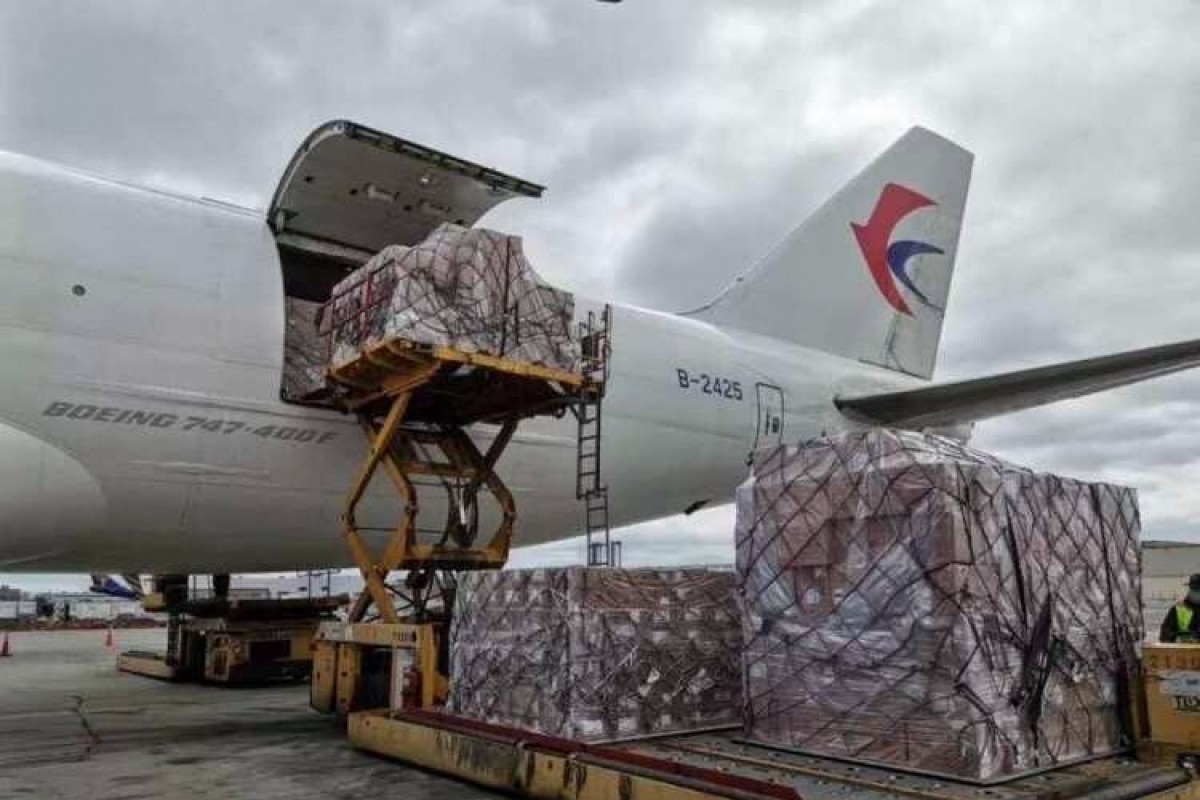
A shipment of 1,000 ventilators donated by Jack Ma Foundation and Joe Tsai Foundation, has arrived in New York. Photo: Handout
Chinese philanthropists are stepping up their
donation of protective gear, essential medical and diagnostic kits to the United States, Europe and Asian countries, despite rising acrimony between diplomats and government officials looking to pin blame amid the world’s worst pandemic in decades.
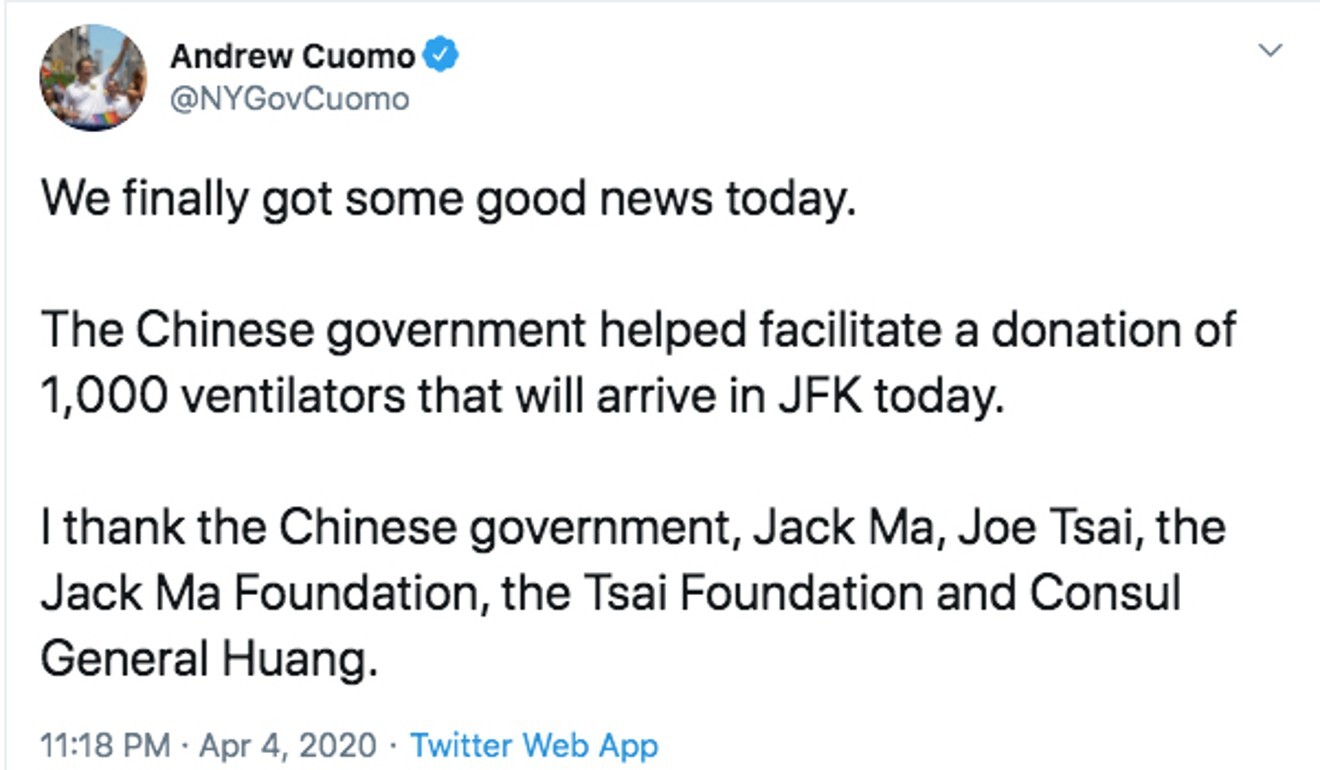
The private foundations of Jack Ma and Joe Tsai, co-founders of this newspaper’s owner Alibaba Group Holding and two of China’s wealthiest technology entrepreneurs, have donated a combined 23 million face masks, 2,000 medical ventilators and 170,000 pieces of protective gear to New York city.
The first 1,000 medical ventilators arrived today, with another 1,000 on the way, for a total donation valued at US$50 million, according to a person familiar with the matter.
Delivery of the essential materials, made possible by behind-the-scene manoeuvres by the donors and officials from both the Chinese and US sides due to import and export regulatory hurdles, highlights the role of civil diplomacy in dealing with the global public health crisis.
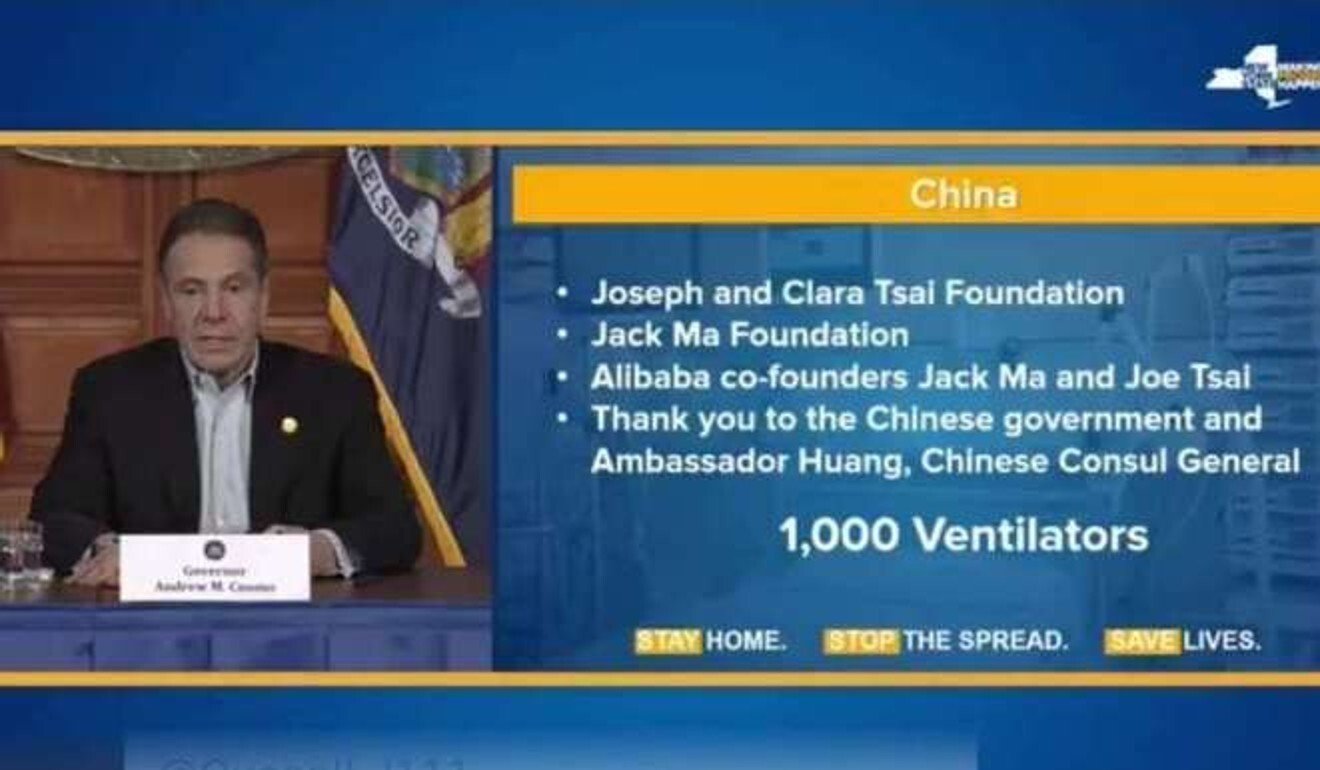
New York Governor Andrew Cuomo thanks the Chinese government for the 1,000 ventilators donated by Jack Ma Foundation and Joe Tsai Foundation, which arrived in New York on Saturday. Photo: Handout
The gesture comes as diplomats of both countries, and even government officials including the US president and his secretary of state, have engaged in a tit-for-tat war of words, as they attempt to pin the blame for the worlds worst pandemic in decades on each other.
Confirmed cases in the US have soared and surpassed China as the new global epicentre. In the US there are nearly 310,000 cases and nearly 8,500 people have died so far from the Covid-19 disease.
Jack Ma is a friend of mine and he’s made it very possible to get about 1,000 ventilators from China. But that was from him and my other friend [Tsai] that was really a gift – Andrew Cuomo, governor of New York
Andrew Cuomo, governor of New York, thanked the Chinese government for easing the transfer of the ventilators to the hard-hit state, the current epicentre of the coronavirus outbreak in the US.
He said the donations were “really good news”, as the state pushes up against the apex of the outbreak, which is likely to hit in about seven days.
“This is a big deal, and this is going to make a significant difference for us,” Governor Andrew Cuomo said on Saturday.
“Jack Ma is a friend of mine and he’s made it very possible to get about 1,000 ventilators from China. But that was from him and my other friend [Tsai] that was really a gift. And we appreciate it very much.”
One of the challenges in making the donation possible was the fact that the US had previously blocked China-made “KN95” standard masks, only allowing “3M N95” masks to be used. Although the two masks have different standards, they essentially have the same performance. On Friday, the US Food and Drugs Administration issued an emergency use authorisation for KN95 masks.
Alfred Wu, associate professor in Lee Kuan Yew School of Public Policy at National University of Singapore, said that what China is doing with its so-called masks diplomacy is very clear. “But given the emergency situation in New York, whatever channel – private or public sources – the equipment comes from, should not matter, especially those for medical workers,” he said.
Separately, the western state of Oregon has also said that it would send 140 ventilators to New York.
The state, like other areas of the US, is facing shortages of medical gear, including masks and ventilators.
“We are not yet at the apex. We are getting closer,” Cuomo said, adding that this was good as it gave the authorities more time to prepare.
A tweet from New York Governor Andrew Cuomo thanking the Chinese government for the 1,000 ventilators donated by Jack Ma Foundation and Joe Tsai Foundation. Photo: Twitter
Cuomo said 113,704 people in New York have tested positive for the coronavirus, with 15,000 having been hospitalised The state’s death toll saw a significant spike on Saturday to reach 3,565, up from 2,935 the previous day.
The White House has been criticised for not better coordinating the supply of medical goods to states, who are competing with each other on the open market.
NUS’ Wu said that tussle between the federal and state governments in the US on key decisions on acquiring medical supplies was not helping the fight against the pandemic. “Unlike in China, where the central government has the say over local governments, in the US, when it comes to public health provision, the power belongs to the state,” he said.
Meanwhile, Cuomo acknowledged that he asked the White House and others for help negotiating the ventilators.
Trump said he would like to hear a more resounding “thank you” from Cuomo for providing medical supplies and helping quickly to add hospital capacity.
Source:SCMP
Posted in Andrew Cuomo, “3M N95” masks, “thank you”, blame game, capacity, Central government, China-made “KN95” standard masks, China’s, Chinese diplomats, chinese government, citizens’ diplomacy, coronavirus outbreak, Coronavirus pandemic, countries, diplomats, donated, Donation, epicentre, face masks, federal and state governments, gifts, global, government officials, Hospital, Jack Ma, Jack Ma Foundation, Joe Tsai, Joe Tsai Foundation, KN95 masks, Lee Kuan Yew School of Public Policy, local governments, medical supplies, National University of Singapore, New York, New York Governor, Oregon, philanthropic foundations, Philanthropists, play, private citizens, protective gear, public health provision, secretary of state, tit-for-tat war of words, Trump, tussle, tweet, Uncategorized, US, US president, ventilators, wealthiest technology entrepreneurs, White House |
Leave a Comment »
03/04/2020
- ‘As two of the great countries on Earth, cooperation between China and the US could, and should, be used to bring a more positive outcome for all humankind,’ academics say
- ‘Political bickering does nothing to contribute to the healthy development of Sino-US relations, nor will it help the people of the world to rationally and accurately understand and cope with the pandemic,’ they say
Chinese academics have urged nations to cooperate to find a solution to the global public health crisis. Photo: AFP
A group of 100 Chinese scholars has signed an open letter calling on the
and China to put an end to their political blame game and work together to fight the
.
The signatories, who include former diplomats and academics from various fields, including political science, international relations and sociology, said that while the origins of the coronavirus remained unknown, hurling accusations achieved nothing but hurt.
Nations should stop “complaining, finger-pointing and blaming one another” and instead cooperate to find a solution to the global public health crisis, they said.
“Political bickering does nothing to contribute to the healthy development of Sino-US relations, nor will it help the people of the world to rationally and accurately understand and cope with the pandemic,” the scholars said in the letter published on Thursday in online news magazine The Diplomat.
“As two of the great countries on Earth, cooperation between China and the US could, and should, be used to bring a more positive outcome for all humankind,” it said.
The scholars also urged the two sides to put aside their bickering over where and how the disease originated.
“At this stage of the pandemic, the exact source and origin of Covid-19 remain undetermined, but these questions are unimportant and finger-pointing is demeaning and hurtful to everyone,” they said.
US and Chinese officials have sparred for weeks over the origins of the coronavirus, which was first detected in the central Chinese city of
Wuhan but has since spread around the world, infecting more than 1 million people and killing close to 53,000.
Donald Trump has repeatedly referred to the pathogen as the “Chinese virus”. Photo: Bloomberg
US President Donald Trump has repeatedly referred to the pathogen as the “Chinese virus”, while other US politicians have said it was created in a Chinese laboratory. For China’s part, foreign ministry spokesman Zhao Lijian suggested the coronavirus
might have been carried into the country by US soldiers.
China’s ambassador to the US
Cui Tiankai said in an interview on American television last month that speculating about the origin of the virus was “harmful”, but the finger-pointing on both sides has plunged relations between the two countries to a new low.
The open letter was the idea of Wang Wen, executive dean of the Chongyang Institute for Financial Studies at Renmin University in Beijing, who said its aim was not only to show the willingness of China’s intellectual elite to promote solidarity and reduce tensions, but to make clear that the priority right now was saving lives.
“We did not criticise anyone in the letter, or mention any names. We did not want to fuel the current disputes and confrontations,” he said.
“Most Chinese intellectuals are peaceful, rational and constructive, and thankfully we quickly reached consensus on the content of the letter.”
China to stage day of mourning for thousands killed by Covid-19
The scholars said that after months of battling the coronavirus and seeing the situation at home improve, China now wanted to share its experience and knowledge with other countries as they seek to contain its spread.
“Chinese people have made unimaginable efforts and sacrifices to achieve hard-won results,” Wang said.
“We are grateful for the support of the international community, including donations from American friends, during the most critical stage of the fight … and we are willing to share our experiences with other countries and provide all available assistance to them.”
Wu Sike, a former Chinese special envoy to the Middle East, was among the signatories to the open letter. Photo: Xinhua
Among the other signatories were Wu Sike, a senior fellow at the Chongyang Institute for Financial Studies and former special envoy to the Middle East, and Wang Yiwei, an international relations professor at Renmin University, who described the Covid-19 pandemic as a “global issue that overrides geopolitics concerns”.
Chinese President Xi Jinping and Trump agreed in a telephone call last week to work together to contain the spread of Covid-19, but critics have questioned how long their cordiality can last against a backdrop of rising China-US tensions over trade, the media and regional security.
Source: SCMP
Posted in Academics, “Chinese virus”, Beijing, blaming, China-US tensions, China’s ambassador to the US, Chinese academics, Chinese President Xi Jinping, Chinese special envoy to the Middle East, come together, complaining, cooperation, coronavirus, COVID-19, Covid-19 pandemic, Earth, finger-pointing, former diplomats, global, great countries on Earth, humankind, international relations,, nations, open letter, origins, pandemics, Political bickering, political blame game, political science, positive outcome, public health crisis, regional security, Renmin University, signatories, Sino-US relations, sociology, The Diplomat, Uncategorized, United States, urges, US President Donald Trump, US soldiers, Washington, Wuhan |
Leave a Comment »
31/03/2020
- Volume of fuel extracted from gas hydrates is a new world record, natural resources ministry says
- Month-long trial also sets a ‘solid technical foundation for commercial exploitation’, it says
China conducted its first operation to extract natural gas from gas hydrates in the South China Sea in 2017. Photo: Reuters
China said on Thursday it extracted 861,400 cubic metres of natural gas from gas hydrates found in the
South China Sea during a month-long trial that ended last week.
The production process, which ran from February 17 to March 18, also set two world records: one for the largest total volume extracted and another for the most produced – 287,000 cubic metres – on a single day, the Ministry of Natural Resources said on its website.
The gas was extracted from an area in the north of the disputed waterway, and from a depth of about 1,225 metres, it said.
The success of the latest trial set a “solid technical foundation for commercial exploitation”, the ministry said, adding that China was the first country in the world to exploit gas hydrates using a horizontal well-drilling technique.
Also known as flammable ice, gas hydrates are icelike solids composed mostly of methane. According to figures from the US Department of Energy, one cubic metre of gas hydrate releases 164 cubic metres of conventional natural gas once extracted.
The South China Sea test coincided with sharp movements in global
oil and gas prices. China, which is the world’s largest oil and gas importer, has been keen to identify alternative fuel sources, including gas hydrates, to strengthen its energy security.
The official Economic Daily reported in 2017 that China’s reserves of flammable ice were equivalent to about 100 billion tonnes of oil, of which 80 billion tonnes were in the South China Sea.
Yang Fuqiang, a senior energy adviser at the Beijing office of the National Resources Defence Council, an international environmental advocacy group, said that natural gas consumption in China was relatively low compared with that of other countries.
“The demand for natural gas is large and the prospect is promising, but it’s hard to say when China will have commercial development of flammable ice,” he said.
While the government has set a target for natural gas to account for 10 per cent of China’s annual energy consumption by the end of this year, in 2019, the figure was just 8.3 per cent.
China’s teapot oil refineries could become ‘money-printing machines’ amid crude price crash
Fan Xiao, chief engineer with the Sichuan Geology and Mineral Bureau, said that compared to conventional fuels like oil and gas, flammable ice was still too costly to extract to make its widespread use commercially viable.
“It is an important resource, but exploiting it in a sustainable, economically viable way is still some way off,” he said.
There were also environmental concerns, such as methane leaking during the exploitation process, which increased greenhouse gas emissions, he said.
Yang agreed, saying there would be leakage of methane during both mining and transport.
“If the leakage exceeds 5 per cent of the total, it will offset its contribution to carbon reduction,” he said.
Source: SCMP
Posted in ‘flammable ice’, ‘money-printing machines’, Beijing, carbon reduction, China, commercial exploitation, conventional natural gas, disputed waterway, environmental concerns, extracts, gas hydrates, global, horizontal well-drilling technique, icelike solids, Methane, National Resources Defence Council, Natural gas, natural resources ministry, new world record, oil and gas prices, oil refineries, Sichuan Geology and Mineral Bureau, South China Sea, teapot, Uncategorized, US Department of Energy |
Leave a Comment »
31/03/2020
BEIJING, March 30 (Xinhua) — The Group of 20 (G20) economies should work together to ensure stability in global industrial and supply chains, said Minister of Commerce Zhong Shan Monday.
All parties should actively take measures such as reducing or removing tariffs, eliminating trade barriers and facilitating unfettered trade, Zhong said at a video conference on COVID-19 control attended by G20 trade and investment ministers.
Zhong suggested the G20 economies should step up international cooperation on disease prevention and control supplies and protect the life and safety of people and medical workers in all countries.
All parties should uphold an open environment for global collaboration, Zhong said, suggesting the parties keep their markets open and safeguard the multilateral trading system and oppose protectionism.
At the meeting, ministers discussed the global impact of the COVID-19 pandemic and G20’s response. The parties agreed that the pandemic is a tremendous shock to international trade and investment, and that the joint statement of the Extraordinary G20 Leaders’ Summit on COVID-19 should be implemented collectively.
It was agreed that the parties should enhance coordination and cooperation and adopt open trade policies to reduce the impact on global supply chains, facilitate cross-border flow of goods and services and revive the confidence in growth of international trade.
The meeting was chaired by Saudi Arabia, which holds the G20 presidency. After the meeting, the Statement of the Extraordinary G20 Trade and Investment Ministers Virtual Meeting on COVID-19 was issued.
Source: Xinhua
Posted in COVID-19, Covid-19 pandemic, disease prevention and control supplies, Extraordinary G20 Trade and Investment Ministers Virtual Meeting on COVID-19, G20 economies, global, Group of 20 (G20) economies, industrial and supply chains, international cooperation, Minister of Commerce Zhong Shan, protectionism, Saudi Arabia, stability, Uncategorized |
Leave a Comment »





 CHINDIA ALERT: You'll be living in their world, very soon