Chindia Alert: You’ll be Living in their World Very Soon
aims to alert you to the threats and opportunities that China and India present. China and India require serious attention; case of ‘hidden dragon and crouching tiger’.
Without this attention, governments, businesses and, indeed, individuals may find themselves at a great disadvantage sooner rather than later.
The POSTs (front webpages) are mainly 'cuttings' from reliable sources, updated continuously.
The PAGEs (see Tabs, above) attempt to make the information more meaningful by putting some structure to the information we have researched and assembled since 2006.
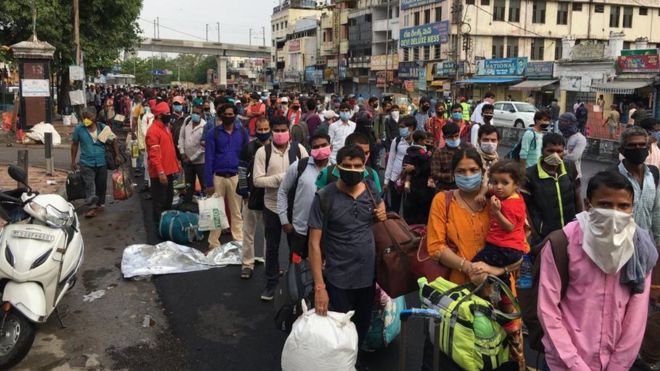
Image caption Passengers gathered outside Secundarabad station in Andhra Pradesh state
India has partially restored train services amid reports of chaos and overcrowding at some stations.
At least 145,000 people will travel in trains on Monday as the country starts to reopen after a prolonged lockdown.
Two hundred trains will now start operations – up from the existing 30 that are currently running.
But maintaining social distancing and cleanliness is proving to be a difficult task as huge crowds gathered outside some stations.
India’s mammoth railway network usually carries 25 million passengers every day.
The ministry of home affairs has issued specific guidelines for the smooth operation of train services. They say that all passengers will have to be screened, social distancing must be followed at the station and in trains and only passengers who have confirmed tickets will be allowed to travel.
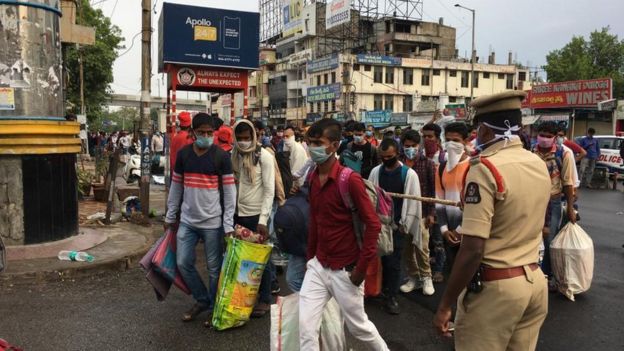
Image caption Police struggled to enforce social distancing due to large crowds
But some stations reported chaotic scenes as officials struggled to enforce these guidelines. BBC Telugu reported that people were standing much too close to each other at Secunderabad railway station in the southern state of Telangana.
“Railway staff and police didn’t allow passengers to go inside the station until at least one hour before the scheduled departure, citing physical distancing measures. This led to some chaos outside the railway station as a large number of passengers had gathered and there was no physical distance maintained. Police later arrived and organised the queues,” BBC Telugu’s Sharath Behara says.
Reporting from Delhi, BBC Hindi’s Salman Ravi said strict social distancing was being followed when passengers boarded trains, and all of them wore masks.
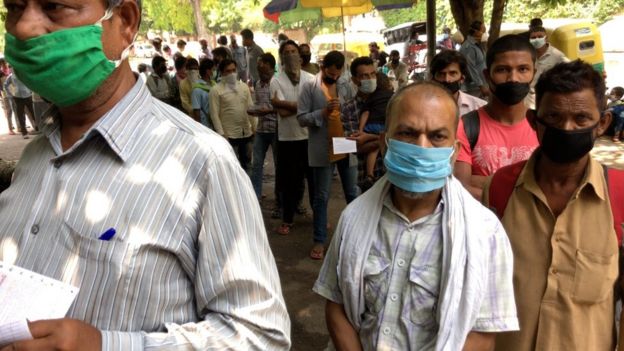
Image caption Passengers waiting outside the train station in Delhi
“But the same was not observed at ticket booking counters. Many people who did not have tickets also turned up at the station and that caused crowding,” he added.
Train services came to a grinding halt when Prime Minister Narendra Modi announced the lockdown on 24 March to stop the spread of coronavirus.
This left millions of daily-wage workers stranded as they desperately tried to go back to their villages from cities. Many of them decided to walk long distances – in some cases more than 1,000 kilometres.
As pressure and criticism mounted, the government started running special trains to ferry migrants. Some 30 trains restarted on 12 May, since then there has been a consistent demand to reopen more routes.
Getting the train network going again is part of the government’s wider strategy to slowly reopen the economy. Millions have lost jobs and factories are struggling to reopen as demand is likely to be sluggish in the coming weeks.
SHANGHAI (Reuters) – China ordered on Saturday that anyone in Wuhan working in certain service-related jobs must take a coronavirus test if they want to leave the city.
The order comes after the central city, where the coronavirus emerged late last year, lifted a 70-day lockdown that all but ended the epidemic there.
People in Wuhan work in nursing, education, security and other sectors with high exposure to the public must take a nucleic acid test before leaving, the National Health Commission said in an order.
The government of Hubei province, of which Wuhan is capital, will pay for the tests, the commission said.
Since the city relaxed its lockdown restrictions people who arrived in there before Chinese New Year, when the virus was peaking in China, are allowed to go back to their homes.
People working in other sectors aiming to leave Wuhan are encouraged to take voluntary tests before going.
Within seven days of arrival at their destinations, people who can present test results showing they do not carry the virus, as well as a clean bill of health on a health app, can go back to work.
Everyone else will have to spend 14 days in quarantine before returning to work.
Authorities have worked with the China’s tech giants to devise a colour-based health code system, retrieved via mobile app, that uses geolocation data and self-reported information to indicate one’s health status.
Wuhan will speed up its efforts to investigate asymptomatic coronavirus cases and confirm the presence of antibodies in people, which might suggest immunity, the commission said.
Wuhan, which accounts for 60% of infections in China and 84% of the death toll as of Saturday, has been testing inhabitants aggressively throughout the virus’ breakout and many companies had already been asking workers from the city to undergo tests before resuming work.
Wuhan revised up its death toll from the coronavirus by 1,290 on Friday, taking the city’s toll to 3,869, because of incorrect reporting, delays and omissions, especially in the chaotic early stages of the outbreak, authorities said.
China national death toll is 4,632 from 82,719 cases.



 CHINDIA ALERT: You'll be living in their world, very soon