Chindia Alert: You’ll be Living in their World Very Soon
aims to alert you to the threats and opportunities that China and India present. China and India require serious attention; case of ‘hidden dragon and crouching tiger’.
Without this attention, governments, businesses and, indeed, individuals may find themselves at a great disadvantage sooner rather than later.
The POSTs (front webpages) are mainly 'cuttings' from reliable sources, updated continuously.
The PAGEs (see Tabs, above) attempt to make the information more meaningful by putting some structure to the information we have researched and assembled since 2006.
Image copyright GETTY IMAGESImage caption Port Talbot employs just under half of Tata’s 8,385 UK workforce
Tata Steel plans to cut as many as 3,000 jobs across its European business in another bid to come to terms with a “severe” international steel market.
The company wants to focus on higher-value products, it said, adding there would be no plant closures.
About two thirds of the job cuts will be office-based, it added.
The announcement comes after a merger with German rival Thyssenkrupp was blocked during the summer. Bosses had hoped the deal could reduce costs.
“Today we are highlighting important proposals towards building a financially strong and sustainable European business,” said Henrik Adam, chief executive of Tata Steel in Europe.
“We plan to change how we work together to enable better cooperation and faster decision-making. This will help us become self-sustaining and cash positive in the face of unprecedented severe market conditions, enabling us to lead the way towards a carbon-neutral future.”
The business employs about 20,000 people and is owned by India’s Tata.
Port Talbot steelworks employs just under half of Tata’s 8,385-strong workforce in the UK.
Wales’ economy minister Ken Skates said: “I am seeking an urgent conversation with Tata to establish what this means for workers in Wales and how we can support those affected by this announcement.”
It also said it would seek to “preserve thousands of jobs in a key foundation industry for the UK” but did not put a number on how many would be saved.
British Steel employs about 4,000 people in Scunthorpe and Teesside.
Mainland social media users come out in strong support for the officer, compounding extensive coverage of vandalism of businesses with ties across the border
Hong Kong’s police force has gained support from online commenters on the mainland. Photo: Nora Tam
As Monday morning’s police shooting of a protester triggered a wave of shock and outrage in Hong Kong, across the border in mainland China, the response online was just as swift – but in support of the force.
“Support Hong Kong police opening fire! Clean up Hong Kong’s cockroaches!” one popular financial blogger on Weibo, China’s Twitter-like platform, said as he shared footage of the incident.
In the video, an officer grapples with a protester and points his gun towards another approaching protester. The second protester reaches out towards the gun, the officer dodges, steps back and shoots him in the torso.
“It feels great [to watch]! Kill them all, these trash and tumours of society,” a Weibo user replied to the video, with a thumbs-up emoji.
“Hongkong’s loser youth, [police] should totally open fire!! It would be best to shoot them in the head,” another post read.
These comments, and many others like them flooding social media in mainland China, highlight the deep divisions in views on each side of the border as Hong Kong’s political crisis drags into its sixth month.
Despite some initial sympathy, mainland public sentiment towards Hong Kong has hardened since July, amid state propaganda painting the protesters as a separatist movement plotted by “Western black hands”.
In recent weeks, the rancour from the mainland has only appeared to deepen, with photos and videos of protesters vandalising businesses with ties to the mainland spreading online.
Last month, a mainland Chinese banker was assaulted in a confrontation with protesters during his lunch break in Central, drawing the wrath of many mainlanders and renewed online calls for military intervention.
Extensive media coverage of the vandalism and attack, as well as a series of inflammatory commentaries, have further fanned the anger.
On Monday, the social media account of state-run Beijing Daily ran the story of the shooting under the headline: “This morning, a gunshot in Hong Kong, to the applause of citizens!”
“At such a critical moment, the police officer acted so bravely and restrained,” the report said.
“After the police fired the shot and subdued the rioters, some citizens at the scene directly applauded the police. The reaction of the public directly shows that the officer fired not only in a legal and reasonable way, but also in line with the will of the people.”
In the video, a man in a dark blue jumper claps his hands at a nearby traffic light, as police officers pin the protesters to the ground.
The Beijing Daily report did not refer to angry bystanders condemning the officers as “murderers”.
Hong Kong police officer who shot protester receives death threats against children after personal details released online, force says
Hu Xijin, editor-in-chief of nationalist tabloid Global Times, and a regular – and hugely popular – commentator on Hong Kong’s unrest, also weighed in.
“As a media worker, I resolutely support this Hong Kong police officer gunning down the attacking rioters,” he wrote to his 2 million fans on Weibo in a post that included video of the shooting.
Hu accused Hong Kong and Western media of “focusing their coverage on the police shooting and diluting the illegal, criminal and evil deeds of the rioters”.
“Such guiding of public opinion is disgusting,” he wrote.
Hu ended his post with a message to Hong Kong police: “Don’t you be afraid of anything, resolutely defend Hong Kong’s law and order, be strong and be tough. You’re not alone on the front lines. Behind you there are not only the [patriotic] Hong Kong public and the nation, but also the country’s paramilitary police and the People’s Liberation Army Hong Kong garrison, who can enter Hong Kong and offer support in accordance with the Basic Law when needed.”
The post was liked more than 26,000 times in six hours.
Scores of Chinese students flee Hong Kong over fears they will be attacked as anti-mainland sentiment sweeps through protesters in city
Meanwhile, Taiwanese President Tsai Ing-wen called on the Hong Kong government to give a detailed response to the Hong Kong people’s calls for democracy and freedom, which she described as “the only path to return to stability and order”.
“Governments should not fire upon unarmed people, this will only exacerbate the problem,” she wrote on her official Facebook account. “Beijing and the Hong Kong government should respond to the Hong Kong people, not with bullets but with the promise of democracy and freedom.”
Taipei’s Mainland Affairs Council, which oversees the island’s policies on Beijing, called on all sides to give up their arms and aggressive actions to make way for peaceful conversation.
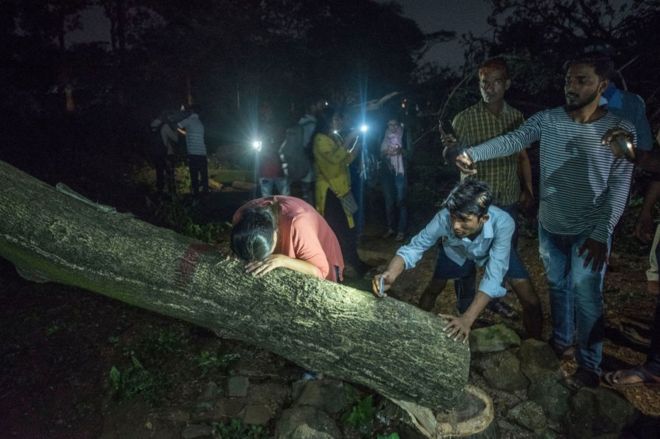
Image copyright GETTY IMAGESImage caption Protesters cry over felled trees in Aarey colony
India’s top court has asked officials to stop cutting trees in a forested area in Mumbai city after protesters clashed with police over the weekend.
The trees, part of a green strip known as Aarey colony, were being cut to make way for a new metro rail project.
Locals have long opposed the move, and filed petitions seeking Aarey to be declared a protected area.
But a high court dismissed the petitions on Friday, sparking protests as officials began felling the trees.
They planned to cut 2,185 trees, and admitted in the Supreme Court that more than 1,500 had already been cut. But petitioners claim that officials have cut around 2,500 trees.
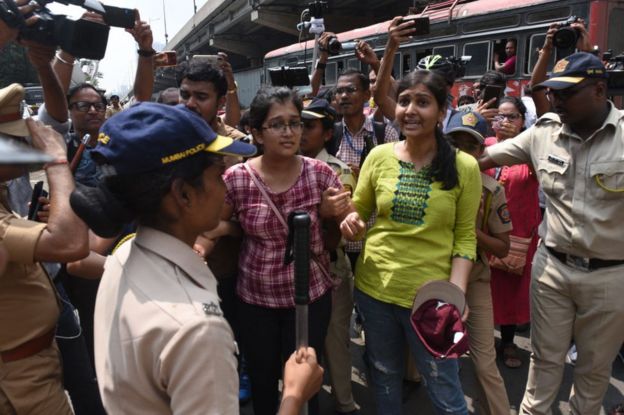
Local residents, students and environmental activists clashed with police on Friday as they took to the streets to stop authorities, and even broke through barricades to enter Aarey colony. More than 50 people were arrested and police imposed restrictions on public gatherings.
The protests grabbed the national spotlight over the weekend, and the Supreme Court took suo moto (without a formal complaint from any party) notice.
What did the Supreme Court say?
A special two-judge bench heard the matter on Monday after students wrote to the chief justice, asking the court to intervene and save the trees.
The court asked the state government of Maharashtra, where Mumbai is located, to not cut any more trees.
Image copyright GETTY IMAGESImage caption Police arrested more than 50 protesters
The court also asked the government to maintain “status quo” – which means that no construction can take place – until 21 October when it will hear the matter again.
The court also ordered the release of all activists who were arrested or detained on bail.
What is Aarey colony?
Spread over 1,300 hectares (3,212 acres), Aarey is a densely forested area dotted with lakes and has the Mithi river flowing through it. It lies at the heart of Mumbai and is often referred to as its last green lung.
It’s locally known as the Aarey “milk colony” because most of the land was given to the department of dairy development in 1951. But they are allowed to grow cattle fodder only on a fraction of the land.
Image copyright GETTY IMAGESImage caption Protesters broke through barricades and clashed with police on Friday
Earlier this year, officials cleared some 40 hectares of the forested area to build a zoo, complete with a night safari. And now, locals complain, another slice of it is in danger from the metro construction.
They also fear that the government will eventually clear the way for private builders to encroach on the Sanjay Gandhi National Park, which lies to the north of Aarey colony.
Officials, however, dismiss these fears as unfounded and point out that the construction for the metro only requires 30 hectares.
How crucial is the metro rail for Mumbai?
The city badly needs a “mass rapid transport system,” Ashwini Bhide, managing director of the Mumbai metro rail corporation, had told the BBC earlier.
The land in Aarey colony, she said, was “the most suitable land due to its size, shape and location”.
She has also been defending the decision to cut the trees on Twitter.
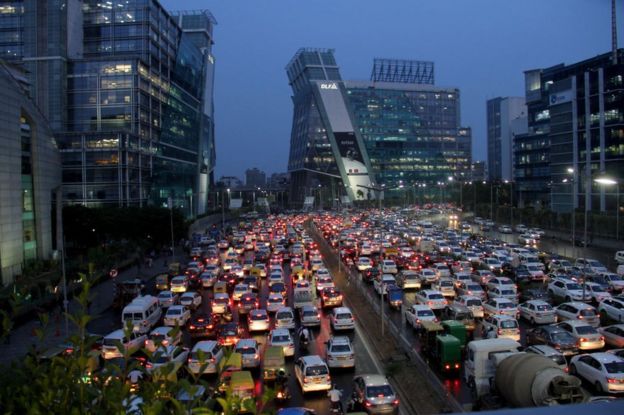
India’s financial hub is congested and infamous for its crawling traffic jams.
Its colonial-era local train system ferries some 7.5 million people between the city’s suburbs and its centre on a daily basis.
Officials say that the metro will eventually carry around 1.7 million passengers every day and bring down the number of vehicles on the road by up to 650,000.
HONG KONG, Oct. 5 (Xinhua) — Chief Executive of China’s Hong Kong Special Administrative Region (HKSAR) Carrie Lam said Saturday that the government will take the greatest resolve to end violence, after rampant rioters Friday wreaked havoc in various areas of Hong Kong.
Lam said in a video address that Hong Kong witnessed “a very dark night” on Friday and the society was half-paralyzed, describing the extreme acts as “unprecedented and appalling.”
Violent and disruptive acts were staged again in Hong Kong on Friday as masked rioters blocked roads, set fires, damaged public facilities, and assaulted police officers and passersby, leaving the transport network paralyzed and forcing numerous shops to close.
“The extreme violence is a clear indication of the widespread danger to public security in Hong Kong,” Lam said.
Given the escalating violence recently, the HKSAR government has invoked the power under the Emergency Regulations Ordinance and put in place the Prohibition on Face Covering Regulation. The anti-mask law, designed to end violence and restore order, came into effect on Saturday, Lam said.
The move has received support from 40 Legislative Council members and many chambers of commerce, media outlets and social organizations, she said.
Lam reiterated the legality of the action and said the HKSAR government adopted appropriate measures using the power conferred by the existing law.
Lam urged foreign officials and lawmakers to understand the nature of the violent incidents. “Hong Kong is facing unprecedented violence and the government needs to adopt resolute legal measures to stop violence, restore peace and order, and protect the rights and freedoms of Hong Kong residents from the threats of rioters.” She said anti-mask legislations were also adopted in a number of western countries.
Lam also called on Hong Kong residents to support the HKSAR government in stopping the violence, make a clean break with rioters, and work together to bring back peaceful lives as soon as possible.
Chinese State Councilor and Foreign Minister Wang Yi and Solomon Islands’ Minister of Foreign Affairs and External Trade Jeremiah Manele sign a joint communique on the establishment of diplomatic relations after their talks in Beijing, capital of China, Sept. 21, 2019. (Xinhua/Xie Huanchi)
BEIJING, Sept. 21 (Xinhua) — China and the Solomon Islands signed a joint communique in Beijing Saturday on the establishment of diplomatic relations.
The communique was signed by Chinese State Councilor and Foreign Minister Wang Yi and Solomon Islands’ Minister of Foreign Affairs and External Trade Jeremiah Manele after they held talks.
The communique stated that the two countries have decided to recognize each other and establish diplomatic relations at the ambassadorial level effective from the date of signature of this communique, in keeping with the interests and desire of the two peoples.
China and the Solomon Islands agree to develop friendly relations on the basis of the principles of mutual respect for sovereignty and territorial integrity, mutual non-aggression, non-interference in each other’s internal affairs, equality, mutual benefit and peaceful coexistence.
The government of Solomon Islands recognizes that there is but one China in the world, that the Government of the People’s Republic of China is the sole legal government representing the whole of China, and that Taiwan is an inalienable part of China’s territory, according to the communique.
“The Government of the Solomon Islands shall sever ‘diplomatic relations’ with Taiwan as of this day and undertakes that it shall no longer develop any official relations or official exchanges with Taiwan. The Government of the People’s Republic of China appreciates this position of the Government of the Solomon Islands,” the communique said.
Prior to the signing of the communique, the Solomon Islands announced in a statement that it recognized the one-China principle and severed the so-called “diplomatic ties” with Taiwan.
The Chief Economic Adviser, K Subramanian, disagreed with the idea of industry-specific incentives and argued for structural reforms in land and labour markets. Members of Prime Minister Narendra Modi’s economic advisory council sound inchoate, resorting to social media and opinion editorials to counter one another.
In essence, the quibble among the members of the economic team of Mr Modi and his government is not about whether India is facing an economic slowdown or not, but about how grave the current economic crisis is.
To put all this in context, it was less than just two years ago, in November 2017, that the global ratings agency Moody’s upgraded India’s sovereign ratings – an independent assessment of the creditworthiness of a country – for the first time in 14 years.
Image copyrightGETTY IMAGESImage captionSales of cars and SUVs have slumped to a seven-year low
Justifying the upgrade, Moody’s had then argued that the economy was undergoing dramatic “structural” reforms under Mr Modi.
In the two years since, Moody’s has downgraded its 2019 GDP growth forecast for India thrice – from 7.5% to 7.4% to 6.8% to 6.2%.
The immediate questions that arise now are: is India’s economic condition really that grim and, if yes, how did it deteriorate so rapidly?
To make matters worse, Finance Minister Nirmala Sitharaman presented her first budget recently with some ominous tax proposals that threatened foreign capital flows and dented investor confidence. It sparked criticism and Ms Sitharaman was forced to roll back many of her proposals.
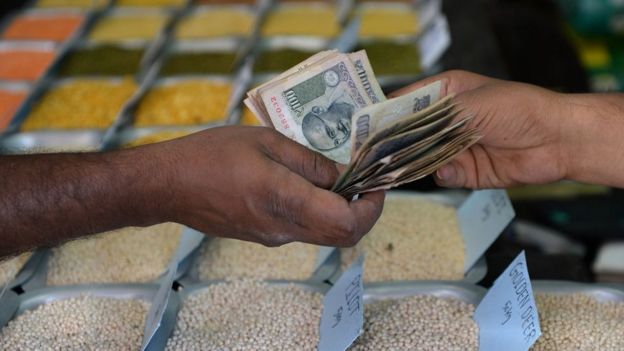
Image copyright GETTY IMAGESImage caption In 2016, India withdrew 85% of all currency notes from the economy
So, it is indeed true that India is facing a sharp economic downturn and severe loss of business confidence.
The alarm over the economic condition is not merely a reflection of a slowdown in GDP growth but also the poor quality of growth.
Private sector investment, the mainstay of sustainable growth in any economy, is at a 15-year low.
In other words, there is almost no investment in new projects by the private sector. The situation is so bad that many Indian industrialists have complained loudly about the state of the economy, the distrust of the government towards businesses and harassment by tax authorities.
But India’s economic slowdown is neither sudden nor a surprise.
Behind the fawning headlines in the press over the past five years about the robustness of India’s growth was a vulnerable economy, straddled with massive bad loans in the financial sector, disguised further by a macroeconomic bonanza from low global oil prices.
India’s largest import is oil and the fortuitous decline in oil prices between 2014 and 2016 added a full percentage point to headline GDP growth, masking the real problems. Confusing luck with skill, the government was callous about fixing the choked financial system.
Media caption What is really happening with India’s economy?
This move destroyed supply chains and impacted agriculture, construction and manufacturing that together account for three-quarters of all employment in the country.
Before the economy could recover from the currency ban shock, the government enacted a transition to a new indirect taxation system of the Goods and Services Tax (GST) in 2017. The GST rollout wasn’t smooth and many small businesses initially struggled to understand it.
Such massive external shocks to the economy, coupled with a reversal in low oil prices, dealt the final blow to the economy. Millions of Indians started to lose their jobs and rural wages remained stagnant. This, in turn, impacted consumption, slowing down the economy sharply.
Not easy
The wobbly state of the economy has also thrown government finances in disarray: tax revenues are much below expectations.
On Monday, the government got a much-needed breather when India’s central bank announced a $24bn (£19bn) one-time payout for the cash-starved government. (This amount is more than the dividend paid by the central bank to the government in all five years of the Congress rule between 2009 and 2014.)
The solutions to the economic crisis are not easy.
Indian industry, fed and fattened with government protection through decades, is once again clamouring for tax cuts and financial incentives.
But it is not clear that such benefits will revive private sector investment and domestic consumption immediately.
For all the hype about the Make in India programme, hailed as the harbinger of the country’s emergence as a manufacturing power, India’s dependence on China for goods has only doubled in the past five years.
India today imports from China the equivalent of 6,000 rupees ($83; £68) worth of goods for every Indian, which has doubled from 3,000 rupees in 2014.
So, India is neither making goods for itself nor for the world.
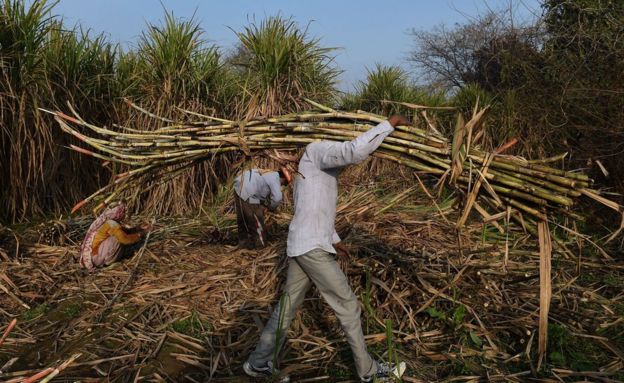
Image copyright AFPImage caption India’s agrarian crisis is a major stumbling block
Ornamental tax and other fiscal incentives to specific industries are not suddenly going to make Indian manufacturers competitive and stop India’s addiction for affordable Chinese goods. If any, the trade spat between China and the United States only saw countries such as Vietnam and Bangladesh benefit and not India.
More currency or trade tariffs are not the solutions either. The central bank has lowered interest rates and there is some push to lowering the cost of capital for industry. But again, Indian industry will invest more only when demand for goods and services increases. And demand will increase only when wages increase, or there is money in the hands of people.
So, the only immediate solution for India seems to be to boost consumption through a stimulus given directly to people, in the classical Keynesian mould.
Of course, such a stimulus should be combined with reforms to boost business morale and confidence.
In sum, India’s economic picture is not pretty.
It is important for India’s political leadership to see this not-so-pretty picture and not hide behind rose tinted glasses. Prime Minister Modi has a unique electoral mandate to embark on bold moves to truly transform the economy and pull India out of the woods.
NEW DELHI/MUMBAI (Reuters) – India’s opposition Congress party selected past president Sonia Gandhi as its interim leader on Saturday, while it searches for a successor to her son Rahul Gandhi, who quit following a crushing election defeat by Prime Minister Narendra Modi.
The Congress Working Committee (CWC) unanimously decided to appoint Sonia Gandhi as “interim president pending the election of a regular president,” the party said in a statement late on Saturday night.
The committee wanted Rahul Gandhi to continue as its president but after he refused, they asked his mother to take over the reins instead, and she accepted, the statement said.
Sonia Gandhi is one of the most influential leaders of the Congress party and is credited with having brought the party back from the brink in 2004 with a surprise victory over the incumbent central government.
The widow of assassinated former Prime Minister Rajiv Gandhi, she was also the party’s longest serving president with 19 years at the helm, from 1998 to 2017, before handing over the baton to her son.
Congress, founded in 1885, is India’s oldest political party and dominated the country for decades after independence, led by generations of the Nehru-Gandhi family. The family produced three prime ministers: Jawaharlal Nehru, India’s first and longest-serving leader, his daughter Indira Gandhi and her son Rajiv.
However, Italian-born Sonia Gandhi faces a tall order to pull the party out of its worst crisis in decades and at the same time choose a worthy and dependable successor.
Party leaders and foot soldiers alike have been defecting to the ruling BJP. Remaining members have been dismayed at the party’s leadership vacuum following Modi’s re-election with a majority that surpassed his victory in 2014, and are questioning the party’s survival.
Rahul Gandhi, 49, announced his decision to quit as Congress leader in May, but the party leadership refused to accept it. They pressed him to reconsider, saying the party needed a unifying figure from the family to avoid splintering.
The party thanked Rahul Gandhi for his “exceptional leadership” during the state and general elections.
Last month in the southern state of Karnataka the defection of more than a dozen legislators from the ruling Congress-led coalition paved the way for Modi’s BJP to form a government.
Congress also appeared split in its response to Delhi’s decision to strip the state of Jammu and Kashmir of special constitutional status on Monday after putting the region on lockdown.
Some Congress members, including senior leader Jyotiraditya Scindia came out in support of the decision, and local media reported many in the party were supporting him.
Rahul Gandhi told reporters on Saturday night in New Delhi that considering there were reports of violence in Jammu and Kashmir, the government should provide transparent information about the actual situation on the ground.
Chinese President Xi Jinping has made becoming a “space flight superpower” a priority for his government
Chinese space authorities prepare to launch a rocket from a commercial cargo ship at sea. Photo: Handout
China has rolled out its first rules to regulate the manufacture of commercial space rockets and test flights in a move to guide healthy development of the commercial space sector, mirroring similar moves by the US in recent years.
As a rising number of start-ups set out to be China’s version of Elon Musk’s SpaceX, the guidelines are the first since China’s space industry was opened to the private sector in 2014. They require companies to obtain official permission before carrying out rocket research and development as well as production, according to a notice published on the web site of the State Administration of Science, Technology and Industry for National Defense on Monday.
The new rules also require a confidentiality system to be established among commercial rocket companies and asks them to follow state export control regulations when in doubt about whether they can provide overseas services and products.
The detailed regulations come as the number of private companies engaged in the commercialisation of China’s space industry increased to almost 100 in 2018 from 30 a year earlier, and as Beijing puts more emphasis on private sector involvement to boost its space ambitions.
China rockets to forefront of global space race with sea launch success
“The specifics give clear direction for China’s commercial space industry, clarifying the qualifications, operational boundaries and national guarantees, which will be conducive to the sector’s healthy and orderly development,” Shu Chang, CEO of Beijing-based commercial rocket pioneer OneSpace Technology, was quoted as saying to state media Global Times on Tuesday
Since coming to power in 2012, Chinese President Xi Jinping has made becoming a “space flight superpower” a priority for his government. Since 2014, Beijing has encouraged more private investors to participate in its space push to bolster commercial space technology development, including policies directed at investment and providing land for launches.
The guidelines issued on Monday said commercial rocket development had the potential to lower the cost of space sector development, improving China’s space power and competitiveness globally. It also encourages private companies to partner with state-backed organisations to take full advantage of the latter’s resources in research development, production and launch facilities.
Trump criticises Nasa moon mission after previously promoting it
The move by China mirrors similar efforts by the US in recent years to shift the burden of space exploration and technology development away from the state and into the private sector, leading to space rocket development by the likes of Elon Musk, Jeff Bezos and Richard Branson.
Military interests still weigh though. President Donald Trump has championed a return to the moon, calling for a lunar gateway that would allow a continuous stream of spacecraft and people to visit the moon, and serve as a leaping off point for Mars. Trump has also called for the creation of a “Space Force”, a sixth branch of the military that would be focused on defending US interests.
China accounts for roughly 3 per cent of the US$16.1 billion invested in private space companies and partnerships since 2009 in the world. But investments have increased rapidly since 2016, and the country led the world in the third quarter of 2018, according to Space Angels, a US investment firm that specialises in private space ventures.
Image copyright GETTY IMAGESImage caption Tamils argue that imposing Hindi will jeopardise their language
The Indian government has revised a controversial draft bill to make Hindi a mandatory third language to be taught in schools across the country.
The draft bill had met particularly strong opposition in the southern state of Tamil Nadu, which has always resisted the “imposition” of Hindi.
In 1965, it saw violent protests against a proposal that Hindi would be India’s only official language.
Tamil is one of the oldest languages and evokes a lot of pride in the state.
However the government decision has not calmed tensions in Tamil Nadu.
The two main political parties in the state, the DMK and AIADMK, have both said that simply revising the draft to say Hindi would not be mandatory is not enough.
The state teaches only two languages – Tamil and English – in the government school curriculum, and the parties do not want a third language introduced at all.
A DMK spokesman told the NDTV news channel that the third language clause would be used as a “back door” to introduce Hindi anyway.
Their rivals, the AIADMK, which allied with the Bharatiya Janata Party (BJP) in the general elections but lost badly in the state, had a similar view.
“Our party has always been clear in our stand. We have always followed a two-language policy. Though mandatory Hindi has been revised in the draft now, we still cannot support this three-language system. Our government will talk to the union government for our rights,” former state education minister and AIADMK spokesman Vaigaichelvan told BBC Tamil.
On Monday, #HindiIsNotTheNationalLanguage began trending on Twitter in India, which saw many from Tamil Nadu facing off against people from other parts of the country and asserting their right not to have the language “imposed” on them.
The BJP government’s real face is beginning to emerge…Hindi is being imposed on South Indians. Tamil Nadu has rebelled against BJP-Govt. Let’s join them to fight the imposition of Hindi! #HindiIsNotTheNationalLanguage
Picture speaks a thousand words! In a diverse country like India, learning a new language should be a choice and not compulsion/imposition.
Declaring any Indian language as a national language will be a joke. #HindiImposition#HindiIsNotTheNationalLanguage
“There is no opposition to actually learning Hindi. In fact with the recent IT boom in the south, so many people from the north have migrated here that its use has become more widespread here. It is true that if you know Hindi you will find it easier to get work in other parts of India, so there are also many people here who willingly learn it. But that should be their choice. What people are opposing is the imposition of it,” senior journalist and political analyst KN Arun told the BBC.
Mr Arun also warned that there was a chance that the issue could lead to further protests in the state, saying that a few hardline Tamil groups had been using the issue to whip up anger among the people.
It is also a particularly emotive issue. Politics in the state is still centred around the ideas and principles of the Dravidian movement, which among other things reveres the Tamil language and links it closely to regional identity.
“Tamil is very rich in literature and different to other languages like Hindi which branched out of Sanskrit. There is fear that the Indian government is trying to slowly introduce Hindi, which will threaten the status of Tamil,” author and journalist Vaasanthi told the BBC.
BEIJING, March 7 (Xinhua) — As China is faced with a growing aging population, the government has pledged to provide better elderly care services and facilities for the silver-haired, and give a strong boost to domestic demand.
Elderly care remains high on the agenda in this year’s government work report, which said that significant steps would be taken to develop elderly care, especially community elderly care services.
The number of people in China aged 60 and above reached 250 million by the end of 2018, accounting for 17.9 percent of the country’s population.
“Growing demand will trigger greater market potential in China’s senior care industry,” said Tang Wenxiang, founder of Fullcheer Group, a major elderly care services provider based in Changsha, capital of central China’s Hunan Province.
Fullcheer Group has 50 branches in more than 10 provinces and cities with a total of 5,000 beds. Tang expects the number of his company’s beds to increase to 50,000 in five years.
“There is still a huge gap between the demand of China’s aging population and the number of elder care facilities,” Tang said.
The country will provide support to institutions offering services in the community like day care, rehabilitation care, and assisted meal services and outdoor fitness services using measures such as tax and fee cuts and exemptions, funding support, and lower charges for water, electricity, gas and heating, according to the government work report.
Tang said government’s measures to develop elderly care services greatly boosted the confidence of entrepreneurs who run businesses in the sector.
Developing the elderly care industry is good for improving people’s well-being and stimulating consumption, said Xu Hongcai, an economist with the China Center for International Economic Exchanges.
“Consumption on elderly care requires the supply of the elder care market, offered by both the government and the market,” he said.
A research report issued by Guolian Securities suggests that a string of policies have been carried out in China to encourage the participation of the social sector in the senior care industry, which will boost the country’s consumption in the health and medical sectors.
As China opens this sector, foreign firms such as France’s Orpea and Japan’s Nichii have tapped the elderly service market in China.
China still lacks leading players in the senior care market which includes nursing care, rehabilitation assistive devices and daily necessities for seniors, Tang said.
The long-term care insurance system will help increase the occupancy rate of some elderly services facilities given a number of elderly people can hardly afford the expenses, according to Tang.


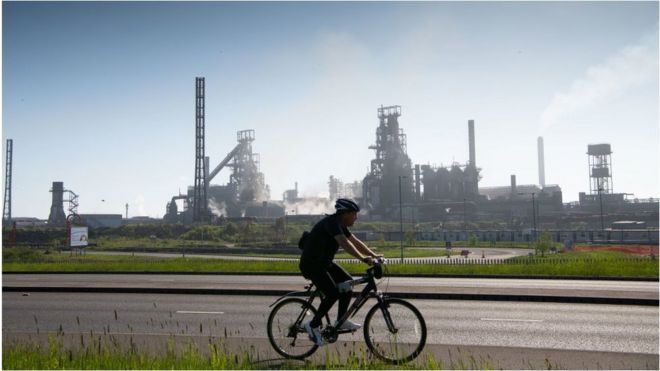 Image copyright GETTY IMAGES









 CHINDIA ALERT: You'll be living in their world, very soon