01/06/2020

Students attend a class at a primary school in Dahua Yao Autonomous County, south China’s Guangxi Zhuang Autonomous Region, May 29, 2020. Guangxi, one of the major battlefields in China’s poverty alleviation campaign, has been making painstaking efforts to improve education for poverty-stricken children, as schooling is believed to be the best way to empower the youngsters to lift their families out of poverty. The region has taken various measures in this regard, including granting students stipends, improving school facilities and nutritional conditions of rural students, and helping more students from rural and impoverished areas have access to higher education. As many households from inhospitable areas have moved into relocation sites built for poverty alleviation in the county seats, relocated children can study in schools in and near resettlements, instead of trekking hours back and forth in mountains for schooling. The faculty is a key to education. The regional government has called in capable teachers to help schools in rural areas, and has been committed to guaranteeing payment to teachers and filling vacancies of teachers in rural areas through special programs. Reducing poverty must begin with reducing ignorance. Therefore, giving rural children a good education is an important task in poverty relief, and also a crucial means to stop poverty being passed on through generations.
Source: Xinhua
Posted in attend, back and forth, capable teachers, children, class, Dahua Yao Autonomous County, education, faculty, filling vacancies, generations, granting students stipends, Guangxi, Guangxi Zhuang Autonomous Region, guaranteeing, households, impoverished areas, improving school facilities, inhospitable, key, mountains, moved, nutritional conditions, out of poverty, passed on, payment, poverty alleviation campaign, poverty-stricken, primary school, reducing ignorance, Reducing poverty, regional government, relocation sites, resettlements, rural, rural areas, schooling, special programs, students, teachers, to improve, trekking, Uncategorized |
Leave a Comment »
26/03/2020
- For many small factories and service businesses, the process of returning to normal operations after disruptions from the coronavirus pandemic has been harder
- Chinese authorities have been pushing for SMEs to make use of technologies such as remote working and smart manufacturing platforms to resume operations quickly
Workers pack instant river snail rice noodles at a factory in Liuzhou, south China’s Guangxi Zhuang Autonomous Region, Jan. 2, 2020. Photo: Xinhua
(SMEs) in China have been resuming work at a faster rate since March with the help of government measures to promote their adoption of technology, China’s Ministry of Industry and Information (MIIT) said in a news conference on Wednesday.
As of Tuesday, 71.7 per cent of SMEs using cloud-based platforms had resumed production, up from 29.6 per cent a month earlier, said Qin Zhihui, deputy director of MIIT’s SME bureau.
Industrial internet platforms, which help to “coordinate production and prevent risks, ensure the integrity and safety of supply chains and give support to key areas which may experience potential work disruptions”, have helped some businesses resume operations, MIIT spokesman Xie Shaofeng said at the same news conference.
“Others used cloud-based computing to help enterprises move their business operations online, promoting remote working, teleconferencing, online training, co-researching and e-commerce,” he added.
For many small factories and service businesses, which account for most employment in China, the process of returning to normal operations
has been more difficult than for larger firms. The smaller firms, for example, are often unable to meet virus prevention conditions set by local governments, including having enough facial masks for employees.
Workers at 60 per cent of Chinese firms still telecommuting under lockdown
In a notice last week, MIIT encouraged SMEs to make use of digital tools such as
and smart manufacturing platforms to resume operations as soon as possible, and urged cloud services providers to open up services for SMEs in both services and manufacturing sectors.
The ministry also said in the notice that it had rolled out more than 370 online training courses for SMEs to stay informed about government policies and access opportunities to learn managerial and technological skills. It said the courses had been viewed more than 8 million times.
China’s cloud infrastructure, which enables remote working and online learning among other applications, has grown rapidly over the past few years. The market grew 66.9 per cent to US$3.3 billion in the fourth quarter of 2019, according to a Canalys report last week, with Alibaba Group Holding’s Alibaba Cloud accounting for 46.6 per cent of the market, followed by Tencent Cloud with 18 per cent and Baidu’s AI Cloud with 8.8 per cent.
Alibaba is the parent company of the South China Morning Post.
Source: SCMP
Posted in Alibaba, Alibaba Cloud, Alibaba Group Holding’s, Baidu’s AI Cloud, China’s Ministry of Industry and Information (MIIT), chinese authorities, Chinese SMEs, cloud-based computing, co-researching, Coronavirus pandemic, digitise businesses, Guangxi Zhuang Autonomous Region, Industrial internet platforms, Liuzhou, online training, remote working, resumed work, river snail rice noodles, service businesses, small factories, smart manufacturing platforms, supply chains, technologies, teleconferencing, Tencent Clou, Uncategorized |
Leave a Comment »
22/09/2019
NANNING, Sept. 21 (Xinhua) — A forum on China-ASEAN cooperation in electric power was held Friday in Nanning City, capital of south China’s Guangxi Zhuang Autonomous Region, according to the organizer.
More than 160 experts from China and members of the Association of Southeast Asian Nations (ASEAN) gathered to discuss topics including investment, technology exchange and interconnection of infrastructure.
Chinese major electric power enterprises completed the investment of 1.8 billion U.S. dollars in 11 projects in the ASEAN countries and signed 9.91 billion U.S. dollars worth of contracts in 2018, according to China Electricity Council.
Cooperation between Chinese electric power enterprises and ASEAN countries covers hydropower, wind power, photovoltaic power and other fields, and has promoted local economic development and achieved win-win progress, said Yu Chongde, secretary general of the council.
China has rich experiences, advanced technology, and strong design and manufacturing capabilities in electric power, all of these are of great importance to ASEAN countries, said Yongyooth Horthong, an official from the Thai Ministry of Energy.
Source: Xinhua
Posted in advanced technology, ASEAN, ASEAN (the Association of Southeast Asian Nations), Association of Southeast Asian Nations (ASEAN), China alert, China Electricity Council, China-ASEAN cooperation, cooperation, design and manufacturing capabilities, electric power, Guangxi Zhuang Autonomous Region, hydropower, Nanning, photovoltaic power, strengthens, Thai Ministry of Energy, Uncategorized, Wind power |
Leave a Comment »
21/09/2019
Chinese Vice Premier Han Zheng, also a member of the Standing Committee of the Political Bureau of the Communist Party of China Central Committee, addresses the opening ceremony of the 16th China-ASEAN Expo and the China-ASEAN Business and Investment Summit in Nanning, south China’s Guangxi Zhuang Autonomous Region, on Sept. 21, 2019. (Xinhua/Shen Hong)
NANNING, Sept. 21 (Xinhua) — Relations between China and countries of the Association of Southeast Asian Nations (ASEAN) have entered a new stage of all-round development, Chinese Vice Premier Han Zheng said Saturday.
Han, also a member of the Standing Committee of the Political Bureau of the Communist Party of China Central Committee, made the remarks at the opening ceremony of the 16th China-ASEAN Expo in Nanning, capital of south China’s Guangxi Zhuang Autonomous Region.
Stressing that ASEAN is a key area in Belt and Road construction, Han said China is willing to work with ASEAN countries to pursue a higher level strategic partnership and build a closer community with a shared future.
China is ready to work with ASEAN to construct the Belt and Road and implement the Master Plan on ASEAN Connectivity 2025 under the guidance of the China-ASEAN Strategic Partnership Vision 2030, Han said.
While stepping up efforts to implement the protocol on upgrading the China-ASEAN Free Trade Area, China will join hands with relevant parties to complete the Regional Comprehensive Economic Partnership, according to the vice premier.
With platforms such as the China International Import Expo and the China-ASEAN Expo injecting strong momentum into common development, China will cooperate with ASEAN in building economic and trade cooperation zones and the China-Indochina Peninsula Economic Corridor.
In addition, efforts will be made to boost the connectivity of infrastructures and deepen innovation cooperation in spheres such as e-commerce, digital trade and 5G internet, Han said.
Source: Xinhua
Posted in 5G internet, all-round development, ASEAN Connectivity 2025, Association of Southeast Asian Nations (ASEAN), Belt and Road construction, China International Import Expo, China International Import Expo (CIIE), China-ASEAN Expo, China-ASEAN Free Trade Area, China-ASEAN Strategic Partnership Vision 2030, China-ASEAN ties, China-Indochina Peninsula Economic Corridor, Chinese Vice Premier, connectivity, digital trade, E-commerce, enter, Guangxi Zhuang Autonomous Region, Han Zheng, infrastructures, innovation cooperation, Nanning, new stage, Regional Comprehensive Economic Partnership, Regional Comprehensive Economic Partnership (RCEP), Standing Committee of the Political Bureau of the Communist Party of China Central Committee, Uncategorized, Vice Premier Han Zheng |
Leave a Comment »
20/09/2019
NANNING, Sept. 19 (Xinhua) — Pham Thi Nguyet Hoa, a vendor living in Vietnam’s Mong Cai, comes to Dongxing, a southern Chinese port city, to sell Vietnam fruits every day. When night falls, she often ends up with thousands of yuan in her pocket, much more than what she can earn at home.
“Most of my customers are Chinese, and it is very convenient to exchange Chinese yuan to Vietnamese Dong as many banks in Dongxing have this currency exchange service,” said Pham.
Tourism has been a pillar industry in the border city of southern China’s Guangxi Zhuang Autonomous Region. Dongxing port saw 12 million people, of which half were tourists, pass through last year, ranking first among all land ports in China.
In the first six months this year, tourism consumption at the port exceeded 6.2 billion yuan (874 million U.S. dollars), up 40.4 percent from the year before.
The flourishing border tourism has brought a huge demand for currency exchange, with a slew of financial reforms rolled out in recent years.
In 2014, the ABC China (Dongxing Experimental Zone) ASEAN Currency business center was established in Dongxing, allowing direct convertibility of Chinese yuan and Vietnamese Dong.
In February 2018, a total of 8 million yuan was transferred in cash from Vietnam to China, marking the first cross-border cash transfer in Guangxi between China and Vietnam.
Fan Zuojun, vice president of Guangxi University, said the cross-border cash transfer will further promote the financial cooperation between China and Members of the Association of Southeast Asian Nations (ASEAN) as well as deepen reform and push forward the internationalization of the Chinese currency in the region.
China and ASEAN countries have always maintained close relations in trade.
In January 2010, the China-ASEAN Free Trade Area was set up, which has significantly boosted bilateral trade. China has maintained its position as the largest trading partner of ASEAN for 10 consecutive years, and trade between China and ASEAN has skyrocketed tenfold from 16 years ago to 587.8 billion U.S. dollars in 2018.
In the first half of 2019, ASEAN became China’s second-largest trading partner, with bilateral trade volume reaching 291.85 billion U.S. dollars, up 4.2 percent year on year.
Guangxi’s geographical advantages have also given it huge development dividends over the past decades. ASEAN has been Guangxi’s largest trade partner for 19 consecutive years, and trade volume between Guangxi and ASEAN in the first seven months of this year topped 128 billion yuan, accounting for 48.7 percent of Guangxi’s total foreign trade.
Now with the launch of the Guangxi Pilot Free Trade Zone (FTZ) in August, bilateral trade exchanges are expected to embrace another golden opportunity.
The pilot FTZ, with a total area of nearly 120 square km, will focus on modern financial services, smart logistics, digital economy, port shipping logistics, international trade and cross-border tourism, among others.
Guangxi vows to make greater efforts to consolidate its financial strength and build itself into an ASEAN-oriented financial portal, with over 90 financial reform measures being rolled out to further facilitate trade and investment and promote innovation in financial services with ASEAN countries.
Posted in ABC China (Dongxing Experimental Zone) ASEAN Currency business center, ASEAN, Association of Southeast Asian Nations (ASEAN), build, China alert, China's border region, China-ASEAN Free Trade Area, Chinese, Chinese yuan, consumption, customers, Dongxing, exchange, expedites, financial gateway, first, Guangxi Pilot Free Trade Zone (FTZ), Guangxi University, Guangxi Zhuang Autonomous Region, land ports, Nanning, night, pillar industry, port city, ranking, reform, sell, Tourism, tourists, Uncategorized, Vietnam, Vietnam fruits, Vietnamese Dong |
Leave a Comment »
10/09/2019
NANNING, Sept. 9 (Xinhua) — South China’s Guangxi Zhuang Autonomous Region on Monday pledged to enhance cooperation with the Association of Southeast Asian Nations (ASEAN) on artificial intelligence (AI).
Chen Wu, chairman of the regional government, said at the First China-ASEAN AI Summit that Guangxi will actively promote technical cooperation, trade, investment and industrial exchange in the AI sector with the ASEAN countries.
Toward this end, the region will speed up the construction of platforms for infrastructure, information sharing and technical cooperation, among others, Chen said.
Guangxi, which boasts both sea and overland links with ASEAN, is building the China-ASEAN Information Harbour to boost digital cooperation with Southeast Asia.
“The summit has sounded the clarion call for the development of AI and big data industry in Guangxi,” said Wang Jingjing, Guangxi regional director of the Chinese AI firm iFlytek.
Hailing the region’s policy and geographical advantages on ASEAN cooperation, Wang said iFlytek hopes to set up an institute on ASEAN languages in Guangxi to facilitate communication between China and ASEAN countries
Source: Xinhua
Posted in AI, AI industry, AI sector, ASEAN, Association of Southeast Asian Nations (ASEAN), big data industry, China's border region, China-ASEAN Information Harbour, Chinese AI firm, clarion call, cooperation, digital cooperation, First China-ASEAN AI Summit, Guangxi, Guangxi Zhuang Autonomous Region, iFlytek, industrial exchange, Investment, overland links, promote, sea links, Southeast Asia, summit, technical cooperation, Trade, Uncategorized |
Leave a Comment »
15/07/2019
Villagers clean a house damaged by floods at Jiangbei Village of Banlan Township, Rongan County, south China’s Guangxi Zhuang Autonomous Region,July 14, 2019. A series of reconstructing and rescuing works have been done since Rong’an was hit by heavy rains recently. (Xinhua/Huang Xiaobang)
BEIJING, July 14 (Xinhua) — At least 17 people were killed or missing and thousands evacuated as torrential downpours unleashed floods and toppled houses in central, eastern and southern China.
The National Meteorological Center on Sunday renewed a blue alert for rainstorms, predicting heavy rain in Zhejiang, Fujian, Jiangxi, Hunan, Guangdong, Yunnan, Sichuan provinces, as well as Guangxi Zhuang Autonomous Region and Tibet Autonomous Region.
Some of those regions will see up to 120 mm of torrential rainfall, it said.
China has a color-coded weather warning system, with red representing the most severe, followed by orange, yellow and blue.
As of 8 a.m. Sunday, at least 17 people died or were reported missing following rain-triggered floods in central Hunan Province, which also forced more than 470,000 people to be relocated and 179,000 were in urgent need of aid.
Four hydrometric stations along the Yangtze River in Xianning city, central Hubei Province, have reported the river water reaching or surpassing a level that can activate local anti-flood work.
In eastern Anhui Province, rain-triggered floods have affected more than 51,000 people and damaged over 2,700 hectares of crops.
The floods have forced the evacuation of 926 people, and caused a direct economic loss of more than 59.6 million yuan (8.66 million U.S. dollars) in the province.
As of Saturday noon, 330,000 people in 18 counties of Jiangxi Province have been affected by rainstorm-triggered floods, with over 10,500 residents relocated.
Poyang Lake, China’s largest freshwater lake in the lower reaches of the Yangtze, is swelling above the alarming level, according to the hydrographic department in Jiangxi.
The water level of the lake reached 20.08 meters as of 8 a.m. Saturday, 1.08 m above the warning level, as recorded by Xingzi Hydrometric Station on the lake.
In south China’s Guangxi Zhuang Autonomous Region, rainstorm has affected more than 360,000 people as of 5 p.m. Sunday, damaging over 35,000 hectares of crops, according to the region’s emergency management department.
The disastrous weather in Guangxi has prompted the region to activate a level-II emergency response and send special work teams and relief materials to the ravaged areas.
In some of the disaster-hit towns, flood water from subterranean rivers has inundated roads.
“After torrential downpours, waters on mountains and underground rivers converge into low-lying lands, which may lead to waterlogging. In affected villages, the water depth in some people’s houses can exceed two meters,” said Liao Bin, an official with Jiuwei Town, Hechi City.
Local authorities have dispatched boats and wooden rafts to transfer the stranded people, set up temporary relocation sites, and deliver living supplies to blocked villages.
Since June, the southwestern province of Guizhou has allocated a total of 16.5 million yuan for its hardest-hit 16 counties.
Source: Xinhua
Posted in Anhui province, blue, central, east, south China, China's largest freshwater lake, color-coded weather warning system, dead or missing, Fujian Province, guangdong province, Guangxi Zhuang Autonomous Region, Guizhou Province, Hechi City, hubei province, Hunan Province, Jiangxi Province, Jiuwei Town, National Meteorological Center (NMC), Orange, orange alert, Poyang Lake, rainstorms, red, sichuan province, sweep, Tibet Autonomous Region, Uncategorized, Xianning city, Yangtze River, yellow alert, Yunnan Province, zhejiang province |
Leave a Comment »
13/06/2019
- Visit to beauty spot spoiled as tourists ordered off the bus to spend, spend, spend
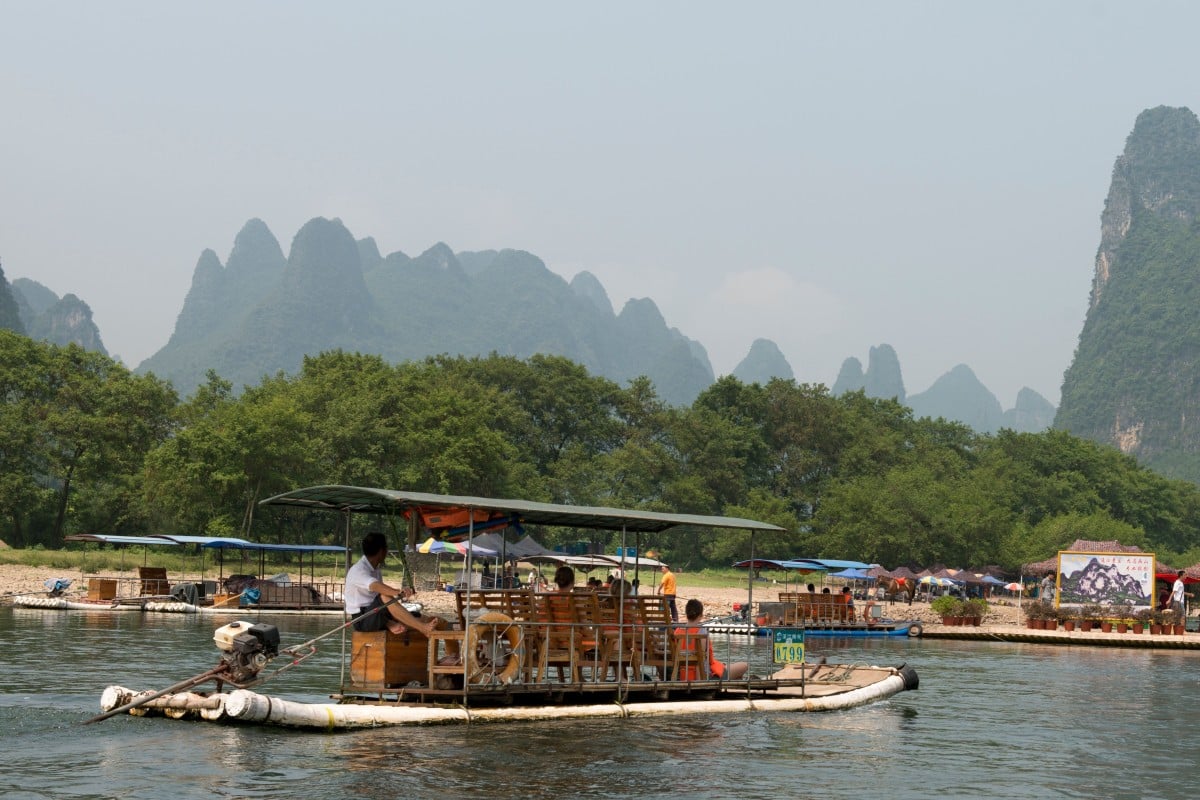
Guilin is renowned for its scenic cruises along the Li River, through magnificent karst mountains. But one tour group was forced on an unexpected shopping trip. Photo: Alamy
A tour guide in the scenic city of Guilin in southern China has been stripped of her licence after forcing tourists to spend at least 20,000 yuan (US$2,900) in local shops.
The tour guide, surnamed Zhao, was captured on video telling her customers they had an hour to spend the money and she would accept no excuses.
The short clip, which has been circulating widely on Chinese social media this week, was filmed on June 1, according to online news portal QQ.com.
“You might have thousands of reasons to refuse me, such as you already have this stuff at home,” Zhao said in the video. “I don’t care why you have come to Guilin. Now you have chosen this group … get off the bus and spend 20,000 yuan [in] an hour.”
Tiffany loses its shine with Chinese tourists as US sales fall 25 per cent
Some of the tourists can be heard on the video murmuring “how can it be like this?”
The 55 members of the tour group, from Hunan province in central China, had travelled to Guilin in the Guangxi Zhuang autonomous region from May 30 to June 2. According to their itinerary, they were supposed to visit three shops on the day the incident happened, but instead visited six, the QQ.com report said.
In its statement on microblogging platform Weibo, the authority also said it was investigating her employer.
Ferrying tourists along China’s Yellow River
Tour guides are banned from forcing tourists to shop or join programmes charging extra fees. A State Council regulation issued two years ago set a 10,000-50,000 yuan penalty for individuals violating the rule, and a further 100,000-500,000 yuan fine for their tour company.
Despite the crackdown in recent years, it is not uncommon for Chinese tourists to be coerced by tour guides into extra spending during their trips. China’s authorities have repeatedly reminded the public to be wary of companies that lure potential tourists with extremely low group fees.
In July last year, a group of 300 elderly people, from the central province of Henan, were reportedly forced to buy jewellery from a shop in Hong Kong. The tour agency charged them just 380 yuan for the whole package and promised there would be no forced shopping activity, according to Henan TV.
But, despite the assurance, they were taken to a jewellery shop where their tour guide told them, “Henan people, spend some money to earn face for your Henan folks.”
Those who did not spend as they were urged had to wait in the shop for hours and were cursed by the tour guide, according to the television report. It is not clear if the tour guide or the agency received any penalty.
Source: SCMP
Posted in barred, forced shopping trip, Guangxi Zhuang Autonomous Region, Guilin, Henan province, Hong Kong, jewellery, karst mountains, Li River, licence, news portal qq.com, State Council regulation, Tiffany, tour guide, Uncategorized, video, Yellow River |
Leave a Comment »
14/03/2019
NANNING, March 13 (Xinhua) — Total volume of trade between China and the Association of Southeast Asian Nations (ASEAN) countries hit a record high of 587.87 billion U.S. dollars in 2018, up 14.1 percent year on year, an official with the Ministry of Commerce said Wednesday.
China-ASEAN trade maintained a strong upward momentum last year, with two-way investments amounting to 205.71 billion U.S. dollars, said Yang Weiqun, deputy head of the Department of Asian Affairs, Ministry of Commerce.
The mutual investment stock has grown 22 times since 2004, Yang added when attending a senior officials meeting for the 16th China-ASEAN Expo, which is scheduled to be held from Sept. 20 to 23 in Nanning, capital of south China’s Guangxi Zhuang Autonomous Region.
The theme of this year’s expo is “Building the Belt & Road, Realizing Our Vision for A Community of Shared Future,” with Indonesia as the Country of Honor.
Yang said China hopes to take this chance to strengthen communication and cooperation with ASEAN countries.
Gustanto, Consul General of the Consulate General of the Republic of Indonesia in Guangzhou, said the expo has made positive contributions to bilateral trade between Indonesia and China.
As the Country of Honor, Indonesia plans to bring more exhibitors and deepen bilateral economic and trade cooperation, he said.
Initiated in 2004, the expo is an important platform to promote trade and relations between China and the ASEAN.
Source: Xinhua
Posted in Belt & Road, bilateral trade, China alert, China-ASEAN, consul general, Consulate General, Country of Honor, deputy head of the Department of Asian Affairs, Guangxi Zhuang Autonomous Region, Gustanto, Indonesia, Ministry of Commerce, Nanning, Republic of Indonesia, Uncategorized, Yang Weiqun |
Leave a Comment »
07/03/2019
Chinese Premier Li Keqiang, also a member of the Standing Committee of the Political Bureau of the Communist Party of China (CPC) Central Committee, joins panel discussions by deputies from Guangxi Zhuang Autonomous Region at the second session of the 13th National People’s Congress in Beijing, capital of China, March 6, 2019. (Xinhua/Ding Lin)
BEIJING, March 6 (Xinhua) — Senior Chinese leaders on Wednesday urged for more efforts to advance high-quality development.
Li Keqiang, Wang Yang and Han Zheng — members of the Standing Committee of the Political Bureau of the Communist Party of China Central Committee — made the remarks at the annual “two sessions” of the country’s top legislative and political advisory bodies.
Joining panel discussions by deputies to the 13th National People’s Congress (NPC) from southwest China’s Guangxi Zhuang Autonomous Region, Premier Li Keqiang stressed following the guidance of Xi Jinping Thought on Socialism with Chinese Characteristics for a New Era as China’s development faces more and graver risks and challenges in 2019.
He called for efforts to keep the economic growth within an appropriate range and promote high-quality development, and urged solid implementation of the planned tax and fee cuts to reduce burden on the real economy.
At the joint panel discussions of political advisors from economy and agriculture sectors, Wang Yang, chairman of the Chinese People’s Political Consultative Conference National Committee, told them to focus on major and difficult tasks, such as high-quality development and supply-side structural reform, and to deepen their investigations and researches. Wang also urged the advisors to guide the people in correctly interpreting the changes in economy and boost their confidence in development.
Vice Premier Han Zheng joined the panel discussions by lawmakers from Hong Kong. He expressed the support to Hong Kong’s bid to build itself into an international innovation and technology hub, and encouraged the people of Hong Kong, especially the youth, to start up businesses and work in the Guangdong-Hong Kong-Macao Greater Bay Area.
Han also joined panel discussions by lawmakers from Macao. He said that Macao will be supported in its efforts to expand new development space, and to develop its tourism and exhibition industries.
Source: Xinhua
Posted in China alert, Chinese leaders, Chinese People's Political Consultative Conference National Committee, exhibition industries, Guangdong-Hong Kong-Macao Greater Bay Area, Guangxi Zhuang Autonomous Region, Han Zheng, high-quality development, Hong Kong, international innovation, Li Keqiang, Macao, National People's Congress (NPC), new era, President Xi Jinping, Southwest China, Standing Committee of the Political Bureau of the Communist Party of China Central Committee, technology hub, Thought on Socialism with Chinese Characteristics, Tourism, Uncategorized, wang yang |
Leave a Comment »




 CHINDIA ALERT: You'll be living in their world, very soon