20/04/2020
- Move to create administrative units for disputed Paracel and Spratly Islands angers Hanoi
- China has been engaged in a series of stand-offs with rival claimants recently
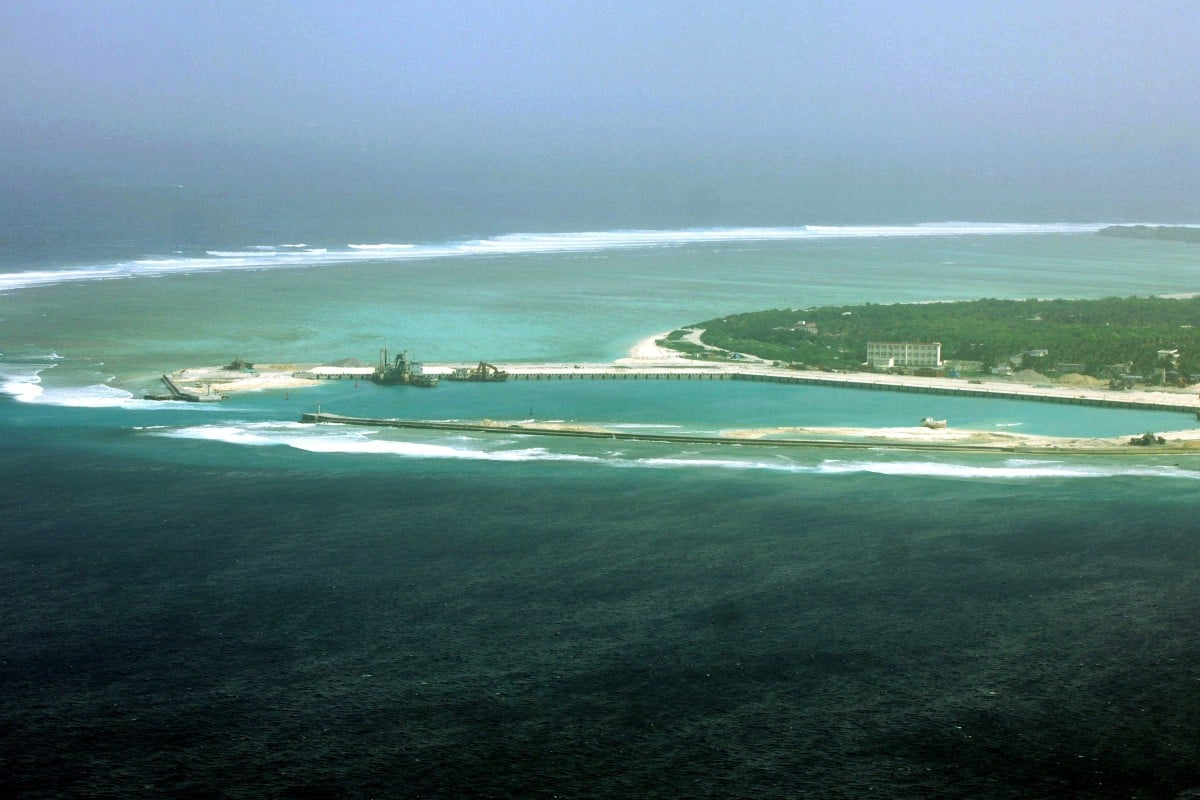
An aerial view of Sanha, a city created to assert China’s claims over the disputed waters. Photo: AFP
China’s latest activities in the South China Sea have triggered a strong protest from rival claimant Vietnam, which said the move “seriously violated” its sovereignty.
The complaint came after China announced on Sunday that it had set up two new administrative districts on the Paracel and Spratly Islands.
The two districts – which China referred to as Xisha and Nansha – will be under the control of Sansha, a city the Chinese government created in 2012 to assert its claims over the South China Sea.
Vietnam’s foreign ministry spokesperson Le Thi Thu Hang issued a statement of protest on Sunday, and said the move would further complicate the situation in the South China Sea.
“These acts are not conducive to the development of the friendly relations between countries and further complicate the situation in the East Sea [Vietnam’s name for the South China Sea], the region and the world,” she said.
“Vietnam demands that China respect Vietnam’s sovereignty and annul its wrongful decisions and not repeat similar activities in the future.”
Under the new plan, the new district of Xisha will be in charge of Paracel Islands, which are also claimed by Vietnam and Taiwan. The Nansha district will manage the Spratly Islands, where there are also multiple competing claims.
Beijing marks out claims in South China Sea by naming geographical features
Chinese Foreign Ministry spokesman Geng Shuang said on Monday that the establishment of the new districts was in line with China’s normal administrative rules.
“China has been resolutely opposing Vietnam’s words and deeds that undermine China’s sovereignty and rights and interests in the South China Sea, and will continue to take necessary measures to firmly safeguard China’s sovereignty and rights and interests.” he said in a press conference
Vietnam is the only claimant which has publicly protested about the move so far. But Zhang Mingliang, an specialist in Southeast Asian politics with Jinan University, said it was likely to have alarmed other members of the Association of Southeast Asian Nations (Asean).
More footage emerges from 2018 near collision of US and China warships in South China Sea
“Setting up such districts will not have much use or actual benefit, and it will cause opposition among the Asean states, many of which have long been suspicious of China’s intentions over the South China Sea,” said Zhang.
“The coronavirus outbreak has already caused some grievances among them towards China, even though they have not been as vocal as the Western countries,” he said.
Richard Heydarian, an academic and former Philippine government adviser, described the move as China taking advantage of a “strategic vacuum” created by the Covid-19 crisis.
South China Sea: Chinese ship Haiyang Dizhi 8 seen near Malaysian waters, security sources say
“On the one hand it’s engaging in face mask diplomacy [providing medical supplies to other countries] … but on the other hand it’s on the offensive,” he said.
“All of them should be seen as part of one package in which China seizes the strategic opportunity of not only its neighbouring countries scrambling to deal with the coronavirus outbreak, but also the US Navy’s suspension of overseas appointments.”
China has recently become involved in a series of stand-off with other claimants in the contested waters.
A Chinese government survey ship reportedly tagged an exploration vessel operated by Malaysia’s state oil company Petronas in the area, and remained off the Malaysian coastline as of late Sunday.
Earlier this month, Vietnam lodged an official protest with China after a Vietnamese fishing boat sunk after a collision in the Paracel Islands.
Source: SCMP
Posted in accuses, angers, Association of Southeast Asian Nations (ASEAN), ‘seriously violating, Beijing, chinese government, collision, coronavirus outbreak, COVID-19, fishing boat, Foreign Ministry spokesperson, Haiyang Dizhi 8, Hanoi, Malaysian, Nansha, Paracel, South China Sea, Southeast Asian, sovereignty, Spratly Islands, sunk, Taiwan, Uncategorized, Vietnam, warships', Xisha |
Leave a Comment »
19/04/2020
- Faced with a backlash from the West over its handling of the early stages of the pandemic, Beijing has been quietly gaining ground in Asia
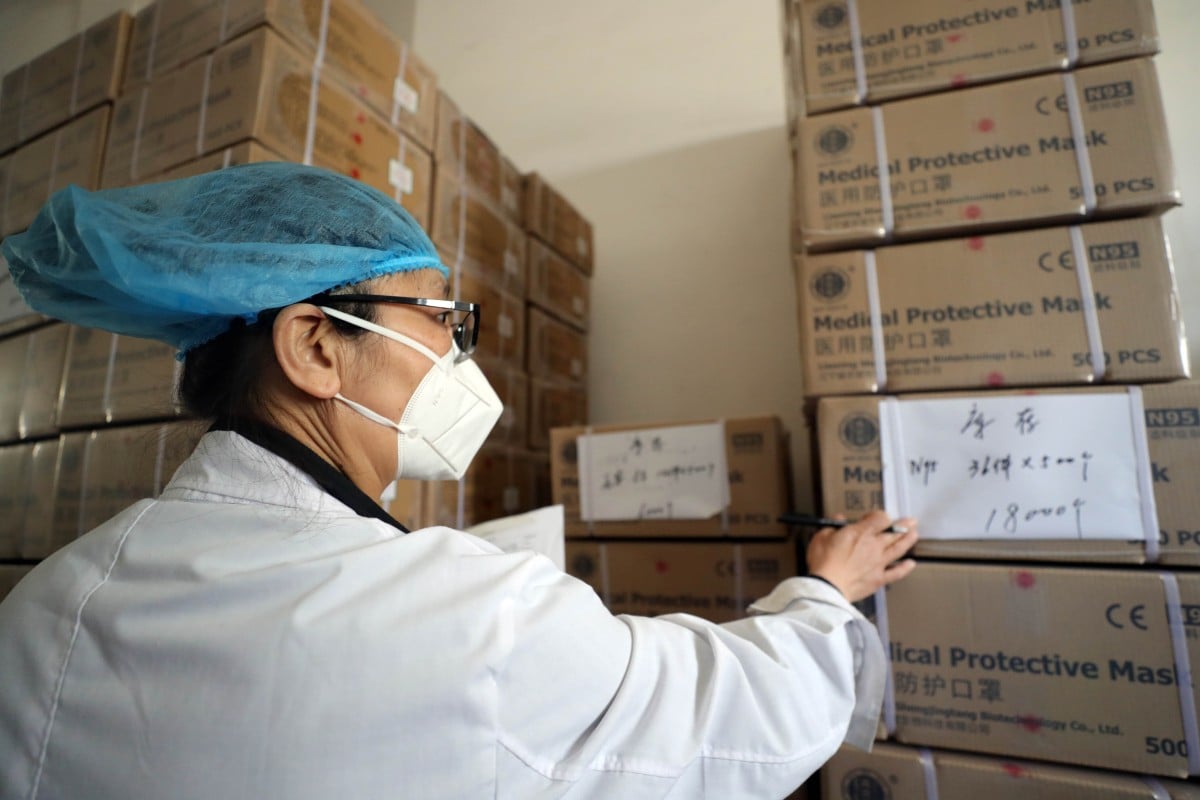
- Teams of experts and donations of medical supplies have been largely welcomed by China’s neighbours
Despite facing some criticism from the West, China’s Asian neighbours have welcomed its medical expertise and vital supplies. Photo: Xinhua
While China’s campaign to mend its international image in the wake of its handling of the
coronavirus health crisis has been met with scepticism and even a backlash from the US and its Western allies, Beijing has been quietly gaining ground in Asia.
Teams of experts have been sent to Cambodia, the Philippines, Myanmar, Pakistan and soon to Malaysia, to share their knowledge from the pandemic’s ground zero in central China.
Beijing has also donated or facilitated shipments of medical masks and ventilators to countries in need. And despite some of the equipment failing to meet Western quality standards, or being downright defective, the supplies have been largely welcomed in Asian countries.
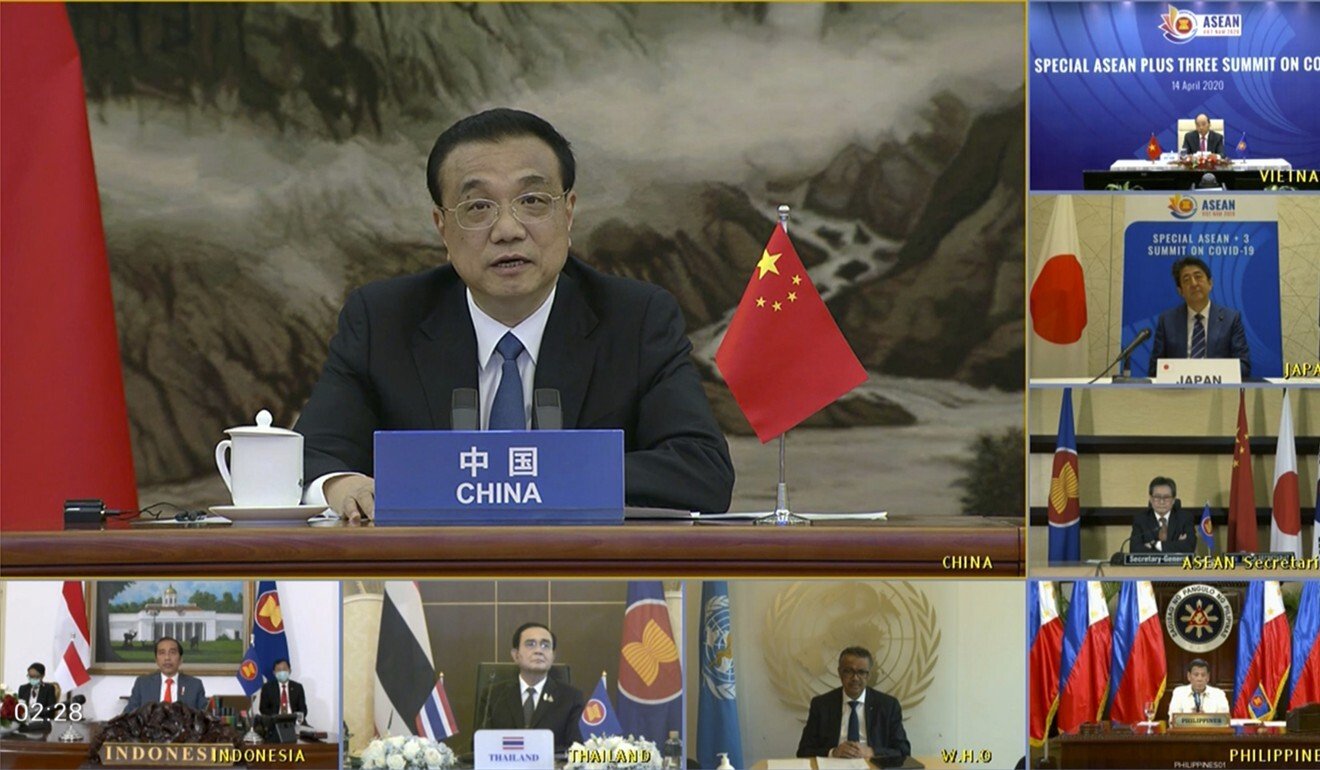
China has also held a series of online “special meetings” with its Asian neighbours, most recently on Tuesday when Premier Li Keqiang discussed his country’s experiences in combating the disease and rebooting a stalled economy with the leaders of the Association of Southeast Asian Nations (Asean), Japan and South Korea.
Chinese Prime Minister Li Keqiang speaks to Asean Plus Three leaders during a virtual summit on Tuesday. Photo: AP
Many Western politicians have publicly questioned Beijing’s role and its subsequent handling of the crisis but Asian leaders – including Philippine President Rodrigo Duterte and Japanese Prime Minister Shinzo Abe – have been reluctant to blame the Chinese government, while also facing criticism at home for not closing their borders with China soon enough to prevent the spread of the virus.
An official from one Asian country said attention had shifted from the early stages of the outbreak – when disgruntled voices among the public were at their loudest – as people watched the virus continue its deadly spread through their homes and across the world.
“Now everybody just wants to get past the quarantine,” he said. “China has been very helpful to us. It’s also closer to us so it’s easier to get shipments from them. The [medical] supplies keep coming, which is what we need right now.”
The official said also that while the teams of experts sent by Beijing were mainly there to observe and offer advice, the gesture was still appreciated.
Another Asian official said the tardy response by Western governments in handling the outbreak had given China an advantage, despite its initial lack of transparency over the outbreak.
“The West is not doing a better job on this,” he said, adding that his government had taken cues from Beijing on the use of propaganda in shaping public opinion and boosting patriotic sentiment in a time of crisis.
“Because it happened in China first, it has given us time to observe what works in China and adopt [these measures] for our country,” the official said.
Experts in the region said that Beijing’s intensifying campaign of “mask diplomacy” to reverse the damage to its reputation had met with less resistance in Asia.
Why China’s ‘mask diplomacy’ is raising concern in the West
“Over the past two months or so, China, after getting the Covid-19 outbreak under control, has been using a very concerted effort to reshape the narrative, to pre-empt the narrative that China is liable for this global pandemic, that China has to compensate other countries,” said Richard Heydarian, a Manila-based academic and former policy adviser to the Philippine government.
“It doesn’t help that the US is in lockdown with its domestic crisis and that we have someone like President Trump who is more interested in playing the blame game rather than acting like a global leader,” he said.
Shahriman Lockman, a senior analyst with the foreign policy and security studies programme at Malaysia’s Institute of Strategic and International Studies, said that as the US had withdrawn into its own affairs as it struggled to contain the pandemic, China had found Southeast Asia a fertile ground for cultivating an image of itself as a provider.
China’s first-quarter GDP shrinks for the first time since 1976 as coronavirus cripples economy
Beijing’s highly publicised delegations tasking medical equipment and supplies had burnished that reputation, he said, adding that the Chinese government had also “quite successfully shaped general Southeast Asian perceptions of its handling of the pandemic, despite growing evidence that it could have acted more swiftly at the early stages of the outbreak in Wuhan”.
“Its capacity and will to build hospitals from scratch and put hundreds of millions of people on lockdown are being compared to the more indecisive and chaotic responses seen in the West, especially in Britain and the United States,” he said.
Coronavirus droplets may travel further than personal distancing guidelines
Lockman said Southeast Asian countries had also been careful to avoid getting caught in the middle of the deteriorating relationship between Beijing and Washington as the two powers pointed fingers at each other over the origins of the new coronavirus.
“The squabble between China and the United States about the pandemic is precisely what Asean governments would go to great lengths to avoid because it is seen as an expression of Sino-US rivalry,” he said.
“Furthermore, the immense Chinese market is seen as providing an irreplaceable route towards Southeast Asia’s post-pandemic economic recovery.”
Aaron Connelly, a research fellow in Southeast Asian political change and foreign policy with the International Institute for Strategic Studies in Singapore, said Asian countries’ dependence on China had made them slow to blame China for the pandemic.
“Anecdotally, it seems to me that most Southeast Asian political and business elites have given Beijing a pass on the initial cover-up of Covid-19, and high marks for the domestic lockdown that followed,” he said.
“This may be motivated reasoning, because these elites are so dependent on Chinese trade and investment, and see little benefit in criticising China.”
China and Vietnam ‘likely to clash again’ as they build maritime militias
The cooperation with its neighbours as they grapple with the coronavirus had not slowed China’s military and research activities in the disputed areas of the
South China Sea – a point of contention that would continue to cloud relations in the region, experts said.
Earlier this month an encounter in the South China Sea with a Chinese coastguard vessel led to the sinking of a fishing boat from Vietnam, which this year assumed chairmanship of Asean.
And in a move that could spark fresh regional concerns, shipping data on Thursday showed a controversial Chinese government survey ship, the Haiyang Dizhi 8, had moved closer to Malaysia’s exclusive economic zone.
The survey ship was embroiled in a months-long stand-off last year with Vietnamese vessels within Hanoi’s exclusive economic zone and was spotted again on Tuesday 158km (98 miles) off the Vietnamese coast.
Source: SCMP
Posted in 10, 13, 15, 16, 17, 18, 1976, 27, 44, 50%, 54, according, across the world, again, against, April, areas, arriving, ASEAN, Asian, Association of Southeast Asian Nations (ASEAN), ASYMPTOMATIC CASES, at, authorities, avoid, ‘mask diplomacy’, battling, Beijing, Beijing’s, biggest, blame, blame game, borders, Britain, build, burnished, cabinet, cases, cautioning, central, central district, chairmanship, China, China's, China’s National Health Commission, Chinese capital, chinese government, Chinese market, City, clinical, closer, closing, coast, coastguard vesse, coastguard vessel, combating, compensate, confirmed, confirmed cases, considered, contain, contention, control, controversial, coronavirus, coronavirus cases, cough, countries, country’s, COVID-19, COVID-19 outbreak, cripples, crisis, criticism, cross infections, Data, day, deadly spread, death toll, deaths, declines, delegations, despite, destabilising, Disease, disputed areas, districts, domestic, down, earlier, eastern, economic recovery, economically, economy, elsewhere, embroiled, epicentre, epidemic, everybody, exclusive economic zones, experiences, eyes, facing, fall, family gatherings, fever, first time, fishing boat, flare-up, foreign policy and security studies programme, Friday, from, GDP, global leader, global pandemic, Government, Guangzhou, Haiyang Dizhi 8, handling, Hanoi’s, Harbin, health commission, Heilongjiang, high-risk, Home, hospitals, However, hubei province, hundreds, imported, imported infections, including, infected, Institute of Strategic and International Studies, interested, International Institute for Strategic Studies, investigations, irreplaceable, Japan, Japanese Prime Minister, Japanese Prime Minister Shinzo Abe, Jiaozhou, km, last, leaders, local, locally, lockdown, low-risk, lowest, mainland, Mainland China, Major, Malaysia’s, March, medical equipment and supplies, medium-risk, miles, military and research activities, millions, months-long, moved, narrative, new, nine, Northeastern, Notably, now, number, off, Official, officials, on guard, outbreak, patients, People, perceptions, Philippine, playing, political, politicians, Post, post-pandemic, pre-empt, Premier Li Keqiang, present, President Trump, prevent, previous, province, provincial capital, provincial government, publicly, published, punished, quarantine, questioned, quickly, quoted, reached, rebooting, rebound, recent, reluctant, remaining, reported, reporting, reputation, research fellow, reshape, resurgence, role, route, Russia, Saturday, saying, scratch, seen, senior analyst, shandong province, shipping data, showed, shrinks, since, Singapore, sinking, Sino-US rivalry, slow, social media, socially, soon enough, South China Sea, South Korea, Southeast Asia, Southeast Asian political change and foreign policy, southern city, spotted, spread, squabble, stalled, stand-off, State Council, statement, stood, stop, subsequent, Suifenhe, Sunday, surge, survey ship, symptoms, tally, task, test positive, Three, Thursday, Total, towards, transmitted, Transparency, travellers, Tuesday, two, Uncategorized, United States, vice governor, vice mayor, Vietnam, Vietnamese, Vietnamese vessels, virtual summit, Virus, Washington, website, weeks, were, Western, within, Wuhan, year |
Leave a Comment »
25/10/2019
- Haiyang Dizhi 8 in waters close to Macau as of 4pm Friday, MarineTraffic reports
- Vessel’s work in disputed waters ‘now complete’, foreign ministry says
The Haiyang Dizhi 8 was close to Macau as of Friday afternoon, according to the MarineTraffic maritime information service. Photo: Weibo
The Chinese survey ship that has been at the centre of a stand-off with Vietnam in the
was back in waters close to home on Friday afternoon, according to an online platform that provides information about maritime activity.
As of 4pm, the Haiyang Dizhi 8 (Marine Geology 8), which had been operating close to Vanguard Bank – a disputed reef in the Spratly Island chain claimed by both Beijing and Hanoi – was located just off Macau, the MarineTraffic service said.
China’s foreign ministry said on Thursday that the vessel had finished the work it had started “in Chinese-controlled waters in early July”.
“According to our understanding the work is now complete,” spokeswoman Hua Chunying told a regular press briefing, without elaborating.
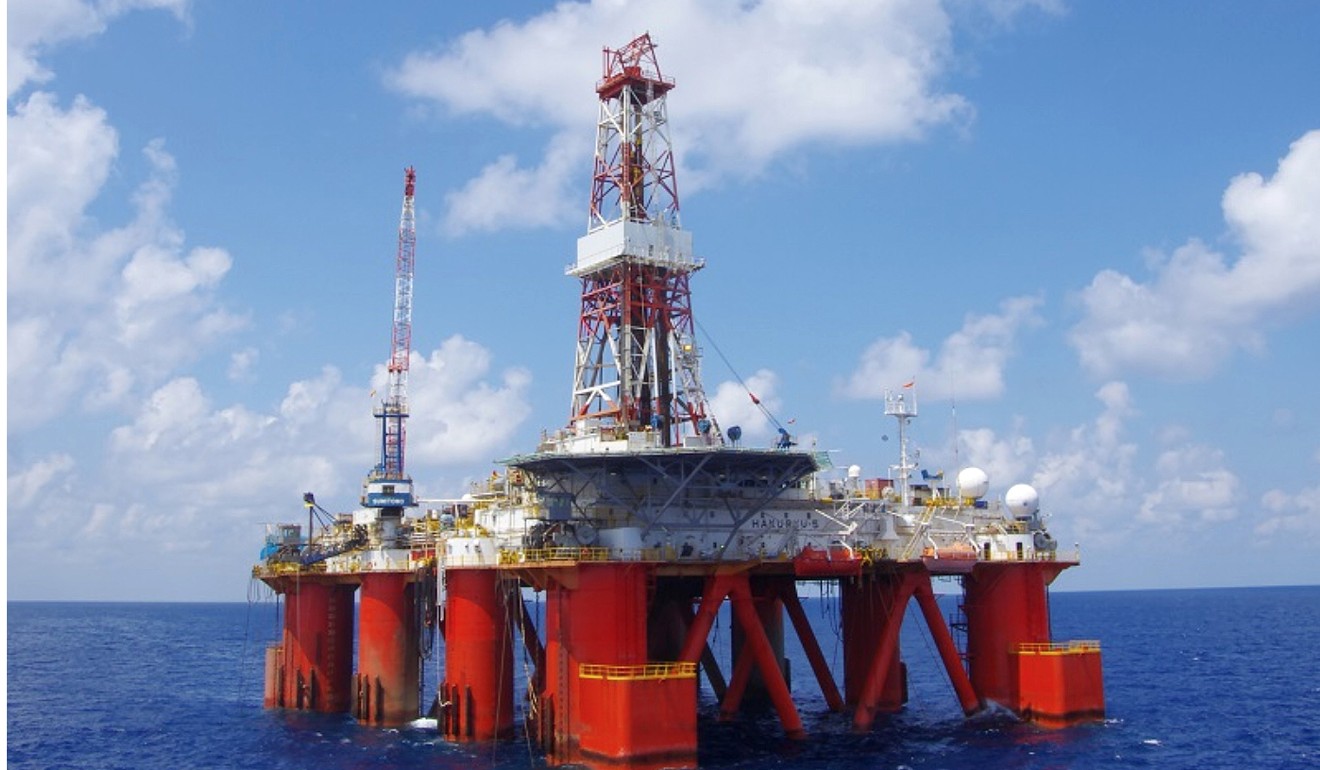
The Japanese oil rig, Hakuryu 5, is reported to have completed its drilling mission near Vanguard Bank earlier this week. Photo: Japan Drilling Co
While in the Vanguard Reef area, the
Haiyang Dizhi 8, escorted by heavily armed coastguard vessels, made multiple passes by an oil block operated by Russian energy company Rosneft.
Observers say the presence of the Chinese vessels in the region is part of Beijing’s efforts to prevent Hanoi from partnering with international energy firms to explore energy reserves in the disputed waterway. The latest activity triggered a months-long stand-off between the two countries.
The departure of the Haiyang Dizhi 8 came amid reports that the Japanese oil rig, Hakuryu 5, owned by Tokyo-based Japan Drilling Company and employed by Rosneft, had earlier this week completed a drilling mission it started in May near Vanguard Bank.
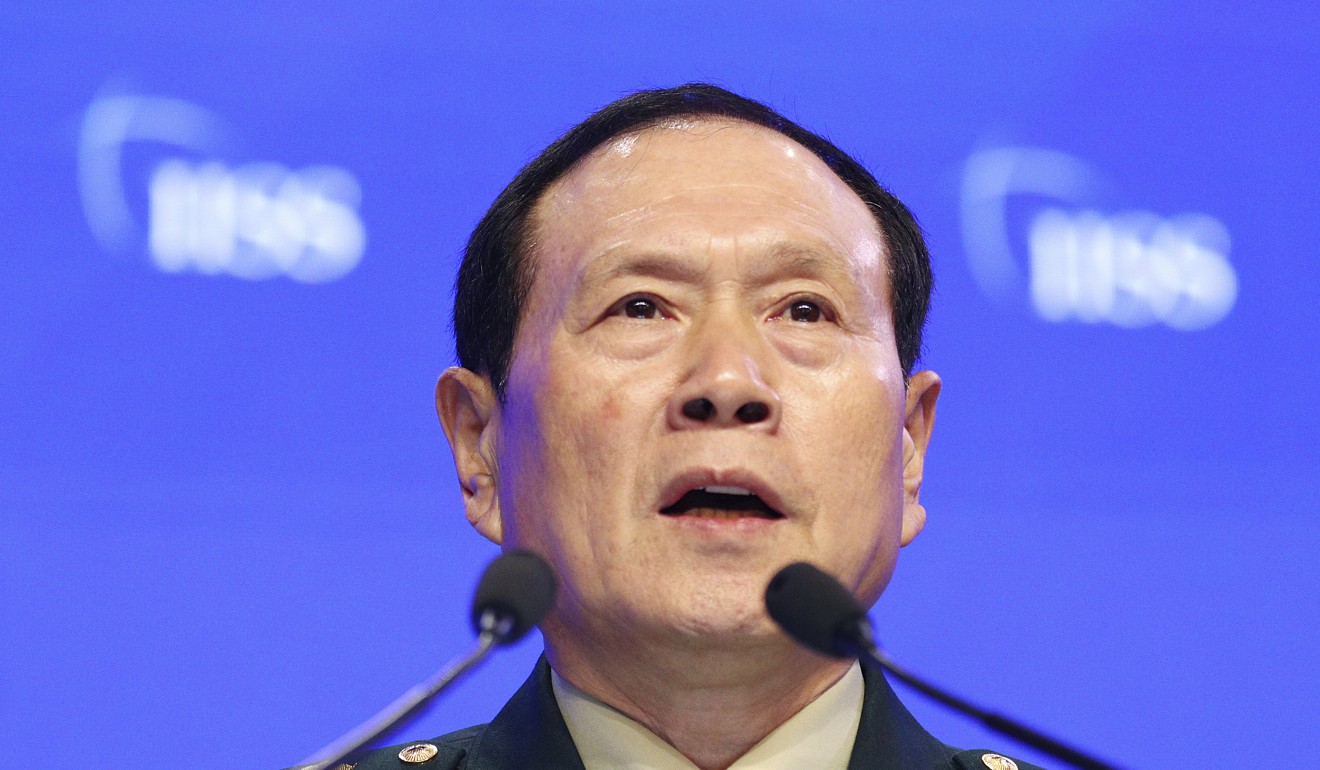
China’s Defence Minister Wei Fenghe told a regional security conference that the South China Sea was an inalienable part of China’s territory. Photo: AP
Although China and Vietnam have said they are looking for a diplomatic solution to prevent confrontations, neither has shown any signs of backing down and tensions have continued to rise.
On Monday, China’s Defence Minister Wei Fenghe told military and defence officials attending a regional security conference in Beijing that the South China Sea was an inalienable part of China’s territory.
“We will not allow even an inch of territory that our ancestors have left to us to be taken away,” he said in his opening speech at the Xiangshan Forum.
Also on Monday, Vietnamese Prime Minister Nguyen Xuan Phuc told lawmakers at the National Assembly that Hanoi would never give any territorial concessions.
“The situation in the South China Sea has become increasingly complicated,” he said. “Our party and state have consistently stated that what belongs to our independence, sovereignty and territorial integrity, we will never give up.”
Last week, Hanoi pulled DreamWorks’ animated film Abominable from theatres over a scene featuring a map that shows Beijing’s self-declared “nine-dash line” in the South China Sea. China uses the U-shaped line to claim sovereignty over more than 80 per cent of the resource-rich waterway, parts of which are also claimed by Vietnam, Malaysia, the Philippines and Brunei.
Ian Storey, a senior fellow at the ISEAS-Yusof Ishak Institute in Singapore, said that the withdrawal of the Haiyang Dizhi might only be “temporary”.
“China has made its point about drilling activities within the nine-dash line and expects Vietnam to suspend further exploration and production activities,” he said. “[But] of course Vietnam won’t.”
China, Malaysia seek to resolve South China Sea disputes with dialogue mechanism
Zhang Mingliang, a specialist in Southeast Asian affairs at Jinan University in the south China city of Guangzhou, said that the Chinese ship’s withdrawal was unlikely to have had anything to do with the comments made by Vietnam.
“I think the main reason is that it had finished its work,” he said. “But the withdrawal could also be seen as an attempt to ease the [China’s] tensions with the US.”
The significance for relations between Beijing and Hanoi was minimal, he said, as the two nations were engaged in one of the world’s most complicated territorial disputes.
“The impact on Sino-Vietnam relations will be limited because there have been too many disputes like this one,” he said.
Source: SCMP
Posted in animated film, “Abominable”, “nine-dash line”, back home, Beijing, Brunei, China's territory, Chinese, Chinese Defence Minister, confrontations, diplomatic solution, disputed waters, DreamWorks, drilling activities, drilling mission, energy company, Foreign Ministry, Guangzhou, Haiyang Dizhi 8, Hakuryu 5, Hanoi, heavily armed, inalienable part, involved, ISEAS-Yusof Ishak Institute, Japanese oil rig, Jinan University, lawmakers, Macau, Malaysia, map, Marine Geology 8, MarineTraffic, National Assembly of Vietnam, Nguyen Xuan Phuc, now complete, Philippines, regional security conference, Rosneft, Russian, Singapore, Sino-Vietnam relations, South China Sea, Southeast Asian affairs, sovereignty, Spratly Island, stand-off, survey ship, territorial concessions, theatres, U-shaped line, Uncategorized, Vanguard Bank, Vessel, Vietnam, Vietnamese Prime Minister, waters, Wei Fenghe, Xiangshan forum |
Leave a Comment »
15/10/2019
HANOI (Reuters) – Vietnamese President and Communist Party chief Nguyen Phu Trong has called for restraint in the disputed South China Sea amid a tense months-long standoff between Chinese and Vietnamese ships, state media reported on Tuesday.
China claims almost all the energy-rich waters but neighbours Brunei, Malaysia, the Philippines, Taiwan and Vietnam also have claims.
Tension escalated when Beijing dispatched a research ship to conduct an energy survey in waters controlled by Vietnam in July.
“On the subject of foreign policy, including the East Sea issue, the General Secretary stressed the importance of maintaining a peaceful and stable environment, and resolutely fighting to protect Vietnam’s independence, sovereignty and territorial integrity,” the state-run Voice of Vietnam (VOV) said on its website.
The South China Sea is known as the East Sea in Vietnam.
Vietnam has good relations with China but should “never compromise” on its sovereignty and territorial integrity, VOV quoted Trong as saying.
The Chinese vessel, the Haiyang Dizhi 8, was continuing its survey in Vietnam’s exclusive economic zone late on Tuesday, under escort from at least three Chinese ships, according to data from Marine Traffic, a website that tracks vessel movements.
Vietnam’s foreign ministry has repeatedly accused the vessel and its escorts of violating its sovereignty and has demanded that China remove its ships from the area.
On Sunday, Vietnam pulled DreamWorks’ animated film “Abominable” from cinemas over a scene featuring a map which shows China’s unilaterally declared “nine-dash line” in the South China Sea.
The U-shaped line is used on Chinese maps to illustrate its claims, including large swathes of Vietnam’s continental shelf, where it has awarded oil concessions.
In August, police broke up a brief protest outside the Chinese embassy in Hanoi over the survey vessel.
Trong has made more public appearances in recent weeks after suffering from an unspecified illness..
The 75-year-old has presided over a widespread crackdown on corruption in the Southeast Asian country that has seen several high-ranking ministers and politicians, including one Politburo member, sent to prison on charges ranging from embezzlement to economic mismanagement.
Source: Reuters
Posted in amid, “Abominable”, “nine-dash line”, Beijing, Brunei, China alert, Chinese embassy, Chinese ships, communist party chief, Continental Shelf, DreamWorks, East Sea, Exclusive economic zone, exclusive economic zone (EEZ), Foreign Ministry, Haiyang Dizhi 8, Hanoi, Malaysia, Marine Traffic, maritime tensions, Nguyen Phu Trong, oil concessions, Philippines, restraint, South China Sea, sovereignty, survey, Taiwan, Uncategorized, urges, Vietnam, Vietnamese President, Vietnamese ships, Voice of Vietnam (VOV) |
Leave a Comment »
24/08/2019
HANOI (Reuters) – A Chinese survey vessel on Saturday extended its activities to an area closer to Vietnam’s coastline, ship tracking data showed, after the United States and Australia expressed concern about China’s actions in the disputed waterways.
The Haiyang Dizhi 8 vessel first entered Vietnam’s exclusive economic zone (EEZ) early last month where it began a weeks-long seismic survey, triggering a tense standoff between military and coastguard vessels from Vietnam and China.
The Chinese vessel continued to survey Vietnam’s EEZ on Saturday under escort from at least four ships and was around 102 kilometres (63 miles) southeast of Vietnam’s Phu Quy island and 185 kilometres (115 miles) from the beaches of the southern city of Phan Thiet, according to data from Marine Traffic, a website that tracks vessel movements.
The Chinese vessel group was followed by at least two Vietnamese naval vessels, according to the data.
Vietnam’s foreign ministry did not immediately respond to a request from Reuters for comment.
A country’s EEZ typically extends up to 200 nautical miles (370 kilometres or 230 miles) from its coastline, according to an international UN treaty. That country has sovereign rights to exploit any natural resources within that area, according to the agreement.
Vietnam and China have for years been embroiled in a dispute over the potentially energy-rich stretch of waters and a busy shipping lane in the South China Sea.
China’s unilaterally declared “nine-dash line” marks a vast, U-shaped, expanse of the South China Sea that it claims, including large swathes of Vietnam’s continental shelf where it has awarded oil concessions.
On Friday, Vietnamese Prime Minister Nguyen Xuan Phuc and his Australian counterpart expressed their concern about China’s activities in the South China Sea, known in Vietnam as the East Sea.
Earlier in the week, the United States said it was deeply concerned about China’s interference in oil and gas activities in waters claimed by Vietnam, and that the deployment of the vessels was “an escalation by Beijing in its efforts to intimidate other claimants out of developing resources in the South China Sea”
Chinese Foreign Ministry spokesman Geng Shuang, in response to the U.S. statement, said Washington was “sowing division and had ulterior motives”.
“The aim is to bring chaos to the situation in the South China Sea and damage regional peace and stability. China is resolutely opposed to this,” Geng told a daily news briefing on Friday.
Source: Reuters
Posted in Australia, Beijing, China alert, Chinese ship, coastguard vessels, East Sea, exclusive economic zone (EEZ), Haiyang Dizhi 8, inches closer, international UN treaty, Marine Traffic, military vessels, Nguyen Xuan Phuc, Phan Thiet, Phu Quy island, seismic survey, South China Sea, standoff, survey vessel, tensions, triggering, Uncategorized, United States, Vietnam, Vietnam coastline, Vietnamese Prime Minister, Washington |
Leave a Comment »








 CHINDIA ALERT: You'll be living in their world, very soon