Archive for ‘heating’

12/12/2019

Father of China’s ‘Ice Boy’ responds to critics after family is knocked back for poverty assistance scheme

  • Wang Fuman became an internet sensation after he was pictured with his head encrusted in ice after freezing trek to school
  • Life has improved since then, but his dad says they are still struggling to make ends meet
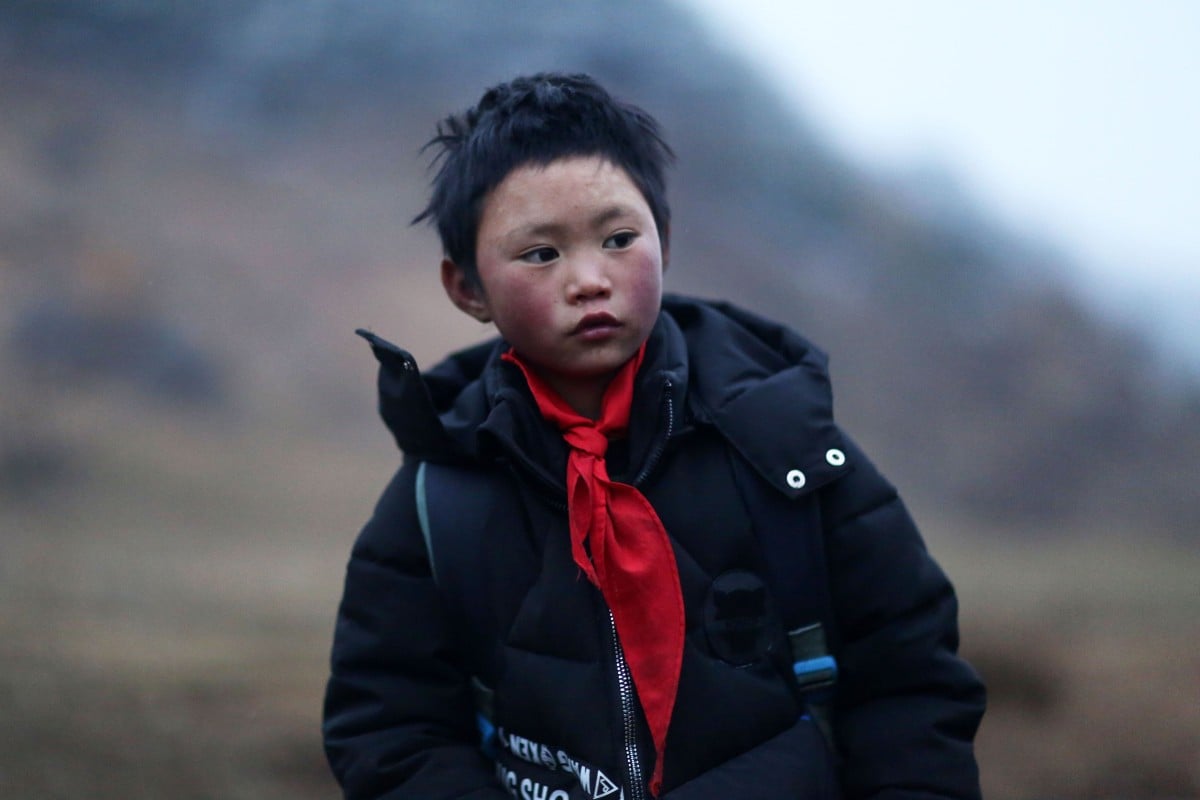
Nine-year-old Wang Fuman’s family has now moved from their mud hut to a two-storey home. Photo: AFP
The father of the “Ice Boy” – who became an internet sensation after he was pictured with his head covered in icicles following a freezing trek to school in southwest China – has spoken out about being rejected for a poverty alleviation scheme.
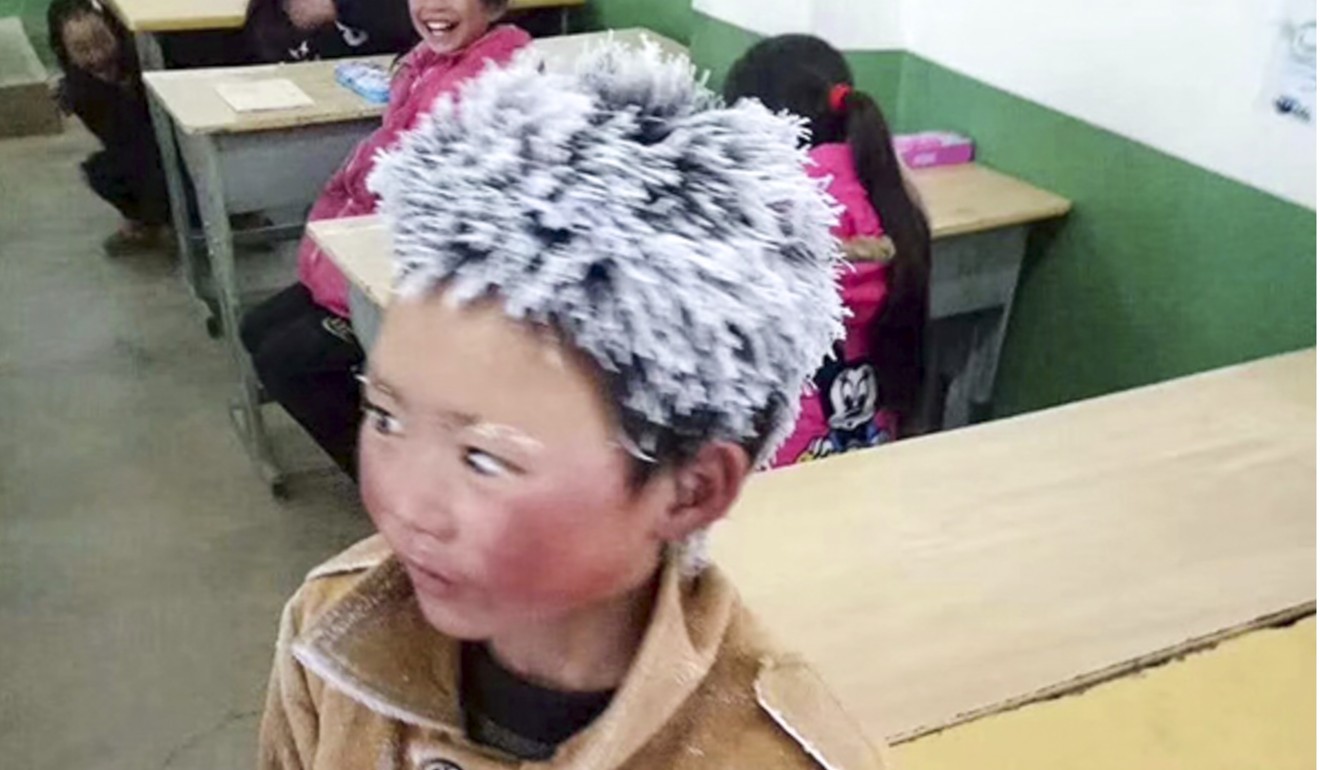
Wang Gangkui’s son, Wang Fuman, was eight when a photo of him taken by a teacher went viral on social media in January last year. It showed the little boy with his hair and eyebrows covered in ice and his cheeks ruddy from the cold after he had walked for over an hour from his home in thin clothing and no hat along treacherous mountain paths.
The plight of the impoverished primary school pupil from Ludian county, a poor area in Zhaotong, Yunnan province, touched hearts across China, with many people expressing sympathy online for the hardships the boy, and other children like him, endured to get to school. Donations of money, warm clothes and heating flooded in.
The photo of Wang Fuman arriving at school with his hair and eyebrows covered in ice went viral last year. Photo: news.163.com
But according to his 30-year-old father, the family is still struggling to make ends meet. He said his application for the assistance scheme had been turned down for the past five years without a satisfactory explanation.

“It’s unfair and unjust that my application wasn’t approved,” Wang Gangkui said on Thursday. “There are allegations in media reports that I have various assets, and they’re just not true. And neither am I trying to take advantage of my son’s fame,” he said.

Families approved for the means-tested scheme, a nationwide programme that is administered at the local level, are given benefits ranging from subsidies to vocational training and job opportunities.

Geng Tao, the party secretary of Zhuanshanbao village, told China News Service on Monday that the Wang family did not meet the eligibility criteria for the programme, citing their two-storey house with a total area of 160 sq metres.

Wang was responding to criticism from internet users after he posted his complaint on social media app Jinri Toutiao on Sunday, a post he later deleted. Some accused him of taking advantage of his son’s fame to get access to government aid, claiming the family was being “greedy” as they were already doing better than others in the region because of the donations they received last year.

State media also weighed in, with Beijing News saying in an editorial on Tuesday that “the authorities should not be influenced by public sentiment towards the Ice Boy and should look at the family’s real situation when assessing if they are in need or not”.

Wang acknowledged that the media attention and subsequent donations from the public had eased the family’s situation, but said they only received a small share.

“There were a lot of donations, but most of them went to the school and were shared among all the pupils and their families here,” he said. “Our family only received a small amount of money.”

After Fuman’s photo went viral, the Ludian county education authorities said there were many “Ice Boys” in the area, and all donations received had been distributed to local families in need, according to China News Service.

A local charity organisation received more than 300,000 yuan (US$42,500) in donations from the public, and said the money was shared among pupils at the Zhuanshanbao primary school, with Fuman receiving just 500 yuan.

Life has improved for Fuman and his family since the photo was taken. He was a 

“left-behind child”

– a term used to describe youngsters from poor families whose parents work in cities away from home, leaving them in the care of relatives. His parents have now returned to their hometown and his father works nearby at a construction site in Zhaotong, earning 3,000 yuan a month – a relatively high salary for the area. But he is the breadwinner for the family of five – his wife, Lu Dafeng, and their two children, Fuman and their 11-year-old daughter Wang Fumei, as well as his mother.

They moved out of their mud hut into the two-storey home, and with the donated funds, Fuman’s primary school was renovated and now has a dormitory equipped with heating. Fuman stays at the school during the week and returns to his home – a 20-minute walk away – on the weekend.

Wang Gangkui said his wife and mother could not apply for jobs designated as “public welfare” positions – such as a street cleaner post offering 500 yuan a month – because they were not recognised as a family in need under the scheme.

He also dismissed media reports that he had two cars, saying he had a second-hand van worth no more than 3,000 yuan. He said reports that his family also had cattle were not true.

Instead, he said he was paying off a loan of tens of thousands of yuan that he took out to build the family’s new house.

There were an estimated 16.6 million people living in poverty in rural China at the end of 2018, about 14 million fewer than a year earlier, according to official data. The ruling Communist Party set the ambitious target of eliminating extreme poverty in China by the end of 2020, and claims that more than 700 million people have already been lifted out of poverty over the past four decades.

Source: SCMP
08/03/2019

China Focus: China to ramp up efforts to provide better elderly care

BEIJING, March 7 (Xinhua) — As China is faced with a growing aging population, the government has pledged to provide better elderly care services and facilities for the silver-haired, and give a strong boost to domestic demand.

Elderly care remains high on the agenda in this year’s government work report, which said that significant steps would be taken to develop elderly care, especially community elderly care services.

The number of people in China aged 60 and above reached 250 million by the end of 2018, accounting for 17.9 percent of the country’s population.

“Growing demand will trigger greater market potential in China’s senior care industry,” said Tang Wenxiang, founder of Fullcheer Group, a major elderly care services provider based in Changsha, capital of central China’s Hunan Province.

Fullcheer Group has 50 branches in more than 10 provinces and cities with a total of 5,000 beds. Tang expects the number of his company’s beds to increase to 50,000 in five years.

“There is still a huge gap between the demand of China’s aging population and the number of elder care facilities,” Tang said.

The country will provide support to institutions offering services in the community like day care, rehabilitation care, and assisted meal services and outdoor fitness services using measures such as tax and fee cuts and exemptions, funding support, and lower charges for water, electricity, gas and heating, according to the government work report.

Tang said government’s measures to develop elderly care services greatly boosted the confidence of entrepreneurs who run businesses in the sector.

Developing the elderly care industry is good for improving people’s well-being and stimulating consumption, said Xu Hongcai, an economist with the China Center for International Economic Exchanges.

“Consumption on elderly care requires the supply of the elder care market, offered by both the government and the market,” he said.

A research report issued by Guolian Securities suggests that a string of policies have been carried out in China to encourage the participation of the social sector in the senior care industry, which will boost the country’s consumption in the health and medical sectors.

As China opens this sector, foreign firms such as France’s Orpea and Japan’s Nichii have tapped the elderly service market in China.

China still lacks leading players in the senior care market which includes nursing care, rehabilitation assistive devices and daily necessities for seniors, Tang said.

The long-term care insurance system will help increase the occupancy rate of some elderly services facilities given a number of elderly people can hardly afford the expenses, according to Tang.

Source: Xinhua

12/12/2018

China Focus: Geothermal heating helps build “smokeless cities” in China

SHIJIAZHUANG, Dec. 11 (Xinhua) — As China seeks to curb air pollution and win the battle for blue skies, more Chinese cities have switched from coal to geothermal heating during this year’s winter heating season, as part of their efforts to become “smokeless cities.”

“My family has replaced coal-fired boiler with geothermal heating this year,” said Sun Shujuan, a villager in Xiongxian County, northern China’s Hebei Province. “Burning coal was dirty and tiring.”

Xiongxian, about 130 kilometers away from Beijing, is part of the Xiongan New Area, another new area of “national significance” established in April 2017 to facilitate the coordinated development of Beijing and the surrounding region.

The county began exploiting its rich geothermal resources, a clean and sustainable energy, in 2009. Now it provides geothermal heating to all its urban areas and is looking to expand in rural households.

“We have provided geothermal heating for about 6,000 households in Xiongxian’s 12 villages this year,” said Chen Menghui, deputy general manager of Sinopec Green Energy Geothermal Development Co., Ltd.

The company, established in 2006, is a joint venture between Arctic Green Energy Corporation of Iceland and Sinopec Star Co., Ltd., a subsidiary of China Petrochemical Corporation (Sinopec), China’s largest geothermal developer.

“Compared with coal-fired boilers, geothermal heating can reduce carbon dioxide emissions by at least half,” Chen said. “It is estimated that we can replace over 10,000 tonnes of coal and cut emissions of more than 40,000 tonnes of carbon dioxide this year in Xiongxian.”

He added that the cost of geothermal heating is about half that of natural gas heating.

Xiongxian is one of the 10 Chinese cities where Sinopec has helped replace coal with geothermal energy, including cities in Shanxi, Shaanxi and Henan provinces.

The company now provides geothermal heating to an area of around 50 square km, and it aims to increase the area by 100 square km by 2023 and help build a total of 20 “smokeless cities” nationwide.

“Local governments are very willing to cooperate with us given the mounting pressure of environmental protection,” Chen said.

China aims to have clean energy replace 74 million tonnes of coal and generate 50 percent of winter heating in northern China by 2019, according to a plan released by Chinese government in 2017.

Rich in resources of geothermal energy, the country now has about 150 square km of geothermal energy heated areas, according to an international forum on geothermal energy held in Shanghai in November.

The areas that have access to geothermal heating or cooling are expected to reach 1,600 square km by 2020, according to a five-year plan for developing geothermal energy released by Chinese government in 2017.

Law of Unintended Consequences

continuously updated blog about China & India

ChiaHou's Book Reviews

continuously updated blog about China & India

What's wrong with the world; and its economy

continuously updated blog about China & India