Archive for ‘Heilongjiang province’

03/12/2019

China-Russia east-route natural gas pipeline in operation

CHINA-HEI LONGJIANG-RUSSIA-EAST-ROUTE NATURAL GAS PIPELINE-OPERATION (CN)

A staff member walks past pipelines in the gas-distributing and compressing station of the China-Russia east-route natural gas pipeline in the city of Heihe, the first stop after the Russia-supplied natural gas enters China, northeast China’s Heilongjiang Province, Nov. 19, 2019. The China-Russia east-route natural gas pipeline was put into operation on Monday. The pipeline is scheduled to provide China with 5 billion cubic meters of Russian gas in 2020 and the amount is expected to increase to 38 billion cubic meters annually from 2024, under a 30-year contract worth 400 billion U.S. dollars signed between the China National Petroleum Corp (CNPC) and Russian gas giant Gazprom in May 2014. The cross-border gas pipeline has a 3,000-km section in Russia and a 5,111-km stretch in China. (Xinhua/Wang Jianwei)

HARBIN, Dec. 2 (Xinhua) — The China-Russia east-route natural gas pipeline was put into operation on Monday.

At the gas-distributing and compressing station in the city of Heihe, northeast China’s Heilongjiang Province, the data screen was switched on, indicating parameter variations of the gas passage. The station is the first stop after the Russia-supplied natural gas enters China.

The pipeline is scheduled to provide China with 5 billion cubic meters of Russian gas in 2020 and the amount is expected to increase to 38 billion cubic meters annually from 2024, under a 30-year contract worth 400 billion U.S. dollars signed between the China National Petroleum Corp (CNPC) and Russian gas giant Gazprom in May 2014.

The cross-border gas pipeline has a 3,000-km section in Russia and a 5,111-km stretch in China.

Shao Hua, general manager of Heihe City Natural Gas Development Co., Ltd. of China Gas, said that the border city of Heihe still largely relies on coal for heat. With the Sino-Russian natural gas pipeline’s operation, the city now has access to a stable supply of clean energy.

Heihe has registered 30,000 households for switching to natural gas for heating. It will take one year to complete full coverage of the gas network in the city, according to the company.

China’s natural gas consumption reached 280.3 billion cubic meters in 2018. The country’s demand for natural gas will continue to soar toward 2040, outstripping domestic output by around 43 percent, according to an International Energy Agency report.

China aims to raise the use of natural gas to 10 percent of the country’s energy mix by 2020 and 15 percent by 2030, said the National Development and Reform Commission.

Source: Xinhua

26/09/2019

300-pound wild boar goes on rampage in Chinese karaoke bar

  • Animal bursts into private room, causing customers to flee
  • Police shoot it dead to bring end to the panic
The boar was filmed by surveillance cameras wandering around the karaoke parlour. Photo: Weibo

A 315-pound (143kg) wild boar went on the rampage at a karaoke parlour in northeast China, scaring customers before staff managed to trap the animal in a room for local police to handle.

The incident happened at an unnamed karaoke establishment in Jixian county, Heilongjiang province on Monday evening, video news site Pear Video reported on Thursday.

Surveillance camera footage shows that the creature charged into the parlour before running into a private room, scaring two customers who ran out of the room. Several more frightened customers were seen running out of other rooms on the same corridor.

“The wild boar managed to enter the establishment because the door wasn’t closed, and it damaged the main bar counter by charging into it,” an unnamed KTV parlour staff member was quoted as saying by Pear Video. “Then it ran into a customer’s private karaoke room and scared them out.”

Frightened customers reported the incident to staff, who trapped the animal in a room.

“Wild boars definitely have an aggressive nature and they can seriously harm people,” a local police officer was quoted as saying. “After receiving instructions from our boss, we used a sniper gun to kill the boar. We had to shoot it three times before it finally died.”

Surveillance camera footage also showed several police officers dragging the dead animal down the karaoke parlour’s corridor.

China has a large population of wild boar, estimated to be about 33.5 million, Reuters has reported.

In 2014, a villager in Heilongjiang died after being attacked by a 100kg wild boar as he was herding cattle on a mountain.

24/09/2019

Russia acts to protect Lake Baikal amid anger at Moscow, concerns over Chinese development

  • Observers say domestic issues prompted Kremlin to tighten environmental protection around the lake in Siberia, but Chinese activities also played a part
  • Businesses catering to growing number of visitors from China may be easy scapegoats as they are ‘among the most visible because they are foreign’
A growing number of Chinese tourists are visiting Lake Baikal in Siberia. Photo: Shutterstock

Russia has tightened environmental protection around Lake Baikal amid growing concerns over degradation, with Chinese development and tourism at the heart of recent debates on the nationally treasured Siberian lake.

New protocols signed by President Vladimir Putin on September 12 clarify how authorities will monitor “compliance with the law on Lake Baikal’s conservation and environmental rehabilitation”.

They also call for improved state environmental monitoring of the lake’s unique ecosystem, aquatic animal and plant life; prevention of and response to risks; analysis of the pressure from fishing on its biological resources; as well as measures to conserve those unique aquatic resources.

Observers say domestic issues – including a backlash over the government’s hand in accelerating environmental damage – prompted the Kremlin to act, but concerns over Chinese activities in the area also played a part.

Eugene Simonov, coordinator of the Rivers Without Boundaries International Coalition, said the protocols were a bid by Moscow to show it was concerned about the lake, where mismanagement and relaxed standards had damaged water quality and the ecosystem – drawing concern from Unesco, which has designated it a World Heritage Site.

But it was also related to local concerns that an influx of Chinese money and tourists in the region was making matters worse.

“One of the leading causes of problems on Lake Baikal is the development of the lake shore for tourism these days, which, at least in the Irkutsk region, is greatly driven by Chinese business,” said Simonov, who has worked extensively on the area’s environmental issues.

He pointed to the “not legal” hotels opened by local and Chinese businesses that cater to the increasing number of tourists from China, saying they stood out as easy scapegoats.

“The real driving force is the desire of locals to privatise the lake shore, illegally, but the Chinese demand is one of the reasons they want to privatise it, while Chinese businesses are among the most visible because they are foreign,” he said.

Public opposition to a water bottling plant being built by a Chinese-owned company pushed local authorities to halt the project in March. Photo: Weibo

Some 186,000 Chinese tourists visited the region last year, up 37 per cent from 2017, according to official Irkutsk figures. But while they accounted for about two-thirds of foreign visitors to the Irkutsk region, they made up only about 10 per cent of the 1.7 million tourists who visited last year.

Concern about Chinese investment and development in the region reached a crescendo in March, when public opposition pushed local authorities to halt the construction of a water bottling plant operated by AquaSib, a Russian firm owned by a Chinese company called Lake Baikal Water Industry, based in China’s Heilongjiang province.

The Irkutsk government acted after more than a million people – more than the city’s population – signed a petition calling for the “Chinese plant” to be halted.

Adventures in the frozen wilderness: a Hong Kong man’s trek across icy Lake Baikal

“There were at least 10 problems [around Lake Baikal] that were much more important at that moment, but it was the Chinese plan that was the focus,” Simonov said, noting the nationalism surrounding the lake as a Russian point of pride.

Paul Goble, a Eurasia specialist who has been tracking the issues at Lake Baikal, said stirring up resentment over Chinese encroachment in Siberia and the country’s Far East had long been a government tactic to quell dissent and unite popular opinion.

But he said the new protocols showed Moscow realised that locals – facing the effects of a deteriorating environment including deforestation driven by China’s domestic market demand – may not be satisfied with that explanation.

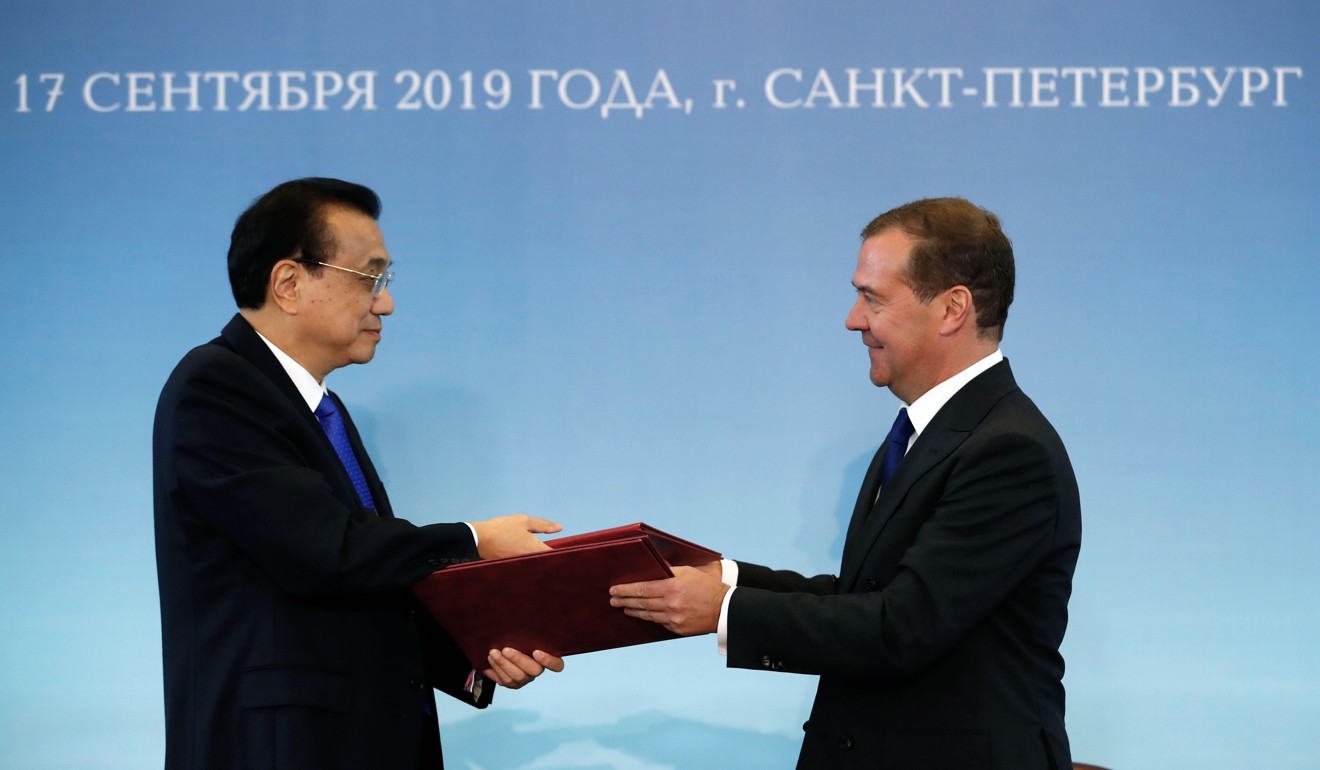
Chinese Premier Li Keqiang and Russian Prime Minister Dmitry Medvedev exchange documents after talks in St Petersburg on Tuesday. Photo: AFP

“People are angry not at China, as might have been the case a year ago or more, but they are angry at Moscow for not standing up to China and what it’s doing,” he said, pointing to this as the reason the Kremlin tightened environmental controls on the lake.

Concerns about the impact of Chinese activities on Russia’s environment come as the two neighbours are playing up closer diplomatic and economic ties. One of the outcomes of a 

three-day meetin

between Chinese Premier Li Keqiang and Russian heads of state last week was an agreement to increase bilateral trade to more than US$200 billion over the next five years.

But how that investment could be sustainable for Russia – a key supplier of raw materials needed by China such as oil, gas and timber – remained to be seen, observers said.
Are Chinese tourists the greatest threat to Lake Baikal?
“Our great relationship is going well, but we have not seen the accompanying rise in Chinese foreign direct investment into Russia – that remains very small, despite all the talk,” said Artyom Lukin, an associate professor with the School of Regional and International Studies at Far Eastern Federal University in Vladivostok.
“Russia is not satisfied with that, they would like to see more Chinese money, more Chinese greenfield investment coming into Russia, into more productive areas of the Russian economy, not just into the extraction sector like oil, timber or coal,” he said.

Lake Baikal has been seen as an area that could draw a lot of Chinese investment. Back in 2016 there were reports of a tourism development deal, worth up to US$11 billion, between Russian operator Grand Baikal and a consortium of Chinese firms, according to Russian state media reports.

But so far most development from Chinese businesses has remained at the small and medium scale.

The reasons for that, according to experts, range from the difficulty of competing with powerful local rivals and the need to tread carefully around anti-China sentiment.

However, the burden and liability of complying with environmental standards also kept operations at a smaller scale.

China and Russia: a fool’s errand for Trump to try to come between them

“It’s simpler and easier to operate smaller businesses and facilities, and it’s easier to monitor and manage them,” said Vitaly Mozharowski, a partner at Bryan Cave Leighton Paisner in Moscow, who specialises in environmental law, noting that concerns included management of waste water and garbage.

Meanwhile, big complexes were obvious targets for scrutiny, and that would only increase with the new protocols in place, Mozharowski said. “Any large-scale initiatives would be considered from the very top of the Russian establishment,” he said.

Source: SCMP

18/08/2019

China offers financial support to deal with typhoon, flood, drought

BEIJING, Aug. 17 (Xinhua) — The central government has offered financial support of 920 million yuan (about 131 million U.S. dollars) to local governments to help counter typhoon, flood control and drought relief.

An emergency relief fund of 600 million yuan has been offered to 11 provincial regions including Henan, Sichuan and Gansu to help them control flood and deal with drought, according to the Ministry of Finance and the Ministry of Emergency Management.

Another fund worth 320 million yuan was used to support Hebei, Liaoning, Jilin and Heilongjiang provinces in flood control and typhoon relief.

Typhoon Lekima landed in east China’s Zhejiang on Aug. 10, wreaking havoc as a super typhoon. About 13 provincial regions have been affected by the typhoon.

China announced the second-highest level in China’s four-level typhoon emergency response system to deal with Typhoon Lekima and minimize casualties and losses.

Source: Xinhua

08/07/2019

China to fire up small test nuclear reactor to heat smog-prone north

  • Compact plants proposed to ease pollution but backers must win over wary public
China is exploring the idea of using small nuclear power plants to phase out coal- and gas-fired heating generators in smog-afflicted northern China. Photo: Reuters
China plans to build a pilot small-scale nuclear reactor that could replace coal or gas to heat towns and cities in its colder northern regions, an official with the state-owned developer in charge of the project said on Monday.
The small heating reactor was planned for the city of Jiamusi in northeastern Heilongjiang province, one of two proposed units with a combined capacity of 400 megawatts, Wang Xujia, a senior engineer with the State Power Investment Corp, said on the sidelines of an industry conference.
“The project is still under central government review for approval,” Wang said, adding that the developer aimed to put the project into operation by 2024.
China has been exploring the use of small nuclear reactors – less than a fifth of the size of a standard reactor – as alternative heating systems in smog-prone northern regions.
The state provides heating throughout northern China from November to March, using predominantly coal- or gas-fired boilers.
State-owned China National Nuclear Corp (CNNC) has already conducted trial runs for a “district heating reactor” (DHR) design, which it says can supply heat to 200,000 urban households.
China-built nuclear reactors may enjoy home advantage as delays and costs stymie foreign competitors
The DHR model consists of a reactor core immersed in a water-filled tank. It is estimated to require investment of 1.5 billion yuan (US$217 million) and take three years to build, making it cheaper and quicker to construct than conventional reactors.

However, while the various designs will use only a fraction of the radioactive material of a conventional nuclear plant, officials acknowledge the biggest challenge is convincing the public the reactors are safe and reliable.

“The planned project in Jiamusi will be located in a remote area of the city which undermines its economic efficiency, but since it is just a demonstration project we just want to complete one first and show it to the public,” Wang said.

China aims to raise total nuclear capacity to 58 gigawatts by the end of next year, but it has not launched any new conventional reactors in more than three years.

China expected to miss target for 2020 nuclear capacity
After Japan’s Fukushima accident in 2011, China conducted a root-and-branch safety review and decided it would only use the most advanced “third generation” technology for any new projects.
However, those technologies – including Westinghouse’s AP1000 and the Areva-developed EPR – have proved to be expensive, complex and prone to long construction delays.
In a bid to broaden its options, the country is developing smaller units and plans to launch its first “small modular reactor” on the island province of Hainan at the end of this year.
China also planned to launch floating nuclear reactors with the aim of developing a fleet of ship-mounted nuclear generators that could be deployed on islands in Southeast Asia, Song Danrong, a reactor designer at CNNC, told Monday’s conference.
This article appeared in the South China Morning Post print edition as: Pilot nuclear reactor may replace coal in north
After brief pause, China rushes to build more nuclear power plants

After brief pause, China rushes to build more nuclear power plants

China General Nuclear Power and rival China National Nuclear plan to build four more reactors on mainland

China General Nuclear Power and rival China National Nuclear plan to build four more reactors on mainland

Under draft rules, nuclear power projects in China will need local support

Under draft rules, nuclear power projects in China will need local support

28/06/2019

Xinhua Headlines: China-Africa trade expo to forge closer economic partnership

Xinhua Headlines: China-Africa trade expo to forge closer economic partnership

Justin Yifu Lin, former senior vice president and chief economist at the World Bank, delivers a speech at the China-Africa Economic and Trade Expo in Changsha, central China’s Hunan Province, June 27, 2019. (Xinhua/Xue Yuge)

by Xinhua writers Cao Kai, Chu Yi, Yang Jian and Zhang Yujie

CHANGSHA, June 27 (Xinhua) — The first China-Africa Economic and Trade Expo opened Thursday in Changsha, capital of central China’s Hunan Province, in a move to forge closer economic ties between the largest developing country and the largest developing continent.

The three-day event has attracted more than 10,000 guests and traders, including those from 53 African countries, according to the organizing committee.

Chinese President Xi Jinping has sent a congratulatory letter.

The expo, announced at the Beijing Summit of the Forum on China-Africa Cooperation (FOCAC) last September, was established to provide a platform for deepening economic and trade cooperation between the two sides, he stressed.

It is hoped that the two sides will strengthen coordination to better implement the eight major initiatives put forward at the Beijing summit of the FOCAC, actively explore new paths for cooperation, open up new points of growth for collaboration, and promote China-Africa economic and trade cooperation to a new level, Xi said.

“Industrial development and free trade amongst ourselves will foster faster growth for our mutual benefit,” said Ugandan President Yoweri Museveni at the opening ceremony. “This Forum should, among others, enable us to devise ways of turning these rays of hope into a reality.”

Hailing the long-term friendship with Africa, Chinese Vice Commerce Minister Qian Keming said at the expo that bilateral trade and economic cooperation should be practical and concrete to meet the development needs of African countries in areas such as infrastructure and talent cultivation.

China saw 3 percent year-on-year growth of foreign trade with African countries in the first five months this year, hitting 84.8 billion U.S. dollars. China’s direct investment to the continent has increased by 1.5 billion U.S. dollars in the past five months, up 20 percent year on year, according to Qian.

According to Assome Aminata Diatta, Senegal’s Minister of Trade and SMEs, China is an ideal partner for Africa to improve its capacity building when China is seeking higher-quality growth driven by innovation.

Bringing modern production lines to Africa, especially in the special economic zones, will likely provide tens of millions of jobs for Africa, accelerate its industrialization and improve the trade structure between China and Africa, Diatta said.

China has set a good example for other developing countries, especially those in Africa which, having a lot in common with China, may benefit from mutual complementarity in the area of development, said Justin Yifu Lin, former senior vice president and chief economist at the World Bank.

The experience, wisdom and programs that China will offer are very good reference for African countries that are now eager to work themselves out of poverty and pursue development, Lin said.

After the opening ceremony, 13 cooperation projects involving eight African countries were signed, worth a total of more than 2.5 billion U.S. dollars.

Conferences, seminars, forums and exhibitions focusing on agriculture, trade, investment and infrastructure construction will be held during the expo, with experts sharing views on closer bilateral exchanges.

The expo will feature exhibition areas covering more than 40,000 square meters, including national pavilions and display areas for enterprises that showcase the achievements and opportunities of China-Africa economic and trade cooperation.

TRADE AND INVESTMENT

With the theme “Win-Win Cooperation for Closer China-Africa Economic Partnership,” the expo, which will become a biennial event, will open a new chapter in the history of bilateral trade.

“Nigeria has a lot of non-oil products of high quality and we want China to buy more,” Uduak M. Etokowoh, an official with the Nigerian Export Promotion Council, told Xinhua.

Nigerian gemstones, Namibian oysters, Kenyan coffee and tea as well as South African wine are attracting many Chinese visitors at the expo.

“We used to export leather materials to Italy and Spain, who now have a wobbling economy,” said Nigerian businessman Mustapha Tijjani Garo. “We are now looking east for the market.”

China has been the largest trading partner of Africa for ten consecutive years. In 2018, trade volume between China and Africa amounted to 204.2 billion U.S. dollars, up 20 percent year on year.

China’s imports of non-resource products from Africa have increased significantly. In 2018, China’s imports from Africa went up 32 percent year on year, with the imports of agricultural products up 22 percent.

“Namibian oysters are selling well in Beijing, Shanghai and Guangzhou,” said Rinouzeu Katjingisiua. “We are hoping to find more partners here.”

For Chinese businessmen, with mounting pressure on labor-intensive industries as cost is surging and industrial upgrading is urgently needed, Africa is a great destination.

Wang Lianfang, owner of Qiqihar Quanlian Heavy Forging Company Ltd. based in northeast China’s Heilongjiang Province, set up an assembling plant in Senegal two years ago to find new markets amid slump domestic demand on agriculture machinery.

“Africa has strong demand,” said Wang, who is selling seeders, tractors and harvesters in the west African country.

“The output is expected to reach 2 billion yuan (291 million U.S. dollars) within 5 years,” said Wang, adding that the company has been working hard for survival in the past three years.

The transfer of labor-intensive industries from China can also give a strong push to Africa’s industrialization and modernization. It will expedite the economic take-off of Africa in the same way as how the industrial transfer had benefited China, Justin Yifu Lin said.

AGRICULTURE AND POVERTY REDUCTION

With abundant resources, a large population and a vast market, Africa is still the poorest continent and falls behind in the overall context of development and is battling poverty and hunger.

For 11 years, paddy land has been Hu Yuefang’s battlefield in Madagascar to fight against poverty.

“Madagascar can reach the self-sufficiency in rice as long as 15 percent of its rice planting area belongs to hybrid varieties,” Hu Yuefang said, adding that the average yield of hybrid rice produced by Chinese technologies in Africa is two to three times more than that of local ones.

Buried in the field all day, the 61-year-old agriculture expert from Yuan Longping High-tech Agriculture Co. Ltd. (LPHT) has been on the frontier of closer agriculture cooperation between the two sides.

He said though he could not come to the scene, he expected fruitful results from the inaugural expo to help tackle challenges and bring shared benefits to China and Africa.

China took deliberate steps using the agriculture sector to transform its economy by setting up favorable agricultural policies, the experience of which can be learned by us to accelerate our development, according to Ugandan Minister of Agriculture Vincent Bamulangaki Ssempijja at the expo.

“We strongly believe that by working together with our Chinese friends through joint venture businesses, investment arrangements and win-win cooperation, the majority of African countries can quickly eradicate poverty,” he said.

Hunger has long been bothering African countries. To help relieve the grain shortage, Chinese agricultural enterprises and experts, like Yuan, have been devoted to the continent for years, sharing China’s wisdom and experience.

“We put red flags on the map to show our steps in promoting hybrid rice in Africa in recent years, which have covered nearly 20 countries in southeastern, western and northern parts of the continent,” said Yao Zhenqiu, LPHT’s deputy general manager.

Guided by Yuan Longping, China’s “Father of Hybrid Rice,” the LPHT expert team has successfully cultivated five kinds of high-yielding hybrid rice seeds suitable for the local soil and climate.

So far, Chinese experts and technicians have carried out more than 300 small-scale projects in nine African countries, promoted 450 agricultural technologies, and trained nearly 30,000 local farmers and technicians, according to Ma Youxiang, an official with China’s Ministry of Agriculture and Rural Affairs, at the expo.

“We will continue to send high-level agricultural experts and vocational education teachers to African countries, to further expand training in Africa and help cultivate more talent in agriculture,” he said.

The World Food Programme (WFP), the food assistance branch of the United Nations, is also taking the expo as an opportunity to meet Chinese business society to tackle food problems in Africa.

WFP will work with China to help Africa achieve the goal of ‘Zero Hunger’, said Qu Sixi, WFP China Representative.

Source: Xinhua

20/02/2019

China to deepen reforms of agriculture sector to boost rural areas

  • Policy statement outlines broad goals including plan to revive domestic soybean production
A farmer picks tea leaves in Mianxian county, Shaanxi province. Beijing’s policy document reiterated a strategy to improve income levels and living standards in China’s countryside. Photo: Xinhua
China will deepen reforms of its agriculture sector to promote its rural economy, the government said in its first policy statement of 2019, as it seeks to bolster growth and offset trade challenges.

Beijing’s statement, released late on Tuesday, comes after the world’s second-largest economy saw its weakest growth in 28 years in 2018 and remains entangled in a trade war with Washington.

“Under the complicated situation of increasing downward pressure on the economy and profound changes in the external environment, it is of special importance to do a good job in agriculture and rural areas,” the government said in the document issued by the State Council and published by official news agency Xinhua.

The biggest winners in Shenzhen, ‘China’s Silicon Valley’? Pig and chicken farmers

Known as the “No 1 document”, this year’s policy reiterated a rural rejuvenation strategy first laid out in 2017 to improve income levels and living standards in China’s countryside.

It also highlighted a plan to boost domestic soybean production but did not offer further details.

Chinese President Xi Jinping visits a farm in northeastern Heilongjiang province during an inspection tour in September. Photo: Xinhua via AP

Industry analysts said on Wednesday they were eagerly awaiting further details to assess the impact of the plan, which had already been flagged by Agriculture Minister Han Changfu earlier this month.

China has been overhauling its crop structure in recent years, reducing support for corn after stocks ballooned, and seeking to promote more planting of oilseeds that it mostly imports.

That goal has become increasingly important since a trade war with the United States, which led China to slap tariffs on soybean imports, tightening domestic supplies.

Han has previously urged authorities in China’s northeast to support soybean production through subsidies and called for rotating of soybeans with other crops including corn and wheat.

Beijing also aims to support the production of rapeseed in the Yangtze River Basin, according to the document.

The garlic case that foreshadowed the US-China trade war

As in previous years, it also called for stable grain production, but also an increase in imports of agriculture products where there are shortages in the domestic market.

“The focus now is on retaining production capacity, in the form of high quality farmland, and using the international market to make up production shortfalls,” said Even Rogers Pay, an agriculture analyst at China Policy, a Beijing-based consultancy.

The reference to imports is positive for trade partners like the United States, said Cherry Zhang, analyst with Shanghai JC Intelligence, who said it raised the likelihood that China will buy more US agriculture products.

China’s DJI turns its eye to enterprise uses like agriculture after conquering global commercial drone market

Shares of Chinese livestock companies, along with pig and poultry breeders, rose on Wednesday following the release of the policy paper.

The document also outlines plans to accelerate development of a new farm subsidy policy system and further crack down on the smuggling of agriculture products.

Additionally, the government said it plans to strengthen the monitoring and control of African swine fever outbreaks, after more than 100 cases were reported in China since August.

Other plans include continuing to tackle rural pollution and promoting recycling of agricultural waste such as manure and agricultural film.

Source: SCMP

Law of Unintended Consequences

continuously updated blog about China & India

ChiaHou's Book Reviews

continuously updated blog about China & India

What's wrong with the world; and its economy

continuously updated blog about China & India