Archive for ‘highlight’

29/04/2020

Coronavirus outbreak in France did not come directly from China, gene-tracing scientists say

  • Researchers conclude that the virus was circulating undetected in France in February
  • Findings highlight the difficulties governments face in tracing the source of coronavirus outbreaks

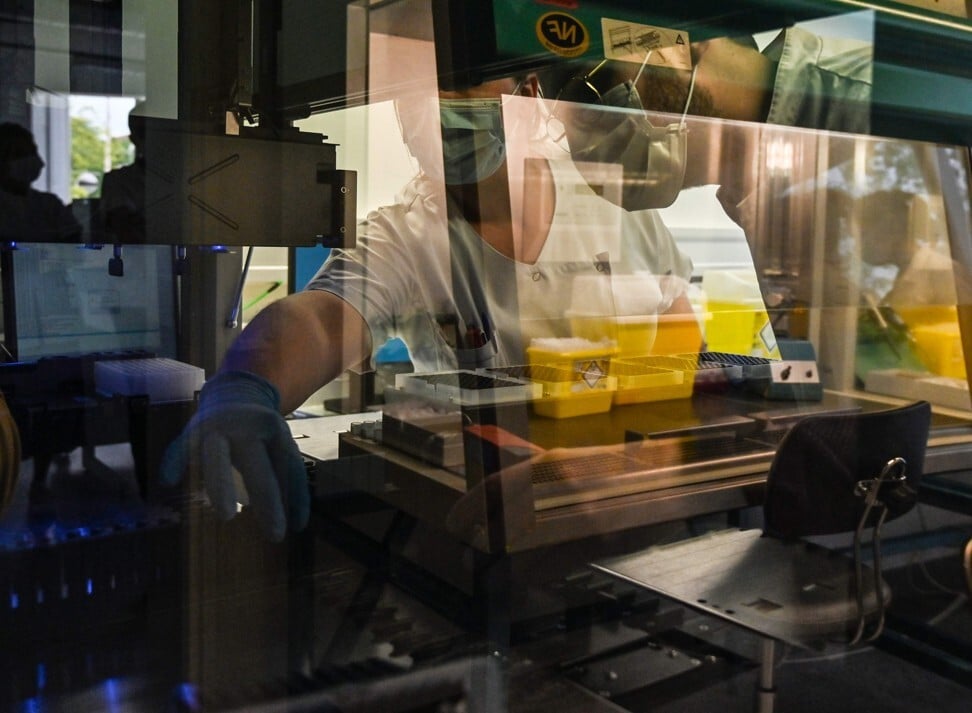
Researchers in France have carried out genetic analysis and found that the dominant types of the viral strains in the country did not come from China or Italy. Photo: AP
The coronavirus outbreak in France was not caused by cases imported from China, but from a locally circulating strain of unknown origin, according to a new study by French scientists at the Institut Pasteur in Paris.
Genetic analysis showed that the dominant types of the viral strains in France belonged to a clade – or group with a common ancestor – that did not come from China or Italy, the earliest hotspot in Europe.
“The French outbreak has been mainly seeded by one or several variants of this clade … we can infer that the virus was silently circulating in France in February,” said researchers led by Dr Sylvie van der Werf and Etienne Simon-Loriere in a non-peer reviewed paper released on bioRxiv.org last week.
The Covid-19 pandemic has infected more than 128,000 people in France and caused more than 23,000 deaths.
France detected the virus in late January, before any other country in Europe. A few patients with a travel history that included China’s Hubei province were sampled on January 24 and tested positive.
The Covid-19 pandemic has infected more than 128,000 people in France and caused more than 23,000 deaths. Photo: AFP
The French government took quick and decisive measures to trace contacts of the infected people and shut down the chance of further infection.

However, these strains were not found in patients tested after the initial imported cases, suggesting “the quarantine imposed on the initial Covid-19 cases in France appears to have prevented local transmission”, the researchers said.

The Pasteur institute collected samples from more than 90 other patients across France and found the strains all came from one genetic line. Strains following this unique path of evolution had so far only been detected in Europe and the Americas.

Singapore Covid-19 cases to rise as not all migrant workers being tested

28 Apr 2020

The earliest sample in the French clade was collected on February 19 from a patient who had no history of travel and no known contact with returned travellers.

Several patients had recently travelled to other European countries, the United Arab Emirates, Madagascar and Egypt but there was no direct evidence that they contracted the disease in these destinations.

To the researchers’ surprise, some of the later strains collected were genetically older – or closer to the ancestral root – than the first sample in this clade.

Spanish official cries reading names of health workers killed by coronavirus
A possible explanation, according to the authors, was that local transmission had been occurring in France for some time without being detected by health authorities.
The French government may have missed detecting the transmission. According to the researchers, a large proportion of those patients might have had mild symptoms or none at all.

The researchers also found that three sequences later sampled in Algeria were closely related to those in France, suggesting that travellers from France might have introduced the virus to the African country and caused an outbreak.

China says US politicians are lying as Trump calls for Covid-19 damages
29 Apr 2020

Benjamin Neuman, professor and chair of biological sciences with the Texas A&M University-Texarkana, said the French strains might have come from Belgium, where some sequences most closely related to the original strain from China were clustered.

“Since the earliest European strains of [the coronavirus] Sars-CoV-2 seem to be associated with Belgium, the idea that the virus spread from Belgium to both Italy and France at around the same time seems plausible, as this paper contends,” he said.

France is the latest in a growing number of countries and areas where no direct link between China and local outbreaks could be established.

The dominant strains in Russia and Australia, for instance, came from Europe and the United States, respectively, according to some studies.

These findings have drawn fire from some politicians who have tried to deflect domestic anger over their handling of the crisis by blaming China.

US President Donald Trump lashed out on social media after two separate teams in the US found the strains devastating New York came from Europe.

Is this the next big hotspot for the ‘little flu’?

28 Apr 2020

“So now the Fake News @nytimes is tracing the CoronaVirus origins back to Europe, NOT China. This is a first!” he tweeted on April 11, referring to a story about the studies in the The New York Times’ science section.

The findings also highlight the difficulties governments face in tracing the source of coronavirus outbreaks.

Less-developed countries may never know where their strains came from due to inadequate testing and sequencing capability.

India, for example, has released the genetic sequence of fewer than 40 samples to the public so far, a small number considering its huge population.

Most of the strains sampled in 35 early cases came from clades that could be traced to Italy and Iran, with only a few from China, according to a recent study. But researchers were not able to track further because of the lack of data.

A scientist on the study, Dr Mukesh Thakur, of the Zoological Survey of India, said it was too early to rule out China as the source of outbreaks in India because the number of samples at hand was limited.

A 20-year-old student studying medicine in Wuhan, for instance, might have come in contact with many people on the way home before she was tested positive on January 30.

Thakur said local media reported that the Indian government quarantined 3,500 people possibly linked to three positive cases imported from Wuhan.

“God knows how many of them tested positive in the subsequent stages,” Thakur said in an email response to the Post’s queries on Tuesday.

Some prominent scientists, including Francis Collins, director of the US National Institutes of Health, said the virus might have been spreading quietly in humans for years, or even decades, without causing a detectable outbreak.

The virus had thus adapted well to the human body. Some genes regulating its binding to host cells were similar, or even identical, to those found in some other highly infectious human viruses, such as HIV and Ebola.

According to some estimates, the ancestor of Sars-CoV-2, the virus causing Covid-19, might have left bats between 50 and 70 years ago. A recent study by a team of geneticists in Oxford University estimated the first outbreak of the current pandemic could have occurred as early as September last year.

They found that the dominant strains circulating in China and Asia were genetically younger than some popular strains in the United States.

Source: SCMP
14/02/2020

Coronavirus: New China figures highlight toll on medical staff

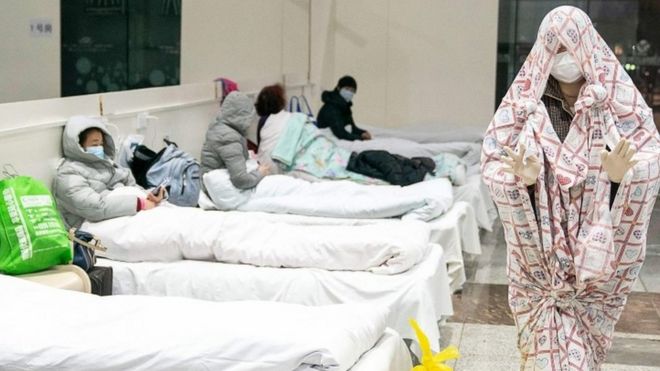
Exhibition hall converted to hospital in Wuhan - 5 FebruaryImage copyright AFP
Image caption Authorities in Wuhan have had to create extra hospital space to cope with large numbers of cases

Chinese officials have given figures for health workers infected with coronavirus, amid concerns about shortages of protective equipment.

Six health workers have died and 1,716 have been infected since the outbreak, they said.

The death a week ago of Doctor Li Wenliang, who tried to warn authorities early on about the virus, provoked a burst of public anger and grief.

More than 1,300 people are now known to have died from the virus.

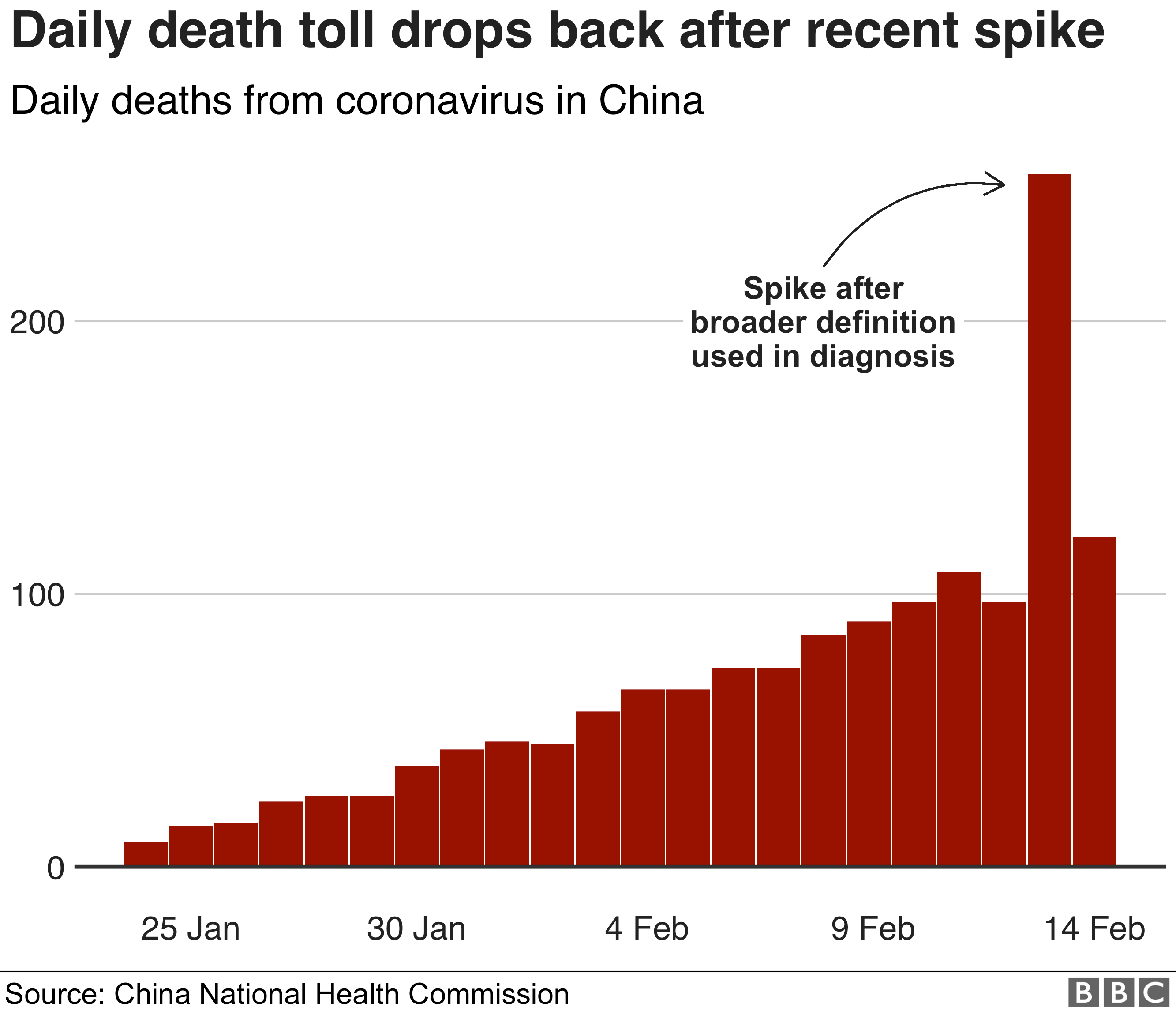
The latest figures show 122 new deaths in China, bringing the toll to 1,381.

The total number of infections has jumped to 63,922 cases, according to the National Health Commission.

The World Health Organization said there was no major shift in the virus’s pattern of mortality or severity, despite a spike in cases in Hubei, the epicentre of the disease, on Tuesday.

Most of this was down to Hubei using a broader definition to diagnose people, said Mike Ryan, head of WHO’s health emergencies programme.

There was also no significant rise in cases outside China, the WHO said.

However, a cruise ship docked in Japan, the Diamond Princess, saw 44 new cases, bringing the total there to 218.

What is the situation with medical workers?

Zeng Yixin, vice minister of China’s National Health Commission, said 1,102 medical workers had been infected in Wuhan, where the outbreak began, and another 400 in other parts of Hubei province.

He said the number of infections among staff was increasing.

Media caption Medics in Wuhan resort to shaving their heads in a bid to prevent cross-infection of the coronavirus

“The duties of medical workers at the front are indeed extremely heavy; their working and resting circumstances are limited, the psychological pressures are great, and the risk of infection is high,” Mr Zeng said, quoted by Reuters.

Local authorities have struggled to provide protective equipment such as respiratory masks, goggles and protective suits in hospitals in the area.

One doctor told AFP news agency that he and 16 colleagues were showing possible symptoms of the virus.

Another medical worker said she and more than 100 other staff at her hospital had been quarantined. A further 30 had been confirmed to have been infected there out of a staff of 500 she told CNN.

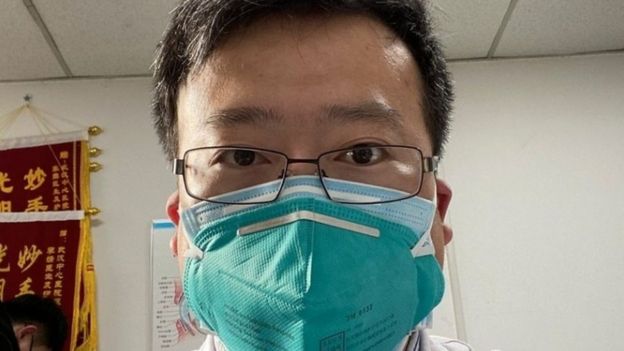
On 7 February the plight of medical workers was highlighted by the death of Li Wenliang, a doctor at Wuhan Central Hospital who had tried to issue the first warning about the virus on 30 December.

Li WenliangImage copyright LI WENLIANG
Image caption Li Wenliang contracted the virus while working at Wuhan Central Hospital

He had sent out a warning to fellow medics but police told him to stop “making false comments”.

A wave of anger and grief flooded Chinese social media site Weibo when news of Dr Li’s death broke.

Presentational grey line
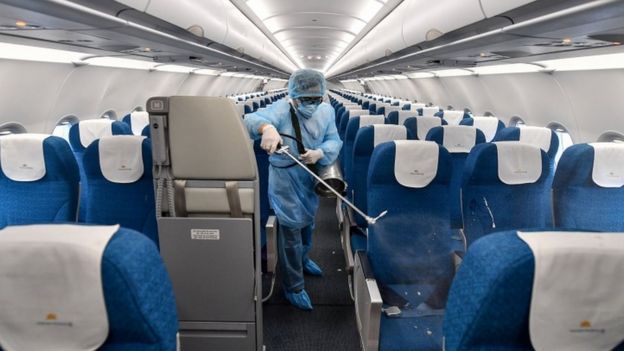
Member of Vietnam Airlines staff disinfects aircraft after flight - 4 FebruaryImage copyright AFP
Image caption Asian airlines have been hard hit by the virus outbreak

Economic impacts of the virus

  • Global airline revenue expected to fall by $4bn (£3.1bn) to $5bn this year
  • China’s car sales likely to fall more than 10% in first half of year, the China Association of Automobile Manufacturers tells Reuters
  • Singapore’s economy could fall into recession as a result of the outbreak, Prime Minister Lee Hsien Loong says
  • Malaysian finance minister says a stimulus package will be announced for aviation, retail and tourism industries
Presentational grey line

What is happening on the Diamond Princess?

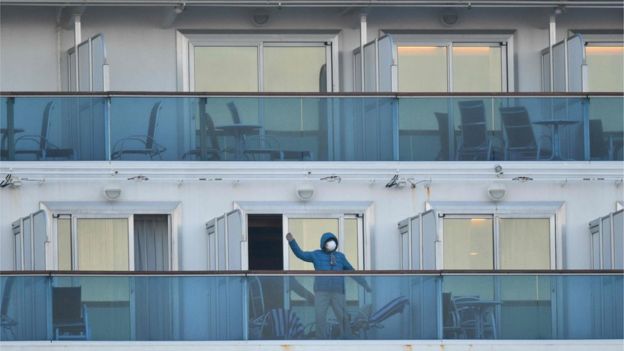
The vessel is in quarantine in Yokohama, in southern Japan. Not all the 3,700 people on board have been tested yet.

People with the virus are taken to hospitals on land to be treated, while those on board are largely confined to their cabins.

passenger on diamond princess cruise shipImage copyright AFP
Image caption The Diamond Princess has 3,700 people on board – not all of whom have been tested

However on Thursday Japan said it would allow those aged 80 or over who have tested negative for the coronavirus to disembark.

Health Minister Katsunobu Kato said they could be allowed off the ship as early as Friday but would have to stay in accommodation provided by the government, the Japan Times reported.

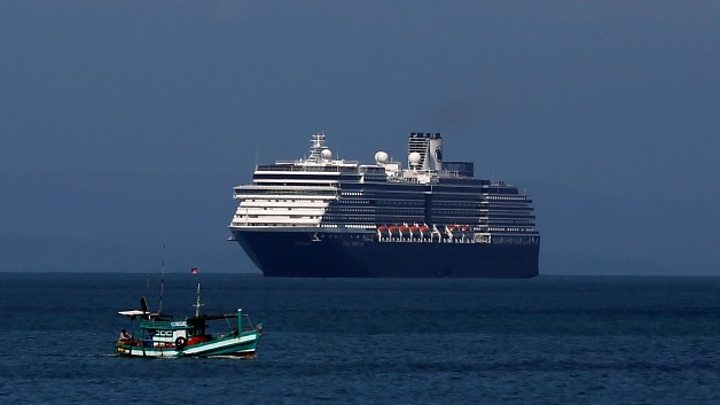
Meanwhile another cruise ship – the MS Westerdam, carrying more than 2,000 people – docked in Cambodia after being turned away by ports in Japan, Taiwan, Guam, the Philippines and Thailand despite having no sick patients on board.

Media caption The Westerdam was finally able to dock in Sihanoukville, Cambodia
Presentational white space

In other developments:

  • Outside China there have now been two deaths and 456 cases in 24 countries
  • Singapore health ministry reports nine new cases, bringing the total number there to 67
  • In the UK, officials are attempting to trace the contacts of the latest person to be diagnosed with coronavirus. The woman, who flew into London Heathrow from China a few days ago, is the ninth case to be confirmed
  • Australia has extended its ban on people coming from mainland China for another week, to 22 February
  • China said it would stagger the return of children to school – several provinces have closed schools until the end of February
  • In Vietnam, which borders China, thousands of people in villages near the capital, Hanoi, have been put under quarantine after several cases were discovered. Vietnam has now confirmed at least 16 cases
  • The Red Cross has called for sanctions relief for North Korea, which would allow the aid agency to transfer funds to buy equipment. Testing kits and protective clothing are urgently needed to prepare for a possible outbreak, it says
  • British rap star Stormzy has postponed the Asian leg of his tour – he had been due to play in locations including Shanghai, Hong Kong, Singapore and Malaysia in March
  • A Russian woman – who was put into a coronavirus quarantine but escaped – is resisting attempts by officials to bring her back to hospital by force. Alla Ilyina, 32, has been refusing to open the door of her St Petersburg apartment to police
China death toll
Presentational white spaceSource: The BBC
Law of Unintended Consequences

continuously updated blog about China & India

ChiaHou's Book Reviews

continuously updated blog about China & India

What's wrong with the world; and its economy

continuously updated blog about China & India