Archive for ‘Hotan’

18/02/2020

China Uighurs: Detained for beards, veils and internet browsing

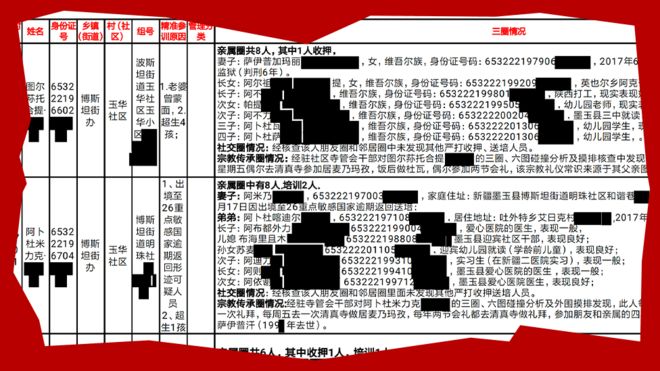
Redacted copy of The Karakax List in ChineseImage copyright UHRP

A document that appears to give the most powerful insight yet into how China determined the fate of hundreds of thousands of Muslims held in a network of internment camps has been seen by the BBC.

Listing the personal details of more than 3,000 individuals from the far western region of Xinjiang, it sets out in intricate detail the most intimate aspects of their daily lives.

The painstaking records – made up of 137 pages of columns and rows – include how often people pray, how they dress, whom they contact and how their family members behave.

China denies any wrongdoing, saying it is combating terrorism and religious extremism.

The document is said to have come, at considerable personal risk, from the same source inside Xinjiang that leaked a batch of highly sensitive material published last year.

One of the world’s leading experts on China’s policies in Xinjiang, Dr Adrian Zenz, a senior fellow at the Victims of Communism Memorial Foundation in Washington, believes the latest leak is genuine.

“This remarkable document presents the strongest evidence I’ve seen to date that Beijing is actively persecuting and punishing normal practices of traditional religious beliefs,” he says.

One of the camps mentioned in it, the “Number Four Training Centre” has been identified by Dr Zenz as among those visited by the BBC as part of a tour organised by the Chinese authorities in May last year.
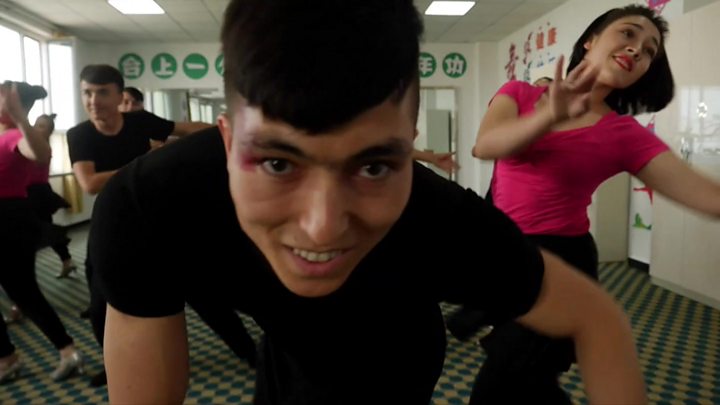
Media caption The BBC previously visited one of the camps identified by scholars using the Karakax List

Much of the evidence uncovered by the BBC team appears to be corroborated by the new document, redacted for publication to protect the privacy of those included in it.

It contains details of the investigations into 311 main individuals, listing their backgrounds, religious habits, and relationships with many hundreds of relatives, neighbours and friends.

Verdicts written in a final column decide whether those already in internment should remain or be released, and whether some of those previously released need to return.

It is evidence that appears to directly contradict China’s claim that the camps are merely schools.

In an article analysing and verifying the document, Dr Zenz argues that it also offers a far deeper understanding of the real purpose of the system.

It allows a glimpse inside the minds of those making the decisions, he says, laying bare the “ideological and administrative micromechanics” of the camps.
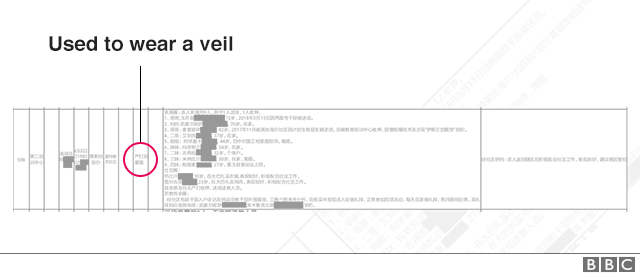
An image showing the lits

Row 598 contains the case of a 38-year-old woman with the first name Helchem, sent to a re-education camp for one main reason: she was known to have worn a veil some years ago.

It is just one of a number of cases of arbitrary, retrospective punishment.

Others were interned simply for applying for a passport – proof that even the intention to travel abroad is now seen as a sign of radicalisation in Xinjiang.
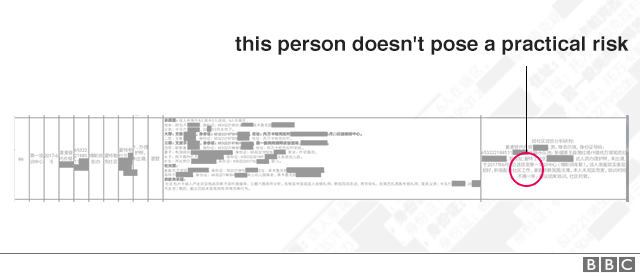
An image showing the list of names and observations

In row 66, a 34-year-old man with the first name Memettohti was interned for precisely this reason, despite being described as posing “no practical risk”.

And then there’s the 28-year-old man Nurmemet in row 239, put into re-education for “clicking on a web-link and unintentionally landing on a foreign website”.
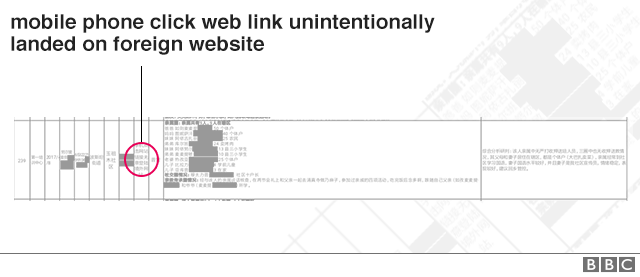
A picture showing the list

Again, his case notes describe no other issues with his behaviour.

The 311 main individuals listed are all from Karakax County, close to the city of Hotan in southern Xinjiang, an area where more than 90% of the population is Uighur.

Predominantly Muslim, the Uighurs are closer in appearance, language and culture to the peoples of Central Asia than to China’s majority ethnicity, the Han Chinese.

In recent decades the influx of millions of Han settlers into Xinjiang has led to rising ethnic tensions and a growing sense of economic exclusion among Uighurs.

Those grievances have sometimes found expression in sporadic outbreaks of violence, fuelling a cycle of increasingly harsh security responses from Beijing.

It is for this reason that the Uighurs have become the target – along with Xinjiang’s other Muslim minorities, like the Kazakhs and Kyrgyz – of the campaign of internment

The “Karakax List”, as Dr Zenz calls the document, encapsulates the way the Chinese state now views almost any expression of religious belief as a signal of disloyalty.

To root out that perceived disloyalty, he says, the state has had to find ways to penetrate deep into Uighur homes and hearts.

In early 2017, when the internment campaign began in earnest, groups of loyal Communist Party workers, known as “village-based work teams”, began to rake through Uighur society with a massive dragnet.

With each member assigned a number of households, they visited, befriended and took detailed notes about the “religious atmosphere” in the homes; for example, how many Korans they had or whether religious rites were observed.

The Karakax List appears to be the most substantial evidence of the way this detailed information gathering has been used to sweep people into the camps.

It reveals, for example, how China has used the concept of “guilt by association” to incriminate and detain whole extended family networks in Xinjiang.

For every main individual, the 11th column of the spreadsheet is used to record their family relationships and their social circle.

Presentational grey line

China’s hidden camps

BBC
Presentational grey line

Alongside each relative or friend listed is a note of their own background; how often they pray, whether they’ve been interned, whether they’ve been abroad.

In fact, the title of the document makes clear that the main individuals listed all have a relative currently living overseas – a category long seen as a key indicator of potential disloyalty, leading to almost certain internment.

Rows 179, 315 and 345 contain a series of assessments for a 65-year-old man, Yusup.

His record shows two daughters who “wore veils and burkas in 2014 and 2015”, a son with Islamic political leanings and a family that displays “obvious anti-Han sentiment”.

His verdict is “continued training” – one of a number of examples of someone interned not just for their own actions and beliefs, but for those of their family.

The information collected by the village teams is also fed into Xinjiang’s big data system, called the Integrated Joint Operations Platform (IJOP).

The IJOP contains the region’s surveillance and policing records, culled from a vast network of cameras and the intrusive mobile spyware every citizen is forced to download.

The IJOP, Dr Zenz suggests, can in turn use its AI brain to cross-reference these layers of data and send “push notifications” to the village teams to investigate a particular individual.
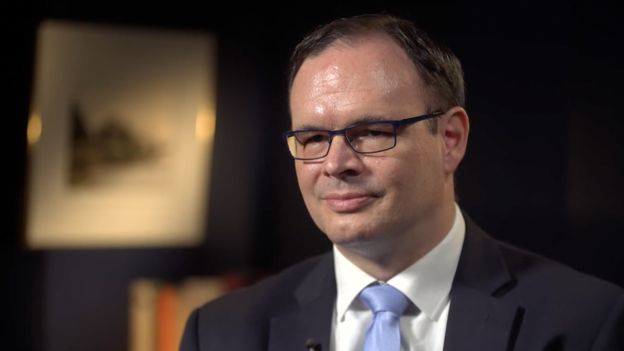
Adrian Zenz, the academic who has analysed and assessed the Karakax List
Image caption Adrian Zenz has analysed the leaked document

The man found “unintentionally landing on a foreign website” may well have been interned thanks to the IJOP.

In many cases though, there is little need for advanced technology, with the vast and vague catch-all term “untrustworthy” appearing multiple times in the document.

It is listed as the sole reason for the internment of a total of 88 individuals.

The concept, Dr Zenz argues, is proof that the system is designed not for those who have committed a crime, but for an entire demographic viewed as potentially suspicious.

China says Xinjiang has policies that “respect and ensure people’s freedom of religious belief”. It also insists that what it calls a “vocational training programme in Xinjiang” is “for the purposes of combating terrorism and religious extremism”, adding only people who have been convicted of crimes involving terrorism or religious extremism are being “educated” in these centres.

However, many of the cases in the Karakax List give multiple reasons for internment; various combinations of religion, passport, family, contacts overseas or simply being untrustworthy.

The most frequently listed is for violating China’s strict family planning laws.

In the eyes of the Chinese authorities it seems, having too many children is the clearest sign that Uighurs put their loyalty to culture and tradition above obedience to the secular state.
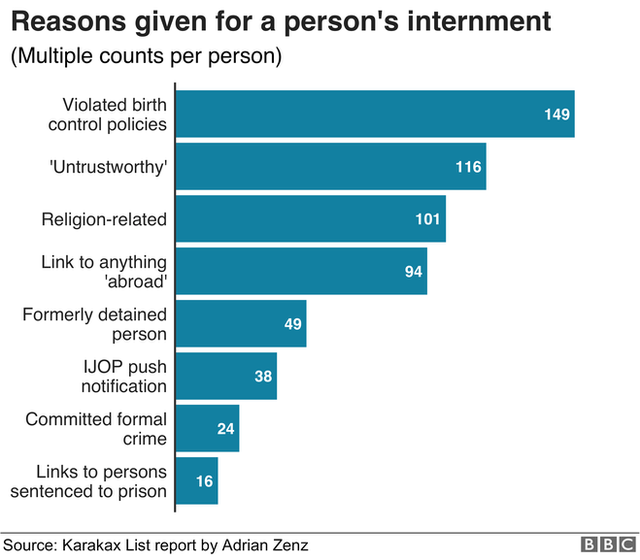
Chart showing reasons given for a person's internment
China has long defended its actions in Xinjiang as part of an urgent response to the threat of extremism and terrorism.

The Karakax List does contain some references to those kinds of crimes, with at least six entries for preparing, practicing or instigating terrorism and two cases of watching illegal videos.

But the broader focus of those compiling the document appears to be faith itself, with more than 100 entries describing the “religious atmosphere” at home.

The Karakax List has no stamps or other authenticating marks so, at face value, it is difficult to verify.

It is thought to have been passed out of Xinjiang sometime before late June last year, along with a number of other sensitive papers.

They ended up in the hands of an anonymous Uighur exile who passed all of them on, except for this one document.

Only after the first batch was published last year was the Karakax List then forwarded to his conduit, another Uighur living in Amsterdam, Asiye Abdulaheb.

She told the BBC that she is certain it is genuine.
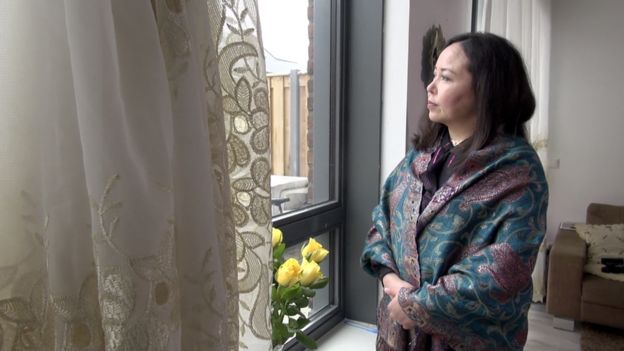
Asiye Abdulaheb, the Uighur woman who helped leak the Karakax List
Image caption Asiye Abdulaheb decided to speak out, despite the danger

“Regardless of whether there are official stamps on the document or not, this is information about real, live people,” she says. “It is private information about people that wouldn’t be made public. So there is no way for the Chinese government to claim it is fake.”

Like all Uighurs living overseas, Ms Abdulaheb lost contact with her family in Xinjiang when the internment campaign began, and she’s been unable to contact them since.

But she says she had no choice but to release the document, passing it to a group of international media organisations, including the BBC.

“Of course I am worried about the safety of my relatives and friends,” she says. “But if everyone keeps silent because they want to protect themselves and their families, then we will never prevent these crimes being committed.”

At the end of last year China announced that everyone in its “vocational training centres” had now “graduated”. However, it also suggested some may stay open for new students on the basis of their “free will”.

Almost 90% of the 311 main individuals in the Karakax List are shown as having already been released or as being due for release on completion of a full year in the camps.

But Dr Zenz points out that the re-education camps are just one part of a bigger system of internment, much of which remains hidden from the outside world.
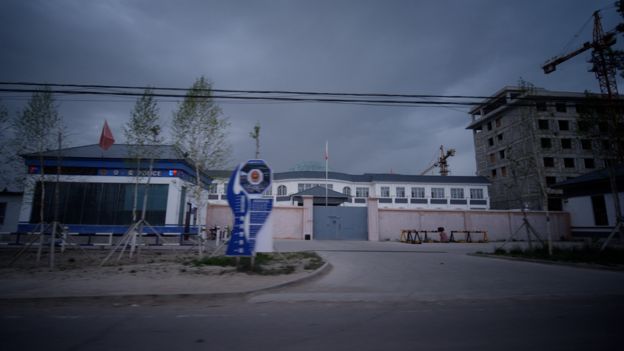
A camp holding Muslims in Xinjiang. (nb: NOT a camp identified in the Karakax List)
Image caption The outside of one of the camps in Xinjiang

More than two dozen individuals are listed as “recommended” for release into “industrial park employment” – career “advice” that they may have little choice but to obey. There are well documented concerns that China is now building a system of coerced labour as the next phase of its plan to align Uighur life with its own vision of a modern society.

In two cases, the re-education ends in the detainees being sent to “strike hard detention”, a reminder that the formal prison system has been cranked into overdrive in recent years.

Many of the family relationships listed in the document show long prison terms for parents or siblings, sometimes for entirely normal religious observances and practices.

One man’s father is shown to have been sentenced to five years for “having a double-coloured thick beard and organising a religious studies group”.

A neighbour is reported to have been given 15 years for “online contact with people overseas”, and another man’s younger brother given 10 years for “storing treasonable pictures on his phone”.

Whether or not China has closed its re-education camps in Xinjiang, Dr Zenz says the Karakax List tells us something important about the psychology of a system that prevails.

“It reveals the witch-hunt-like mindset that has been and continues to dominate social life in the region,” he said.

Source: The BBC
16/06/2019

Beijing sees ‘broad consensus’ with UN on Xinjiang as human rights groups blast envoy’s visit

  • UN counterterrorism chief Vladimir Voronkov not expected to make statement after visiting region last week
  • Trip prompts calls for independent observation in Muslim-majority area where an estimated 1 million people are held in detention facilities
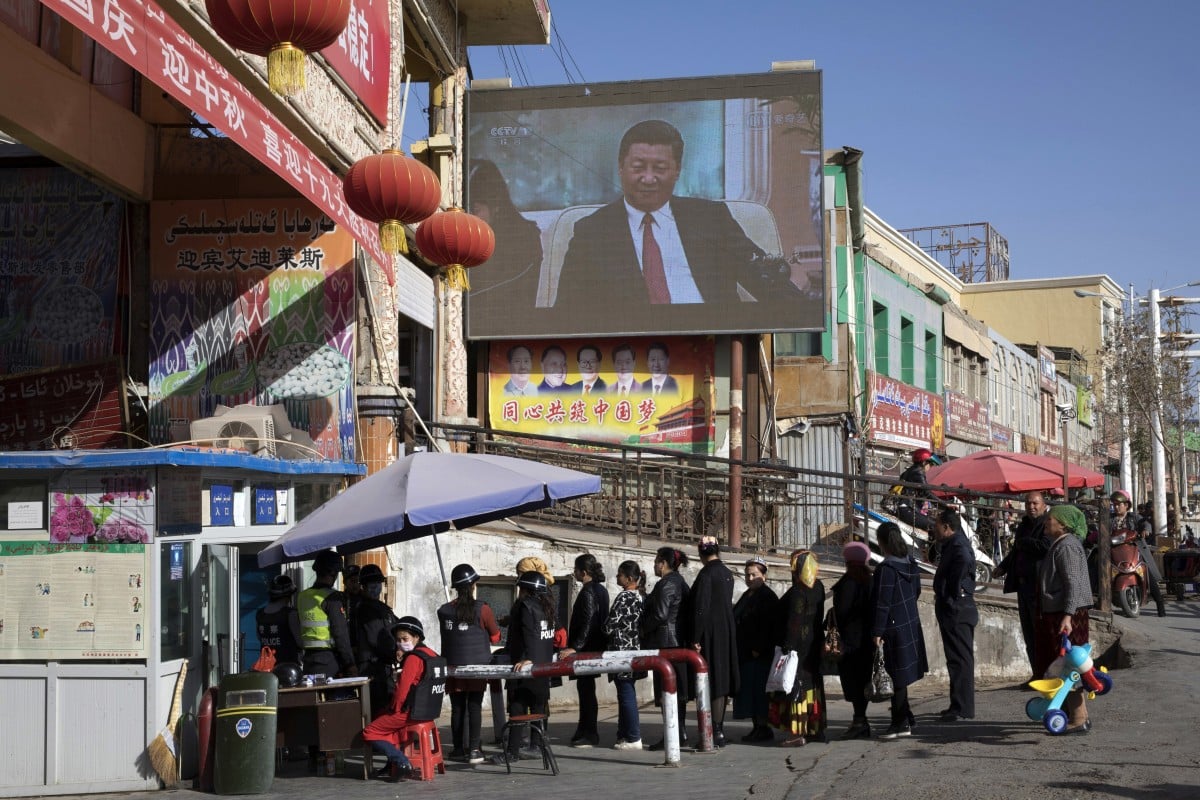
Residents go through a security checkpoint at the entrance to a bazaar in Hotan, Xinjiang. The UN’s counterterrorism chief visited the far western region last week. Photo: AP
Human rights group Amnesty International has joined growing criticism of a top UN official’s visit to China’s 
Xinjiang region

, echoing calls for more independent investigations of detention facilities for ethnic Uygurs.

The invitation to the United Nations envoy to visit was Beijing’s latest attempt to show it has nothing to hide in what it calls “re-education facilities” that hold an estimated 1 million people in the Muslim-majority area in western China.
But critics have warned that state-led media tours and diplomatic visits lack the unfettered access needed to make a proper assessment of alleged rights abuses in the region.
UN counterterrorism chief Vladimir Voronkov 
visited Beijing and Xinjiang

from Thursday to Saturday and met Le Yucheng, the vice foreign minister, according to a statement from the foreign ministry on Sunday. The statement said the two sides had reached a “broad consensus”.

UN human rights chief ‘is welcome to visit Xinjiang’

Voronkov’s visit follows months of pressure to allow the UN to investigate alleged human rights abuses in Xinjiang. China has so far only allowed guided tours of the region for foreign journalists and diplomatic envoys.

Reuters reported on Saturday that Voronkov’s itinerary was planned by China and that his UN office did not expect to make any public statement about the trip, according to an email from Voronkov’s office seen by the news agency.

The United Nations said in August last year it had credible reports that detention facilities in Xinjiang held 1 million Uygurs and other Muslims. Beijing says the facilities are for “vocational training” and tied to deradicalisation and anti-terrorism efforts.

Patrick Poon, a Hong Kong-based researcher with Amnesty International, said he was “very much concerned” about how the UN envoy’s visit had been arranged.

“From what we saw in the previous visits orchestrated by the Chinese government for diplomats, it’s very difficult for anyone to believe how this visit will be able to show any authentic situation on the ground,” Poon said.

“If the Chinese government is sincere, let independent UN experts, such as the special rapporteurs, have independent observation of what’s happening in Xinjiang.”

Xinjiang’s vanishing mosques highlight pressure on China’s Muslims
His remarks followed criticism of the trip from Human Rights Watch on Friday.
“The UN allowing its counterterrorism chief to go to Xinjiang risks confirming China’s false narrative that this is a counterterrorism issue, not a question of massive human rights abuses,” Human Rights Watch UN director Louis Charbonneau told Agence France-Presse.
Also on Friday, US Deputy Secretary of State John Sullivan called UN Secretary General Antonio Guterres to express “deep concerns” about Voronkov’s visit, according to the State Department website. Sullivan called for “unmonitored and unhindered access to all camps and detainees in Xinjiang by UN human rights officials”.
The United States has been increasingly vocal about China’s human rights abuses. Vice-President Mike Pence is due to give a speech on China’s “control and oppression” of citizens on June 24, but according to Bloomberg it could be postponed to avoid inflaming tensions with Beijing ahead of a possible meeting between US President Donald Trump and his Chinese counterpart Xi Jinping at the Group of 20 leaders summit in Japan on June 28-29. The speech was originally scheduled for June 4 but was delayed by Trump, Bloomberg reported, citing sources familiar with the matter.
Source: SCMP
05/06/2019

Xinjiang’s vanishing mosques highlight pressure on China’s Muslims as Ramadan ends with a whimper

  • Few signs of Eid celebrations after crackdown that has seen a reported million Uygurs and other minorities interned in camps
  • Muslims in far western Chinese region say they are now ‘too scared’ to practise their faith in public
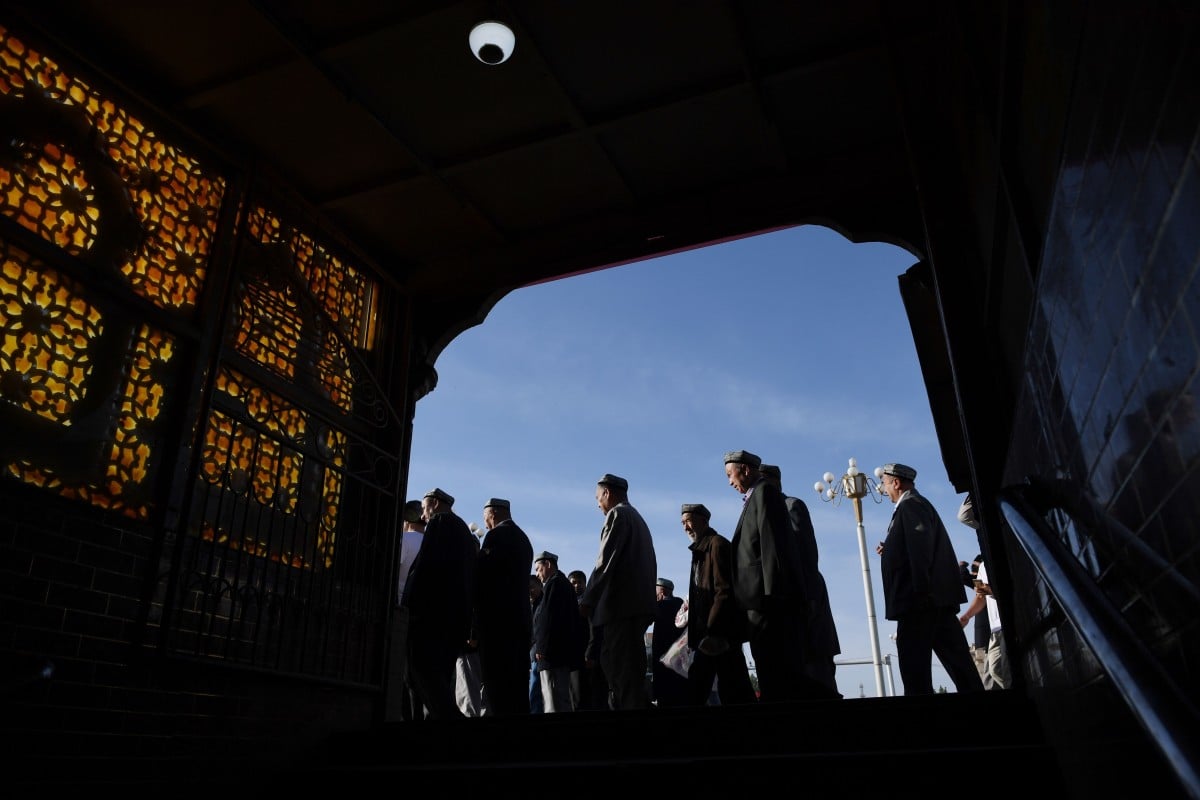
Worshippers leave a mosque in Kasghar after prayers on Wednesday. Photo: AFP
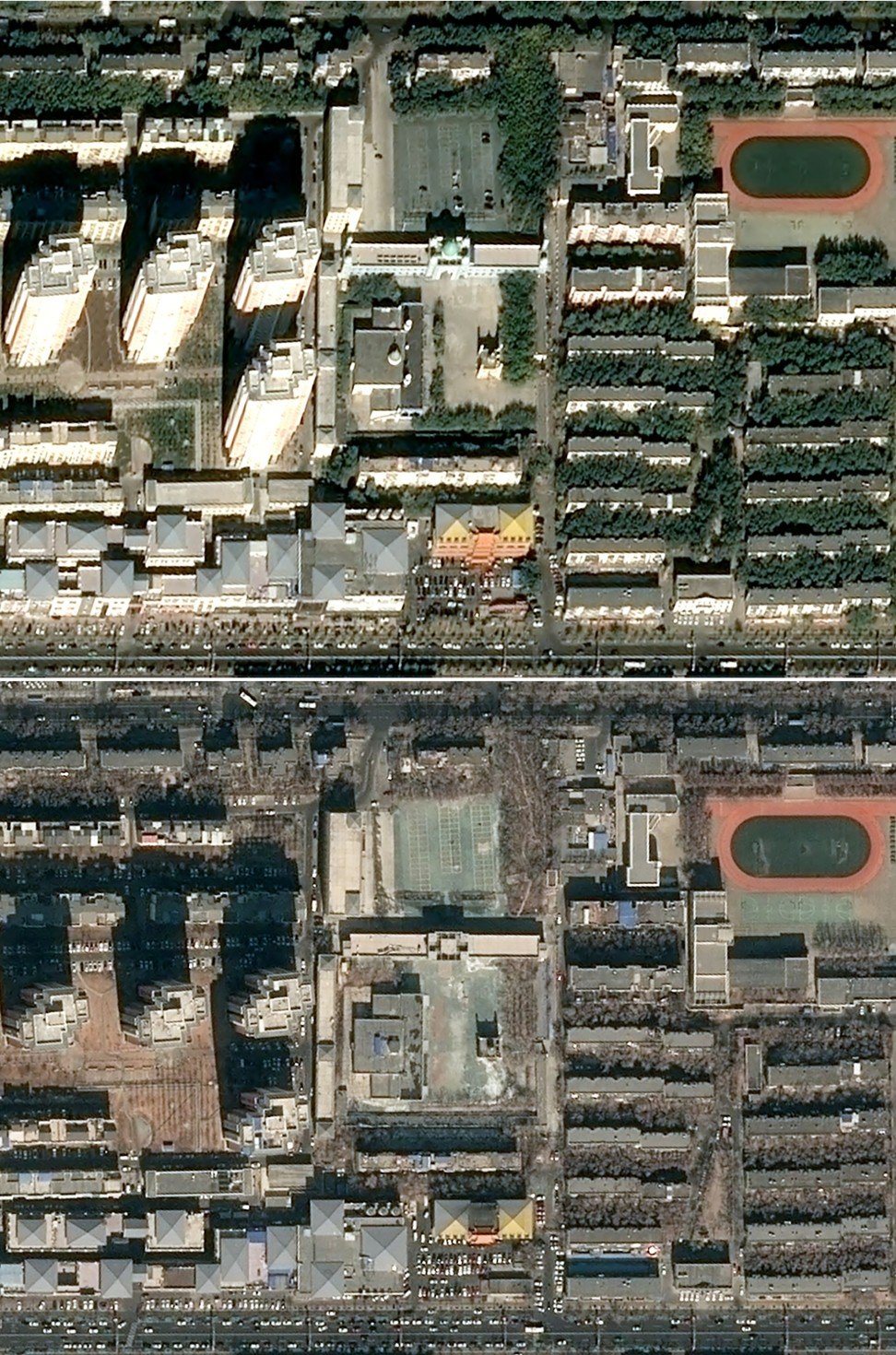
The corner where Heyitkah mosque in China’s far western region of Xinjiang once hummed with life is now a car park where all traces of the tall, domed building have been erased.
While Muslims around the world celebrated the end of Ramadan with prayers and festivities this week, the recent destruction of dozens of mosques in Xinjiang highlights the increasing pressure Uygurs and other ethnic minorities face in the heavily policed region.
Behind the car park in the city of Hotan, the slogan “Educate the people for the party” is emblazoned in red on the wall of a primary school where students must scan their faces upon entering the razor-wired gates.
The mosque “was beautiful,” recalled a vendor at a nearby bazaar. “There were a lot of people there.”
Satellite images reviewed by AFP and visual analysis non-profit Earthrise Alliance show that 36 mosques and religious sites have been torn down or had their domes and corner spires removed since 2017.
Satellite images from 2014 (top) and March this year show the disappearance of the dome of the Karamay West Mosque in Xinjiang. Photo: AFP/ Distribution Airbus Defence and Space/ CNES 2019/ Produced By Earthrise

In the mosques that are open, worshippers go through metal detectors while surveillance cameras monitor them inside.

“The situation here is very strict, it takes a toll on my heart,” said one Uygur, who requested anonymity for fear of reprisals. “I don’t go any more,” he added, referring to mosques. “I’m scared.”

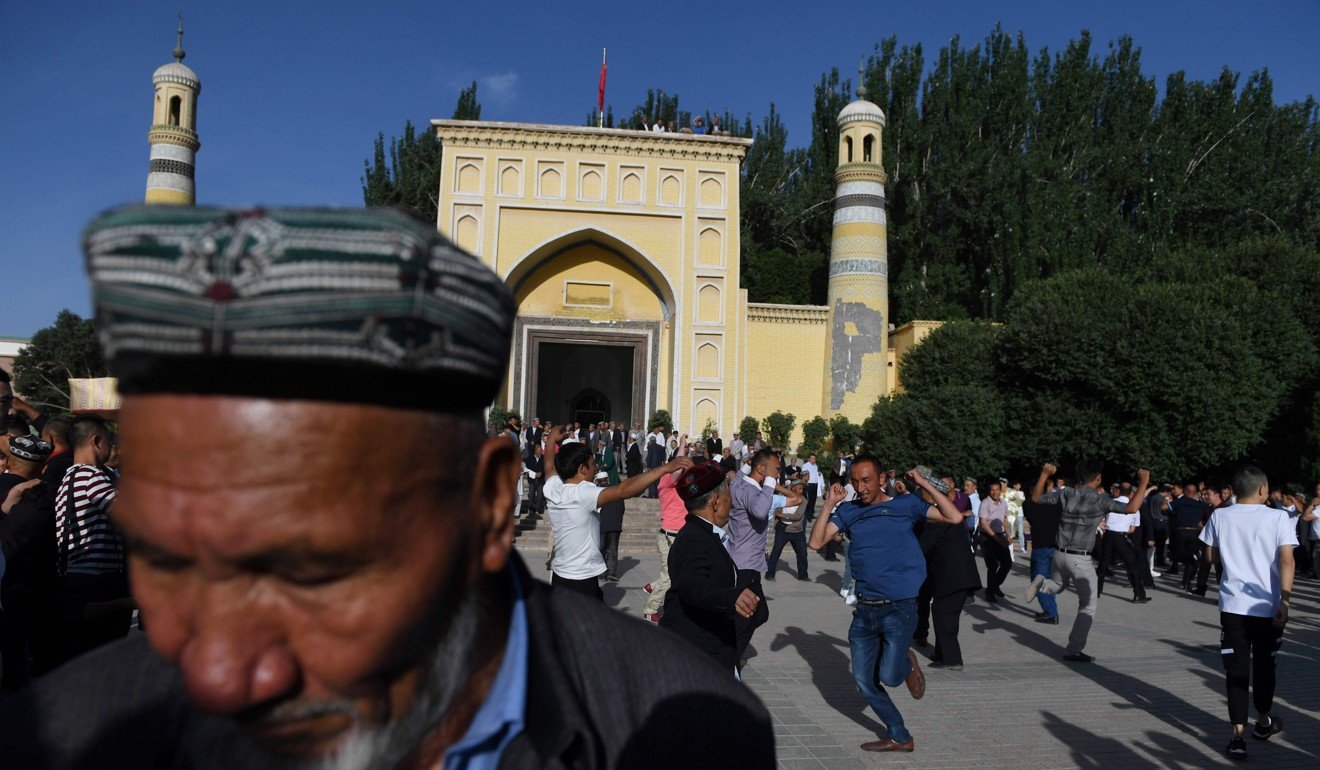
In the ancient Silk Road city of Kashgar, no longer does the sunrise call for prayer echo throughout the city – a ritual the manager of the city’s central mosque once proudly shared with touristsOn Wednesday, locals celebrating Eid al-Fitr quietly filed into the entrance of state-approved Idkah Mosque – one of the largest in China – as police and officials fenced off the wide square surrounding the building and plain clothes men monitored every person’s actions.

It was another low-key Ramadan for Muslims in Xinjiang, where restaurants were busy serving food to customers throughout the day, a time when practising Muslims fast.

In Hotan on Friday – a holy day for believers – the only mosque in the city was empty after sundown, an important prayer session when Muslim families typically break their daily Ramadan fast.

Earlier in the day, at least 100 people attended a midday session but the vast majority were elderly men.

Human Rights Watch decodes surveillance app used to classify people in China’s Xinjiang region

The ruling Communist Party “sees religion as this existential threat”, said James Leibold, an expert on ethnic relations and policy in China at La Trobe University.

Over the long term, the Chinese government wants to achieve “the secularisation of Chinese society,” he told AFP.

The Xinjiang government told AFP that it “protects religious freedoms” and citizens can celebrate Ramadan “within the scope permitted by law”, without elaborating.

The authorities have thrown a hi-tech security net across the region, installing cameras, mobile police stations and checkpoints in seemingly every street in response to a spate of deadly attacks blamed on Islamic extremists and separatists in recent years.

An estimated one million Uygurs and other Turkic-speaking ethnic groups are held in a vast network of internment camps.

After initially denying their existence, Chinese authorities last year acknowledged that they run “vocational education centres” aimed at steering people clear of religious extremism by teaching them Mandarin and China’s laws.

In those centres, it was a different Ramadan.

The Xinjiang government told AFP that people in the centres are not allowed to hold religious activities because Chinese law forbids it within education facilities, but they are free to do so “when they return home on weekends”.

Uygur men dance after Eid al-Fitr prayers in Kashgar. Photo: Greg Baker/ AFP

In recent years, Chinese authorities have ramped up controls on public displays of religion and Islamic traditions in Xinjiang.

AFP reporters did not see any veiled women and few men sporting long beards during a week-long visit to the region. Former internment camp inmates have said they were incarcerated for these outward signs of their religion.

Places of worship too have become targets of Beijing’s draconian security measures.

Human Rights Watch decodes surveillance app used to classify people in China’s Xinjiang region

In the satellite images analysed by AFP and Earthrise Alliance, 30 religious sites were completely demolished while six had their domes and corner spires removed.

AFP reporters visited about half a dozen sites, and found that some mosques had been repurposed into public spaces.

Police officers blocked journalists from entering Artux, just north of Kashgar, where the town’s grand mosque and dozens of other community mosques were destroyed.

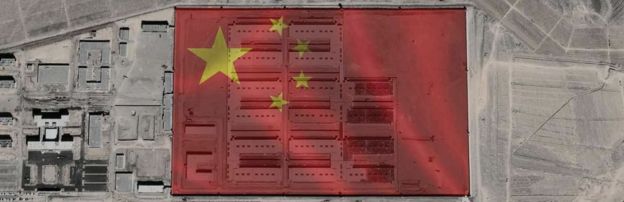
The area is some 22 kilometres (14 miles) away from an enormous complex believed to be a re-education centre. Visible from a nearby village, the facility has razor-wired walls, watchtowers and imposing block buildings.In Kashgar, two cameras perched on the columns of a former mosque point at its entrance. There is no minaret or dome – instead, a shop selling dresses lies to its right alongside houses.

A demolished mosque in Hotan has been converted into a garden, paved with concrete walkways and sparsely planted trees.

On the outskirts of town, situated between a cemetery and sand dunes, two white flags and a pile of burned refuse and debris was all that was left of an old shrine named Imam Asim.

China’s top Xinjiang official Chen Quanguo should face sanctions over alleged abuses, US lawmakers say

Uygurs consider these mosques and shrines “their ancestral heritage,” said Omer Kanat, director of the Uygur Human Rights Project.

“The Chinese government just wants to erase everything … that is different from Han, everything which belongs to Uygur culture or Islamic culture in the region,” he said.

Juma Maimaiti, the official imam of Idkah Mosque, told AFP in an interview arranged by the propaganda department that the demolition of mosques “has never happened here”.

“But our government has proceeded to protect some key mosques,” he added, and said that the city of Kashgar has over 150 mosques.

A propaganda slogan and surveillance camera at a mosque in Yangisar, south of Kashgar. Photo: AFP

Though Beijing’s restrictions on religious piety, such as fasting, are not new, observers say conditions have deteriorated to the point where celebrations for the holy month in Xinjiang are reduced or largely invisible.

Islamic greetings and openly fasting in public are no longer permitted, said Darren Byler, a lecturer at the University of Washington who focuses on Uygur culture.

While there are Uygurs who continue to practise their faith, they are “internalising it at this moment – they’re not expressing it openly,” he said.

EU calls out Beijing on human rights but activists want harder line against China’s Xinjiang and Tibet policy

At state-backed mosques, religious activity is controlled as Beijing pursues a five-year plan to “Sinicise” Islam as the “only way for a healthy development of Islam” in the country, said Yang Faming, president.

Source: SCMP

Law of Unintended Consequences

continuously updated blog about China & India

ChiaHou's Book Reviews

continuously updated blog about China & India

What's wrong with the world; and its economy

continuously updated blog about China & India