Archive for ‘housing estate’

14/05/2020

China relocates villagers living in 800m-high cliffs in anti-poverty drive

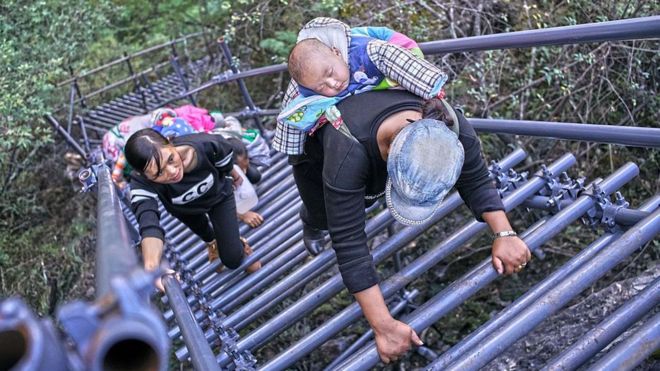
People climb on the newly-built metal ladder with hand railings to Ahtuler village on a cliff on November 11, 2016Image copyright GETTY IMAGES
Image caption The village made headlines after photos showed people scaling ladders to get home

They used to call an 800m-high cliff home, but dozens of villagers in China’s Sichuan province have now been relocated to an urban housing estate.

Atulie’er village became famous after photos emerged showing adults and children precariously scaling the cliff using just rattan ladders.

Around 84 households have now been moved into newly built flats as part of a local poverty alleviation campaign.

It’s part of a bigger national campaign to end poverty by the end of 2020.

‘So happy I got a house’

Atulie-er village made headlines in 2016 when it was revealed that its villagers had to scale precarious ladders to get home, carrying babies and anything the village needed.

Soon afterwards the government stepped in and replaced these with steel ladders.

The households have now been moved to the county town of Zhaojue, around 70km away.

They will be rehoused in furnished apartment blocks, which come in models of 50, 75 and 100 sq m – depending on the number of people in each household.

It’ll be a big change for many of these villagers, who are from the Yi minority and have lived in Atulie-er for generations.

Photos on Chinese state media showed villagers beaming, one of them telling state media outlet CGTN that he was “so happy that I got a good house today”.

‘Big financial burden’

According to Mark Wang, a human geography professor at the University of Melbourne, such housing schemes are often heavily subsidised by the government, typically up to 70%. However, in some instances families have been unable to afford the apartments despite the subsidies.

“For some really poor villages, the 30% may still be difficult for them to pay, so they end up having to borrow money – [ironically] causing them even more debt,” he told BBC News.

“For the poorest, it’s a big financial burden and so in some instances, they might have to stay.”

According to Chinese state media outlet China Daily, each person will have to pay 2,500 yuan ($352; £288) for this particular move – so for a family of four, the cost would come up to 10,000 yuan.
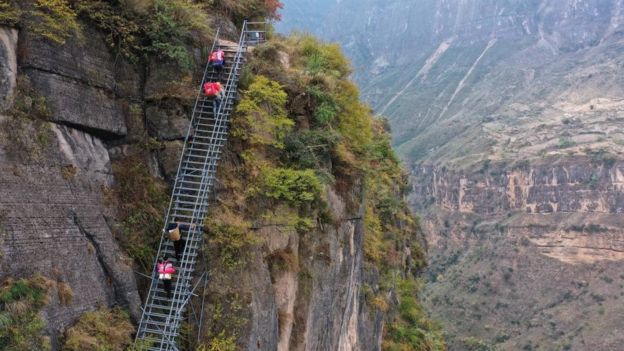
Villagers Living On Cliff Shop Online In LiangshanImage copyright GETTY IMAGES
Image caption This is the journey the villagers had to make to get home

This is quite a low price, says Mr Wang, as he had heard of people having to pay up to 40,000 yuan for other relocation projects.

Mr Wang says in most poverty resettlement campaigns, villagers are given a choice whether or not to move, and are not usually moved into cities from the countryside.

“In most instances it’s a move to a county town or a suburb. So it’s not like they’re moving to a big city. Not everyone wants an urban life and most of those who do would have already left these villages and moved to the big cities,” he says.

“Usually the government [puts a limit] on the resettlement distance. This is in most people’s favour because it means they can keep their farm land, so that’s very attractive.”

The Atulie’er villagers will share this new apartment complex with impoverished residents across Sichuan province.
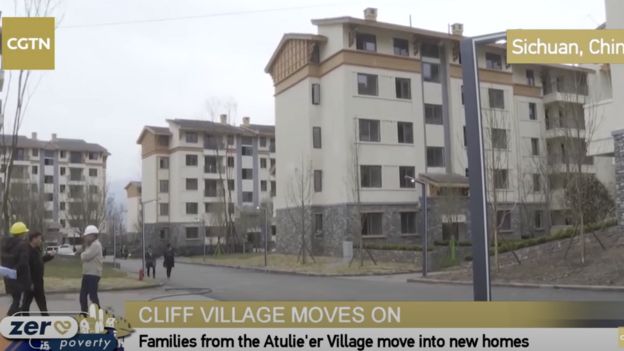
The new apartment blocksImage copyright CGTN/YOUTUBE
Image caption The villagers will be living in these apartment buildings

Around 30 households will remain in the Atulie’er village- which is set to turn into a tourism spot.

According to Chinese state media outlet China Daily, these households will effectively be in charge of local tourism, running inns and showing tourists around.

The county government has ambitious plans – planning to install a cable car to transport tourists to the village and to develop some surrounding areas. An earlier report said there were plans to turn the village into a vacation resort, with state media saying the state would pump 630 million yuan into investment.

Though these developments are likely to bring more jobs to the area, it’s not clear what safeguards are in place to make sure that the site’s ecological areas are protected and not at risk of being overdeveloped.
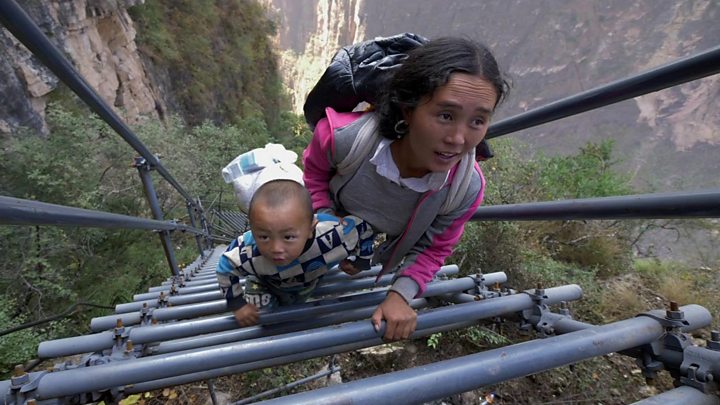
Media caption Do people in China’s rural communities think poverty reduction can work?

Chinese President Xi Jinping has declared that China will eradicate poverty in China by 2020.

There’s no one standard definition of poverty across all of China, as it differs from province to province.

One widely quoted national standard is 2,300 yuan ($331; £253) net income a year. Under that standard, there were around 30 million people living in poverty across the whole of China in 2017.

But the 2020 deadline is approaching fast – and Mr Wang says the plan could be derailed by the virus outbreak.

“Even without Covid-19 it would be hard to meet this deadline and now realistically, it has made it even more difficult.”

Source: The BBC

07/07/2019

In drought-hit Delhi, the haves get limitless water, the poor fight for every drop

NEW DELHI (Reuters) – In this teeming capital city of more than 20 million people, a worsening drought is amplifying the vast inequality between India’s rich and poor.

The politicians, civil servants and corporate lobbyists who live in substantial houses and apartments in central Delhi pay very little to get limitless supplies of piped water – whether for their bathrooms, kitchens or to wash the car, dog, or spray a manicured lawn. They can do all that for as little as $10-$15 a month.

But step into one of the slum areas in the inner city, or a giant disorganized housing estate on the outskirts and there is a daily struggle to get and pay for very limited supplies of water, which is delivered by tanker rather than pipe. And the price is soaring as supplies are fast depleting.

India’s water crisis is far from even-handed – the elite in Delhi and most other parts of the country remain unaffected while the poor scramble for supplies every day. Prime Minister Narendra Modi’s official residence and those of his cabinet are in central Delhi, as are those of most lawmakers.

That may help to explain why it took until this week for Modi to call for a massive water conservation program, the first big initiative by the government despite years of warnings about dry reservoirs and depleted water tables, policy makers and water industry experts said.

Telecom sales representative Amar Nath Shukla, who lives in a giant unauthorized housing sprawl on the south side of Delhi, says he is now paying 700 rupees ($10) for a small tanker to bring him, his wife and three school-age children 2,000 liters of water, their weekly quota.

A year ago, Shukla would buy two of the rusty, oval-shaped tankers a week for 500 rupees each but he cut back to one as the price climbed 40 percent.

“Why should a densely populated settlement get so little of water and why should the sparsely-populated central district of New Delhi receive so much of extra supply?” asked Shukla.
More than 30 other residents Reuters spoke to in his Sangam Vihar district also complained about the quality of water.
“Until last year I was drinking the water sold by a few local suppliers but then I fell ill and the doctor asked me to buy water bottles made by only big, reputed companies,” said Dilip Kumar Kamath, 46, waving a prescription which listed abdominal pain and stomach infection as his ailments.

WATER GANGS

Delhi’s main government district and the army cantonment areas get about 375 liters of water per person per day but residents of Sangam Vihar on average receive only 40 liters for each resident per day. The water comes from boreholes and tankers under the jurisdiction of the Delhi water board, run by the city government.

But residents say some of the boreholes have been taken over by private operators associated with criminal gangs and local politicians. These gangs also have a major role in providing private tankers, which are all illegal, making people liable to price gouging.

And all this when temperatures, and demand, are soaring. Delhi was the second driest it has been in 26 years in June, and recorded its highest ever temperature for the month at 48 degrees Celsius on June 10.

Monsoon rains reached the capital on Thursday, more than a week later than usual, with only a light drizzle.

Most private tanker operators in Delhi either illegally pump out fast depleting ground water or steal the water from government supplies, various government studies show.

In Delhi, nearly half of the supply from the Delhi water board either gets stolen with the connivance of lowly officials or simply seeps out via leaky pipes, several studies show.

The board’s 1,033 tanker fleet is well short of the city’s requirements. Hundreds of private water tankers are operating this summer, though there are no official numbers.

WATER WARS

The water scarcity is even more acute in the Bhalswa Dairy locality of northwestern Delhi, more than 30 km (20 miles) from Sangam Vihar. The water from a couple of community taps and hand pumps are too toxic to use, forcing people to queue up for a government tanker that comes just once a day.

As a result, fights frequently break out when people, mostly can-carrying women and children, sprint towards the arriving tanker. Last year, at least three people were killed in scuffles that broke out over water in Delhi.

“Fights over water supplies have gone up since May and these fights now constitute almost 50% of our daily complaints,” said a police official at the Bhalswa Dairy Police station, who declined to be named.

Some tanker operators have also started selling bottled water, underlining concerns over the quality of water in their tanks and how costs for ordinary people can mount, said the police official.

Nearly 200,000 people living in the Bhalswa area are vulnerable to liver-related disease such as jaundice and hepatitis, said Kamlesh Bharti, president of non-governmental organization Kamakhya Lok Sewa Samiti, which works in the areas of health and education.

The Bhalswa area is next to a big waste landfill, which has contaminated both surface and groundwater in the area.

According to UK-based charity WaterAid, about 163 million people in India, roughly 12 percent of the population, do not have access to clean water close to their homes, the most of any country.

Almost all middle-class residents in the city have either water purifiers at home or they buy big cans of water from Bisleri, India’s top bottled water brand, Coca-Cola Co (KO.N) or PepsiCo Inc (PEP.O).

Bottled water suppliers reported a nearly three-fold jump in sales in India between 2012 and 2017, according to market research company Euromonitor.

India’s dependence on groundwater and the country’s failure to replenish aquifers have exacerbated the crisis, said V.K. Madhavan chief executive of WaterAid.

Both individual households and myriad industries mostly use fresh water and the reuse and recycling of water “is almost an alien concept” in the country, Madhavan said.

Still, Delhi authorities said the plan to build three dams in the upper reaches of the Yamuna river, which passes through the city, would help Delhi overcome the shortage.

It will take 3-4 years to construct them, said S. K. Haldar, a top official of the Central Water Commission.

But issues such as land acquisition, resettlement and environmental clearances could make such an aggressive timetable untenable, Madhavan said.

Source: Reuters

Law of Unintended Consequences

continuously updated blog about China & India

ChiaHou's Book Reviews

continuously updated blog about China & India

What's wrong with the world; and its economy

continuously updated blog about China & India