01/09/2019
- US president likely had Beijing ‘on his mind’ when he made his audacious offer, diplomat says
- Proposal ‘could be interpreted as a very clear signal’ to China and Denmark that the US sees Greenland as part of an exclusive strategic zone, academic says
China has been building closer ties with Greenland in recent years. Photo: Reuters
US President Donald Trump’s eyebrow-raising idea to buy Greenland from Denmark last month epitomised what analysts say is Washington’s fear of the growing interplay of Chinese money, Russian aggression and Arctic political division.
Of all the countries involved in the region, Denmark is feeling the most heat, and not just because Trump recently cancelled a trip and called its Prime Minister Mette Frederikse “nasty” for describing his plan to buy the world’s largest island “absurd”.
Over the past few years, both of Denmark’s self-ruled governments – Greenland and the Faroe Islands – have increasingly turned to China for commercial deals, adding weight to Beijing’s growing strategic influence in the vast area that forms the common backyard of Europe, North America and Russia.
Russia seeks Chinese support in developing Arctic shipping routes
Greenland is of particular concern to the White House and the Pentagon as it is home to the US Thule Air Force Base, located far above the polar circle and which served as the first line of defence during the cold war.
Nowadays, the island is also strategically important for the US ballistic missile early warning system, as the shortest route from Europe to North America goes via the ice-cloaked, resource-rich territory.
“Though it’s difficult to tell the motivations of President Trump, he likely had China on his mind with his Greenland offer,” said a Beijing-based diplomat, who asked not to be named.
The US was likely to step up its presence in Greenland in the future, the person said.
In May, US Secretary of State Mike Pompeo accused China and Russia of introducing a strategic power struggle into the Arctic region and described Beijing’s behaviour there as aggressive.
When Greenland signalled an interest in engaging a Chinese state-owned company to build two airports in 2017 – the island’s prime minister flew to Beijing to appeal for financial backing – Copenhagen stepped in amid US pressure, reluctantly agreeing to finance the projects from the public coffers.
Denmark’s reluctance stems from a long-standing mistrust between Copenhagen and Greenland, as the island’s quest for economic development is viewed by the Danes as an attempt to shore up capital to push for a future independence movement.
“There is no doubt that the US foreign and security policy community is becoming far more interested in Greenland as a strategic asset,” said Andreas Bøje Forsby, a researcher at the University of Copenhagen’s Nordic Institute of Asian Studies.
“Proposing to buy Greenland could be interpreted as a very clear signal to both China and Denmark that Greenland is part of an exclusive American strategic zone,” he said.
Danish Prime Minister Mette Frederikse described Donald Trump’s plan to buy Greenland as “absurd”. Photo: Reuters
The government of the Faroe Islands – an archipelago located between Scotland, Norway and Iceland – has a similar readiness to engage with China but for a different purpose.
Unlike Greenland, there are no immediate political movements calling for independence from Denmark, making its overall relationship with Copenhagen more amiable.
This month, the Faroese government will open a liaison office in Beijing, located within the Danish embassy.
“Our top priority is to have a free-trade agreement with China,” Sigmundur Isfeld, the first head of the Faroe Islands’ representation to Beijing, said.
US defence report flags China’s expanding military reach in the Arctic
With Norway – a key competitor of the Faroes in the fishing and export industries – eyeing a similar arrangement with China, the time was ripe to clinch a deal, he said.
“It is a challenge for us … we need to get in the game.”
Although part of Denmark, the Faroe Islands are not part of the European Union and therefore have to form separate trade agreements with other countries.
“For example, there is an EU-Japan economic partnership agreement. It covers all EU nations, but it does not cover the Faroe Islands,” Isfeld said.
Trade between Greenland and China totalled US$126 million in 2108. Photo: AFP
China, for its part, has sought to exert its economic and cultural influence on the Faroes, which has a population of about 52,000 people.
, the embattled Chinese telecoms giant, has been working with the islands’ main telecoms provider for four years and is said to be finalising a plan for 5G upgrades across the archipelago.
Beijing also helped fund a project for a Chinese-Faroese dictionary.
With a population of about 56,000 people, Greenland is one of China’s smallest trading partners. In the first seven months of 2019, trade between the two was US$126 million, with Chinese imports of fish accounting for the bulk of the total.
The Greenland government’s annual political and economic report for 2019 said that strong demand for metals from China had contributed to mineral and mining projects in the country, though China’s transition to a less mineral-intensive economy could spell trouble for the future of the sector.
The island’s gross domestic product is expected to grow by 3 per cent this year, according to the report, with seafood – principally cod, halibut and prawns – set to continue to be its chief export.
The end of the Arctic as we know it
China’s attempts in recent years to expand its involvement in Greenland have run into roadblocks.
In 2016, a Chinese mining company expressed interest in taking over an abandoned marine station in Grønnedal, an offer that the Danish government turned down the following year. A Chinese state-owned construction company had also offered to build airports in Greenland, but withdrew its offer this year.
Also this year, China expanded its involvement in exporting from Kvanefjeld, one of the world’s largest deposits of rare earths and uranium, by creating a joint venture to process and export the resources.
Beijing has made clear its strategic ambitions in the region. Early last year, it unveiled its Polar Silk Road strategy, plotting the course for its future development goals in the region – including scientific, commercial, environmental preservation and resource extraction efforts.
It also aligned its Arctic interests with its Belt and Road Initiative. Chinese companies are encouraged to invest in building infrastructure along the routes and conduct commercial trial voyages to gauge feasibility.
Putin boasts of nuclear icebreaker fleet as he outlines Arctic expansion plans
Anders Rasmussen, a former Danish prime minister and erstwhile Nato secretary general, said in an article published in Atlantic magazine last month that with melting ice caps opening the Arctic Sea to shipping, Arctic sea lanes “will likely become another flashpoint of renewed competition among the great powers as climate change alters our world”.
It was a situation he said he found “regrettable, but inevitable”.
“Both China and Russia are interested in getting a foothold in Greenland, to expand their influence in the Arctic region,” Rasmussen said. “Instead of being a source of contention,
Greenland should serve to highlight how many interests the United States and Denmark have in common.”
Source: SCMP
Posted in 5G upgrades, airports, Anders Rasmussen, archipelago, Arctic, Arctic expansion plans, Arctic political division, Arctic Sea, Arctic sea lanes, Arctic shipping routes, Atlantic magazine, Beijing, Belt and Road Initiative, Belt and Road Initiative (BRI), China alert, China’s growing presence, Chinese mining company, Chinese money, Chinese support, Chinese-Faroese dictionary, climate change, Cold War, commercial, Copenhagen, Danish embassy, Danish government, Danish prime minister, Denmark, early warning system, environmental preservation, EU nations, EU-Japan economic partnership agreement, Europe, European Union, Faroe Islands, Faroese government, first line of defence, Grønnedal, Greenland, Huawei, Iceland, imports of fish, Kvanefjeld, liaison office, melting ice caps, Mette Frederikse, Mike Pompeo, Nato secretary general, Nordic Institute of Asian Studies, North America, Norway, nuclear icebreaker fleet, offer, Pentagon, polar circle, Polar Silk Road strategy, President Donald Trump, Prime minister, prompt, Putin, rare earths, resource extraction, Russia, Russian aggression, scientific, Scotland, shipping, telecoms giant, to buy, Uncategorized, United States, University of Copenhagen, Uranium, US ballistic missile, US Secretary of State, US Thule Air Force Base, Washington, White House |
Leave a Comment »
09/07/2019
- Chinese president also called for the three nations to uphold multilateralism in talks with Vladimir Putin and Narendra Modi in Osaka
- In a separate meeting with other BRICS leaders, he said Beijing opposed ‘illegal and unilateral sanctions’ and ‘long-arm jurisdiction’
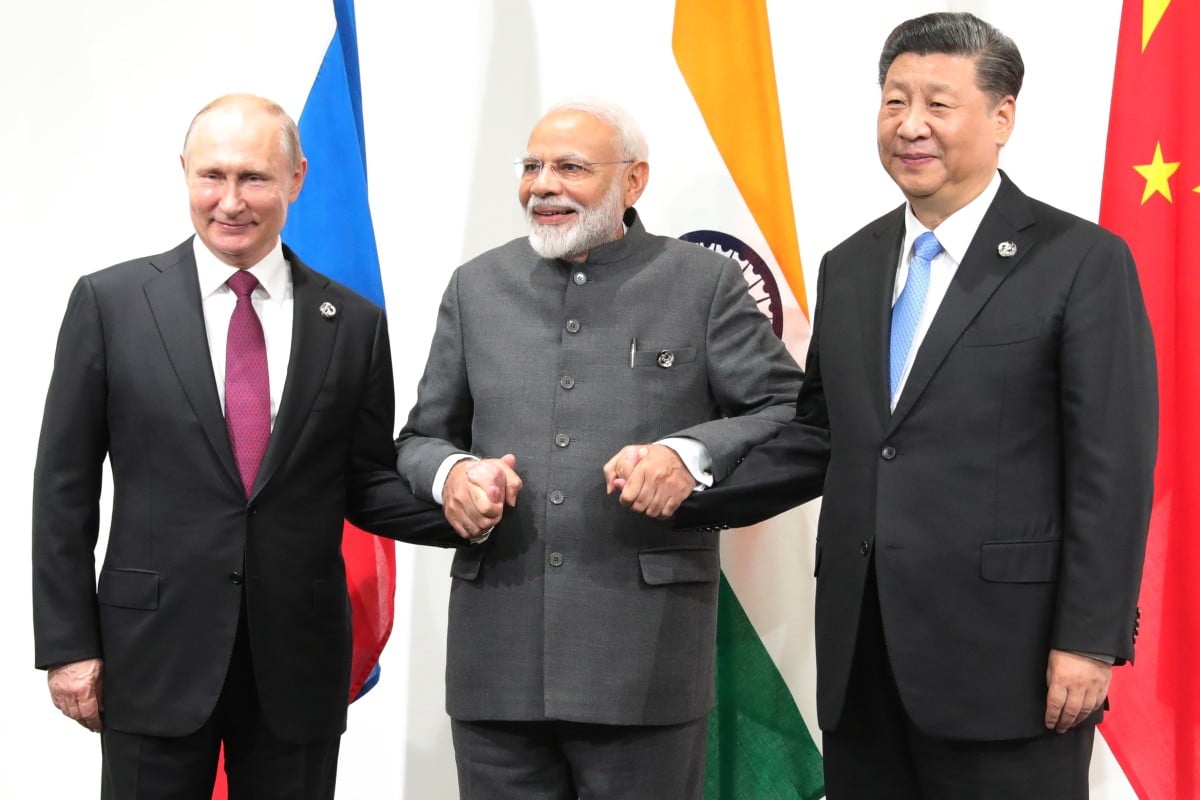
(From left) Russian President Vladimir Putin, Indian Prime Minister Narendra Modi and Chinese leader Xi Jinping meet on the sidelines of the G20 summit in Osaka, Japan, on Friday. Photo: EPA-EFE
Chinese President Xi Jinping on Friday called on the leaders of Russia and India to take “global responsibility” to safeguard the three countries’ interests and uphold multilateralism, as Beijing seeks to rally support amid its protracted trade war with Washington.
Xi made the remarks during a trilateral meeting with Vladimir Putin and Narendra Modi on the sidelines of the annual
summit of world leaders in Osaka, Japan.
The trilateral meeting was part of the Chinese leader’s efforts to marshal international support ahead of his
with US President Donald Trump, seeking to reach a truce on the year-long trade conflict between the world’s two biggest economies.
“The rise of protectionism and unilateralism has severely affected global stability and economic growth, as well as the existing international order which emerging economies and developing countries have relied on,” Xi was quoted as saying by state broadcaster CCTV.
“China, Russia and India should take on global responsibility to safeguard the fundamental and long-term interests of these three countries and the world,” he said.
Xi also called for the nations to promote “a more multipolar world and the democratisation of international relations” – meaning with less reliance on a US-led world order.
During a meeting with leaders of the other BRICS countries – major emerging economies Brazil, Russia, India, China and South Africa – Xi also said Beijing opposed what it saw as “illegal and unilateral sanctions” and “long-arm jurisdiction”.
The efforts to forge closer ties among China, Russia and India come as all three nations are locked in disputes with the United States.
New Delhi, a key strategic ally in Washington’s Indo-Pacific policy to contain China’s rise, has been upset over tariffs imposed on Indian goods by the Trump administration. Meanwhile, geopolitical rivalry and the Kremlin’s alleged meddling in US elections has strained relations between Moscow and Washington.
Beneath the smiles and handshakes, tensions simmer as world leaders meet for G20
Wu Jianghao, director general of the Chinese foreign ministry’s Asian affairs department, said the trilateral meeting laid out a framework for future cooperation.
“The three countries have spoken with one voice on some major global issues, helping stability and injecting positive energy to the current international situation – which is filled with instability and uncertainties,” Wu said at a briefing on Friday.
Wu said that the leaders did not talk about Huawei Technologies or 5G networks, but that the three countries had maintained good communication on telecoms issues and would continue to cooperate.
Washington has banned US companies from selling American technology to Huawei and put pressure on its allies to block the Chinese tech firm over security concerns.
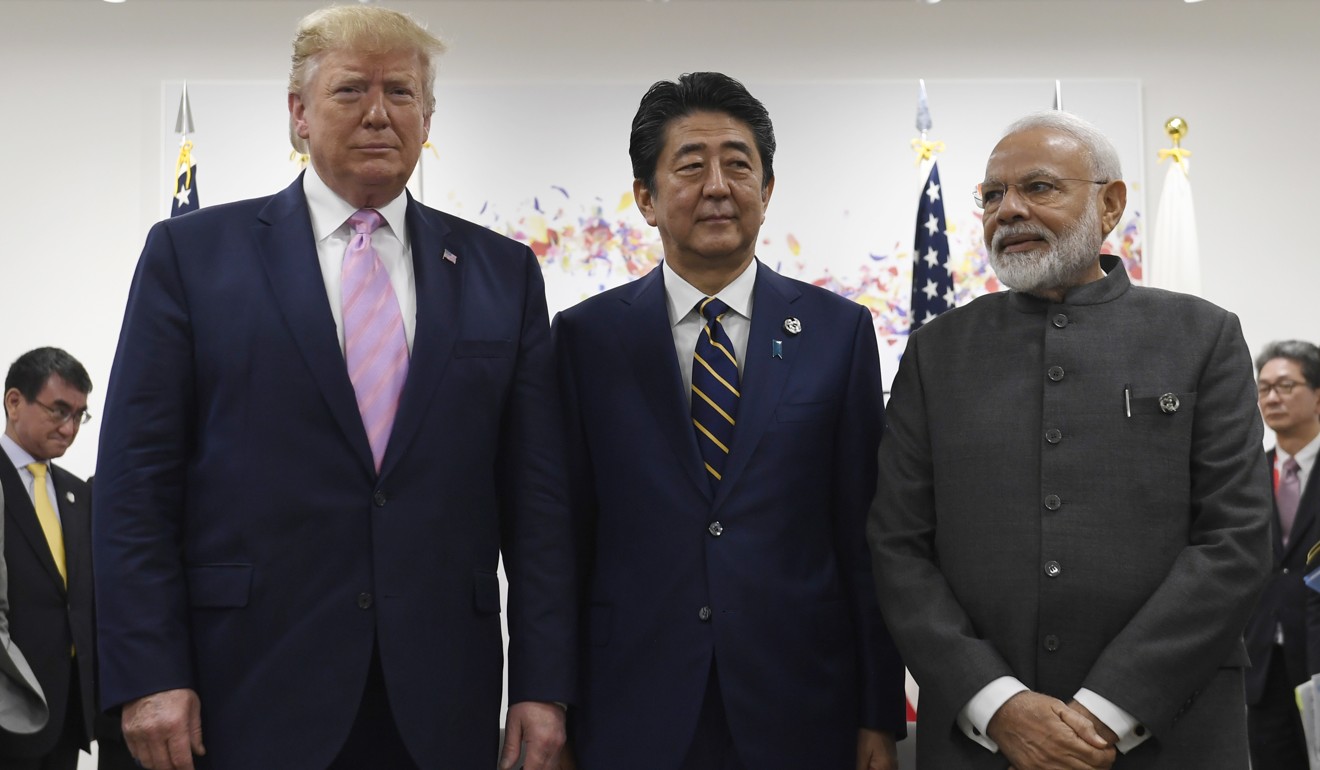
(From left) US President Donald Trump, Japanese Prime Minister Shinzo Abe and Indian Prime Minister Narendra Modi pose for a photo before their meeting. Photo: AP
Meanwhile, the United States is also seeking to build ties with India, with Trump holding trilateral talks with Modi and Japanese Prime Minister Shinzo Abe on Friday.
Indian Foreign Secretary Vijay Gokhale described that trilateral meeting as “very good”, saying it was “short but very productive”.
“The main topic of discussion was the Indo-Pacific, about how the three countries could work together in terms of connectivity, infrastructure and ensuring that peace and stability is maintained, and working together to build upon this new concept so that it would benefit the region as a whole and the three countries,” Gokhale said.
On the Modi-Trump bilateral meeting, he said the two leaders had “a very warm discussion”. They also briefly discussed 5G, with the focus on business cooperation between the two countries to leverage their technology and the potential of the Indian market, according to Gokhale.
He said the discussion of how to develop 5G networks was “in terms of business, not in terms of governments”. “It’s an exciting new area that India and the US can work together [on],” he said.
Source: SCMP
Posted in 5G networks, Beijing, BRICS leaders, China alert, Chinese President Xi Jinping, director general of the Chinese foreign ministry’s Asian affairs department, global responsibility, Huawei, India alert, Indo-Pacific policy, Japanese Prime Minister Shinzo Abe, Narendra Modi, New Delhi, Osaka, President Donald Trump, protect interests, Russia, Uncategorized, Vladimir Putin, Washington |
Leave a Comment »
06/07/2019
- Ambassador Vikram Misri has called on China to balance its US$60 billion trade deficit with India ‘before the issue becomes politically sensitive’
- He also says India will not take sides over its use of US-blacklisted Huawei, as ‘any decision taken over this will only be taken in our national interest’
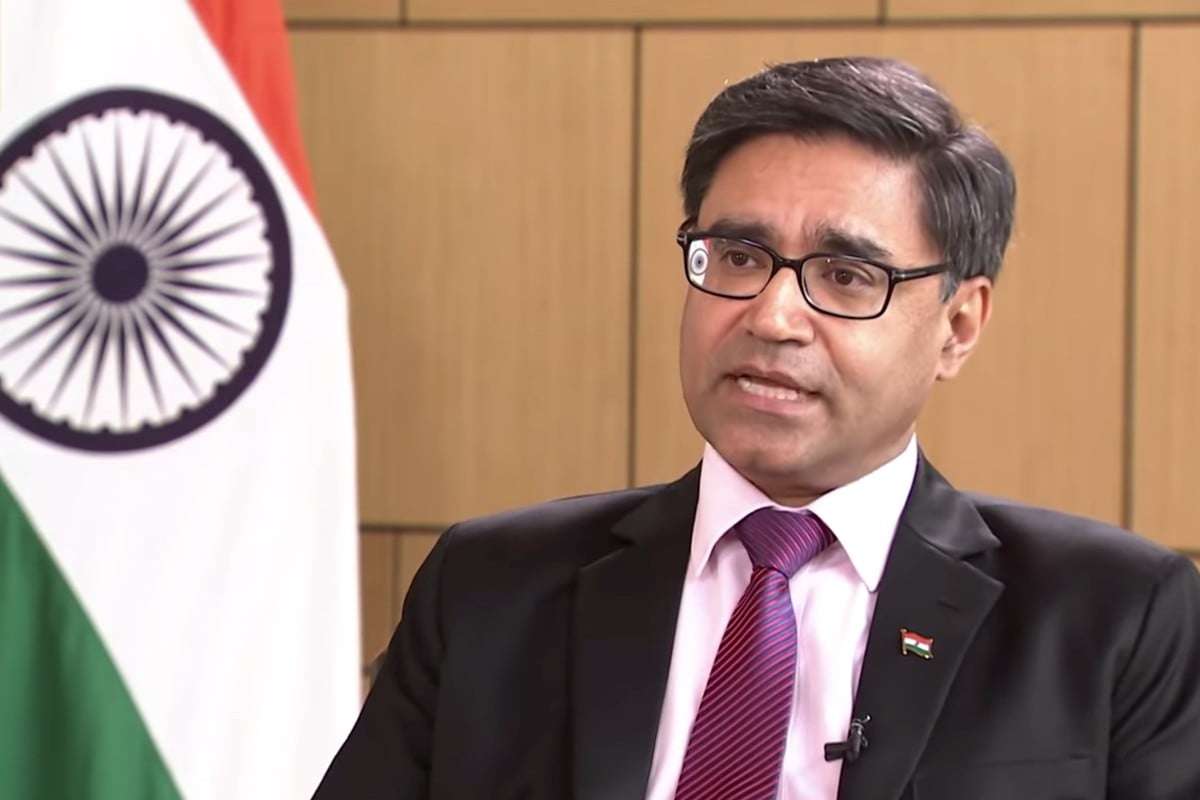
Indian ambassador to China Vikram Misri says that while the countries’ differences will not derail ties, there are still thorny issues to grapple with. Photo: CGTN
so they do not get in the way of the Asian superpowers working together for global stability, India’s top diplomat in China said on Friday.
To emphasise his point, Ambassador Vikram Misri listed eight long-standing and new bilateral issues that required attention, including
’s almost US$60 billion trade deficit with China, cooperation on counterterrorism and a
.
“This trade imbalance is not economically sustainable in the long run,” said Misri at an Asia Society event in Hong Kong. “It is in our mutual interest to find workable solutions before the markets react in unpredictable ways and the issue becomes politically sensitive.”
Frosty ties between two of the world’s largest economies have thawed in the past year following a 73-day
in 2017, with Beijing seeking to forge closer ties with New Delhi amid its ongoing trade and tech war with the United States.
Ivanka Trump, the unlikely messenger of India-US relations
In May, Beijing dropped its long-held objections towards United Nations sanctions on
, the founder and leader of terrorist group Jaish-e-Mohammed, which was behind the suicide bombing of Indian soldiers that brought India and Pakistan to the brink of war earlier this year.
Analysts said this would pave the way for a better relationship between India and China.
Misri said both countries enjoyed a “full-spectrum relationship” of economic, commercial and people-to-people ties, and this was reinforced by the “strong personal bond” Indian Prime Minister
and Chinese President
had, despite the “elements of competition”.
The leaders of the two nations met four times last year and twice in 2019, with Xi set to visit India later this year. Both men share an understanding that “our rise can be mutually reinforcing” and a mutual interest in “preventing differences from turning into disputes”, the ambassador added.
But while Misri, a career diplomat posted to Beijing at the start of this year, stressed that differences would not derail ties, he made no bones about the thorny issues both sides are grappling with.
Will Modi’s snub of Xi’s belt and road derail China-India ties?
Both nations are still engaged in the second of a three-stage process to settle their border dispute – the world’s largest in terms of area, he said.
The first stage was an agreement on the political parameters for a boundary settlement in 2005. The current stage involves agreeing on a framework for a boundary settlement, which Misri said would be translated “into a delineated and demarcated boundary” in the final stage.
Communication over water and shared rivers has also been a key area of cooperation for the two nations.
Indian ambassador to China Vikram Misri speaking at the Asia Society in Hong Kong. Photo: Asia Society
They have established channels for information sharing on cross-frontier rivers, which last year enabled the Chinese side to warn the relevant Indian authorities of a landslide which would send a large amount of water to India. While in this instance the two sides were able to avert a loss of life, they can do more to broaden cooperation, Misri said.
He alluded to how China and India are vying for influence in the Indian Ocean, saying it was an area where both had “contiguous zones of maritime interest”.
The two sides need to work together to preserve peace and stability in the Indo-Pacific region – which stretches from the Indian Ocean to the central Pacific Ocean – and ensure transparent economic and commercial cooperation, infrastructure and connectivity, he said.
As China, India and Russia draw close, has Trump overplayed his hand?
Misri, who served as the private secretary to Modi as well as former prime ministers Manmohan Singh and I.K. Gujral, said there were three areas of mutual interest for India and China.
Besides a “peaceful periphery”, they should cooperate to ensure there are open international systems regarding trade and technology, and that global governance is reformed so the voices of nations such as theirs can be heard.
The Russia-India-China trilateral meeting on the sidelines of last month’s
summit in Osaka, where leaders discussed issues ranging from energy security to climate change, was an opportunity to discuss alternative viewpoints on changing international issues.
This was crucial amid the economic instability caused by
, that were causing “generalised damage” to the global economy, Misri said.
In the question and answer session with the event’s 112 attendees, Misri was asked if India was feeling the pressure to choose in the face of US efforts to get its allies to reconsider using or ban Chinese tech firm
from their superfast 5G networks.
Washington says Huawei equipment could be used by Beijing for spying and the US Commerce Department has placed the company on its entity list, effectively banning US companies from selling equipment and components to it.
When US President
and Xi met at the G20 summit, Trump announced American companies could resume sales to Huawei as long as the products involved did not threaten national security.
Misri referred to this, and said: “Let’s see how it shapes up.”
He added the issue was far from decided for India as it had only achieved 4G connectivity recently and was not yet ready to build out its
Still, he said, “there’s no question on taking sides over this”. “Our leadership is very clear that any decision taken over this will only be taken in our national interest.”
Source: SCMP
Posted in 5G infrastructure, Ambassador Vikram Misri, Asia Society, Beijing, China alert, cross-frontier rivers, differences, disputes, Huawei, India alert, Indian Prime Minister Narendra Modi, manmohan singh, New Delhi, Osaka, President Xi Jinping, Russia, Russia-India-China trilateral meeting, Uncategorized, us commerce department, US President Donald Trump |
Leave a Comment »
04/07/2019
- ‘There’s no need for a confrontation in technology because science has no borders,’ says the founder of CloudMinds
- Huang has watched from up close as the US gradually descended from its telecoms supremacy and China caught up
Bill Huang in 2018. Photo: YouTube
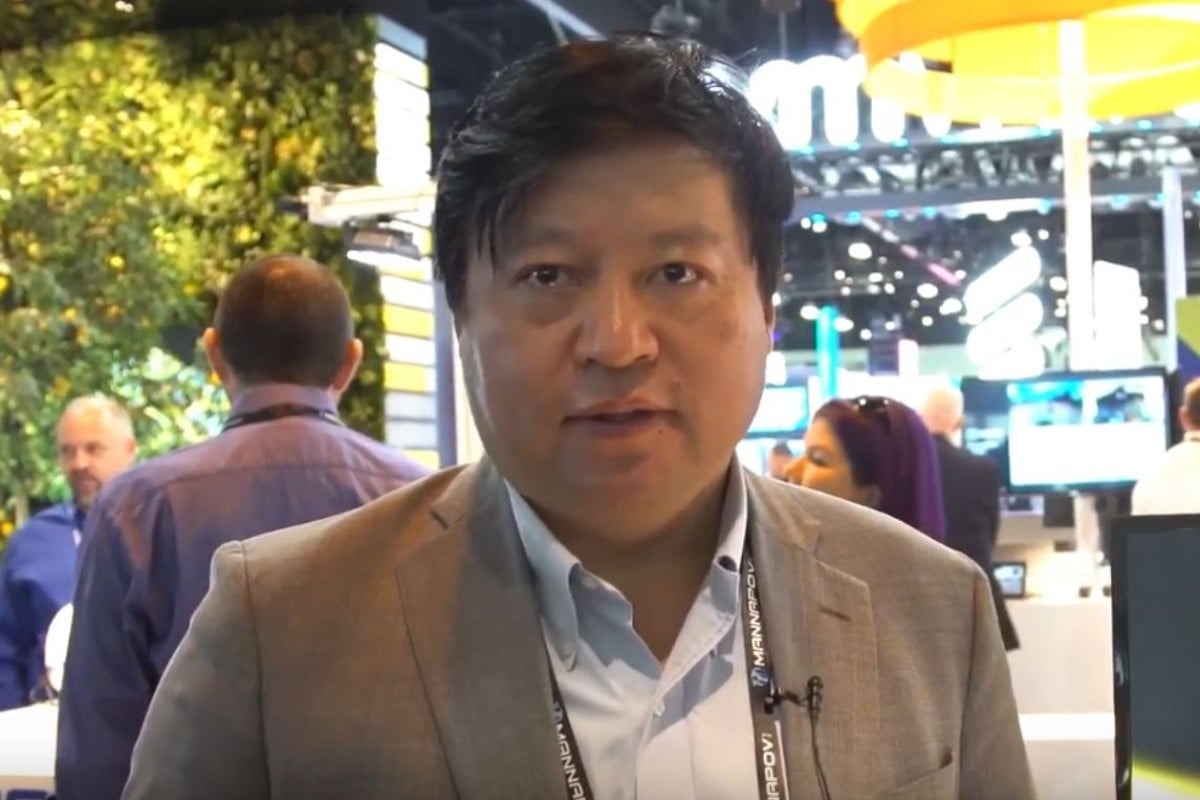
Bill Huang, a Chinese-American telecoms industry veteran, used to target China and its vast, untapped market with the technological know-how he had learned in the US.
But over the past few years, the tables have turned. In his latest business endeavour, the engineer turned entrepreneur is relying on China for a key technology that would transform mobile communication for the next decade – and it is a technology the US has fallen behind on.
As one of the first young mainland Chinese to attend graduate school in the US after diplomatic relations were resumed 40 years ago, and as one of the early participants in Beijing’s global recruitment programme to attract top talent in science and technology, Huang has a unique perspective on the current bilateral stand-off that centres on technology.
CloudMinds Technology, a privately held robotics sector company he founded in 2015, needs the superfast 5G network to support its cloud-based platforms for operating intelligent robots. The next-generation wireless technology has become a flash point in the escalating US-China tech rivalry, and Huang is at the forefront of it all.
“It’s kind of like a one-sided rivalry. Because the US doesn’t have the [5G] technology,” Huang said on the sidelines of a recent conference on China in Philadelphia.
For months, the US government has waged a campaign to block the Chinese telecoms giant Huawei from dominating global 5G networks, lobbying allies to shun the company for what it says are risks of espionage or sabotage by Beijing.
Huawei is already ahead of its European rivals in market share thanks in part to its lower prices. But so far no companies in the US – which has long led the telecoms industry – can make the equipment needed to build the next generation of networks.
Huang, 57, who spent three decades in the mobile communication sector, has watched from up close as the US gradually descended from its telecoms supremacy and China quietly caught up.
Technology is not like martial arts, or Shakespeare’s book, it’s not like everything is copyrighted Bill Huang, CEO of CloudMinds Technology
In its heyday, US giants like AT&T sold network equipment to countries around the world. Huang himself once worked at AT&T’s research hub Bell Labs, a dominant leader in telecoms innovation known as “the idea factory” and arguably the most innovative scientific institution for a long stretch of the 20th century.
“In the last 20 years, the US went from [being] No 1 in the telecommunications industry to now almost exiting telecommunications equipment manufacturing,” Huang said, citing the acquisition of Lucent and Motorola by European counterparts.
It was a decline Huang witnessed with an initial sense of sadness. As a veteran of Bell Labs, he said, he had felt extremely proud of the company’s contribution not only to America, but to telecoms technology worldwide.
“But secondly I also felt a level of pride for China,” he said, “because it went from nothing in telecommunications to lead the world in telecommunications in less than 30 years.”
Huawei was under secret US surveillance, US fraud hearing told
Glenn O’Donnell, an analyst at Forrester Research, said the decline of major US telecoms providers had little to do with politics, but was a function of inadequate interest in innovatation because of their dominance in the field.
“The long lease cycles and until recently the relative maturity of the market really didn’t lend itself well for real innovation,” he said.
“And that’s now changing, and all of those players that decided not to play in telecommunications are now wishing they had a stake because there’s a lucrative new market.”
Also drastically different today is the state of relations between China and the US. As they fight their costly trade war, tensions and acrimony have spilled into other aspects of bilateral relations, from technology, defence and geopolitics to ideology. There are even warnings of “decoupling” – something almost unimaginable to Huang, whose personal trajectory has been shaped by the intertwined ties between his homeland and his adopted country.
Fifth-generation mobile telecommunications technology, or 5G, enables data to be transferred at a speed that is 20 times faster than current standards. Photo: Reuters
He calls himself “a product of China-US relations”. Such was his proud conviction that he gave his son the middle name “Nixon”, after the president who put relations with China back on track in 1972 with a historic trip to Beijing that ended over two decades of antagonism and isolation since the Chinese Communist Party took power.
The visit by Richard Nixon – who died in 1994, the same year Huang’s son was born – not only mended bilateral relations, but created an opportunity for Huang and many others like him: to learn the most advanced science and technology from the world’s leading innovation powerhouse.
Born in 1962 into an intellectual family in southwestern China, Huang spent most of his childhood in the turmoil of the Cultural Revolution.
“As professors, my parents had a very difficult time during the Cultural Revolution. But they insisted that we spend time to study,” he said.
Huang recalled being a “wild kid”, going to school to “have fun”. But when the time came to study, he was able to pick up the pace, which he attributed to the academic minds that run in his family.
Hailed as a “child prodigy”, he passed the country’s first university entrance exam in a decade at the age of 15. A year later, in 1978, he was in the first batch of students to enter university after the disruptions of the decade-long upheaval. He chose to major in electrical engineering, following in his father’s footsteps.
In his sophomore year at the Huazhong Institute of Technology, his parents told him to apply for graduate programmes in the US.
“They think the US has the best technology in the world, and they wanted me to come here to study,” he said. “I read everything about the US … and I was very eager to come.”
Arriving at the University of Illinois’ Chicago campus in 1982, at age 20, Huang was one of the first new Chinese graduates to further their studies in the US after the re-establishment of diplomatic relations in 1979. He did not speak English (although he could read it), and had to enrol in a three-month language training program before he could attend lectures.
He studied computer science in addition to electrical engineering, working day and night on projects in the lab – a time he looks back on with fondness.
“It was some of the most intense time in my life, I suppose,” Huang said. “But I was young and relentless, and I could go on for three days without sleep. … I thoroughly enjoyed it.”
US to speed up 5G development plans as race with China accelerates
Despite their vastly different cultural backgrounds, Huang made friends with his American classmates and fellow foreign students, some of whom were from India and what was then the Soviet Union.
“I experienced zero racial prejudice,” he said. “That was Chicago in the 1980s. I don’t know what happened today, [but back then] it was thoroughly what I thought was the ‘melting pot’.”
In his computer science classes, Huang learned Unix – a state-of-the-art operating system developed by Bell Labs – from adjunct professors who had helped create the program.
Little did he know he would later become a researcher at Bell Labs. “That was the holy ground of telecommunications,” he said, still beaming with pride when speaking of his former employer, which invented, among other things, the communications satellite and the cellular telephone system.
Bill Huang as a graduate student in Chicago in the early 1980s. Photo: CCTV
In 1994, Huang joined 10 other former Bell Labs engineers at a California-based telecoms infrastructure provider that targeted the vast and underserved Chinese market. A year later, the company merged with a telecoms software company to become UTStarcom, with Huang as its co-founder and chief technology officer.
UTStarcom tapped into the fast-growing Chinese telecoms market with a low-cost, limited-range wireless service known as the Personal Access System (PAS). It went public on the Nasdaq exchange five years later. In 2001, China passed the US as having the most mobile phone customers. The rapidly expanding market propelled UTStarcom’s growth; its revenues increased tenfold between its IPO and 2003, when it controlled 60 per cent of China’s PAS market.
In 2007, having lived in the US for longer than he did in China and having become an American citizen, Huang moved from Silicon Valley to Beijing with his wife and son. China Mobile, the country’s largest telecoms operator, had asked him to help build a “Bell Labs for China” – a request he readily accepted.
“It was not only a simple job, but a responsibility, a challenge I thought I should accept no matter what,” he told Chinese state broadcaster CCTV in 2017.
Smartphone screen with resolution million times higher than iPhone: Chinese researchers make technology breakthrough
As the head of the China Mobile Research Institute, Huang led the carrier’s leap from 3G to 4G, and he was also at the centre of 5G research. “We put a lot of effort into researching what standards are required for the future network,” he said.
His return to China preceded the “Thousand Talents Plan”, a state-backed recruitment drive to lure the world’s brightest scientists and experts – especially those with roots in China – with lavish grants. But when the plan was set up in 2008, Huang was among the first batch of researchers to be enlisted.
“I express my heartfelt thanks to the state and the people for giving me such a good opportunity and condition to return home and serve the country,” Huang was quoted as saying at a forum for recipients of Thousand Talents awards hosted by People’s Daily in 2010.
“I worked for over 20 years abroad, and all my work was in the field of technology. I hope to bring the whole set of things I know back to China,” he added.
The recruitment scheme, much celebrated at the time, has become a sensitive subject today as tensions between the US and China escalate. It has drawn growing scrutiny and suspicion from the US, where investigators are looking for any connection to theft of American intellectual property. In response, China hushed up or deleted references to the programme in universities, companies and cyberspace.
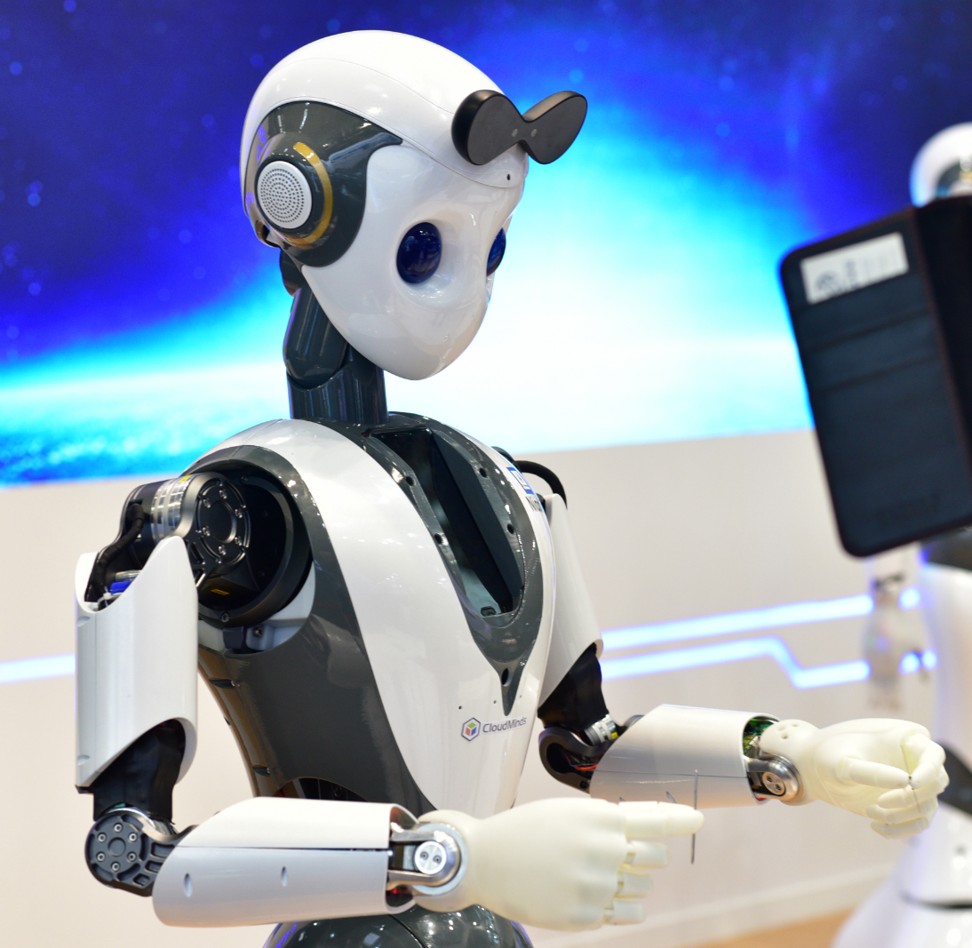
A robot made by CloudMinds Technology showcased at the Mobile World Congress Barcelona in February. Photo: Handout
When asked about US complaints regarding China’s alleged technology theft, Huang gave a vehement defence of China.
“I think these are just basically blatant accusations with no ground,” he said. “Ninety-nine per cent [of the technologies] are not stolen. There are industrial espionage cases … but they’re not systematic cases, and they’re not [the result of the] rivalry between China and the US – they’re the result of competition.”
Huang also dismissed accusations that Chinese scientists and experts have “stolen” US technology.
“Technology is not like martial arts, or Shakespeare’s book, it’s not like everything is copyrighted,” he said.
“Everyone in Silicon Valley in the last 50 years started from somewhere, and then they become an entrepreneur and they move [on] to start their own companies. So in the early days, everyone took a little bit from what they have worked on.”
“It was customary, and then it became very litigious. Then people started saying: wait a minute, you can do that? So there were many exemplary cases, then it became more and more refined in what you can take and what you cannot take; what is protected and what is not protected. All of these things are happening industry-wide, it’s not a single US and China issue.”
Can China meet US demands over IP theft and forced technology transfer?
But intellectual property theft is not the only American grievance. Many US companies have accused China of forced technology transfers, with foreign businesses required to hand over technology to their Chinese partners in exchange for access to the market.
Huang said that complaint “has been there since day one”.
“Chinese companies will always complain about American companies. American companies will always complain about Chinese companies. The reason is very simple: every company would want to use regulations and law to their advantage,” he said.
A trained engineer, Huang holds a “globalist” view of technology – at odds with the national security perspective that has become prevalent in Washington.
“There’s no need for a confrontation in technology because science has no borders,” he said.
“In Huawei labs, there are many American engineers. In Intel and Qualcomm’s labs, I can assure you there are many Chinese engineers, and there are many German, French, Swedish engineers in all of these organisations. The fact they’re sold by a Chinese company or they’re sold by an American company has no meaning because behind the technologies is an international effort.”
To make his point, Huang calls the technology created by CloudMinds a “US and China technology”.
“I mean, how do you categorise it? Is it created by China or the US? It’s created by both. Because we have engineers in Silicon Valley, and we have engineers in Beijing.”
Protecting IP in China is hard, but awareness is rising, thanks to Trump
The company has dual headquarters, with its global operation based in Santa Clara, California, and its China operation based in Beijing – a structure Huang says now “makes perfect sense”.
“That was by design, by our lawyers. They kind of foresaw, if there [are] going to be trade tensions, this would be the right way to do it.”
But Huang questions if these tensions – a large part of which he said had been “politicised” – are so deeply embedded in every corner of society.
“I come to the United States very often, and I talk to the industry. I still feel it is the same America.”
“I encountered no scrutiny, no warning, and everyone is encouraging us, both from the US and from China, to continue our practice,” he said, adding that he only felt the tension when speaking to lawyers and government officials.
“But I am worried by all these stories. I think that’s why I said earlier: in the media it all looks very scary, but in practice, it’s all business as usual.”
Source: SCMP
Posted in America couldn’t offer, AT&T, Beijing, Bell Labs, Bill Huang, California, China Mobile Research Institute, Chinese engineers, CloudMinds, Cultural Revolution, Forrester Research, French, German, Huawei, Huazhong Institute of Technology, Intel, IP theft, People’s Daily, Qualcomm Inc, Richard Nixon, Santa Clara, Silicon Valley, Swedish, Thousand Talents awards, Uncategorized, University of Illinois, Unix, US-trained telecoms entrepreneur, UTStarcom, wireless technology |
Leave a Comment »
29/06/2019
OSAKA (Reuters) – The United States and China agreed on Saturday to restart trade talks with Washington holding off new tariffs on Chinese exports, signalling a pause in the trade hostilities between the world’s two largest economies.
Commenting on a long-running dispute over China’s Huawei, President Donald Trump said U.S. firms would be able to sell components to the world’s biggest telecoms network gear maker where there was no national security problem.
The truce offered relief from a nearly year-long trade standoff in which the countries have slapped tariffs on billions of dollars of each other’s imports, disrupting global supply lines, roiling markets and dragging on global economic growth.
“We’re right back on track and we’ll see what happens,” Trump told reporters after an 80-minute meeting with Chinese President Xi Jinping on the sidelines of a summit of leaders of the Group of 20 (G20) major economies in Osaka, western Japan.
Trump said while he would not lift existing import tariffs, he would refrain from slapping new levies on an additional $300 billion worth of Chinese goods – which would have effectively extended tariffs to everything China exports to the America.
“We’re holding back on tariffs and they’re going to buy farm products,” he said at a news conference, without giving any details of China’s future agricultural product purchases.
“If we make a deal, it will be a very historic event.”
He gave no timeline for what he called a complex deal but said he was not in a rush. “I want to get it right.”
HUAWEI HOPES
On Huawei, Trump said the U.S. commerce department would meet in the next few days on whether to take it off a list of firms banned from buying components and technology from U.S. companies without government approval.
China welcomed the step.
“If the U.S. does what it says, then of course, we welcome it,” said Wang Xiaolong, the Chinese foreign ministry’s envoy for G20 affairs.
U.S. microchip makers also applauded the move.
“We are encouraged the talks are restarting and additional tariffs are on hold and we look forward to getting more detail on the president’s remarks on Huawei,” John Neuffer, president of the U.S. Semiconductor Association, said in a statement.
Huawei has come under mounting scrutiny for over a year, led by U.S. allegations that “back doors” in its routers, switches and other gear could allow China to spy on U.S. communications.
While the company has denied its products pose a security threat, the United States has pressed its allies to shun Huawei in their fifth generation, or 5G, networks and has also suggested it could be a factor in a trade deal.
The problems at Huawei have filtered across to the broader chip industry, with Broadcom Inc warning of a broad slowdown in demand and cutting its revenue forecast.
RELIEF AND SCEPTICISM
In a lengthy statement on the two-way talks, China’s foreign ministry quoted Xi as telling Trump he hoped the United States could treat Chinese companies fairly.
On the issues of sovereignty and respect, China must safeguard its core interests, Xi was cited as saying.
“China is sincere about continuing negotiations with the United States … but negotiations should be equal and show mutual respect,” the foreign ministry quoted Xi as saying.
Trump had threatened to extend existing tariffs to almost all Chinese imports into the United States if the meeting brought no progress on wide-ranging U.S. demands for reforms.
Source: Reuters
Financial markets are likely to breathe a sigh of relief on news of the resumption in U.S.-China trade talks.
“Returning to negotiations is good news for the business community and breathes some much needed certainty into a slowly deteriorating relationship,” said Jacob Parker, a vice-president of China operations at the U.S.-China Business Council.
“Now comes the hard work of finding consensus on the most difficult issues in the relationship, but with a commitment from the top we’re hopeful this will put the two sides on a sustained path to resolution,” he said.
Some, however, warned the pause might not last.
“Even if a truce happens this weekend, a subsequent breakdown of talks followed by further escalation still seems likely,” Capital Economics said in a commentary on Friday.
The United States says China has been stealing American intellectual property for years, forces U.S. firms to share trade secrets as a condition for doing business in China, and subsidizes state-owned firms to dominate industries.
China has said the United States is making unreasonable demands and must also make concessions.
Talks collapsed in May after Washington accused Beijing of reneging on reform pledges. Trump raised tariffs to 25% from 10% on $200 billion of Chinese goods, and China retaliated with levies on U.S. imports.
The U.S.-China feud had cast a pall over the two-day G20 gathering, with leaders pointing to the threat to global growth.
In their communique, the leaders warned of growing risks to the world economy but stopped short of denouncing protectionism, calling instead for a free, fair trade environment after talks some members described as difficult.
Posted in agricultural product purchases, Back on track, China alert, China and U.S. agree, Chinese President Xi Jinping, components, Group of 20 (G20), holding off, Huawei, major economies, new tariffs, Osaka, President Donald Trump, restart trade talks, Technology, U.S. Semiconductor Association, Uncategorized, United States, Washington |
Leave a Comment »
28/06/2019
BEIJING, June 28 (Xinhua) — Chinese President Xi Jinping is set to sit down with his U.S. counterpart, Donald Trump, on the sidelines of the Group of 20 (G20) summit in the Japanese city of Osaka, igniting a flicker of hope to bring the China-U.S. trade talks back on track.
The meeting arrives at a time when Washington’s trade offensive against China is not only poisoning one of the world’s most important bilateral relationships, but also risking throttling the already frail global economic recovery. Its significance is thus too great to miss.
When the two presidents met each other at last year’s G20 summit in Argentina’s capital city of Buenos Aires, they reached an important consensus to pause the trade confrontation and resume talks. Since then, negotiating teams on both sides have held seven rounds of consultations in search for an early settlement.
However, China’s utmost sincerity demonstrated over the months seems to have only prompted some trade hawks in Washington to press for their luck.
Following its failure to coerce Beijing into swallowing a deal with unequal terms, a disappointed and enraged Washington returned to its tactic of tariffs by raising additional levies on 200 billion U.S. dollars’ worth of Chinese goods from 10 percent to 25 percent, and threatening a new round of tariff hikes on another 300 billion dollars’ worth of goods.
Some ultra-conservative U.S. decision-makers, who have for many years seen in China a “threat” to Washington’s sole superpower status, have tried to extend the trade campaign into a broader operation to shut China out and contain its rise.
As a result, Washington is cracking down on Chinese high-tech companies including telecom equipment provider Huawei, while many Chinese students seeking to study in the United States are facing more restrictions like months-long visa delay.
Thanks to Washington’s relentless efforts, the two countries, which should have celebrated the 40th anniversary of their diplomatic ties this year, are seeing their relations slipping down the path to a possible all-out confrontation.
Despite Washington’s “in-your-face” style of maximum pressure strategy, China has been steadfastly consistent in its position. It has always been committed to settling trade frictions via dialogue and consultation and safeguarding its legitimate and sovereign rights at the same time.
Beijing, as it has on various occasions reaffirmed, does not want a trade war, but is not afraid of one, and will fight to the end if necessary.
Last week, Xi had a telephone conversation with Trump at the request of the U.S. leader, saying that he stands ready to meet Trump in Osaka to exchange views on fundamental issues concerning the development of China-U.S. relations.
Xi’s words reflect an alarming fact that the two countries are facing a challenge to the fundamentals of their relationship. The upcoming Xi-Trump meeting provides a unique opportunity for the two sides to find new common ground in easing trade tensions and bring the troubled ties back onto the right track.
If the two sides can reach an agreement to pick up the talks, the United States needs to place itself on an equal footing with China, and accommodate China’s legitimate concerns on the basis of mutual respect, equality and mutual benefit in order to seek win-win results in the future negotiations.
Just one day ahead of the Osaka G20 summit, some U.S. politician again threatened to slap punitive levies on imported Chinese goods. Such cheap tactics to bring China down to its knees with pressure will get nowhere.
For more than a year, Washington’s spoils in its tariff campaign have so far only seen rising daily costs for ordinary American consumers, growing rejections from U.S. farmers, industry workers and business leaders, roller-coaster rides in U.S. stock markets, as well as China’s increasingly stronger determination to defend its rights.
The trade fight between the world’s two largest economies has already hit hard the global market and dented investors’ confidence worldwide. The latest World Trade Outlook Indicator reading of 96.3 remains at the weakest level since 2010, signaling continued falling trade growth in the first half of 2019, according to the World Trade Organization.
Trade wars produce no winner. In his latest telephone talk with Xi, Trump said he believes the entire world hopes to see the United States and China reach an agreement. To get an agreement, Washington’s hardliners need to know that Beijing will neither surrender to their pressure, nor permit Washington to deprive Chinese people of their rights to pursue a better life.
And for the agreement to be sustainable, Washington’s China policy should be rational. A rising China is not seeking to grab global hegemony. It will continue to work with nations around the world, including the United States, to boost common development and build a community with a shared future for mankind.
The past 40 years of China-U.S. relationship have proved that when the two countries work together, they both win and the world gains as well. But when they fight each other, all are poised to lose.
China and the United States, as two major economies in the international community, bear special responsibility for the wider world.
Therefore, the two sides, just as what Xi said during his meeting with The Elders delegation this April in Beijing, need to manage their differences, expand cooperation and jointly promote bilateral relations based on coordination, cooperation and stability so as to provide more stable and expectable factors to the world.
Source: Xinhua
Posted in Argentina, back, Beijing, bring, Buenos Aires, Chinese President Xi Jinping, Huawei, meeting, on track, opportunity, Osaka, President Donald Trump, talks, tariffs, Uncategorized, Washington, Xi-Trump meetin |
Leave a Comment »
23/06/2019
- Leader will arrive on Thursday, ahead of G20 summit in Osaka, foreign ministry says
- He is expected to hold talks with Donald Trump on sidelines of meeting
China has confirmed that President Xi Jinping will travel to japan this week. Photo: AFP
China on Sunday confirmed that President Xi Jinping will attend the G20 summit in Osaka this week.
Xi will spend three days in Japan – his first visit to the country since coming to power in 2013 – the foreign ministry said.
He will travel to Japan on Thursday and is expected to meet his US counterpart Donald Trump on the sidelines of the meeting of leading and emerging economies, which runs from Friday to Saturday, it said.
It is possible the pair will hold formal negotiations over dinner, as they did in Argentina in December at the last G20 summit.
Presidents Xi and Trump are expected to hold talks over dinner, as they did in Argentina in December. Photo: Kyodo
On Saturday, People’s Daily, the mouthpiece of China’s Communist Party said in a commentary that the trade war between China and the US could be resolved only through “equal conversation”.
“For the talks to resume … the key is to address the primary concern of the other side. The tariffs already in place must be revoked,” it said.
Trade deal ‘within reach if Xi and Trump show courage’
Meanwhile, state broadcaster CCTV on Friday criticised Washington’s decision to add five Chinese companies to its list of entities considered a threat to national security.
“The US made this move to put more pressure China ahead of the trade talks,” it said, adding that it might produce a result opposite to the one desired by Washington.
The report came after the US commerce department said it had added five Chinese firms that manufacture supercomputers and their components to the entity list, restricting their ability to do business with the US.
The blacklist effectively bars American firms from selling technology to the Chinese organisations without government approval. Last month, the commerce ministry added telecoms giant
to the list, heightening tensions with Beijing.
Xi told Trump on Tuesday he was willing to meet in Japan. Photo: AP
In a telephone conversation on Tuesday, Xi told Trump he was willing to meet in Japan and said he “agreed that the two countries’ trade delegations should keep communications going to solve their differences”, CCTV reported.
Kong Xuanyou, China’s new envoy to Japan, said on Friday that he hoped Xi would make an official visit to the country soon, ideally during the cherry blossom season next spring. The foreign ministry statement made no mention of such a visit.
Source: SCMP
Posted in CCTV, China confirms, China’s new envoy to Japan, Commerce Ministry, equal conversation, Foreign Ministry, G20 summit, Huawei, Japan, mouthpiece of China’s Communist Party, Osaka, People’s Daily, President Donald Trump, President Xi Jinping, revoked, tariffs, three-day trip, Uncategorized, Washington |
Leave a Comment »
22/06/2019
LONDON, June 21 (Xinhua) — Chinese Ambassador to the United Kingdom Liu Xiaoming on Friday said he trusted that Britain will make its decision independently, in the UK’s national interest and in the interest of Sino-UK cooperation.
Liu said in an exclusive interview with Sky News that even though there have always been differences between China and Britain, these differences have not prevented the countries from working for the common good.
Liu said Huawei is a good company and it has made its contribution to the telecom industry in the country.
The Ambassador said Huawei is the leader in 5G technology. “I do hope that the UK will keep Huawei for the benefit,” he said.
Source: Xinhua
Posted in 5G technology, believes, Chinese ambassador, Huawei, independent decision, Sky News, telecom industry, UK, Uncategorized |
Leave a Comment »
17/06/2019
- Washington has blamed Tehran for an attack on two oil tankers near the Strait of Hormuz, putting pressure on Iran’s allies like China
- Beijing usually backs its trade partner – but experts say the trade war with the US and problems with Huawei may have changed the equation
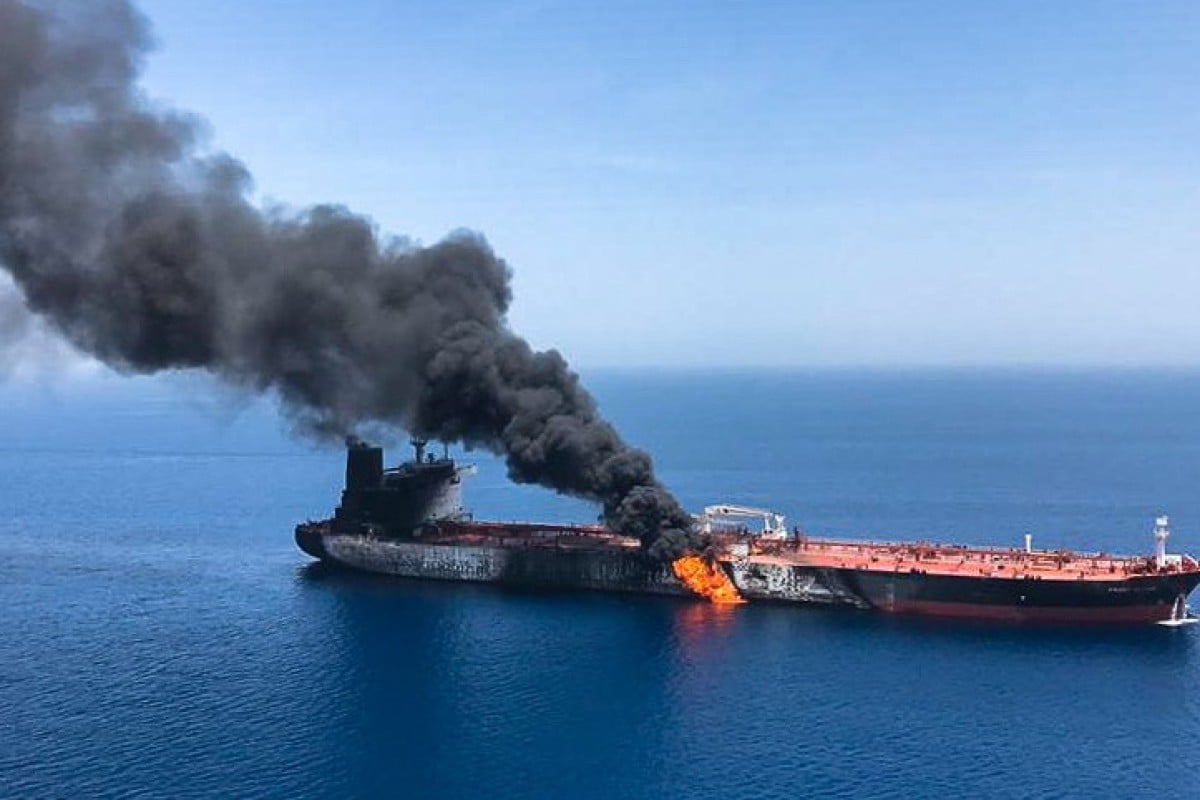
A tanker burns in the Gulf of Oman after a mystery attack that the United States has blamed on Iran. Photo: AFP
When
headed to Tehran this week for the first visit by a sitting Japanese prime minister in four decades, some in the diplomatic world imagined he could be the man to bring
back to the negotiating table with the
.
Those hopes were torpedoed on Thursday when, on the same day Abe was meeting Iran’s supreme leader Ayatollah Khamenei, explosions ripped through two oil tankers, one Japanese and one Norwegian, near the Strait of Hormuz, a strategically significant shipping lane.
The attack immediately overshadowed an earlier success for Abe, who had met President Hassan Rowhani a day before and was assured Iran would stick to the terms of a 2015 agreement limiting its nuclear activities.
Washington accused Iran of being behind the attack on the tankers, releasing a video on Friday that it said showed Iran’s revolutionary guard removing an unexploded mine from one of the ships, and warning that it would “defend its interests”.
Iranian President Hassan Rowhani and Japanese Prime Minister Shinzo Abe meet Iran’s Supreme Leader Ayatollah Ali Khamenei in Tehran. Photo: Reuters
Tehran, for its part, claimed to have been set up, with its foreign minister Mohammad Javad Zarif saying “suspicious doesn’t begin to describe” the incident. So much, then, for hopes of mediation.
US President
, who had encouraged the Japanese leader’s visit, admitted on Twitter soon afterwards that when it came to negotiating, “they are not ready, and neither are we!”
Still, the incident exposed more than just the naivety of those hoping for an Abe-led breakthrough. In raising the stakes in Washington’s confrontation with Tehran, it also threw the spotlight on Iran’s dwindling number of allies – and perhaps most significantly on its largest trading partner, China – which face mounting pressure to rethink the relationship.
Tanker attacks: world divided over Iran role as Saudi prince breaks silence
The day after the attack, China’s President
said Beijing would promote its ties with Iran “however the situation changes” – a comment made during a meeting with Iranian President Hassan Rowhani on the sidelines of the Shanghai Cooperation Organisation summit in Kyrgyzstan – but diplomatic observers question just how far China can go in accommodating its controversial trading partner.
BEST FRIENDS FOREVER?
Iran has long been able to count on support from China, which accounts for 30 per cent of the Islamic republic’s exports and imports, and its willingness to defy US pressure is a gamble at least partly based on an assumption it can continue to count on Beijing’s support.
As Iran’s largest economic partner – Chinese direct investment in Iran hit a record high of nearly US$4 billion last year, according to data analysis project ChinaMed – Beijing already plays a key role in relieving US pressure on Iran, said Mohsen Shariatinia, assistant professor of regional studies at Shahid Beheshti University in Tehran.
But experts warn that reliance will come into question as China becomes increasingly hamstrung by its own problems.
China has enough problems of its own, starting with US pressure on Huawei. Photo: EPA
Chief among Beijing’s headaches are its
with Washington and the related assault on its
giant
– which, as analysts point out, originally ignited over allegations it was defying US sanctions on Iran. Beijing will also be well aware of the need to keep
, its second-biggest oil supplier and Tehran’s critic-in-chief, happy.
On the other hand, analysts say, China will be wary of being seen to abandon its old friend, as doing so would send a message to other nations at odds with Washington that they could no longer look to China as a diversification strategy.
“This could mean Chinese investment is vulnerable to US interference,” said Esfandyar Batmanghelidj, founder of Bourse Bazaar, a media company that supports business diplomacy between Europe and Iran.
Sanctions drive Iranian students away from US towards Asia
Doing so, Batmanghelidj said, would put a question mark over one of China’s most significant foreign policies of recent years – President Xi’s signature
to fund infrastructure across Eurasia.
THE BELT AND ROAD QUESTION
Tensions between Iran and the US have reached boiling point in recent weeks, after the Trump administration last month ended waivers on sanctions for nations importing Iranian oil – a move the US says is aimed at making the republic “radioactive to the international community” and which Rowhani has described as an “economic war against Iran”.
So far, China has largely stuck by the Islamic Republic, continuing to buy fuel from it despite the latest wave of US sanctions on Iranian oil that followed Trump’s decision last year to withdraw the US from the landmark 2015 agreement curbing Tehran’s nuclear development.
The deal had been widely lauded as a triumph of multilateralism and the dawning of a new economic era for Iran.
US releases video of ‘Iranian forces removing unexploded mine’ from ship
Part of its eagerness to support Iran has stemmed from the Islamic Republic’s key position in the Belt and Road plan. In 2017 alone, China signed deals for more than US$15 billion in Iranian infrastructure investment, according to the
mouthpiece China Daily.
Planned projects include high-speed rail lines, upgrades to the nation’s electrical grid, and natural gas pipelines. The two nations have also vowed to boost bilateral trade to US$600 billion in the next seven years.
“China sees Iran as its Western gateway, where not only is it a big market in itself, but it will also be the gateway to the rest of the
and ultimately to Europe for China,” said Anoush Ehteshami, professor of international relations at Durham University in Britain.
Nisha Mary Mathew, at the Middle East Institute in Singapore, said that China’s relationship with Iran was not just economic – but primarily strategic, with both nations envisioning an international order that was no longer dominated by the US and its Western allies.
DEFIANCE, FOR NOW
If the belt and road gives China good reason to stick with Iran, there are plenty of voices urging just that action. As Andrea Ghiselli at Shanghai’s Fudan University pointed out, US sanctions until now have only strengthened the hardline factions in Iran’s government.
The combination of the US withdrawal from the nuclear deal – which had the support of the international community – along with Europe’s tepid efforts to rescue it, may have emboldened those favouring resistance over negotiation.
Xi’s supportive comments in Kyrgyzstan were only the latest in a string of remarks from China that could encourage such factions.
If Trump kills off Huawei, do Asia’s 5G dreams die?
After China’s Foreign Minister Wang Yi met Iranian Foreign Minister Mohammad Javad Zarif in Beijing last month, the ministry’s spokesman Lu Kang said China’s economic relationship with Iran was “reasonable and lawful”.
Two months prior to that, China’s Minister of Commerce Zhong Shan, while hosting his Iranian counterpart Farhad Dejpasand, had claimed China’s “determination to maintain and develop the China-Iran comprehensive strategic partnership is unshakeable”.
Chinese President Xi Jinping with Iranian President Hassan Rowhani. Photo: AFP
Even so, the pressure is getting to some. In February, Foreign Minister Zarif temporarily resigned, in what Andrea Ghiselli at Fudan University in Shanghai called a clear sign of the “changing and precarious power balance with Iran’s foreign policy establishment”.
And nowhere is the pressure felt more keenly than the economy and China’s ability to serve as a lifeline.
“The real anxiety in Iran right now is about market share,” said Bourse and Bazaar’s Batmanghelidj. “If you’re exporting zero oil and your customers are buying oil elsewhere, you lose market share.
“The government wants to know if it agreed to go back to the negotiating table and the US promised sanctions relief, that there are people who are going to buy in significant volume.”
TURNING POINT: HUAWEI
For many analysts, the event most likely to have changed the equation in Beijing’s eyes is the arrest by the Canadian authorities of
, the chief financial officer of Chinese telecom giant Huawei.
Meng’s arrest came at the request of the US government, which claimed her company had violated sanctions by selling equipment to Iran.
Many observers saw the action as Washington’s way of signalling to Chinese companies that they would face repercussions if they eased the pressure on Iran by continuing to trade.
Huawei’s chief financial officer Meng Wanzhou. Photo: Reuters
“Going after Huawei was about going after Chinese enterprises – signalling that they can no longer trade with Iran with impunity,” Batmanghelidj said.
Since then, Chinese firms have shown increased skittishness towards trading with Iran. According to China’s General Customs Administration, Chinese exports to Iran declined by more than half between October 2018 and February 2019, from over US$1 billion to just under US$500 million.
Mohammad Ali Shabani, a researcher at the School of Oriental and African Studies in London, said other countries in the region were now watching to see if China would blink in the face of US pressure. “This could have dire consequences for China’s image as a reliable partner,” he said.
NOT JUST ABOUT AMERICA
There are reasons beyond US pressure that may factor into Beijing’s thinking. It has long stated its opposition to Iranian nuclear weapons development, and Chinese Foreign Minister Wang Yi has said that China is “ready” to take on “its due responsibilities and make a greater contribution to world peace and common development”.
Trade war: here are Beijing’s options – and none look any good
Zhao Hong, at the Research School of Southeast Asian Studies at Xiamen University, said that in stepping up as a responsible world power Beijing faced a dilemma over its approach to Iran.
“Chinese leaders have to painfully balance an impulse towards economic cooperation with Iran against other vital interests, including convincing Washington that China is a responsible stakeholder,” he wrote in the Journal of Contemporary China.
Saudi Aramco’s Ras Tanura oil refinery. The country is China’s second-largest oil supplier after Russia. Photo: Reuters
Then there is China’s relationship with Iran’s chief adversary, Saudi Arabia, to consider. Riyadh is China’s second-largest oil supplier, behind Russia, and it plays a central role in Beijing’s energy strategy.
According to International Trade Centre data, more than 12 per cent of China’s imported oil came from Saudi Arabia last year, compared with just 6 per cent from Iran. Last year, Saudi Arabia shipped 56.73 million tonnes of oil to China, or 1.135 million barrels per day.
Why would Kim Jong-un trust Trump, now that he’s ripped up Iran’s nuclear deal?
This April, China imported 6.3 million tonnes of oil from Saudi Arabia, nearly twice the 3.24 million tonnes it imported from Iran, according to China’s General Administration of Customs.
Iran’s comparatively small share of China’s oil imports market and its heavy reliance on China as a trading partner add up to a deeply uneven relationship, experts say, and it is this imbalance that will encourage the US that China may be open to rethinking its ties.
As Jon Alterman, director of the Middle East programme at Washington DC think tank the Centre for Strategic and International Studies, pointed out, while China was Iran’s largest trading partner, Iran represented less than 1 per cent of China’s international trade.
“Iran needs China,” Alterman said. “But to China, Iran is expendable.”
Source: SCMP
Posted in Ayatollah Khamenei, Beijing, Belt and Road (B&R), Centre for Strategic and International Studies, Durham University in Britain, Farhad Dejpasand, Foreign Minister Wang Yi, Fudan University, General Administration of Customs, General Customs Administration, Gulf of Oman, high-speed rail lines, Huawei, iran, Iran’s ties with China, Iranian Foreign Minister Mohammad Javad Zarif, Iranian President Hassan Rowhani, Islamic Republic, Japanese Prime Minister Shinzo Abe, Journal of Contemporary China, Kyrgyzstan, Meng Wanzhou, Middle East, Middle East Institute in Singapore, Minister of Commerce Zhong Shan, Oil tanker attacks, oil tankers, President Xi Jinping, Research School of Southeast Asian Studies, Riyadh, Russia, Saudi Arabia, Saudi Aramco's Ras Tanura oil refinery, Strait of Hormuz, Tehran, torpedoed, Uncategorized, United States, US President Donald Trump, Washington, Xiamen University |
Leave a Comment »
15/06/2019
- In the last half of the 20th century US worries about a rising Japan led to tariffs and technology mistrust
- Differences in the Chinese experience may predict a different outcome
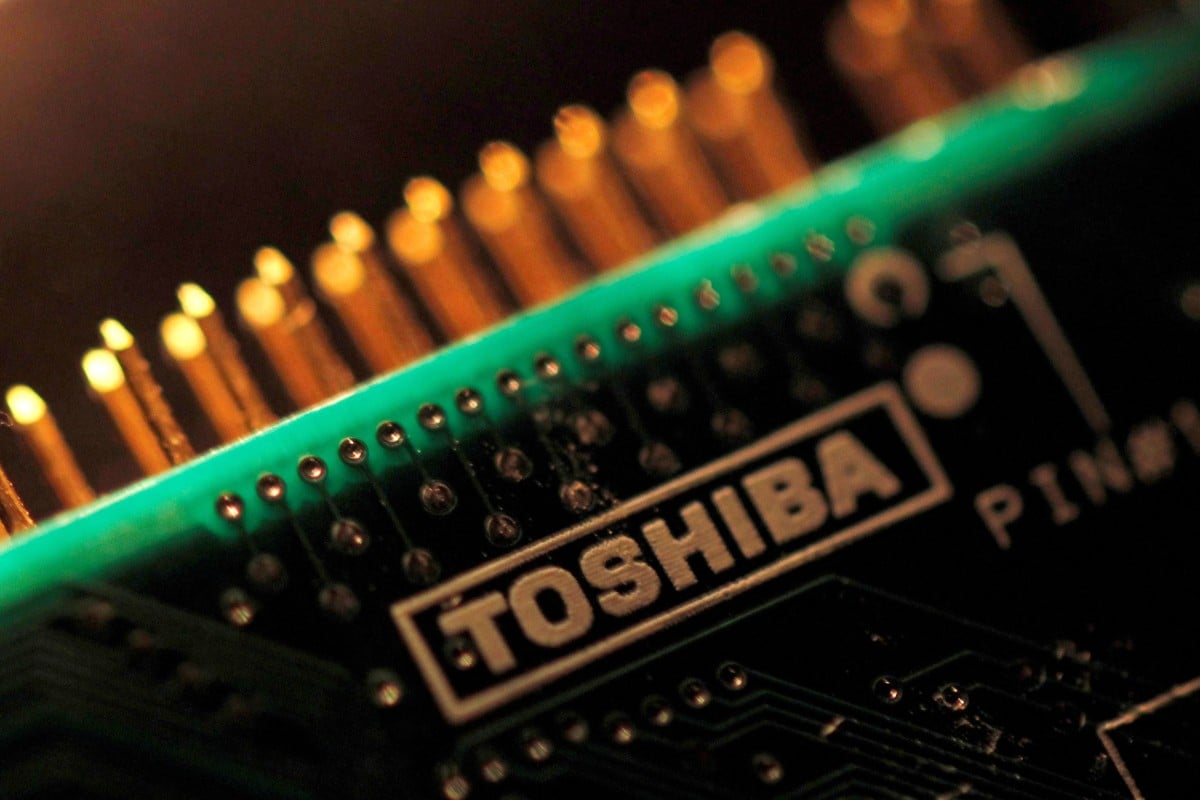
Toshiba was one of the companies affected by US actions to prevent the rise of Japan in a trade war that echoes in today’s tensions between the US and China. Photo: Reuters
If history is a mirror to the future, the similarities between the spiralling technology stand-off between China and the US and the economic wars waged by the US with Japan – which peaked in the 1980s and 1990s – may be instructive. But there are differences between the two which may predict a different outcome.
The US-Japan economic tensions started in the 1950s over textiles, extended to synthetic fibres and steel in the 1960s, and escalated – from the 1970s to 1990s – to colour televisions, cars and semiconductors, as Japan’s adjusted industrial policy and technology development moved it up the industrial chain.
Boosted by government support, Japan’s semiconductor industry surpassed the US as the world’s largest chip supplier in the early 1980s, causing wariness and discontent in the US over national security risks and its loss of competitiveness in core technologies.
The Reagan administration regarded Japan as the biggest economic threat to the US. Washington accused Tokyo of state-sponsored industrial policies, intellectual property theft from US companies, and of dumping products on the American market.
The US punished Japanese companies for allegedly stealing US technology and illegally selling military sensitive products to the Soviet Union. It also forced Japan to sign deals to share its semiconductor technologies and increase its purchases of US semiconductor products.
“The Trump administration is using similar tactics against China that were used against Japan in the 1980s and 1990s,” said an adviser to the Chinese government, on condition of anonymity, adding that the US was continuing its hegemony to curtail China’s tech development and was trying to mobilise its allies to follow suit.
After talks to end the US-China trade faltered last month, Huawei – a global leader in the 5G market – is now standing at centre stage of a protracted technology stand-off between Beijing and Washington, which has grown increasingly wary of the rising competitiveness of Chinese tech companies.
Zhang Monan, a researcher with the Beijing-based China Centre for International Economic Exchanges, does not foresee an easing of the rivalry between the US and China.
“The current US-China conflicts are more complicated than those between the US and Japan,” she said.
“The US will only get more intense in its containment of China and the tech rivalry won’t ease, even if China and the US could reach a deal to de-escalate the trade tensions.”
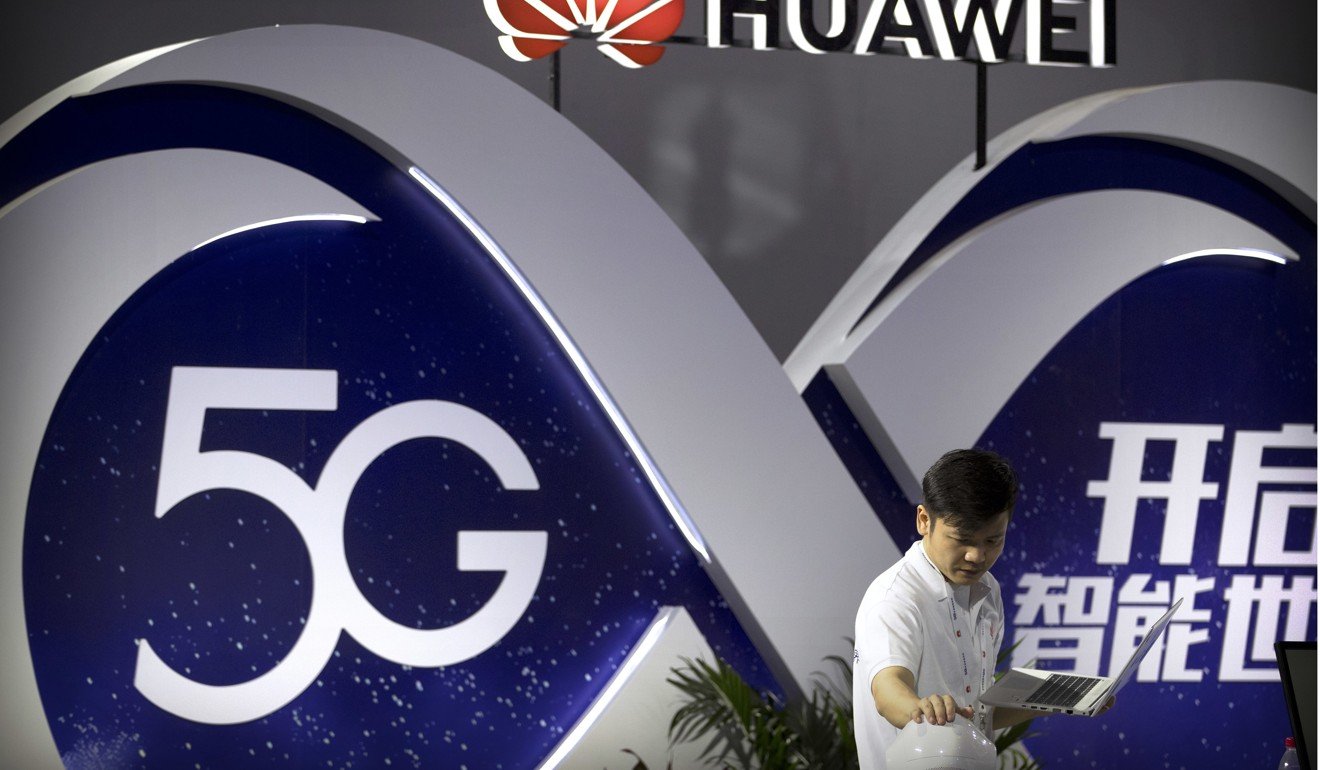
Huawei is at the centre of a technology stand-off between Beijing and Washington. Photo: AP
Back in 1982, the US justice department charged senior officials at Hitachi with conspiracy to steal confidential computer information from IBM and take it back to Japan. IBM also sued Hitachi. The two companies settled the case out of court and Hitachi paid 10 billion yen (US$92.3 million) to IBM in royalties in 1983, while accepting IBM inspections of its new software products for the next five years.
Toshiba, a major electronics producer in Japan, and Norway’s Kongsberg Vaapenfabrikk secretly sold sophisticated milling machines to the Soviet Union from 1982 to 1984, helping to make its submarines quieter and harder to detect. This transfer of sensitive military technology in the middle of an arms race between the US and the Soviet Union was not revealed until 1986.
The US issued a three-year ban on Toshiba products in 1987 and the company ran full-page advertisements in more than 90 American newspapers apologising for its actions.
In 1985, the US imposed 100 per cent tariffs on Japanese semiconductors. A year later, in its five-year semiconductor deal with the US, Japan agreed to monitor its export prices, increase imports from the US, and submit to inspections by the Office of the United States Trade Representative.
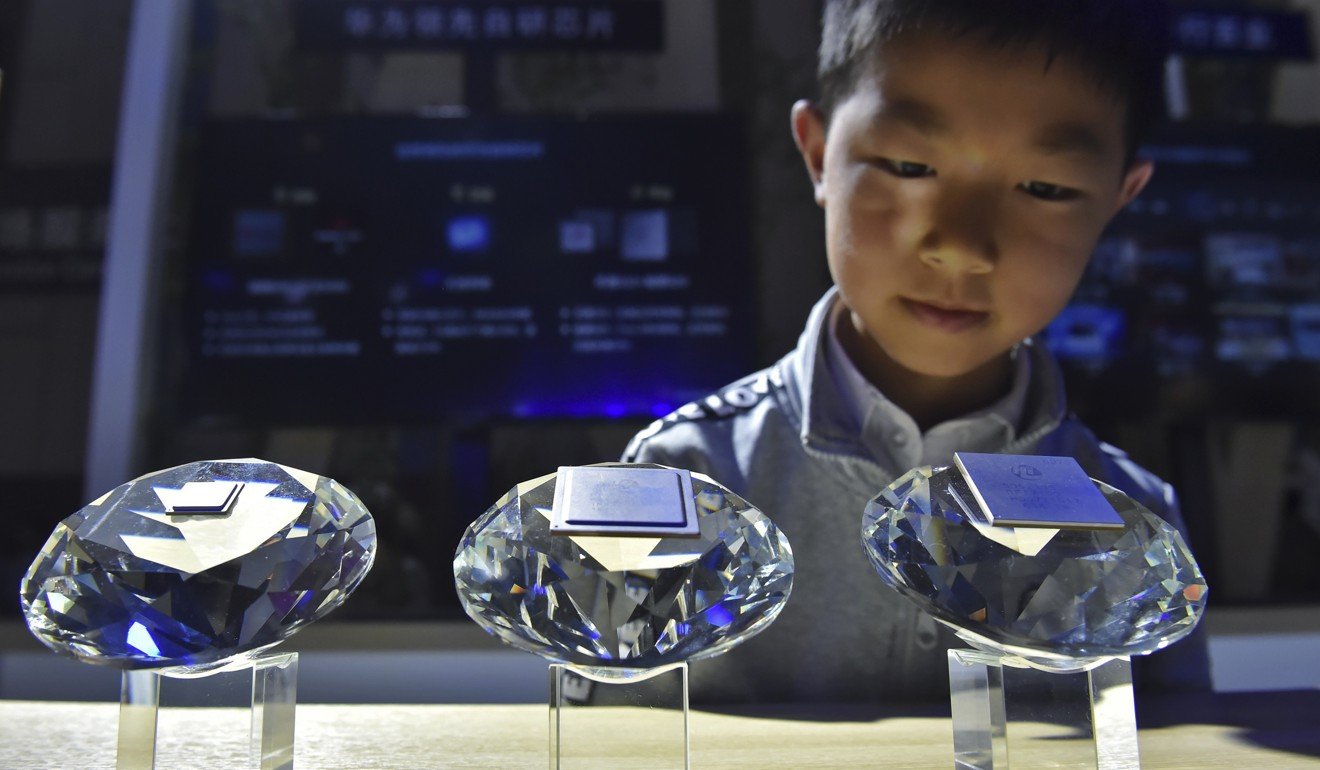
A display of chips designed by Huawei for 5G base stations on show at the China International Big Data Industry Expo. Photo: AP
This was followed by a second five-year semiconductor deal in 1991, in which Japan agreed to double the US market share in Japan to 20 per cent. In yet another bilateral semiconductor deal in 1989 Japan was required to open its semiconductor patents to the US.
Meanwhile, the US government boosted its efforts to help American businesses cement their industrial leverage in the chip sector and unveiled rules to protect its domestic chip industry.
The two countries were irreconcilable in 1996 on how to measure their respective market share. Overall market circumstances had also changed by then, with the US becoming competitive in microprocessing, and South Korea and Taiwan emerging as strong rivals to Japan.
Its dominance in semiconductors lost, Japan reached out to Europe for a range of cooperative technology deals.
Cooperate, don’t confront: academic advises Beijing on trade war tactics
“History can tell that high technology matters greatly to national security strategies. It is not a process of mere market competition. It follows the law of the jungle,” Zhang said.
The US has intensified its investment scrutiny by rolling out the Foreign Investment Risk Review Modernisation Act last year, which extends the regulation to key industrial technology sectors.
Zhang predicted the US would continue to contain China’s technological development in key sectors such as AI, aerospace, robots and nanotechnology – all of which are of great importance to Beijing.
The US has said Chinese tech giants Huawei and ZTE present a national security risk. Last April it cut US supplies to ZTE, citing violations of sanctions against Iran and North Korea. The ban was removed three months later after ZTE paid US$1.4 billion in fines.
It was a wake-up call for China to develop its own core technologies. The subsequent US ban on Huawei added to the urgency to do so, observers said.
Wang Yiwei, a professor in international relations with Renmin University, said China had to develop its own hi-tech know-how while continuing the opening up process.
“China has paid a price to learn whose globalisation it is,” he said.
“We may see some extent of disengagement with the US in technology and dual-use sectors, but China can speed up cooperation with European countries, and other countries such as Israel, to offset the risks from the US.”
In December, the US filed criminal charges against Huawei and its chief financial officer Sabrina Meng Wanzhou, alleging bank fraud, obstruction of justice and technology theft.
The squeeze continued last month with the US blacklisting Huawei, restricting its access to American hi-tech supplies and putting pressure on its allies to freeze the company out of the 5G market. So far, those allies, including Germany and Japan, have remained hesitant about meeting the US request and refrained from siding with either country.
Chinese foreign ministry spokesman Geng Shuang said on Monday that Huawei had obtained 46 commercial contracts in 30 countries as of June 6, “including some US allies and some European countries that the US has been working hard to persuade out of the contracts”.
For Zhang, the differences between Japan’s experience of US concerns of technological advancement and China’s may offer some hope for Chinese ambitions.
“Dependent on US for security protection, Japan was limited in [its ability to] push back and was already a developed country,” she said.
“But China has huge domestic market potential to address the imbalance [between] economic and technology development. This remains a big attraction to multinational companies, which would enable China to integrate into global innovation and technology cooperation, but China has to figure out how to dispel the doubts on its growth model.”
Source: SCMP
Posted in Beijing, China alert, China Centre for International Economic Exchanges, China International Big Data Industry Expo, Foreign Investment Risk Review Modernisation Act, Hitach, Huawei, IB, IBM, iran, Israel, Japan, Japan experience, Kongsberg Vaapenfabrikk, learn, Lessons, North Korea, Norway, Office of the United States Trade Representative, Reagan administration, Renmin University, Toshiba, trade war, Trump administration, Uncategorized, Washington, ZTE |
Leave a Comment »











 CHINDIA ALERT: You'll be living in their world, very soon