15/05/2020
- Hungarian Foreign Minister Peter Szijjarto tells Chinese counterpart, Wang Yi, that his country ‘always upholds the one China principle’
- Wang also speaks to foreign ministers of Estonia and Bosnia and Herzegovina ahead of World Health Assembly, which starts on Monday
Chinese Foreign Minister Wang Yi spoke to three European foreign ministers on Thursday. Photo: AP
Hungary supports Beijing’s efforts to prevent
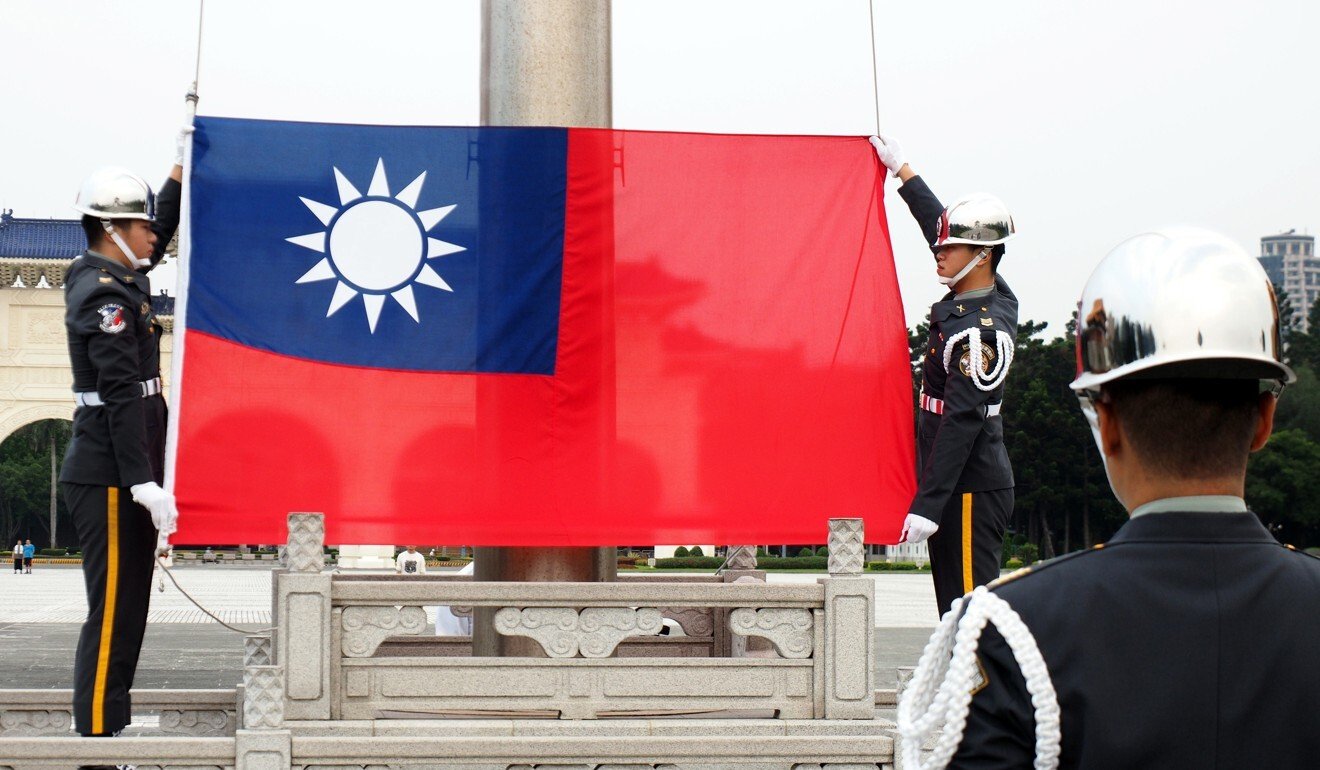
Taiwan taking part in the upcoming World Health Assembly (WHA), according to a Chinese statement issued after a telephone conversation between the two countries’ foreign ministers.
China’s Foreign Minister Wang Yi called his European counterpart, Peter Szijjarto, on Thursday, the foreign ministry in Beijing said.
During the call, Szijjarto told Wang that Budapest would not support Taiwan’s accession to the World Health Organisation (WHO) ahead of the annual gathering of health ministers from around the world that starts in Geneva on Monday and which Taipei is keen to attend.
Hungary “always upholds the one China principle”, Szijjarto was quoted as saying.
A report about the ministers’ call by the Hungarian foreign ministry, however, made no mention of Taiwan.
It said that Szijjarto thanked Wang for the medical supplies China had sent to Hungary board 121 flights since the start of the Covid-19 pandemic.
The pair also discussed cooperation on 5G and the development of a rail project between Budapest and the Serbian capital, Belgrade, it said.
Beijing opposes Taiwan’s involvement in the WHO. Photo: EPA-EFE
As well as speaking to Szijjarto, Wang called the foreign ministers of Estonia and Bosnia and Herzegovina on Thursday to discuss the Covid-19 pandemic, but Taiwan was not mentioned, the Chinese statement said.
Taipei donated 80,000 face masks to Estonia in April, and last week, Urmas Paet, an Estonian member of the European parliament urged Budapest to support Taiwan’s membership of the WHO and “not allow itself to be manipulated by China”.
Taiwan has long campaigned to regain observer status at the WHO and has ramped up those efforts since the start of the global health crisis. Despite the devastation caused by Covid-19,
Taiwan has reported just 440 confirmed cases and seven deaths.
Taiwan attended the WHA meetings as an observer between 2009 and 2016, unopposed by Beijing as at the time the island was led by president Ma Ying-jiu from the mainland-friendly Kuomintang.
However, relations between Taipei and Beijing have soured since 2016 and the election of
President Tsai Ing-wen, from the pro-independence Democratic Progressive Party, who won a second term of office in January.
WHO put nations at risk by excluding Taiwan from knowledge sharing, US report says
13 May 2020
Taiwan has not been alone in its campaign to regain its WHO status, with the United States, Australia, New Zealand, Canada and several European countries backing the move.
Last week, US Secretary of State Mike Pompeo called on all nations to support Taipei’s participation as an observer at the WHA, and urged WHO director general Tedros Adhanom Ghebreyesus to allow it.
Despite the support, Taiwan’s Vice-Premier Chen Chien-jen said on Thursday that because of the pressure from Beijing there was now little chance of Taiwan attending the WHA.
China’s foreign ministry spokesman Zhao Lijian said last week it was “resolutely opposed” to New Zealand’s support for Taiwan.
In his calls to Europe, Wang also said that cooperation between Beijing and 17 central and eastern European nations – under the “17+1” banner – would not be affected by the health crisis and that further talks would be held once it had been brought under control.
Source: SCMP
Posted in 5G, around the world, Australia, Beijing, Belgrade, Bosnia, Budapest, canada, cooperation, Covid-19 pandemic, Democratic Progressive Party, development, Estonia, European countries, foreign ministers, Geneva, health ministers, Herzegovina, Hungarian Foreign Minister, Hungary, Kuomintang, medical supplies, membership, Mike Pompeo, New Zealand, one-China principle, opposing, President Tsai Ing-wen, pro-independence, rail project, Serbian capital, stands, Taipei, Taiwan’s, Uncategorized, United States, US Secretary of State, Wang Yi, World Health Assembly, World Health Organisation |
Leave a Comment »
30/04/2020
- European nations are divided over how best to deal with Beijing, which looms larger in their policy and public debates
- Think tanks came together and reported on China’s much-touted medical aid and ‘mask diplomacy’ during Covid-19 crisis
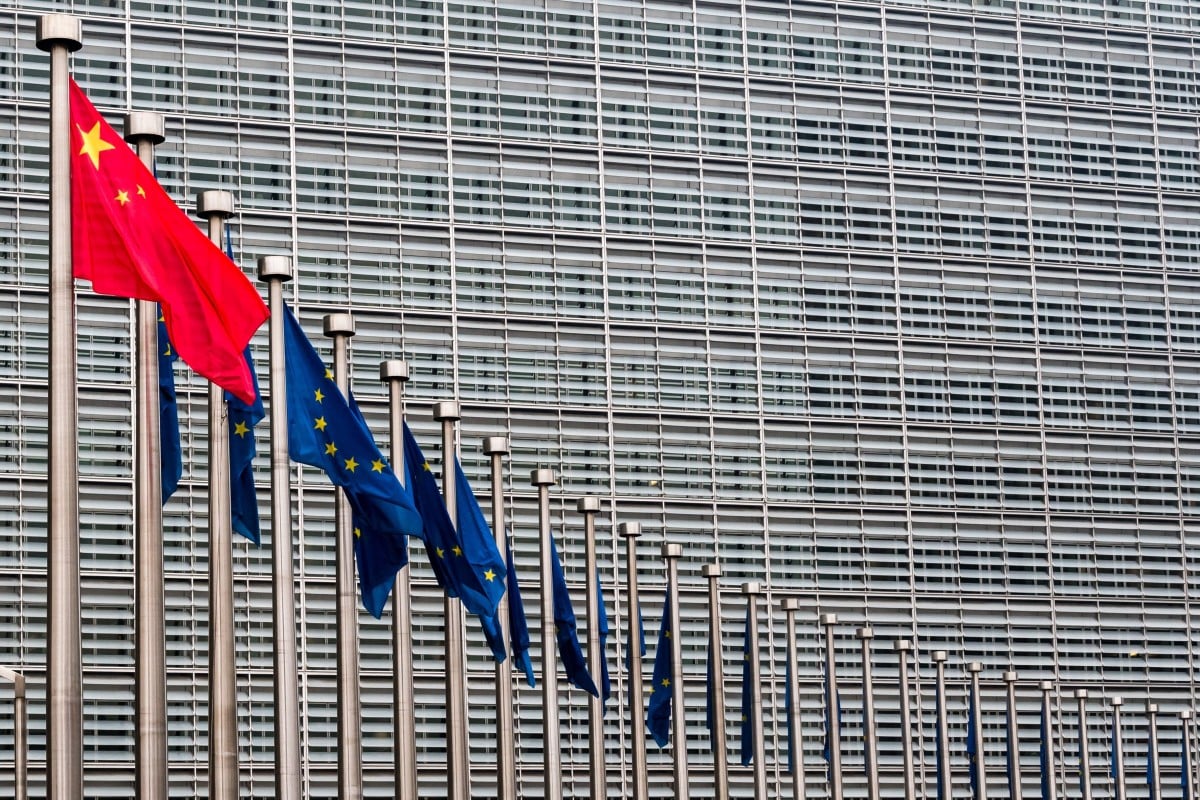
European nations are looking to be more cohesive in their approach towards relations with China. Photo: Bloomberg
As Beijing steps up its pressure campaign on Europe in the wake of the Covid-19 pandemic, their relations look set to become more diverse and contested amid growing distrust and wariness of China’s expanding influence, according to new research.
The study, based on analysis of China’s role in 19 European countries’ handling of the coronavirus crisis, showed that Europe remained largely divided over how to deal with Beijing, which has figured ever more prominently in policy and public debates in many parts of the continent.
A total of 28 experts from 21 think tanks across the continent, collectively known as the European Think-tank Network on China, were involved in the research.
It came on the heels of a diplomatic debacle in the past week that saw the European Union reportedly bowing to pressure by China. The EU reportedly toned down part of a report documenting Beijing’s disinformation efforts to deflect the blame and rewrite the global coronavirus narrative.
Although a spokesperson for the EU denied those allegations, the saga has “moreover revealed the pressures that China has placed on
officials during the crisis”, according to John Seaman, editor of the report and a research fellow at the French Institute of International Relations.
In a phone call on Wednesday, Chinese Premier Li Keqiang and European Commission President Ursula von der Leyen shrugged off concerns about their discord and vowed to boost the fight against the virus and boost economic recovery, according to Xinhua.
Germany ‘rejected China’s bid for positive spin’ on pandemic response
According to Seaman, the Covid-19 crisis hit at a time when traditionally trade-driven China-EU relations had grown more complex and competitive after the European Commission said for the first time last year that Beijing was a systemic rival.
“Debates over the need to adopt more coherent strategies towards China have been emerging across Europe. In many ways, the current crisis has become a catalyst for a number of trends that have been shaping Europe-China relations in recent years, while in other ways it has turned the tables,” he said in the report.
“It has simultaneously brought Europe and China into closer cooperation, pushed them further apart, and seemingly underlined the fractures that exist within Europe on how to approach an increasingly influential China.”
A growing number of European countries, including
Sweden and Britain, have joined the United States and
Australia in calling for an international inquiry into China’s handling of the pandemic. Leaders from Germany and France have also pressed Beijing for greater transparency about the origin of the deadly virus.
The European think tanks’ report was also focused on China’s unusually aggressive coronavirus diplomacy, with Chinese embassies and ambassadors shifting the blame on to Western democracies and promoting Beijing’s messaging “with varying degrees of dogmatism, divisiveness and moderation” on Twitter and in traditional media.
“While China’s increasingly proactive public diplomacy is widespread, and there appears to be a relative degree of consistency in messaging, there is a diversity in method that ranges from low key (Latvia or Romania) to charm offensive (Poland, Portugal, Italy or Spain) to provocative or aggressive (Sweden, Germany or France),” the report said.
It examined China’s much-touted medical aid and “mask diplomacy” and found “a correlation between Chinese companies with commercial interests in the country and donations from these companies” in countries including Greece, Hungary, Italy, Portugal and Spain.
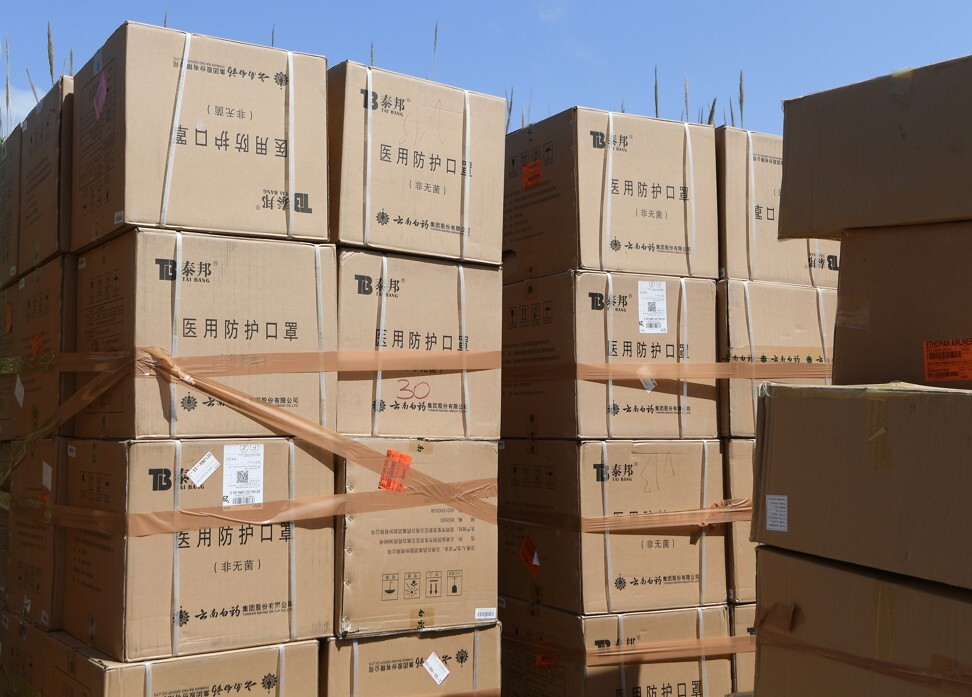
Boxes of medical supplies from China in Rome. Some European nations are growing wary about China’s diplomatic overreach and apparent willingness to alter the coronavirus narrative. Photo: Xinhua
Many countries have pushed back against China’s diplomatic overreach and its preferred narrative that has served to “[underline] the apparent successes of its autocratic governance model, ignoring its clear downfalls in managing the crisis initially, while sowing doubt on the effectiveness of liberal democracies”, according to Seaman.
While the European Union’s foreign policy chief Josep Borrell warned of Beijing’s geopolitical game to expand its influence through spinning and “politics of generosity”, countries such as Germany and Sweden have moved to tighten investment screening, 5G and industrial policies targeting Chinese firms.
Zhang Ming, China’s top envoy to the EU, last week dismissed the concerns about China’s alleged ploy to use the vulnerabilities of other countries to advance China’s geopolitical interests, such as with the country’s embattled tech giant Huawei and the ambitious Belt and Road Initiative.
“Disinformation is our common enemy and we need to make joint efforts to eradicate it,” Zhang said, claiming China had been a victim of unspecified disinformation campaigns.
The report also noted that China’s actions towards Europe in times of crisis looked set to amplify the fractures across the continent and prompt further debates about the need for a coherent EU strategy on China.
A poll of more than 12,000 people across the 28 EU member countries by German think tank Bertelsmann Stiftung in September last year showed 45 per cent of Europeans saw China as a competitor while only 9 per cent believed their countries shared the same political interests or values with China.
Another survey of 16 European countries released by the Pew Research Centre in December also showed the continent remained deeply divided over how to approach China.
While people in most of western Europe and some of Central and Eastern Europe, such as Slovak and Czech, saw China negatively, 51 per cent in Greece had a positive view of China and those in Russia, Ukraine, Poland, Bulgaria and Lithuania tended to see China more favourably.
Source: SCMP
Posted in according, Australia, “disinformation”, Beijing, Britain, Bulgaria, Chinese premier Li Keqiang, Covid-19 crisis, Czech, distrust, diversity, divided, dogmatism, during, Eastern Europe, European Commission President, European nations, European Union, France, French Institute of International Relations, Germany, Greece, hit, Hungary, international inquiry, Italy, Lithuania, medical aid, pandemic, Poland, Portugal, Rome, Russia, Slovak, Spain, Sweden, Twitter, Ukraine, Uncategorized, United States, Xinhua |
Leave a Comment »
25/02/2020
LONDON (Reuters) – Britain’s biggest retailer Tesco (TSCO.L) has completed its exit from China with the 275 million pound sale of its joint venture stake to state-run partner China Resources Holdings (CRH).
Having struggled to crack the Chinese market, Tesco established the Gain Land venture with CRH in 2014, combining the British group’s 131 stores in China with its partner’s almost 3,000.
The disposal of its 20% stake allows Tesco to further simplify and focus the business on core operations, it said on Tuesday, adding that the proceeds will be used for general corporate purposes.
The deal is scheduled to complete on Feb. 28.
Shares in Tesco were up 0.7% at 0816 GMT, extending its gains over the last year to 12.4%.
“This extra 275 million pounds of ‘forgotten value’ should be accretive to most street valuations,” said Bernstein analyst Bruno Monteyne.
After costly exits from Japan and the United States and the sale of its South Korean business, Tesco signalled in December a further retreat from its once lofty global ambitions by starting a review of its operations in Thailand and Malaysia – its last remaining wholly owned businesses in Asia.
A sale of its operations in Thailand and Malaysia would mean Tesco’s only remaining overseas operations, apart from Ireland, would be its central European division, comprising stores in the Czech Republic, Hungary, Poland and Slovakia.
The Asian exit could be one of the last acts of Tesco CEO Dave Lewis, who will be succeeded by Ken Murphy in October.
Bernstein’s Monteyne expects Tesco to start a 1 billion pound share buyback programme in its 2020-21 financial year.
“With this transaction and the possible sale of Thailand and Malaysia, Tesco’s biggest short-term concern could be how to efficiently return cash to shareholders,” he said.
Source: Reuters
Posted in Britain’s biggest retailer, Business, China, China Resources Holdings (CRH), completes, Czech Republic, exit, Hungary, Ireland, Japan, Malaysia, Poland, Slovakia, South Korean, Tesco, Tesco (TSCO.L), Thailand, Uncategorized, United States |
Leave a Comment »
21/02/2020
(Reuters) – Airlines have been suspending flights to China or modifying service in response to the coronavirus outbreak.
Below are details (in alphabetical order):
AIRLINES THAT HAVE CANCELLED ALL FLIGHTS TO MAINLAND CHINA
** American Airlines – Extends suspension of China and Hong Kong flights through April 24
** Air France – Said on Feb.6 it would suspend flights to and from mainland China for much of March
** Air India – Suspends flights to Shanghai, Hong Kong until June 30
** Air Seoul – The South Korean budget carrier suspended China flights from Jan. 28 until further notice.
** Air Tanzania – Tanzania’s state-owned carrier, which had planned to begin charter flights to China in February, postponed its maiden flights.
** Air Mauritius – Suspended all flights to China and Hong Kong
** Austrian Airlines – until end-February.
** British Airways – Jan. 29-March 31.
** Delta Airlines – Feb. 2-April 30
** Egyptair suspended flights on Feb, 1, but on Feb. 20 said it would resume some flights to and from China starting next week.
** El Al Israel Airlines – Said on Feb. 12 it would suspend its Hong Kong flights until March 20 and reduce its daily flights to Bangkok. It suspended flights to Beijing from Jan. 30 to March 25 following a health ministry directive.
** Iberia Airlines – The Spanish carrier extended its suspension of flights from Madrid to Shanghai, its only route, from Feb. 29 until the end of April.
** JejuAir Co Ltd – Korean airline to suspend all China routes starting March 1
** Kenya Airways – Jan. 31 until further notice.
** KLM – Will extend its ban up to March 28
** Lion Air – All of February.
** LOT – Extends flight suspension until March 28
** Oman and Saudia, Saudi Arabia’s state airline, both suspended flights on Feb. 2 until further notice.
** Qatar Airways – Feb. 1 until further notice.
** Rwandair – Jan. 31 until further notice.
** Scoot, Singapore Airlines’ low-cost carrier – Feb. 8 until further notice.
** United Airlines – Feb. 5-April 23. Service to Hong Kong suspended Feb. 8-April 23.
** Vietjet and Vietnam Airlines – Suspended flights to the mainland as well as Hong Kong and Macau Feb. 1-April 30, in line with its aviation authority’s directive.
AIRLINES THAT HAVE CANCELLED SOME CHINA FLIGHTS/ROUTES OR MODIFIED SERVICE
** Air Canada – Extended the suspension of its flights to Beijing and Shanghai until March 27. It also suspended its Toronto to Hong Kong flights from March 1 to March 27, but its Vancouver to Hong Kong route remains active. [bit.ly/39zgmI0]
** Air China – Said on Feb. 12 it will cancel flights to Athens, Greece, from Feb. 17 to March 18
** Air China – State carrier said on Feb. 9 it will “adjust” flights between China and the United States.
** Air New Zealand – Suspended Auckland-Shanghai service Feb. 9-March 29. Reduced capacity on Shanghai route throughout April and Hong Kong route throughout April and May.
** ANA Holdings – Suspended routes including Shanghai and Hong Kong from Feb. 10 until further notice.
** Cathay Pacific Airways – Plans to cut a third of its capacity over the next two months, including 90% of flights to mainland China. It has encouraged its 27,000 employees to take three weeks of unpaid leave in a bid to preserve cash.
** Emirates and Etihad – The United Arab Emirates, a major international transit hub, suspended flights to and from China, except for Beijing.
** Finnair – Cancelled all flights to mainland China and decreased the number of flights to Hong Kong until March 28.
** Hainan Airlines – Suspended flights between Budapest, Hungary, and Chongqing Feb. 7-March 27.
** Korean Air Lines Co. – The national flag carrier suspended eight routes to China and reduced services on nine Chinese routes between Feb. 7 and 22.
** Philippine Airlines – Cut the number of flights between Manila and China by over half.
** Qantas Airways – Suspended direct flights to China from Feb. 1. The Australian national carrier halted flights from Sydney to Beijing and Sydney to Shanghai between Feb. 9-March 29.
** Royal Air Maroc – The Moroccan airline suspended direct flights to China Jan. 31-Feb. 29. On Jan. 16, it had launched a direct air route with three flights weekly between its Casablanca hub and Beijing.
** Russia – All Russian airlines, with the exception of national airline Aeroflot, stopped flying to China from Jan. 31. Small airline Ikar will also continue flights between Moscow and China. All planes arriving from China will be sent to a separate terminal in the Moscow Sheremetyevo airport. Aeroflot reduced the frequency of flights to Beijing, Shanghai and Guangzhou until Feb. 29.
** Nordic airline SAS – Extended its suspension of flights to Shanghai and Beijing until March 29.
** Singapore Airlines – Suspended or cut capacity on flights to Beijing, Shanghai, Guangzhou, Shenzhen, Chengdu, Xiamen and Chongqing, some of which are flown by regional arm SilkAir.
** UPS – Cancelled 22 flights to China because of the virus and normal manufacturing closures due to the Lunar New Year holiday.
** Virgin Atlantic – Extended its suspension of daily operations to Shanghai until March 28.
** Virgin Australia – Said it will withdraw from the Sydney-Hong Kong route from March 2 because it was “no longer a viable commercial route” due to growing concerns over the virus and civil unrest in Hong Kong.
Source: Reuters
Posted in Aeroflot, Air France, Air India, Air Mauritius, Air New Zealand, Air Seoul, Air Tanzania, airlines, American Airlines, ANA Holdings, Australian national carrier, Austrian Airlines, Bangkok, Beijing, British Airways, Budapest, Casablanca, Cathay Pacific Airways, Chengdu, China and Hong Kong flights, China flights, Chongqing, coronavirus outbreak, Delta Airlines, EgyptAir, El Al Israel Airlines, Emirates and Etihad, Finnair, Guangzhou, Hainan Airlines, Hong Kong, Hungary, Iberia Airlines, Ikar, KLM, Korean Air Lines Co, Korean airline, LOT, Lunar New Year holiday, Madrid, Mainland China, Manila, Moroccan airline, Moscow, Moscow Sheremetyevo airport, Nordic airline SAS, Oman and Saudia, Philippine Airlines, Qantas Airways, Qatar Airways, Russia, Rwandair, Shanghai, Shenzhen, SilkAir, Singapore Airlines, suspend, Sydney, Uncategorized, UPS, Vietjet and Vietnam Airlines, Virgin Atlantic, Virgin Australia, Xiamen |
Leave a Comment »
18/01/2020
- President Milos Zeman says Beijing has not fulfilled its promises and he will not attend this year’s 17+1 summit
- He had hoped the country would be an ‘unsinkable aircraft carrier’ for Chinese investment in Europe, but now Zeman has changed his tone
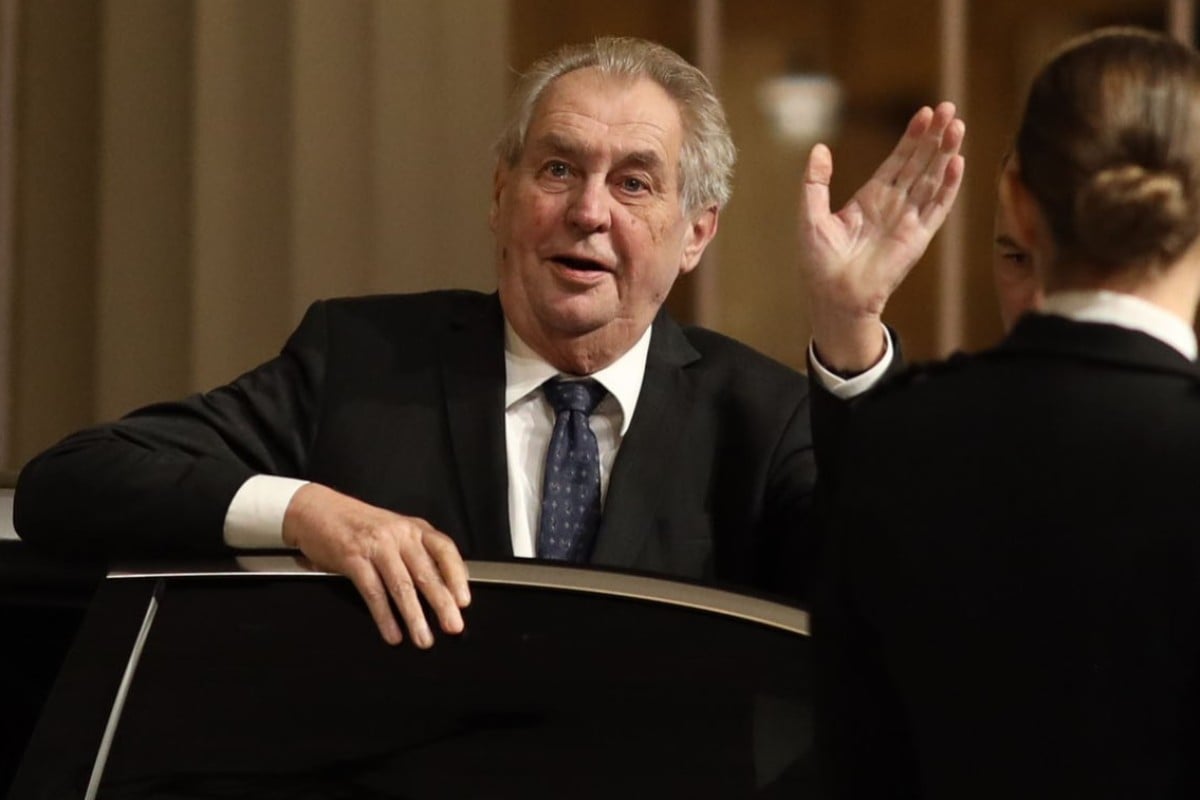
Czech Republic President Milos Zeman has voiced disappointment over China’s lack of investment in the country. Photo: AFP
Czech President Milos Zeman’s decision to skip
China’s summit with European leaders in April shows the “honeymoon is over” between Prague and Beijing, analysts say, as it tries to shake up the relationship to push for more investment.
And China could face similar trouble with other nations looking for more at this year’s “17+1” summit with Central and Eastern European nations in Beijing.
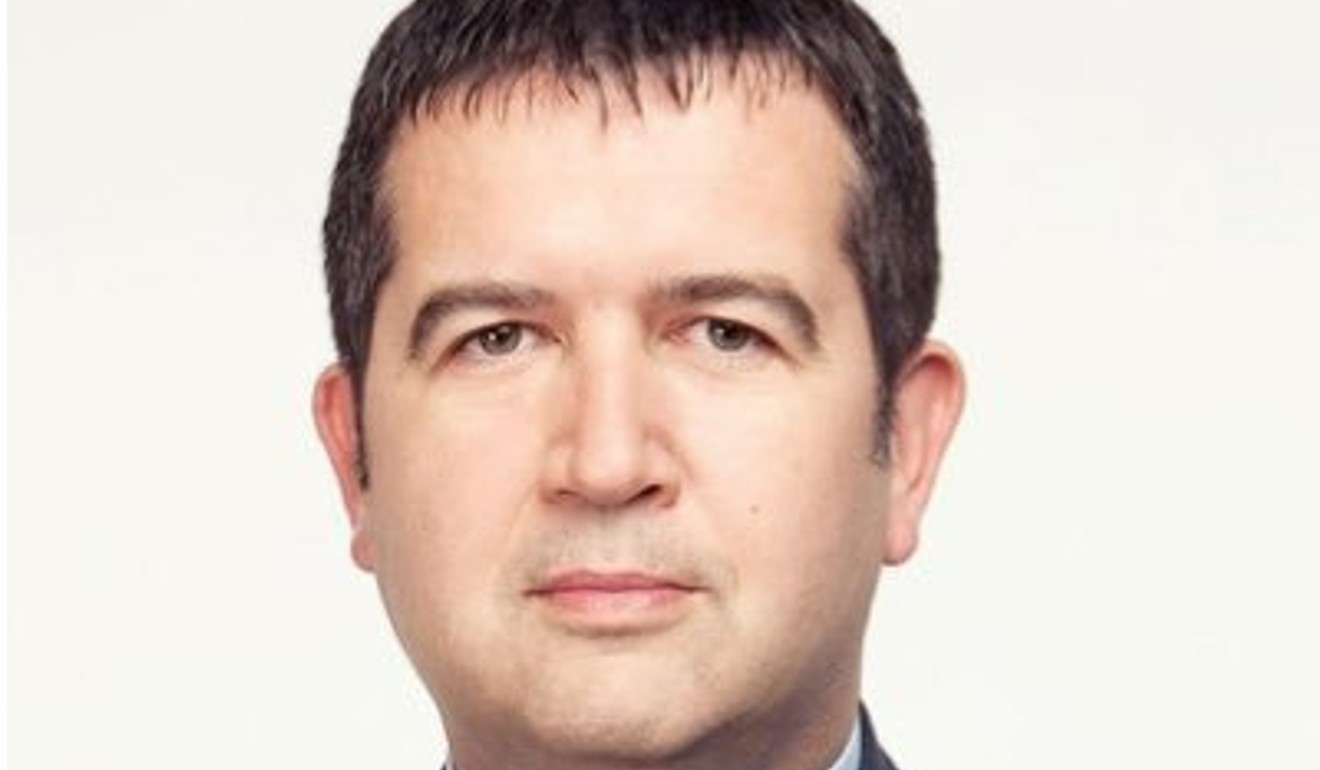
Top leaders usually attend the gathering, but Zeman on Sunday said he would not be going, and that China had not “done what it promised” by failing to invest more in his country. He would instead send Deputy Prime Minister Jan Hamacek, which he said was “adequate to the level of cooperation”.
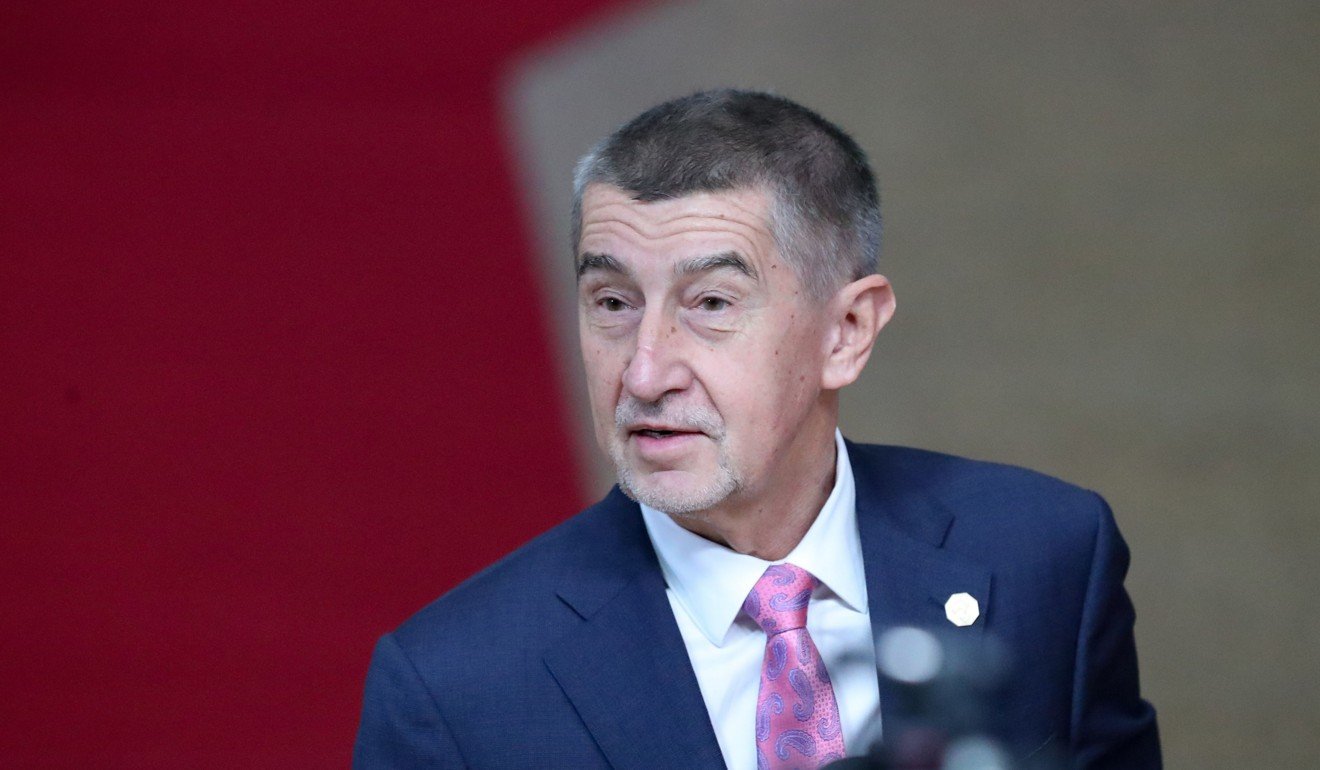
At last year’s summit in Croatia, Prague was represented by Prime Minister Andrej Babis, who was diplomatically on par with the Chinese representative,
But it is China’s turn this year, and President Xi Jinping will be the host – meaning heads of state are expected to attend. The 17+1 grouping was launched by Beijing in 2012.
Deputy Prime Minister Jan Hamacek will represent Prague at the 17+1 summit. Photo: Twitter
Zeman was a strong advocate for deepening economic ties with China and investments were on the rise, for a time. But Zeman and other Czech leaders have increasingly questioned the nature of the relationship, especially as the economic benefits have dwindled.
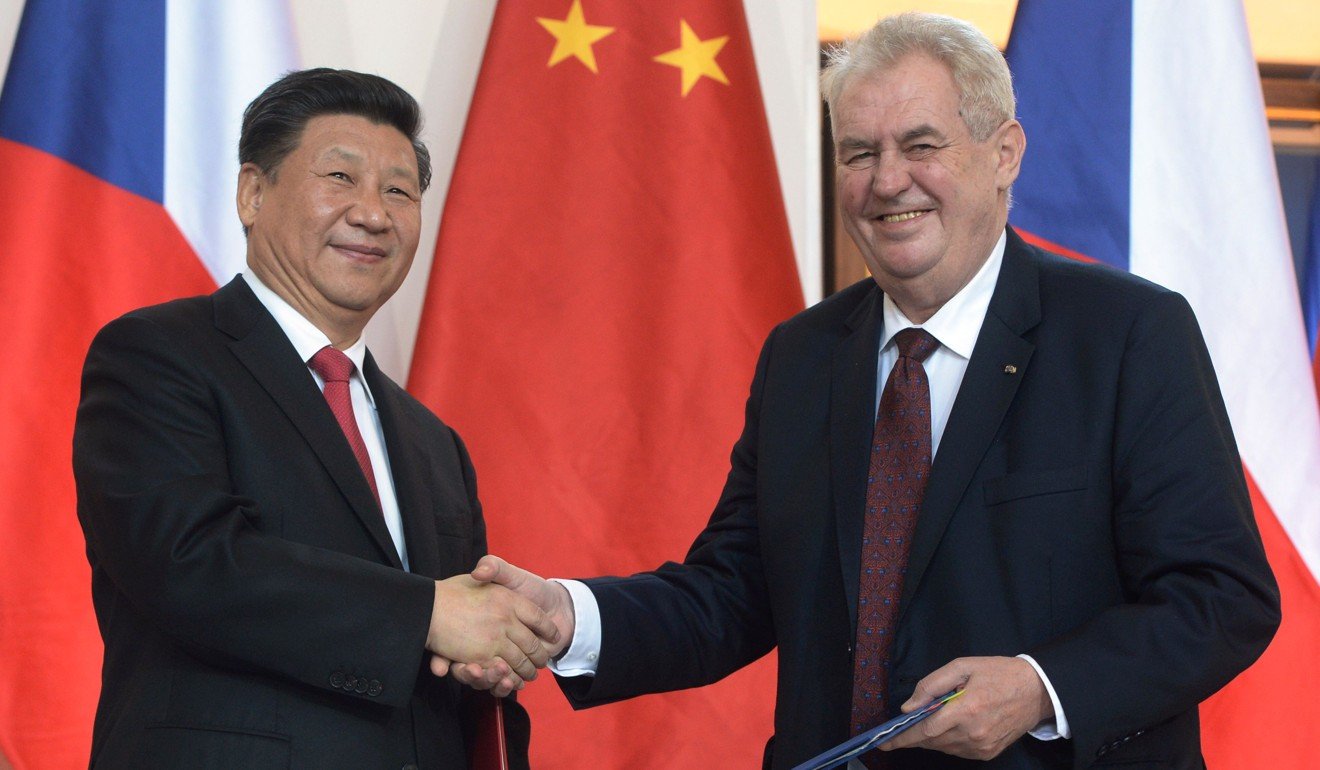
Relations with China grew after Zeman, who is in his second term as president, took office in 2013. The peak came in 2016, when Xi visited the country and promised more Chinese investment. That year, Zeman said he hoped his country would be an “unsinkable aircraft carrier” for Chinese investment in Europe.
But since then, the investments have faltered, not just in the Czech Republic, but across Central and Eastern Europe, and Zeman has changed his tone. In April, he called the lack of investment in his nation a “stain on the Czech-China relationship”, in an interview with Chinese state broadcaster CCTV.
Chinese President Xi Jinping meets his Czech counterpart Milos Zeman during a visit to Prague in 2016, when he promised more investment. Photo: AFP
“I suppose he feels that promises made to him personally were not fulfilled, since he has had personal contact with Xi Jinping on a number of occasions … he surely feels that his commitment to China has not been reciprocated,” said Jeremy Garlick, assistant professor of international relations at the University of Economics, Prague.
Zeman has visited China five times and was the only EU leader to attend a Chinese military parade in 2015 to mark the 70th anniversary of the end of World War II.
I suppose he feels that promises made to him personally were not fulfilled, since he has had personal contact with Xi Jinping on a number of occasions Jeremy Garlick, University of Economics, Prague
Rudolf Furst, a senior researcher at Charles University in Prague, said Zeman had given up his unequivocal support for a pragmatic pro-Chinese agenda.
“Chinese investments flow in Czechia have remained low, and not matching the Czech structural needs for stimulating the GDP growth,” he said.
Most of the 17+1 member states, except for Hungary and Greece, were now “perceiving the Chinese investment promises as merely virtual”, Furst said. “The 2012 new wave of China’s honeymoon is over.”
Rhodium Group has tracked Chinese foreign direct investment data in Europe since 2000. Its data shows that while total Chinese investment in the Czech Republic had grown to about €1 billion (US$1.1 billion) by 2018, growth has been slow, while neighbouring countries like Italy and Germany had some 15 to 20 times more investment in their economies.
Cumulative Chinese foreign direct investment in the Czech Republic between 2000 and 2017 sat at about €600 million, and grew to €1 billion in 2018, while that in neighbour Germany grew from €20.6 billion to €22.2 billion over the same period.
The picture is much the same for Eastern Europe as a whole – Austria, Bulgaria, the Czech Republic, Hungary, Poland, Romania and Slovakia received just 2 per cent of China’s overall investment in Europe in 2018, according to the data.
Countries like France, Germany and Britain meanwhile received 9, 12 and 24 per cent, respectively.
Czech Republic becomes unlikely front line in China’s soft power war
Other Czech politicians have also taken a tougher line on China. Babis warned of a “considerable” trade deficit with China in 2018. The country exported US$1.8 billion of goods to China in the first nine months of last year, down 4.3 per cent from a year earlier. But it imported US$11.7 billion of products from China – by far its largest source of imports.
And after Zeman’s announcement this week, the Green Party, which holds a handful of seats in the Czech Senate, called for Prague to pull out of the 17+1 platform altogether.
Prime Minister Andrej Babis warned of a “considerable” trade deficit with China in 2018. Photo: AFP
Richard Turcsanyi, director of the Central European Institute of Asian Studies at Palacky University in the Czech Republic, said both Prague and Beijing were expecting too much.
“I see the current sharp downturn of Czech-China relations being related to very high and unrealistic expectations which existed perhaps on both sides, driven to a large extent by the ignorance of each other,” he said.
“Due to the impressive economic growth of China and also its international economic expansion, many expected that China could quickly become a significant economic actor in the Czech Republic,” he said.
“In reality, the Czech Republic and China are not natural trading or investment partners. They are more of competitors when it comes to moving up the value chain, rather than complementary economic partners – contrary to what has been claimed for years as part of the diplomatic exchanges.”
Political tensions with China have also increased, including over security allegations about Huawei Technologies, and sensitive issues like Taiwan and Tibet.
This week, Shanghai suspended official contact with the Czech capital Prague after it signed a sister city agreement with Taipei – following Prague cancelling its deal with Beijing in October over a “one China” pledge. Shanghai was also a sister city with Prague.
And although Zeman has been critical of the US-led campaign against Huawei, Babis ordered Czech government institutions to stop using products from the Chinese tech giant last year.
“There has been a breakdown of trust in China, at the level of the public, the media, and now even the president,” Garlick said.
Source: SCMP
Posted in Austria, ‘honeymoon is over’, Beijing, Britain, Bulgaria, Central European Institute of Asian Studies, Charles University, China, Chinese President Xi Jinping, Chinese state broadcaster CCTV, Czech Republic President, Eastern Europe, France, Germany, Greece, huawei technologies, Hungary, Milos Zeman, Palacky University, Poland, Prague, Romania, Slovakia, Taiwan, Tibet, Uncategorized, University of Economics, Prague |
Leave a Comment »
02/12/2019
(Reuters) – Asian companies dominate the market for electric vehicle (EV) batteries and they are expanding their production capacity in Europe, China and the United States in a fight to win lucrative contracts from global automakers.
Some carmakers worry, however, there won’t be enough batteries for all the EVs they plan to launch in the coming years and a bitter row between South Korea’s SK Innovation and LG Chem risks exacerbating the potential shortfall.
Below are details of the world’s leading EV battery makers with details of their customers and expansion plans:
CATL
China’s Contemporary Amperex Technology (CATL), the world’s biggest EV battery maker, counts BMW (BMWG.DE), Volkswagen (VOWG_p.DE), Daimler (DAIGn.DE) – which makes Mercedes cars – Volvo, Toyota Motor Corp (7203.T) and Honda Motor Co (7267.T) among its customers.
The company emerged as a major force partly thanks to Beijing’s policy of only subsidising vehicles equipped with Chinese batteries in the world’s biggest EV market. Beijing is phasing out EV subsidies next year.
CATL, which operates factories in China, is building its first overseas plant in Germany and is considering a U.S. factory.
PANASONIC CORP (6752.T)
Japan’s Panasonic, a supplier of U.S. EV pioneer Tesla (TSLA.O), said it has installed equipment to ramp up production at Tesla’s Nevada plant to 35 GWh from its current production of around 30 GWh as of late October. Panasonic has said it is investing about $1.6 billion in the factory.
Panasonic also produces EV batteries in Japan, China and plans to shift some of its plants to a new joint venture with Toyota. Panasonic’s clients also include Honda and Ford Motor Company (F.N).
For a graphic of expansion plans: tmsnrt.rs/35tFmOL
BYD CO LTD (002594.SZ)
China’s BYD, which is backed by U.S. investor Warren Buffett, is also one of the world’s biggest EV battery makers. It mainly uses them in-house for its own cars and buses. BYD said last year it is was considering cell production in Europe.
LG CHEM LTD (051910.KS)
The South Korean firm was an early industry mover, winning a contract to supply General Motor’s (GM.N) Volt in 2008. It also supplies Ford, Renault (RENA.PA), Hyundai Motor (005380.KS), Tesla, Volkswagen and Volvo.
It is investing 3.3 trillion won ($2.8 billion) to build and expand production facilities near Tesla’s plant in Shanghai. It has a joint venture (JV) in China with Geely Automobile Holdings (0175.HK), which makes Volvos, and is in talks with other carmakers about JVs in major markets.
The firm is considering building a second U.S. factory in addition to its facility in Michigan and is expanding its plant in Poland.
SAMSUNG SDI CO LTD (006400.KS) Samsung SDI an affiliate of South Korean tech giant Samsung Electronics (005930.KS), has EV battery plants in South Korea, China and Hungary, which supply customers such as BMW (BMWG.DE), Volvo and Volkswagen. Samsung SDI is investing about 1.2 billion euros ($1.3 billion) to expand its factory in Hungary though the EU is investigating whether Budapest’s financial support complies with the bloc’s state aid rules.
Samsung started production last year on the Hungary plant, which will produce batteries for 50,000 EVs a year.
SK INNOVATION CO LTD (096770.KS) LG Chem’s cross-town rival SK Innovation supplies batteries to Volkswagen, Daimler and Kia Motors (000270.KS), as well as Jaguar Land Rover [TAMOJL.UL] and Ferrari (RACE.MI).
An oil refiner that came to the battery industry late, SKI is investing about $3.9 billion to build three plants in the United States, China and Hungary, with a goal of expanding its annual production capacity to 33 GWh by 2022.
SKI currently operates one battery factory in South Korea, with a capacity of 4.7 GWh annually.
It set up a joint venture with Beijing Automotive Industry Corporation (BAIC) of China in August 2018 and another Chinese partner. It is in talks with Volkswagen about another battery JV and is building a $1.7 billion factory in the U.S. state of Georgia, not far from Volkswagen’s Chattanooga plant.
Source: Reuters
Posted in automakers, batteries, battery, Beijing Automotive Industry Corporation (BAIC), Beijing’s, biggest, BMW, BMW (BMWG.DE), Budapest’s, BYD, BYD CO LTD (002594.SZ), Chattanooga, China alert, Chinese, Contemporary Amperex Technology (CATL), contracts, Daimler, Electric vehicle, equipped, Europe, EV pioneer, Factory, Ferrari (RACE.MI), firm, Ford, Ford Motor Company (F.N), Geely Automobile Holdings (0175.HK), General Motor’s (GM.N), Georgia, Germany, global, Honda Motor Co (7267.T), Hungary, Hyundai Motor (005380.KS), industry mover, Japan, Japan’s, Kia Motors (000270.KS), LG Chem, LG CHEM LTD (051910.KS), Makers, Mercedes, Michigan, Nevada, Panasonic, PANASONIC CORP (6752.T), Plant, Poland, policy, Renault (RENA.PA), Rover [TAMOJL.UL], Samsung Electronics (005930.KS), SAMSUNG SDI CO LTD (006400.KS), Shanghai, SK Innovation, SK INNOVATION CO LTD (096770.KS), South Korea, South Korean, subsidising, Tesla (TSLA.O), Toyota Motor Corp (7203.T), U.S., U.S. investor, Uncategorized, United States, vehicles, Volkswagen, Volkswagen (VOWG_p.DE), Volt, Volvo, Warren Buffett, world's |
Leave a Comment »
02/10/2019
- The trip comes amid growing resistance from European leaders over what they see as China’s failure to change long-term practices unfair to foreign investors
- French President’s trip to Beijing follows Chinese leader’s visit to France in March
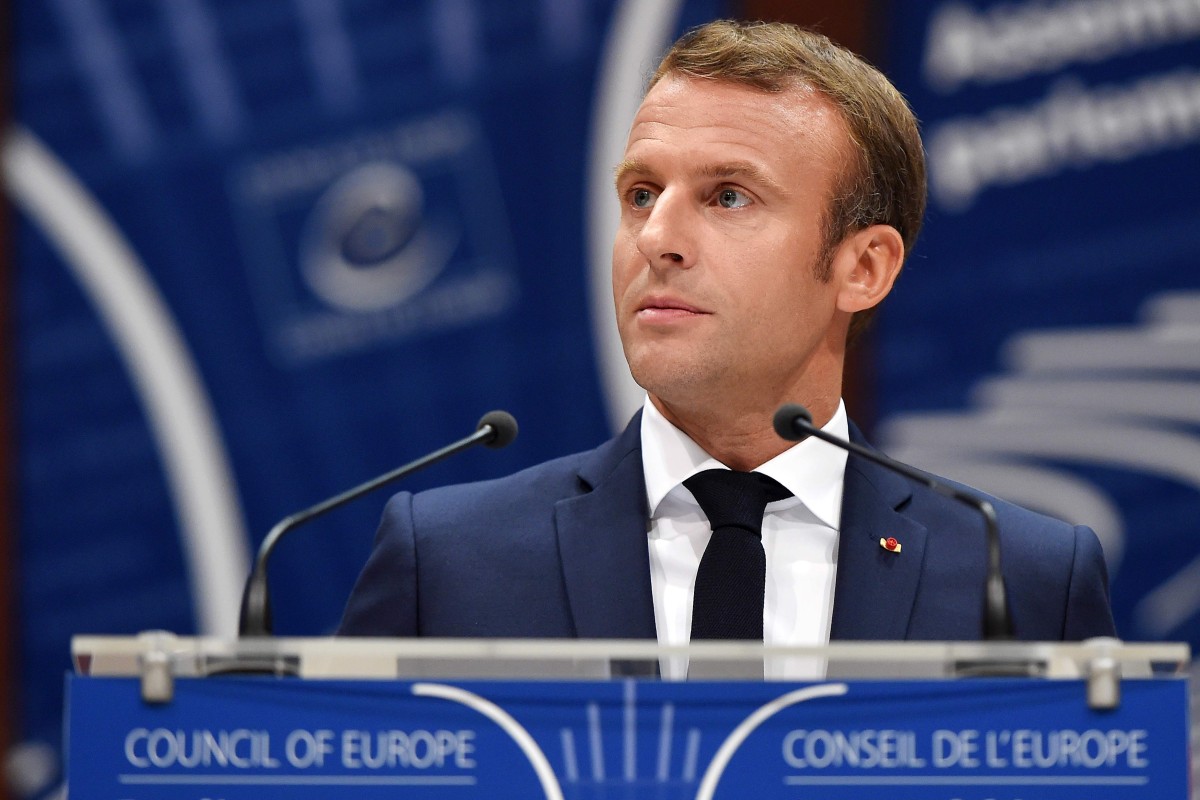
President Emmanuel Macron of France speaks to the Council of Europe parliamentary assembly on Tuesday. Photo: AFP
French President Emmanuel Macron will visit China next month as Europe’s most diplomatically active leader focuses on climate change cooperation and trade promotion with Asia’s leading power, a source briefed on the Elysee Palace’s discussions said.
This will be the second Chinese tour for Macron since he took office in 2017, and it will come amid escalating resistance from European politicians and business communities over what they see as China’s failure to change long-standing practices unfair to foreign investors.
His visit also comes at a time when France – as well as the European Union as a whole – is bracing for Washington’s potential levies of tariffs on European products, and the lack of progress on climate change policies with US President Donald Trump’s administration.
“President Macron will meet President Xi [Jinping], while France strives for better cooperation with China on climate and trade,” the source said. “His itinerary is still in the pipeline, but he is expected to visit Beijing and Shanghai.”
Macron, 41, who is widely seen as emerging as Europe’s most aggressive leader filling the political vacuum left by German Chancellor Angela Merkel’s political twilight, has cast himself as an honest broker between Russia and Ukraine, and between the US and Iran.
He has also been critical of China’s influence in Europe, joining forces with Merkel to push for a tougher EU stance on the world’s second biggest economy.
In March, when Xi claimed a major diplomatic victory by clinching a memorandum of understanding with Italy on the Belt and Road Initiative, Macron declared: “The time of European naivety is ended. For many years we had an uncoordinated approach and China took advantage of our divisions.”
Macron also backed investment screening mechanisms for Chinese business moves in Europe, while endorsing plans to change the EU’s notoriously strict antitrust rules in order to facilitate mergers between large European groups and companies to counter Chinese companies’ global ambitions.
Macron urges Iran and US to show ‘courage of building peace’
The EU is also wary of China’s effort to “divide and rule” the European Union. Greece and Hungary – both recipients of large amounts of Chinese investments – have repeatedly wanted to water down EU’s stance on issues deemed sensitive to Beijing, including the South China Sea and China’s human rights violations.
“It would be good [for Macron] to stress that 17+1 is irritating,” said Joerg Wuttke, president of EU Chamber of Commerce in China, in reference to China’s engagement with a group of EU and non-EU member states in eastern and southeastern Europe.
“After all, the EU has a ‘one China’ policy, [so] EU could expect this position from China too.”
Macron’s domestic call for EU unity has translated into diplomatic appeals, with China being one of the targets.
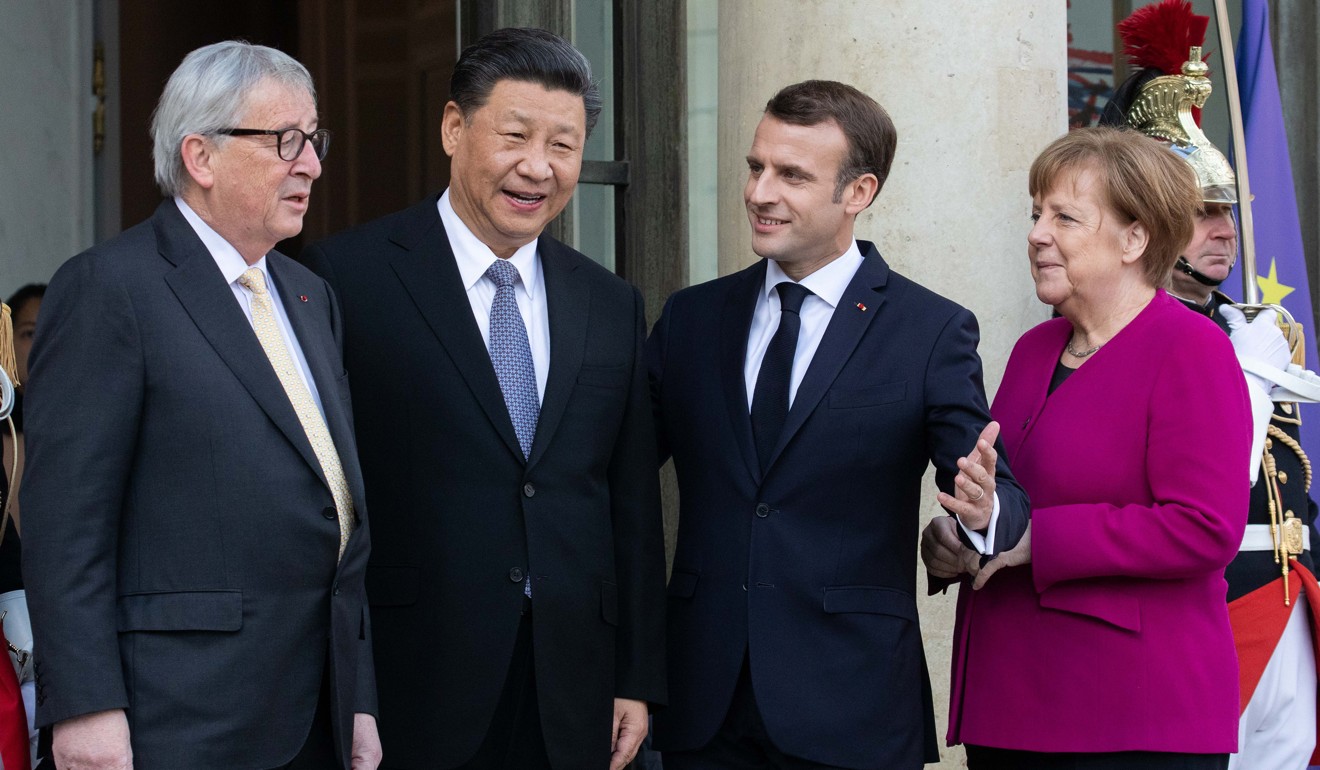
(From left) Jean-Claude Juncker, president of the European Commission; Xi Jinping, China’s leader; Emmanuel Macron, France’s president; and Angela Merkel, Germany’s chancellor, ahead of a meeting in Paris on March 26. Photo: Christophe Morin/Bloomberg
When Xi visited France in March, Macron hosted him at the Elysee Palace in the presence of Merkel and European Commission President Jean-Claude Juncker, showcasing European solidarity when it comes to EU-China policies.
In terms of French-Chinese bilateral ties, trade imbalances have persisted after Macron called for a “rebalancing” during his last visit.
France has a 1.4 per cent market share in China, compared with China’s 9 per cent market share in France. China represents France’s largest bilateral trade deficit, totalling €US$29.2 billion (US$31.9 billion) last year, ahead of Germany.
The EU has been calling for reciprocal investment treatment with China, a call that European business leaders in China expect Macron to make.
France bids farewell to late president Jacques Chirac
“We [Europe] need … a solid investment agreement to allow EU business to conduct their affairs in a similar manner as Chinese companies can operate in Europe. The agreement should be finalised in 2020, but not at all cost,” said Wuttke.
“The last thing EU business needs in China is a weak agreement that institutionalises imbalances,” he added.
Part of that involves building “more efficient defensive tools to prevent abusive technology transfers and to address the deep asymmetry in EU-China relations when it comes to access to public procurement markets,” said Mathieu Duchâtel, director of Asia programme at the Paris-based think tank Institut Montaigne.
Duchâtel added that it was also important to convey the message to Beijing that there are areas for cooperation even amid a more defensive China policy from France.
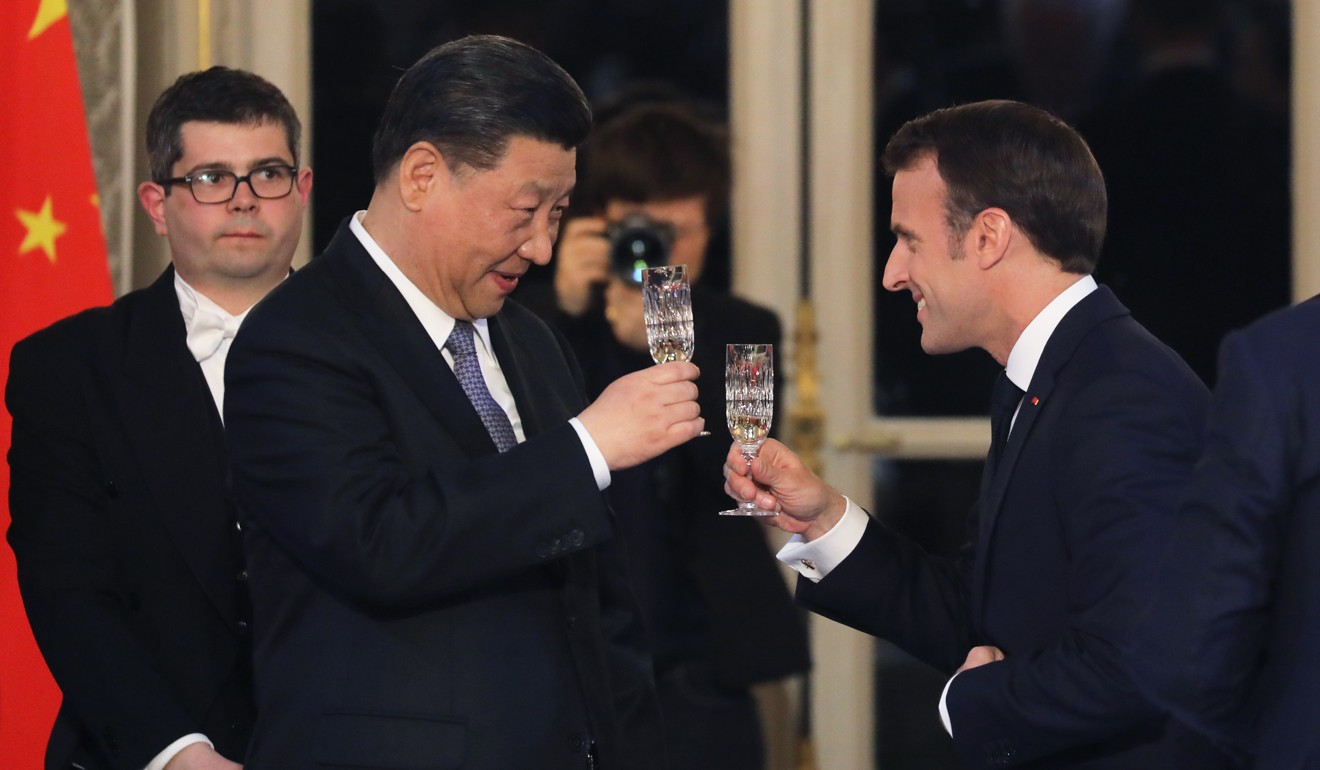
Chinese President Xi Jinping and French leader Emmanuel Macron toast raise a toast during a state dinner in Paris on March 25. Photo: EPA-EFE
One such area is the climate and environment, where China is “an important partner” for France to reach its goal of global carbon neutrality by 2050, he said.
“The energy/environment agenda is a political priority in Paris and one of very few issues on which cooperation with China remains promising and will continue to create business opportunities,” he said.
China is the world’s biggest carbon polluter, producing around 30 per cent of the planet’s man-made carbon dioxide. It remains committed to the 2015 Paris accord on climate change, even after Trump pulled the US out of the deal.
Under the agreement, the long-term temperature goal is to keep the increase in global average temperature to well below 2°C above pre-industrial levels, and to pursue efforts to limit the increase to 1.5°C.
Source: SCMP
Posted in Angela Merkel, Beijing, Belt and Road Initiative, Belt and Road Initiative (BRI), building peace, Carbon dioxide, carbon polluter, China alert, climate change, Council of Europe, courage, deep asymmetry, divide and rule, energy/environment agenda, EU, EU Chamber of Commerce in China, European Commission, European Commission President, European Union, focus, France, German Chancellor, Greece, human rights violations, Hungary, imbalances, institutionalises, INVESTMENTS, iran, Italy, Jacques Chirac, Jean-Claude Juncker, meet, Memorandum of understanding, Memorandum of Understanding (MOU), month, one-China policy, Paris, Planet, political twilight, recipients, South China Sea, technology transfers, Trade, Uncategorized, US, US President Donald Trump, Xi JinPing |
Leave a Comment »
13/07/2019
Visiting Chinese State Councilor and Foreign Minister Wang Yi (L) shakes hands with Hungarian Minister of Foreign Affairs and Trade Peter Szijjarto prior to their talks in Budapest, Hungary, July 12, 2019. (Xinhua/Attila Volgyi)
BUDAPEST, July 12 (Xinhua) — Visiting Chinese State Councilor and Foreign Minister Wang Yi and Hungarian Minister of Foreign Affairs and Trade Peter Szijjarto held talks on Friday, pledging closer exchanges and more cooperation.
Noting this year marks the 70th anniversary of the establishment of China-Hungary diplomatic relations, Wang said the two countries have always respected and supported each other, showing mutual trust over the past seven decades. And in 2017, bilateral relations entered a new historical stage when a comprehensive strategic partnership was established by the leaders of two nations.
In face of increasingly unstable and uncertain international situation, Hungary, Wang said, has taken a clear-cut stance to develop friendly relations with China, firmly support the building of the Belt and Road and participate in the China and Central and Eastern European Countries (CEEC) cooperation.
Calling Hungary a reliable and trustworthy partner, the Chinese top diplomat said China will continue to back Hungary’s development path in line with its own national conditions, and support it to safeguard its legitimate rights and interests and to play a more important role in the European Union (EU) and the world.
The two sides should seize the opportunity of the 70th anniversary of establishment of bilateral diplomatic relations, maintaining, consolidating and developing the China-Hungary comprehensive strategic partnership, as well as deepening exchanges at all levels, said Wang.
The two sides should enhance all-around cooperation based on the principle of extensive consultation, joint contribution and shared benefits, he said, while also calling on the two sides to strengthen strategic coordination to safeguard their common rights and interests as well as international fairness and justice.
On his part, Szijjarto said Hungary-China bilateral relations are at their best in history.
Hungary is the first European country to sign the Belt and Road cooperation agreement with China, which aligns well with Hungary’s “Opening to the East” policy, corresponds to the China-EU cooperation, and is conducive to promote the Eurasian interconnection, he said.
Hungary is willing to work with China to maintain closer high-level exchanges, expand cooperation in areas like trade, investment, finance, and education, and closely coordinate and cooperate in multilateral affairs, so as to promote bilateral relations to make new progress, said Szijjarto.
On Thursday, the Chinese top diplomat also attended the opening ceremony of a photo exhibition marking the 70th anniversary of the establishment of China-Hungary diplomatic relations here in the Hungarian capital.
Source: Xinhua
Posted in Belt and Road (B&R), Budapest, Central and Eastern European countries (CEEC), China-Hungary diplomatic relations, Chinese State Councilor and Foreign Minister Wang Yi, closer exchanges, European Union (EU), Hungarian capital, Hungarian FM, Hungarian Minister of Foreign Affairs and Trade, Hungary, more cooperation, Opening to the East, Uncategorized |
Leave a Comment »
06/07/2019
BEIJING, July 6 (Xinhua) — Chinese State Councilor and Foreign Minister Wang Yi will visit Poland, Slovakia and Hungary from July 7 to 13, at the invitation of Polish Foreign Minister Jacek Czaputowicz, Slovak Foreign Minister Miroslav Lajcak, and Hungarian Foreign Minister Peter Szijjarto respectively.
He will also co-host the second plenary session of China-Poland Intergovernmental Cooperation Committee with Czaputowicz and the second China-Hungary “Belt and Road” working group meeting with Szijjarto during the visit, foreign ministry spokesperson Geng Shuang said Saturday in Beijing.
Source: Xinhua
Posted in Beijing, China-Hungary "Belt and Road" working group, China-Poland Intergovernmental Cooperation Committee, Chinese State Councilor and Foreign Minister, Hungary, Poland, Slovakia, Uncategorized, Wang Yi |
Leave a Comment »
19/05/2019
Li Zhanshu, chairman of the Standing Committee of the National People’s Congress (NPC), meets with Norwegian King Harald V in Oslo, Norway, May 16, 2019. China’s top legislator Li Zhanshu paid an official friendly visit to Norway from May 15 to 18, expecting to promote the development of Sino-Norwegian ties to score more progress. (Xinhua/Huang Jingwen)
OSLO, May 18 (Xinhua) — China’s top legislator Li Zhanshu paid an official friendly visit to Norway from May 15 to 18, expecting to promote the development of Sino-Norwegian ties to score more progress.
During the stay in Norway, Li, chairman of the Standing Committee of the National People’s Congress (NPC), met with Norwegian King Harald V, Norwegian Prime Minister Erna Solberg and President of the Norwegian parliament Storting Tone Wilhelmsen Troen.
When meeting with Norwegian King Harald V, Li conveyed the greetings of Chinese President Xi Jinping to the King, and expressed congratulations on the Norwegian National Day, which falls on May 17.
Li said during the King’s successful visit to China last year, the two heads of state made strategic plans for the development of bilateral relations in the new era. As this year marks the 65th anniversary of the establishment of diplomatic relations between China and Norway, the two sides are expected to seize the opportunity to cement friendship and expand cooperation on the basis of mutual respect and treating each other equally, so as to realize better development of bilateral relations.
Harald V expressed gratitude to China’s friendliness to the Norwegian side, saying Norway admires China’s tremendous development achievements. He said Norway is ready to strengthen cooperation with China in such fields as winter sports, and will make efforts to help China successfully host the 2022 Beijing Winter Olympics.
When meeting with Solberg, Li said although Sino-Norwegian relations have experienced ups and downs, friendship and cooperation has always been the main theme of the ties. As both countries share common interests on safeguarding current global mechanism, building an open world economy, the two sides should jointly support multilateralism and free trade. Moreover, the two countries have similar development concepts and share strong economic complementarities, so the outlook of bilateral cooperation is very broad.
Norway is welcome to actively participate in the construction of the Belt and Road Initiative. And bilateral cooperation on economy, trade, environmental protection, science and technology, people-to-people exchanges and tourism is expected to be forged ahead, said China’s top legislator.
“China hopes the Norwegian side provides a fair, just and non-discriminatory business environment for Chinese enterprises’ investment and operation in Norway,” said Li.
Solberg said bilateral cooperation has maintained sound momentum since the normalization of bilateral ties, expecting the two sides to push forward talks on inking a free trade deal and deepen cooperation in such areas as maritime affairs, shipping, fishery and environmental protection. She also voiced the will to advance communication and collaboration with China on issues concerning the United Nations, coping with the climate change and Arctic affairs.
When respectively meeting with Troen and members of the parliament’s standing committee on foreign affairs and defense, Li introduced China’s development path and political system.
“The reasons why China continues to make new development achievements are that we have embarked on a development path that suits our national conditions. This is the path of socialism with Chinese characteristics,” said Li, stressing that the Chinese people will unswervingly follow this path.
He said that the NPC of China is willing to work with the Norwegian parliament to implement the important consensus reached by the leaders of the two countries, strengthen friendly exchanges at all levels, enhance understanding and trust through frank dialogues, and create a favorable environment for pragmatic cooperation.
Troen said that this visit is of great significance as Li’s tour marks the first visit of a Chinese leader since the normalization of bilateral relations in 2016. The Norwegian parliament is willing to carry out all-round exchanges and cooperation with the NPC of China, and make positive contributions to the development of state-to-state ties.
The two legislators also exchanged views on jointly safeguarding multilateral trade system, sustainable development and other issues of common concerns.
On May 16, Li attended the economic and trade conference in commemoration of the 65th anniversary of Norway-China diplomatic relations. He said in a speech that President Xi’s proposal of the high-quality development of jointly building the Belt and Road and the policy of China’s further expansion of opening up have provided new opportunities for the common development of all countries. The two countries’ enterprises are expected to seize the opportunity, tap cooperation potentials, so as to translate the desire for strong cooperation into more practical results.
During the tour, Li visited the Chinese skiers who were training in Norway and encouraged them to train hard and carry out bilateral friendship.
He also visited a local ecological agriculture project, an oil gas processing plant, and met with local officials in Norway’s southwestern county of Rogaland and its southern city of Stavanger.
Norway is the first lag of Li’s ten-day tour in Europe, which will also take him to Austria and Hungary.
Source: Xinhua
Posted in Arctic affairs, Austria, bilateral ties, chairman of the Standing Committee of the National People's Congress (NPC), China's top legislator, Chinese President Xi Jinping, climate change, Environmental protection, Erna Solberg, fishery, Harald V, Hungary, Li Zhanshu, maritime affairs, Norway, Norway-China diplomatic relations, Norwegian King, Norwegian National Day, Norwegian Prime Minister, President of the Norwegian parliament, promote, Rogaland, shipping, Sino-Norwegian ties, Storting Tone Wilhelmsen Troen, Uncategorized, United Nations, visits |
Leave a Comment »






 CHINDIA ALERT: You'll be living in their world, very soon