Archive for ‘imitation’

08/05/2020

China ‘copycat’ buildings: Government clamps down on foreign imitations

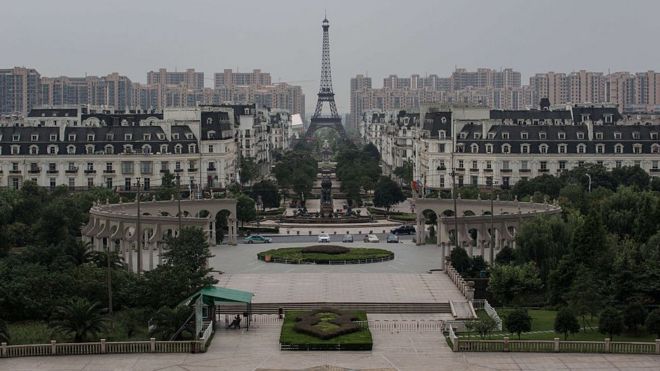
A replica of Paris in Tianducheng, Hangzhou, ZhejiangImage copyright GUILLAUME PAYEN / GETTY
Image caption – Paris? Actually a replica in Tianducheng, Hangzhou, Zhejiang province

From English towns, to Alpine villages, to the Eiffel Tower – copies of foreign architecture can be seen across China.

But now the government is clamping down, in order to promote local design.

A government statement says “plagiarising, imitating, and copycatting” designs is prohibited in new public facilities.

The statement says buildings “reveal a city’s culture” – and that “large, foreign, and weird” designs should be limited.

The guidelines also clamp down on new skyscrapers – limiting them, in general, to a maximum of 500 metres.
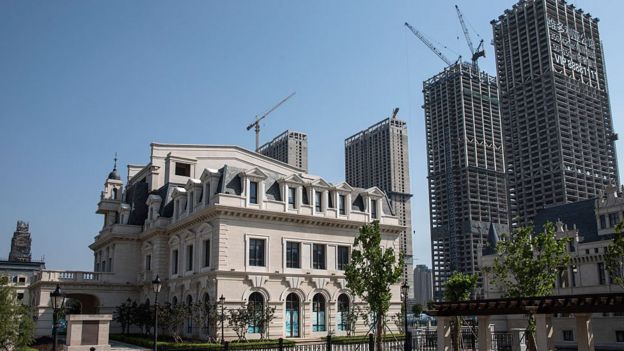
New European-style buildings in Dalian, ChinaImage copyright THIERRY FALISE / GETTY
Image caption New European-style buildings by tower blocks in Dalian, China

According to the Global Times, the “fake, shoddy versions” of foreign buildings appear in “many third and fourth-tier Chinese cities”.

The government did not say what will happen to existing “foreign” buildings, but does say there will be “city inspections” to check for problems.

The statement, issued on 27 April but only reported this week, singles out stadiums, exhibition centres, museums and theatres as public facilities where it’s especially important to ban plagiarism.

“City constructions are the combination of a city’s external image and internal spirit, revealing a city’s culture,” the government statement says.

It calls for a “new era” of architecture to “strengthen cultural confidence, show the city’s features, exhibit the contemporary spirit, and display the Chinese characteristics”.
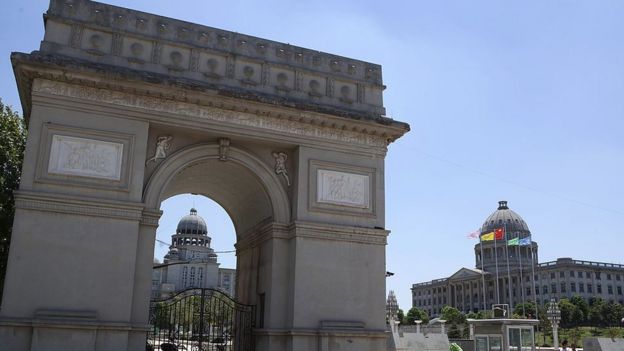
Not the Arc de Triomphe, but a college gate in WuhanImage copyright STR / AFP / GETTY
Image caption – Not the Arc de Triomphe, but a college gate in Wuhan

The guidelines on “foreign” architecture were mostly welcomed on Chinese social media.

“The ban is great,” wrote a Weibo user, according to state media the Global Times. “It’s much better to protect our historical architectures than build fake copycat ones.”

Another recalled seeing an imitation White House in Jiangsu province. “It burned my eyes,” she said.
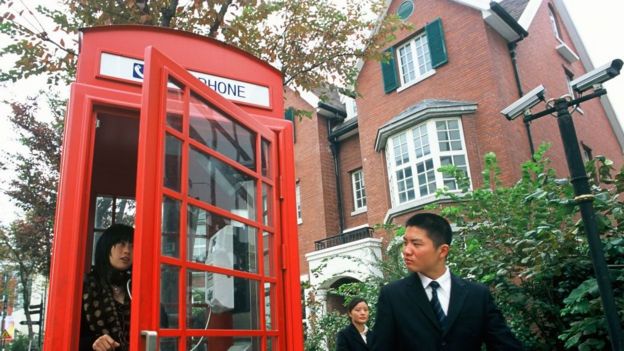
Thames Town, an English-themed town near ShanghaiImage copyright OLIVIER CHOUCHANA / GETTY
Image caption Thames Town, an English-themed town near Shanghai, pictured in 2008

In 2013, the BBC visited “Thames Town”, an imitation English town in Songjiang in Shanghai.

The town features cobbled streets, a medieval meeting hall – even a statue of Winston Churchill – and was a popular spot for wedding photos.

“Usually if you want to see foreign buildings, you have to go abroad,” said one person. “But if we import them to China, people can save money while experiencing foreign-style architecture.”
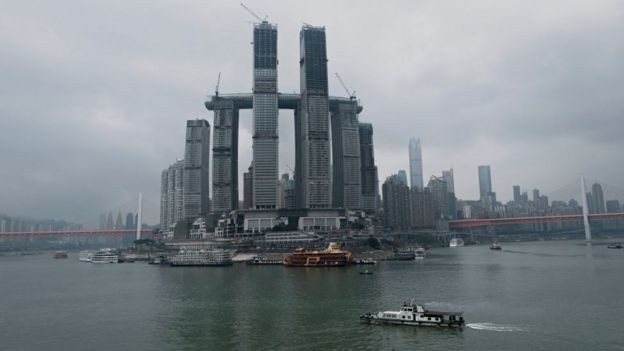
Raffles City, Chongqing, in 2019 - mimicking the Marina Bay Sands hotel in SingaporeImage copyright WANG ZHAO / GETTY
Image caption – Raffles City, Chongqing, in 2019 – mimicking the Marina Bay Sands hotel in Singapore

China, of course, is not the only country to borrow – or copy – other countries’ designs.

Las Vegas in the US revels in its imitations of iconic foreign architecture including the Eiffel Tower and Venetian canals.

Thailand also has developments that mimic the Italian countryside and charming English villages, mainly aimed at domestic tourists.

Source: The BBC

03/03/2019

Across China: From imitation to creation, Chinese village paints new life

SHENZHEN, March 2 (Xinhua) — Zhao Xiaoyong was once called “China’s Van Gogh,” as the farmer turned oil painter made over 100,000 replicas of Van Gogh’s work over the past 20 years.

However, he never saw a single authentic piece of the Dutch post-impressionist painter until 2014 when he finally saved enough for a trip to the Netherlands.

The trip inspired him to think over his business and create his own works. “The masterpieces that I saw at the European museums made me realize that I have to develop my own style.”

Zhao is from Dafen, a village known for oil paintings in southern China’s Shenzhen City. Home to 1,200 studios and 8,000 painters, the village produces millions of replicas of Van Gogh, Monet and Picasso that are sold at home and abroad. According to statistics, 80 percent of oil paintings exported from China come from Dafen.

While the market demand for replicas is shrinking, Zhao and other painters in the village are creating their own art styles and attracting tourists.

Neighboring Hong Kong, Shenzhen is one of China’s first special economic zones for the country’s reform and opening drive. The painting industry started in Dafen Village in 1989 when Hong Kong purchasers sought to establish an oil painting base nearby.

Zhao, who quit his job at a craft factory, started learning how to paint from scratch in 1996. He imitated Van Gogh’s works via a painting album, including “sunflowers” and “almond blossoms.”

He sold his first works in 1999 when an American buyer ordered 20 paintings. More orders later came from abroad, prompting Zhao to recruit apprentices.

“My wife and my younger brothers are all my students,” he said with a smile. “I was even called ‘China’s Van Gogh’ in a documentary.”

Zhao and his team worked from 1 p.m. to 3 a.m. painting eight pieces per person every day at most. Prices for the replicas ranged from 200 yuan (30 U.S. dollars) to 3,000 yuan per piece, depending on the size.

In 2008, when the economic recession hit most parts of the world, a drastic reduction of foreign orders forced Zhao to explore the domestic market. Profits kept shrinking after 2012 due to consumers’ diversifying tastes and rising costs.

Since then, many painters in the village have given up making replicas and turned to innovation and creation.

Chen Qiuzhi, who used to paint copies of masterpieces like Zhao, has worked hard to develop his own style, combining Chinese calligraphy with painting. To support him, his wife sold two apartments and had an art center built.

The center, located at the far end of Dafen village, covers an exhibition area of over 3,000 square meters and has become a landmark of Dafen. Some 100 calligraphy works are exhibited at the center with other craftwork.

Ten years of hard work has won him fame, with his works popular in the auction market. Now, one piece of his calligraphy is worth tens of thousands of yuan, almost 100 times the value of replicas he painted in the past. The art center also draws visitors.

“Only by creation can one’s works be remembered,” said Chen.

Today, Dafen has gathered nearly 300 art creators. In 2017, the annual output value of Dafen reached 4.15 billion yuan, among which the original works have accounted for 20 to 30 percent.

From imitation to creation, Dafen Village has been making the transition from a low-end oil painting workshop cluster to an art center, said Liu Yajing, director of the village’s oil painting office.

She said an oil painting museum, a performance theater, a training center and a hotel are being built to develop the village into a tourist resort featuring oil painting production, trade, training and exhibition.

Compared with his Van Gogh replicas, painter Zhao finds his own works hard to sell. But he believes that he will finally be recognized someday in the future.

“Imitation leads me nowhere. I will continue to concentrate on creation for the market and also for my dream as a real artist,” Zhao said.

Source: Xinhua

Law of Unintended Consequences

continuously updated blog about China & India

ChiaHou's Book Reviews

continuously updated blog about China & India

What's wrong with the world; and its economy

continuously updated blog about China & India