Archive for ‘Imperial College London’

04/04/2020

Mass lockdowns in Europe may have helped save 59,000 lives, says study

  • Researchers from Imperial College in London looked at how 11 countries had responded to the crisis and estimated how many lives had been saved by intervention
  • Some of the worst affected countries such as Italy and Spain would have seen tens of thousands more deaths, according to the model
Empty streets outside the Colosseum in Rome. Photo: AFP

Mass lockdowns and widespread social distancing may have prevented 59,000 Covid-19 deaths, according to a new model from Imperial College in London.

A team of researchers – including Neil Ferguson, whose projections helped inform the British government’s response to the outbreak and Samir Bhatt – estimated that tens of thousands of lives had been saved in 11 countries as a result of measures such as case isolation, school closures, bans on mass gatherings as well as local and national lockdowns.

The measures had a “substantial impact in reducing transmission” for countries with more advanced epidemics, with an estimated 38,000 deaths averted in Italy and 16,000 in Spain, but it is “too early to be sure” about similar reductions for countries in the earlier stages of the outbreak, researchers said.

Most countries in the model – Austria, Belgium, Denmark, France, Germany, Norway, Sweden, Switzerland and the United Kingdom – began their interventions between March 12 and 14.

“While we cannot determine which set of interventions have been most successful, taken together, we can already see changes in the trends of new deaths,” the researchers said.

“We note that substantial innovation is taking place, and new, more effective interventions or refinements of current interventions, alongside behavioural changes will further contribute to reductions in infections.”

The report, published on Monday, also estimated that between 7 and 43 million people had been infected in the 11 countries by late March – somewhere between 1.88 per cent and 11.43 per cent of the population – and said a large number of cases had probably gone unreported.

On average, the proportion of the population infected in the assessed countries was 4.9 per cent, with the highest estimates in Spain and Italy, and the lowest in Germany and Norway.

The coronavirus that causes Covid-19 first began to spread late last year in central China, but has since become a devastating global pandemic, with the most confirmed cases in the United States, Italy, Spain, Germany, France and mainland China.

Life under Italy’s lockdown: the hard lessons other countries must learn

2 Apr 2020

A separate study by Ferguson and other researchers, including Imperial College epidemiologist Azra Ghani, published on Monday in The Lancet found that the overall case fatality ratio for Covid-19 was lower than estimates for the severe acute respiratory syndrome (Sars) and Middle East respiratory syndrome (Mers) coronaviruses, but “substantially higher” than those of recent influenza pandemics such as the H1N1 influenza in 2009.

“With the rapid geographical spread observed to date, Covid-19 therefore represents a major global health threat in the coming weeks and months,” the researchers said.

“Our estimate of the proportion of infected individuals requiring hospitalisation, when combined with likely infection attack rates (around 50–80 per cent), show that even the most advanced health care systems are likely to be overwhelmed.

“These estimates are therefore crucial to enable countries around the world to best prepare as the global pandemic continues to unfold.”

Italy ‘still proud to be part of EU’ amid stronger ties with China and coronavirus pandemic
2 Apr 2020

The study also found that the risk of death increased significantly for individuals in older age groups, although they noted early results indicate children are not at a lower risk of infection compared with adults.

Using data from China, researchers estimated the overall case fatality ratio to be at 1.38 per cent, with a lower ratio of 0.32 per cent for under-60s, compared with 6.4 per cent for over-60s and rising to 13.4 per cent for people who were over 80.

“It is clear from the data that has emerged from China that case fatality ratio increases substantially with age,” they said.

The age gradient was also observed in cases outside China, where the fatality ratio was estimated at 1.4 per cent for people under the age of 60, compared with 4.5 per cent for those 60 and over.

Source: SCMP
23/01/2020

Coronavirus: Wuhan shuts public transport over outbreak

Wuhan, a Chinese city of eleven million people, has temporarily shut down its public transport as it tries to halt the outbreak of a new strain of virus.

Those living in the city have been advised not to leave, in a week when millions of Chinese are travelling for the upcoming Lunar New Year holiday.

The respiratory illness has spread to other parts of China, with some cases in other countries including the US.

There are more than 500 confirmed cases and 17 people have died.

Known for now as 2019-nCoV, the virus is understood to be a new strain of coronavirus not previously identified in humans. The Sars (severe acute respiratory syndrome) virus that killed nearly 800 people globally in the early 2000s was also a coronavirus, as is the common cold.

All the fatalities so far have been in Hubei, the province around Wuhan.

Meanwhile, after a day of discussions in Geneva, the World Health Organization’s (WHO) emergency committee has announced it will not yet declare a “global emergency” over the new virus.

Director general Dr Tedros Ghebreyesus said more information was needed about the spread of the infection. The committee of health experts will meet again on Thursday.

A global emergency is the highest level of alarm the WHO can sound and has previously been used in response to swine flu, Zika virus and Ebola.

What measures have been announced?

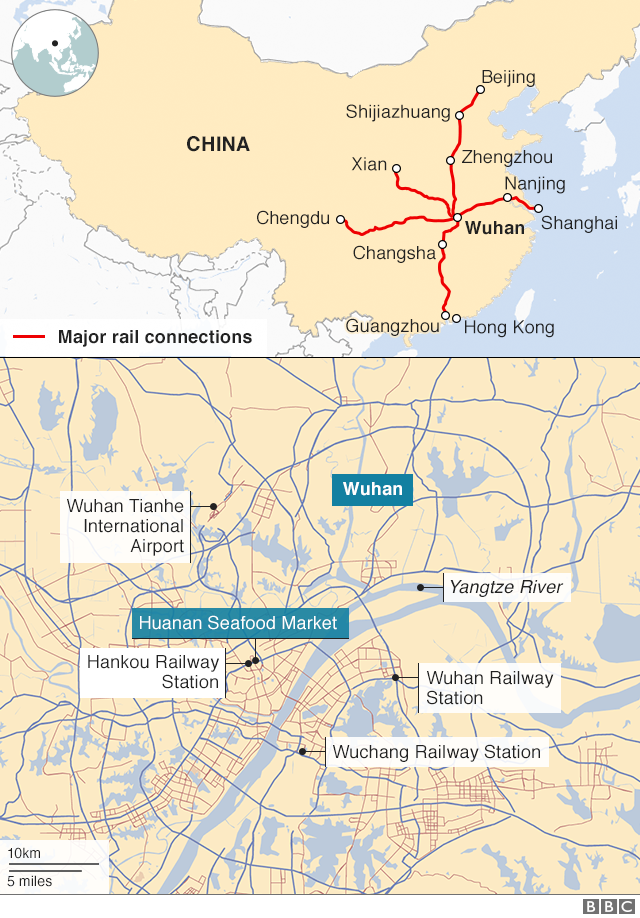
From Thursday, all flights and passenger train services out of Wuhan have been stopped.

Bus, subway and ferry services all shut down from 10:00 local time (02:00 GMT).

A special command centre in Wuhan set up to contain the virus said the move was meant to “resolutely contain the momentum of the epidemic spreading”.

Map of Wuhan transportThose living in Wuhan had already been told to avoid crowds and minimise public gatherings.

State news agency Xinhua said tourist attractions and hotels in the city had been told to suspend large-scale activities while libraries, museums and theatres were cancelling exhibitions and performances.

A Lunar New Year prayer-giving ceremony at the city’s Guiyuan Temple, which attracted 700,000 people last year, has also been cancelled.

The hashtag “Wuhan is sealed off” was trending on Chinese social media website Weibo.

One user said worries about food and disinfectant made it feel like “the end of the world”, while another said they were on the “verge of tears” when Chinese officials announced the shut-down.

The WHO’s Dr Ghebreyesus described the latest measures as “very strong” and said they would “not only control the outbreak, they will minimise spread internationally”.

Chinese officials said the country was now at the “most critical stage” of prevention and control.

“Basically, do not go to Wuhan. And those in Wuhan please do not leave the city,” said National Health Commission vice-minister Li Bin in one of the first public briefings since the beginning of the outbreak.

line

Like shutting down London before Christmas

By James Gallagher, BBC health and science correspondent

Wuhan is starting to look like a city in quarantine.

Officials had already warned residents not to leave the city and visitors not to come.

Now the reported public transport ban – which includes flights – slams many of the routes in and out of the city shut.

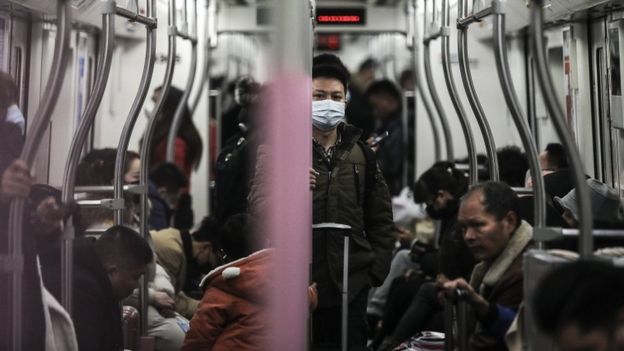
A man wears a mask on the subway on January 22, 2020 in Wuhan, Hubei province, ChinaImage copyright GETTY IMAGES
Image caption Subways in Wuhan will be temporarily shut

It is a significant attempt to stop the spread of this new virus, which we now know can spread from person to person.

Limiting transport will cut the chance of the virus reaching other cities in China and other countries around the world.

This all comes just as millions of people are travelling across China for the week-long holiday that is Lunar New Year.

If you’re struggling for context – imagine shutting down London in the week before Christmas.

The big question left is the roads – and whether any of Wuhan’s 11 million inhabitants will be able to simply drive away.

line

What’s the picture globally?

Officials in Hong Kong reported the territory’s first two cases on Wednesday and one case was reported in the nearby city of Macau.

The patient in Macau is said to be a businesswoman who arrived from Wuhan over the weekend.

The first US case was confirmed on Tuesday. President Donald Trump said the situation was “totally under control” and that he trusted the information being provided by Chinese authorities.

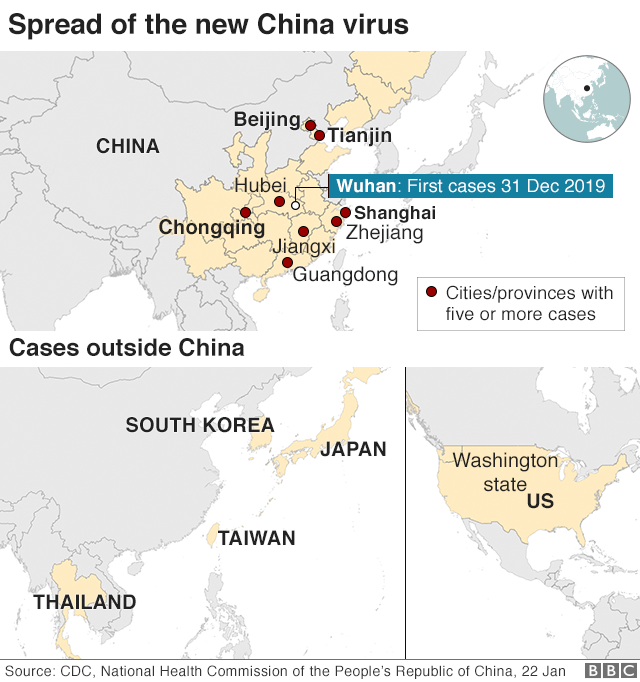
Map: Confirmed cases in China and around the world
There have been three cases in Thailand, one in Korea, one in Japan and one in Taiwan.

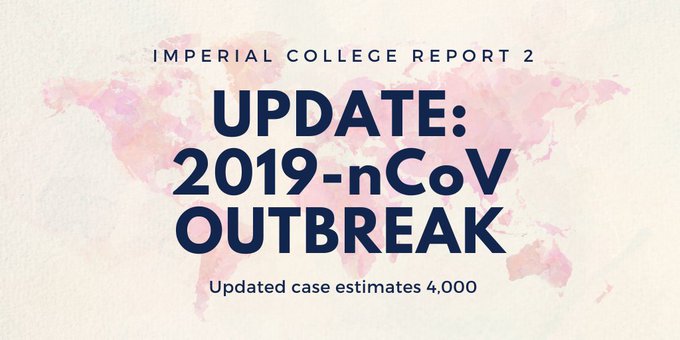
Although only about 500 cases have been confirmed, calculations by scientists at the MRC Centre for Global Infectious Disease Analysis at Imperial College London suggest there are 4,000 people sick with the virus in Wuhan.

What do we know about the virus?

The virus originated in a seafood market in Wuhan that “conducted illegal transactions of wild animals”, authorities said. The market has since been shut down.

There is also evidence of human to human transmission with the new virus spreading to family members and healthcare workers.

But understanding how easily and how often the virus spread between people is one of the major outstanding questions in this outbreak.

The virus infects the lungs and symptoms start with a fever and cough. It can progress to shortness of breath and breathing difficulties.

Source: The BBC

18/01/2020

New Chinese virus ‘will have infected hundreds’

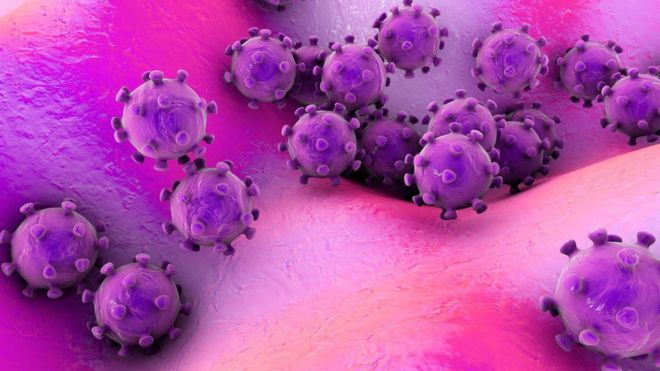
VirusesImage copyright GETTY IMAGES
Image caption There were six coronaviruses known to infect people before the latest discovery

The number of people already infected by the mystery virus emerging in China is far greater than official figures suggest, scientists have told the BBC.

There have been more than 60 confirmed cases of the new coronavirus, but UK experts estimate a figure nearer 1,700.

Two people are known to have died from the respiratory illness, which appeared in Wuhan city in December.

“I am substantially more concerned than I was a week ago,” disease outbreak scientist Prof Neil Ferguson, said.

The work was conducted by the MRC Centre for Global Infectious Disease Analysis at Imperial College London, which advises bodies including the UK government and the World Health Organization (WHO).

Singapore and Hong Kong have been screening air passengers from Wuhan, and US authorities announced similar measures starting on Friday at three major airports in San Francisco, Los Angeles and New York.

How were the numbers calculated?

The crucial clue to the scale of the problem lies in the cases being detected in other countries.

While the outbreak is centred on the central Chinese city of Wuhan, there have been two cases in Thailand and one in Japan.

“That caused me to worry,” said Prof Ferguson.

He added: “For Wuhan to have exported three cases to other countries would imply there would have to be many more cases than have been reported.”

It is impossible to get the precise number, but outbreak modelling, which is based on the virus, the local population and flight data, can give an idea.

Wuhan International Airport serves a population of 19 million people, but only 3,400 a day travel internationally.

The detailed calculations, which have been posted online ahead of publication in a scientific journal, came up with a figure of 1,700 cases.

What does it all mean?

Prof Ferguson said it was “too early to be alarmist” but he was “substantially more concerned” than a week ago.

Chinese officials say there have been no cases of the virus spreading from one person to another.

Instead they say the virus has crossed the species barrier and come from infected animals at a seafood and wildlife market in Wuhan.

Prof Ferguson argues: “People should be considering the possibility of substantial human-to-human transmission more seriously than they have so far.

“It would be unlikely in my mind, given what we know about coronaviruses, to have animal exposure, be the principal cause of such a number of human infections.”

Understanding how a novel virus is spreading is a crucial part of assessing its threat.

The WHO’s China office said the analysis was helpful and would help officials plan the response to the outbreak.

“Much remains to be understood about the new coronavirus,” it said. “Not enough is known to draw definitive conclusions about how it is transmitted, the clinical features of the disease, the extent to which it has spread, or its source, which remains unknown.”

WuhanImage copyright GETTY IMAGES
Image caption The outbreak occurred in the city of Wuhan, south of Beijing

What is this virus?

Viral samples have been taken from patients and analysed in the laboratory.

And officials in China and the World Health Organization have concluded the infection is a coronavirus.

Coronaviruses are a broad family of viruses, but only six (the new one would make it seven) are known to infect people.

At the mild end they cause the common cold, but severe acute respiratory syndrome (Sars) is a coronavirus that killed 774 of the 8,098 people infected in an outbreak that started in China in 2002.

Analysis of the genetic code of the new virus shows it is more closely related to Sars than any other human coronavirus.

The virus has caused pneumonia in some patients and been fatal in two of them.

What do other experts say?

Dr Jeremy Farrar, director of the Wellcome medical research charity, said: “There is more to come from this epidemic.

“Uncertainty and gaps remain, but it’s clear that there is some level of person-to-person transmission.

Media caption Coronavirus feared to have infected more than initially thought, according to scientists

“We are starting to hear of more cases in China and other countries and it is likely, as this modelling shows, that there will be many more cases in a number of countries.”

Prof Jonathan Ball, from the University of Nottingham, said: “What’s really important is until there has been widespread laboratory testing it is very difficult to put a real number on the cases out there.

“But this is a figure we should take seriously until we know otherwise, 41 animal-to-human ‘spillovers’ is stretching it a bit and there probably is more underlying infection than has been detected so far.”

Source: The BBC

Law of Unintended Consequences

continuously updated blog about China & India

ChiaHou's Book Reviews

continuously updated blog about China & India

What's wrong with the world; and its economy

continuously updated blog about China & India