Archive for ‘implementation’

30/05/2020

US-China tensions set to worsen as moderates lose out to hardliners, observers say

  • Chinese groups calling for more ‘fighting spirit’ are getting the upper hand on those who favour calm and cooperation, government adviser says
  • From Hong Kong to Covid-19, trade to the South China Sea, Beijing and Washington are clashing on a growing number of fronts and in an increasingly aggressive way
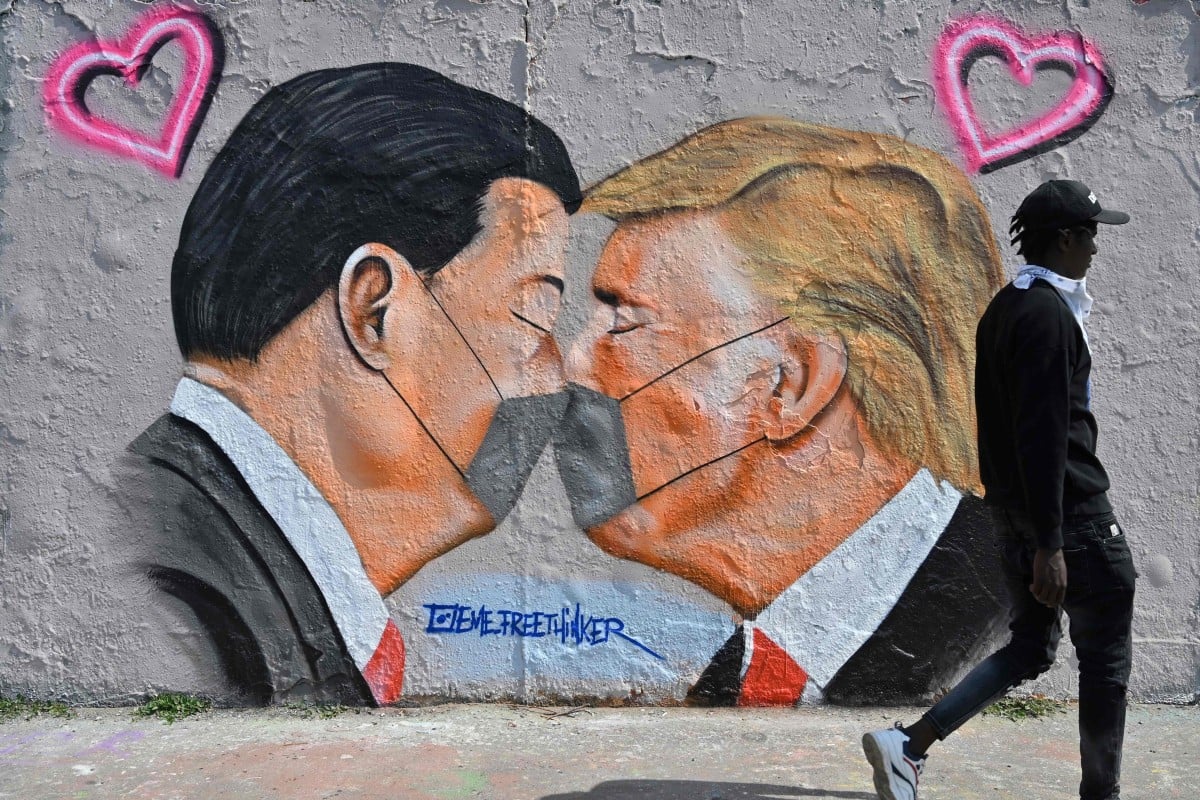
Efforts to promote dialogue and cooperation between the US and China are failing, observers say. Photo: AFP
Moderates who favour dialogue and cooperation as a way to resolve China’s disputes with the United States are losing ground to hardline groups bent on taking the fight to Washington, according to political insiders and observers.
“There are two camps in China,” said a former state official who now serves as a government adviser and asked not to be named.
“One is stressing the combat spirit, the other is trying to relieve tensions. And the former has the upper hand.”
Relations between China and the US are under intense pressure. After Beijing moved to introduce a national security law for Hong Kong, US President Donald Trump said on Friday that Washington would begin eliminating the special policy exemptions it grants the city, as it no longer considers it autonomous from mainland China.
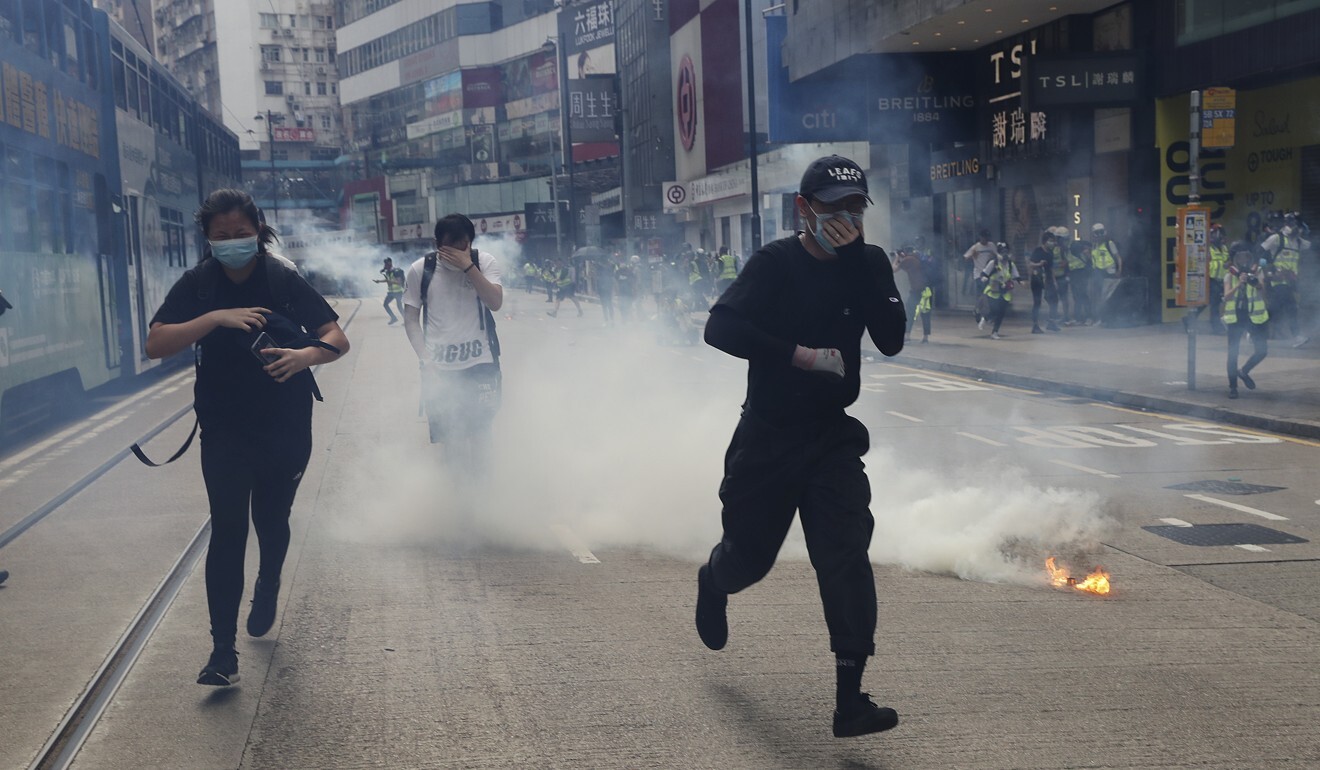
Beijing’s decision to enact a national security law for Hong Kong was met with anger from the US and other Western countries. Photo: Sam Tsang
The two nations have also clashed over trade, Xinjiang, Taiwan and the South China Sea, with the US passing several acts denouncing Beijing and sanctioning Chinese officials.
China has also experienced turbulence in its relations with other countries, including Australia and members of the European Union, mostly related to the Covid-19 pandemic
 and Beijing’s efforts to position itself as a leader in the fight against the disease with its policy of “mask diplomacy”.

After Canberra appealed for an independent investigation to be carried out to determine the origins of the coronavirus, Beijing responded by imposing tariffs on imports of Australian barley, showing it is prepared to do more than just trade insults and accusations with its adversaries.

Pang Zhongying, a professor of international relations at Ocean University of China in Qingdao, said there was a worrying trend in China’s relations with other nations.

“We need political and diplomatic means to resolve the challenges we are facing, but … diplomatic methods have become undiplomatic,” he said.

“There are some who believe that problems can be solved through tough gestures, but this will never work. Without diplomacy, problems become confrontations.”

Chinese Foreign Minister Wang Yi

said during his annual press conference on the sidelines of the National People’s Congress last weekend that China and the United States must work together to prevent a new Cold War.

His words were echoed by Chinese Premier Li Keqiang, who said during a press conference after the closure of the legislative session on Thursday that the many challenges facing the China-US relations could only be resolved through cooperation.

However, the government adviser said there was often quite a chasm between what China’s leaders said and what happened in reality.

“Even though we say we do not want a Cold War, what is happening at the working level seems to be different.” he said. “The implementation of policies is not properly coordinated and often chaotic.”

Tensions between China and the US have been in a poor state since the start of a trade war almost two years ago. After multiple rounds of negotiations, the sides in January signed a phase one deal, but the positivity that created was short-lived.

In February, Beijing expelled three reporters from The Wall Street Journal over an article it deemed racist, while Washington has ramped up its military activity in the South China Sea and Taiwan Strait, and threatened to revoke the visas of Chinese students studying science and technology in the US over concerns they might be engaged in espionage.

Beijing has also used its state media and army of “Wolf Warrior” diplomats to promote its narrative, though many Chinese scholars and foreign policy advisers have said the latter’s nationalistic fervour has done more harm than good and appealed to Beijing to adopt a more conciliatory tone.
However, Hu Xijin, editor-in-chief of Chinese tabloid Global Times, said China had no option but to stare down the US, which regarded the world’s most populous nation as its main rival.
“Being contained by the US is too high a price for China to pay,” he said. “I think the best thing people can do is forget the old days of China-US ties”.

Jin Canrong, a professor of international relations at Renmin University in Beijing, wrote in a recent newspaper article that Beijing’s actions – notably enacting a national security law for Hong Kong – showed it was uncompromising and ready to stand its ground against the US.

Wu Xinbo, dean of international studies at Fudan University in Shanghai, agreed, saying relations between the two countries were likely to worsen in the run-up to the US presidential election in November and that Beijing should be prepared for a fight.

But Adam Ni, director of China Policy Centre, a think tank in Canberra, said the issue was not that the moderate camp had been sidelined, but rather Beijing’s perception of the US had changed.

“Beijing has woken up to the idea that America’s tough policy on China will continue and it is expecting an escalation of the tensions,” he said.

“The centre of gravity in terms of Beijing’s perception of the US has shifted, in the same way the US perception of China has shifted towards a more negative image”.

Beijing was simply responding in kind to the hardline, assertive manner of the US, he said.

Source: SCMP

13/05/2020

Xinhua Headlines-Xi Focus: Xi stresses achieving moderately prosperous society in all respects

Chinese President Xi Jinping, also general secretary of the Communist Party of China Central Committee and chairman of the Central Military Commission, learns about poverty alleviation efforts at an organic daylily farm in Yunzhou District of Datong City, north China’s Shanxi Province, May 11, 2020. (Xinhua/Li Xueren)

— Xi stressed addressing the difficulties faced by enterprises in resuming production and operation.

— Xi underscored lifting the remaining poor population out of poverty.

— Xi required implementing pro-employment policies.

TAIYUAN, May 12 (Xinhua) — Chinese President Xi Jinping has stressed efforts to complete building a moderately prosperous society in all respects, and ride on the momentum to write a new chapter in socialism with Chinese characteristics for a new era.

Xi, also general secretary of the Communist Party of China (CPC) Central Committee and chairman of the Central Military Commission, made the remarks during an inspection tour in north China’s Shanxi Province.

Xi called for efforts to overcome the adverse impacts of the COVID-19 epidemic and make greater strides in high-quality transformation and development to ensure that the target of poverty eradication is reached and the building of a moderately prosperous society in all respects is completed.

During the tour from Monday to Tuesday, Xi inspected work on coordinating the regular epidemic response with economic and social development, and on consolidating the poverty eradication results.

While visiting an organic daylily farm in Yunzhou, Datong City, on Monday, Xi said what he cares about the most after poverty eradication is how to consolidate the achievements, prevent people from falling back into poverty, and make sure rural people’s incomes rise steadily.

He said an important benchmark to evaluate an official’s job performance is to see the amount of good and concrete services he or she has delivered to the people.

When visiting a community of relocated villagers, Xi said relocation is not only about better living conditions but also about chances to get rich. He called for follow-up support to residents with tailor-made rural business projects to ensure sustainable development.

Highlighting that whether the people can benefit shall be a top concern, Xi demanded more supporting policies be put in place in terms of industrial development, financing, agricultural insurance, among others.

Xi applauded the strenuous efforts made by primary-level officials on helping people fight poverty.

At the home of villager Bai Gaoshan, Xi chatted with Bai’s family as they sat on a “kang” — a bed-stove made out of clay or bricks in north China.

Chinese President Xi Jinping, also general secretary of the Communist Party of China Central Committee and chairman of the Central Military Commission, learns about poverty alleviation efforts in a village of Xiping Township in Datong City, north China’s Shanxi Province, May 11, 2020. (Xinhua/Xie Huanchi)

Xi said the CPC wholeheartedly seeks happiness for the Chinese people, having stopped collecting agricultural taxes and fees, helping the impoverished rural residents with housing and medical service, training them with skills, and finding ways for them to live a prosperous life.

“I believe our villagers will enjoy better days ahead,” Xi said.

On top of that, he called for consolidating achievements in poverty alleviation, and then focusing on rural vitalization to ensure a better life for rural residents.

He then went on to visit the 1,500-year Yungang Grottoes, a “treasure house” of artifacts featuring elements blending Chinese and foreign cultures, as well as cultures of China’s ethnic minorities and the Central Plains.

Xi stressed that historical and cultural heritages are irreplaceable precious resources, and protecting them should always be put in the first place in tourism development.

Noting that tourism should not be over-commercialized, Xi said tourism should become a way for the Chinese to understand and appreciate the culture of the nation and enhance their cultural confidence.

The historical implications of communication and integration behind the Yungang Grottoes should be further explored to enhance the sense of community for the Chinese nation, said Xi.

During a research tour in a stainless steel manufacturer in the provincial capital Taiyuan on Tuesday morning, Xi said products and technology are the lifeline of businesses, calling for more efforts in technological innovation to make a greater contribution to the development of advanced manufacturing.

He also called on businesses to strictly implement epidemic prevention and control measures to ensure the safety and health of their workers, while promoting the resumption of work and production to make up for the time lost.

Chinese President Xi Jinping, also general secretary of the Communist Party of China Central Committee and chairman of the Central Military Commission, waves to workers during a research tour in a stainless steel manufacturer in Taiyuan, capital city of north China’s Shanxi Province, May 12, 2020. (Xinhua/Li Xueren)

Later on, Xi went to check the ecological protection work of the Fenhe River in the city, and urged the incorporation of environment protection, energy revolution, green development, and economic transformation.

After hearing the work reports of the CPC Shanxi Provincial Committee and the provincial government on Tuesday afternoon, Xi stressed that no relaxation is allowed in epidemic prevention and control, noting that efforts should be made to guard against both imported infections and domestic rebounds, improve regular prevention and control mechanism, and prevent new outbreaks.

Xi called for efforts on more promptly and effectively addressing the difficulties faced by enterprises in resuming production and operation, on solid implementation of all the policies and measures for expanding domestic demand, and on strengthening the competitiveness and quality of the real economy, especially the manufacturing industry.

Chinese President Xi Jinping, also general secretary of the Communist Party of China Central Committee and chairman of the Central Military Commission, speaks with workers during a research tour in a stainless steel manufacturer in Taiyuan, capital city of north China’s Shanxi Province, May 12, 2020. (Xinhua/Xie Huanchi)

Continuous efforts should be made to promote the adjustment and optimization of China’s industrial structure, and scientific and technological innovations should be greatly enhanced to continue achieving breakthroughs in new infrastructures, technologies, materials, equipment as well as new products and business models, Xi said.

He stressed overcoming the difficulties and obstacles facing reforms in key areas, including state-owned enterprises and assets, the fiscal, tax, and financial system, business environment, the private sector, domestic demand expansion, and urban-rural integration.

Xi also highlighted efforts to improve the country’s system and mechanism for opening-up.

China will uphold the concept that lucid waters and lush mountains are invaluable assets, and steadily implement the national strategy for ecological protection and high-quality development of the Yellow River basin, he said.

More should be done to accelerate institutional innovation and strengthen the implementation of institutions to help form a green way of production and living, he said.

Efforts should be made to solidify the foundation for the development of agriculture and rural areas, beef up policy support for grain production and lift the remaining poor population out of poverty, Xi said.

Authorities should adhere to the people-centered development philosophy and ensure the bottom line of people’s livelihood, Xi said. He added that efforts should be made to implement pro-employment policies and facilitate the employment of key groups such as college graduates, veterans, rural migrant workers and urban people facing difficulties.

Efforts should be expedited to improve the weak areas in the public health system exposed by the epidemic and shift the focus of social governance to the primary levels, Xi said.

The rich and colorful local history and culture as well as revolutionary cultural resources should be fully drawn on and used to promote cultural advancement, Xi said.

He stressed consistent efforts to promote core socialist values to guide Party cadres as well as the public to enhance morality, cultivate good ethics and strengthen cultural confidence.

Xi also called for efforts to improve the Party’s political ecosystem, strictly observe the Party’s political discipline and rules and fight against corruption and undesirable conduct.

Source: Xinhua

10/03/2019

Xi stresses implementation of rural revitalization strategy

(TWO SESSIONS)CHINA-BEIJING-XI JINPING-NPC-DELIBERATION (CN)

Chinese President Xi Jinping, also general secretary of the Communist Party of China (CPC) Central Committee and chairman of the Central Military Commission, joins deliberation with deputies from central China’s Henan Province at the second session of the 13th National People’s Congress in Beijing, capital of China, March 8, 2019. (Xinhua/Xie Huanchi)

BEIJING, March 8 (Xinhua) — Chinese President Xi Jinping on Friday called for more efforts to implement the rural revitalization strategy with the chief goal to modernize agriculture and rural areas.

“The top task for implementing the rural revitalization strategy is to ensure supply of important farm produce, grain in particular,” said Xi, also general secretary of the Communist Party of China Central Committee and chairman of the Central Military Commission.

He made the remarks when joining deliberation with deputies from Henan Province at the second session of the 13th National People’s Congress, China’s national legislature.

Efforts should be made to promote the supply-side structural reform in the agricultural sector to achieve food security while building a modern and efficient agriculture, Xi added.

Xi also called for enhanced protection of agriculture ecological environment and prevention and treatment of pollution in rural areas.

Xi stressed strict penalties on crimes involving food safety so as to ensure safe farm produce for the public.

Efforts should be made to strengthen the leadership of grassroots Party units in the rural areas, Xi said, noting that the practices of rural residents’ self-governance should be further explored.

Xi also called for measures to promote two-way flow and equal exchange of factors, including human resources, lands and capital, between urban and rural areas.

“The task to eradicate extreme poverty must be fulfilled by 2020,” Xi stressed.

Implementation of the rural revitalization strategy and seeking progress in work related with agriculture, rural areas and farmers should be taken into consideration and promoted in the overall economic and social development, Xi said.

Li Keqiang, Wang Huning and Han Zheng — members of the Standing Committee of the Political Bureau of the CPC Central Committee — on Friday also separately joined deliberation with NPC deputies.

Premier Li Keqiang stressed building a business environment that is fair and convenient for enterprises under all forms of ownership, when joining a deliberation with deputies from Hubei Province.

He called for efforts to fully carry out the reforms of tax and fee cuts and further stimulate the market vitality.

Wang Huning, a member of the Secretariat of the CPC Central Committee, asked deputies from central China’s Hunan Province to take bigger steps in pushing forward high-quality development.

He also called for taking a people-centered approach to further live up to people’s new expectations for their cultural lives.

Joining the deliberation of the Beijing delegation, Vice Premier Han Zheng underlined deepening the coordinated development of the Beijing-Tianjin-Hebei region to further relieve Beijing of functions nonessential to its role as the capital.

Source: Xinhua

Law of Unintended Consequences

continuously updated blog about China & India

ChiaHou's Book Reviews

continuously updated blog about China & India

What's wrong with the world; and its economy

continuously updated blog about China & India