Chindia Alert: You’ll be Living in their World Very Soon
aims to alert you to the threats and opportunities that China and India present. China and India require serious attention; case of ‘hidden dragon and crouching tiger’.
Without this attention, governments, businesses and, indeed, individuals may find themselves at a great disadvantage sooner rather than later.
The POSTs (front webpages) are mainly 'cuttings' from reliable sources, updated continuously.
The PAGEs (see Tabs, above) attempt to make the information more meaningful by putting some structure to the information we have researched and assembled since 2006.
BRUSSELS (Reuters) – The euro zone’s trade surplus with the rest of the world grew in February, with a decline in imports from China as well as sharply lower energy needs because of mild winter weather.
The unadjusted goods trade surplus grew to 23.0 billion euros ($25.1 billion) in February, compared with 18.5 billion euros a year earlier. Exports rose by 1.6%, while imports fell by 1.0%.
For China, which already had widespread coronavirus restrictions in place in February, exports from the European Union as a whole were slightly lower than in February 2019. However, imports were down by 8.1%, according to data on Eurostat’s website.
Energy imports as a whole also declined by 9.6% in February, when comparing Jan-Feb data issued on Monday and January data from a month ago. That translated into 10.1% lower imports from Russia and 5.9% less from Norway.
The trade surplus with the United States, by contrast, grew by 21% in the month as exports increased and imports declined. The persistent surplus in goods has been a source of transatlantic tension.
On a seasonally adjusted basis the euro zone trade surplus also rose to 25.8 billion euros in February from 18.2 billion euros in January. Exports were 1.8% higher month-on-month and imports 2.3% lower.
BEIJING/SHANGHAI (Reuters) – China expects to import more soybeans and pork this year following the novel coronavirus outbreak and African swine fever, which has decimated its pig herds.
Soybean imports are forecast at 92.48 million tonnes this year, rising to 96.62 million tonnes in 2025 and 99.52 million tonnes in 2029, an official from the agriculture ministry told a video conference on the outlook for agriculture released on Monday.
Pork imports this year are seen rising to 2.8 million tonnes, a 32.7% increase from the previous year.
China is a key buyer and consumer of soybeans and pork globally, and typically imports millions of tonnes of soybeans per year to crush for meal to feed its livestock.
The African swine fever outbreak, however, had slashed China’s pig herd by over 40% last year, reducing supplies in the world’s biggest pork consumer.
Combined with the coronavirus outbreak, which hit the transport of pigs and delayed the restart of slaughtering plants, prices of China’s favourite meat rose to record levels in February.
China has been increasing pork imports in recent months to make up for the drop in domestic supply.
Despite the expected surge in imports, China’s 2020 pork consumption is forecast to fall to 42.06 million tonnes, down 5.6% year-on-year, hit by high prices and a fall in consumer demand due to the coronavirus outbreak, according to the agriculture ministry.
In line with the slowing consumption, China’s slaughtered pig herd this year will fall 7.8% year-on-year to 501.49 million heads. Pork output this year will also decline to 39.34 million tonnes from 2019, but will rebound to around 54 million tonnes in 2022.
In the longer term, however, pork imports are expected to gradually fall, the ministry forecast, while beef and mutton imports are set to increase in the next decade.
Meanwhile, China’s domestic soybean output is seen at 18.81 million tonnes in 2020, a 3.9% gain from the previous year, while crushing volumes were pegged at 85.98 million tonnes.
Soybean consumption will increase steadily and continue to rely mainly on imports in the next 10 years, said a ministry official.
The ministry also said China’s corn acreage and output are both set to increase in 2020, with production forecast to reach over 260 million tonnes this year, while annual rice output is expected to hold steady above 200 million tonnes per year in the next 10 years.
BEIJING (Reuters) – China will promote the sales of export products in domestic markets, as foreign trade faces unprecedented challenges due to the coronavirus pandemic, an assistant commerce minister said on Friday.
As the coronavirus spreads to almost all of China’s trading partners, the world’s second-largest economy is set to reach a grim milestone for full year growth, with the pace of expansion likely to be the slowest since the Cultural Revolution ended in 1976. And, the export sector is facing millions of job losses and factory shutdowns.
“Due to the rapid spread of the epidemic in the world, foreign demand has slumped and the biggest difficulty facing foreign trade companies is the plunge in orders,” said Ren Hongbin, the assistant minister at the Ministry of Commerce.
He said firms across the board have had their orders cancelled or delayed, and new orders are “very hard to sign”.
“The uncertainty about the pandemic has become the biggest uncertainty for foreign trade development.”
Forecasters expect China’s 2020 growth could be nearer the 2.0% mark – the slowest in over 40 years – due to the sweeping impact of the pandemic both at home and overseas. The economy grew 6.1% last year.
China’s overseas shipments fell 17.2% in January-February from the same period a year earlier, marking the steepest fall since February 2019. Imports sank 4% from a year earlier.
Among the government measures to support the sector, China is accelerating efforts to build online trade fairs and guiding exporters to work with e-commerce retailers for sales in domestic markets and coordinating with its trading partners to stabilise supply chains, said Ren.
The Canton Fair, China’s oldest and biggest trade fair due to take place online, will feature live-streaming services for participants, Li Xingqian, another commerce ministry official, told the same briefing. The fair was originally scheduled to begin on April 15, but was postponed due to the coronavirus outbreak.
China is willing to boost trade relations with other countries, including the United States, under the new circumstances, said Ren, adding that Beijing hopes to work together with Washington to promote bilateral trade.
Both countries have been engaged in a near two-year long trade war with tit-for-tat tariffs on each other’s goods, before negotiators called a truce with an interim trade deal in January.
Hong Kong and Thailand are likely to suffer most from the novel coronavirus outbreak because of close their economic ties with China
A drop in Chinese tourist arrivals and imports, as well as supply chain disruptions are likely to weigh on regional economy
Thailand’s economy could be one of the most affected by the coronavirus outbreak due to its close ties with China, especially in the tourism sector. Photo: Bloomberg
Hong Kong and Thailand are likely to be the hardest hit Asian economies outside mainland China from the deadly coronavirus outbreak, according to analysts.
The 2019-nCoV, which had claimed the lives of nearly 640 people and infected more than 31,000 in mainland China by Friday, is viewed as even more damaging than the severe acute respiratory syndrome (Sars) epidemic in 2002-2003 because of prolonged factory closures and transport restrictions that have locked down many Chinese cities.
China has become more closely integrated with the rest of Asia since the Sars outbreak, meaning the disruptions to China’s industrial and export sectors, combined with a sharp drop in economic activity in the first quarter, will have significant repercussions across the region, particularly through tourism and trade, analysts said.
“A collapse in tourism arrivals from China will be the first shock wave for the rest of the region,” said Gareth Leather, senior Asia economist at Capital Economics. “Factory closures in China will affect the rest of the region by disrupting regional supply chains.”
A collapse in tourism arrivals from China will be the first shock wave for the rest of the region. Factory closures in China will affect the rest of the region by disrupting regional supply chainsGareth Leather
Hong Kong would likely be the most affected because of its status as a trade hub, its tight linkages to the Chinese economy and the sharp decline in tourism expenditure that is expected, UBS economist William Deng noted.
“Due to the risk of infection, domestic households significantly reduced such activities as dining out, shopping and entertainment,” Deng wrote in a recent note. He cut Hong Kong’s gross domestic product (GDP) growth forecast to minus 1.8 per cent for 2020, against his previous projection of a 0.5 per cent drop.
A community outbreak spread by human-to-human transmission has started in the city, said Professor Yuen Kwok-yung, a top microbiologist at the University of Hong Kong on Wednesday.
Thailand could be the next most affected due to its dependence on Chinese tourism. Outside Hong Kong and Macau, the country has the highest exposure to China as a share of GDP in the region.
China locks down Hangzhou, mega-city far from epicentre of coronavirus outbreak
ANZ Bank’s head of Asia research Khoon Goh said that the novel coronavirus could knock US$760 million from Thailand’s economy in the first quarter. Hong Kong could could see losses of US$1.4 billion. Travel services as a share of GDP were 11.2 per cent in Thailand and 9.4 per cent in Hong Kong.
“The Thai economy would expand at a slower rate in 2020 than previously forecast and much further below its potential due to the outbreak of coronavirus,” Bank of Thailand said in a statement after it slashed interest rates to a record low on Wednesday.
South Korean and Taiwanese businesses will also have negative spillover effects from the coronavirus outbreak because of supply chain disruptions and weaker consumer sentiment inside and outside China, analysts said.
South Korean car and tech companies that rely on parts from Chinese suppliers are exposed to potential production disruptions stemming from factory closures and the evacuation of Korean workers from China-based production lines, said Sean Hwang, corporate finance group analyst at Moody’s Investors Group.
Coronavirus: here are the places and airlines restricting travel to China
For instance, Hyundai Motor Company closed some if its South Korea-based plants on February 4 because of a shortage of wiring harnesses.
Korean customers are also limiting their trips to bricks-and-mortar retail stores such as E Mart and Lotte Shopping to avoid crowds amid the outbreak, potentially leading to a significant decline in revenue and earnings, Hwang said.
Although Singapore is not as closely tied to China as Hong Kong, the city state could still see a knock-on effect from China’s expected near-term downturn, as its economy has become much more integrated with the world’s second largest economy since the Sars outbreak.
The number of Chinese tourists rose six times from 568,000 in 2003 to 3.4 million in 2018, said Irvin Seah, senior economist at DBS Bank.
Coronavirus outbreak: global businesses shut down operations in China
“We expect a decline of about 1 million tourists or about SGD1 billion (US$722 million) of lost tourism receipts for every three months of travel ban,” Seah said. “We have lowered our full-year GDP growth forecast to 0.9 per cent, down from 1.4 per cent previously.”
Taiwan has banned Chinese visitors as well as foreigners who have visited Hong Kong and Macau from entering the island due the coronavirus. International cruise ships are also unable to dock on the island, which will lead to at least 112 liner visits cancelled by the end of March, affecting around 144,000 passengers, said the Taiwan International Ports Corporation.
Capital Economics’ Leather said the economic impact on Taiwan from 2019-nCoV could stand out from the rest of Asia, as it had the most exposure in value-added, intermediate exports to China – 18 per cent of GDP.
20 coronavirus infections confirmed on cruise ship in Japan, as thousands remain under quarantine
Elsewhere, Malaysia’s commodity driven trade growth this year has been threatened by the almost 20 per cent fall in crude oil prices, a decline triggered by fears that the coronavirus outbreak would dampen China’s imports. Malaysia’s purchasing managers’ index, a survey of manufacturers, dropped to 48.8 in January from 50.0 the prior month prior, data released this week showed. The drop was blamed on slowing output, with new orders dropping the most since September amid a decline in exports.
“The Bank Negara Malaysia’s surprising policy rate cut at the last meeting on 22 January, just around the time the coronavirus started to dominate headlines, tells us that the central bank is ahead of the curve in recognising the risk,” said Prakash Sakpal, Asia economist at ING Bank said.
India and Indonesia will be the least affected given the small contribution the tourism sector makes to their economies, and the low share of visitors from China, ANZ’s Goh said.
NEW DELHI (Reuters) – India sought to boost growth in a federal budget on Saturday that raised spending on farms and expressways and offered cuts inpersonal taxes, but the measures fell short of market expectations and battered stocks.
Prime Minister Narendra Modi’s government is grappling with the country’s worst slowdown in a decade, with falling employment, consumption and investment ratcheting up the pressure to revive growth.
The government estimates growth this year to March 31 will slip to 5%, the weakest pace since the global financial crisis of 2008-09. It also warned an expected rebound the following year might entail a blow-out in fiscal deficit targets.
Finance Minister Nirmala Sitharaman, presenting the budget for the financial year beginning April 1, said 2.83 trillion rupees ($39.8 billion) will be allocated toward agriculture and allied activities, up 5.6 percent on the previous year.
RELATED COVERAGE
India raises import taxes in move set to spook some foreign firms
The funds will be deployed to help farmers set up solar power generation units as well as establish a national cold storage system to transport perishables.
Sitharaman also vowed to spend $50.7 billion in coming years on a federal water scheme to address challenges facing one of the world’s most water-stressed nations.
Agriculture accounts for near 15% of India’s $2.8 trillion economy and is a source of livelihood for more than half of the country’s 1.3 billion population.
Sitharaman announced a new personal tax system including cuts for those ready to give up a myriad of tax breaks. She also abolished payment of dividend distribution tax by companies to spur investment.
“People have reposed faith in our economic policy,” Sitharaman said to the thumping of desks in parliament. “This is a budget to boost their income and enhance their purchasing power.”
Opposition parties slammed the budget, saying it had failed to address the slowdown in consumer demand and investment. “The government is in complete denial that the economy faces a grave macro economic challenge,” said former finance minister P. Chidambaram.
But higher government spending has put pressure on public finances, prompting caution from rating agencies. Sitharaman said the fiscal deficit for the current year would widen to 3.8% of GDP, up from 3.3% targeted for the current year.
Gene Fang, associate managing director, sovereign risk at Moody’s, said: “India’s 2020/21 budget highlights the challenges to fiscal consolidation from slower real and nominal growth, which may continue for longer than the government forecasts.”
GOVERNMENT SPENDING
For fiscal 2020/21 Sitharaman set the fiscal deficit at 3.5 percent. Moody’s said India’s government debt is already significantly higher than the average for Baa-rated sovereigns, a product of persistent fiscal deficits.
To help finance government spending, Sitharaman set a target for selling stakes in state firms at 2.1 trillion rupees for 2020/21, more than three times the amount expected this year.
She said the government will sell a part of its holding in state-run Life Insurance Corp, the country’s biggest insurance company.
But many experts said the measures did not go far enough to address the slowdown and structural flaws.
“In a normal scenario this budget would have been considered as good providing tax benefit to the common man, corporate and focus on farmers’ incomes, but the situation required more,” said Vinod Nair, head of research at Geojit Financial Services in Kochi.
Indian shares slid to a more than three-month low after a special trading session on Saturday, dented by what analysts said was a lack of sufficient stimulus measures. The NSE Nifty 50 index .NSEI closed 2.5% lower while the benchmark S&P BSE Sensex .BSESN fell 2.4%
“Markets had very high expectations from the budget … these expectations have not been met,” said Deepak Jasani of HDFC Securities.
The government also announced higher duties on a host of imports from walnuts to phone parts. Taxes on imports of pre-assembled printed circuit boards were raised to 20% from 10% and there were new taxes on mobile phones ringers and display panels in a bid to boost local manufacturing.
In its annual economic report released on Friday the government predicted growth would rebound to 6.0% to 6.5% in the fiscal year beginning April 1.
Some economists say global trade tensions and the outbreak of coronavirus in China pose a new risk to economic recovery by hitting cross-border commerce and supply chains.
Black market imports from China, confusing regulations and pollution concerns are undermining India’s fireworks industry
Industry sources say Diwali sales this year were down by 30 per cent
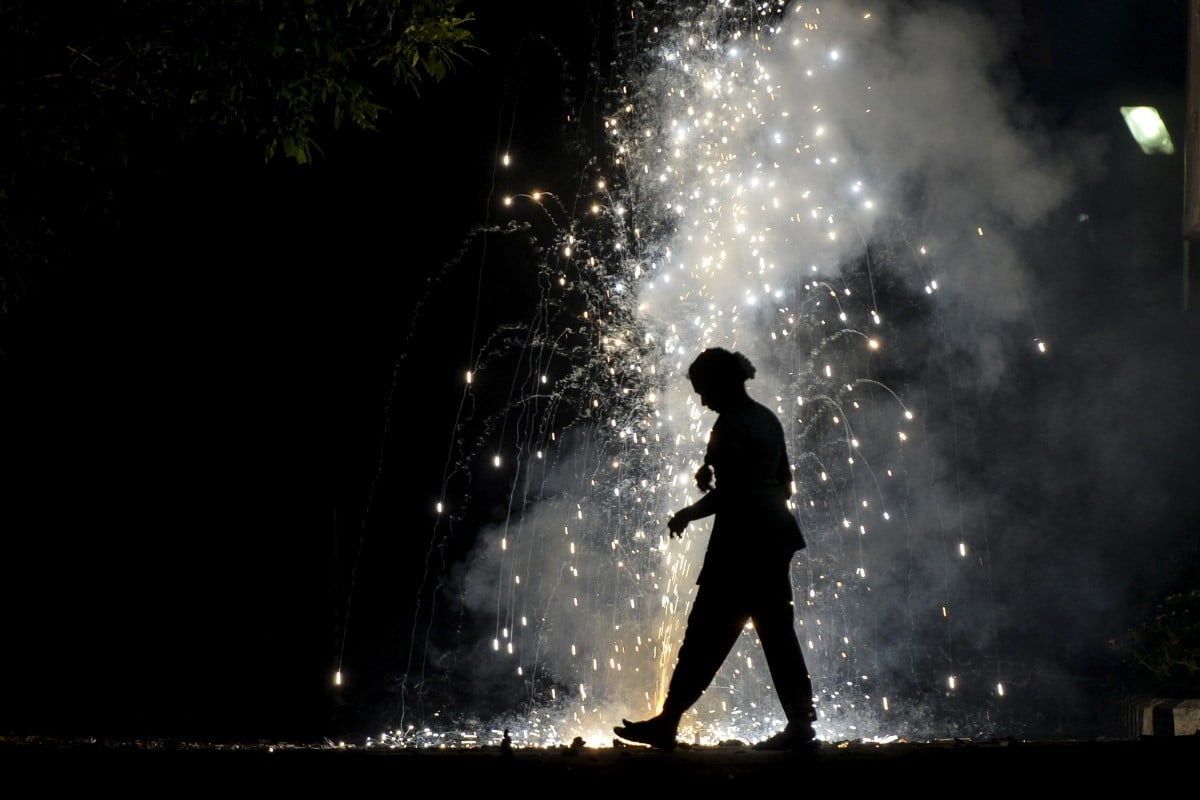
A woman is silhouetted by lit firecrackers during Diwali celebrations in Chennai. Photo: AFP
Arumugam Chinnaswamy set up his makeshift booth selling firecrackers in a Chennai neighbourhood a week ahead of Diwali, the Hindu festival of lights, with great expectations of doing a brisk trade.
Yet a week later, he has been forced to pack up more than half his stock in the hope he’ll have better luck next year.
“Four years ago, I sold firecrackers worth 800,000 rupees (US$11,288) on the eve of Diwali alone. This year, the sales have not even been a quarter of that,” said Chinnaswamy, 65, painting a grim picture that will be recognised by many in the Indian fireworks industry.
Chinnaswamy buys his firecrackers in Sivakasi, an industrial town in the southern Indian state of Tamil Nadu that produces more than 90 per cent of the country’s fireworks.
Sivakasi’s dry climate has helped to make it the firework capital of India and many production facilities in the town have been in the business for close to a century. For the most part, the industry has resisted mechanisation and still deals in handmade products. Its 1,100-plus manufacturing units provide jobs for 800,000 mostly uneducated workers and its diligent labour force have earned the town the nickname of ‘Little Japan’.
A worker lays firecrackers in an outdoor yard at a manufacturing unit involved in the production of firecrackers ahead of the Hindu festival of Diwali, in Sivakasi. Photo: AFP
But this reputation is under threat, struggling under the weight of an anti-pollution campaign, regulatory uncertainty and the arrival of cheap black-market Chinese imports. Irregular monsoons and a slowdown-induced cash crunch have not helped matters either.
Industry figures estimate the Diwali sales of India’s 80 billion-rupee firecracker industry took a 30 per cent drop this year.
A TOXIC PROBLEM
With pollution in Indian cities among the worst in the world, the government has come under pressure to do something about the nation’s toxic air – a problem that becomes more acute during Diwali due to the toxic fumes emitted when celebratory fireworks are set off. This Diwali, for instance, many areas in New Delhi recorded an Air Quality Index (AQI) of 999, the highest possible reading (the recommended limit is 60).
That makes the fireworks industry seem like an easy target when it comes to meeting government air quality targets.
Trouble began brewing in October last year when the Supreme Court banned the manufacture of traditional fireworks containing barium nitrate, a chief polluter. That decision put a rocket under the industry, as barium nitrate is cheap and is used in about 75 per cent of all firecrackers in India.
Factories in Sivakasi responded with a four-month shutdown protest that decimated annual production levels by up to a third.
A seal denotes environment friendly ‘Green Fireworks’ at a manufacturing unit in Sivakasi. Photo: AFP
Apparently realising it had overstepped the mark – and that enforcing the Supreme Court regulations would be next to impossible – the government stepped in to rescue the industry, offering its assistance in the manufacture of environment-friendly crackers containing fewer pollutants, but it was too little, too late.
“The Supreme Court verdict was simply Delhi-centric with the vague idea of [cracking down on] urban pollution. It lacked any on-the-ground knowledge of the fireworks industry,” said Tamil Selvan, president of the Indian Fireworks Association, which represents more than 200 medium and large manufacturers.
Singapore travellers give Hong Kong a miss over Diwali long weekend
“Fireworks are low-hanging fruit for the anti-pollution drive as the industry is unorganised. Could the government or judiciary place a similar blanket ban on more pollution-causing industries like automobiles, plastics or tobacco?” asked Selvan.
CHINESE COMPETITION
The industry has also been hit by a flood of cheap Chinese firecrackers that are smuggled into the country on the black market.
In September, the country’s federal anti-smuggling agency, the Directorate of Revenue Intelligence, cautioned various government departments that huge quantities of Chinese-produced firecrackers had reached Indian soil in the lead up to Diwali.
But industry sources complain they have seen little action from the government to combat the problem.
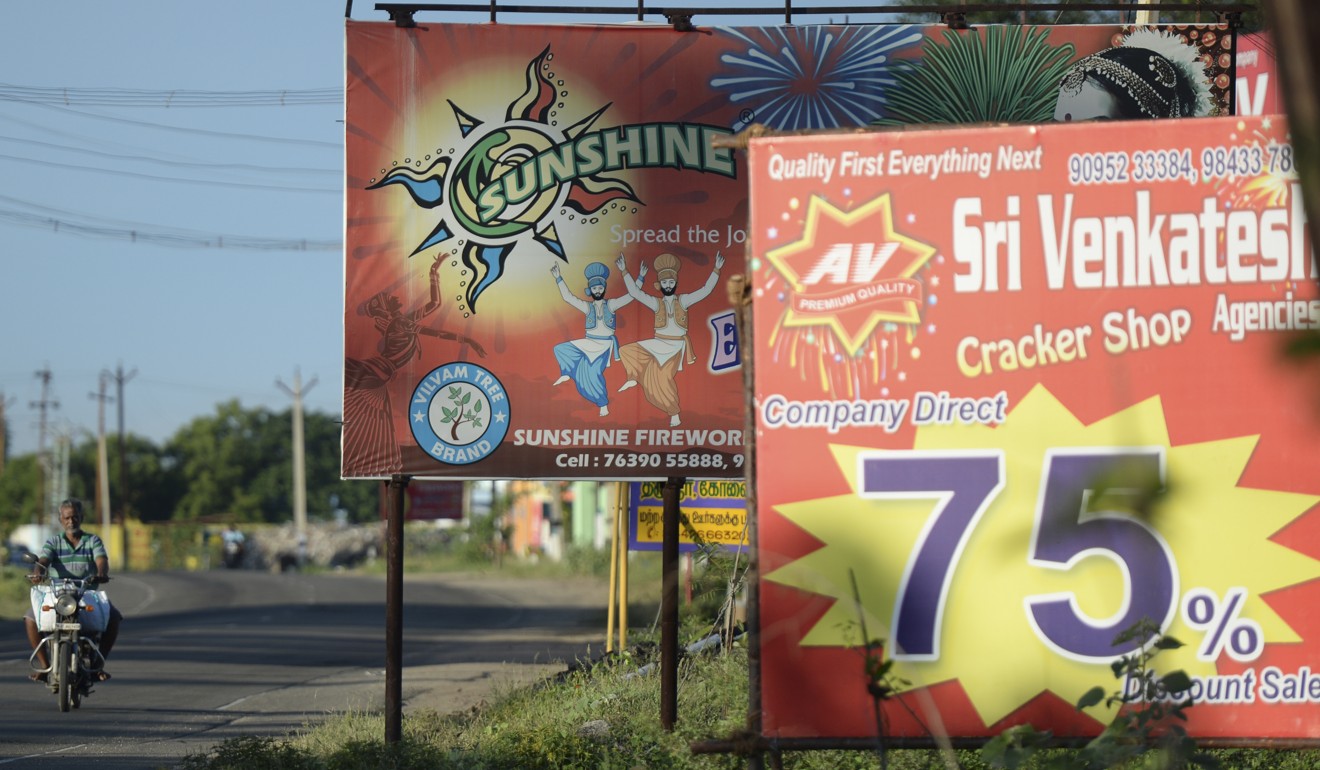
An advert for firecrackers ahead of the Hindu festival of Diwali, in Sivakasi. Photo: AFP
Legally, Indian manufacturers can neither import nor export firecrackers. The Indian firecracker industry is the second-largest in the world after China’s.
Raja Chandrashekar, chief of the Federation of Tamil Nadu Fireworks Traders, a lobbying body, said low-end Indian-manufactured firecrackers such as roll caps and dot caps – popular among children – had struggled to compete with Chinese-made pop pops and throw bombs.
“Despite our repeated complaints to government bodies, Chinese firecrackers find a way into India, particularly in the northern parts. This is severely affecting our business,” said Chandrashekar.
While more Chinese fireworks might be entering India, the effect has been to undermine the industry, resulting in fewer sales overall.
FIZZLING OUT?
The Sivakasi fireworks industry faces other problems, too. Not least among these is the use of child labour, which had been rampant until a government crackdown a few years ago, and the practice of some factories to operate without proper licences and with questionable safety standards.
But despite the darker aspects of the industry, its role goes beyond merely helping Diwali celebrations go with a bang every year.
India is crazy about gold. But can the love last as prices skyrocket?
“The livelihoods of over five million people who are indirectly involved in the business, in areas such as trade and transport, depend on the survival of the industry,” said Chandrashekar.
That survival looks increasingly in question. Dull sales of fireworks have been reported in major cities including New Delhi, Mumbai, Bangalore and Hyderabad, though exact numbers can be hard to come by due to the unregulated nature of the industry and unreliable numbers shared by manufacturers.
So great has the resultant outcry been that some cynics even wonder whether the industry is struggling as much as it claims or whether it is part of a ploy by manufacturers to gain more government concessions and avoid any further crackdown.
“These firecracker manufacturers lie through their teeth about the Diwali sales for self-serving motives such as tax avoidance. The overall business is healthy,” said Vijay Kumar, editor of the Sivakasi-based monthly magazine Pyro India News.
“Though there was a 30-40 per cent shortage in annual production, all the manufactured products have been sold this year. No large stockpile is left with any manufacturer.”
Customers buy firecrackers on the eve of the Hindu festival of Diwali in Amritsar. Photo: AFP
Still, regardless of the manufacturers’ motives, the result of the industry’s struggles has been that street sellers like Chinnaswamy have fewer fireworks to sell – and they are struggling even to sell those.
Chinnaswamy says people are confused about the government’s anti-pollution drive and about what firecrackers are now legal and this has discouraged them from buying. Despite the government’s effort to promote “green crackers” he says these are too hard to come by to be a ready solution, at least for this year.
“There was no clarity on what type of firecrackers, whether green crackers or otherwise, can be set off and at what time of the day. Many consumers even asked me whether or not the conventional firecrackers are totally banned while there was much misinformation floating about on social media,” said Chinnaswamy.
Shaking his head, all he can do is hope that next year his Diwali goes with more of a bang.
Customs authority at southern port of Sanshan brings forward deadline for scrap cargoes to arrive
Capacity has been ‘seriously exceeded’ and there are temporary controls on how many boats can dock
China is restricting imports of scrap metal as part of its efforts to reduce pollution. Photo: Reuters
The port of Sanshan in southern China’s Guangdong province stopped accepting scrap metal shipments on Thursday after an excessive build-up of stockpiles caused by importers racing to bring in cargoes ahead of new rules starting next week.
China, the world’s biggest metals consumer, is restricting imports of eight types of scrap metal, including high-grade copper scrap, from July 1 in a
Because scrap stockpiles at the port have grown too large, customs decided to bring forward the deadline for scrap cargoes to arrive at Sanshan from June 29 to June 26, according to a notice from the Sanshan port authority sent to customers and reviewed by Reuters.
Shipments arriving from June 27 could not be accepted, said the notice, whose authenticity was confirmed by a port official who asked to remain unidentified.
Sanshan’s import capacity had “already been seriously exceeded” and there were temporary controls on the number of boats allowed to dock, the official added.
It was not immediately clear when shipments would be able to resume. Firms that have received quotas from China’s Ministry of Ecology and Environment will still be allowed to import the soon-to-be-restricted metal after July 1, but no quotas have been issued so far for Guangdong and its key scrap hub of Foshan.
The Sanshan port official said cargoes declared to customs before July 1 would be able to pass.
The environment ministry last week released the first batch of quotas, which for copper scrap totalled around 240,000 tonnes, mostly for companies in Zhejiang, another of China’s metal recycling centres.
China to issue scrap metal import licences as restrictions tighten
The port of Sanshan, which is near Foshan and under the jurisdiction of Guangzhou customs, is one of only 18 seaports in China authorised to handle solid waste imports.
Guangzhou customs did not immediately respond to a faxed request for comment.
BEIJING (Reuters) – China’s exports likely contracted in February after a surprise bounce in January, while imports fell for a third straight month, a Reuters poll showed, heightening anxiety over whether Washington and Beijing can resolve deep differences over trade.
China’s exports in February are expected to have fallen 4.8 percent from a year earlier, according to the median estimate of 32 economists in a Reuters poll, following a 9.1 percent rise in January.
Such a drop would be the biggest since December 2016, and suggest a further weakening in global demand.
Imports in February are expected to have fallen 1.4 percent from a year earlier, compared with the previous month’s 1.5 percent decline.Stronger-than-expected imports could prompt some China watchers to say the economy is showing signs of bottoming out in response to a string of stimulus measures in 2018.
But most analysts typically caution that China’s data early in the year can be highly distorted by the timing of the Lunar New Year holidays, when some business rush out shipments or scale back output before shutting for a extended break. As such, analysts’ estimates for February varied widely.
TRADE DEAL NOT A SILVER BULLET
In recent weeks, the United States and China appear to have moved closer to a trade deal that would roll back tit-for-tat tariffs on each others’ goods, with Beijing making pledges on structural economic changes, a source briefed on negotiations said on Sunday.
But President Donald Trump will reject any pact that is not perfect, Secretary of State Mike Pompeo said this week.
Even if concrete steps such as dismantling tariffs are agreed, it would not be a panacea for all of China’s economic woes. Its exporters would have to piece supply chains back together, win back market share and contend with slowing demand globally.
Factory surveys have suggested exports and imports will remain weak in coming months, with February’s official gauge showing export orders fell to their weakest level since the global financial crisis.
China’s overall trade surplus is seen to have shrunk sharply to $26.38 billion in February from $39.16 billion the previous month, according to the Reuters poll.
In response to growing domestic and global pressure, China’s government this week unveiled a 2019 economic growth target of 6.0-6.5 percent, down from an actual 6.6 percent in 2018, the slowest pace in nearly 30 years.
China to slash taxes, boost lending to prop up slowing economy
Premier Li Keqiang told parliament on Tuesday that China will shore up the economy through billions of dollars in additional tax cuts and infrastructure spending, and will lower real interest rates.
“A set of pro-growth measures are planned despite positive progress in U.S.-China trade talks, which makes us think that either China doesn’t have full confidence in a trade truce or that the damages from the trade conflict cannot easily be undone,” said Iris Pang, Greater China economist at ING.
HANGZHOU, March 1 (Xinhua) — East China’s Zhejiang Province plans to increase its trade volume with Africa to 40 billion U.S. dollars by the end of 2022 to account for at least 20 percent of the total Sino-Africa trade.
Zhejiang’s department of commerce issued an action plan revealing the details on Friday as China’s first provincial-level plan on economic cooperation with African countries.
The 40-billion-dollar target will mark a significant rise from the 30.1-billion-dollar trade between Africa and Zhejiang, home to many of China’s most successful private businesses, in 2018.
The plan also promises to increase investments in Africa’s industries of textiles, garments, chemicals, equipment manufacturing and pharmaceuticals to meet the continent’s development needs.
The province, however, will bar investments that are polluting and highly energy-consuming from going to Africa, said the plan, which also calls for more agricultural investments and cooperation.
The document also said the province would expand goods imports from Africa, especially in the non-resources category.
According to China Customs, China’s foreign trade with Africa reached 204.19 billion dollars in 2018, up 19.7 percent year-on-year and 7.1 percentage points higher than the growth of China’s overall foreign trade during the same period.
Specifically, the country’s exports to Africa rose 10.8 percent to 104.91 billion dollars in 2018, while its imports from Africa surged 30.8 percent to reach 99.28 billion dollars.
President Donald Trump has said that the US and China are “very very close” to signing a trade agreement, potentially ending the long-running feud between the two countries.
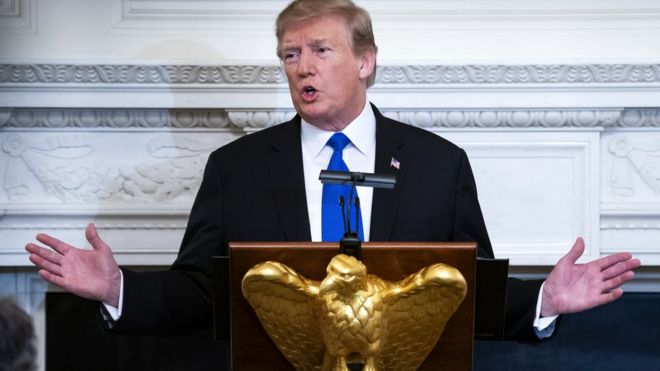
Mr Trump told US governors on Monday that both nations “are going to have a signing summit”.
“Hopefully, we can get that completed. But we’re getting very, very close,” he said.
It follows a decision to delay imposing further trade tariffs on Chinese goods.
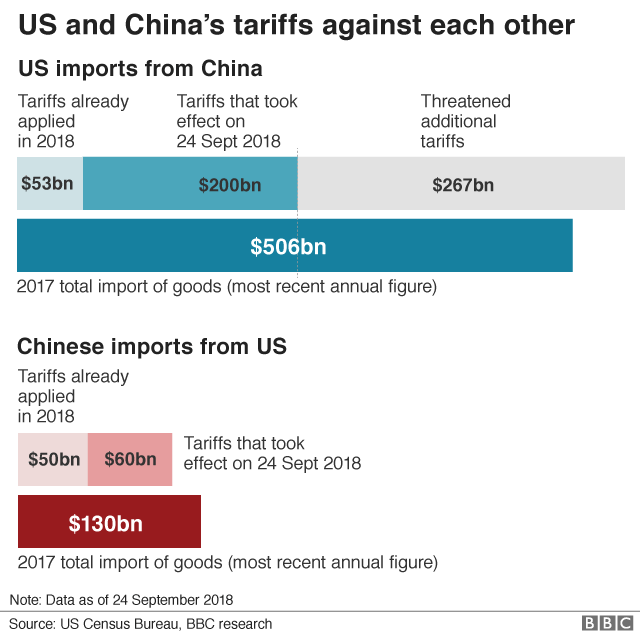
Mr Trump’s decision to delay tariff increases on $200bn (£153bn) worth of Chinese goods was seen as a sign that the two sides were moving ahead in settling their damaging trade war.
Last week, Mr Trump noted progress in the latest round of negotiations in Washington, including an agreement on currency manipulation, though no details were disclosed.
Sources told CNBC on Friday that China had committed to buying up to $1.2 trillion in US goods, but there had been no progress on the intellectual property issues.
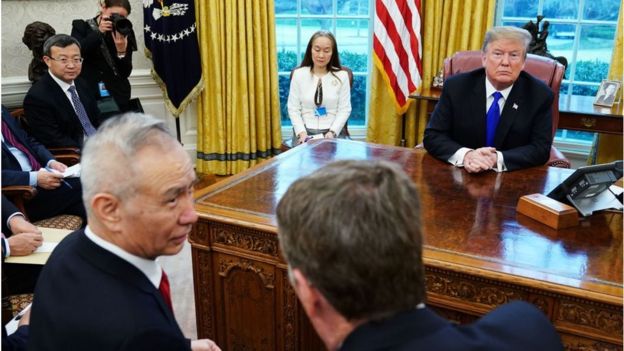
Image copyrightAFPImage captionPresident Trump met China’s Vice Premier Liu He on Friday
Gregory Daco, chief US economist at Oxford Economics, said: “We had anticipated such a delay and believe a handshake agreement in which China will promise to import more agricultural products, work towards a stable currency and reinforce intellectual property rights protection will be achieved in the coming weeks.
“However, we don’t foresee a significant rollback of existing tariffs, and see underlying tensions regarding China’s strategic ambitions, its industrial policy, technological transfers and ‘verification and enforcement’ mechanisms remaining in place.”
What has happened in the trade war so far?
Mr Trump initiated the trade war over complaints of unfair Chinese trading practices.
That included accusing China of stealing intellectual property from American firms, forcing them to transfer technology to China.
The US has imposed tariffs on $250bn worth of Chinese goods, and China has retaliated by imposing duties on $110bn of US products.
Mr Trump has also threatened further tariffs on an additional $267bn worth of Chinese products – which would see virtually all of Chinese imports into the US become subject to duties.







 CHINDIA ALERT: You'll be living in their world, very soon