Archive for ‘India’

24/02/2020

‘Namaste Trump’: Modi holds huge rally for Trump’s visit

AHMEDABAD, India (Reuters) – Donald Trump was cheered by more than 100,000 Indians at the opening of the world’s largest cricket stadium on Monday, promising “an incredible trade deal” and “the most feared military equipment on the planet” at his biggest rally abroad.

Indians wore cardboard Trump masks and “Namaste Trump” hats to welcome the U.S. president at the huge new Motera stadium in Prime Minister Narendra Modi’s own political homeland, the western city of Ahmedabad.

Modi, a nationalist who won re-election last year and has shifted his country firmly to the right with policies that his critics decry as authoritarian and ethnically divisive, touts his relationship with Trump as proof of his own global standing.

U.S. officials have described Trump’s visit as a way to counter China’s rise as a superpower.

“You have done a great honour to our country. We will remember you forever, from this day onwards India will always hold a special place in our hearts,” Trump said to thunderous applause.

India is one of the few big countries in world where Trump’s personal approval rating is above 50%. It has built up ties with the United States in recent years as Washington’s relationship has become strained with India’s foe Pakistan.

“As we continue to build our defence cooperation, the United States looks forward to providing India with some of the best and most feared military equipment on the planet,” Trump said.

Trump said the two countries will sign deals on Tuesday to sell military helicopters worth $3 billion and that the United States must become the premier defence partner of India, which relied on Russian equipment during the Cold War. Reuters reported earlier that India has cleared the purchase of 24 helicopters from Lockheed Martin (LMT.N) worth $2.6 billion.

But in a sign of the underlying political tensions in India, violent protests broke out in Delhi – where Trump is due on Tuesday – over a new citizenship law that critics say discriminates against Muslims and is a further attempt to undermine the secular foundations of India’s democracy.

Vehicles were set on fire in the eastern part of Delhi, metal barricades torn down, and thick smoke billowed through the air as thousands of those who are supporting the new law clashed with those opposing it.

In his speech Trump extolled India’s rise as a stable and prosperous democracy as one of the achievements of the century. “You have done it as a tolerant country. And you have done it as a great, free country,” he said.

Trump planned to raise the issue of religious freedoms in India with Modi, an administration official said last week.

VERY BIG DEALS

In Ahmedabad, Modi embraced Trump as he stepped off Air Force One, along with his wife, Melania.

Folk dancers carrying colourful umbrellas danced alongside the red carpet as drummers, trumpeters and other musicians performed at the airport to welcome Trump and the U.S. delegation. Crowds lined the route along his cavalcade, many taking pictures on their phones.

The two sides did not manage to hammer out a trade deal ahead of the visit, with differences remaining over agriculture, medical devices, digital trade and proposed new tariffs. Trump said he was going to discuss economic ties with Modi, describing him as a tough negotiator.

“We will be making very, very major, among the biggest ever made, trade deals. We are in the early stages of discussion for an incredible trade agreement to reduce barriers of investment between the United States and India,” he said.

“And I am optimistic that working together, the prime minister and I can reach a fantastic deal that’s good and even great for both of our countries – except that he is a very tough negotiator.”

Modi, who has built a personal rapport with Trump, is pulling out the stops for the president although prospects for even a limited trade deal during the visit are seen as slim.

“There is so much that we share, shared values and ideals … shared opportunities and challenges, shared hopes and aspirations,” said Modi at the rally.

Trump, who faces his own re-election campaign this year, has frequently praised Modi for his crowd-pulling power.

Last year, Trump held a “Howdy Modi” rally with Modi in Houston, drawing 50,000 people, mainly Indian Americans. At the time, Trump likened Modi to Elvis Presley as a draw for crowds.

Later, Trump and his entourage which includes daughter Ivanka and son-in-law Jared Kushner flew to Agra to see the Taj Mahal at sunset. Children lined the route cheering and waving flags as his convoy drove past.

Trump and Melania posed for pictures at the Taj, the 17th century monument to love. “It’s incredible,” he told reporters.

Source: Reuters
23/02/2020

India says discovers fields with over 3,000 tonnes of gold ore

LUCKNOW, India (Reuters) – India, the world’s second-biggest gold consumer, has discovered gold fields with reserves of over 3,000 tonnes in its most populous northern state, a government official said on Saturday.

India mines between 2 to 3 tonnes of gold annually, relying on expensive imports to fulfil nearly all of its demand, which averaged 843 tonnes per year over the past 10 years.

Its hunger for gold – used extensively in jewellery, as offerings to Gods and in lavish weddings – cost India more than $31 billion on imports last year, making the metal its second-biggest import item after crude oil.

Federal and state departments have discovered traces of gold in northern Uttar Pradesh’s Sonbhadra district after surveying the area for more than 10 years, said Roshan Jacob, the head of the mining department in Uttar Pradesh state.

“In Son Pahadi we have found 2,940 tonne… in the Hardi Pahadi area 646 kilogram of ore has been traced,” Jacob told Reuters, referring to the two areas where gold ore had been discovered.

The state is now seeking forest and environment clearances after which it will open up the reserves for bidding, Jacob said.

The concentration level of gold in the area is about 3 grams per tonne of ore and the state is working with the Geological Survey of India to determine how much gold can be extracted from the fields, she added.

India has time and again considered a plan to revive a cluster of colonial-era gold mines in southern Karnataka state but the project has failed to take off due to predictions of low output and high costs involved.

Source: Reuters

22/02/2020

Trump in India: A brief history of US presidents’ trips

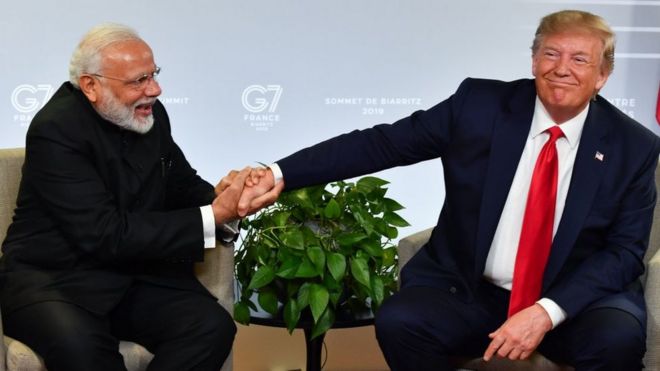
Indian Prime Minister Narendra Modi (L) and US President Donald Trump shakes hands as they speak during a bilateral meeting in Biarritz, south-west France on August 26, 2019.Image copyright GETTY IMAGES
Image caption Mr Trump is making his first official visit to India

US President Donald Trump is expecting a raucous welcome on his first official state visit to India on Monday and Tuesday.

He follows a long line of leaders who have made the journey. Some of his predecessors were greeted enthusiastically; others stumbled through diplomatic gaffes; one even had a village named after him.

Can history be a guide to how this diplomatic tryst might go? Here’s a brief look at past visits, ranked in order of how they went.

The good: President Eisenhower

Let’s begin at the beginning.

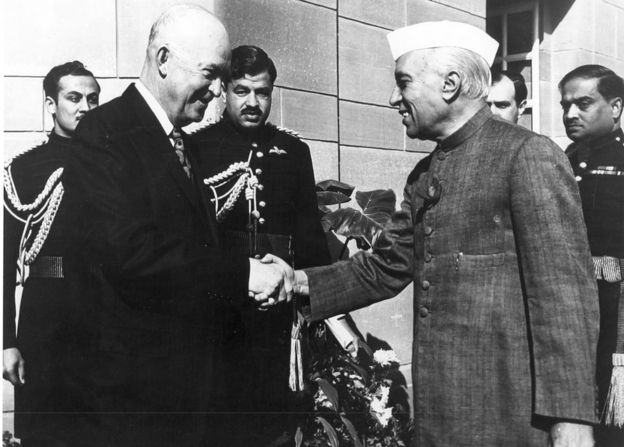
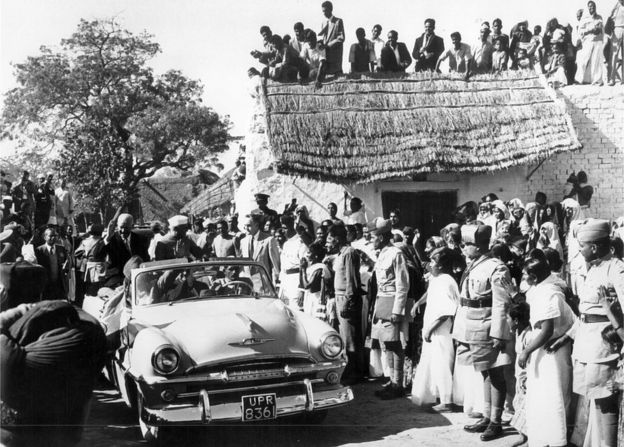
Dwight D Eisenhower, the first US president to visit India, was greeted with a 21-gun salute when he landed in the national capital, Delhi, in December 1959. Huge crowds lined the streets to catch a glimpse of the World War Two hero in his open-top car – Mr Trump is expecting a similar reception in Ahmedabad city, where he will be doing a road show.

President Eisenhower (L) with Prime Minister Jawaharlal NehruImage copyright US EMBASSY ARCHIVES
Image caption Dwight D Eisenhower, pictured with Prime Minister Jawaharlal Nehru, was the first US president to make the trip

The warmth between President Eisenhower and Indian Prime Minister Jawaharlal Nehru helped during what was a rocky phase in US-India ties. This was early in the Cold war, when the US and Pakistan had become become close allies, and India insisted on staying neutral or “non-aligned”. Like today, relations with China were at the core of the India-US equation, with Washington pressuring Delhi to take an aggressive stance with Beijing on the issue of Tibet.

But, on the whole, Eisenhower’s four-day trip was billed a success. And nearly every US president on a state visit to India has emulated his itinerary: he laid flowers at Mahatma Gandhi’s memorial, took in the splendour of the Taj Mahal, addressed parliament and spoke at Delhi’s iconic Ramlila grounds, which, according to one news report, attracted one million people.

When he left, Nehru said he had taken with him “a piece of our heart”.

President Eisenhower drove in open car to small village to get a glimpse of rural India on December 13, 1959.Image copyright US EMBASSY ARCHIVES
Image caption President Eisenhower was greeted by large crowds
Presentational white spaceThe game-changer: Bill Clinton

If there was a game-changing visit, it would be Bill Clinton’s in March 2000 with Prime Minister Atal Bihari Vajpayee. Mr Clinton’s arrival came after a two-decade lull – neither Ronald Reagan nor George Bush Snr made the journey East. It came at a tricky time as Washington had imposed sanctions on Delhi following its 1999 test of a nuclear bomb.

But, according to Navtej Sarna, a former Indian Ambassador to the US, the five-day trip was “a joyous visit”. It included stops in Hyderabad, a southern city that was emerging as a tech hub, and Mumbai, India’s financial capital. “He came and saw the economic and cyber potential of India, and democracy in action,” says Mr Sarna.

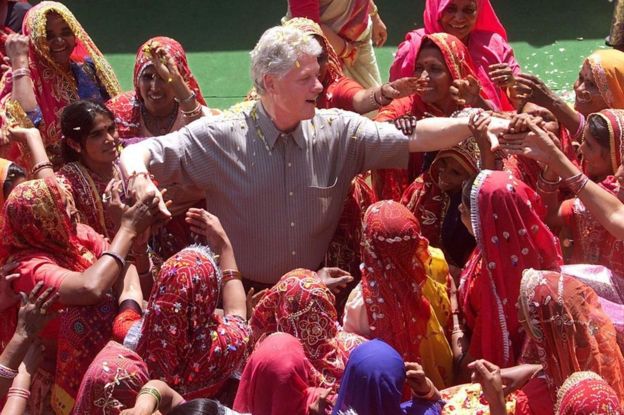
US President Bill Clinton shakes hands with local villagers after touring Nayla Village 23 March 2000.Image copyright GETTY IMAGES
Image caption Bill Clinton’s visit was described as “joyous”
Mr Clinton also danced with villagers, took a tiger safari and sampled Delhi’s famously creamy black dal (lentils) at a luxury hotel that has since been associated with the president.

The country’s reaction is perhaps best expressed in this New York Times headline: “Clinton fever – a delighted India has all the symptoms.”

The nuclear deal: George W Bush

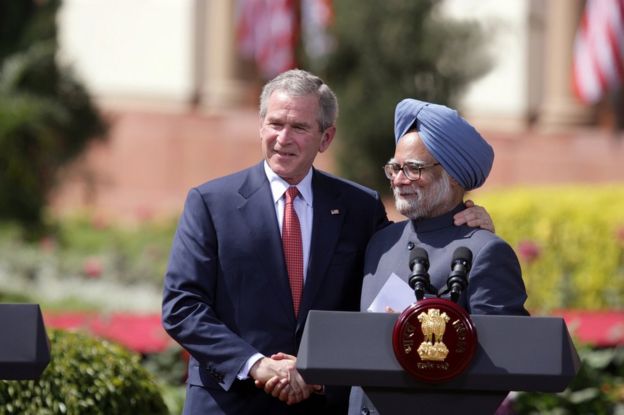
George W Bush, as Forbes magazine once put it, was the “best US president India’s ever had”. His three-day visit in March 2006 was a highlight in the two countries’ strategic relationship – especially in matters of trade and nuclear technology, subjects they have long wrangled over. His strong personal dynamic with Prime Minister Manmohan Singh was hard to miss – after he left office, Mr Bush, a keen artist, even painted a portrait of Mr Singh.

The two leaders are credited for a historic but controversial nuclear deal, which was signed during Mr Bush’s visit. It brought India, which had for decades refused to sign the Nuclear Non-Proliferation Treaty (NPT), out of isolation. Energy-hungry India got access to US civil nuclear technology in exchange for opening its nuclear facilities to inspection.

George W Bush (L) with Manmohan Singh (R)Image copyright US EMBASSY ARCHIVES
Image caption George W Bush and Manmohan Singh had a very good relationship
However, while the visit was substantive, it was not as spectacular as others – there was no trip to the Taj, nor an address to parliament. But the timing was important. Anti-US sentiment over the invasion of Iraq was running high – left-wing MPs had staged a protest against Mr Bush’s visit, and there were demonstrations in other parts of India.

Double visit: Barack Obama

Barack Obama was the only president to make two official visits. First, in 2010 with Prime Minister Manmohan Singh, and then in 2015 with Prime Minister Narendra Modi.

On his first visit – in a break from the past – he landed in Mumbai, instead of Delhi, with a large trade delegation. This was not just about economic ties but a show of solidarity following the Mumbai terror attacks of 2008, which killed 166 people. Mr and Mrs Obama even stayed at the Taj Mahal hotel, one of the main targets.

It was significant that the US president declared support for India to join a reformed and expanded UN Security Council, says Alyssa Ayres, a former US deputy assistant secretary of state for South Asia. “That all these years later nothing has changed in the UN system is another matter, but that was a major policy shift for the United States.”

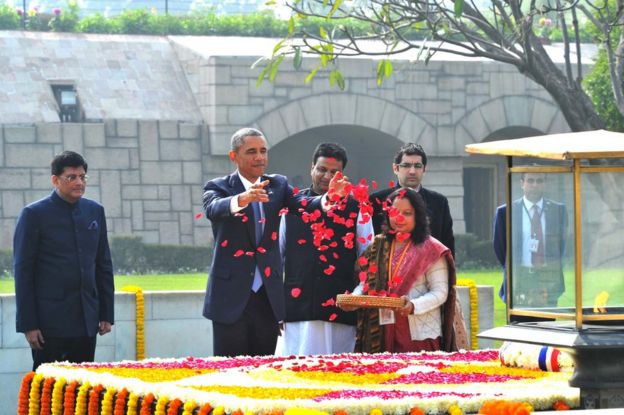
US President Barack Obama paying floral tributes at the samadhi of Mahatma Gandhi at Rajghat in Delhi.Image copyright US EMBASSY ARCHIVES
Image caption Barack Obama visited India twice
Mr Obama returned in 2015 as chief guest at India’s Republic Day celebrations, at PM Modi’s invitation. Trade, defence and climate change were at the heart of the talks. The trip also emphasised an Indo-Pacific strategy, where both leaders expressed unease over Beijing’s provocations in the South China Sea.

The not-so-good: Jimmy Carter

Although Jimmy Carter’s two-day visit in 1978 was a thaw in India-US relations, it was not free of hiccups.

With some 500 reporters in tow, Carter followed a packed itinerary: he met Prime Minister Morarji Desai, addressed a joint session of parliament, went to the Taj Mahal, and dropped by a village just outside Delhi.

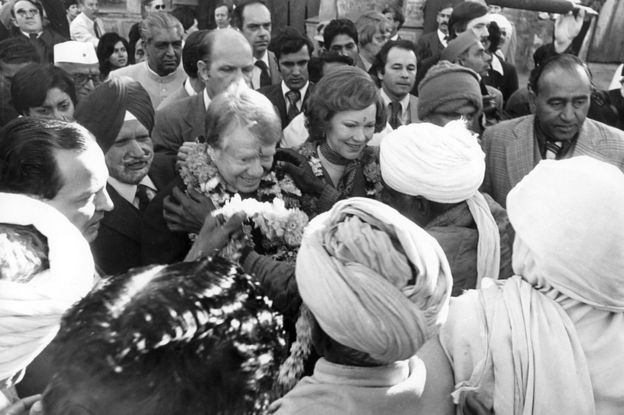
The village, Chuma Kheragaon, had a personal connection: Carter’s mother, Lillian, had visited here when she was in India as a member of the Peace Corps in the late 1960s. So when Carter and his wife, Rosalynn, made the trip, they gave the village money and its first television set. It was even renamed “Carterpuri”, a moniker it still holds.

Jimmy Carter being greeted by villagers of 'Carterpuri'Image copyright US EMBASSY ARCHIVES
Image caption Jimmy Carter being greeted by villagers of ‘Carterpuri’
But beyond the photo-ops, India and the US were sparring. India was building its nuclear programme, and had conducted its first test in 1974. The US wanted India to sign the NPF, which sought to stop the spread of nuclear weapons. But India refused, saying the agreement discriminated against developing countries.

In a leaked conversation that made headlines and threatened to derail the visit, Mr Carter promised his Secretary of State, Cyrus Vance, a “very cold and very blunt” letter to Desai. The two leaders signed a declaration, promising greater global co-operation, but Carter left India without the assurances he had hoped for.

The ugly: Richard Nixon

Richard Nixon was no stranger to India when he arrived in August 1969 for a day-long state visit. He had been here as vice-president in 1953, and before that on personal trips. But, by all accounts, he wasn’t a fan.

“Nixon disliked Indians in general and despised [Prime Minister] Indira Gandhi,” according to Gary Bass, author of Blood Telegram: Nixon, Kissinger and a Forgotten Genocide. And, he adds, the feeling was said to be mutual.

This was also at the height of the Cold War, and India’s non-alignment policy “appalled” American presidents. Mr Bass says that under Gandhi, India’s neutrality had turned into a “noticeably pro-Soviet foreign policy”.

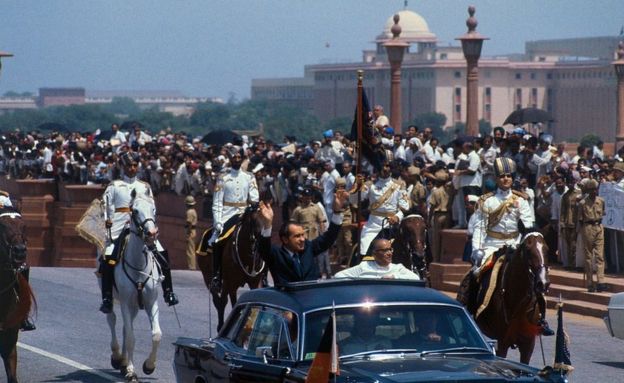
President Richard Nixon waves to crowds as he rides in open car with the acting president of India, Mohammad Hidyatullah, in motorcade from airport upon arrival here July 31.Image copyright GETTY IMAGES
Image caption Richard Nixon waves to the crowds alongside Mohammad Hidyatullah, India’s acting president
The relationship only turned frostier after the trip as India backed Bangladesh (then East Pakistan) in its fight for independence from Pakistan, a close American ally. The differences were laid bare when Gandhi visited the White House in 1971. Declassified state department cables later revealed that Nixon referred to her as an “old witch”.

And the future: Donald Trump

The US and India have certainly had their ups and downs, but during the last official visit in 2015, Mr Obama and Mr Modi signed a declaration of friendship: “Chalein saath saath (Let’s move forward together)…” it began.

President Trump’s visit will take the relationship forward, but it’s unclear how.

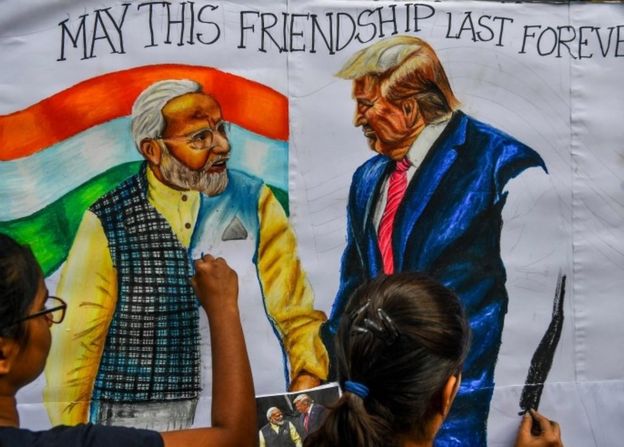
Students paint on canvas faces of US President Donald Trump (R) and India"s Prime Minister Narendra Modi, in the street in Mumbai on February 21, 2020, ahead of the visit of US President in IndiaImage copyright AFP

His arrival in Ahmedabad, the main city in PM Modi’s home state of Gujarat, followed by a big arena event, is expected to draw a massive crowd. It will echo President Eisenhower’s rally in Delhi years ago, perhaps cementing the personal ties between the two leaders.

But while Mr Trump’s trip will be packed with pageantry, it could be light on policy. Unlike other presidential visits, this one is not expected to yield concrete agreements, with the trade deal Mr Trump so badly wants looking unlikely.

Source: The BBC

20/02/2020

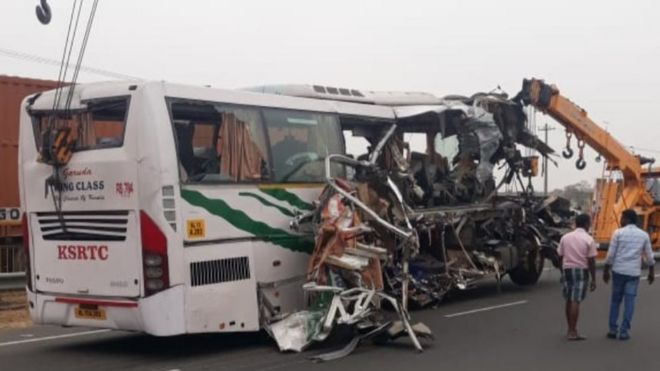
Container slides off truck killing 19 in India freak accident

The bus after the accidentImage copyright TIRUPUR MANIKANDAN

At least 19 people have been killed in a freak accident in southern India, after a container slipped off a truck and rammed into a passenger bus.

Police are investigating the incident, but officials say the container came off its hinges after one of the wheels of the truck had a puncture.

“There were about 48 people in the bus, and several are in a critical condition,” an official told BBC Hindi.

The incident occurred around 3:30am local time (21:50 GMT), police said.

The bus was on a highway when the container slipped off the truck, which was in the opposite lane. It then rolled onto the other side, colliding with the bus.

The Volvo bus, owned by the Kerala state transport corporation, was travelling from Bangalore city in the neighbouring state of Karnataka to Ernakulam in Kerala.

The district collector, Dr Vijay Karthikeyan, told BBC Hindi that the cause of the accident was still being investigated.

The driver of the truck is reportedly absconding.

Source: The BBC

19/02/2020

Rare snow leopard spotted in India

Snow leopards, a threatened species, live at an altitude above 3,000m in typically open and rocky areas.

And after a long time a snow leopard was spotted in the Himalayan state of Himachal Pradesh.

The iconic big cats’ conservation status improved from “endangered” to “vulnerable” in 2017.

The sighting was rare enough to prompt officials to release the footage on social media platforms – but it’s unclear when it was shot.

Footage by India’s Press Information Bureau and Environment Ministry

Source: The BBC

17/02/2020

The Kashmir journalist forced into manual labour

Muneeb Ul IslamImage copyright MUKHTAR ZAHOOR
Image caption Muneeb Ul Islam can no longer afford to work as a journalist in Kashmir

Journalists in Indian-administered Kashmir are struggling to make ends meet amid a months-long communications blockade that has only partially been lifted. The BBC’s Priyanka Dubey visited the region to find out more.

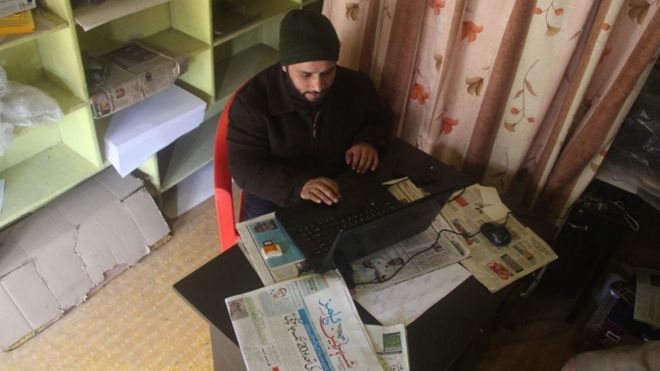
Muneeb Ul Islam, 29, had worked as a photo-journalist in Kashmir for five years, his pictures appearing in several publications in India and abroad.

But the young photographer’s dream job vanished almost overnight in August last year, when India’s federal government suspended landline, mobile and internet services in Kashmir.

The government’s move came a day before its announcement that it was revoking the region’s special status – a constitutionally-guaranteed provision, which gave Kashmir partial autonomy in matters related to property ownership, permanent residency and fundamental rights.

The controversial decision catapulted the Muslim-majority valley into global news – but local journalists like Mr Islam had no way to report on what was going on. And worse, they had to find other things to do because journalism could no longer pay the bills.

By January, the region had not had access to the internet for more than 150 days, India’s longest such shutdown.

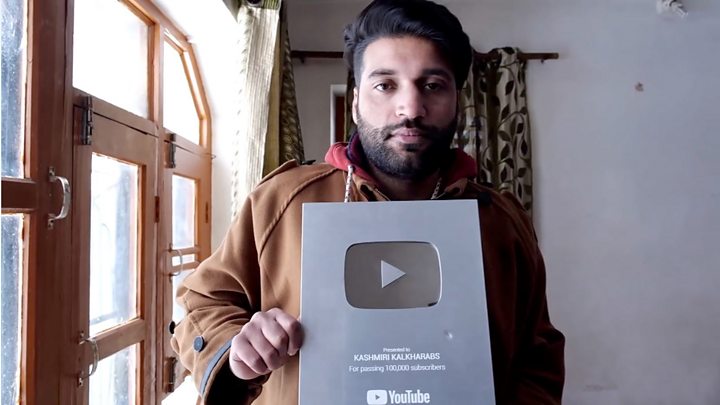
Media caption The silenced YouTube stars of Indian-administered Kashmir

“I chose journalism because I wanted to do something for my people,” Mr Islam explains. “I covered this conflict-ridden region with dedication until the loss of Kashmir’s special status put a full stop on my journey.”

In January, the government eased restrictions and allowed limited broadband service in the Muslim-majority valley, while 2G mobile coverage resumed in parts of the neighbouring Jammu region. But mobile internet and social media are still largely blocked.

India says this is necessary to maintain law and order since the region saw protests in August, and there has also been a long-running insurgency against Indian rule. But opposition leaders and critics of the move say the government cannot leave these restrictions in place indefinitely.

Meanwhile, journalists like Mr Islam are struggling.

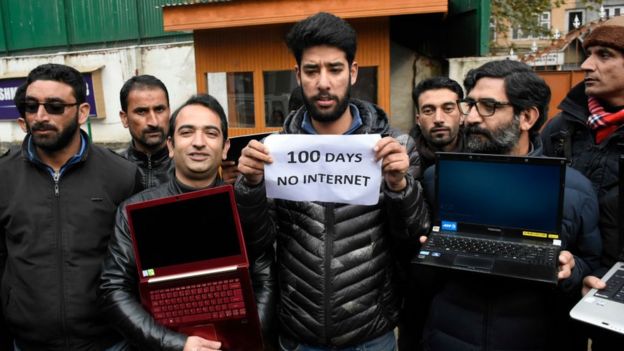
Kashmiri journalists protest against the continuous internet blockade for 100th day out Kashmir press club , Srinagar, Indian Administered Kashmir on 12 November 2019.Image copyright GETTY IMAGES
Image caption Kashmiri journalists protested after 100 days of no internet in the region

For months, Mr Islam says, he kept trying to report and file stories and photos.

In September, he even spent 6,000 rupees ($84; £65) of his own money to make two trips to the capital, Srinagar, for a story. But he soon ran out of funds and had to stop.

He then tried to file his stories on a landline phone: he would call and read them aloud to someone on the other side who could type it out. But, as he found out, his stories didn’t earn him enough money to cover the cost of travelling for hours in search of a working landline.

Presentational grey line

Read more on Kashmir

Presentational grey line

And Mr Islam was desperate for money because his wife was ill. So he eventually asked his brother for help, finding work carrying bricks on a construction site in his neighbourhood in Anantnag city. It pays him 500 rupees a day.

Mr Islam is not the only journalist in Kashmir who has been forced to abandon their career for another job.

Another journalist, who did not want to reveal his name, says he had been working as a reporter for several years, but quit the profession in August. He now plans to work in a dairy farm.

People at the Anantnag information officeImage copyright MUKHTAR ZAHOOR
Image caption Internet is available in some government offices

Yet another reporter, who also also wished to remain anonymous, says he used to earn enough to comfortably provide for his family. Now, he barely has money to buy petrol for his motorcycle.

“I have no money because I have not been able to file any story in the last six months,” a third reporter, who spoke to the BBC on the condition of anonymity, says. “My family keeps telling me to find another job. But what else can I do?”

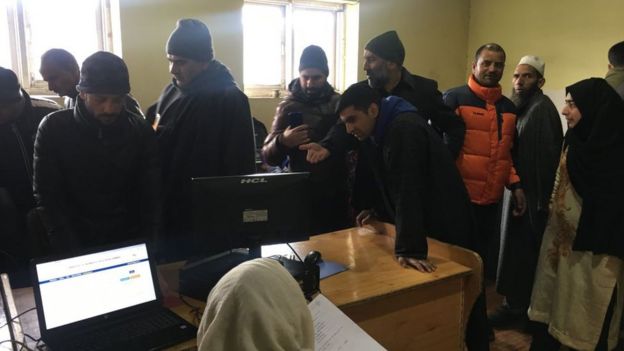
In December, people were given limited access to the internet at a government office in Anantnag, but this hasn’t helped local journalists. The office, Mr Islam says, is always crowded and there are only four desktops for a scrum of officials, students and youngsters who want to log on to respond to emails, fill exam forms, submit job applications or even check their social media.

“We have access for only for a few minutes and the internet speed is slow,” he explains. “We are barely able to access email, forget reading the news.”

What’s more, Mr Islam says those who work at the office often ask customers to show them the contents of emails. “This makes us uncomfortable, but we don’t have a choice.”

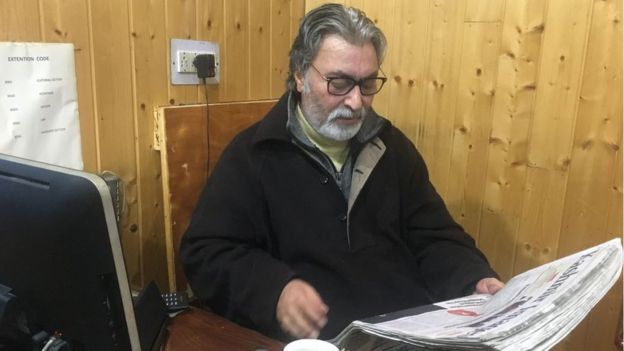
Basheer Manzar, the editor of Kashmir ImagesImage copyright MUKHTAR ZAHOOR
Image caption Basheer Manzar runs Kashmir Images, a local newspaper

Many journalists say that they have been completely cut off from their contacts for months now, making it hard to to maintain their networks or sources.

They also speak of how humiliating it is to beg for wi-fi passwords and hotspots at the cramped media centre in Srinagar, which has less than two dozen computers for hundreds of journalists.

This has left publishers in the lurch too. “My reporters and writers are not able to file,” says Basheer Manzar, the editor of Kashmir Images.

He still publishes a print edition, he says, because if he doesn’t do so for a certain number of days in the month, he will lose the license.

But the website continues to struggle, he adds, because most of the readers in Indian-administered Kashmir have no access to the internet.

“I know what is happening in New York through news on the TV, but I don’t know what’s happening in my hometown.”

Source: The BBC

14/02/2020

India orders telcos to pay dues now, after top court threatens contempt

NEW DELHI/MUMBAI (Reuters) – The Indian government ordered mobile carriers on Friday to immediately pay billions of dollars in dues after the Supreme Court threatened the companies and officials with contempt proceedings for failing to implement an earlier ruling.

The court, which had ordered companies including Vodafone Idea (VODA.NS) and Bharti Airtel (BRTI.NS) to pay 920 billion Indian rupees ($13 billion) in overdue levies and interest by Jan. 23, last month rejected petitions seeking a review of the order it issued back in October.

“This is pure contempt, 100% contempt,” Justice Arun Mishra told lawyers for the companies and the government on Friday.

Later in the day, the Department of Telecommunications called for “immediate payments” from the telcos. A second order instructed relevant offices to stay open on Saturday to “facilitate the Telecom Licensees to make payments or contact them with respect to any matter related to that.”

The companies had contested the government’s definition of revenues subject to tax and Vodafone Idea and Bharti Airtel both flagged risks to their ability to continue as ongoing concerns following the October order. They did not immediately respond to calls seeking comment on the new ruling.

The companies, along with Reliance Jio, which is backed by Asia’s richest man, Mukesh Ambani, control more than 90% of India’s mobile market.

Jio, a relatively new entrant which has disrupted the market with its cut-price offerings, has paid its dues.

Shares in Vodafone Idea, in which Britain’s Vodafone Group (VOD.L) owns a sizable stake, closed down 24.4% after the order. The company’s future is in doubt, with Vodafone Group having said it has no plans to commit any more equity into India.

Shares in Bharti Airtel rose 4.64%, as many investors expect it will be able to survive the payment, leaving it and Jio with a potential opportunity to win market share and enjoy an effective duopoly in the sector. In a letter to the government, Bharti Airtel said it would deposit 100 billion rupees by Thursday and pay the balance “well before” the next hearing on March 17.

Justice Mishra rebuked the government for having failed to implement the court order on collecting the dues. “A desk officer in the government stays a Supreme Court order … Is there any law left in the country?,” he said.

“We will draw up contempt against everyone,” he added, implying that both company and government officials could be fined or jailed if the dues are not paid by March 17.

Analysts said the court’s move could harm the government more broadly, as well as the companies.

“It can’t be in anybody’s interest if a company as high profile as Vodafone Idea shuts shop. Also, the government’s own dues from the sector are at risk,” said Mahesh Uppal, director at ComFirst, a telecom consultancy firm.

BANKS BURDENED

Indian banks are burdened with nearly $140 billion of bad loans and face another huge hit if Vodafone Idea is forced into bankruptcy.

Banks in India are owed roughly 300 billion rupees by Vodafone Idea, according to a Macquarie report from last year.

“Banks were yet to make additional provisioning for these loans as they were expecting some sort of a relief from the court,” said Siddharth Purohit, an analyst at SMC Institutional Equities.

Banks that have the highest exposure to Vodafone Idea include State Bank of India (SBI.NS), Punjab National Bank (PNBK.NS), Canara Bank (CNBK.NS) and Bank of India (BOI.NS), among others, the Macquarie report said.

Vodafone Idea, which owes the government about $4 billion in dues related to the ruling, has seen its shares slide more than 40% since the court ruling in October.

The broader Indian stock market also reversed early gains to trade lower after the ruling as investors worried about the fallout.

Still, some analysts remained hopeful the government could appeal to the court to review its decision.

“Let’s see how the government reacts and what they do. If the government appeals to the court they could still settle it out, and we may see some positives emerge for everyone,” said a senior industry analyst, who asked not to be named.

Source: Reuters

14/02/2020

European diplomats check India’s loosening of Kashmir clampdown

SRINAGAR/NEW DELHI, India (Reuters) – More than two dozen diplomats are visiting Indian-administered Kashmir, New Delhi said on Wednesday, as the country tries to reassure foreign allies following several months of unrest in the contested territory.

The group includes European diplomats, some of whom declined a previous invitation from New Delhi to visit the region. A proposed vote in the European Union parliament next month could chastise India for its actions in Kashmir.

The Muslim-majority Himalayan region is claimed by India and arch-rival Pakistan and has been in turmoil since New Delhi stripped it of special status and clamped down on communication and freedom of movement in August.

India has since eased those restrictions, and restored limited internet connectivity last month, ending one of the world’s longest such shutdowns in a democracy.

But many political leaders, including three former chief ministers of Jammu & Kashmir state, are still in detention without charge six months after the crackdown, and foreign journalists have so far been denied permission to visit the region.

Representatives from countries including Germany, Canada, France, New Zealand, Mexico, Italy, Afghanistan and Austria are on a two-day visit to “witness for themselves the progressive normalisation of the situation,” India’s foreign ministry said in a statement on Wednesday.

Representatives from several countries, including Germany’s ambassador Walter Lindner, were pictured on a traditional wooden shikara boat on Dal Lake, in Kashmir’s main city of Srinagar.

“We are interacting with the traders, businesswomen and entrepreneurs in Srinagar about the status of business and tourism,” Afghanistan’s envoy Tahir Qadiry said in a tweet on Wednesday.

Sources familiar with the itinerary said the trip will also include meetings with the Indian army and government officials, as well as journalists and civil society groups selected by the security services.

Last month fifteen foreign envoys visited Kashmir – a trip participants characterised as tightly-choreographed with no room for independent meetings.

“Things looked calm, but we only had a very short time out the window of the car to assess the situation,” said a diplomat who attended the previous trip.

“They told the truth, but not necessarily the whole truth,” he added of his meetings with delegates.

Source: Reuters
13/02/2020

Why do many India MPs have criminal records?

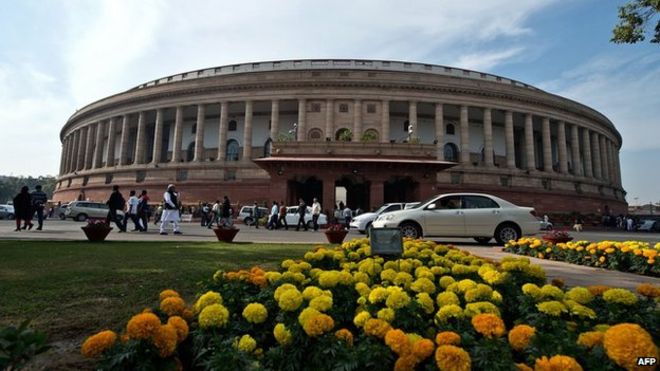
Indian parliamentImage copyright AFP
Image caption A third of the current members of parliament have criminal cases pending against them

“We need to build a consensus on how to prevent individuals with a criminal record from contesting elections.”

A necessary, even obvious fundamental you would think of building the world’s largest democracy.

And when Sonia Gandhi, India’s most powerful politician, uttered those words three years ago, even her main opponent, the leader of the BJP agreed.

Yet since then, things have gone in the opposite direction – with more alleged lawbreakers among India’s lawmakers than ever, a third of the current parliament according to a watchdog called the Association for Democratic Reforms.

By some calculations, politicians with a criminal record are more likely to be elected than those with a clean slate – because, says the ADR, they have more illicit funds with which to buy votes.

And on Tuesday night, India’s cabinet sought to ensure there was even less chance of criminal politicians facing their own laws.

It issued an order overturning a Supreme Court ruling demanding the disqualification of any politician convicted for crimes punishable with more than two years in jail.

This was “to ensure that governance is not adversely impacted“, the government had argued, with no apparent irony intended.

Unusual speed

Arguably, of course, the government is right. Losing tainted local or national politicians – among them many accused murderers, rapists and fraudsters – could upset delicate political alliances and make it even harder to get laws passed.

So often derided for doing nothing, this time round the cabinet acted with unusual speed.

The urgency it appears is the impending conclusion of two cases involving key politicians, due before Prime Minister Manmohan Singh gets back to India from a trip to the US.

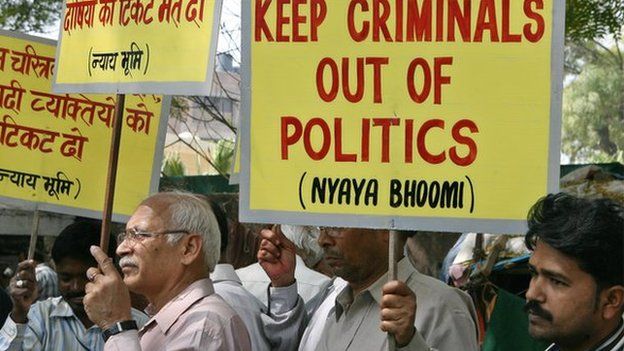
Protest against criminals contesting the parliamentary elections in Delhi on March 14, 2009Image copyright AFP
Image caption There’s been some criticism of criminal politicians

One concerns Lalu Prasad Yadav, a former railways minister and Congress party ally, charged with pocketing millions of dollars in subsidies for non-existent livestock.

Another concerns Congress MP Rashid Masood, already convicted of corruption and due to be sentenced next week. When the BBC asked his office for a comment, his assistant told us “he is unwell”.

“Don’t know whether to laugh or cry” tweeted MP Baijayant Panda in response to the government’s protective move.

He is a rare voice though inside the chamber campaigning against criminals sitting alongside him.

There’s been some other criticism outside, but not much. Indians have become very used to these kinds of shenanigans.

Almost forgotten already are calls in the Verma commission report into the December 16 Delhi gang rape case for all politicians accused of sexual crimes to be barred from office. Instead, six politicians charged with rape remain in office.

The opposition BJP has said it will oppose the cabinet order. But its record is just as murky, with even more accused criminals among its elected members in parliament and state assemblies than the Congress.

And with elections round the corner, none of the parties want to risk real reform right now, whatever they have signed up to in the past.

The world’s largest democracy is not alone in allowing so many questionable people to run it. Fellow Brics member Brazil has similar numbers of alleged criminals running the country.

The difference though is that in Brazil, brazen political abuses have provoked major protest.

But, says Indian MP Baijayant Panda: “This is a phase all democracies have gone through – look at the US.”

Voters will start to demand change, he predicts: “This is the last era of brazenness.”

Source: The BBC

Law of Unintended Consequences

continuously updated blog about China & India

ChiaHou's Book Reviews

continuously updated blog about China & India

What's wrong with the world; and its economy

continuously updated blog about China & India