20/05/2020
TAIPEI (Reuters) – Taiwan cannot accept becoming part of China under its “one country, two systems” offer of autonomy , President Tsai Ing-wen said on Wednesday, strongly rejecting China’s sovereignty claims and likely setting the stage for an ever worsening of ties.
China responded that “reunification” was inevitable and that it would never tolerate Taiwan’s independence.
In a speech after being sworn in for her second and final term in office, Tsai said relations between Taiwan and China had reached an historical turning point.
“Both sides have a duty to find a way to coexist over the long term and prevent the intensification of antagonism and differences,” she said.
Tsai and her Democratic Progressive Party won January’s presidential and parliamentary elections by a landslide, vowing to stand up to China, which claims Taiwan as its own and says it would be brought under Beijing’s control by force if needed.
“Here, I want to reiterate the words ‘peace, parity, democracy, and dialogue’. We will not accept the Beijing authorities’ use of ‘one country, two systems’ to downgrade Taiwan and undermine the cross-strait status quo. We stand fast by this principle,” Tsai said.
China uses the “one country, two systems” policy, which is supposed to guarantee a high degree of autonomy, to run the former British colony of Hong Kong, which returned to Chinese rule in 1997. It has offered it to Taiwan, though all major Taiwanese parties have rejected it.
China’s Taiwan Affairs Office, responding to Tsai, said Beijing would stick to “one country, two systems” – a central tenet of Chinese President Xi Jinping’s Taiwan policy – and “not leave any space for Taiwan independence separatist activities”.
“Reunification is a historical inevitability of the great rejuvenation of the Chinese nation,” it said. “We have the firm will, full confidence, and sufficient ability to defend national sovereignty and territorial integrity.”
China views Tsai as a separatist bent on formal independence for Taiwan. Tsai says Taiwan is an independent state called the Republic of China, its official name, and does not want to be part of the People’s Republic of China governed by Beijing.
TAIWAN OPEN TO DIALOGUE
China has stepped up its military drills near Taiwan since Tsai’s re-election, flying fighter jets into the island’s air space and sailing warships around Taiwan.
Tsai said Taiwan has made the greatest effort to maintain peace and stability in the narrow Taiwan Strait that separates the democratic island from its autocratic neighbour China.
“We will continue these efforts, and we are willing to engage in dialogue with China and make more concrete contributions to regional security,” she added, speaking in the garden of the old Japanese governor’s house in Taipei, in front of a socially-distanced audience of officials and diplomats.
Taiwan has become a rising source of friction between China and the United States, with the Trump administration strongly backing Taiwan even in the absence of formal diplomatic ties.
U.S. Secretary of State Mike Pompeo sent his congratulations to Tsai on Tuesday, praising her “courage and vision in leading Taiwan’s vibrant democracy”, in a rare high-level message from Washington direct to Taiwan’s government.
China’s Foreign Ministry condemned Pompeo’s remarks, and said the government would take “necessary countermeasures”, though did not elaborate.
China cut off a formal talks mechanism with Taiwan in 2016 after Tsai first won election.
Yao Chia-wen, a senior adviser to Tsai, told Reuters the chance of talks with China were small given ongoing tensions.
“We are ready to engage with them any time, but China is unlikely to make concessions to Taiwan,” he said. “In the next four years there’s little chance for the cross-strait relationship to improve.”
Source: Reuters
Posted in antagonism, authorities, autocratic, autonomy, ‘peace, parity, democracy, and dialogue’, “necessary countermeasures”, Beijing, by force, central tenet, China, China’s Foreign Ministry, China’s sovereignty, Chinese President Xi Jinping’s, claims, coexist, condemned, congratulations, cross-strait, democratic island, Democratic Progressive Party, differences, downgrade, elaborate, Elections, former, former British colony, Government, guarantee, historical, Hong Kong, independence, inevitable, intensification, Japanese governor’s house, Landslide, Mike Pompeo, military drills, neighbour, parliamentary, People’s Republic of China, President, President Tsai Ing-wen, presidential, principle, rejects, rejuvenation, remarks, Republic of China, reunification, rule, status quo, Taipei, Taiwan, Taiwan Affairs Office, Taiwan Strait, Trump administration, turning point, U.S. Secretary of State, Uncategorized, undermine, United States, Washington |
Leave a Comment »
25/04/2020
- But trade with partner countries might not be as badly affected as with countries elsewhere in the world, observers say
- China’s trade with belt and road countries rose by 3.2 per cent in the January-March period, but second-quarter results will depend on how well they manage to contain the pathogen, academic says
China’s investment in foreign infrastructure as part of its Belt and Road Initiative has been curtailed because of the coronavirus pandemic. Photo: Xinhua
The
coronavirus pandemic is set to cause a slump in Chinese investment in its signature
and a dip in trade with partner countries that could take a year to overcome, analysts say.
But the impact of the health crisis on China’s economic relations with nations involved in the ambitious infrastructure development programme might not be as great as on those that are not.
China’s total foreign trade in the first quarter of 2020 fell by 6.4 per cent year on year, according to official figures from Beijing.
Trade with the United States, Europe and Japan all dropped in the period, by 18.3, 10.4 and 8.1 per cent, respectively, the commerce ministry said.
By comparison, China’s trade with belt and road countries increased by 3.2 per cent in the first quarter, although the growth figure was lower than the 10.8 per cent reported for the whole of 2019.
China’s trade with 56 belt and road countries – located across Africa, Asia,
Europe and South America – accounts for about 30 per cent of its total annual volume, according to the commerce ministry.
Despite the first-quarter growth, Tong Jiadong, a professor of international trade at Nankai University in Tianjin, said he expected China’s trade with belt and road countries to fall by between 2 and 5 per cent this year.
His predictions are less gloomy than the 13 to 32 per cent contraction in global trade forecast for this year by the
World Trade Organisation.
“A drop in [China’s total] first-quarter trade was inevitable but it slowly started to recover as it resumed production, especially with Southeast Asian, Eastern European and Arab countries,” Tong said.
“The second quarter will really depend on how the epidemic is contained in belt and road countries.”
Nick Marro, Hong Kong-based head of global trade at the Economist Intelligence Unit, said he expected China’s total overseas direct investment to fall by about 30 per cent this year, which would be bad news for the belt and road plan.
“This will derive from a combination of growing domestic stress in China, enhanced regulatory scrutiny over Chinese investment in major international markets, and weakened global economic prospects that will naturally depress investment demand,” he said.
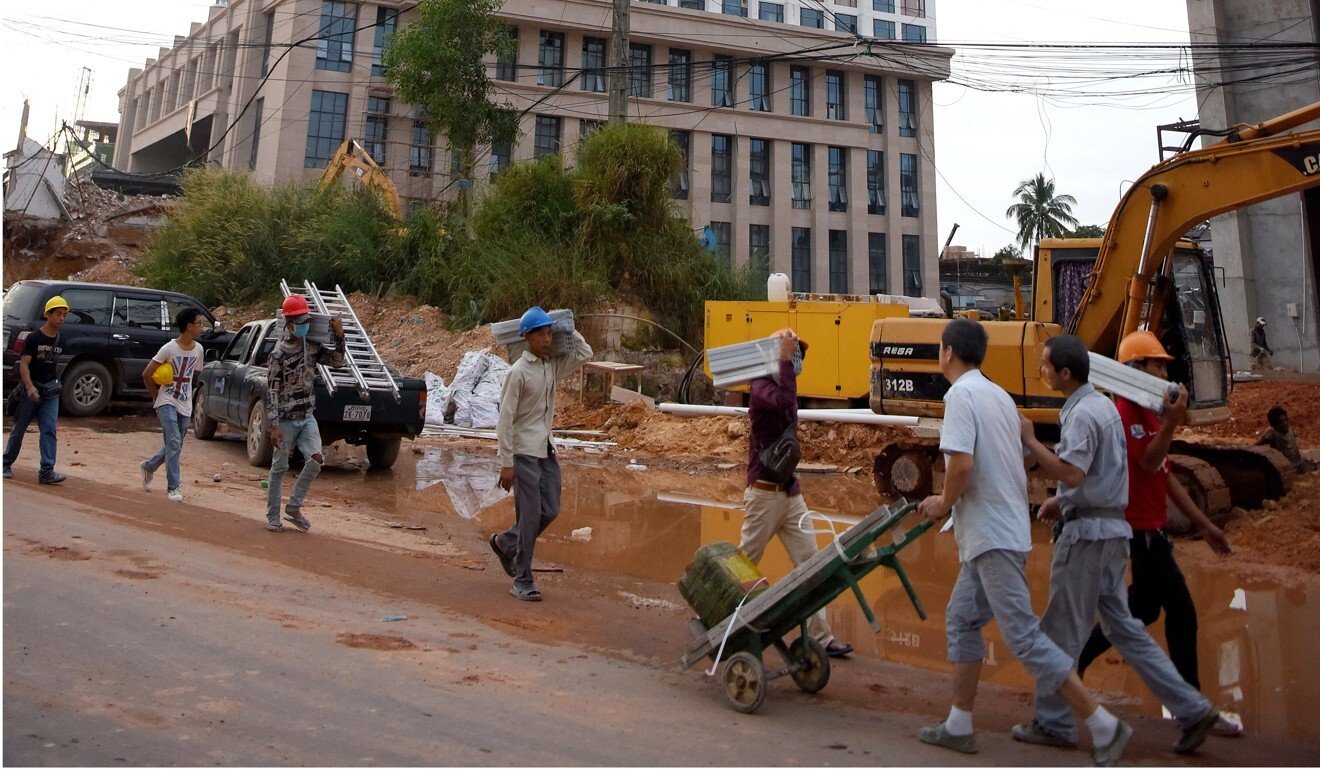
The development of the Chinese built and operated special economic zone in the Cambodian town of Sihanoukville is reported to have slowed, while infrastructure projects in Bangladesh, including the Payra coal-fired power plant, have been put on hold.
The development of the Chinese built and operated special economic zone in the Cambodian town of Sihanoukville is reported to have slowed. Photo: AFP
Marro said the reduction of capital and labour from China might complicate other projects for key belt and road partner, like Pakistan, which is home to infrastructure projects worth tens of billions of US dollars, and funded and built in large part by China.
“Pakistan looks concerning, particularly in terms of how we’ve assessed its sovereign and currency risk,” Marro said.
“Public debt is high compared to other emerging markets, while the coronavirus will push the budget deficit to expand to 10 per cent of GDP [gross domestic product] this year.”
Last week, Pakistan asked China for a 10-year extension to the repayment period on US$30 billion worth of loans used to fund the development of infrastructure projects, according to a report by local newspaper Dawn.
China’s overseas investment has been falling steadily from its peak in 2016, mostly as a result of Beijing’s curbs on capital outflows.
Last year, the direct investment by Chinese companies and organisations other than banks in belt and road countries fell 3.8 per cent from 2018 to US$15 billion, with most of the money going to South and Southeast Asian countries, including Singapore, Vietnam, Indonesia and Pakistan.
Tong said the pandemic had made Chinese investors nervous about putting their money in countries where disease control measures were becoming increasingly stringent, but added that the pause in activity would give all parties time to regroup.
“Investment in the second quarter will decline and allow time for the questions to be answered,” he said.
“Past experience along the belt and road has taught many lessons to both China and its partners, and forced them to think calmly about their own interests. The epidemic provides both parties with a good time for this.”
Dr Frans-Paul van der Putten, a senior research fellow at Clingendael Institute in the Netherlands, said China’s post-pandemic strategy for the
belt and road in Europe
might include a shift away from investing in high-profile infrastructure projects like ports and airports.
Investors might instead cooperate with transport and logistics providers rather than invest directly, he said.
“Even though in the coming years the amount of money China loans and invests abroad may be lower than in the peak years around 2015-16, I expect it to maintain the belt and road plan as its overall strategic framework for its foreign economic relations,” he said.
Source: SCMP
Posted in 10-year, 2018, 2019, 2020, 30, academic, according, accounts, across, activity, africa, airports, allow, ambitious, analysts, annual volume, answered, Arab countries, Asia, bad news, Bangladesh, because, Beijing, Belt and Road Initiative, belt and road plan, billion, billions, budget deficit, Cambodian, capital, capital outflows, cause, China, China’s, Chinese, Clingendael Institute, combination, Commerce Ministry, compared, comparison, complicate, contained, contraction, cooperate, coronavirus, Coronavirus pandemic, countries, curbs, Currency, curtailed, Dawn, decline, demand, depend, depress, derive, development, dip, direct investment, disease control measures, domestic stress, dropped, Eastern European, economic prospects, economic relations, Economist Intelligence Unit, elsewhere, Emerging markets, enhanced, epidemic, especially, Europe, extension, fall, falling, Fell, figure, first-quarter, forecast, foreign, foreign trade, GDP [gross domestic product], global trade, gloomy, great, growth, health crisis, high, impact, increased, increasingly, Indonesia, inevitable, Infrastructure, infrastructure projects, international markets, International trade, Investment, investors, involved, January, Japan, Labour, last week, loans, local newspaper, located, logistics, lower, Major, manage, March, might not, nations, naturally, nervous, Netherlands, observers, official figures, on hold, other, overall strategic framework, overcome, overseas, Pakistan, pandemic, parties, partner, pathogen, pause, Payra coal-fired power plant,, per cent, Period, ports, predictions, production, professor, programme, providers, Public debt, put, questions, recover, reduction, regroup, regulatory scrutiny, repayment, reported, results, resumed, Risk, second-quarter, signature, Singapore, slowed, slower, slump, South, South America, Southeast Asian, sovereign, special economic zone, stringent, take, this year, Tianjin, time, Total, town, Trade, Transport, Uncategorized, United States, US dollars, US$30, Vietnam, weakened, while, World, world trade organisation, worth, year, year-on-year |
Leave a Comment »
17/06/2019
- Beijing is still behind in terms of its space-based military capabilities, but the gap is closing fast, experts say
- US law now prohibits Nasa from communicating with China’s space agency
This story is part of an ongoing series on US-China relations produced jointly by the South China Morning Post and POLITICO, with reporting from Asia and the United States.
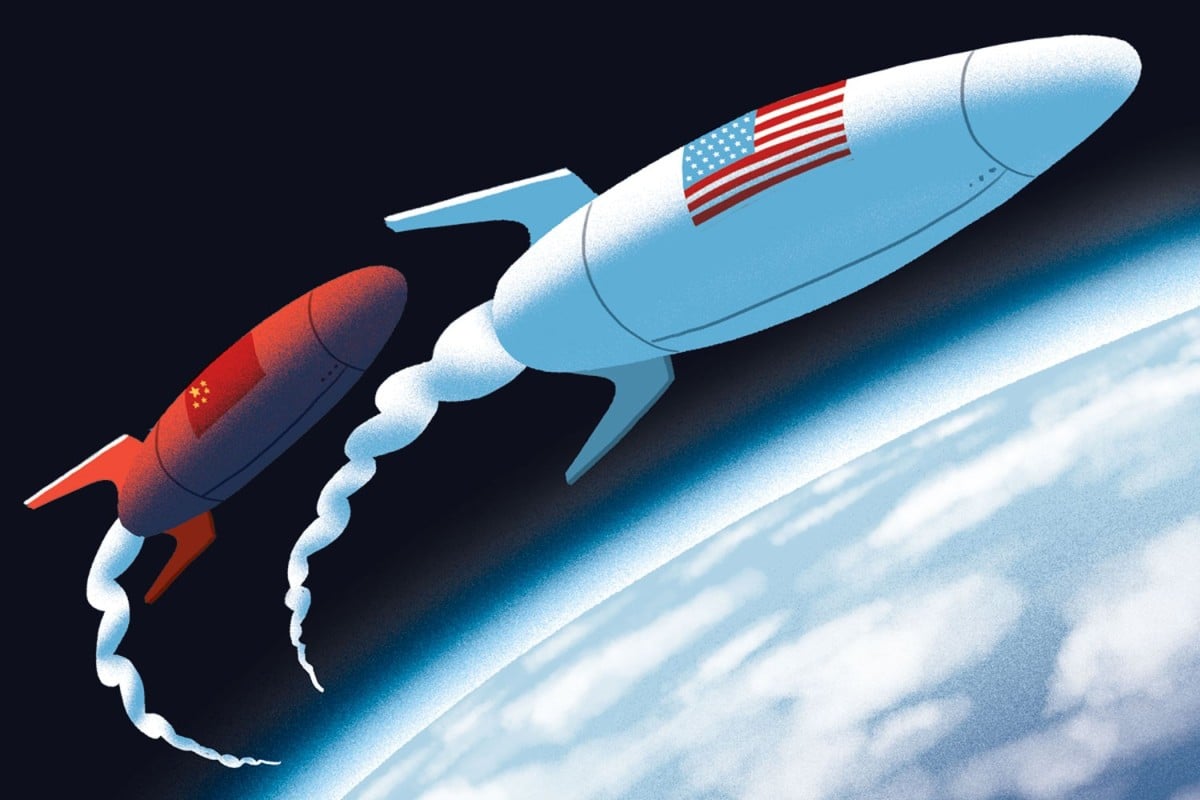
A top Chinese general has a warning for any US leaders planning an arms race in space: be prepared to lose.
Outspending a rival power into economic exhaustion might have helped the US win the cold war, said Qiao Liang, a major general in the Chinese air force who co-wrote the book Unrestricted Warfare: China’s Master Plan to Destroy America. But he said it would not work against a wealthy manufacturing powerhouse like China.
“China is not the Soviet Union,” Qiao said in an interview with the South China Morning Post, a news partner of POLITICO. “If the United States thinks it can also drag China into an arms race and take down China as it did with the Soviets … in the end, probably it would not be China who is down on the ground.”
Qiao’s words come as both Washington and Beijing are pouring money and resources into an increasingly militarised space race that some security specialists and former US officials fear is heightening the risk of war. The aggressive manoeuvres include US President Donald Trump’s proposal for a stand-alone
– which Qiao dismissed as “an unwise move” – and efforts by both countries to develop laser and cyber weapons that could take out each other’s satellites.
The rivalry is plainly on the minds of leaders at the Pentagon, which cites “space” 86 times in a new threat assessment of China’s military. It also warns that the People’s Liberation Army (PLA) is working on “enabling long-range precision strikes” and developing directed-energy weapons for use in orbit.
Sea launch rockets China to forefront of global space race
Trump, Vice-President Mike Pence and a slew of US military leaders have cited China’s military space programmes as a key rationale for proposing the Space Force, which would gather nearly all the defence department’s space-related programmes into a new military branch – similar to the one China created four years ago. Congress is considering the administration’s plan, although some defence hawks are sceptical.
Pence has also expressed alarm at China’s success in
, a place US astronauts last visited in 1972.
“Last December, China became the first nation to land on the far side of the moon and revealed their ambition to seize the lunar strategic high ground and become the world’s pre-eminent spacefaring nation,” Pence said at a meeting of the National Space Council in March.
China and the US are pouring money into an increasingly militarised space race that some observers fear is heightening the risk of war. Photo: Shutterstock
Even more worrying, neither country seems interested in placing the issue on the diplomatic agenda to lower the tensions, some security advocates say. That is in contrast to the decades of space cooperation that have existed between the US and Russia.
“One of my biggest concerns is that for all the talk about how horrible an armed conflict with China would be for everyone, all the current US policies and actions seem to be preparing for armed conflict instead of avoiding it,” said Brian Weeden, director of programme planning at the Secure World Foundation, which advocates for using space in a peaceful and sustainable way.
“There is not a lot of dialogue between the US and China,” he said.
But other space experts say China is a greater threat to the United States than most people realise – and even an “imminent threat”, according to independent analyst Namrata Goswami.
“If anything, it [the threat from China] is underappreciated and underplayed in the US,” she said. “I suspect that is because the US military might not want to call attention to its own vulnerabilities regarding its space assets.”
Chang’e 4 lunar probe sends first photo of far side of the moon
Qiao said China was not seeking a space war but was preparing to counter any nation, including the US, that sought to pose a threat to its national security.
China’s economic prowess left it well positioned to prevail in an expensive contest with the US, he said.
“When the United States and the Soviet Union engaged in the cold war and the arms race, the United States was the largest manufacturing country, and the Soviet Union was not even the second,” he said. “But today it is China who is the world’s top manufacturer.”
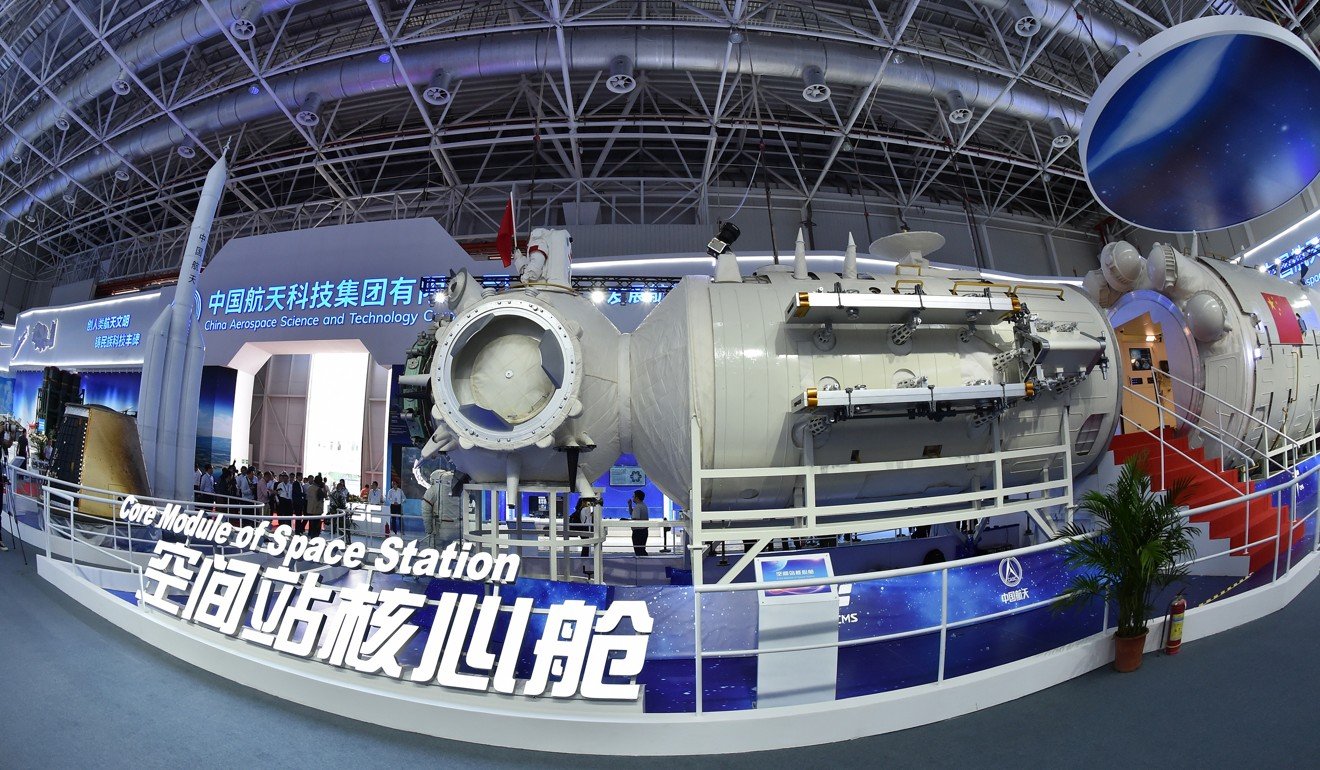
A full-size model of the core module of China’s space station goes on show at Airshow China in November. Photo: Xinhua
Recent reports from US spy agencies and think tanks indicate that China’s efforts are advancing quickly. Those include estimates that China will soon be able to field high-powered lasers designed to attack objects in low-Earth orbit – and evidence that its weapons can already attack targets much further from the Earth than the United States can.
China’s reliance on space assets is also expanding: it has more than 120 intelligence, surveillance and reconnaissance satellites of its own – second only to the United States.
About half of them are owned and operated by the military and could be used to track and target US forces around the world, the report warns.
Will China’s new laser satellite be ‘Death Star’ for submarines?
The threat getting the most attention is the danger China’s orbiting weapons might pose to the satellites the United States relies on for communications, navigation and surveillance – for both military operations and economic well-being.
China is heavily investing in so-called counterspace technology, including the development of at least three antisatellite missile systems, according to an April report from the Centre for Strategic and International Studies. It is also developing satellites that can make physical contact with other satellites in orbit, the report said.
While that technology can be used for repairs in orbit, it can also be used to disable a satellite or tear off a solar array to impact a satellite’s power source.
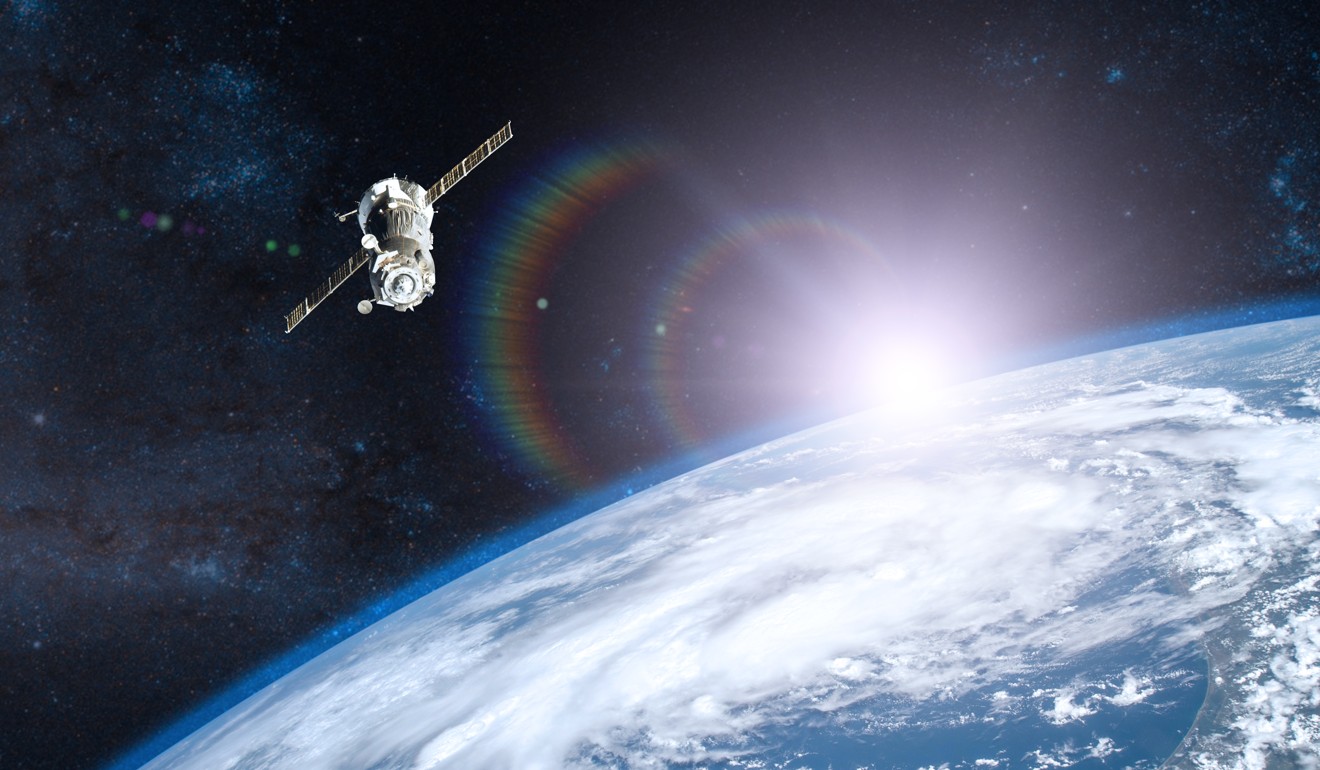
China is developing satellites that can make physical contact with other satellites in orbit. Photo: Xinhua
The Pentagon’s “China Military Power” report found that China is also pursuing new jamming and “directed energy” weapons that can interfere with satellites. In a conflict, that technology would probably be used to “blind and deafen the enemy”, the report said.
China also reorganised the PLA in 2015 to create a Strategic Support Force, a military branch dedicated entirely to space, electronic and cyberwarfare. The new branch was designed to bring space assets from across the military under one organisation, similar to the goal of the US Space Force.
The space-centric branch, which reports directly to the Central Military Commission, is focused primarily on satellite launches and intelligence, navigation and communication operations, but also conducts research and development on new counterspace capabilities, according to the US Defence Intelligence Agency report published in February.
China ‘has overtaken Russia’ as a maritime power
Chinese military units are also training with missiles that could damage or destroy satellites, the agency also reported in February, adding that China will probably have a ground-based laser that can blind optical sensors on satellites in low-Earth orbit by 2020.
Unlike the United States or Russia, China is also believed to have the capacity to use missiles to attack satellites in the more distant geosynchronous orbit, or 35,000km (22,000 miles) above Earth.
If any country were to launch a physical strike in geosynchronous orbit (GEO), the debris field would make the area, which is today used for critical missions like early missile warning and weather observations, unusable.
“We have much more to lose in GEO than any other country,” said Kaitlyn Johnson, an associate fellow who specialises in space security at the Centre for Strategic and International Studies. “We wouldn’t want to have a first strike capability.”
Chinese military units are training with missiles that could destroy satellites. Photo: Reuters
Military experts also worry that China could try to seize areas of the moon that contain strategic resources including ice that could be used for rocket fuel or life support.
But they say it is much more likely China will want to use dominance in space to influence conflicts on Earth. For instance, being able to threaten the military’s GPS or communications satellites might deter the US from getting involved in a conflict in the South China Sea, Weeden said.
The US Space Force is intended to close some of those gaps by grouping space assets together to build expertise and giving the new service autonomy over its budget requests. One of the biggest goals of the new branch is to speed up space acquisitions, allowing new technology to be fielded faster, and to develop a space “doctrine” that would oversee how the US fights conflicts when space platforms are at stake.
China adds new satellite to rival US global positioning system
The Chinese government insists that it is merely responding to aggressive US moves to dominate space militarily. Qiao called it “bullying and hegemonic” for the United States to insist that other countries cannot follow suit.
“The US space troops have long existed,” he said. “They just did not become an independent force … moreover, the US possessed anti-satellite capabilities as early as the 1970s and 1980s. China only developed anti-satellite capabilities at the end of the 1990s and even in the first decade of this century.”
China had little choice but to enhance its capabilities, he said.
“China’s purpose to develop space capabilities, firstly, is we do not want to be blackmailed by others,” Qiao said in the interview. “Second, we hope to use space peacefully. But if others want to oppress us by occupying the heights of space and opening up a ‘fourth battlefield’, China will certainly not accept it.”
Qiao Liang, a major general in the Chinese air force, says it is “bullying and hegemonic” for the United States to insist other countries cannot develop a space force. Photo: Handout
Still, China remained far from surpassing US dominance, he said. “We cannot overtake the US in the next decade or two, but we will narrow the gap in a comprehensive way. And it is possible we may take the lead in some individual areas.”
Weeden agreed.
“China is developing many of the same space capabilities the US did decades ago, while the US is focused on sustaining its capabilities and making them more resilient,” he said.
“On the whole, the US is still far more capable than China is but the relative advantage is narrowing.”
What is space junk and why is it a problem?
The two nations have some diplomatic channels through which they could cooperate in space, including the United Nations’ Committee on the Peaceful Uses of Outer Space, of which both are members. In 2015, the Obama administration established a dialogue with China on space safety, which is quietly continuing under Trump, although Weeden said the meetings were mostly high-level talks.
But the Wolf Amendment, which was first passed in a Congressional appropriations bill in 2011, forbids the US government from working with China and prohibits any bilateral cooperation between the China National Space Administration and the US National Aeronautics and Space Administration on national security grounds. And there is virtually no collaboration between the militaries of the two nations today.
To open the door for conversations that could ease tensions and avoid miscommunication, the US and China must “crawl before we walk”, Audrey Schaffer, the director of space strategy and plans at the defence department, said at a March event on US-China space relations hosted by the Secure World Foundation.
Some potential first steps include the two countries sharing information like their national defence strategies, providing launch notifications of space vehicles or opening routine, secure communications channels between diplomats. Each step would help build trust and transparency, Schaffer said, pointing to the strong relationship between the US and Russia in space as evidence that it could be done.
“Even then when the relationship was just as strained, if not more so, we did manage to work bilaterally and multilaterally with the Soviets to really create mechanisms that would help reduce the risks of conflict and enhance stability,” Schaffer said.
Source: SCMP
Posted in China alert, inevitable, military confrontation, NASA, outer space, racing, towards, Uncategorized, US |
Leave a Comment »





 CHINDIA ALERT: You'll be living in their world, very soon