Chindia Alert: You’ll be Living in their World Very Soon
aims to alert you to the threats and opportunities that China and India present. China and India require serious attention; case of ‘hidden dragon and crouching tiger’.
Without this attention, governments, businesses and, indeed, individuals may find themselves at a great disadvantage sooner rather than later.
The POSTs (front webpages) are mainly 'cuttings' from reliable sources, updated continuously.
The PAGEs (see Tabs, above) attempt to make the information more meaningful by putting some structure to the information we have researched and assembled since 2006.
City at centre of outbreak finally able to declare itself clear of disease after months in lockdown and thousands of deaths
Risk of infection remains, however, with some patients testing positive for coronavirus that causes disease without showing symptoms
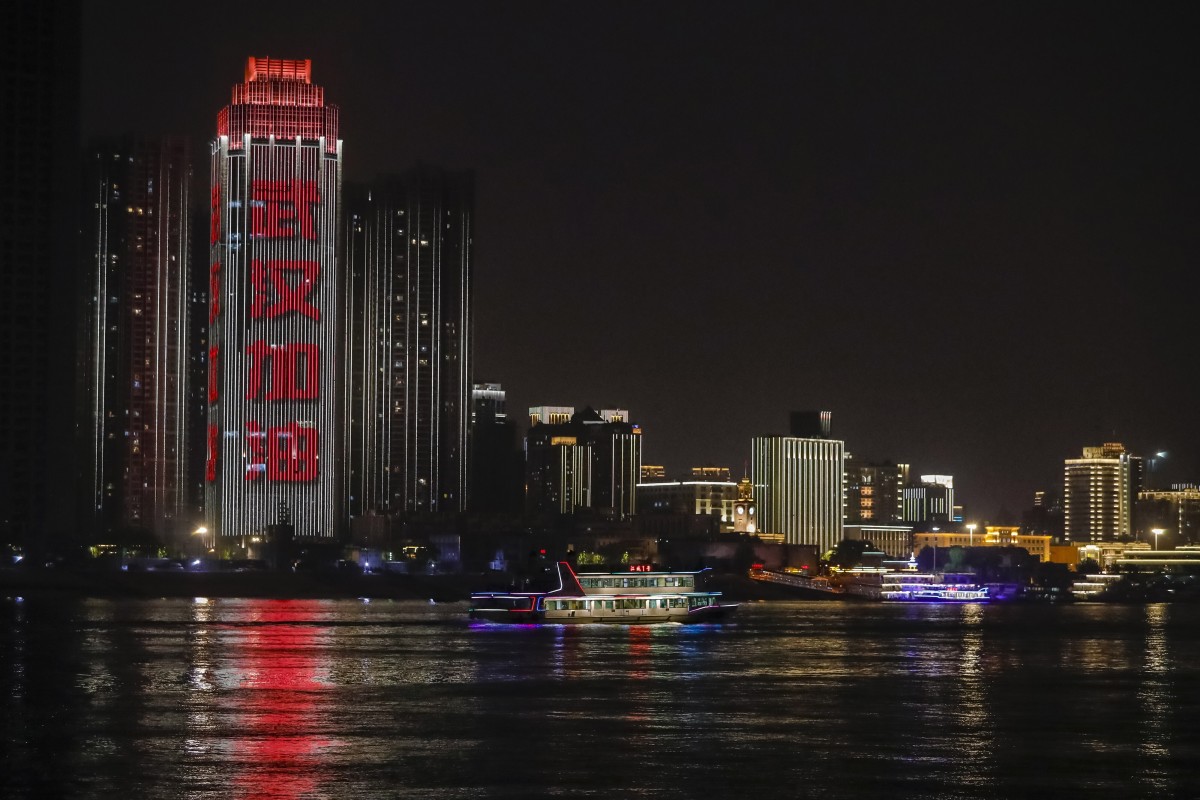
Ferries and other public transport services resumed in Wuhan last week. Photo: Xinhua
The city of Wuhan, the initial epicentre of the coronavirus pandemic, no longer has any Covid-19 patients in hospital after the last 12 were discharged on Sunday.
Their release ended a four-month nightmare for the city, where the disease was first detected in December. The number of patients being treated for Covid-19, the disease caused by a new coronavirus, peaked on February 18 at 38,020 – nearly 10,000 of whom were in severe or critical condition.
“With the joint efforts of Wuhan and the national medical aid given to Hubei province, all cases of Covid-19 in Wuhan were cleared as of April 26,” Mi Feng, a spokesman for the National Health Commission said on Sunday afternoon.
The announcement came only one day after the city discharged the last patient who had been in a severe condition. That patient also was the last severe case in Hubei province.
The last patient discharged from Wuhan Chest Hospital, a 77-year-old man surnamed Ding, twice tested negative for Sars-CoV-2, the virus that causes Covid-19, and was released at noon on Sunday.
“I missed my family so much!” Ding told Changjing Daily.
Another unidentified patient exclaimed as he left the hospital: “The air outside is so fresh! The weather is so good today!”
Wuhan faced a long journey to bring its patient count down to zero.
The city of 11 million, the capital of Hubei province and a transport hub for central China, was put under a strict lockdown on January 23 that barred anyone from entering or exiting the city without official approval for 76 days until it was officially lifted on April 8.
Coronavirus: Wuhan, Los Angeles officials discuss getting back to work after lockdown
22 Apr 2020
Residents were ordered to stay in their apartments as the city stopped public transport and banned private cars from city streets. As the epidemic worsened, more than 42,000 medical staff from across the country were sent to the city and to Hubei province to help ease the burden on the local health care system.
Wuhan was the hardest hit city in China, accounting for 50,333 of the 82,827 locally transmitted Covid-19 cases recorded in China. More than 4,600 died in the country from the disease.
On March 13, the city reported for the first time that there were no new suspected cases of the infection, and five days later there were no confirmed cases.
The number of discharged patients bottomed out at 39.1 per cent at the end of February, gradually climbing to 92.2 per cent by last Thursday.
“Having the patients in the hospital cleared on April 26 marks a major achievement for the city’s Covid-19 treatment,” the Wuhan Health Commission said in a statement.
However, having no severe cases in hospital does not mean all the discharged patients will require no further treatment as they may still need further care.
“Clearing all the severe cases marks a decisive victory for the battle to safeguard Wuhan,” health minister Ma Xiaowei told state broadcaster China Central Television on Saturday.
“Some patients who have other conditions are being treated in specialised hospitals. It has been properly arranged.”
Coronavirus: Chinese writer hit by nationalist backlash over diary about Wuhan lockdown
18 Apr 2020
Ten patients aged between 42 and 85 who have been declared coronavirus-free are still in intensive care at the city’s Tongji Hospital where they are being treated for kidney problems and other complications arising from Covid-19. Some still need ventilators to help them breathe.
These 10 patients are under 24-hour care, with 190 nurses on four-hour rotations. There are other patients in a similar condition in two other hospitals in Wuhan, according to the Hubei Broadcasting and Television Network.
However, the discharge of the last batch of Covid-19 patients does not mean that the risk of infection is gone.
The city reported 20 new cases of people testing positive for Sars-CoV-2, the official name for the coronavirus that causes the disease, but who do not yet show symptoms.
There are 535 such carriers under medical observation. Past data shows some of these asymptomatic carriers will develop symptoms, and so will be counted as Covid-19 patients under China’s diagnosis and treatment plan.
China’s coronavirus infection curve has flattened out with about 694 imported cases of Covid-19 on top of about 800 locally transmitted ones now under treatment.
The national health commission spokesman warned that people still need to be on high alert as the virus is continuing to spread around the globe, with no sign yet of a slowdown.
“[We] must not drop our guard and loosen up. [We] must discover cases in time and deal with them quickly,” Mi said, citing the continued pressure from cases imported by people returning from overseas.
“The next step will be to implement the requirements of the central government and continue to guard against imported cases and a rebound of domestic transmitted cases.”
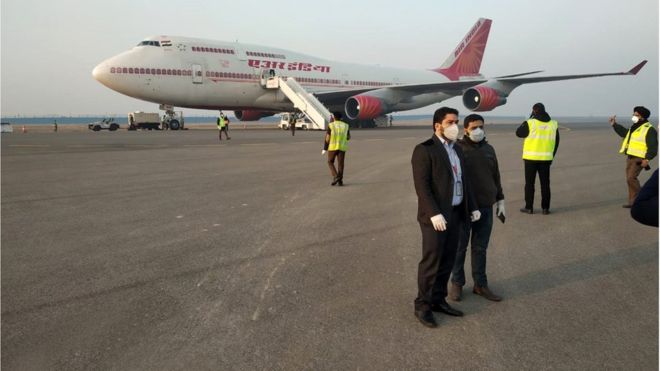
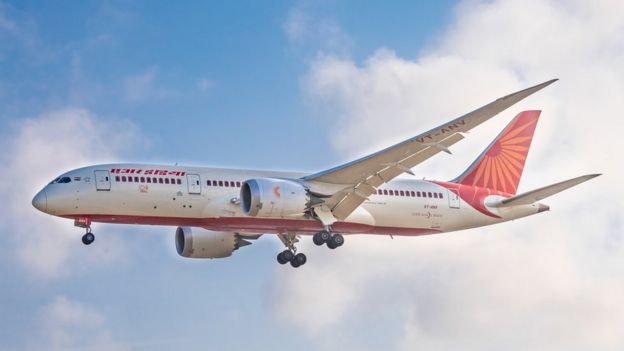
Image copyright GETTY IMAGESImage caption Air India has flown a number of rescue missions
India’s national carrier Air India has been praised for flying a number of flights to rescue Indians stranded in coronavirus-affected countries. Now, a group of pilots have alleged their safety was compromised – a charge the airline denies.
Air India’s fleet has long been used by the government to help Indians in crisis. This has included everything from delivering relief materials during natural calamities to airlifting citizens from Middle Eastern countries during the 2011 Arab Spring.
But this time, as Covid-19 sweeps across the world, crew members have made several allegations about serious shortcomings with regards to ensuring the safety of crew and passengers on recent rescue flights.
In a letter seen by the BBC, the Executive Pilots Association, a body that represents senior long-haul pilots of the airline, says they have been given “flimsy” pieces of Personal Protective Equipment (PPE) that “tear and disintegrate easily on rescue flights”.
The letter, which has been sent to the airline and the aviation ministry, adds that “disinfection processes [for aircraft] are short of international industry best practices”.
Image copyright GETTY IMAGESImage caption Air India is India’s largest airline
“These inadequacies compound the chances of viral exposure and equipment contamination and may even lead to community transmissions of Covid-19 within crew members, passengers and the public at large,” the letter states.
The Indian Pilots’ Guild, which also represents Air India’s long-haul pilots, has written to the ministry citing similar concerns. The BBC has seen this letter as well.
A senior pilot, who did not wish to be identified, told the BBC it is not that the crew “doesn’t want to work in these testing times for the country”.
“All we are asking is that proper safety procedures should be followed. If we don’t have the right PPE and disinfection processes, we are risking the safety of everybody on the plane, our family, and residents of the buildings where we live,” he said.
“We are being compared to soldiers and that is very humbling. But you have to give the right gear to your soldiers.”
An Air India spokesperson acknowledged the letters and said: “Air India is proud of its crew.”
“Our crew has shown tremendous strength, integrity and dedication. All possible measures have been taken towards their health and safety. Best available PPE are procured for our crew,” he told the BBC.
‘Quarantine violations’
The pilot also added that in some cases the norm of following 14-day quarantine period for everybody returning from abroad was not applied to crew members.
The BBC is aware of at least one case where a pilot who returned from a Covid-19-affected country was asked to fly again within seven days.
The spokesperson denied these allegations, saying that “all crew having done international flights have been home quarantined”.
“They have been advised to self-isolate should they develop any symptoms and report immediately. We are following all government quarantine guidelines,” he added.
Image copyright GETTY IMAGESImage caption Air India is due to take stranded Europeans from India to Germany
The two letters add that the crew do not have any specific Covid-19-related insurance policies and don’t have medical teams to examine them when they return from international flights.
“Medical teams all over India are now being covered under a government scheme, although surprisingly air crew are not,” the letters say.
The pilot added that “we are not comparing ourselves to medical staff – they really are the frontline soldiers”.
“But we are also risking our lives, and an insurance will just give us some peace of mind,” he said.
The association has also highlighted the issue of unpaid allowances to the crew.
“Our flying-related allowances, comprising 70% of our total emoluments, remain unpaid since January 2020. This is grossly unfair,” the letter says.
The pilot added that this went against Prime Minister Narendra Modi’s request to employers not to withhold or cut wages in this time of crisis.
“I will repeat again that we do not mind serving the nation, but we need our pay to be protected. We need to be able to look after our families,” he said.
The airline spokesperson said that “all salaries have been paid and efforts are on to clear some pending dues”, but pilots say the withheld allowances are around 70% of their total earnings.
Air India has been saddled with massive debts and several efforts to sell it have failed.
However despite this, the airline is in the midst of planning a massive operation to evacuate foreigners in India at great cost.
The passengers will be collected from several major Indian cities and flown to Frankfurt, but Air India will not be bringing back any Indian citizens who may still be stuck in Europe.
The pilot said “it’s commendable that Air India is helping those in need” but asked why Indians could not be on the return flights as the planes would be flying home empty.
“I want to stress that we will not stop flying rescue and supply missions at any cost. We just want to be heard,” another pilot told the BBC.
“Otherwise it feels like we are alone in this battle when the need is for all of us to work together and look after each other.”
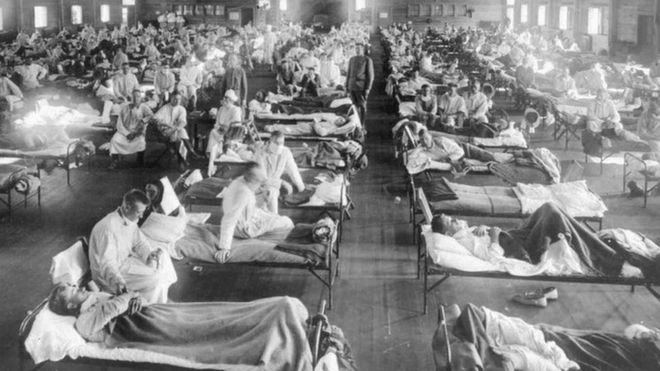
Image copyright NATIONAL MUSEUM OF HEALTH AND MEDICINEImage caption The 1918 flu pandemic is believed to have infected a third of the population worldwide
All interest in living has ceased, Mahatma Gandhi, battling a vile flu in 1918, told a confidante at a retreat in the western Indian state of Gujarat.
The highly infectious Spanish flu had swept through the ashram in Gujarat where 48-year-old Gandhi was living, four years after he had returned from South Africa. He rested, stuck to a liquid diet during “this protracted and first long illness” of his life. When news of his illness spread, a local newspaper wrote: “Gandhi’s life does not belong to him – it belongs to India”.
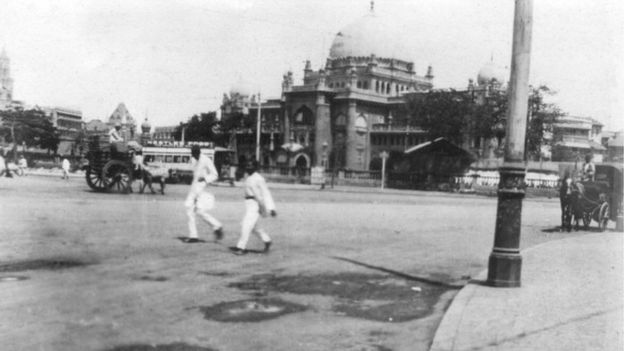
Outside, the deadly flu, which slunk in through a ship of returning soldiers that docked in Bombay (now Mumbai) in June 1918, ravaged India. The disease, according to health inspector JS Turner, came “like a thief in the night, its onset rapid and insidious”. A second wave of the epidemic began in September in southern India and spread along the coastline.
The influenza killed between 17 and 18 million Indians, more than all the casualties in World War One. India bore a considerable burden of death – it lost 6% of its people. More women – relatively undernourished, cooped up in unhygienic and ill-ventilated dwellings, and nursing the sick – died than men. The pandemic is believed to have infected a third of the world’s population and claimed between 50 and 100 million lives.
Gandhi and his febrile associates at the ashram were lucky to recover. In the parched countryside of northern India, the famous Hindi language writer and poet, Suryakant Tripathi, better known as Nirala, lost his wife and several members of his family to the flu. My family, he wrote, “disappeared in the blink of an eye”. He found the Ganges river “swollen with dead bodies”. Bodies piled up, and there wasn’t enough firewood to cremate them. To make matters worse, a failed monsoon led to a drought and famine-like conditions, leaving people underfed and weak, and pushed them into the cities, stoking the rapid spread of the disease.
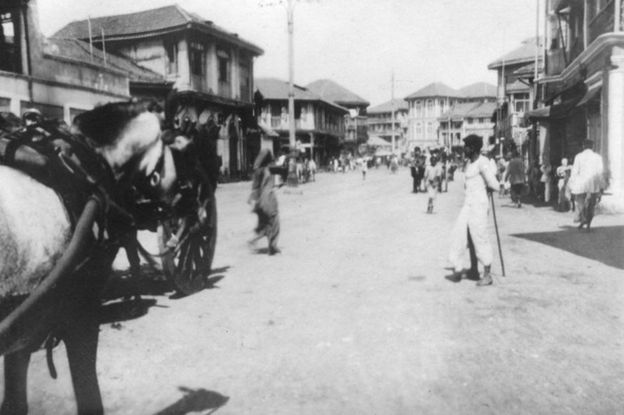
Image copyright PRINT COLLECTORImage caption Bombay was one of the worst hit cities by the 1918 pandemic
To be sure, the medical realities are vastly different now. Although there’s still no cure, scientists have mapped the genetic material of the coronavirus, and there’s the promise of anti-viral drugs, and a vaccine. The 1918 flu happened in the pre-antibiotic era, and there was simply not enough medical equipment to provide to the critically ill. Also western medicines weren’t widely accepted in India then and most people relied on indigenous medication.
Yet, there appear to be some striking similarities between the two pandemics, separated by a century. And possibly there are some relevant lessons to learn from the flu, and the bungled response to it.
The outbreak in Bombay, an overcrowded city, was the source of the infection’s spread back then – this something that virologists are fearing now. With more than 20 million people, Bombay is India’s most populous city and Maharashtra, the state where it’s located, has reported the highest number of coronivirus cases in the country.
By early July in 1918, 230 people were dying of the disease every day, up nearly three times from the end of June. “The chief symptoms are high temperature and pains in the back and the complaint lasts three days,” The Times of India reported, adding that “nearly every house in Bombay has some of its inmates down with fever”. Workers stayed away from offices and factories. More Indian adults and children were infected than resident Europeans. The newspapers advised people to not spend time outside and stay at home. “The main remedy,” wrote The Times of India, “is to go to bed and not worry”. People were reminded the disease spread “mainly through human contact by means of infected secretions from the nose and mouths”.
“To avoid an attack one should keep away from all places where there is overcrowding and consequent risk of infection such as fairs, festivals, theatres, schools, public lecture halls, cinemas, entertainment parties, crowded railway carriages etc,” wrote the paper. People were advised to sleep in the open rather than in badly ventilated rooms, have nourishing food and get exercise.
“Above all,” The Times of India added, “do not worry too much about the disease”.
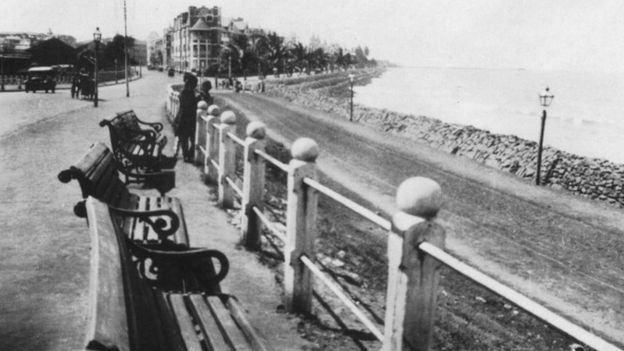
Image copyright PRINT COLLECTOR
Colonial authorities differed over the source of infection. Health official Turner believed that the people on the docked ship had brought the fever to Bombay, but the government insisted that the crew had caught the flu in the city itself. “This had been the characteristic response of the authorities, to attribute any epidemic that they could not control to India and what was invariably termed the ‘insanitary condition’ of Indians,” observed medical historian Mridula Ramanna in her magisterial study of how Bombay coped with the pandemic.
Later a government report bemoaned the state of India’s government and the urgent need to expand and reform it. Newspapers complained that officials remained in the hills during the emergency, and that the government had thrown people “on the hands of providence”. Hospital sweepers in Bombay, according to Laura Spinney, author of Pale Rider: The Spanish Flu of 1918 and How It Changed the World, stayed away from British soldiers recovering from the flu. “The sweepers had memories of the British response to the plague outbreak which killed eight million Indians between 1886 and 1914.”
Image copyright PRINT COLLECTORImage caption The hospitals in Bombay were overwhelmed by patients
“The colonial authorities also paid the price for the long indifference to indigenous health, since they were absolutely unequipped to deal with the disaster,” says Ms Spinney. “Also, there was a shortage of doctors as many were away on the war front.”
Eventually NGOs and volunteers joined the response. They set up dispensaries, removed corpses, arranged cremations, opened small hospitals, treated patients, raised money and ran centres to distribute clothes and medicine. Citizens formed anti-influenza committees. “Never before, perhaps, in the history of India, have the educated and more fortunately placed members of the community, come forward in large numbers to help their poorer brethren in time of distress,” a government report said.
Now, as the country battles another deadly infection, the government has responded swiftly. But, like a century ago, civilians will play a key role in limiting the virus’ spread. And as coronavirus cases climb, this is something India should keep in mind.




 CHINDIA ALERT: You'll be living in their world, very soon