Archive for ‘interest rates’

19/03/2020

Rich world pumps aid to fight coronavirus, epicentre Europe reeling

LONDON/BEIJING (Reuters) – The world’s wealthiest nations poured unprecedented aid into the traumatized global economy on Thursday as coronavirus cases ballooned in the current epicentre Europe even as they waned at the pandemic’s point of origin, China.

With almost 219,000 infections and more than 8,900 deaths so far, the epidemic has stunned the world and drawn comparisons with painful periods such as World War Two, the 2008 financial crisis and the 1918 Spanish flu.

“This is like an Egyptian plague,” said Argentinian hotelier Patricia Duran, who has seen bookings dry up for her two establishments near the famous Iguazu Falls.

“The hotels are empty – tourist activity has died.”

Tourism and airlines have been particularly battered, as the world’s citizens hunker down to minimize contact and curb the spread of the flu-like COVID-19. But few sectors have been spared by a crisis threatening lengthy global recession.

On markets, investors have dumped assets everywhere, many switching to U.S. dollars as a safe haven. Other currencies hit historic lows, with Britain’s pound near its weakest since 1985.

Policymakers in the United States, Europe and Asia have slashed interest rates and opened liquidity taps to try to stabilise economies hit by quarantined consumers, broken supply chains, disrupted transport and paralysed businesses.

The virus, thought to have originated from wildlife on mainland China late last year, has jumped to 172 other nations and territories with more than 20,000 new cases reported in the past 24 hours – a new daily record.

Cases in Germany, Iran and Spain rose to over 12,000 each. An official in Tehran tweeted that the coronavirus was killing one person every 10 minutes.

LONDON LOCKDOWN?

Britain, which had sought to take a gradual approach to containment, was closing dozens of underground stations in London and ordering schools shut from Friday.

Some 20,000 military personnel were on standby to help and Queen Elizabeth was due to leave Buckingham Palace in the capital for her ancient castle at Windsor. Britain has reported 104 deaths and 2,626 cases, but scientific advisers say the real number of infections may be more than 50,000.

Italian soldiers transported corpses overnight from an overwhelmed cemetery in Europe’s worst-hit nation where nearly 3,000 people have died. Germany’s military was also readying to help despite national sensitivities over its deployment dating back to the Nazi era.

Supermarkets in many countries were besieged with shoppers stocking up on food staples and hygiene products. Some rationed sales and fixed special hours for the elderly.

Solidarity projects were springing up in some of the world’s poorest corners. In Kenya’s Kibera slum, for example, volunteers with plastic drums and boxes of soap on motorbikes set up handwashing stations for people without clean water.

Russia reported its first coronavirus death on Thursday.

Amid the gloom, China provided a ray of hope, as it reported zero new local transmissions in a thumbs-up for its draconian containment policies since January. Imported cases, however, surged, accounting for all 34 new infections.

The United States, where President Donald Trump had initially played down the coronavirus threat, saw infections close in on 8,000 and deaths reach at least 151.

Trump has infuriated Beijing’s communist government by rebuking it for not acting faster and drawn accusations of racism by referring to the “Chinese virus”.

“EXTRAORDINARY TIMES”

In a bewildering raft of financial measures around the world, the European Central Bank launched new bond purchases worth 750 billion euros ($817 billion). That brought some relief to bond markets and also halted European shares’ slide, though equities remained shaky elsewhere.

“Extraordinary times require extraordinary action,” ECB President Christine Lagarde said, amid concerns that the strains could tear apart the euro zone as a single currency bloc.

The U.S. Federal Reserve rolled out its third emergency credit programme in two days, aimed at keeping the $3.8 trillion money market mutual fund industry functioning.

China was to unleash trillions of yuan of fiscal stimulus and South Korea pledged 50 trillion won ($39 billion).

The desperate state of industry was writ large in Detroit, where the big three automakers – Ford Motor Co (F.N), General Motors Co (GM.N) and Fiat Chrysler Automobiles NV (FCHA.MI) (FCAU.N) – were shutting U.S. plants, as well as factories in Canada and Mexico.

With some economists fearing prolonged pain akin to the 1930s Great Depression but others anticipating a post-virus bounceback, gloomy data and forecasts abounded.

In one of the most dire calls, J.P. Morgan economists forecast the Chinese economy to drop more than 40% this quarter and the U.S. economy to shrink 14% in the next.

There was a backlash against conspiracy theories and rumours circulating on social media, with Morocco arresting a woman who denied the disease existed.

And in Brazil, where President Jair Bolsonaro initially labelled the virus “a fantasy”, more members of the political elite fell ill. At night, housebound protesters banged pots and pans, shouting “Bolsonaro out!” from their windows.

Source: Reuters

11/03/2020

WHO declares coronavirus pandemic as cases soar worldwide

  • Infections outside China have risen 13-fold, according to World Health Organisation
WHO Director General Tedros Adhanom Ghebreyesus speaks during a news conference in Geneva in February. Photo: Reuters

The World Health Organisation declared the coronavirus outbreak a pandemic on Wednesday, saying cases outside China have risen 13-fold.

The top infectious-disease specialist in the US told lawmakers the pathogen is 10 times more deadly than the seasonal flu.

Britain announced a US$39 billion stimulus package, hours after the Bank of England cut interest rates. Cases in Britain jumped 22 per cent to 456.

German Chancellor Angela Merkel pledged to do “whatever is necessary”, and the European Central Bank’s president warned of a significant shock.

Source: SCMP

27/08/2019

Viewpoint: How serious is India’s economic slowdown?

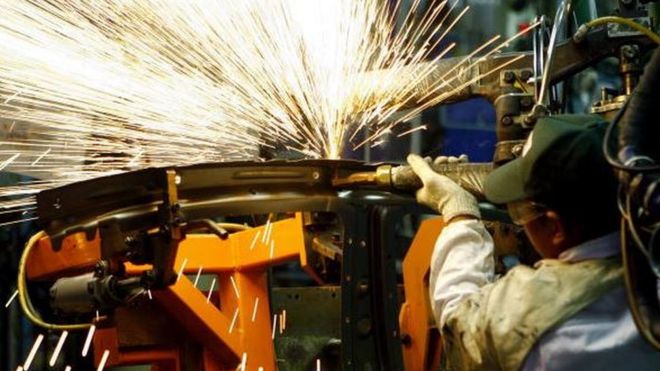
Indian factory worker
Image caption Private sector investment is at a 15-year low

Top Indian government officials are engaged in a vociferous public debate over the state of the country’s economy.

Rajiv Kumar, the head of the government’s think tank Niti Aayog, recently claimed that the current slowdown was unprecedented in 70 years of independent India and called for immediate policy interventions in specific industries.

The Chief Economic Adviser, K Subramanian, disagreed with the idea of industry-specific incentives and argued for structural reforms in land and labour markets. Members of Prime Minister Narendra Modi’s economic advisory council sound inchoate, resorting to social media and opinion editorials to counter one another.

In essence, the quibble among the members of the economic team of Mr Modi and his government is not about whether India is facing an economic slowdown or not, but about how grave the current economic crisis is.

This is a remarkable reversal in stance of the same group of economists who, until a few months ago, waxed eloquent about how India was the fastest growing economy in the world, generating seven million jobs a year.

To put all this in context, it was less than just two years ago, in November 2017, that the global ratings agency Moody’s upgraded India’s sovereign ratings – an independent assessment of the creditworthiness of a country – for the first time in 14 years.

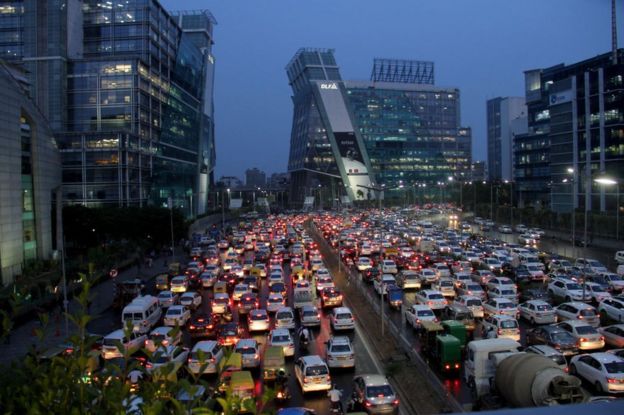
GurgaonImage copyrightGETTY IMAGES
Image captionSales of cars and SUVs have slumped to a seven-year low

Justifying the upgrade, Moody’s had then argued that the economy was undergoing dramatic “structural” reforms under Mr Modi.

In the two years since, Moody’s has downgraded its 2019 GDP growth forecast for India thrice – from 7.5% to 7.4% to 6.8% to 6.2%.

The immediate questions that arise now are: is India’s economic condition really that grim and, if yes, how did it deteriorate so rapidly?

Presentational grey line

Read more about the Indian economy

Presentational grey line

One of India’s most celebrated entrepreneurs, the founder of the largest coffee store chain, Café Coffee Day, recently killed himself, ostensibly due to unmanageable debt, slowing growth and alleged harassment by tax authorities.

The auto industry is expected to shed close to a million direct and indirect jobs due to a decline in vehicle sales. Sales growth of men’s inner wear clothing, a key barometer of consumption popularised by former Federal Reserve Chair Alan Greenspan, is negative. Consumption demand that accounts for two-thirds of India’s GDP is fast losing steam.

To make matters worse, Finance Minister Nirmala Sitharaman presented her first budget recently with some ominous tax proposals that threatened foreign capital flows and dented investor confidence. It sparked criticism and Ms Sitharaman was forced to roll back many of her proposals.

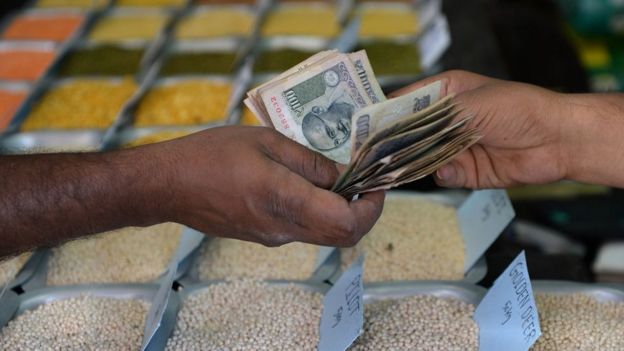
An Indian customer hands over cash to a food grain merchant at a wholesale trading shop in BangaloreImage copyright GETTY IMAGES
Image caption In 2016, India withdrew 85% of all currency notes from the economy

So, it is indeed true that India is facing a sharp economic downturn and severe loss of business confidence.

The alarm over the economic condition is not merely a reflection of a slowdown in GDP growth but also the poor quality of growth.

Private sector investment, the mainstay of sustainable growth in any economy, is at a 15-year low.

In other words, there is almost no investment in new projects by the private sector. The situation is so bad that many Indian industrialists have complained loudly about the state of the economy, the distrust of the government towards businesses and harassment by tax authorities.

But India’s economic slowdown is neither sudden nor a surprise.

Behind the fawning headlines in the press over the past five years about the robustness of India’s growth was a vulnerable economy, straddled with massive bad loans in the financial sector, disguised further by a macroeconomic bonanza from low global oil prices.

India’s largest import is oil and the fortuitous decline in oil prices between 2014 and 2016 added a full percentage point to headline GDP growth, masking the real problems. Confusing luck with skill, the government was callous about fixing the choked financial system.

To make matters worse, Mr Modi embarked on a quixotic move in 2016 to withdraw all high-value banknotes from circulation overnight. This effectively removed 85% of all currency notes from the economy.

Media caption What is really happening with India’s economy?

This move destroyed supply chains and impacted agriculture, construction and manufacturing that together account for three-quarters of all employment in the country.

Before the economy could recover from the currency ban shock, the government enacted a transition to a new indirect taxation system of the Goods and Services Tax (GST) in 2017. The GST rollout wasn’t smooth and many small businesses initially struggled to understand it.

Such massive external shocks to the economy, coupled with a reversal in low oil prices, dealt the final blow to the economy. Millions of Indians started to lose their jobs and rural wages remained stagnant. This, in turn, impacted consumption, slowing down the economy sharply.

Not easy

The wobbly state of the economy has also thrown government finances in disarray: tax revenues are much below expectations.

On Monday, the government got a much-needed breather when India’s central bank announced a $24bn (£19bn) one-time payout for the cash-starved government. (This amount is more than the dividend paid by the central bank to the government in all five years of the Congress rule between 2009 and 2014.)

The solutions to the economic crisis are not easy.

Indian industry, fed and fattened with government protection through decades, is once again clamouring for tax cuts and financial incentives.

But it is not clear that such benefits will revive private sector investment and domestic consumption immediately.

For all the hype about the Make in India programme, hailed as the harbinger of the country’s emergence as a manufacturing power, India’s dependence on China for goods has only doubled in the past five years.

India today imports from China the equivalent of 6,000 rupees ($83; £68) worth of goods for every Indian, which has doubled from 3,000 rupees in 2014.

India’s exports have remained stuck at 2011 levels and not grown.

So, India is neither making goods for itself nor for the world.

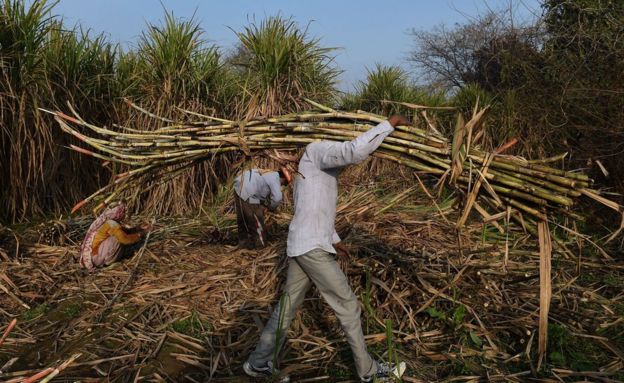
An Indian farmer carries sugarcane to load on a tractor to sell it at a nearby sugar mill in Modinagar in Ghaziabad, some 45km east of New Delhi, on January 31, 2018Image copyright AFP
Image caption India’s agrarian crisis is a major stumbling block

Ornamental tax and other fiscal incentives to specific industries are not suddenly going to make Indian manufacturers competitive and stop India’s addiction for affordable Chinese goods. If any, the trade spat between China and the United States only saw countries such as Vietnam and Bangladesh benefit and not India.

More currency or trade tariffs are not the solutions either. The central bank has lowered interest rates and there is some push to lowering the cost of capital for industry. But again, Indian industry will invest more only when demand for goods and services increases. And demand will increase only when wages increase, or there is money in the hands of people.

So, the only immediate solution for India seems to be to boost consumption through a stimulus given directly to people, in the classical Keynesian mould.

Of course, such a stimulus should be combined with reforms to boost business morale and confidence.

In sum, India’s economic picture is not pretty.

It is important for India’s political leadership to see this not-so-pretty picture and not hide behind rose tinted glasses. Prime Minister Modi has a unique electoral mandate to embark on bold moves to truly transform the economy and pull India out of the woods.

Source: The BBC

19/06/2019

Viewpoint: How the British reshaped India’s caste system

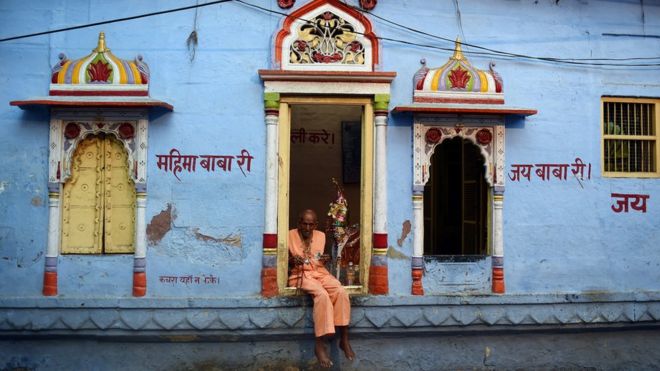
A priest sits in front of a Hindu templeImage copyright AFP

A Google search for basic information on India’s caste system lists many sites that, with varying degrees of emphasis, outline three popular tropes on the phenomenon.

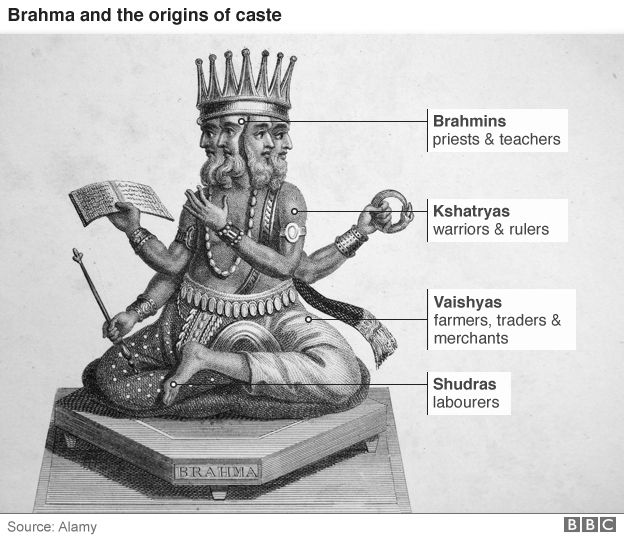
First, the caste system is a four-fold categorical hierarchy of the Hindu religion – with Brahmins (priests/teachers) on top, followed, in order, by Kshatriyas (rulers/warriors), Vaishyas (farmers/traders/merchants), and Shudras (labourers). In addition, there is a fifth group of “Outcastes” (people who do unclean work and are outside the four-fold system).

Second, this system is ordained by Hinduism’s sacred texts (notably the supposed source of Hindu law, the Manusmriti), it is thousands of years old, and it governed all key aspects of life, including marriage, occupation and location.

Third, caste-based discrimination is illegal now and there are policies instead for caste-based affirmative action (or positive discrimination).

These ideas, even seen in a BBC explainer, represent the conventional wisdom. The problem is that the conventional wisdom has not been updated with critical scholarly findings.

The first two statements may as well have been written 200 years ago, at the beginning of the 19th Century, which is when these “facts” about Indian society were being made up by the British colonial authorities.

In a new book, The Truth About Us: The Politics of Information from Manu to Modi, I show how the social categories of religion and caste as they are perceived in modern-day India were developed during the British colonial rule, at a time when information was scarce and the coloniser’s power over information was absolute.

graphic
Image caption Conventional wisdom says the caste system is a four-fold categorical hierarchy of the Hindu religion

This was done initially in the early 19th Century by elevating selected and convenient Brahman-Sanskrit texts like the Manusmriti to canonical status; the supposed origin of caste in the Rig Veda (most ancient religious text) was most likely added retroactively, after it was translated to English decades later.

These categories were institutionalised in the mid to late 19th Century through the census. These were acts of convenience and simplification.

The colonisers established the acceptable list of indigenous religions in India – Hinduism, Sikhism, Jainism – and their boundaries and laws through “reading” what they claimed were India’s definitive texts.

The so-called four-fold hierarchy was also derived from the same Brahman texts. This system of categorisation was also textual or theoretical; it existed only in scrolls and had no relationship with the reality on the ground.

This became embarrassingly obvious from the first censuses in the late 1860s. The plan then was to fit all of the “Hindu” population into these four categories. But the bewildering variety of responses on caste identity from the population became impossible to fit neatly into colonial or Brahman theory.

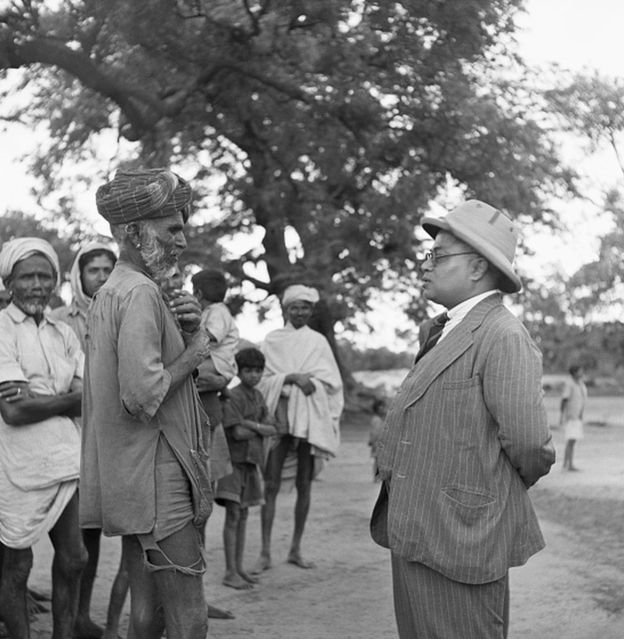
A leader of those formerly considered untouchable discusses a food shortage with a government official. Bengal Province, British India. | Location: Bengal Province, British IndiaImage copyright GETTY IMAGES
Image caption A leader of those formerly considered untouchable with a government official in British India

WR Cornish, who supervised census operations in the Madras Presidency in 1871, wrote that “… regarding the origin of caste we can place no reliance upon the statements made in the Hindu sacred writings. Whether there was ever a period in which the Hindus were composed of four classes is exceedingly doubtful”.

Similarly, CF Magrath, leader and author of a monograph on the 1871 Bihar census, wrote, “that the now meaningless division into the four castes alleged to have been made by Manu should be put aside”.

Anthropologist Susan Bayly writes that “until well into the colonial period, much of the subcontinent was still populated by people for whom the formal distinctions of caste were of only limited importance, even in parts of the so-called Hindu heartland… The institutions and beliefs which are now often described as the elements of traditional caste were only just taking shape as recently as the early 18th Century”.

In fact, it is doubtful that caste had much significance or virulence in society before the British made it India’s defining social feature.

Astonishing diversity

The pre-colonial written record in royal court documents and traveller accounts studied by professional historians and philologists like Nicholas Dirks, GS Ghurye, Richard Eaton, David Shulman and Cynthia Talbot show little or no mention of caste.

Social identities were constantly malleable. “Slaves” and “menials” and “merchants” became kings; farmers became soldiers, and soldiers became farmers; one’s social identity could be changed as easily as moving from one village to another; there is little evidence of systematic and widespread caste oppression or mass conversion to Islam as a result of it.

All the available evidence calls for a fundamental re-imagination of social identity in pre-colonial India.

The picture that one should see is of astonishing diversity. What the colonisers did through their reading of the “sacred” texts and the institution of the census was to try to frame all of that diversity through alien categorical systems of religion, race, caste and tribe. The census was used to simplify – categorise and define – what was barely understood by the colonisers using a convenient ideology and absurd (and shifting) methodology.

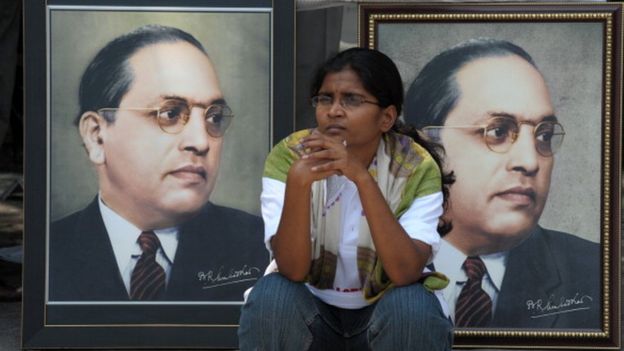
n Indian woman sits infront of portraits of Bhimrao Ramji Ambedkar during 122nd birth anniversary celebrations for Ambedkar in Hyderabad on April 14, 2012.Image copyright AFP
Image caption India’s constitution was written by BR Ambedkar, a member of the Dalit community which is at the bottom of the caste system

The colonisers invented or constructed Indian social identities using categories of convenience during a period that covered roughly the 19th Century.

This was done to serve the British Indian government’s own interests – primarily to create a single society with a common law that could be easily governed.

A very large, complex and regionally diverse system of faiths and social identities was simplified to a degree that probably has no parallel in world history, entirely new categories and hierarchies were created, incompatible or mismatched parts were stuffed together, new boundaries were created, and flexible boundaries hardened.

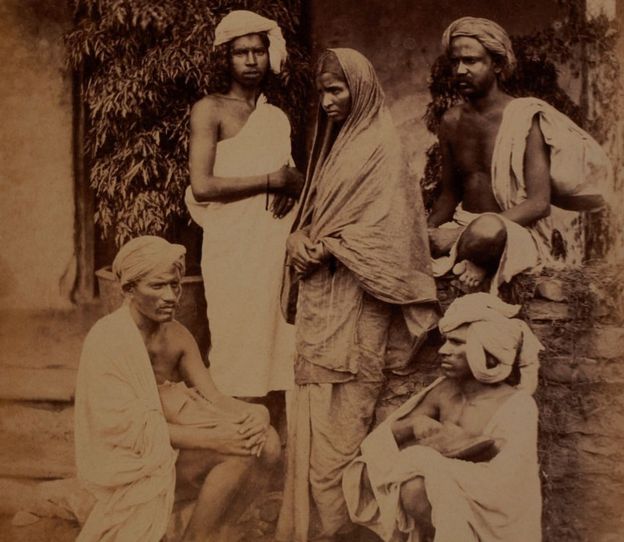
Group of Untouchables, India, circa 1890Image copyright GETTY IMAGES
Image caption Dalits, or untouchables, were at the bottom of the caste system

The resulting categorical system became rigid during the next century and quarter, as the made-up categories came to be associated with real rights. Religion-based electorates in British India and caste-based reservations in independent India made amorphous categories concrete. There came to be real and material consequences of belonging to one category (like Jain or Scheduled Caste) instead of another. Categorisation, as it turned out in India, was destiny.

The vast scholarship of the last few decades allows us to make a strong case that the British colonisers wrote the first and defining draft of Indian history.

So deeply inscribed is this draft in the public imagination that it is now accepted as the truth. It is imperative that we begin to question these imagined truths.

Source: The BBC

Law of Unintended Consequences

continuously updated blog about China & India

ChiaHou's Book Reviews

continuously updated blog about China & India

What's wrong with the world; and its economy

continuously updated blog about China & India