Chindia Alert: You’ll be Living in their World Very Soon
aims to alert you to the threats and opportunities that China and India present. China and India require serious attention; case of ‘hidden dragon and crouching tiger’.
Without this attention, governments, businesses and, indeed, individuals may find themselves at a great disadvantage sooner rather than later.
The POSTs (front webpages) are mainly 'cuttings' from reliable sources, updated continuously.
The PAGEs (see Tabs, above) attempt to make the information more meaningful by putting some structure to the information we have researched and assembled since 2006.
Buffett’s Berkshire posted a record quarterly net loss of nearly US$50 billion
Company sells entire stakes in US airlines, Buffett says ‘world has changed’
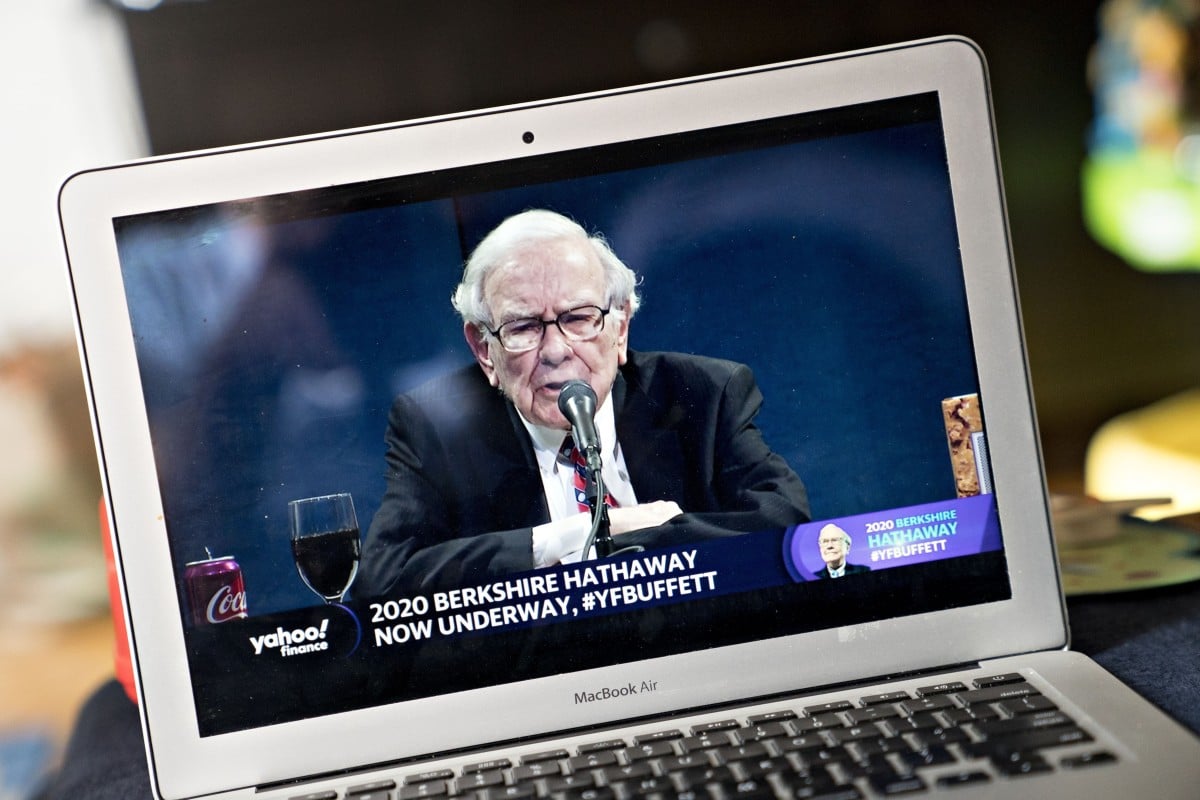
Warren Buffett speaks during the virtual Berkshire Hathaway annual shareholders meeting. Photo: Bloomberg
Billionaire investor Warren Buffett said Saturday he’s confident the US economy will bounce back from its pummelling by the coronavirus pandemic because “American magic has always prevailed”.
The 89-year-old made the sanguine prediction about the world’s largest economy as his holding company Berkshire Hathaway reported first-quarter net losses of nearly US$50 billion.
Buffett also announced Saturday that his company had sold all its stakes in four major US airlines last month, as the pandemic clobbered the travel industry.
“It turns out I was wrong,” he said of his acquisitions of 10 per cent stakes in American Airlines, Delta Air Lines, Southwest Airlines and United Airlines.
Berkshire Hathaway had paid US$7 billion to US$8 billion, and “we did not take out anything like that,” he said.
Between the purchases that took place over months, and the sale, “the airlines business I think changed in a very major way” and could no longer meet Berkshire criteria for profitability, he said.
Buffett’s announcement may further hurt airlines already pushed to the brink by coronavirus lockdown measures, now looking to the US government for US$25 billion in relief funds.
Berkshire Hathaway, based in Omaha, Nebraska, called its first-quarter setback “temporary” but said it could not reliably predict when its many businesses would return to normal or when consumers would resume their former buying habits.
Warren Buffett (left) and vice-chairman Charlie Munger at the annual Berkshire shareholder shopping day in Omaha, Nebraska in 2019. Photo: Reuters
“We’ve faced great problems in the past, haven’t faced this exact problem – in fact we haven’t really faced anything that quite resembles this problem,” Buffett said in a lengthy speech on the country’s economic history.
“But we faced tougher problems, and the American miracles, American magic has always prevailed and it will do so again.”
“We are now a better country, as well as an incredibly more wealthy country, than we were in 1789 … We got a long ways to go but we moved in the right direction,” he said, referencing the abolition of slavery and women’s suffrage.
Warren Buffett has traded his old flip phone for Apple’s iPhone
25 Feb 2020
“Never bet against America.”
Buffett is considered one of the savviest investors anywhere. His fortune of US$72 billion is the fourth-largest in the world, according to Forbes, and in normal years, the company’s annual gathering in Omaha is a high-point of the calendar for investors, a “Woodstock for capitalists”.
But the devastating economic impact of the pandemic has hit hard at Berkshire Hathaway’s wide range of investments, and the need for social distancing forced it to hold the annual meeting online.
Buffett addressed his shareholders in a live-stream flanked only by Gregory Abel, who is in charge of Berkshire’s non-insurance operations.
His business partner for six decades, 96-year-old Charlie Munger, did not appear.
China’s first-quarter GDP shrinks for the first time since 1976 as coronavirus cripples economy
Buffett, in a statement, played down his company’s bleak-looking net figure. He said a better measure of the company’s performance was its operating earnings, which exclude investments and are less subject to sharp fluctuations.
By that measure, Berkshire Hathaway saw growth to US$5.9 billion from US$5.55 billion a year earlier.
The brutal drop in the net – to a loss of US$49.75 billion from a profit last year of US$21.7 billion – resulted primarily from the virus-related decline in value of its broad investment portfolio, which ranges from energy to transport to insurance and technology.
Chinese cryptocurrency billionaire finally sits down to eat with Warren Buffett
7 Feb 2020
The annual meeting often has an almost carnival atmosphere, as thousands of fans and investors flock to Nebraska to hear from the celebrated “Oracle of Omaha”. Buffett, famous for his relatively modest lifestyle, turns 90 on August 30.
In documents filed Saturday, Berkshire noted that until mid-March many of its companies were posting “comparative revenue and earnings increases” over the same 2019 period.
Many of its companies – including in rail transport, energy production and some manufacturing and service businesses – are deemed essential and are able to continue working amid the far-reaching confinement orders.
But their turnover slowed considerably in April, the company statement said.
Moves taken by those companies such as employee furloughs, salary cuts and reductions, and capital spending reductions are “necessary actions” and “temporary,” it said.
BEIJING (Reuters) – Tang Yue, a 27-year-old teacher from the city of Guilin in southwest China, steam-presses a blue dress and takes dozens of photographs before picking one to clinch her 200th online sale.
For a growing number of Chinese like Tang, hit by job losses, furloughs and salary cuts, the consumer economy has begun to spin in reverse. They are no longer buying – they are selling.
Instead of emerging from the coronavirus epidemic and returning to the shopping habits that helped drive the world’s second-largest economy, many young people are offloading possessions and embracing a new-found ethic for hard times: less is more.
With Tang’s monthly salary of about 7,000 yuan ($988), the self-described shopaholic said she has bought everything from Chanel lipsticks to Apple’s (AAPL.O) latest iPad in the past three years.
But the adrenaline rush that comes with binge-shopping is gone, said Tang, whose wages have been slashed with the suspension of all the classes on tourism management she usually teaches.
“The coronavirus outbreak was a wake-up call,” she said. “When I saw the collapse of so many industries, I realised I had no financial buffer should something unfortunate happen to me.”
There is no guarantee that the nascent minimalist trend will continue once the coronavirus crisis is fully over, but if it does, it could seriously damage China’s consumer sector and hurt thousands of businesses from big retailers to street-corner restaurants, gyms and beauty salons.
To be sure, there are signs that pent-up demand will drive a rush of spending as authorities reopen malls, leisure venues and tourist spots. In South Korea, the first major economy outside of China to be hit by the virus, people thronged malls this weekend to go “revenge shopping” to make up for time lost in lockdown.,
There are some signs that a similar trend will take hold in China, where some upscale malls are starting to get busy, although luxury firm Kering SA (PRTP.PA) – which owns Gucci, Balenciaga and other fashion brands – has said it is hard to predict how or when sales in China might come back.
A recent McKinsey & Co survey showed that between 20% and 30% of respondents in China said they would continue to be cautious, either consuming slightly less or, in a few cases, a lot less.
“The lockdown provided consumers with a lot of time and reasons to reflect and consider what is important to them,” said Mark Tanner, managing director at Shanghai-based research and marketing consultancy China Skinny.
“With much more of their days spent in their homes, consumers also have more time and reasons to sort through things they don’t feel they need – so they’re not living around clutter that is common in many apartments.”
#DITCHYOURSTUFF
Tang made a spreadsheet to keep track of her nearly 200 cosmetic products and hundreds of pieces of clothing. She then marked a few essentials in red that she wanted to keep. In the past two months, she has sold items worth nearly 5,000 yuan on second-hand marketplaces online.
Bargain-hunting online has become a new habit for some Chinese as the stigma that once hung over second-hand goods has begun to fade.
Idle Fish, China’s biggest online site for used goods, hit a record daily transaction volume in March, its parent company Alibaba (BABA.N) told Reuters.
Government researchers predict that transactions for used goods in China may top 1 trillion yuan ($141 billion) this year.
Posts with the hashtag #ditchyourstuff have trended on Chinese social media in recent weeks, garnering more than 140 million views.
Jiang Zhuoyue, 31, who works as an accountant at a traditional Chinese medicine company in Beijing – one of the few industries that may benefit from the health crisis – has also decided to turn to a simpler life.
“I used to shop too much and could be easily lured by discounts,” said Jiang. “One time Sephora offered 20% off for all goods, I then bought a lot of cosmetics because I feel I’m losing money if I don’t.”
Jiang, the mother of a 9-month-old baby, said she recently sold nearly 50 pieces of used clothing as the lockdown gave her the opportunity to clear things out. “It also offered me a chance to rethink what’s essential to me, and the importance of doing financial planning,” she said.
Eleven Li, a 23-year-old flight attendant, said she used to spend her money on all manner of celebrity-endorsed facial masks, snacks, concert tickets and social media activity, but now has no way to fund her spending.
“I just found a new job late last year, then COVID-19 came along, and I haven’t been able to fly once since I joined, and I’ve gotten no salary at all,” said Li, who said she was trying to sell her Kindle.
Some are even selling their pets, as they consider leaving big cities like Beijing and Shanghai where the high cost of living is finally catching up with them.
NO RETURN TO OLD WAYS?
As the coronavirus comes under control in China, the government is gradually releasing cities from lockdown, easing transport restrictions and encouraging consumers to venture back into malls and restaurants by giving out billions-worth of cash vouchers, worth between 10 yuan and 100 yuan.
But many people say they are still worried about job security and potential wage cuts because of the struggling economy. Nationwide retail sales have plunged every month so far this year.
Xu Chi, a Shanghai-based senior strategic analyst with Zhongtai Securities, said some Chinese consumers may prove the ‘21 Day Habit Theory,’ a popular scientific proposition that it only takes that long to establish new habits.
“We believe people’s spending patterns follow the well-known theory, which means most people in China, having been cooped-up at home for more than a month and not having binge-shopped, may break the habit and not return to their old ways,” Xu said.
Jiang said she was determined not to return to her free-spending ways and planned to cook more at home.
“I’ll turn to cheaper goods for some luxury brands,” she said. “I’ll choose Huawei’s smartphone, because (Apple’s) iPhone has too much brand premium.”
Tang, who has recently used 100 yuan of shopping coupons to stock up on food, is going to hold the purse strings even tighter.
“I’ve set my monthly budget at 1,000 yuan,” she said. “Including one – and just one – bottle of bubble tea.”
SHANGHAI (Reuters) – Apple Inc’s (AAPL.O) discounts on the iPhone 11 in China and the release of a new low-price SE model have put the company in a better position than rivals to weather a coronavirus-related plunge in global smartphone demand.
While China, which accounts for roughly 15% of Apple’s revenue, appears to be a rare bright spot, investors will be keen to get a picture of global demand when the Cupertino, California-headquartered company reports second-quarter results on Thursday.
The iPhone maker has shut retail stores in the United States and Europe following the COVID-19 outbreak, and China is the only major market where it has been able to reopen all shops.
Consumer spending is expected to be muted as the pandemic has crippled economies and Apple, the world’s second-most valuable tech company, is better armed with the launch of its new price-conscious iPhone model, analysts said.
“Apple is better positioned than most to experience a rapid recovery in a post COVID world,” Evercore analyst Amit Daryanani said in a research note. “We see demand as pushed out, not canceled.”
He added that the launch of the $399 iPhone SE suggested that Apple’s supply chain was getting back on its feet after weeks of shutdown earlier this year.
Analysts expect Apple to report a 6% drop in revenue and an 11% fall in net income in its fiscal second quarter, according to Refinitiv data.
On the other hand, Chinese brands such as Oppo and Vivo who have steadily moved to offer high-end models to challenge iPhones, stand to lose marketshare as bargain hunters choose Apple.
Earlier this month, several online retailers in China slashed prices of the iPhone 11 by as much as 18% – a tactic Apple has used in the past to boost demand. And while initial social media reaction to the new iPhone SE was muted, analysts said they were seeing a pick up in demand.
The cheaper iPhone SE could tempt iPhone owners to opt for a newer device, something they might have otherwise delayed in a weak economy, said Nicole Peng, who tracks the smartphone sector at research firm Canalys.
“People want to avoid uncertainty in a downturn,” she said. “Having a brand like Apple that can showcase quality and make people less worried about breakdowns or after-sales service can bring in buyers.”
CHEAP IS GOOD
Early data suggests that the Chinese smartphone market is recovering rapidly in the aftermath of the virus, and Apple has emerged relatively unscathed.
Sales of iPhones in China jumped 21% last month from a year earlier and more than three fold from February, government data showed, meaning March-quarter sales in the country were likely to have slipped just 1%.
To be sure, a recovery in Chinese demand won’t offset sales lost in the United States and Europe. And the company is yet to launch a smartphone enabled with 5G wireless technology like those offered by Asian rivals, a disadvantage for Apple so far.
But those same expensive 5G models may not sell well in the current climate of frugality, analysts said.
“If there are no massive subsidies (in China), I doubt there will be many smartphone users who will be eager to upgrade to 5G,” said Linda Sui, who tracks the smartphone sector at research firm Strategy Analytics.
Sui expects iPhone shipments in 2020 to be down 2 percentage points at the most, versus double digit declines at Chinese firms.
Apple also has revenue from its services business to fall back on. It has leveraged its large iPhone customer base to boost services revenue from music, apps, gaming and video.
“Apple’s Services segment should remain resilient in today’s work-from-home environment, thereby demonstrating the durability of Apple’s model,” Cowen analyst Krish Sankar said.
not long ago – unless they have a child addicted to the wildly popular app, on which users make and share short, amusing videos.
It has grown explosively since its 2016 launch, with 800 million monthly active users now – 300 million of them outside China in places such as India (120 million) and the
(37 million). And many have no idea it is owned by a Chinese company, ByteDance.
The first Chinese app to mount a real global challenge to Facebook and Instagram, it is seen as one of the shiniest new weapons in the US-China technology war. And a boost, perhaps, to Chinese soft power.
TikTok, the missing link between Hong Kong and Indian protesters?
9 Feb 2020
It experienced a growth spurt in 2019 that analysts predicted would slow a little this year. That, however, was before the coronavirus, which seems to be giving the app a bump, especially beyond its core teenage fan base.
As pandemic fears rise and millions are stuck indoors, major Hollywood celebrities such as Jennifer Lopez, 50, have taken to posting their own all-singing, all-dancing videos, which then go viral on other media platforms.
Even the World Health Organisation has jumped on the bandwagon, joining the app in late February to share public health advice.
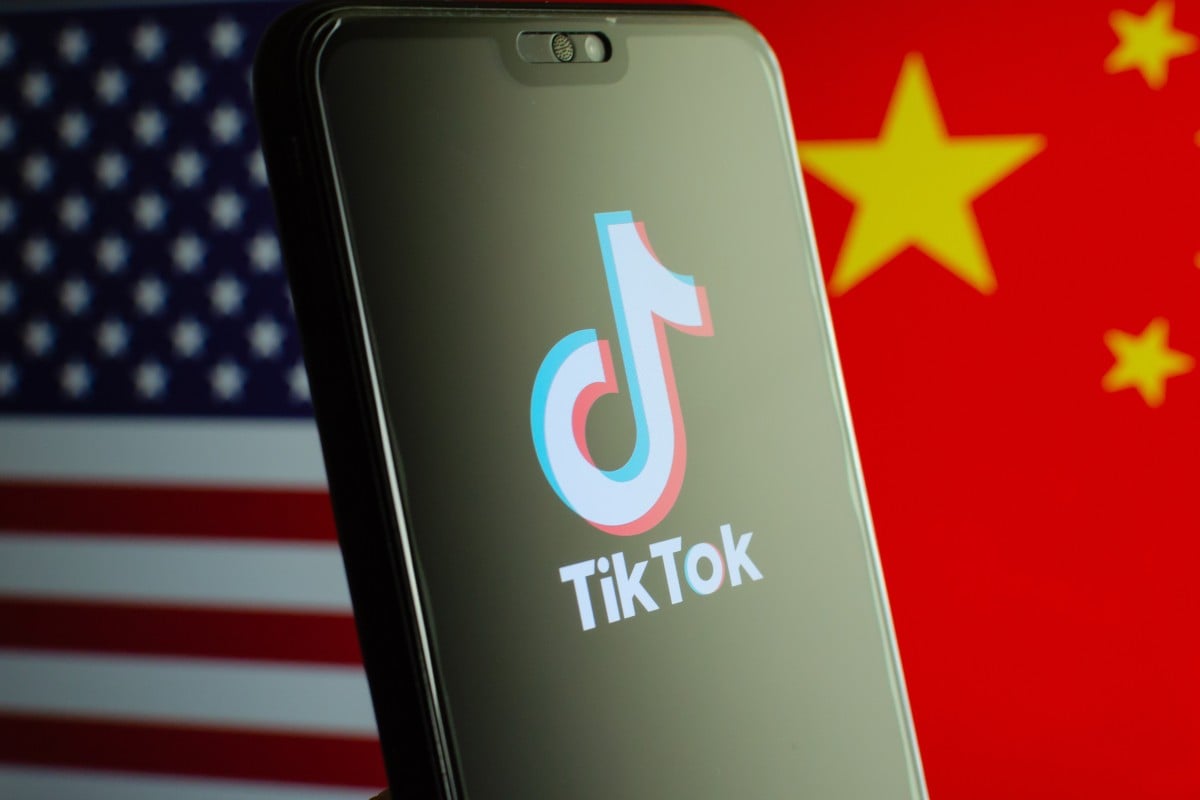
The TikTok logo on a smartphone. Photo: Getty Images
But to some, the growth of TikTok is far from benign.
Privacy advocates and several US congressmen want to rein in the app over concerns it may censor and monitor content for the Chinese government, and be used for misinformation and election interference. This despite the fact that TikTok keeps its servers outside China and swears it will not hand over user data.
Are these fears justified – or fuelled by political and anticompetitive motives?
Thinkers such as Yuval Noah Harari warn that the coronavirus pandemic could be a watershed in the history of mass surveillance.
But Eric Harwit, a professor of Asian studies at the University of Hawaii, does not buy such arguments against TikTok, especially given that 60 per cent of its US users are aged 16 to 24.
“ByteDance has done a pretty good job of having a firewall between TikTok and the Chinese version of it, Douyin.
TikTok, iPhone: all you need to escape Mumbai’s slums – for 15 seconds
1 Nov 2019
“Also, many users in the US are teens and they’re not a particularly useful source of national security information.
“So I’d say the concerns are motivated more by a general fear of any kind of Chinese telecommunication application rather than actual attempts to siphon off valuable US intelligence information.
“And Facebook and other American companies have similar products,” Harwit points out. “US government officials will always want to protect American commercial interests.”
Sarah Cook, a China analyst for Freedom House – the US government-funded think tank – disagrees.
“We have concerns about how Facebook and Twitter deal with information affecting electoral politics, and that’s magnified if you’re talking about a Chinese company that now has a user base that rivals theirs.”
Chinese officials, she argues, have shown a willingness to censor and manipulate information well beyond their country’s borders – for instance, regarding the scale of the initial outbreak in Wuhan, an obfuscation that may have exacerbated its impact abroad.
“For those who think Chinese government censorship is only Chinese people’s problem, this pandemic shows how much that’s not the case.
“And even if it’s not happening right now with TikTok, the concern is that Chinese companies are beholden to their government, whether they want to be or not.
“I’m not saying block TikTok entirely,” she says. “It’s a question of looking at it in a democratic system and deciding on reasonable oversight and safeguards to protect users and information flows when that time comes.”
When it comes to expanding China’s cultural influence, though, neither Cook nor Harwit believes the app is especially effective.
Most people are oblivious to its Chinese origins, which the user experience does not reflect in any way. So there is no goodwill-generating soft power of the sort wielded by, say,
If anything, TikTok often promotes the increasingly homogenous, Western-leaning culture seen on many globally popular social media apps.
So says Morten Bay, a lecturer in digital and social media at the University of Southern California’s Annenberg School for Communication and Journalism.
“A semi-Western culture, with small variations of local culture, is becoming the norm on social media. And Chinese soft power is difficult to assert because there’s no value difference.”
And even if Chinese tech companies keep taking bigger bites of the Western market, he is sceptical of China’s “ability to leverage that for soft power in a geopolitical sense”.
“Because there is a very big apparatus pushing against China in that regard. As soon as TikTok started gaining traction in the US, people came out against it, trying to make everyone aware of the privacy and geopolitical issues.
The #KaunsiBadiBaatHai campaign on TikTok aims to raise awareness about women’s safety issues in India. Image: TikTok
“So China faces a lot of resistance,” Bay concludes. “And I’m not sure a social media platform on its own can do much about that.”
Still, if you had to back a horse in this race, TikTok would be it, says Zhang Mengmeng.
When she and her colleagues from global industry analysis firm Counterpoint Research visited the company, they were impressed by its research and development capabilities.
“Because they’re a very young company, their pace for incubating new projects is a lot faster, especially compared to successful but older internet companies in China which have been around for 15 to 20 years.
Indian invasion of Chinese social media apps sparks fear and loathing in New Delhi
28 Apr 2019
“They have lots of little start-up projects within the company and their organisational structure is very flat – it doesn’t matter what your age is, if you have a good idea, you get promoted very quickly.”
TikTok’s rise is also emblematic of a broader role reversal in the US-China tech war, she believes.
“Before, the US was more advanced in terms of internet development and China seemed to just copy its new ideas. Now, this is reversing. There are so many people in China using the internet that start-ups there can test ideas very easily.
“So now it seems like a lot of US companies are trying to see what ideas are coming out of China.” ■
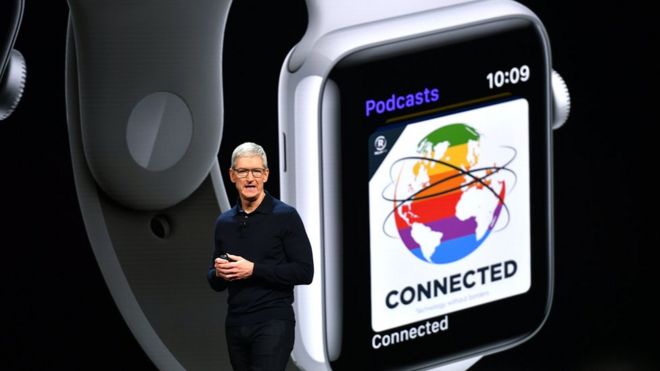
Apple’s chief executive Tim Cook said the company would open its first physical stores in India in 2021 and a online outlet later this year.
Apple had to seek special approval from the Indian government to open a store without a local partner.
The announcement was made at the company’s annual shareholders’ meeting.
Investors at the meeting also voted on a proposal that the firm should alter how it responds when governments ask it to remove apps from its marketplace.
Though the measure wasn’t approved, it failed by a slimmer margin then similar proposals in the past.
Apple’s move into India, the second largest smartphone market in the world, has been expected for some time, but the announcement of a date was new.
In 2018 India changed the laws that prevented foreign brands from opening single-brand stores in the country. Nevertheless Mr Cook said India had wanted Apple to open its store with a local partner.
Mr Cook told investors he didn’t think Apple would be a “good partner”.
“We like to do things our way,” he said.
Apple sells its products through third-party stores in India at the moment. But its sales lag competitors Samsung and Huawei.
With demand for Apple products slowing in China – even before the outbreak of Coronavirus – the firm is hoping it can spur growth in other developing markets like India.
Human rights vote
Apple investors also voted on a proposal meant to change the way the company handles requests by governments to remove applications from its App Store.
The proposal would have forced Apple to publicly commit to respecting “freedom of expression as a human right.”
The measure was tied to Apple’s removal of apps by the Chinese government, including an app that allowed protestors in Hong Kong get around China’s internet restrictions.
Supporters of the measure said Apple was complicit in Chinese human right abuses when it gave in to requests to remove these types of apps.
The measure was voted down but received nearly 40% of the vote.
Similar measures have been proposed in the past but have never received as much support.
Two shareholder advisory groups, Glass Lewis and Institutional Shareholder Services recommended voting in favour of the proposal.
Coronavirus concerns
Mr Cook also addressed the impact that coronavirus is having on Apple’s operations.
The tech giant warned investors early this month that it expected to miss its quarterly earnings estimate because of the outbreak. Many of the Chinese plants that make components for Apple products – like its iPhones and MacBook laptops- have been closed or operating at with limited capacity to reduce the spread of the disease.
The shareholders meeting also allowed investors to ask Apple executives questions about the company’s other development.
One investor asked why the company had not bought the rights to the upcoming reunion of the TV show Friends – which is slated for HBO Max.
Mr Cook said a spinoff would not be keeping with the brand of Apple TV Plus – which is focused on original content.
International rules on seabed mining set for approval in 2020, with China most likely to lead the race, UN body says
Governments, research institutions and commercial entities have already signed contracts for the exploration phase to extract minerals from the seabed, with China holding the most. Photo: Shutterstock
China is in pole position for the global race to start deep sea mining operations to extract valuable minerals used in smartphones and electric car batteries from the seabed.
The head of the International Seabed Authority (ISA) said China was likely to become the first country in the world to start mining seabed minerals if the international rules for exploitation were approved next year.
The ISA has already signed 30 contracts with governments, research institutions and commercial entities for exploration phase, with China holding the most, five contracts.
The body, which was established to manage the seabed resources by the United Nations Convention on the Law of the Sea (UNCLOS), is aiming to adopt seabed mineral exploitation rules by July 2020.
As China leads the hunt for deep-sea minerals, environmental concerns surface
“I do believe that China could easily be among the first (to start exploitation),” said Michael Lodge, ISA general secretary, who visited China last week.
“The demand for minerals is enormous and increasing, there is no doubt about the market.”
There is also interest from European countries including Belgium, Britain, Germany and Poland, as well as from the Middle East.
The quest to exploit seabed minerals – such as polymetallic nodules containing nickel, copper, cobalt and manganese – is driven by demand for smartphones and electric car batteries, and the need to diversify supply.
However, no one has yet shown that deep sea mining can be cost effective and some non-governmental organisations have questioned whether it would be possible to reach a deal on exploitation rules next year.
“I think, it’s pretty good. I think the current draft is largely complete,” Lodge said, when asked about prospects of adopting the rules by next July.
One of the issues yet to be agreed is proportionate financial payments to the Jamaica-based ISA for subsea mineral exploitation outside national waters.
“We are looking at ad valorem royalty that would be based on the value of the ore at a point of extraction … The middle range is 4 per cent to 6 per cent ad valorem royalty, potentially increasing over time,” Lodge said.
New iPhone models to use recycled rare earths, Apple says
If the rules are approved, it could take about two to three years to obtain permits to start deep sea mining under the current draft, Lodge said.
Canadian Nautilus Minerals had tried to mine underwater mounds for copper and gold in the national waters off Papua New Guinea, but ran out of money and had to file for creditor protection earlier this year.
This has not deterred others, such as Global Sea Mineral Resources (GSR), a unit of Belgian group DEME, and Canada’s DeepGreen, to continue technology tests and research.
In July, Greenpeace called for an immediate moratorium on deep sea mining to learn more about its potential impact on deep sea ecosystems, but the ISA has rejected such a proposal.
SHANGHAI (Reuters) – Smartphone shipments to China in February fell to their lowest in six years, market data indicated, as consumers continued to put off handset purchases amid a slowing economy.
Shipments to the world’s biggest smartphone market totaled 14.5 million units, down 19.9 percent from a year ago, according to data from the China Academy of Information and Communications Technology, a government-affiliated research institute.
That is the lowest since February 2013, when shipments to the China totaled 20.7 million.
Overall consumer purchases typically slow during February as the Chinese spend much of the month with family celebrating the Lunar New Year. But shipments this year fell more than usual as a slowing economy, exacerbated by a Sino-U.S. trade war, hurt demand for gadgets across the board.
Apple cited slowing iPhone sales in China when it took the rare step of cutting its sales forecast earlier this year. The firm then teamed up with China’s Ant Financial and local banks to offer interest-free iPhone financing in its first such move in the country as it looked to boost waning sales.
Several third-party retailers have also offered iPhones at discounted prices.
With smartphone sales expected to stay weak, companies like Chinese market leader Huawei Technologies have aimed to launch more expensive models to corner higher margins.
In 2018, Huawei’s market share of China’s $500-$800 device segment rose to 26.6 percent from 8.8 percent, according to Counterpoint Research. Apple’s share fell to 54.6 percent from 81.2 percent as it launched devices cracking the $1,000 price point, while others released competitive devices for less.










 CHINDIA ALERT: You'll be living in their world, very soon