09/07/2019
- Ambassador to China Vikram Misri says they will be ‘meeting more and more in common waters’, and more exchanges are needed
- He also says preparations are under way for President Xi Jinping to visit India
The INS Kolkata arrives in Qingdao for PLA Navy 70th anniversary celebrations in April.
The Indian ambassador called for more communication between the two navies. Photo: Reuters
The Chinese and Indian navies should establish communication because they are increasingly operating within close proximity, according to India’s ambassador to China.
While the two nations’ militaries communicated extensively, it was mainly between their land forces, and that should be extended to the navies and air forces, Vikram Misri said.
“We need to talk about the two air forces and the two navies – especially the two navies – because we are operating in the same waters and increasingly in the coming years, we will be meeting more and more in common waters,” Misri said.
“I think it is important for us to develop those levels of understanding and communication,” he said. “There are some [navy and air force] exchanges now, but not as well developed as in the case of the land force.”
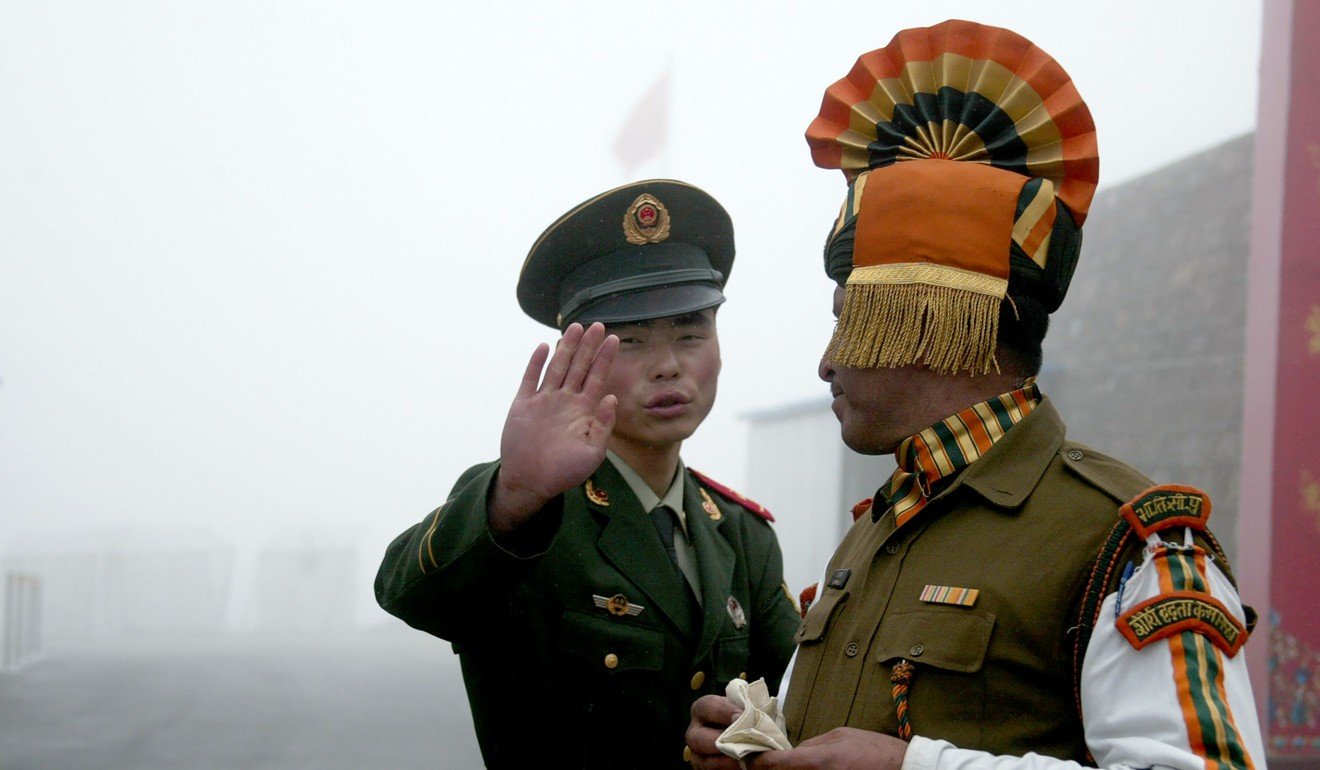
China and India have made efforts to repair their relations since a tense stand-off at the Doklam plateau two years ago, when communications between their forces along the border were seen as inadequate to contain the tension.
China and India have sought to repair relations after a tense stand-off at Doklam. Photo: AFP
Misri said the two nations had made incremental progress, and opened new points where “border personnel can meet and exchange information, or exchange views about any particular situation”.
The ambassador was visiting the Indian consulate in Hong Kong over the weekend, six months after taking up the post and six weeks after Prime Minister Narendra Modi was re-elected.
He said preparations were under way for Chinese President Xi Jinping to visit India, which was expected to happen in the fourth quarter, after they pledged earlier to strengthen cooperation.
Tensions between
have periodically flared along their 4,000km (2,485-mile) border, resulting in a brief war in 1962. Relations have also been strained by China’s ties with Pakistan, and India’s concern over China’s growing presence in the Indian Ocean.
India has also not signed on to China’s global trade and infrastructure strategy, the
, which has projects that run through the disputed Kashmir region.
“Our concerns with regards to this particular initiative are very clear, and we have continued to share them very, very frankly with our Chinese partners,” Misri said. “I think there is understanding on the part of our Chinese partners with regard to this.”
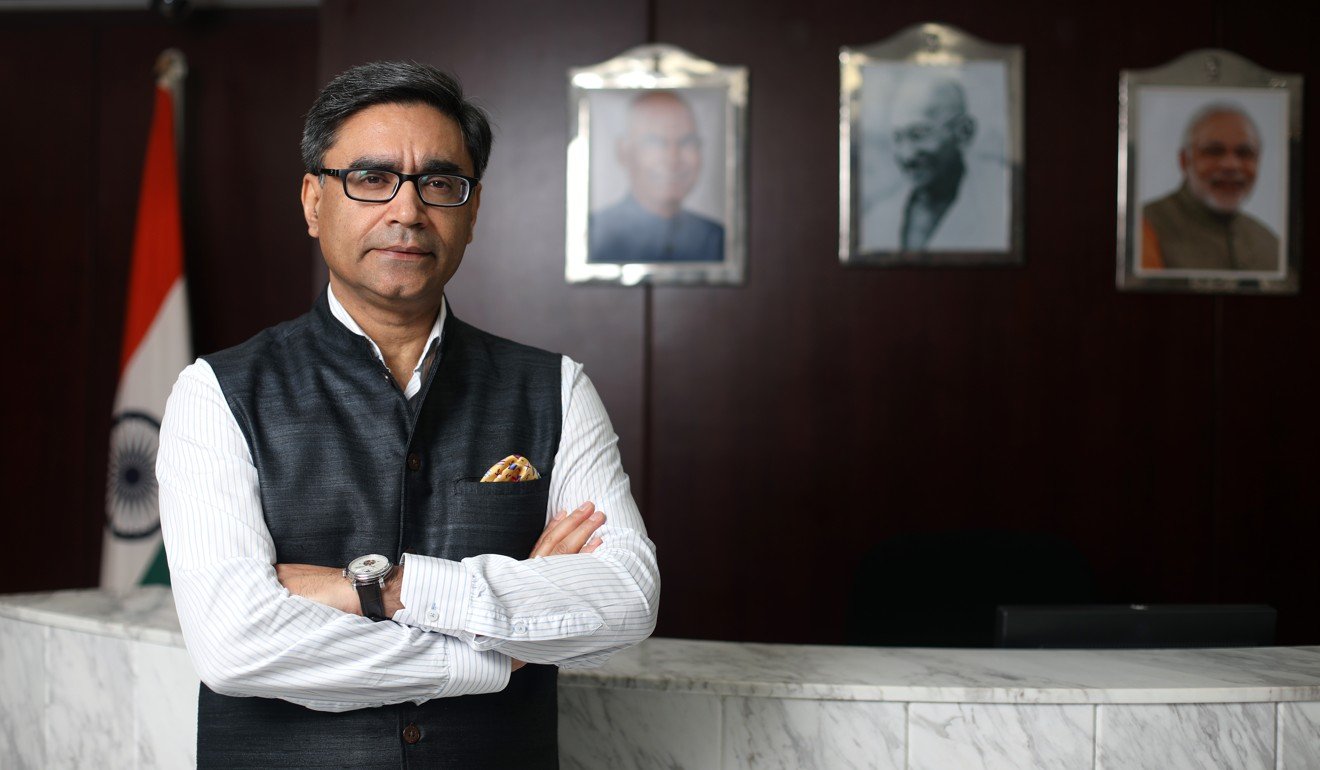
Indian ambassador to China Vikram Misri said New Delhi’s concerns on the Belt and Road Initiative were clear. Photo: Xiaomei Chen
But he said the two nations should not let their differences evolve into disputes, and they should focus on areas where they can cooperate.
One such area was maritime and investment cooperation in the Indo-Pacific region, including infrastructure and disaster response. The US in recent years has focused on the Indo-Pacific region, and has asked its allies to send naval vessels to the area as a counterbalance to Beijing.
“We have made the point that our vision of the Indo-Pacific is not a strategy, which sometimes is a concern on the part of some partners, aimed against any particular country,” Misri said. “It is definitely not a military alliance in any format.
“It is on the other hand a vision that aims at economic and development cooperation with our partners in the Indo-Pacific space,” he said, adding that India was discussing such cooperation with China.
He also said trilateral meetings between China, India and Russia would become more regular after their three leaders met on the sidelines of the
summit in Osaka, Japan last month, when they vowed to uphold multilateralism.
Those meetings would allow the nations to address challenges facing the international trading system and pushback against globalisation, but Misri said they should not be seen as a bid to counter the US, which is also involved in a trade battle with India.
India also had a trilateral meeting with Japan and the United States during the G20 summit.
“The fact that these countries seek us out also shows that they see value in engaging with India, and we have important issues to discuss in each of these settings,” he said. “None of our individual relationships is going to come at the cost of a relationship with any other partner.”
The ambassador said there could be a broader consensus on counterterrorism. Photo: AP
Misri also said there could be a broader consensus between China and India on counterterrorism. The two nations have clashed over Indian efforts to blacklist Masood Azhar, leader of the Pakistan-based terror group Jaish-e-Mohammed (JeM), at the United Nations, which China objected to for years – a move seen in India as being done at the behest of Islamabad.
Azhar was finally listed as a global terrorist by the UN in May, after JeM claimed responsibility for a deadly terror attack on Indian security forces in Pulwama in February, although the listing did not directly reference the attack.
“It could have happened earlier … but I’m glad that it did happen, and we hope to build on that – that should be taken as progress, and we hope to build on that in the coming years,” Misri said.
“Everybody is aware of the context in which the listing happened, and therefore, I don’t think it’s hidden from anybody as to what this was aimed at or who this was aimed at, or what the motivation for the action might have been.”
As for the tensions between India and Pakistan following the terror strike in Indian-controlled Kashmir, Misri said progress would be “largely dependent on Pakistan” and the actions it needed to take to address the “ecosystem of terror that prevails in different parts of that country”.
Source: SCMP
Posted in 70th anniversary, Ambassador Vikram Misri, Belt and Road Initiative (BRI), celebrations, Chinese navy, Chinese President Xi Jinping, communicate, counterterrorism, Doklam plateau, ecosystem of terror, Group of 20 (G20), Hong Kong, Indian ambassador to China, Indian consulate, indian navy, Indian-controlled Kashmir, INS Kolkata, Jaish-e-Mohammed (JeM), Japan, Masood Azhar, Osaka, pla navy, President Xi Jinping, Prime Minister Narendra Modi, Qingdao, Russia, Uncategorized, US, We need to talk |
Leave a Comment »
11/03/2019
Mudasir Ahmed Khan alias ‘Mohd Bhai’, the mastermind of the 14 February Pulwama terror attack, was killed in an encounter earlier today in South Kashmir.
Mudasir was a Jaish-e-Mohammed (JeM) terrorist and the one who arranged the vehicle and the explosives for Adil Ahmed Dar, the suicide bomber who attacked a CRPF convoy killing 44 troopers.
He was among three terrorists killed in Tral in south Kashmir’s Pulwama district by security forces an overnight encounter, which began after the terrorists opened fire during a cordon and search operation in Pinglish area.
Police said that among the three terrorists neutralised at Pinglish in Tral, two were locals and one was Pakistani national.
Bodies of all three terrorists are charred beyond recognition and police have sought assistance of their family members for DNA test to establish their identity.
Mobile phone record indicates that Mudasir was in constant touch with Adil after providing the van to him.
Mudasir was a 23-year-old resident of Mir Mohalla of Tral in Pulwama. The son of a labourer, Mudasir was an electrician with a graduate degree.
He joined the JeM sometime in 2017 as an overground worker and was later drawn into the terror outfit by Noor Mohammed Tantrey, alias ‘Noor Trali’, who is believed to have helped the terror group’s revival in the Kashmir Valley.
Mudasir disappeared from his home on 14 January 2018 following the killing of Tantray in December 2017. The same month, his role came under lens in the Lethpora attack on a CRPF camp that left five personnel dead.
Officials believe that Mudasir was also involved in the terror strike at the army camp in Sunjawan in February 2018, in which six personnel and a civilian were killed.
The National Investigation Agency (NIA), which is probing the 14 February terror attack, had carried out searches at Mudasir’s residence on 27 February.
Authorities are also looking for another JeM operative, identified as Sajjad Bhat, a resident of Bijbehara in south Kashmir, who was one who bought the vehicle used in the attack on the CRPF convoy.
Source: The Statesman
Posted in Adil Ahmed Dar, army camp, attack, Bijbehara, CRPF, DNA test, electrician, graduate degree, identity, India alert, Jaish-e-Mohammed (JeM), JeM, Kashmir Valley, Lethpora, mastermind, Mohd Bhai, Mudasir Ahmed Khan, National Investigation Agency (NIA), Noor Mohammed Tantrey, Noor Trali, Pakistani, Pinglish, Pulwama, Sajjad Bhat, South Kashmir, suicide bomber, Sunjawan, terrorist, Tral, Uncategorized |
Leave a Comment »
07/03/2019
ISLAMABAD (Reuters) – Pakistan intensified its crackdown against Islamist militants on Thursday, with the government announcing it had taken control of 182 religious schools and detained more than 100 people as part of its push against banned groups.
The move represents Pakistan’s biggest move against banned organisations in years and appears to be targeting Islamic welfare organisations that the United States says are a front for militant activities.
Pakistan is facing pressure from global powers to act against groups carrying out attacks in India, including Jaish-e-Mohammed (JeM), which claimed responsibility for the Feb. 14 attack that killed at least 40 Indian paramilitary police.
The escalating tension in the wake of the bombing led to a major confrontation between the nuclear-armed rivals, with both countries carrying out aerial bombing missions and even engaging in a brief dogfight that prompted fears of a war.
Pakistani officials say the crackdown is part of a long-planned drive and not a response to Indian anger over what New Delhi calls Islamabad’s failure to rein in militant groups operating on Pakistani soil.
Previous large-scale crackdowns against anti-India militants have broadly been cosmetic, with the proscribed groups able to survive and continue operations.
The interior ministry said law enforcement agencies had placed 121 people in “preventive detention” as part of the crackdown that began this week.
“Provincial governments have taken in their control management and administration of 182 seminaries (madaris)”, the ministry said in a statement, referring to religious schools.
What to do with madrasas is a thorny issue in Pakistan, a deeply conservative Muslim nation where religious schools are often blamed for radicalisation of youngsters but are the only education available to millions of poor children.
The interior ministry said other institutions from different groups had been taken over, including 34 schools or colleges, 163 dispensaries, 184 ambulances, five hospitals and eight offices of banned organisations.
Many banned groups such as JeM run seminaries, which counter-terrorism officials say are used as recruiting grounds for militant outfits
Jamaat-ud-Dawa (JuD), which operates hospitals and a fleet of ambulances, is estimated to run about 300 madrasas across the country. Pakistan’s government banned the group this week.
JuD calls itself a humanitarian charity but the U.S. State Department has designated it a “foreign terrorist organisation” and calls it a front for Lashkar-e-Taiba (LET), a Pakistan-based group accused of orchestrating attacks in India, including the 2008 Mumbai attack that killed 166 people.
An image casts doubt on India airstrike claims
JuD called the crackdown unfair and said it would seek to counter the government action in courts.
“The whole nation is asking that what message the government wants to send by sealing welfare organisations and kicking students out,” said JuD spokesman Yahya Mujahid.
Pakistan has long used Islamist groups to pursue its aims in the region, but it has denied New Delhi’s accusations it actively supports militants fighting Indian forces in India’s part of Muslim-majority Kashmir.
The South Asian neighbours have fought three wars since independence from Britain in 1947, two of them over Kashmir which they both claim in whole but rule in part.
Source: Reuters
Posted in 1947, aerial bombing missions, ambulances, banned organisations, Britain, counter-terrorism officials, crackdown, dispensaries, dogfight, foreign terrorist organisation, hospitals, humanitarian charity, independence, Indian forces, interior ministry, Islamabad, Islamic welfare organisations, Jaish-e-Mohammed (JeM), Jamaat-ud-Dawa (JuD), JeM run seminaries, Kashmir, Lashkar-e-Taiba (LeT), madrasas, militant outfits, militants, mumbai, Muslim nation, Muslim-majority Kashmir, New Delhi, nuclear-armed rivals, Pakistan, paramilitary police, proscribed groups, provincial governments, recruiting ground, religious schools, schools or colleges,, seminaries (madaris), South Asian neighbours, U.S. State Department, Uncategorized, United States |
Leave a Comment »
07/03/2019
The Chinese foreign ministry on Thursday released a statement in Chinese following the visit of vice-foreign minister Kong Xuanyou to Pakistan, lauding Islamabad’s response.
WORLD Updated: Mar 07, 2019 16:42 IST
Kong visited Pakistan as Islamabad faced pressure from global powers to act against groups carrying out attacks in India, including Jaish-e-Mohammed (JeM), which claimed responsibility for the February 14 attack that killed 40 CRPF personnel in Pulwama.(REUTERS File Photo)
China has praised Pakistan for its handling of the tense situation with India, appreciating Islamabad’s “restraint” in the aftermath of the Pulwama terror attack in Jammu and Kashmir in February.
The Chinese foreign ministry on Thursday released a statement in Chinese following the visit of vice-foreign minister Kong Xuanyou to Pakistan, lauding Islamabad’s response.
“China has paid close attention to the present situation between Pakistan and India, and appreciates Pakistan remaining calm and exercising restraint from the beginning, and persisting in pushing to lower the temperature with India via dialogue,” the foreign ministry statement said.
It paraphrased Kong’s discussions with Pakistan’s leadership comprising Prime Minister Imran Khan, army chief General Qamar Javed Bajwa and foreign minister Shah Mehmood Qureshi.
In turn, the statement quoted the Pakistani side thanking China’s “objective and fair position” on the situation and for its efforts to promote the “cooling” of the situation.
Kong visited Pakistan as Islamabad faced pressure from global powers to act against groups carrying out attacks in India, including Jaish-e-Mohammed (JeM), which claimed responsibility for the February 14 attack that killed 40 CRPF personnel in Pulwama.
The Pulwama suicide attack – the worst in Kashmir in decades – led to the most serious conflict in years between the nuclear-armed neighbours with India carrying out a strike on a JeM camp in Balakot and then a dogfight over the skies of Kashmir.
The crisis seems to have eased after Pakistan returned IAF Wing Commander Abhinandan Varthaman last Friday, nearly two days after he was captured.
Kong was quoted as telling the Pakistani leadership that China maintains that the sovereignty and territorial integrity of all countries should be earnestly respected and that Beijing is unwilling to see acts that violate the norms of international relations.
The statement quoted Kong as saying that China calls on Pakistan and India to refrain from taking actions to aggravate the situation, show goodwill and flexibility, launch dialogue as soon as possible, and work together to maintain regional peace and stability.
China is willing to continue to play a constructive role in this regard, Kong is quoted to have said.
According to the statement, the Pakistani leaders appreciated China’s objective and fair position on the situation in Pakistan and India and thanked China for its efforts to promote the cooling of the situation.
It added that the Pakistani side reiterated that it is unwilling to see an escalation of the situation and is willing to resolve the contradictions and differences between the two sides through dialogue and peacefully, and welcomes China and the international community to play an active role in this regard.
Source: Hindustan Times
Posted in Balakot, China alert, CRPF, dialogue, dogfight, foreign minister, Foreign Ministry, General Qamar Javed Bajwa, IAF Wing Commander Abhinandan Varthaman, Imran Khan, India alert, Islamabad, Jaish-e-Mohammed (JeM), Jammu and Kashmir, Kashmir, Kong Xuanyou, nuclear-armed neighbours, Pakistan, Pakistan’s army chief, Prime minister, Pulwama, response, Shah Mehmood Qureshi, Uncategorized, vice-foreign minister |
Leave a Comment »




 CHINDIA ALERT: You'll be living in their world, very soon