Chindia Alert: You’ll be Living in their World Very Soon
aims to alert you to the threats and opportunities that China and India present. China and India require serious attention; case of ‘hidden dragon and crouching tiger’.
Without this attention, governments, businesses and, indeed, individuals may find themselves at a great disadvantage sooner rather than later.
The POSTs (front webpages) are mainly 'cuttings' from reliable sources, updated continuously.
The PAGEs (see Tabs, above) attempt to make the information more meaningful by putting some structure to the information we have researched and assembled since 2006.
MUNICH (Reuters) – U.S. Secretary of State Mike Pompeo defended on Saturday his nation’s global role despite misgivings in Europe, vowing that Western values would prevail over China’s desire for “empire”.
Pompeo was seeking to reassure Europeans troubled by U.S. President Donald Trump’s “America first” rhetoric, ambivalence over the transatlantic NATO military alliance and tariffs on European goods.
“I’m happy to report that the death of the transatlantic alliance is grossly exaggerated. The West is winning, and we’re winning together,” he said in a speech at the Munich Security Conference, listing U.S. steps to protect liberal democracies.
RELATED COVERAGE
U.S., allied firms testing alternatives to Chinese 5G technology – Esper
Pompeo was, in part, responding to German President Frank-Walter Steinmeier, who on Friday accused the United States, Russia and China of stoking global mistrust.
Trump’s decision to pull out of the 2015 Iran nuclear deal, as well as the Paris climate accord, have undermined European priorities, while moves such as recognition of Jerusalem as Israel’s capital have weakened European diplomacy, envoys say.
Pompeo defended the U.S. strategy, saying Europe, Japan and other American allies were united on China, Iran and Russia, despite “tactical differences.”
He reiterated Washington’s opposition to the Nord Stream 2 gas pipeline under construction between Russia and Germany under the Baltic Sea, a project backed by the government of German Chancellor Angela Merkel.
Citing Russia’s 2014 annexation of Crimea, cyber threats in Iran and economic coercion by China, Pompeo said those countries were still “desiring empires” and destabilising the rules-based international system.
U.S. Secretary of Defense Mark Esper, speaking immediately after Pompeo, focused his remarks solely on China, accusing Beijing of a “nefarious strategy” through telecommunications firm Huawei [HWT.UL].
“It is essential that we as an international community wake up to the challenges presented by Chinese manipulation of the long-standing international rules-based order,” Esper said.
He said it was not too late for Britain, which last month said it would allow Huawei a limited role in building its 5G networks, to take “two steps back,” but added he still needed to asses London’s decision.
“We could have a win-win strategy if we just abide by the international rules that have been set in place for decades … that respect human rights, that respect sovereignty,” he said.
More than 1,300 people are now known to have died from the virus.
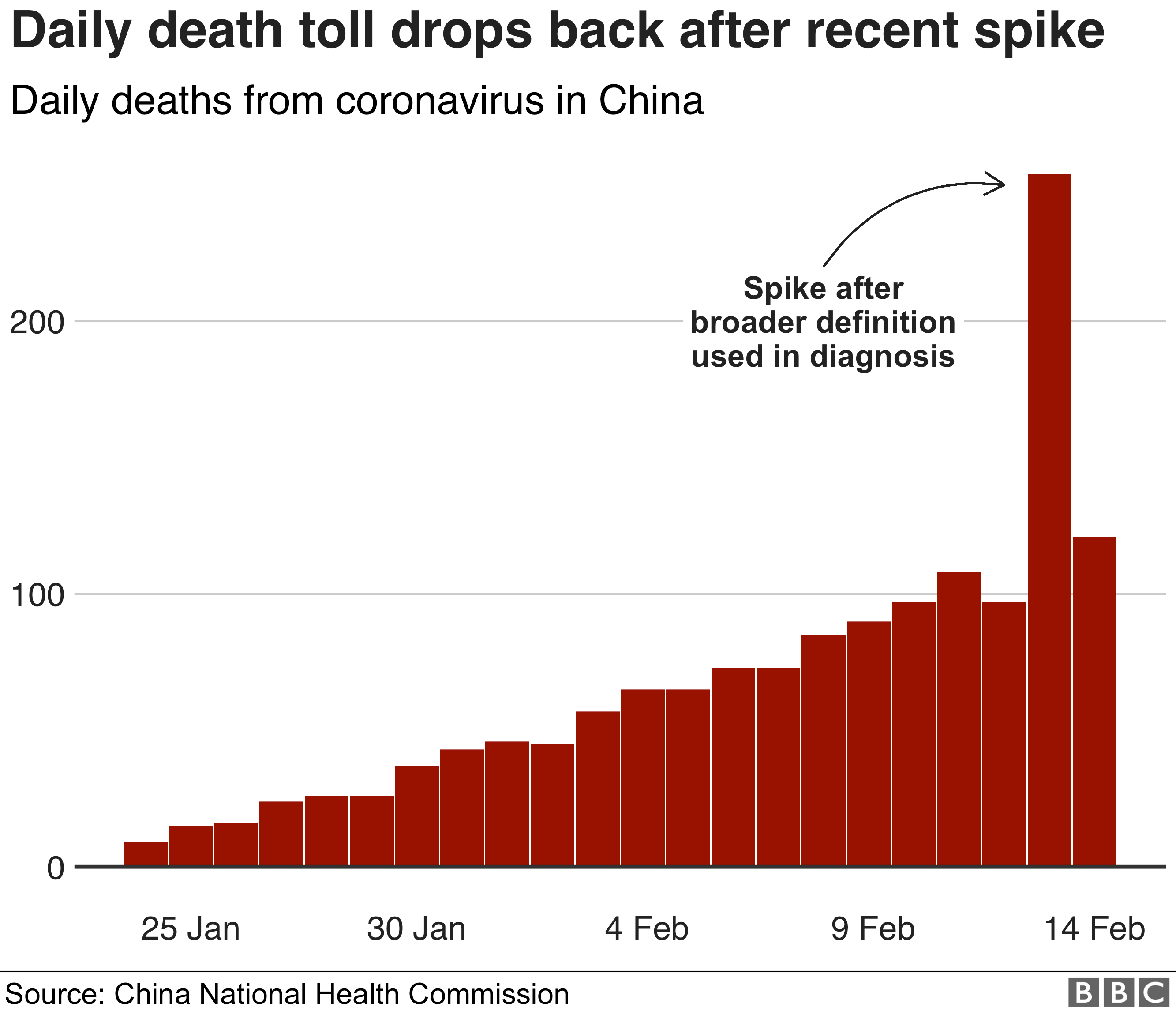
The latest figures show 122 new deaths in China, bringing the toll to 1,381.
The total number of infections has jumped to 63,922 cases, according to the National Health Commission.
The World Health Organization said there was no major shift in the virus’s pattern of mortality or severity, despite a spike in cases in Hubei, the epicentre of the disease, on Tuesday.
Most of this was down to Hubei using a broader definition to diagnose people, said Mike Ryan, head of WHO’s health emergencies programme.
There was also no significant rise in cases outside China, the WHO said.
However, a cruise ship docked in Japan, the Diamond Princess, saw 44 new cases, bringing the total there to 218.
What is the situation with medical workers?
Zeng Yixin, vice minister of China’s National Health Commission, said 1,102 medical workers had been infected in Wuhan, where the outbreak began, and another 400 in other parts of Hubei province.
He said the number of infections among staff was increasing.
Media caption Medics in Wuhan resort to shaving their heads in a bid to prevent cross-infection of the coronavirus
“The duties of medical workers at the front are indeed extremely heavy; their working and resting circumstances are limited, the psychological pressures are great, and the risk of infection is high,” Mr Zeng said, quoted by Reuters.
Local authorities have struggled to provide protective equipment such as respiratory masks, goggles and protective suits in hospitals in the area.
One doctor told AFP news agency that he and 16 colleagues were showing possible symptoms of the virus.
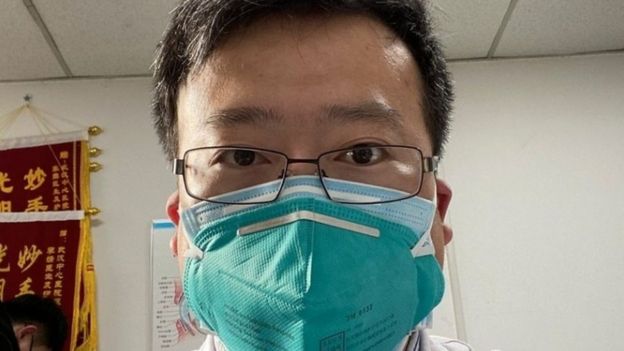
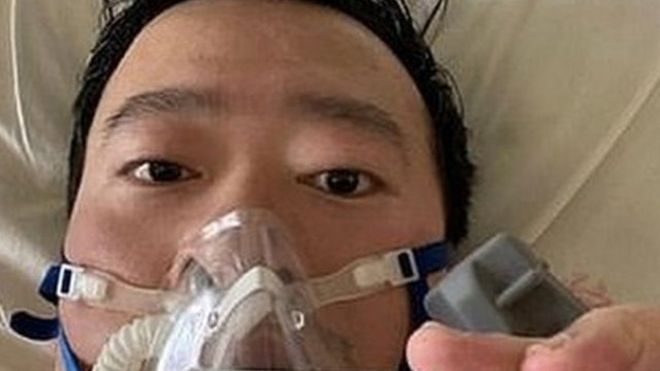
On 7 February the plight of medical workers was highlighted by the death of Li Wenliang, a doctor at Wuhan Central Hospital who had tried to issue the first warning about the virus on 30 December.
Image copyright LI WENLIANGImage caption Li Wenliang contracted the virus while working at Wuhan Central Hospital
He had sent out a warning to fellow medics but police told him to stop “making false comments”.
A wave of anger and grief flooded Chinese social media site Weibo when news of Dr Li’s death broke.
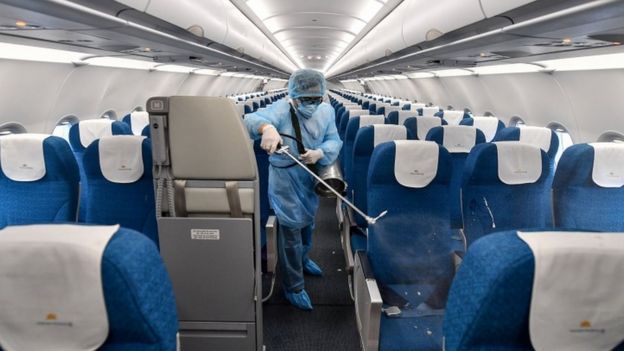
Image copyright AFPImage caption Asian airlines have been hard hit by the virus outbreak
Economic impacts of the virus
Global airline revenue expected to fall by $4bn (£3.1bn) to $5bn this year
China’s car sales likely to fall more than 10% in first half of year, the China Association of Automobile Manufacturers tells Reuters
Singapore’s economy could fall into recession as a result of the outbreak, Prime Minister Lee Hsien Loong says
Malaysian finance minister says a stimulus package will be announced for aviation, retail and tourism industries
What is happening on the Diamond Princess?
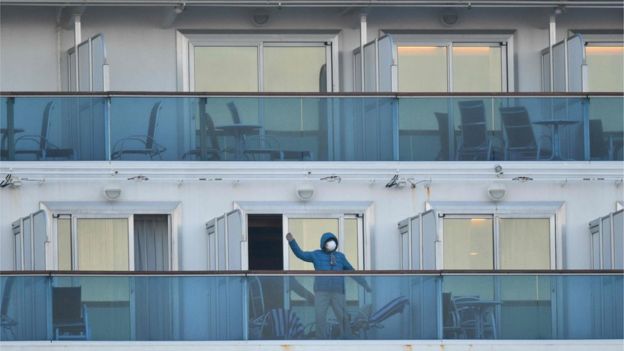
The vessel is in quarantine in Yokohama, in southern Japan. Not all the 3,700 people on board have been tested yet.
People with the virus are taken to hospitals on land to be treated, while those on board are largely confined to their cabins.
Image copyright AFPImage caption The Diamond Princess has 3,700 people on board – not all of whom have been tested
However on Thursday Japan said it would allow those aged 80 or over who have tested negative for the coronavirus to disembark.
Health Minister Katsunobu Kato said they could be allowed off the ship as early as Friday but would have to stay in accommodation provided by the government, the Japan Times reported.
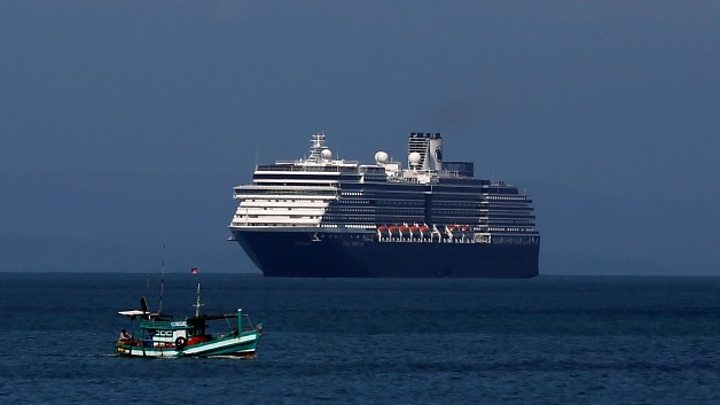
Meanwhile another cruise ship – the MS Westerdam, carrying more than 2,000 people – docked in Cambodia after being turned away by ports in Japan, Taiwan, Guam, the Philippines and Thailand despite having no sick patients on board.
Media caption The Westerdam was finally able to dock in Sihanoukville, Cambodia
In other developments:
Outside China there have now been two deaths and 456 cases in 24 countries
Singapore health ministry reports nine new cases, bringing the total number there to 67
Australia has extended its ban on people coming from mainland China for another week, to 22 February
China said it would stagger the return of children to school – several provinces have closed schools until the end of February
In Vietnam, which borders China, thousands of people in villages near the capital, Hanoi, have been put under quarantine after several cases were discovered. Vietnam has now confirmed at least 16 cases
The Red Cross has called for sanctions relief for North Korea, which would allow the aid agency to transfer funds to buy equipment. Testing kits and protective clothing are urgently needed to prepare for a possible outbreak, it says
A Russian woman – who was put into a coronavirus quarantine but escaped – is resisting attempts by officials to bring her back to hospital by force. Alla Ilyina, 32, has been refusing to open the door of her St Petersburg apartment to police
The Eyes of Darkness features a Chinese military lab in Wuhan that creates a virus as a bioweapon; civilians soon become sick after accidentally contracting it
In fact, the one lab in China able to handle the deadliest viruses is in Wuhan and helped sequence the novel coronavirus the world is currently battling
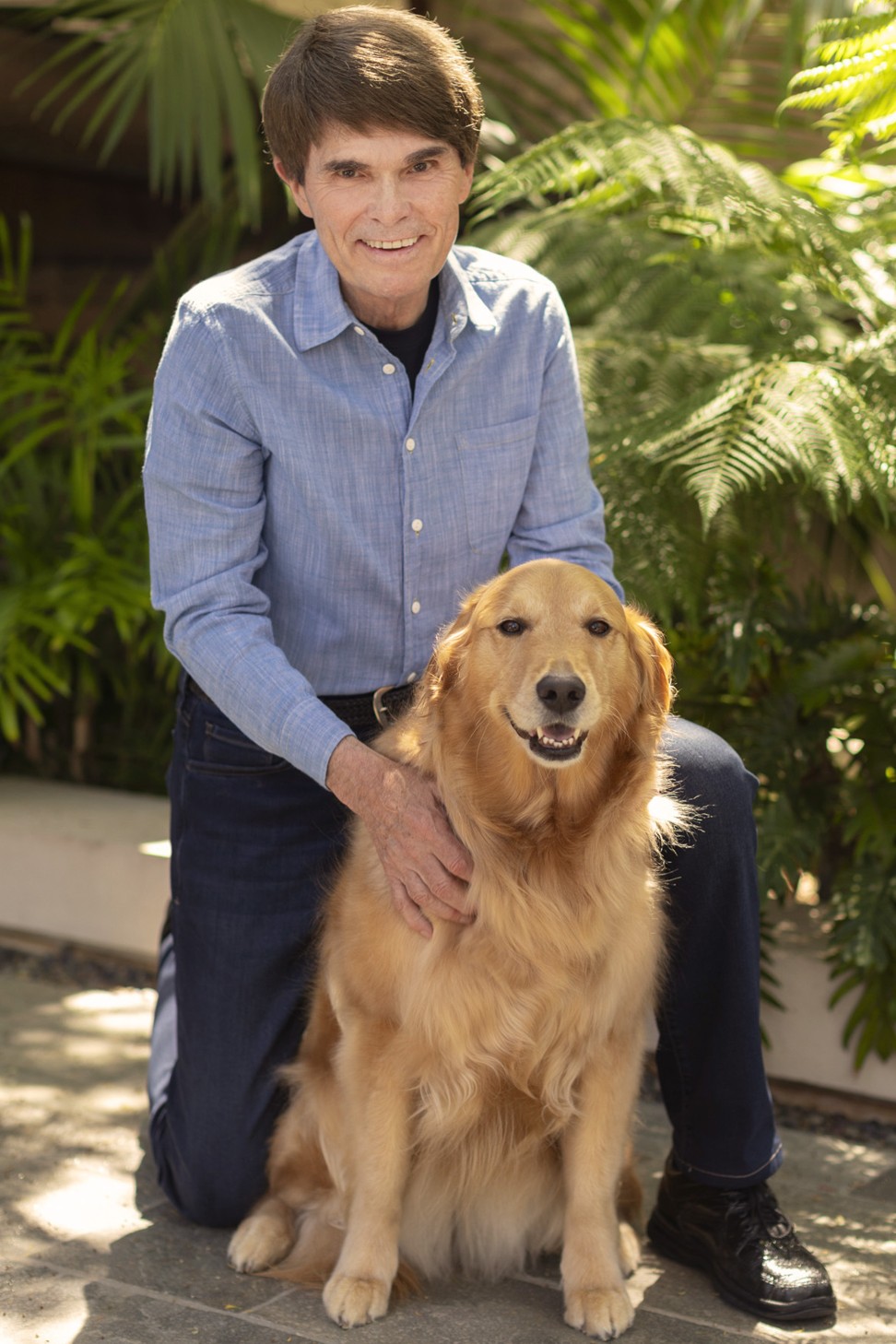
The Eyes of Darkness, a 1981 thriller by bestselling suspense author Dean Koontz, tells of a Chinese military lab that creates a virus as part of its biological weapons programme. The lab is located in Wuhan, which lends the virus its name, Wuhan-400. A chilling literary coincidence or a case of writer as unwitting prophet?
In The Eyes of Darkness, a grieving mother, Christina Evans, sets out to discover whether her son Danny died on a camping trip or if – as suspicious messages suggest – he is still alive. She eventually tracks him down to a military facility where he is being held after being accidentally contaminated with man-made microorganisms created at the research centre in Wuhan.
If that made the hair on the back of your neck stand up, read this passage from the book: “It was around that time that a Chinese scientist named Li Chen moved to the United States while carrying a floppy disk of data from China’s most important and dangerous new biological weapon of the past decade. They call it Wuhan-400 because it was developed in their RDNA laboratory just outside the city of Wuhan.”
In another strange coincidence, the Wuhan Institute of Virology, which houses China’s only level four biosafety laboratory, the highest-level classification of labs that study the deadliest viruses, is just 32km from the epicentre of the current coronavirus outbreak.
The opening of the maximum-security lab was covered in a 2017 story in the journal Nature, which warned of safety risks in a culture where hierarchy trumps an open culture.
Koontz has written more than 80 novels and 74 works of short fiction. Photo: Douglas Sonders
Fringe conspiracy theories that the coronavirus involved in the current outbreak appears to be man-made and likely escaped from the Wuhan virology lab have been circulated, but have been widely debunked. In fact the lab was one of the first to sequence the coronavirus.
In Koontz’s thriller, the virus is considered the “perfect weapon” because it only affects humans and, since it cannot survive outside the human body for longer than a minute, it does not demand expensive decontamination once a population is wiped out, allowing the victors to roll in and claim a conquered territory.
It’s no exaggeration to call Koontz a prolific writer. His first book, Star Quest, was published in 1968 and he has been churning out suspense fiction at a phenomenal rate since with more than 80 novels and 74 works of short fiction under his belt. The 74-year-old, a devout Catholic, lives in California with his wife. But what are the odds of him so closely predicting the future?
Albert Wan, who runs the Bleak House Books store in San Po Kong, says Wuhan has historically been the site of numerous scientific research facilities, including ones dealing with microbiology and virology. “Smart, savvy writers like Koontz would have known all this and used this bit of factual information to craft a story that is both convincing and unsettling. Hence the Wuhan-400,” says Wan.
British writer Paul French, who specialises in books about China, says many of the elements around viruses in China relate back to the second world war, which may have been a factor in Koontz’s thinking.
The Eyes of Darkness, by Koontz.
“The Japanese definitely did do chemical weapons research in China, which we mostly associate with Unit 731 in Harbin and northern China. But they also stored chemical weapons in Wuhan – which Japan admitted,” says French.
Publisher Pete Spurrier, who runs Hong Kong publishing house Blacksmith Books, muses that for a fiction writer mapping out a thriller about a virus outbreak set in China, Wuhan is a good choice.
“It’s on the Yangtze River that goes east-west; it’s on the high-speed rail [line] that goes north-south; it’s right at the crossroads of transport networks in the centre of the country. Where better to start a fictional epidemic, or indeed a real one?” says Spurrier. (Spurrier works part-time as a subeditor for the Post.)
Albert Wan runs the Bleak House Books store in San Po Kong, Hong Kong.
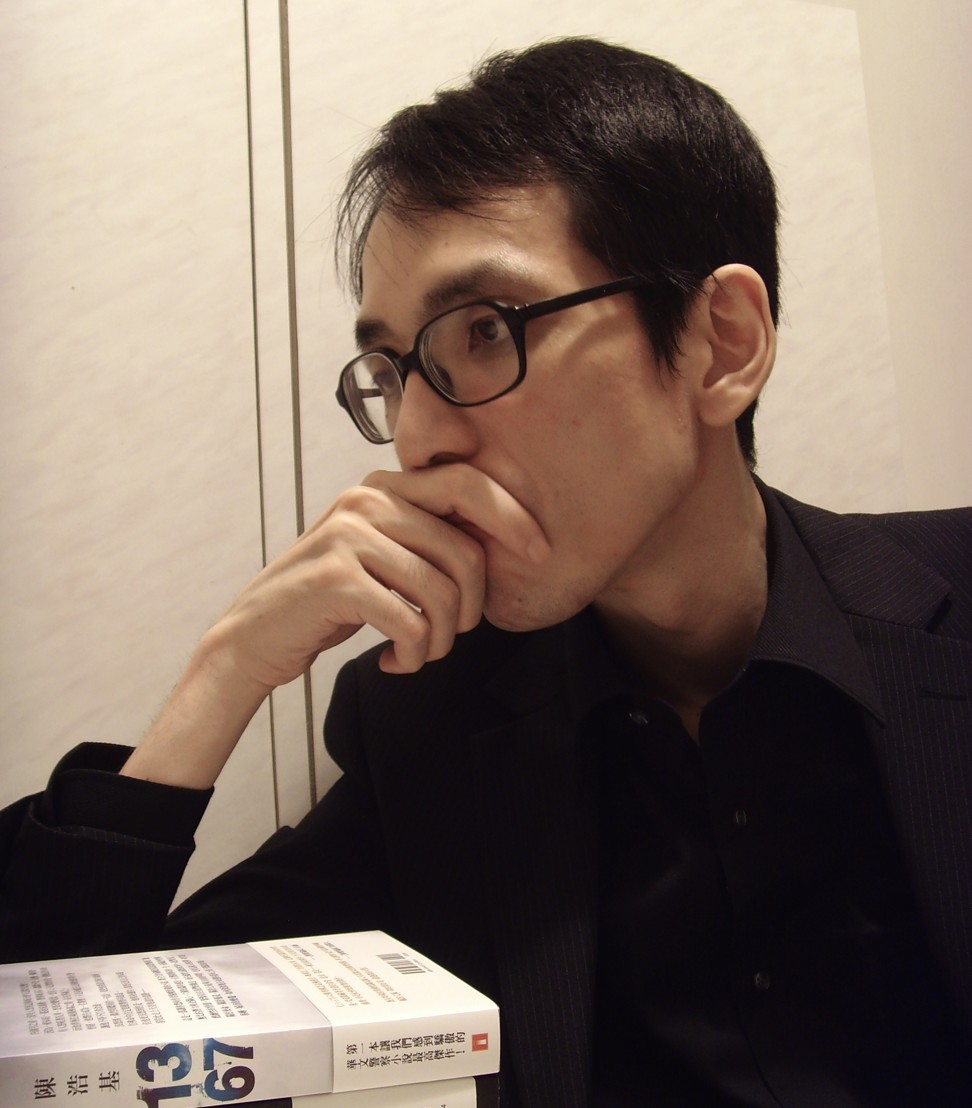
Hong Kong crime author Chan Ho-kei believes that this kind of “fiction-prophecy” is not uncommon.
“If you look really hard, I bet you can spot prophecies for almost all events. It makes me think about the ‘infinite monkey’ theorem,” he says, referring to the theory that a monkey hitting keys at random on a typewriter keyboard for an infinite amount of time will almost surely type any given text.
“The probability is low, but not impossible.”
British writer Paul French.
Chan points to the 1898 novella Futility, which told the story of a huge ocean liner that sank in the North Atlantic after striking an iceberg. Many uncanny similarities were noted between the fictional ship – called Titan – and the real-life passenger ship RMS Titanic, which sank 14 years later. Following the sinking of the Titanic, the book was reissued with some changes, particularly in the ship’s gross tonnage.
“Fiction writers always try to imagine what the reality would be, so it’s very likely to write something like a prediction. Of course, it’s bizarre when the details collide, but I think it’s just a matter of mathematics,” says Chan.
Many of Koontz’s books have been adapted for television or the big screen, but The Eyes of Darkness never achieved such glory. This bizarre coincidence will thrust it into the spotlight and may see sales of this otherwise forgotten thriller jump.
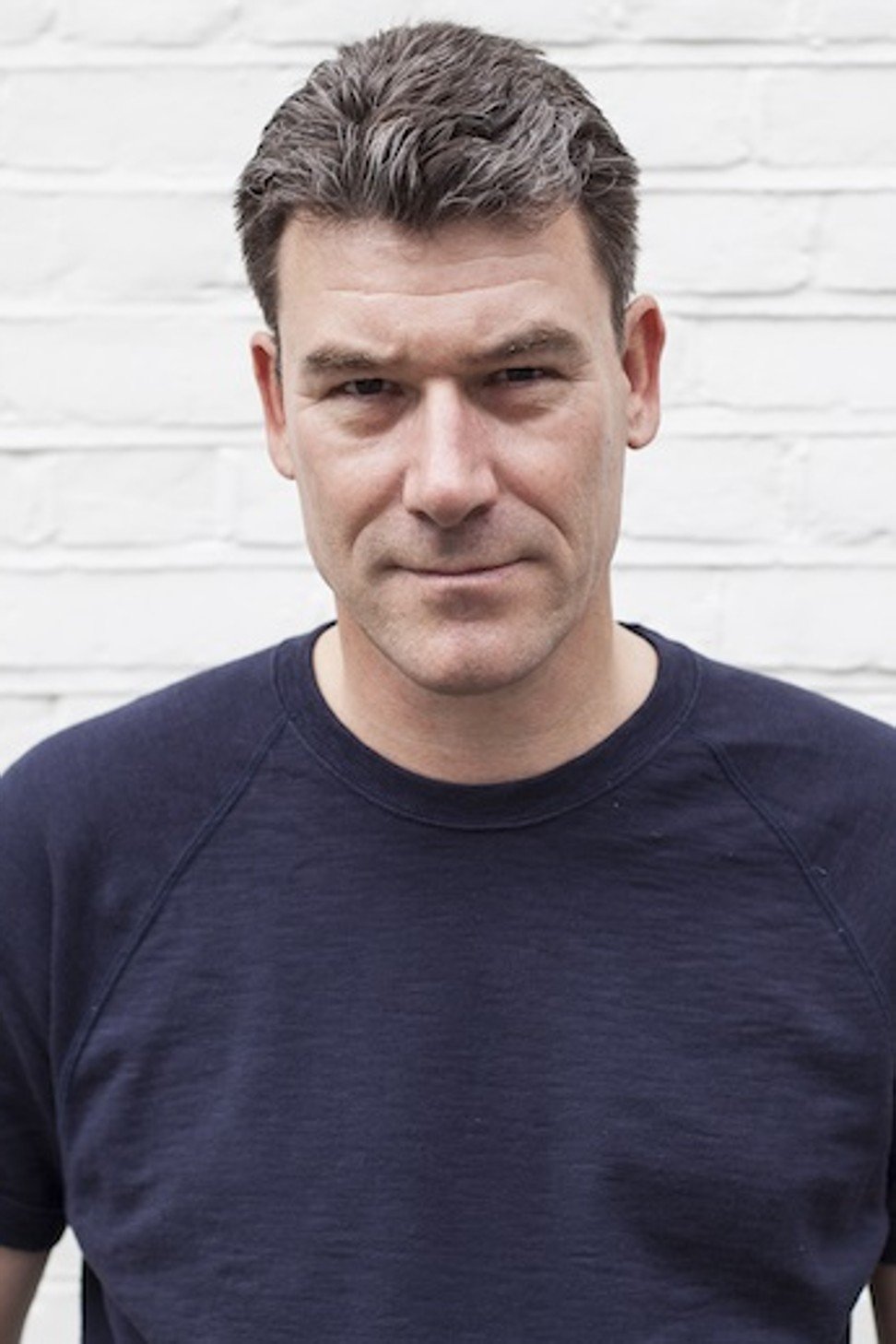
Hong Kong crime author Chan Ho-kei.
Amazon is currently offering it on Kindle for just US$1. Perhaps, like Futility, it will also be reissued with some updates to make it really echo the current outbreak.
Hong Kong and Thailand are likely to suffer most from the novel coronavirus outbreak because of close their economic ties with China
A drop in Chinese tourist arrivals and imports, as well as supply chain disruptions are likely to weigh on regional economy
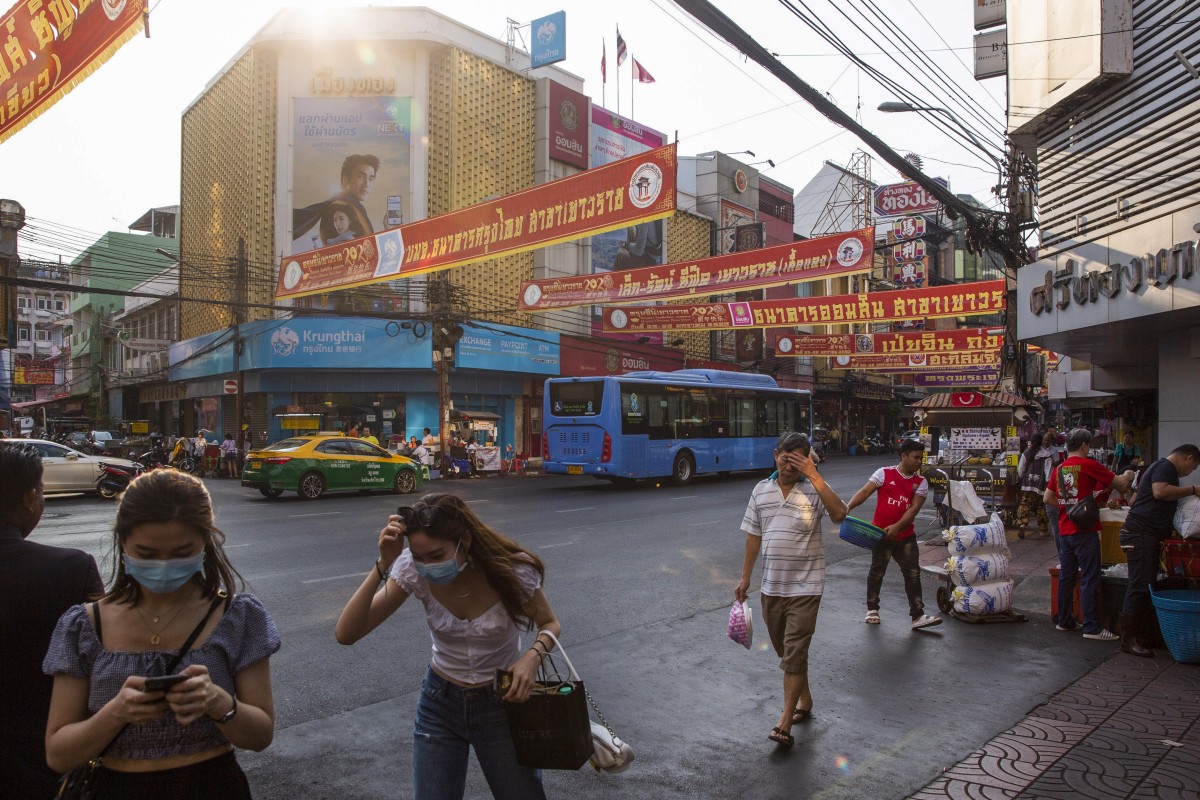
Thailand’s economy could be one of the most affected by the coronavirus outbreak due to its close ties with China, especially in the tourism sector. Photo: Bloomberg
Hong Kong and Thailand are likely to be the hardest hit Asian economies outside mainland China from the deadly coronavirus outbreak, according to analysts.
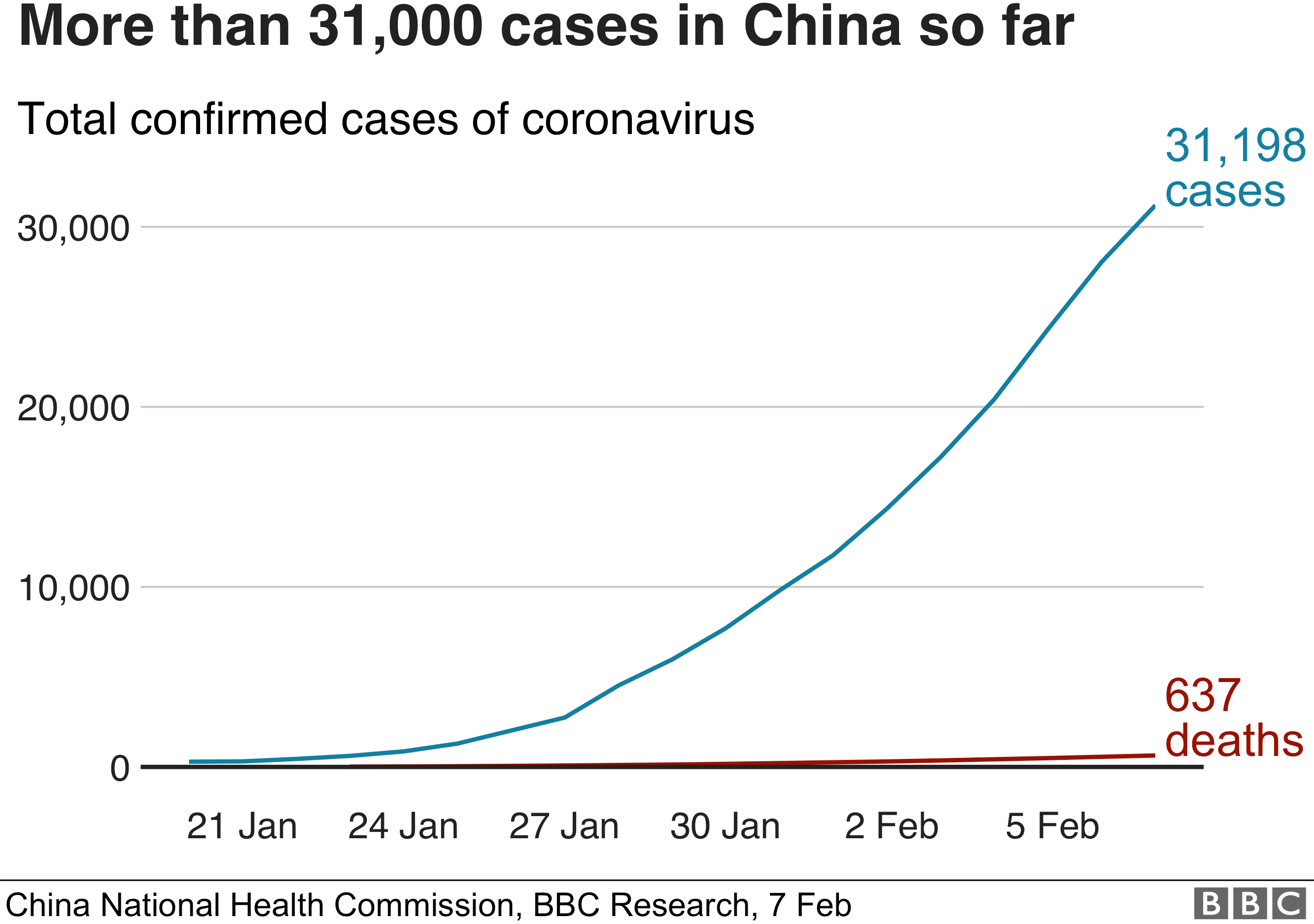
The 2019-nCoV, which had claimed the lives of nearly 640 people and infected more than 31,000 in mainland China by Friday, is viewed as even more damaging than the severe acute respiratory syndrome (Sars) epidemic in 2002-2003 because of prolonged factory closures and transport restrictions that have locked down many Chinese cities.
China has become more closely integrated with the rest of Asia since the Sars outbreak, meaning the disruptions to China’s industrial and export sectors, combined with a sharp drop in economic activity in the first quarter, will have significant repercussions across the region, particularly through tourism and trade, analysts said.
“A collapse in tourism arrivals from China will be the first shock wave for the rest of the region,” said Gareth Leather, senior Asia economist at Capital Economics. “Factory closures in China will affect the rest of the region by disrupting regional supply chains.”
A collapse in tourism arrivals from China will be the first shock wave for the rest of the region. Factory closures in China will affect the rest of the region by disrupting regional supply chainsGareth Leather
Hong Kong would likely be the most affected because of its status as a trade hub, its tight linkages to the Chinese economy and the sharp decline in tourism expenditure that is expected, UBS economist William Deng noted.
“Due to the risk of infection, domestic households significantly reduced such activities as dining out, shopping and entertainment,” Deng wrote in a recent note. He cut Hong Kong’s gross domestic product (GDP) growth forecast to minus 1.8 per cent for 2020, against his previous projection of a 0.5 per cent drop.
A community outbreak spread by human-to-human transmission has started in the city, said Professor Yuen Kwok-yung, a top microbiologist at the University of Hong Kong on Wednesday.
Thailand could be the next most affected due to its dependence on Chinese tourism. Outside Hong Kong and Macau, the country has the highest exposure to China as a share of GDP in the region.
China locks down Hangzhou, mega-city far from epicentre of coronavirus outbreak
ANZ Bank’s head of Asia research Khoon Goh said that the novel coronavirus could knock US$760 million from Thailand’s economy in the first quarter. Hong Kong could could see losses of US$1.4 billion. Travel services as a share of GDP were 11.2 per cent in Thailand and 9.4 per cent in Hong Kong.
“The Thai economy would expand at a slower rate in 2020 than previously forecast and much further below its potential due to the outbreak of coronavirus,” Bank of Thailand said in a statement after it slashed interest rates to a record low on Wednesday.
South Korean and Taiwanese businesses will also have negative spillover effects from the coronavirus outbreak because of supply chain disruptions and weaker consumer sentiment inside and outside China, analysts said.
South Korean car and tech companies that rely on parts from Chinese suppliers are exposed to potential production disruptions stemming from factory closures and the evacuation of Korean workers from China-based production lines, said Sean Hwang, corporate finance group analyst at Moody’s Investors Group.
Coronavirus: here are the places and airlines restricting travel to China
For instance, Hyundai Motor Company closed some if its South Korea-based plants on February 4 because of a shortage of wiring harnesses.
Korean customers are also limiting their trips to bricks-and-mortar retail stores such as E Mart and Lotte Shopping to avoid crowds amid the outbreak, potentially leading to a significant decline in revenue and earnings, Hwang said.
Although Singapore is not as closely tied to China as Hong Kong, the city state could still see a knock-on effect from China’s expected near-term downturn, as its economy has become much more integrated with the world’s second largest economy since the Sars outbreak.
The number of Chinese tourists rose six times from 568,000 in 2003 to 3.4 million in 2018, said Irvin Seah, senior economist at DBS Bank.
Coronavirus outbreak: global businesses shut down operations in China
“We expect a decline of about 1 million tourists or about SGD1 billion (US$722 million) of lost tourism receipts for every three months of travel ban,” Seah said. “We have lowered our full-year GDP growth forecast to 0.9 per cent, down from 1.4 per cent previously.”
Taiwan has banned Chinese visitors as well as foreigners who have visited Hong Kong and Macau from entering the island due the coronavirus. International cruise ships are also unable to dock on the island, which will lead to at least 112 liner visits cancelled by the end of March, affecting around 144,000 passengers, said the Taiwan International Ports Corporation.
Capital Economics’ Leather said the economic impact on Taiwan from 2019-nCoV could stand out from the rest of Asia, as it had the most exposure in value-added, intermediate exports to China – 18 per cent of GDP.
20 coronavirus infections confirmed on cruise ship in Japan, as thousands remain under quarantine
Elsewhere, Malaysia’s commodity driven trade growth this year has been threatened by the almost 20 per cent fall in crude oil prices, a decline triggered by fears that the coronavirus outbreak would dampen China’s imports. Malaysia’s purchasing managers’ index, a survey of manufacturers, dropped to 48.8 in January from 50.0 the prior month prior, data released this week showed. The drop was blamed on slowing output, with new orders dropping the most since September amid a decline in exports.
“The Bank Negara Malaysia’s surprising policy rate cut at the last meeting on 22 January, just around the time the coronavirus started to dominate headlines, tells us that the central bank is ahead of the curve in recognising the risk,” said Prakash Sakpal, Asia economist at ING Bank said.
India and Indonesia will be the least affected given the small contribution the tourism sector makes to their economies, and the low share of visitors from China, ANZ’s Goh said.
News of his death was met with an intense outpouring of grief on Chinese social media site Weibo – but this quickly turned into anger.
There had already been accusations against the government of downplaying the severity of the virus – and initially trying to keep it secret.
Dr Li’s death has fuelled this further and triggered a conversation about the lack of freedom of speech in China.
The country’s anti-corruption body has now said it will open an investigation into “issues involving Dr Li”.
The Chinese government has previously admitted “shortcomings and deficiencies” in its response to the virus, which has now killed 636 people and infected 31,161 in mainland China.
According to Chinese site Pear Video, Dr Li’s wife is due to give birth in June.
What has the public reaction been?
Chinese social media has been flooded with anger – it is hard to recall an event in recent years that has triggered as much grief, rage and mistrust against the government.
The top two trending hashtags on the website were “Wuhan government owes Dr Li Wenliang an apology” and “We want freedom of speech”.
Both hashtags were quickly censored. When the BBC searched Weibo on Friday, hundreds of thousands of comments had been wiped. Only a handful remain.
“This is not the death of a whistleblower. This is the death of a hero,” said one comment on Weibo.
A photo circulating on Twitter reportedly sourced from messaging platform WeChat also shows a message in Chinese saying “Farewell Li Wenliang” written in the snow on a riverbank.
Many have now taken to posting under the hashtag “Can you manage, do you understand?” – a reference to the letter Dr Li was told to sign when he was accused of disturbing “social order”.
These comments do not directly name him – but are telling of the mounting anger and distrust towards the government.
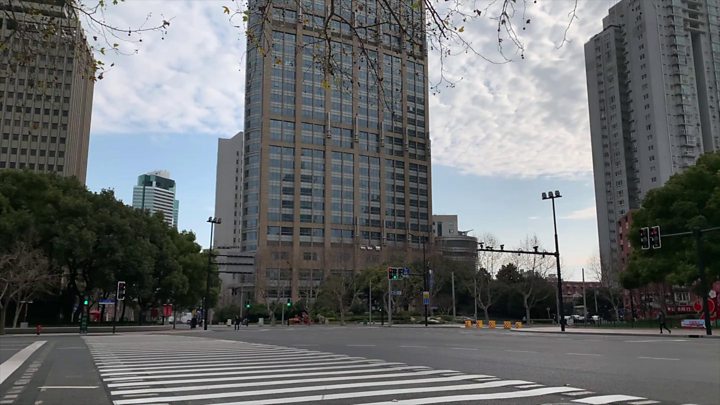
Media caption Coronavirus: Shanghai’s deserted streets and metro
“Do not forget how you feel now. Do not forget this anger. We must not let this happen again,” said one comment on Weibo.
“The truth will always be treated as a rumour. How long are you going to lie? What else do you have to hide?” another said.
“If you are angry with what you see, stand up,” one said. “To the young people of this generation, the power of change is with you.”
An epic political disaster
The death of Dr Li Wenliang has been a heart-breaking moment for this country. For the Chinese leadership it is an epic political disaster.
It lays bare the worst aspects of China’s command and control system of governance under Xi Jinping – and the Communist Party would have to be blind not to see it.
If your response to a dangerous health emergency is for the police to harass a doctor trying to blow the whistle, then your structure is obviously broken.
The city’s mayor – reaching for excuses – said he needed clearance to release critical information which all Chinese people were entitled to receive.
Now the spin doctors and censors will try to find a way to convince 1.4 billion people that Dr Li’s death is not a clear example of the limits to the party’s ability to manage an emergency – when openness can save lives, and restricting it can kill.
He was initially declared dead at 21:30 on Thursday (13:30GMT) by state media outlets the Global Times, People’s Daily and others.
Hours later the Global Times contradicted this report – saying he had been given a treatment known as ECMO, which keeps a person’s heart pumping.
Journalists and doctors at the scene said government officials had intervened – and official media outlets had been told to change their reports to say the doctor was still being treated.
But early on Friday, reports said doctors could not save Dr Li and his time of death was 02:58 on Friday.
Image copyright LI WENLIANGImage caption Li Wenliang contracted the virus while working at Wuhan Central Hospital
What did Li Wenliang do?
Dr Li, an ophthalmologist, posted his story on Weibo from a hospital bed a month after sending out his initial warning.
He had noticed seven cases of a virus that he thought looked like Sars – the virus that led to a global epidemic in 2003.
On 30 December he sent a message to fellow doctors in a chat group warning them to wear protective clothing to avoid infection.
Four days later he was summoned to the Public Security Bureau where he was told to sign a letter.
In the letter he was accused of “making false comments” that had “severely disturbed the social order”. Local authorities later apologised to Dr Li.
In his Weibo post he describes how on 10 January he started coughing, the next day he had a fever and two days later he was in hospital. He was diagnosed with the coronavirus on 30 January.
Media caption The BBC’s online health editor on what we know about the virus
Singapore has raised its Disease Outbreak Response System Condition (Dorscon) level from yellow to orange. This means that the disease is deemed severe and spreads easily from person to person but has not spread widely and is being contained
Chinese President Xi Jinping has told his US counterpart Donald Trump that China is “fully confident and capable of defeating the epidemic”. The country has introduced more restrictive measures to try to control the outbreak:
The capital Beijing has banned group dining for events such as birthdays. Cities including Hangzhou and Nanchang are limiting how many family members can leave home each day
Hubei province has switched off lifts in high-rise buildings to discourage residents from going outside.
The virus has now spread to more than 25 countries. There have been more than 28,000 cases worldwide but only two of the deaths have been outside mainland China.
The new coronavirus has been declared a global emergency by the World Health Organization, as the outbreak continues to spread outside China.
“The main reason for this declaration is not what is happening in China but what is happening in other countries,” said WHO chief Tedros Adhanom Ghebreyesus.
The concern is that it could spread to countries with weaker health systems.
Meanwhile, the US has told its citizens not to travel to China.
The state department issued a level four warning – having previously urged Americans to “reconsider” travel to China – and said any citizens in China “should consider departing using commercial means”.
China has said it will send charter plans to bring back Hubei province residents who are overseas “as soon as possible”.
A foreign ministry spokesman said this was because of the “practical difficulties” Chinese citizens have faced abroad. Hubei is where the virus emerged.
At least 213 people in the China have died from the virus, mostly in Hubei, with almost 10,000 cases nationally.
The WHO said there had been 98 cases in 18 other countries, but no deaths.
Most international cases are in people who had been to Wuhan in Hubei.
However in eight cases – in Germany, Japan, Vietnam and the United States – patients were infected by people who had travelled to China.
Getty Coronavirus outbreak outside China
18 The number of countries with cases
14 Cases in Thailand and Japan
13 Singapore
11 South Korea
8 Australia and Malaysia
5 France and USA
Source: WHO and local authorities
Speaking at a news conference in Geneva, Dr Tedros described the virus as an “unprecedented outbreak” that has been met with an “unprecedented response”.
He praised the “extraordinary measures” Chinese authorities had taken, and said there was no reason to limit trade or travel to China.
The US Commerce Secretary, Wilbur Ross, has said the outbreak could “accelerate the return of jobs to North America”.
Preparing other countries
What happens if this virus finds its way into a country that cannot cope?
Many low- and middle-income countries simply lack the tools to spot or contain it. The fear is it could spread uncontrollably and that it may go unnoticed for some time.
Remember this is a disease which emerged only last month – and yet there are already almost 10,000 confirmed cases in China.
The 2014 Ebola outbreak in West Africa – the largest in human history – showed how easily poorer countries can be overwhelmed by such outbreaks.
And if novel coronavirus gets a significant foothold in such places, then it would be incredibly difficult to contain.
We are not at that stage yet – 99% of cases are in China and the WHO is convinced the country can control the outbreak there.
But declaring a global emergency allows the WHO to support lower- and middle-income countries to strengthen their disease surveillance – and prepare them for cases.
How unusual is this declaration?
The WHO declares a Public Health Emergency of International Concern when there is “an extraordinary event which is determined… to constitute a public health risk to other states through the international spread of disease”.
It has previously declared five global public health emergencies:
Swine flu, 2009 – The H1N1 virus spread across the world in 2009, with death toll estimates ranging from 123,000 to 575,400
Polio, 2014 – Although closer than ever to eradication in 2012, polio numbers rose in 2013
Zika, 2016 – The WHO declared Zika a public health emergency in 2016 after the disease spread rapidly through the Americas
Ebola, 2014 and 2019 – The first emergency over the virus lasted from August 2014 to March 2016 as almost 30,000 people were infected and more than 11,000 died in West Africa. A second emergency was declared last year as an outbreak spread in DR Congo
Media caption Inside the US laboratory developing a coronavirus vaccine
How is China handling the outbreak?
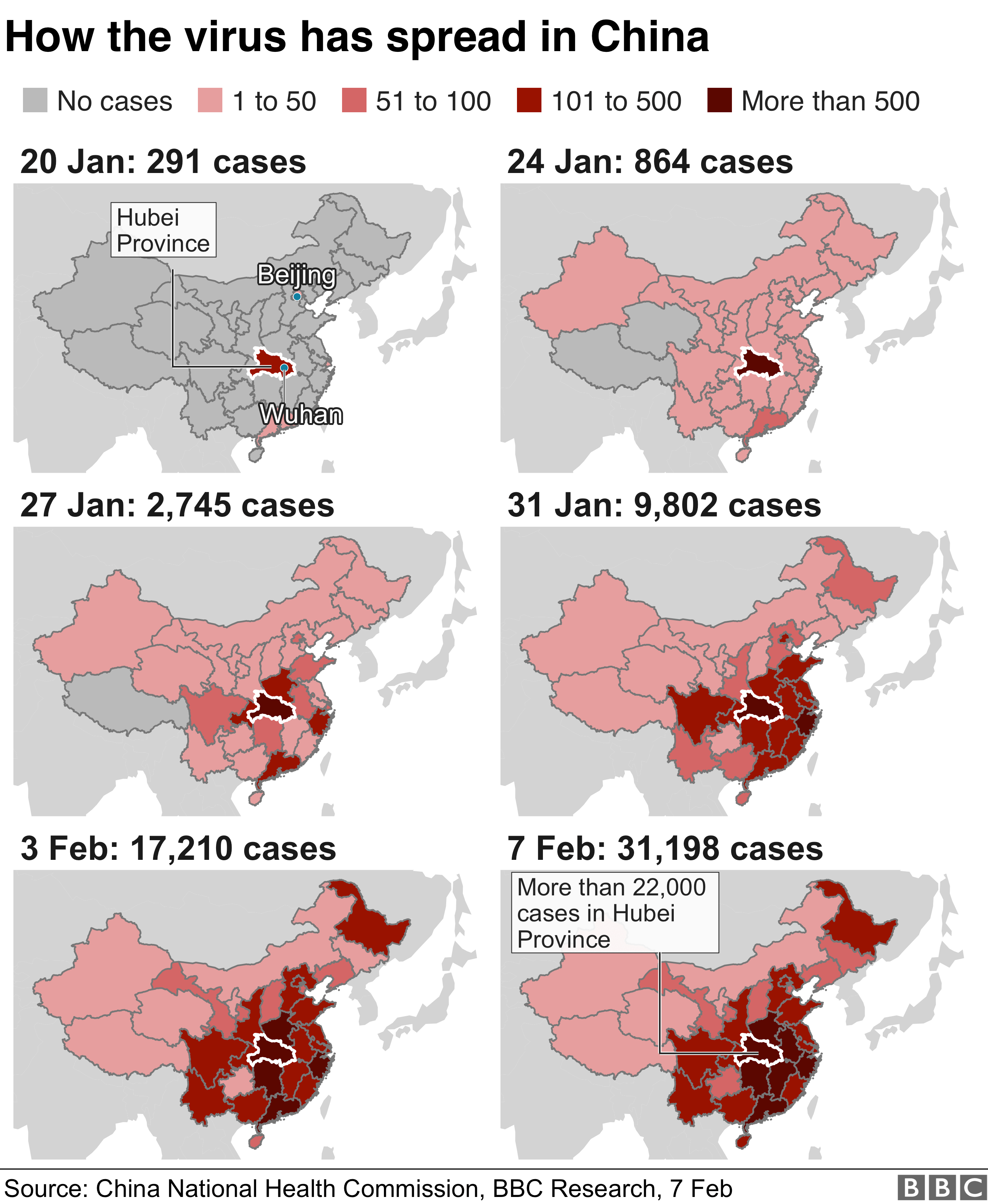
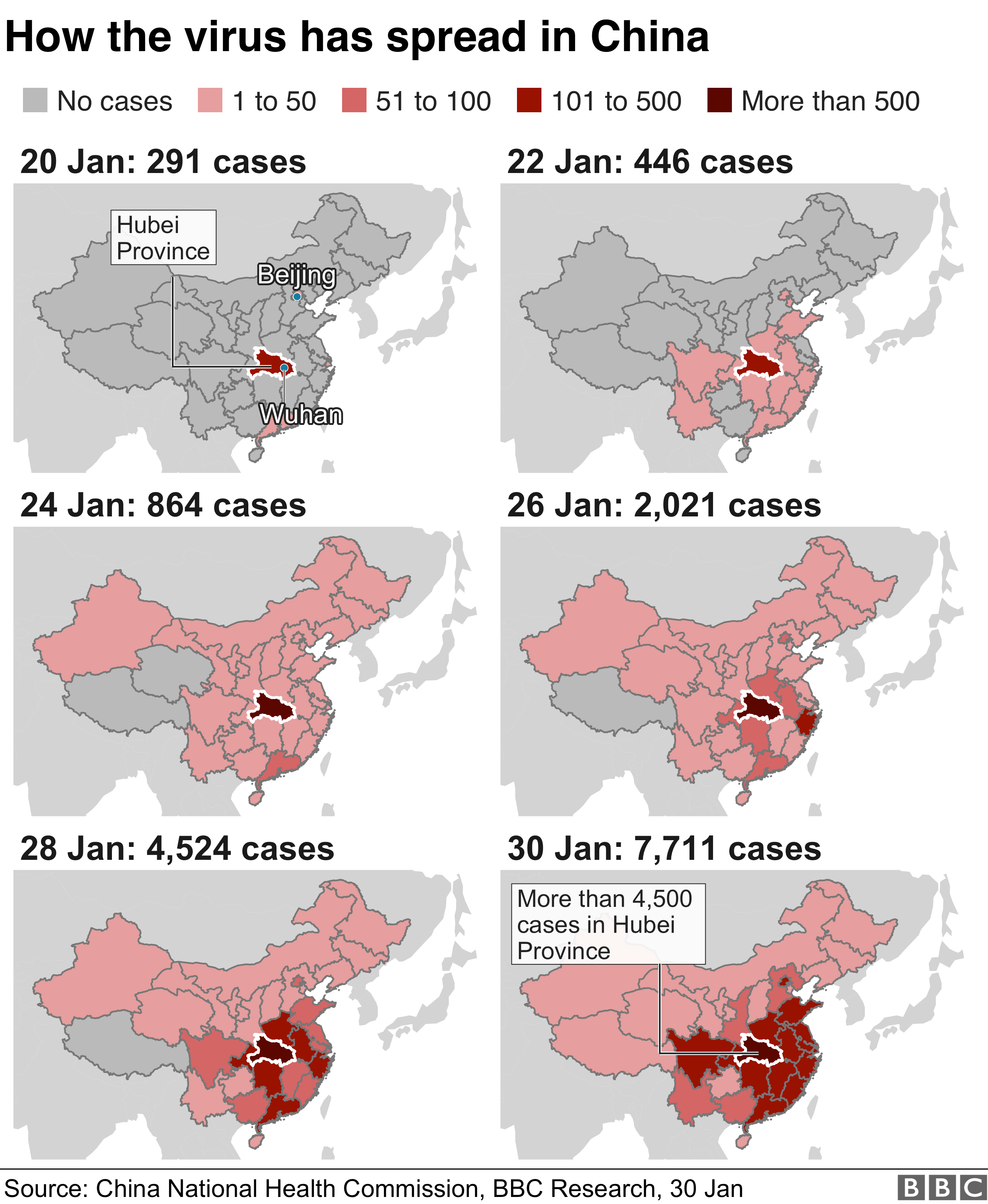
A confirmed case in Tibet means the virus has reached every region in mainland China. According to the country’s National Health Commission, 9,692 cases have tested positive.
The central province of Hubei, where nearly all deaths have occurred, is in a state of lockdown. The province of 60 million people is home to Wuhan, the heart of the outbreak.
The city has effectively been sealed off and China has put numerous transport restrictions in place to curb the spread of the virus.
People who have been in Hubei are also being told to work from home until it is considered safe for them to return.
The virus is affecting China’s economy, the world’s second-largest, with a growing number of countries advising their citizens to avoid all non-essential travel to the country.
How is the world responding?
Voluntary evacuations of hundreds of foreign nationals from Wuhan are under way.
The UK, Australia, South Korea, Singapore and New Zealand are expected to quarantine all evacuees for two weeks to monitor them for symptoms and avoid contagion.
Australia plans to quarantine its evacuees on Christmas Island, 2,000km (1,200 miles) from the mainland in a detention centre that has been used to house asylum seekers.
In other recent developments:
Italy suspended flights to China after two Chinese tourists in Rome were diagnosed with the virus; earlier 6,000 people on board a cruise ship were temporarily barred from disembarking
In the US, Chicago health officials have reported the first US case of human-to-human transmission. Around 200 US citizens have been flown out of Wuhan and are being isolated at a Californian military base for at least 72 hours
Russia has decided to close its 4,300km (2,670-mile) far-eastern border with China
Two flights to Japan have already landed in Tokyo. Japan has now raised its infectious disease advisory level for China
Some 250 French nationals have been evacuated from Wuhan
India has confirmed its first case of the virus – a student in the southern state of Kerala who was studying in Wuhan
Israel has barred all flight connections with China
Papua New Guinea has banned all visitors from “Asian ports”
Tokyo (Reuters) – Japan on Saturday moved to contain the economic impact of a coronavirus outbreak originating in China as strict new measures aimed at limiting the spread of the virus, including targeting foreign visitors, came into effect.
Japan had 17 confirmed cases as of Friday, including some without symptoms. One of the most recent was a bus guide who worked on a bus tour for tourists from China – the same tour as a bus driver who also came down with the virus.
Prime Minister Shinzo Abe told a Saturday meeting of a government task force coordinating Japan’s response to the virus to come up with steps aimed at easing the impact of the outbreak on Japan’s economy.
Abe has made tourism a key part of his economic policy, with a large proportion of foreign visitors from China, and major Japanese companies have a number of factories in China.
“I ask ministers to compile measures to use reserves (in the state budget) and implement them as soon as possible,” Abe was quoted by Kyodo news agency as saying.
“The new coronavirus is having a major impact on tourism, the economy and our society as a whole. The government will do its utmost to address the impact.”
No further details were given, though Abe stressed ensuring that Japanese residents have access to medical checkups and masks, which have been selling out around the nation.
New measures to fight the disease took effect on Saturday, including banning the entry of Chinese holding passports issued by Hubei, where the disease is thought to have originated, as well as all foreigners who had visited the province within two weeks, whether they show symptoms or not.
The government also brought forward implementing measures including compulsory hospitalisation and the use of public funds for treatment by six days to Saturday.
Of the 2.6 million tourists who came to Japan in December 2019, nearly 600,000 were Chinese, outnumbered only by South Koreans, government data shows. Japan aims to have 40 million tourists visit the country in 2020, up from 31.8 million in 2019.
On Friday, the president of Japanese airline ANA Holdings (9202.T) said it was considering suspending flights to China after February reservations plunged, Jiji news agency reported.
JTB Corporation, Japan’s largest travel agency, said it was suspending tours to China throughout February, Kyodo news agency reported.
Lufthansa, British Airways, Air Canada among several big name airlines to halt flights, while others reduce services
Travel agents expecting slump in sales amid rising uncertainty over how epidemic will play out
Many airlines have cancelled flights into mainland China because of the coronavirus outbreak. Photo: AP
International air travellers and ticketing agents are in for a turbulent time in the weeks ahead as airlines around the world react to the coronavirus epidemic by cancelling or limiting flights to and from the Chinese mainland.
Lufthansa, British Airways, Air Canada and Indonesia’s Lion Air have
, while United Airlines, American Airlines, IndiGo, Finnair, Delta Air Lines and Jetstar Asia have significantly reduced their services.
“It’s going to be pretty bad for travel agencies. We’ve had a lot of cancellations. Everyone is afraid of coming to China,” said Annabelle Auger from Travel Stone in Beijing.
“Many of our European clients are very worried because of the media coverage they’ve seen. Still, people are willing to wait and see for a few weeks to see how things go,” she said.
For foreigners looking to leave China, Auger said they should contact their embassy to find out about repatriation flights.
“The situation is very unclear, so it’s difficult to give any general recommendations,” she said.
Already this week, the embassies of the United States, Japan, South Korea and Britain have cleared flights to evacuate their nationals from Hubei, the central China province at the heart of the outbreak.
Auger said she and her colleagues had been busy rearranging flights for China-based foreigners who had gone away for the holidays.
“The schools are closed, so families with children abroad are thinking, ‘OK, let’s extend our stay for another week’,” she said.
Politics may have stalled information in coronavirus crisis, scientist says
30 Jan 2020
The Beijing government said on Monday it would extend the Lunar New Year
holiday until Sunday to help stop the spread of the disease, while school breaks have also been extended.
Another travel agent in Beijing, who asked not to be named, said the virus outbreak had yet to have a significant impact on business but concerns were growing.
“We are a bit worried that things may get difficult in the coming months,” she said. “But we trust that the government is doing all it can and will take the appropriate measures to solve the problems.”
Zhu Tao, director of the flight standards department at the Civil Aviation Administration of China (CAAC), said at a press conference in Beijing on Thursday that the relevant authorities were working closely with airlines to help Chinese nationals trapped overseas to get home.
The government had already chartered flights from Japan, Myanmar and South Korea to bring Chinese nationals back to Hubei, he said.
While all flights out of Hubei have been suspended since last week, Zhu said air transport was playing its part in fighting the disease.
As of Wednesday, the CAAC had sent 86 flights carrying 5,129 medical workers and 115,000 items of equipment and other supplies into Wuhan, he said.
Wu Zunyou, the chief epidemiologist at the China Centre for Disease Control and Prevention, said that efforts to prevent the coronavirus spreading outside the country had been successful, as only about 1 per cent of the confirmed infections were outside China.
Despite the flight cancellations, Beijing’s Capital International Airport was operating as normal on Thursday.
Andre Muchanga, a student from Abu Dhabi at the Beijing Institute of Technology, said he made a late decision to fly home.
“I decided to buy my ticket last night,” he said. “At school, our dormitory is almost completely empty. I knocked on a friend’s door last night and found there was no one there, so I decided I better just go home and spend some time with my family.”
He said he decided not to buy a return flight as it he did not know when his classes would resume.
Signs at check-in counters reminded passengers who had travelled to Hubei or had a Hubei address to put themselves in isolation for 14 days.
While flights out of Hubei have been stopped, there was still plenty of inbound traffic.
“The number of domestic inbound travellers seems pretty normal for this time of year,” a man working on an information desk at Capital airport said.
“It’s the sixth day of the Lunar New Year. Lots of people have to return to work.”
An Air China employee, surnamed Hu, said that the airport had stepped up its disinfecting and general cleaning work. Body temperature checks had been installed at all access points and employees had been told to wear masks, he said.
“I don’t mind working during the Lunar New Year holiday,” he said. “I’m not afraid of the virus, I’m here to serve the people.”
The Lunar New Year’s Eve in Wuhan, ground zero of the novel coronavirus outbreak in central China, is nothing but special. Behind the seemingly quiet streets, people in all walks of life are racing against time to fight against the invisible enemy.
WUHAN, Jan. 25 (Xinhua) — There were far fewer cars on the streets and bustling crowds were not seen in the shopping malls in the central Chinese city of Wuhan on Jan. 24 — the Eve of the Chinese Lunar New Year.
The scene was quite different from the occasion in the previous years because of the novel coronavirus that has claimed over 40 lives and infected over a thousand nationwide. With a population of over 10 million, Wuhan, the capital city of Hubei Province, is the center of the epidemic.
Photo taken on Jan. 24, 2020 shows a medical aid team of Army Medical University leaving for Wuhan in southwest China’s Chongqing. On the Chinese Lunar New Year’s Eve, a group of 150 medical workers from the Army Medical University left for Wuhan, the center of the novel coronavirus (2019-nCoV) outbreak, to provide medical aid. (Xinhua)
Yang Yingchen, a volunteer of the Red Cross Society of China’s Wuhan branch, had a busy day answering calls.
“People from across the nation called to check on accounts and addresses to make donations,” said Yang. “Many would say ‘Come on, Wuhan’ to us, which makes me feel especially warm and deeply moved.”
Chen Li, a doctor in a Wuhan hospital, spent the Chinese Lunar New Year’s Eve at home to quarantine herself. She is a little bit worried about having had contact with infected patients, but luckily she has no signs of symptoms for the time being.
“Before joining the fight against the epidemic, I had sent my four-year-old son to my parents. I has disinfected all the articles in my house,” she said.
Chen’s husband is at the forefront of the fight against the epidemic. “We haven’t seen each other for over a week,” said Chen. On Saturday morning, she put on protective clothing again and returned to work.
“Actually, I can’t be isolated for too long. There’s still a lot of work to be done,” she said. “I just don’t know when I can see my boy again.”
Aerial photo taken on Jan. 24, 2020 shows mechanical equipment working at the construction site of a special hospital in the Caidian District of western suburb of Wuhan, central China’s Hubei Province. The central China metropolitan of Wuhan will follow Beijing’s SARS treatment model to build a special hospital for admitting patients infected in the outbreak of pneumonia caused by the novel coronavirus. (Xinhua/Xiao Yijiu)
The virus had resulted in 41 deaths in China by the end of Friday, mostly in Wuhan, according to the National Health Commission. Nationwide, a total of 1,287 cases were confirmed, including 237 in critical condition.
Confirmed cases were also reported in China’s Hong Kong, Macao and Taiwan, as well as Thailand, Japan, the Republic of Korea, the United States, Vietnam, Singapore, Nepal and France.
Wuhan is following Beijing’s SARS treatment model in 2003 to build a makeshift hospital with a capability of 1,000 beds for admitting infected patients. Construction on the facility began Thursday night. It will be completed and put into use prior to Feb. 3, less than 10 days away.
“It’s going to be another all-nighter. We need to speed up work and complete the hospital as soon as possible,” said Lyu Jun, a young truck driver at the construction site. This is his first Spring Festival away from home.
For ordinary people, this year’s Lunar New Year’s Eve lacks some gatherings but is still a time to extend greetings and wishes.
Yin Yeqiong, from Hunan Province, refunded her tickets back home after much debate. “I had it in my mind to still go home, but finally decided to stay in Wuhan,” she said. “Our stay will help reduce panic in other places.”
Liu Jie, a dough sculptor, put on a New Year costume and watched the Spring Festival Gala with his family. “We’re now at a critical period, so I texted New Year wishes to friends and relatives this year. I believe this is the best way,” he said.
Liu Jiapeng, a children’s book editor, stayed in Wuhan during the Spring Festival for the past four decades. “I always stayed with my family, and we would have every meal together,” said Liu. “But this year, I haven’t had one meal with them.”
On the day of the Lunar New Year’s Eve, he and his wife bought some goods for their parents, brought them to their house and briefly chatted. As they were waiting for the elevator, Liu looked back and saw his father standing at the windowsill, watching them leave.
Medical workers of Army Medical University assemble before leaving for Wuhan in southwest China’s Chongqing, Jan. 24, 2020. On the Chinese Lunar New Year’s Eve, a group of 150 medical workers from the Army Medical University left for Wuhan, the center of the novel coronavirus (2019-nCoV) outbreak, to provide medical aid. (Xinhua)
China is mobilizing medical resources nationwide to aid Wuhan and control the epidemic. Doctors, nurses and experts from across the nation have been selected to join the battle, and manufacturers have restarted their plants to produce medical consumables that have been running short in many places.
A national research team of 14 experts, headed by renowned respiratory scientist Zhong Nanshan, has been set up to help prevent and control the outbreak on Friday.
“This is going to be an unforgettable Spring Festival,” said Chen Ying, a writer. “Because I feel that at this moment, there are so many families that I do not know, in every corner of this city, praying for our home.”
“My New Year wish is simple,” said Liu Jie. “I hope the virus will soon be conquered and everyone in Wuhan and the whole nation would be safe and healthy.”
Image copyright WEIBOImage caption She posted pictures of her meal on social media platform WeChat
The Chinese embassy in Paris has tracked down a woman from Wuhan who said she took tablets to pass airport health checks.
The woman boasted on social media that she had been suffering from a fever, but managed to reduce her symptoms with medicine.
She later posted pictures showing herself dining at what she claimed was a Michelin-starred restaurant in Lyon.
The embassy has now confirmed that her symptoms are under control.
The woman left Wuhan – where the new coronavirus emerged late last year – before flights were suspended, but when thermal scanning was in place.
Since yesterday, public transport has been shut down, with residents told not to leave the city.
At least 25 people with the virus have died. It was first reported to the World Health Organization 31 December.
The virus has spread to countries as far as South Korea, Japan and the US.
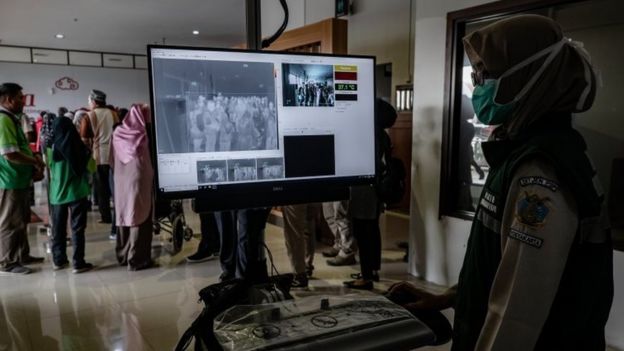
Image copyright GETTY IMAGESImage caption People have been thermally scanned when leaving Wuhan, and arriving at their destination. This picture was taken in Indonesia on Thursday
The woman detailed her journey to Lyon on social media site WeChat.
“Finally I can have a good meal, I feel like I’ve been starving for two days. When you are in a gourmet city of course you have to eat Michelin [food],” she wrote.
“Just before I left, I had a low fever and cough. I was scared to death and rushed to eat [fever-reducing] medicine. I kept on checking my temperature. Luckily I managed to get it down and my exit was smooth.”
She also posted pictures of the meal she enjoyed. It is not clear exactly when she arrived.
Her post quickly went viral and she was widely criticised by other social media users.
The Chinese embassy in Paris said it had received calls and emails about the woman. It said she had taken antipyretics, and that it attached “great importance” to the case.
The embassy said it contacted her on Wednesday evening and asked her to refer herself to medical services.
On Thursday, in a new statement, the embassy said the woman’s temperature was under control, and that she had no more fever or cough symptoms.
It added that she did not require “further examinations” at this point.
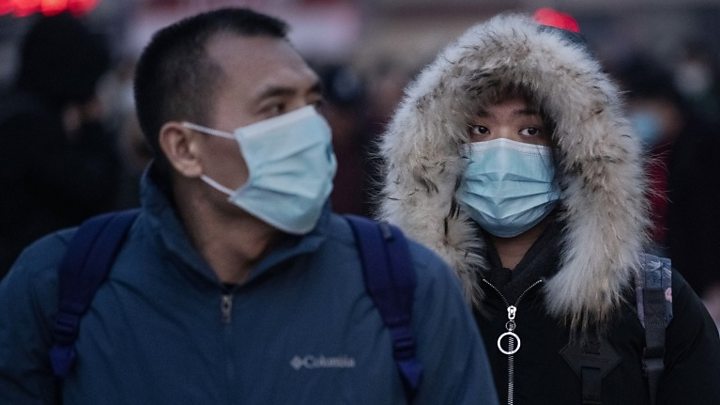
Media caption Fears over coronavirus in China trigger face mask shortage
China has effectively quarantined nearly 20 million people in Hubei province. Other major cities in China like Beijing and Shanghai are also affected.
Authorities have cancelled all large-scale celebrations in Beijing. Temple fairs are banned, film releases postponed and the Forbidden City will be closed to the public.
All this comes as millions of Chinese people are travelling across the country for Lunar New Year.
Currently known as 2019-nCoV, the virus is understood to be a new strain of coronavirus not previously identified in humans.

















 CHINDIA ALERT: You'll be living in their world, very soon