29/02/2020

Japanese Prime Minster Shinzo Abe (R, front) meets with Yang Jiechi (L, front), a member of the Political Bureau of the Communist Party of China (CPC) Central Committee and director of the Office of the Foreign Affairs Commission of the CPC Central Committee, in Tokyo, Japan, Feb. 28, 2020. (Xinhua/Gang Ye)
TOKYO, Feb. 28 (Xinhua) — China and Japan agreed on Friday to step up public health cooperation to contain the outbreak of the novel coronavirus (COVID-19) epidemic.
The pledge was made during a meeting between Japanese Prime Minister Shinzo Abe and Yang Jiechi, a member of the Political Bureau of the Communist Party of China (CPC) Central Committee and director of the Office of the Foreign Affairs Commission of the CPC Central Committee.
During the meeting, Yang said China and Japan assisted each other in the fight against COVID-19 and worked together to overcome the difficulties, thus deepening the friendship between the two countries.
China sincerely thanks Japan for its precious support, and is willing to continue providing support and help for Japan’s fight against the epidemic, strengthen bilateral and multilateral medical and health cooperation, so as to jointly safeguard the health and wellbeing of the peoples of the two countries and the world, he said.
Yang said the China-Japan relations have maintained a sound momentum of development. He noted that Chinese President Xi Jinping and Abe held two successful meetings last year, leading efforts in building China-Japan relations in line with the requirements of the new era.
China is ready to work with Japan to implement the important consensus reached by the leaders of the two countries, respect each other, seek common ground while reserving differences, and work together to build a new pattern of bilateral relations featuring joint cooperation, win-win and mutual benefit, said Yang.
Xi’s upcoming state visit to Japan is of great significance and China is ready to maintain close communication with Japan and make preparations for the visit, he said.
China firmly supports Japan in successfully hosting the Tokyo Olympic Games, he added.
For his part, Abe said Xi’s upcoming state visit to Japan this year is of great importance and Japan will make careful preparations to ensure the success and fruitful results of the visit.
The peoples of Japan and China have shown friendly feelings in their joint fight against the COVID-19 epidemic, Abe said.
He said Japan speaks highly of China’s positive achievements in the fight against the virus and is ready to strengthen exchanges and cooperation with China in information sharing and epidemic prevention and control, and send a positive signal to the international community of jointly tackling the challenges to global public health security.
Also on Friday Yang attended the eighth China-Japan high-level political dialogue with head of Japan’s national security council Shigeru Kitamura and met with Japanese Foreign Minister Toshimitsu Motegi.
Source: Xinhua
Posted in China, China-Japan relations, Chinese President Xi Jinping, cooperation, COVID-19 epidemic, fighting, Japan, Japanese, Japanese Foreign Minister, Japanese Prime Minister, Japanese Prime Minister Shinzo Abe, member of the Political Bureau of the Communist Party of China (CPC) Central Committee, Office of the Foreign Affairs Commission of the CPC Central Committee, pledge, Uncategorized, Yang Jiechi |
Leave a Comment »
17/02/2020

Chinese State Councilor and Foreign Minister Wang Yi (R) meets with Japanese Foreign Minister Toshimitsu Motegi on the sidelines of the 56th Munich Security Conference in Munich, Germany, Feb. 15, 2020. (Xinhua/Shan Yuqi)
MUNICH, Germany, Feb. 16 (Xinhua) — Chinese State Councilor and Foreign Minister Wang Yi on Saturday met Japanese Foreign Minister Toshimitsu Motegi on the sidelines of the 56th Munich Security Conference, with both pledging mutual support in the fight against the novel coronavirus epidemic (COVID-19).
Wang thanked Japan for its understanding and support for China’s fight against COVID-19, noting that stories of many Japanese people extending a helping hand to China have been spreading on the Chinese Internet, from which the Chinese people have felt the friendship and warmth from Japan as a neighbor.
The mutual support between China and Japan in this fight against the epidemic fully reflects the tradition of mutual help among Eastern countries, Wang said, adding that he believes the friendship between the two peoples will be further deepened.
Wang said that with the joint efforts of China and all parties, he believes the epidemic will end soon. The Chinese economy has been affected by the epidemic, but efforts can be made to make up for the losses. China’s goals of building a moderately prosperous society in an all-round way and winning the battle against poverty this year will certainly be achieved.
China is willing to continue to strengthen mutually beneficial cooperation with Japan in economy, trade, personnel exchanges and other aspects to jointly push bilateral strategic relations of mutual benefit to a new level, and bring more benefits to the two countries and peoples, Wang said.
For his part, Motegi said that China has made great efforts to control the spread of the virus, which Japan highly appreciates, and that he believes China will be able to overcome the epidemic at an early date.
Japan is willing to continue to fully support and help China, work closely with China to further deepen cooperation in various fields, and jointly prepare for important high-level exchanges between the two countries this year, so as to score new developments in Japan-China relations, said Motegi.
Source: Xinhua
Posted in 56th Munich Security Conference, affected, battle, Chinese economy, Chinese Internet, Chinese State Councilor and Foreign Minister Wang Yi, COVID-19, epidemic, Japan, Japan-China relationship, Japanese Foreign Minister, Japanese people, mutual support, neighbor, novel coronavirus epidemic, pledging, poverty, prosperous society, Toshimitsu Motegi, Uncategorized |
Leave a Comment »
23/11/2019
Chinese President Xi Jinping poses for a group photo with foreign delegates attending the 2019 New Economy Forum before meeting with them at the Great Hall of the People in Beijing, capital of China, Nov. 22, 2019. (Xinhua/Huang Jingwen)
BEIJING, Nov. 22 (Xinhua) — Chinese President Xi Jinping said on Friday realizing the Chinese dream of national rejuvenation is by no means to seek hegemony.
Saying he has full confidence in China’s prospects for development, Xi noted China does not intend to replace any power, rather, its aim is to “regain the dignity and status it deserves.”
The president made the remarks when meeting with foreign delegates attending the 2019 New Economy Forum held in Beijing.
China, with a 5,000-year-old history of civilization, is home to the four great inventions that had contributed tremendously to the progress of human civilization. The country had become a semi-colonial and semi-feudal society since the Opium Wars, but the Chinese people had never yielded and spared no effort in seeking a path to national rejuvenation, Xi stressed.
Earth-shattering changes have taken place since the founding of the People’s Republic of China 70 years ago, and the humiliating history of China as a semi-colonial and semi-feudal country will never be repeated, he said.
“The fundamental reason is that we have found a correct path that suits China’s national conditions, conforms to the trends of the times and enjoys the support of the people. The path is socialism with Chinese characteristics,” Xi said.
With full confidence, the Chinese people will unswervingly follow this path, he added.
Xi noted that innovation is a major theme of the current times, as the world is undergoing changes rarely seen in a century, featuring a new round of technological revolution and rapid industrial transformation.
The common challenges facing humanity call for concerted efforts of all countries. No country can become an independent innovation center or enjoy fruits of innovation alone, Xi said. “Innovation should benefit the world rather than being encaved.”
He said China is willing to carry out cooperation in innovation with other countries including the United States, so as to better benefit the people of the two countries and the world.
Despite great achievements, China will continue to adhere to the traditional concept of “harmony in diversity,” stick to the path of peaceful development, and strive for mutually beneficial cooperation with other countries, Xi told the foreign delegates.
China will stick to the reform and opening-up through bold innovations and with a manner of “feeling the rocks on the riverbed when crossing the river,” he said.
“The more resistance we are confronted with, the more determined we will be to open up,” Xi said. “I have full confidence in China’s prospects of development.”
During the meeting, former U.S. Secretary of State Henry Kissinger, former U.S. Treasury Secretary Henry Paulson, Egyptian Tourism Minister Dalia al-Mashat, former Japanese Foreign Minister Yoriko Kawaguchi, and Credit Suisse Group AG CEO Tidjane Thiam exchanged views, and expressed their support for innovation cooperation.
The 2019 New Economy Forum, which focused on development trends and social impacts of innovation, gathered more than 500 delegates from more than 60 countries around the world.
Source: Xinhua
Posted in 2019 New Economy Forum, 5,000-year-old, Beijing, Chinese President Xi Jinping, Credit Suisse Group AG CEO, crossing, Egyptian Tourism Minister, founding of the People's Republic of China (PRC), four great inventions, Henry Kissinger, history of civilization, human civilization, innovation, Japanese Foreign Minister, Opium Wars, progress, River, riverbed, rocks, Socialism with Chinese characteristics, U.S. Secretary of State, U.S. Treasury Secretary, Uncategorized |
Leave a Comment »
21/08/2019
Chinese State Councilor and Foreign Minister Wang Yi meets with Japanese Foreign Minister Taro Kono, who is here to attend the upcoming ninth meeting of foreign ministers of China, Japan and the Republic of Korea (ROK), in Beijing, capital of China, Aug. 20, 2019. (Xinhua/Zhang Ling)
BEIJING, Aug. 20 (Xinhua) — Chinese State Councilor and Foreign Minister Wang Yi met here Tuesday with Japanese Foreign Minister Taro Kono, who was here to attend the upcoming ninth meeting of foreign ministers of China, Japan and the Republic of Korea (ROK).
Wang said recently China and Japan saw the improvement of ties and the achievement should be cherished as it did not come easily. He called closer communication between the two sides to create necessary conditions and a good atmosphere for high-level political exchanges in the next stage.
Wang said the two sides should strengthen cooperation in the multilateral arena and jointly oppose all forms of protectionism and unilateralism.
He clarified China’s principles and positions on sensitive issues between China and Japan, stressing that both sides should strengthen risk prevention and control, and handle differences in a constructive manner.
Kono said that Japan is willing to work closely with China to ensure positive results of high-level political exchanges in the next stage.
Wang also clarified China’s opposition to the U.S. attempt to deploy land-based intermediate-range missiles in the region. Kono reiterated that Japan will continue to adhere to the “purely defensive defense” strategy.
The meeting of the three countries’ foreign ministers is scheduled for Wednesday.
Source: Xinhua
Posted in China alert, Chinese State Councilor and Foreign Minister Wang Yi, foreign ministers, Japan, Japanese Foreign Minister, Republic of Korea (ROK), Taro Kono, Uncategorized |
Leave a Comment »
18/08/2019
- Beijing will be watching as leaders of African nations and international organisations gather for development summit in Yokohama later this month
- Tokyo is expected to use the conference to articulate how its approach to aid and infrastructure is different from Chinese projects
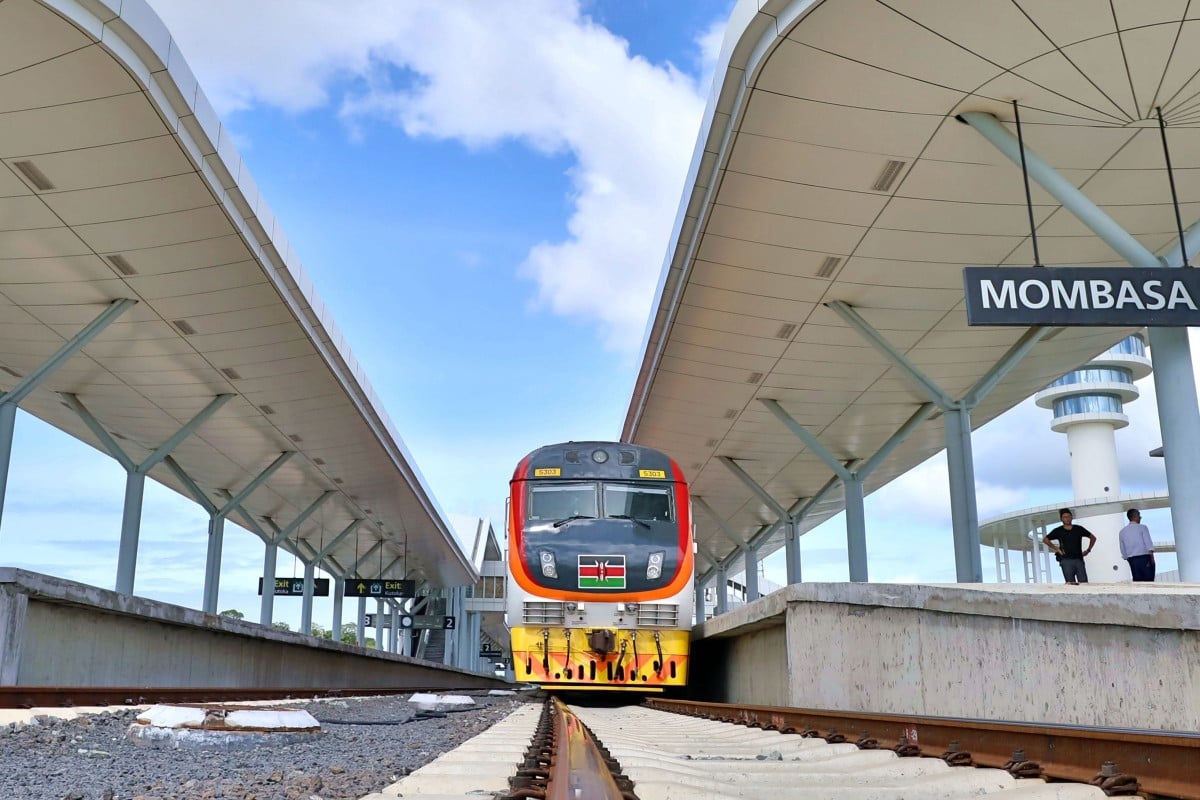
The Mombasa-Nairobi Standard Gauge Railway, funded by China, opened in 2017. Japan has criticised Chinese lending practices in Africa. Photo: Xinhua
The long rivalry between China and Japan is again playing out in Africa, with Tokyo planning to pour more aid into the continent and invest in infrastructure projects there.
Beijing – which has for decades funnelled money into the continent – will be watching as the leaders of 54 African countries and international organisations descend on Yokohama later this month for the seventh Tokyo International Conference on African Development (TICAD).
Japan reportedly plans to pledge more than 300 billion yen (US$2.83 billion) in aid to Africa during the conference. While that might not be enough to alarm China – which in recent years has been on a spending spree in the continent – it will be paying close attention.
Japan has in the past used the meetings to criticise Chinese lending practices in Africa, saying it was worried about the “unrealistic” level of debt incurred by African countries – concerns that China has dismissed.
This year, analysts expect Tokyo will use the conference to articulate how its approach to African development is substantively different from that of the Chinese.
“So, look for the words ‘quality’, ‘transparency’ and ‘sustainability’ to be used a lot throughout the event,” said Eric Olander, managing editor of the non-partisan China Africa Project.
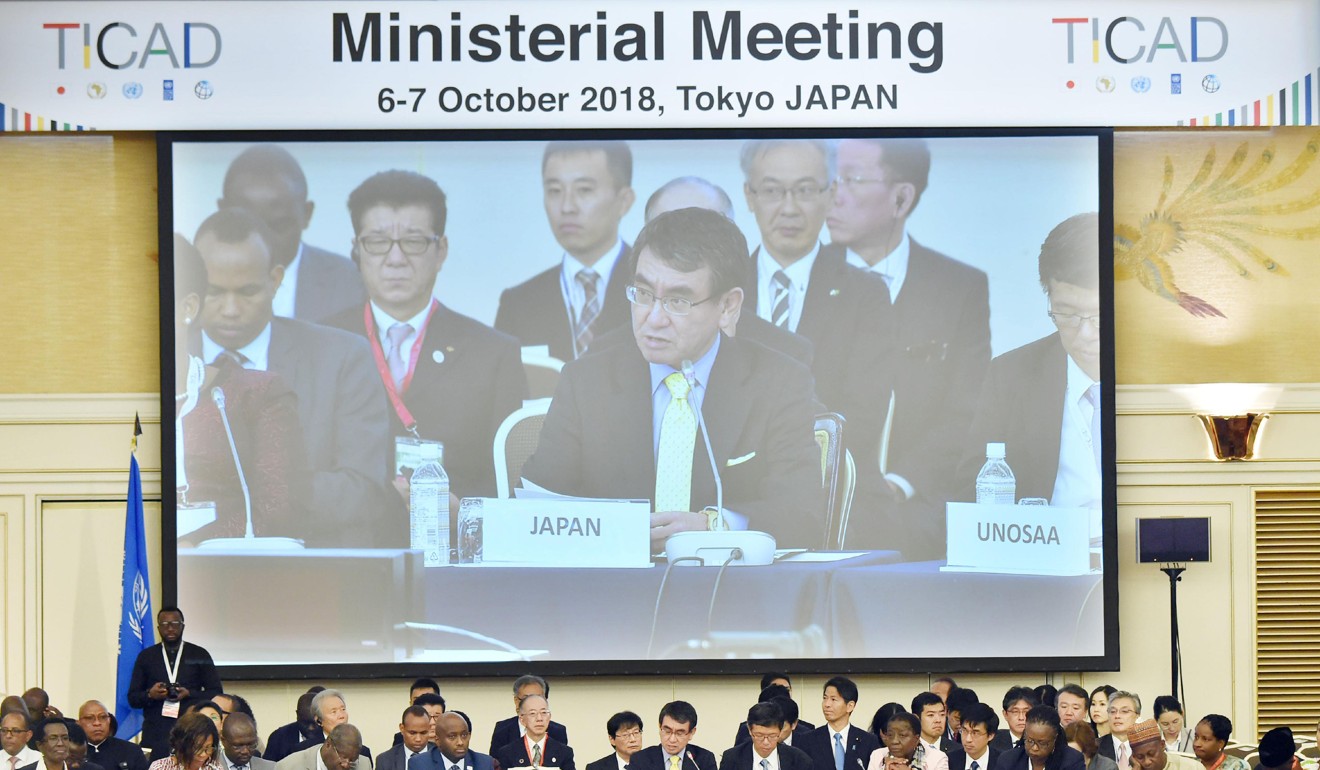
Japanese Foreign Minister Taro Kono gives a speech at the TICAD in Tokyo in October. Japan will reportedly pledge US$2.83 billion in aid to Africa this year. Photo: The Yomiuri Shimbun
Olander said Japan often sought to position its aid and development programmes as an alternative to China’s by emphasising more transparency in loan deals, higher-quality infrastructure projects and avoiding saddling countries with too much debt.
“In some ways, the Japanese position is very similar to that of the US where they express many of the same criticisms of China’s engagement strategy in Africa,” Olander said.
But the rivalry between China and Japan had little to do with Africa, according to Seifudein Adem, a professor at Doshisha University in Kyoto, Japan.
“It is a spillover effect of their contest for supremacy in East Asia,” said Adem, who is from Ethiopia.
“Japan’s trade with Africa, compared to China’s trade with Africa, is not only relatively small but it is even shrinking. It is a result of the acceleration of China’s engagement with Africa.”
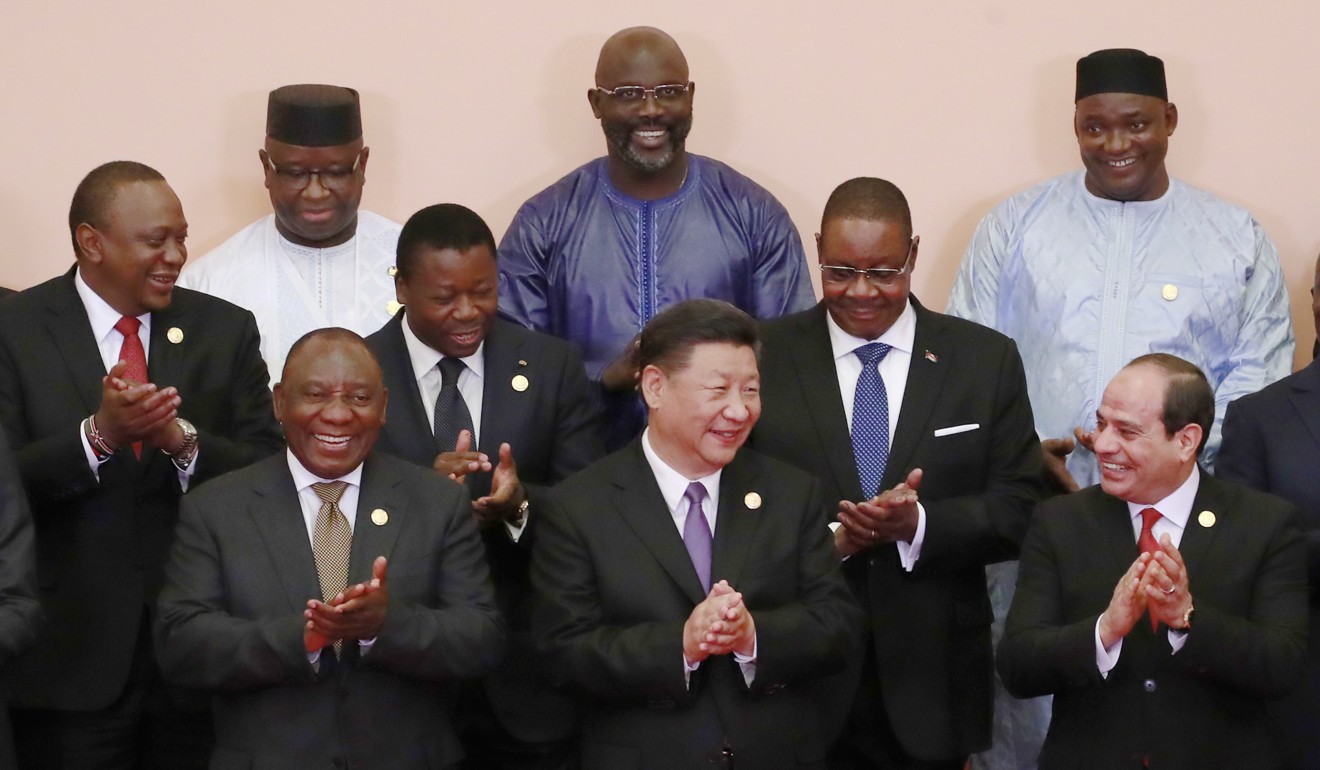
Chinese President Xi Jinping attends a group photo session with African leaders during the Forum on China-Africa Cooperation in Beijing last year. Photo: AP
Japan launched the TICAD in 1993, to revive interest in the continent and find raw materials for its industries and markets for products. About a decade later, China began holding a rival event, the Forum on China-Africa Cooperation.
It is at heart an ideological rivalry unfolding on the continent, according to Martin Rupiya, head of innovation and training at the African Centre for the Constructive Resolution of Disputes in Durban, South Africa.
“China cast Japan as its former colonial interloper – and not necessarily master – until about 1949. Thereafter, China’s Mao [Zedong] developed close relations, mostly liberation linkages with several African nationalist movements,” Rupiya said.
Beijing had continued to invoke those traditional and historical ties, which Japan did not have, he said.
“Furthermore, Japan does not command the type of resources – call it largesse – that China has and occasionally makes available to Africa,” Rupiya said.
Although both Asian giants have made inroads in Africa, the scale is vastly different.
While Japan turned inward as it sought to rebuild its struggling economy amid a slowdown, China was ramping up trade with African countries at a time of rapid growth on the continent.
That saw trade between China and Africa growing twentyfold in the last two decades. The value of their trade reached US$204.2 billion last year, up 20 per cent from 2017, according to Chinese customs data. Exports from Africa to China stood at US$99 billion last year, the highest level since the 1990s. Meanwhile, through its Belt and Road Initiative that aims to revive the Silk Road to connect Asia with Europe and Africa, China is funding and building Kenya’s Standard Gauge Railway and the Addis Ababa-Djibouti Railway. Beijing is also building major infrastructure projects in Zambia, Angola and Nigeria.
Japan’s trade with Africa is just a small fraction of Africa’s trade with China. In 2017, Japan’s exports to the continent totalled US$7.8 billion, while imports were US$8.7 billion, according to trade data compiled by the Massachusetts Institute of Technology.
How speaking with one voice could help Africa get a better deal from China
But Japan now appears eager to get back in the game and expand its presence in Africa, and analysts say this year’s TICAD will be critical – both in terms of the amount of money Tokyo commits to African development and how it positions itself as an alternative to the Chinese model.
Ryo Hinata-Yamaguchi, a visiting professor at Pusan National University in South Korea, said the continent was “economically vital to Japan, both in trade and investments”.
“Moreover, Japan has established some strong links with African states through foreign aid,” Hinata-Yamaguchi said.
“Japan’s move is driven by both economic and political interests. Economically, Japan needs to secure and maintain its presence in, and linkages with, the African states while opening new markets and opportunities,” he said.
To counter China’s belt and road strategy, Japan has launched the Asia-Africa Growth Corridor project, an economic cooperation deal, with India and African countries.
Tokyo meanwhile pledged about US$30 billion in public-private development assistance to Africa over three years at the 2016 TICAD, in Nairobi. But China offered to double that amount last year, during its Forum on China-Africa Cooperation in Beijing.
Still, Japan continues to push forward infrastructure projects on the continent. It is building the Mombasa Port on the Kenyan coast, while Ngong Road, a major artery in Nairobi, is being converted into a dual carriageway with a grant from Tokyo.
Japan is also funding the construction of the Kampala Metropolitan transmission line, which draws power from Karuma dam in Uganda. In Tanzania, it provided funding for the Tanzania-Zambia Railway Authority (Tazara) flyover. And through the Japan International Cooperation Agency, Tokyo also helps African countries improve their rice yields using Japanese technology.
There are nearly 1,000 Japanese companies – including carmakers like Nissan and Toyota – operating in Africa, but that is just one-tenth the number of Chinese businesses on the continent.
Are Chinese loans putting Africa on the debt-trap express?
Olander said Japan’s construction companies were among the best in the world, albeit not necessarily the cheapest, and that Tokyo was pushing its message about “high-quality” construction.
XN Iraki, an associate professor at the University of Nairobi School of Business, said Japan wanted to change its approach to Africa on trade, which had long been dominated by cars and electronics.
“[It has] no big deals like China’s Standard Gauge Railway. But after China’s entry with a bang – including teaching Mandarin through Confucius Institutes – Japan has realised its market was under threat and hence the importance of the TICAD, which should remind us that Japan is also there.”
Source: SCMP
Posted in Addis Ababa-Djibouti railway, africa, African Centre for the Constructive Resolution of Disputes, aid and infrastructure, alternative, Angola, Asia, Beijing, Belt and Road Initiative, Belt and Road Initiative (BRI), best in the world, carmakers, cars, cheapest, China Africa Project, China alert, Chinese President Xi Jinping, Chinese projects, colonial interloper, Confucius Institutes, construction companies, continent, counter, debt-trap express, development summit, different, Doshisha University in Kyoto, dual carriageway, Durban, East Asia, Electronics, Ethiopia, Europe, flyover, Forum on China-Africa Cooperation, Forum on China-Africa Cooperation (FOCAC), Forum on China–Africa Cooperation, high-quality development, ideological rivalry, Japan, Japanese Foreign Minister, Japanese technology, Kampala Metropolitan transmission line, Karuma dam, Kenya’s Standard Gauge Railway, Kenyan coast, largesse, leaders of African nations organisations, leaders of international organisations, Mandarin, Mao Zedong, Massachusetts Institute of Technology, master, Mombasa Port, Mombasa-Nairobi Standard Gauge Railway, Nairobi, Nigeria, Nissan, Pusan National University, quality, resources, rice yields, rivalry, seeks, Silk Road, South Africa, South Korea, Standard Gauge Railway, Sustainability, Tanzania, Tanzania-Zambia Railway Authority (Tazara), Taro Kono, TICAD, Tokyo, Tokyo International Conference on African Development (TICAD), Toyota, Transparency, Uganda, Uncategorized, University of Nairobi School of Business, watching, Yokohama, Yomiuri Shimbun, Zambia |
Leave a Comment »
18/05/2019
Japanese Prime Minister Shinzo Abe (R) meets with Yang Jiechi, a member of the Political Bureau of the Communist Party of China (CPC) Central Committee and director of the Office of the Foreign Affairs Commission of the CPC Central Committee, in Tokyo, Japan, May 17, 2019. (Xinhua/Ma Caoran)
TOKYO, May 17 (Xinhua) — Japanese Prime Minister Shinzo Abe met with Yang Jiechi, a member of the Political Bureau of the Communist Party of China (CPC) Central Committee and director of the Office of the Foreign Affairs Commission of the CPC Central Committee, here on Friday.
Yang said that since the beginning of this year, Abe has repeatedly expressed in public the willingness to further develop China-Japan relations. Not long ago, Abe appointed Toshihiro Nikai, secretary-general of Japan’s Liberal Democratic Party, to attend the second Belt and Road Forum for International Cooperation, which has generated positive reactions in both countries, Yang said.
The China-Japan relations are at a new historic starting point, facing important opportunities, he said.
Under the guidance of the four political documents between China and Japan and the important consensus reached by leaders of the two countries, and in the spirit of taking history as a mirror and looking into the future, China is ready to work with Japan to strengthen high-level guidance, to enhance political mutual trust, to firmly grasp the general direction of peace, friendship and cooperation, and to push for steady development of bilateral relations on the right track, he said.
China supports Japan in hosting a successful Group of 20 summit in Osaka, which will effectively boost confidence and positive expectations from the international community and inject more positive energy into world economic development, Yang said.
Abe asked Yang to convey his cordial greetings to Chinese leaders. He said this year is an important year, as Japan entered the Era of “Reiwa” and China will celebrate the 70th anniversary of the founding of the People’s Republic of China.
Abe said he looks forward to promoting bilateral relations and opening a new era of China-Japan relations.
Yang visited Japan and co-chaired the sixth high-level political dialogue between China and Japan at the invitation of Japanese National Security Advisor Shotaro Yachi.
During the visit, Yang also met with Japanese Foreign Minister Taro Kono and Japan’s Chief Cabinet Secretary Yoshihide Suga respectively.
Source: Xinhua
Posted in Abe, Belt and Road Forum for International Cooperation (BRF), Chief Cabinet Secretary, China–Japan relations, director of the Office of the Foreign Affairs Commission of the CPC Central Committee, Era of "Reiwa", Japanese Foreign Minister, Japanese National Security Advisor, Japanese PM, Liberal Democratic Party, member of the Political Bureau of the Communist Party of China (CPC) Central Committee, Prime Minister Shinzo Abe, secretary-general, Senior Chinese official, Shotaro Yachi, Taro Kono, Toshihiro Nikai, Uncategorized, Yang Jiechi, Yoshihide Suga |
Leave a Comment »
16/04/2019
Chinese Premier Li Keqiang meets with Japanese Foreign Minister Taro Kono and some other cabinet ministers who are here to attend the fifth high-level economic dialogue between China and Japan in Beijing, capital of China, April 15, 2019. (Xinhua/Rao Aimin)
BEIJING, April 15 (Xinhua) — Chinese Premier Li Keqiang Monday met with Japanese Foreign Minister Taro Kono and some other cabinet ministers who were here to attend the fifth high-level economic dialogue between China and Japan.
Li said China and Japan are important neighbors. Since last year, through joint efforts, bilateral relations have returned to the right track and achieved new development. On the basis of the principles enshrined in the four China-Japan political documents, the two sides should promote the long-term, healthy and stable development of bilateral relations in the spirit of taking history as a mirror and looking into the future.
He said since China and Japan are two of the world’s major economies, strengthening cooperation is not only in the interests of the two countries but also conducive to peace, stability and prosperity in the region and world.
As both sides support free trade and abide by the rules of the World Trade Organization, they should work together to create a fair, equitable and non-discriminatory business environment for each other’s companies, said Li.
The Chinese side will unswervingly deepen reforms and expand opening up, and welcome Japanese companies to expand investment in China, Li added.
China and Japan successfully held the first meeting of the China-Japan Innovative Cooperation Mechanism this April, said Li, expressing the hope that the two countries further enhance cooperation in the area of innovation and expand cooperation in the areas of finance, third-party market and tourism.
The premier said China stands ready to work with Japan and other relevant parties to promote the negotiation of the China-Japan-Republic of Korea free trade agreement and the Regional Comprehensive Economic Partnership (RCEP) to create more opportunities for regional countries.
China supports Japan in hosting the G20 Okasa Summit this year, Li said, adding that China is willing to jointly promote the reform of global economic governance to inject new impetus into the world economy.
Hailing that Japan-China ties returned to normal last year and the high-level economic dialogue yielded fruitful results, Taro Kono said Japan-China relations in the new era were greatly intensified.
Japan is willing to enhance cooperation with China in areas such as innovation, finance, environmental protection, hydrogen-energy, tourism, youth, smart city and the third-party market, deepen coordination in multi-lateral areas and promote the RCEP negotiation to achieve new progress this year.
Source: Xinhua
Posted in China alert, China-Japan Innovative Cooperation Mechanism, China-Japan-Republic of Korea free trade agreement, Chinese premier Li Keqiang, Japan, Japanese Foreign Minister, Japanese officials, major economies, Premier Li, Regional Comprehensive Economic Partnership (RCEP), Taro Kono, Uncategorized, World Trade Organization (WTO) |
Leave a Comment »
15/04/2019
Chinese State Councilor and Foreign Minister Wang Yi co-chairs the fifth high-level economic dialogue between China and Japan with visiting Japanese Foreign Minister Taro Kono in Beijing, capital of China, April 14, 2019. (Xinhua/Li Tao)
BEIJING, April 14 (Xinhua) — Chinese State Councilor and Foreign Minister Wang Yi on Sunday co-chaired the fifth high-level economic dialogue between China and Japan with visiting Japanese Foreign Minister Taro Kono in Beijing.
Hailing that China-Japan relations has returned to the right track and yielded new achievements by the joint efforts of the two countries’ leaders and people of all social circles, Wang said the fourth high-level economic dialogue, which was restarted after an eight-year hiatus last April, facilitated policy communication and pragmatic cooperation effectively.
This year marks the 70th anniversary of the founding of the People’s Republic of China, while Japan will enter the new era “Reiwa”, Wang said, adding that the two countries should uphold the major consensus reached by the two countries’ leaders and jointly construct bilateral economic relations to meet the needs of the new era.
The two sides should make steady headway in promoting bilateral investments and trade cooperation, jointly build the Belt and Road, and actively explore third party market cooperation as well as local cooperation, Wang said.
He also called for consolidating the cooperation results in such areas as energy conservation and environment protection, science and technology innovation, high-end manufacturing, finance, sharing economy, medical care and elderly care industries.
Wang said that China and Japan should make joint efforts to promote trade and investment liberalization and facilitation, uphold a business environment of fairness, justice and non-discrimination, speed up negotiations on the Regional Comprehensive Economic Partnership and China-Japan-ROK free trade agreement, and safeguard multilateralism and free trade regime.
Kono said that economic cooperation has been an important foundation and driving force for Japan-China relations.
Facing a global situation of intense uncertainty, the two sides should jointly safeguard the multilateral trade mechanism based on rules, he said.
During the dialogue, senior foreign affairs and economic officials of both countries exchanged views and achieved a series of consensus on macroeconomic policies, bilateral economic cooperation and exchanges, regional economic integration, and global economic governance.
Before the dialogue, Wang and Kono jointly attended the opening ceremony of the “China-Japan Youth Exchange Promotion Year.”
Source: Xinhua
Posted in Beijing, Belt and Road Initiative (BRI), China alert, China-Japan Youth Exchange Promotion Year, China-Japan-ROK free trade agreement, Chinese State Councilor and Foreign Minister, economic dialogue, elderly care industries, Energy conservation, environment protection, Finance, high-end manufacturing, Japan, Japanese Foreign Minister, medical care, People’s Republic of China, Regional Comprehensive Economic Partnership, Reiwa, science and technology innovation, sharing economy, Taro Kono, Uncategorized, Wang Yi |
Leave a Comment »




 CHINDIA ALERT: You'll be living in their world, very soon