Archive for ‘Kashmiri’

09/04/2020

India and Pakistan locked in border fighting amid coronavirus crisis

NEW DELHI (Reuters) – Indian and Pakistani troops in disputed Kashmir are engaged in their most frequent cross-border fighting of at least two years, official data shows, even as both nuclear-armed rivals battle surging coronavirus outbreaks.

Kashmir has long been a flashpoint between the neighbours but tension was renewed after New Delhi withdrew the autonomy of the Himalayan region last August and split it into federally-administered territories.

Both countries claim the region in full, but rule only parts, and often accuse each other of breaching a 2003 ceasefire pact by shelling and firing across the Line of Control (LoC), an informal border in Kashmir, and of killing dozens every year.

Indian Army data reviewed by Reuters shows 411 ceasefire violations by Pakistan’s military in March, the highest number in a single month since at least 2018. That compares with 267 violations in March last year recorded by the Indian Army.

“(The) Pakistan Army never initiates ceasefire violations along LoC, but it has always responded befittingly to Indian Army’s unprovoked firing,” said Major-General Babar Iftikhar, of the public relations wing of the Pakistan Army.

Iftikhar said Pakistan’s military had recorded 705 ceasefire violations by the Indian Army since the beginning of the year.

The Indian Army data showed 1,197 Pakistani violations during the same period.

Reuters is not in a position to independently verify the competing claims.

Four Indian army officials said the heightened border activity was a cover to help militants from Pakistan-backed groups infiltrate into Indian Kashmir, as some troops help to run health camps and hand out food in the battle on the virus.

“The increase in ceasefire violations is an indication that Pakistan is trying to push militants into the Kashmir valley,” said one of the officials, who all sought anonymity because they were not authorised to speak to media.

India has 5,734 infections, including 166 deaths, while Pakistan has reported 4,072 cases and 58 deaths, with the military of each helping its government’s efforts against the virus.

As summer approaches, infiltration into Kashmir typically picks up. An Indian security official said between 250 and 300 militants were estimated to be ready to cross over from Pakistan, citing intelligence reports.

“This is the time when our (border) fence is the weakest,” with damage caused by winter snows, said the official, who sought anonymity.

On Monday, the Indian Army said in a statement it killed five Pakistan-backed militants at the LoC during a firefight in heavy snow, with five of its special forces soldiers also killed.

Pakistan denies giving material support to militants in Kashmir but says it provides moral and diplomatic backing for the self-determination of Kashmiri people.

Source: Reuters
24/05/2019

Indian forces kill leader of al Qaeda affiliate in Kashmir – police

SRINAGAR (Reuters) – Indian forces have killed the leader of an al Qaeda affiliated militant group in Kashmir, police said on Friday, triggering protests in parts of the disputed region.

Zakir Rashid Bhat, 25, was trapped by security forces in a three-storey house in southern Kashmir late on Thursday, said a senior police officer, adding that the house was set ablaze during the operation.

“As we were clearing debris from the house, he tried to get up. Our troops fired at him and he was killed,” said the officer, who declined to be named because he was not authorised to speak to media.

For decades, separatists have fought an armed conflict against Indian rule in Kashmir, with the majority of them wanting independence for the Himalayan region, or to join New Delhi’s arch rival Pakistan.

India has stepped up an offensive against militants in the Muslim-majority region since a suicide attack in February killed 40 Indian troopers in Kashmir and brought India and Pakistan to the brink of war.

Pakistan denies giving material support to militants in Kashmir but says it provides moral and diplomatic backing for the self-determination of Kashmiri people.

Protests by supporters of Bhat broke out in parts of Kashmir on Thursday and there were reports of demonstrations early on Friday, the police officer said.

Fearing more unrest, authorities said schools were closed and railway services suspended in the affected areas.

Any large scale unrest in the region would be a challenge for Indian Prime Minister Narendra Modi as he prepares for a second term after winning a general election on Thursday.

Bhat, a former commander of the Hizbul Mujahideen, the largest of the militant groups fighting against Indian rule in Kashmir, founded his own group and declared its association with al Qaeda in 2017.

Also known as Zakir Musa, he was seen as a successor to Burhan Wani, a popular Hizbul Mujahideen commander whose death in 2016 sparked clashes that left 90 civilians dead.

Source: Reuters

09/03/2019

Man arrested over Kashmir grenade attack

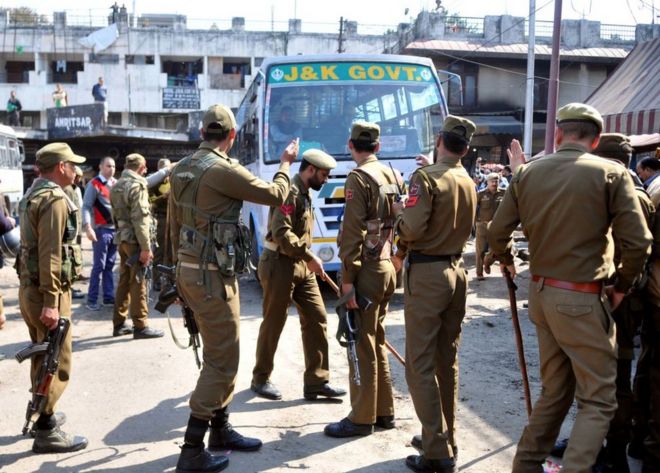
Police at the site of the blast in Jammu city on 7 March 2019.Image copyrightGETTY IMAGES
Image captionThe blast occurred at a busy bus station in Jammu city

Indian police have arrested an alleged member of the Hizbul Mujahideen militant group after a grenade attack killed at least two people and injured more than 30 others.

The attack took place on Thursday in a bus station in the Indian-administered state of Jammu and Kashmir.

Last month a suicide attack against security forces triggered cross-border air strikes between India and Pakistan.

Hizbul Mujahideen has said it was not behind Thursday’s attack.

But police told BBC Urdu that the accused, Yasir Javed Bhat, had confessed. He is a Kashmiri and reported to be in his 20s.

“He revealed that he was tasked with throwing the grenade by Farooq Ahmed Bhat, a district commander of Hizbul Mujahideen in Kulgam district,” inspector general Manish Kumar Sinha said.

Mr Sinha added that they were gathering more intelligence on Yasir.

Hizbul Mujahideen was formed in 1989 when an armed insurgency against Indian rule first broke out in the valley. It was the largest Kashmiri militant group through the 1990s and is considered to be pro-Pakistani.

India has blamed Pakistan for supporting militancy in the region – a charge Islamabad denies.

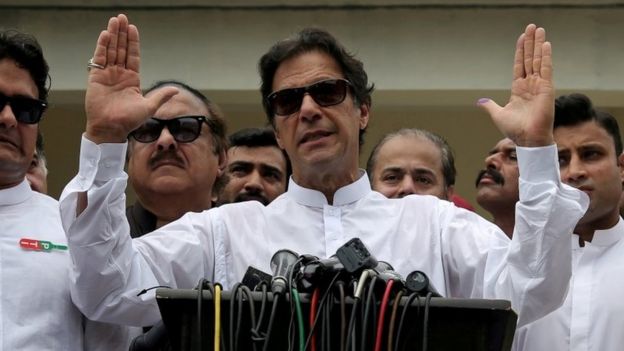
Cricket star-turned-politician Imran Khan, chairman of Pakistan Tehreek-e-Insaf (PTI), speaks after voting in the general election in Islamabad, July 25, 2018Image copyrightREUTERS
Image captionPakistan PM Imran Khan said Pakistan was not behind the suicide attack in February

This has long been a source of tension between the nuclear-armed neighbours as groups based in Pakistan have carried out deadly attacks on Indian soil. The suicide attack last month killed more than 40 central reserve policemen in Indian-administered Kashmir.

Tensions between the two sides escalated quickly. India carried out air strikes against what it said was a militant camp based in Pakistan and the latter retaliated with air raids of its own.

An Indian fighter jet was shot down in Pakistan-administered Kashmir and the pilot was captured. Two days later, Pakistan handed over the pilot to Indian officials establishing a fragile truce.

Source: The BBC

Law of Unintended Consequences

continuously updated blog about China & India

ChiaHou's Book Reviews

continuously updated blog about China & India

What's wrong with the world; and its economy

continuously updated blog about China & India