21/03/2020
- Two aircraft worked together to identify ‘suspicious objects’ in disputed waters, PLA Navy captain says
- With military tensions rising in region, China is keen to put its anti-submarine capabilities to the test, observer says
The PLA Navy said the anti-submarine drill over the South China Sea took place earlier this month. Photo: Handout
Chinese military aircraft recently conducted an anti-submarine drill over the
, the People’s Liberation Army said on Friday, amid a growing number of patrols and exercises by US warships in the region.
The drill, which involved two aircraft, was conducted earlier this month, not long before the US naval and marine units took part in expeditionary strike force training in the disputed waters, the PLA Navy said in a report.
While acknowledging the difficulties involved in such an operation, the report said the aircraft successfully identified several suspicious objects.
“Anti-submarine exercises are like trying to find a needle in a haystack. It’s difficult, the underwater hydrological conditions are complex,” Yu Yang, the captain of one of the aircraft, was quoted as saying.
But by having two planes working together, it “increase[d] the probability of finding a submarine”, he said.
The anti-submarine exercise involved two aircraft from the PLA Navy. Photo: Handout
Wang Shelin, one of the commanders of the exercise, said that anti-submarine operations were not only dangerous but a real test of the pilots’ skills.
Successfully completing the mission demanded precise “control of the speed and altitude of the aircraft”, he said.
The publication of the PLA report came after the United States staged a four-day exercise in the South China Sea last week involving the Theodore Roosevelt Carrier Strike Group, the America Expeditionary Strike Group and the 31st Marine Expeditionary Unit.
At the end of last month, the
US Navy accused the PLA of “unsafe and unprofessional” behaviour after a Chinese destroyer pointed a laser at an American maritime patrol aircraft flying over international waters west of Guam.
Collin Koh, a research fellow with the S Rajaratnam School of International Studies at Nanyang Technological University in Singapore, said the Chinese military was keen to promote its anti-submarine capabilities.
“This means we can expect to see more such exercises in the future, with no let up because of the
coronavirus,” he said.
“You can also see this as a response not only to the [recent] carrier strike group operations, but the intensified US military presence in the South China Sea.
“And it would not be surprising if a nuclear attack submarine was in the vicinity of the carrier strike group,” he said.
Chinese and US defence chiefs discuss coronavirus crisis in phone call
Song Zhongping, a Hong Kong-based commentator on military affairs, said that with the possibility of a military conflict growing in the South China Sea, it was important for the PLA Navy to increase its anti-submarine training.
“The rivalry between the great powers is getting more and more intense, and the PLA must strengthen its preparations,” he said.
Echoing commander Wang’s comments, Song said that the high volume of maritime traffic and sheer size and depth of the South China Sea made searching for submarines difficult.
“So the PLA is trying to enhance its capabilities by constantly installing and testing new anti-submarine equipment,” he said.
Source: SCMP
Posted in America Expeditionary Strike Group, American, anti-submarine, ‘unsafe and unprofessional’, Chinese, conduct, coronavirus, destroyer, drills, Guam, laser, maritime patrol aircraft, Nanyang Technological University, naval planes, People’s Liberation Army, pla navy, Singapore, South China Sea, Theodore Roosevelt Carrier Strike Group, Two aircraft, Uncategorized, US Navy |
Leave a Comment »
28/02/2020
- US Pacific Fleet calls the action last week ‘unsafe and unprofessional’ and a breach of code of conduct
- Analyst describes it as a ‘serious provocation’ that could have posed a navigational hazard
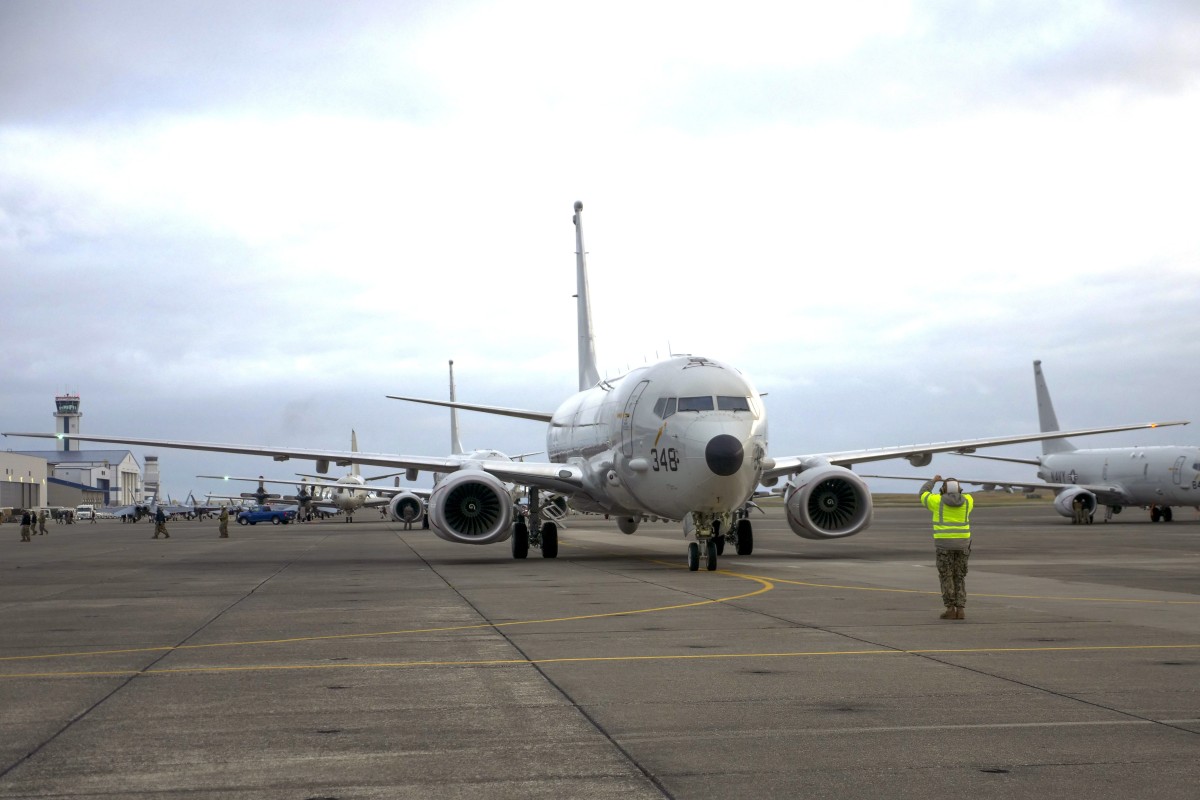
The US said a P-8A Poseidon maritime patrol aircraft was targeted as it flew over international waters in the western Pacific last week. Photo: AP
A Chinese destroyer pointed a laser at an American maritime patrol aircraft over the western Pacific Ocean last week, the US Navy said, calling the incident “unsafe and unprofessional”.
The US Pacific Fleet said in a statement on Friday that the destroyer targeted the P-8A Poseidon aircraft as it flew over international waters about 610km (380 miles) west of Guam on February 17.
“The laser, which was not visible to the naked eye, was captured by a sensor on board the P-8A,” the statement said. “Weapons-grade lasers could potentially cause serious harm to aircrew and mariners, as well as ship and aircraft systems.”
It said the action by the Chinese warship had breached the multilateral Code for Unplanned Encounters at Sea, which “specifically addresses the use of lasers that could cause harm to personnel or damage to equipment”.
China’s arms industry back in business despite disruption by coronavirus
The action was also “inconsistent” with a memorandum of understanding reached between the US and Chinese defence ministries on rules of behaviour for safety during air and maritime encounters, the US Pacific Fleet said.
The P-8A is deployed to the Kadena Air Force Base in Okinawa, Japan, and is part of a squadron that conducts routine operations, maritime patrols and reconnaissance in the US 7th Fleet area of operations, according to the statement.
China and the United States have exchanged tough words as tensions simmer over their military activities in the Asia-Pacific region, particularly over the South China Sea and Taiwan.
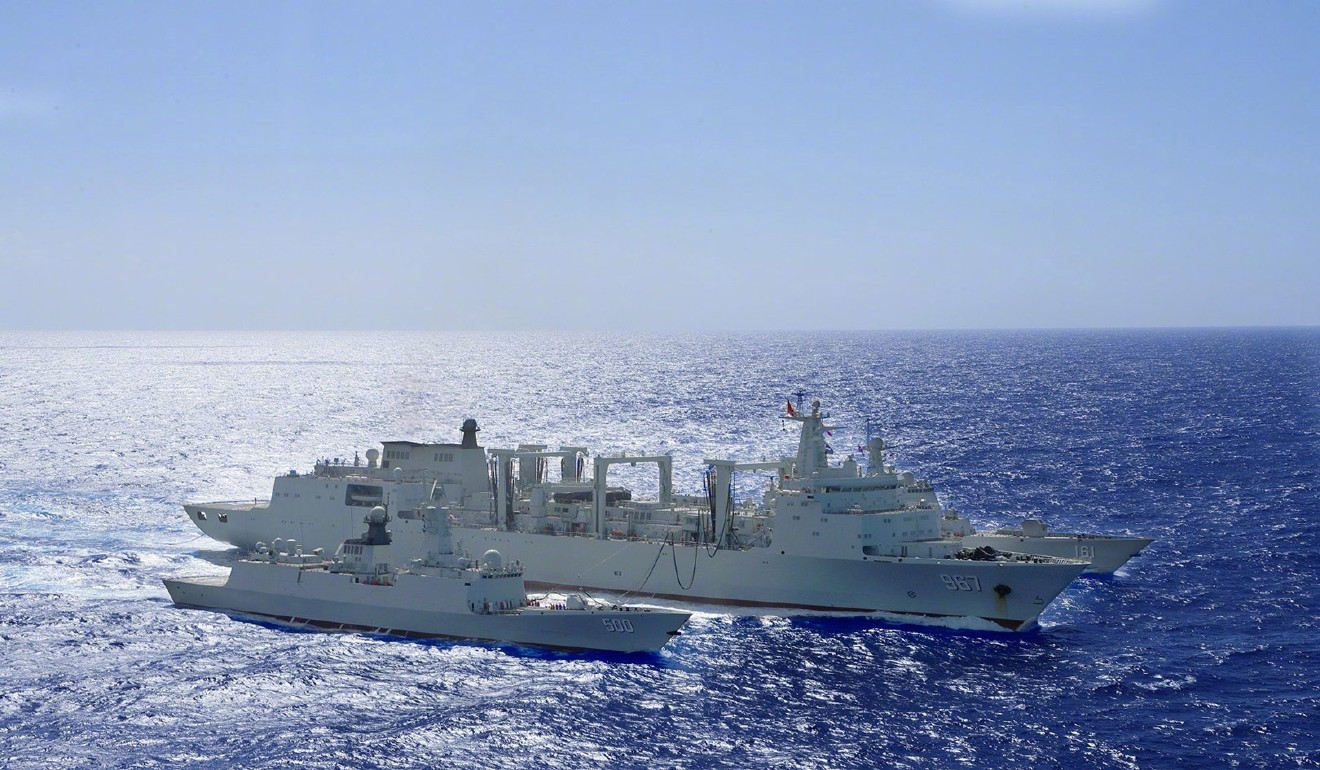
A Chinese destroyer is said to have pointed a laser at a US Navy aircraft near Guam.
Photo: Weibo The Chinese South Sea Fleet completed a 41-day drill in the western Pacific earlier this week, according to state media, in a move to show its military exercises were continuing even as the country battles the coronavirus epidemic.
Collin Koh, a research fellow with the S Rajaratnam School of International Studies at Singapore’s Nanyang Technological University, said the latest incident was a “serious provocation”, noting that the Chinese military had also pointed lasers at the US in Djibouti.
The South China Sea dispute explained
“Use of lasers is as dangerous as manoeuvring one’s aerial or naval asset too close to another to cause the potential of collision – the lasers can pose a serious navigational hazard,” Koh said.
“While both [the Chinese and US navies] have the legitimate right to carry out their activities on the high seas out there in the western Pacific – including the use of these platforms to monitor each other – the use of lasers to endanger navigation in fact represents a serious provocation,” he said.
“The US Navy P-8A might have flown lower for closer observation, but I don’t think it went to the point of risking a collision with the [Chinese] warship.”
The incident was likely to further undermine trust and military stability between China and the United States, Koh said.
Conflict prevention in the South China Sea depends on China abiding by the existing rules of navigation
“It also wouldn’t be the first time the [Chinese navy] formations would have had ‘company’ from US military assets keeping tabs on them,” he said.
But Hong Kong-based military commentator Song Zhongping rejected the US Navy’s claim that the Chinese warship had violated the code of conduct, saying its action was just a routine warning.
“The US is unhappy because the Chinese fleet was very close to Guam, and it saw the Chinese fleet as taking an unfriendly measure against the US,” he said.
“But it’s normal for a naval fleet and aircraft to send warnings to each other,” Song said. “If the other side’s reconnaissance plane gets too close to vessels, it can be a security risk. So they take self-defence measures.”
Source: SCMP
Posted in ‘serious provocation’, ‘unsafe and unprofessional’, Chinese, Code of conduct, coronavirus epidemic, Guam, Japan, Kadena Air Force Base, laser, navigational hazard, Okinawa, P-8A Poseidon, patrol aircraft, pointed, Singapore’s Nanyang Technological University, The Chinese South Sea Fleet, Uncategorized, US Pacific Fleet, warship |
Leave a Comment »



 CHINDIA ALERT: You'll be living in their world, very soon