Chindia Alert: You’ll be Living in their World Very Soon
aims to alert you to the threats and opportunities that China and India present. China and India require serious attention; case of ‘hidden dragon and crouching tiger’.
Without this attention, governments, businesses and, indeed, individuals may find themselves at a great disadvantage sooner rather than later.
The POSTs (front webpages) are mainly 'cuttings' from reliable sources, updated continuously.
The PAGEs (see Tabs, above) attempt to make the information more meaningful by putting some structure to the information we have researched and assembled since 2006.
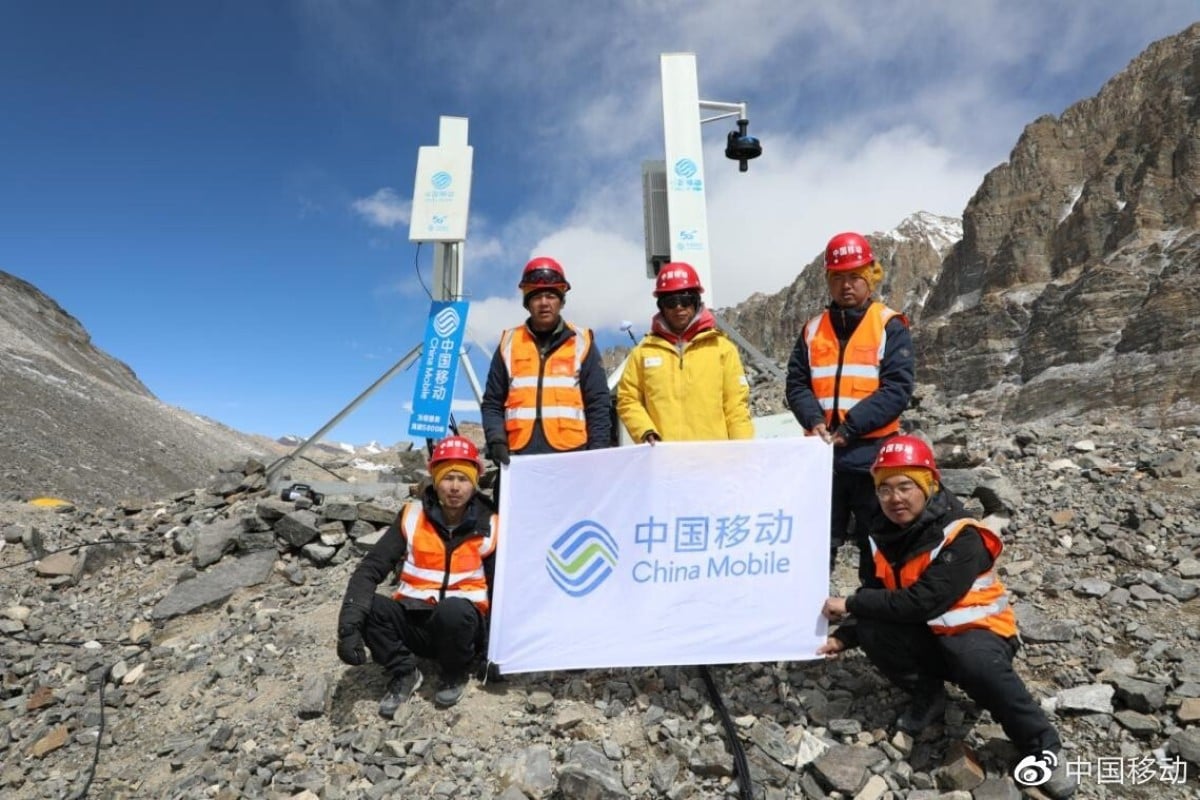
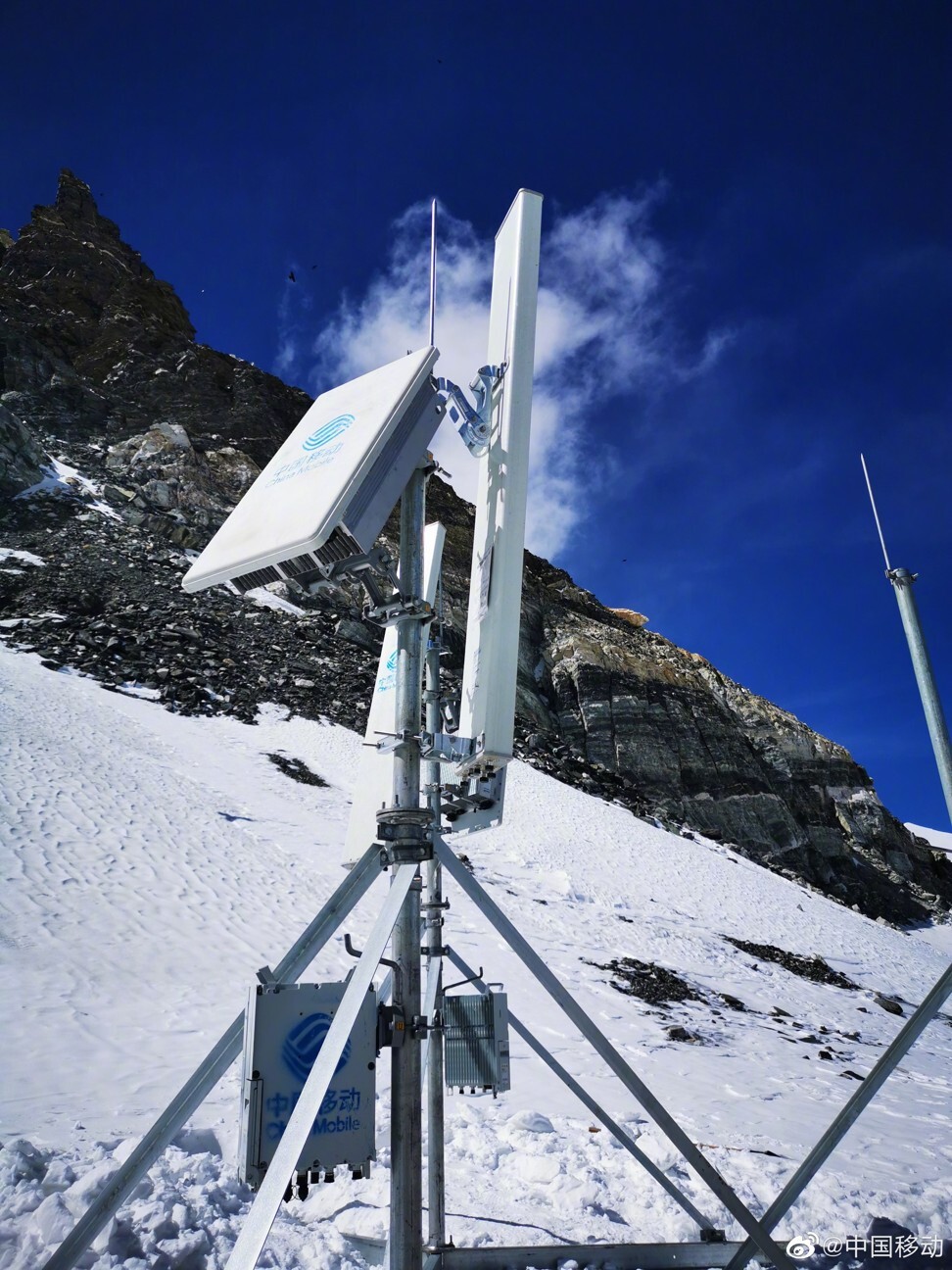
This marks the latest mobile network upgrade on Mount Everest, where Chinese carriers had previously installed 2G, 3G and 4G equipment
China Mobile plans to deploy Huawei 5G gear at an altitude of 6,500 metres, providing network coverage to the mountain’s summit
A team from China Mobile shows off the initial 5G base stations, supplied by Huawei Technologies, that the telecoms carrier deployed on Mount Everest this April. Photo: Weibo
Huawei Technologies has teamed up with wireless network operators China Mobile, China Unicom and China Telecom to roll out advanced 5G infrastructure on
The deployment of 5G base stations on the famous Himalayan mountain, with an elevation of 8,848 metres, has extended the reach of the next-generation mobile technology, which has been held up as “the connective tissue” for the Internet of Things, autonomous cars, smart cities and other new applications – providing the backbone for the industrial internet. The new 5G infrastructure roll-outs were announced by Huawei in a post on Chinese microblogging site Weibo on Monday and confirmed by its spokeswoman on Tuesday.
China Mobile, the world’s largest wireless network operator, said its 5G project on Mount Everest marked “not only another extreme challenge in a human life exclusion zone, but also laid a solid foundation for the later development of 5G smart tourism and 5G communications for scientific research”, according to the company’s post on Weibo on Monday.
The Hong Kong and New York-listed carrier set up three 5G base stations – radio access gear that connects mobile devices to the broader telecommunications network – on April 19 in two camps at altitudes of 5,300 metres and 5,800 metres, which provide online download speed of about 1 gigabit per second.
China Mobile plans to install two more 5G base stations, supplied by telecommunications gear maker Huawei Technologies, on Mount Everest before April 25. Photo: Weibo
Installation of two more base stations are expected to be completed by China Mobile before April 25 in another camp at an altitude of 6,500 metres, providing 5G network coverage to the summit of Mount Everest. The international border between China and Nepal is 1,414 kilometres in length and runs across that summit.
More than 150 China Mobile employees are taking part on the construction and maintenance of the new 5G base stations as well as upgrading existing infrastructure on the surrounding areas, according to the company. It said 25 kms of new optical cables have also been laid out to support this project.
China Telecom confirmed its Mount Everest project on Tuesday in a statement, which said its 5G base stations were installed on April 13 at an altitude of 5,145 metres. It partnered with state-run China Central Television to broadcast a 24-hour live-streamed programme on April 14 from Mount Everest, which had an audience of more than six million people.
China Mobile did not immediately respond to a request for comment. China Unicom did not immediately reply to a separate request for comment.
Mobile network operators in China launched initial commercial 5G services last year. The country has already deployed more than 160,000 5G base stations, covering more than 50 cities, according to a report published last month by the GSMA, the trade body which represents mobile operators worldwide.
While initial commercial 5G mobile services were launched in countries like South Korea, the US, and Australia, the scale of China’s market is likely to dwarf the combined size of those economies, negating any first-mover advantage.
The steady annual deployment of new 5G base stations is critical to meet future demand in the world’s second largest economy and biggest smartphone market. China is expected to have 600 million 5G mobile users by 2025, which would make up 40 per cent of total global 5G subscribers, according to the GSMA.
BEIJING (Reuters) – China’s factory activity likely rose for a second straight month in April as more businesses re-opened from strict lockdowns implemented to contain the coronavirus outbreak, which has now paralysed the global economy.
The official manufacturing Purchasing Manager’s Index (PMI), due for release on Thursday, is forecast to fall to 51 in April, from 52 in March, according to the median forecast of 32 economists polled by Reuters. A reading above the 50-point mark indicates an expansion in activity.
While the forecast PMI would show a slight moderation in China’s factory activity growth, it would be a stark contrast to recent PMIs in other economies, which plummeted to previously unimaginable lows.
That global slump, caused by heavy government-ordered lockdowns, as well as the cautious resumption of business in China, suggests any recovery in the world’s second-largest economy is likely to be some way off.
“The recovery so far has been led by a bounce-back in production, however, the growth bottleneck has decisively shifted to the demand side, as global growth has weakened and consumption recovery has lagged amid continued social distancing,” Morgan Stanley said in a note.
“The expected slump in external demand has likely capped further recovery in industrial production.”
The latest official data showed 84% of mid-sized and small business had reopened as of April 15, compared with 71.7% on March 24.
Hobbled by the coronavirus, China’s economy shrank 6.8% in the first quarter from a year earlier, the first contraction since current quarterly records began.
That has left Chinese manufacturers with reduced export orders and a logistics logjam, as many exporters grapple with rising inventory, high costs and falling profits. Some have let workers go as part of the cost-cutting efforts.
A China-based brokerage Zhongtai Securities estimated that the country’s real unemployment rate, measured using international standards, could exceed 20%, equal to more than 70 million job losses and much higher than March’s official reading of 5.9%.
Sheng Laiyun, deputy head at the statistics bureau, said on Sunday migrant workers and college graduates are facing increasing pressures to secure jobs, while official jobless surveys show nearly 20% of employed workers not working in March.
Chinese authorities have rolled out more support to revive the economy. The People’s Bank of China earlier in April cut the amount of cash banks must hold as reserves and reduced the interest rate on lenders’ excess reserves.
BEIJING/SHANGHAI (Reuters) – China’s Inceptio Technology, a startup developing self-driving trucks, has raised $100 million in its latest funding round from logistics firm GLP, its key strategic investor G7 and other investors, two sources familiar with the matter told Reuters.
The proceeds from its series A funding round will be used to further develop its technologies and to start commercial trials, said the sources, who declined to be named as they were not authorised to speak to media.
The company, which aims to operate a freight network with autonomous driving trucks in China from 2022, has partnerships with Dongfeng Automobile Co Ltd (600006.SS), Sinotruk Hong Kong Ltd (3808.HK) and Foton (600166.SS).
The two-year-old firm is developing autonomous driving software and an in-car computing system while the truckmakers are responsible for the vehicles’ platforms.
Inceptio declined to comment. G7 and Singapore-based GLP did not immediately respond to requests for comment.
Inceptio focuses on level 3 and 4 technologies. A level 3 vehicle will enable drivers to turn their attention away from driving but they still need to take over if the car encounters a problem, while with level 4 technologies, there is no human intervention in most circumstances.
The trucking industry is expected to an earlier adopter of autonomous driving technology compared to passenger vehicle makers as driving on highways is more predictable than on busy city streets.
German automaker Daimler (DAIGn.DE) and U.S. postal giant United Parcel Service Inc (UPS.N) have invested in self-driving trucks.
Indian defence officials have reported a coronavirus outbreak at a key naval base in the western city of Mumbai.
Twenty-one personnel have tested positive for Covid-19 at INS Angre, which is the seat of the force’s western command, the navy said in a statement on Saturday.
It added that there are no infections aboard any ships or submarines.
India has 11,906 active infections and 480 deaths, according to the latest data from the ministry of health.
The Navy said that they had tested a number of personnel who had come into contact with a soldier who had tested positive earlier this month. Many of those who had tested positive for the virus, the statement added, were asymptomatic.
All 21 personnel live in the same residential block, which has been declared a containment zone and has been placed under lockdown.
In a video message to personnel last week, Navy Chief Admiral Karambir Singh stressed the importance of keeping ships and submarines free of the virus.
“The coronavirus pandemic is unprecedented and it has never been seen before. Its impact has been extraordinary across the globe, including India,” he said.
The navy has been playing an active role in India’s response to the Covid-19 outbreak.
It has set up isolation facilities to treat patients at one of its premier hospital units and is also running quarantine camps.
The outbreak aboard the Indian naval base follows reports of outbreaks aboard vessels belonging to other nations.
More than 500 sailors on the USS Roosevelt have tested positive for the virus and one of them died earlier this week. And nearly a third of the sailors serving with France’s aircraft carrier Charles de Gaulle – 668 out of nearly 2,000 – have been infected with coronavirus.
US death toll passes 3,000 as New York’s hospitals are pushed to breaking point
Italy extends lockdown as cases exceed 100,000; UN Security Council votes by email for first time
The USNS Comfort passes the Statue of Liberty as it enters New York Harbour on Monday. Photo: Reuters
Harsh lockdowns aimed at halting the march of the coronavirus pandemic extended worldwide Monday as the death toll soared toward 37,000 amid new waves of US outbreaks.
The tough measures that have confined some two-fifths of the globe’s population to their homes were broadened. Moscow and Lagos joined the roll call of cities around the globe with eerily empty streets, while Virginia and Maryland became the latest US states to announce emergency stay-at-home orders, followed quickly by the capital city Washington.
In a symbol of the scale of the challenge facing humanity, a US military medical ship sailed into New York to relieve the pressure on overwhelmed hospitals bracing for the peak of the pandemic.
France reported its highest daily number of deaths since the outbreak began, saying 418 more people had succumbed in hospital.
Spain, which announced another 812 virus deaths in 24 hours, joined the United States and Italy in surpassing the number of cases in China, where the disease was first detected in December.
On Tuesday, mainland China reported a rise in new confirmed coronavirus cases, reversing four days of declines, due to an uptick in infections involving travellers arriving from overseas.
Mainland China had 48 new cases on Monday, the National Health Commission said, up from 31 new infections a day earlier.
All of the 48 cases were imported, bringing the total number of imported cases in China to 771 as of Monday.
There was no reported new case of local infection on Monday, according to the National Health Commission. The total number of infections reported in mainland China stood at 81,518 and the death toll at 3,305. Globally, more than 760,000 have been infected, according to official figures.
Here are the developments:
Hospital ship arrives in New York
New York’s governor issued an urgent appeal for medical volunteers Monday amid a “staggering” number of deaths from the coronavirus, saying: “Please come help us in New York, now.”
The plea from Governor Andrew Cuomo came as the death toll in New York State climbed past 1,200 – with most of the victims in the big city – and authorities warned that the crisis pushing New York’s hospitals to the breaking point is just a preview of what other cities across the US could soon face.
Cuomo said the city needs 1 million additional health care workers.
“We’ve lost over 1,000 New Yorkers,” he said. “To me, we’re beyond staggering already. We’ve reached staggering.”
The governor’s plea came as a 1,000-bed US Navy hospital ship docked in Manhattan on Monday and a field hospital was going up in Central Park for coronavirus patients.
New York City reported 914 deaths from the virus as of 4:30pm local time Monday, a 16 per cent increase from an update six hours earlier. The city, the epicentre of the US outbreak, has 38,087 confirmed cases, up by more than 1,800 from earlier in the day.
Coronavirus field hospital set up in New York’s Central Park as city’s health crisis deepens
Gloom for 24 million people in Asia
The economic fallout from the coronavirus pandemic will prevent almost 24 million people from escaping poverty in East Asia and the Pacific this year, according to the World Bank.
In a report released on Monday, the Washington-based lender also warned of “substantially higher risk” among households that depend on industries particularly vulnerable to the impact of Covid-19. These include tourism in Thailand and the Pacific islands; manufacturing in Vietnam and Cambodia; and among people dependent on “informal labour” in all countries.
The World Bank urged the region to invest in expanding conventional health care and medical equipment factories, as well as taking innovative measures like converting ordinary hospital beds for ICU use and rapidly trining people to work in basic care.
Billionaire blasted for his Instagram-perfect isolation on luxury yacht
31 Mar 2020
Indonesia bans entry of foreigners
Indonesia barred foreign nationals from entering the country as the world’s fourth-most populous country stepped up efforts to contain the spread of the coronavirus pandemic.
The travel ban, to be effective soon, will also cover foreigners transiting through the country, Foreign Minister Retno Marsudi said after a cabinet meeting in Jakarta Tuesday. The curbs will not apply to holders of work permits, diplomats and other official visitors, she said.
The curbs on foreign citizens is the latest in a raft of measures taken by Indonesia to combat the deadly virus that’s sickened more than 1,400 people and killed 122. President Joko Widodo’s administration previously banned flights to and from mainland China and some of the virus-hit regions in Italy, South Korea and Iran. The president on Monday ordered stricter implementation of social distancing and health quarantine amid calls for a lockdown to contain the pandemic.
Indonesia has highest coronavirus mortality rate in Southeast Asia
First US service member dies
The first US military service member has died from the coronavirus, the Pentagon said on Monday, as it reported another sharp hike in the number of infected troops.
The Pentagon said it was a New Jersey Army National Guardsman who had tested positive for Covid-19 and had been hospitalised since March 21. He died on Saturday, it said.
Earlier on Monday, the Pentagon said that 568 troops had tested positive for the coronavirus, up from 280 on Thursday. More than 450 Defence Department civilians, contractors and dependents have also tested positive, it said.
US military has decided to stop providing more granular data about coronavirus infections within its ranks, citing concern that the information might be used by adversaries as the virus spreads.
The new policy, which the Pentagon detailed in a statement on Monday, appears to underscore US military concerns about the potential trajectory of the virus over the coming months – both at home and abroad.
School to resume in South Korea … online
South Korean children will start the new school year on April 9 with only online classes, after repeated delays due to the outbreak of the new coronavirus, the government said Tuesday.
Prime Minister Chung Sye Kyun said that despite the nation’s utmost efforts to contain the virus and lower the risk of infection, there is consensus among teachers and others that it is too early to let children go back to school.
The nation’s elementary schools, and junior and senior high schools were supposed to start the new academic year in early March, but the government has repeatedly postponed it to keep the virus from spreading among children.
The start was last postponed until April 6, but has now been delayed three more days to allow preparations to be made for online classes.
The nation now has 9,786 confirmed cases in total, with 162 deaths.
Italy extends lockdown as cases exceed 100,000
Italy’s government on Monday said it would extend its nationwide lockdown measures
against a coronavirus outbreak, due to end on Friday, at least until the Easter season in April.
The Health Ministry did not give a date for the new end of the lockdown, but said it would be in a law the government would propose. Easter Sunday is April 12 this year. Italy is predominantly Roman Catholic and contains the Vatican, the heart of the church.
Italians have been under lockdown for three weeks, with most shops, bars and restaurants shut and people forbidden from leaving their homes for all but non-essential needs.
Italy, which is the world’s hardest hit country in terms of number of deaths and accounts for more than a third of all global fatalities, saw its total death tally rise to 11,591 since the outbreak emerged in northern regions on February 21.
The death toll has risen by 812 in the last 24 hours, the Civil Protection Agency said, reversing two days of declines, although the number of new cases rose by just 4,050, the lowest increase since March 17, reaching a total of 101,739.
Deadliest day in Italy and Spain shows worst not over yet
28 Mar 2020
Women stand near the body of a man who died on the sidewalk in Guayaquil, Ecuador. Photo: Reuters
Ecuador struggles to collect the dead
Ecuadorean authorities said they would improve the collection of corpses, as delays related to the rapid spread of the new coronavirus has left families keeping their loved ones’ bodies in their homes for days in some cases.
Residents of Guayaquil, Ecuador’s largest city, have complained they have no way to dispose of relatives’ remains due to strict quarantine and curfew measures designed to prevent spread of the disease. Last week, authorities said they had removed 100 corpses from homes in Guayaquil.
But delays in collecting bodies in the Andean country, which has reported 1,966 cases of the virus and 62 deaths, were evident midday on Monday in downtown Guayaquil, where a man’s dead body lay on a sidewalk under a blue plastic sheet. Police said the man had collapsed while waiting in line to enter a store. Hours later, the body had been removed.
More than 70 per cent of the country’s coronavirus cases, which is among the highest tallies in Latin America, are in the southern province of Guayas, where Guayaquil is located.
Panama to restrict movement by gender
The government of Panama announced strict quarantine measures that separate citizens by gender in an effort to slow the spread of the novel coronavirus.
From Wednesday, men and women will only be able to leave their homes for two hours at a time, and on different days. Until now, quarantine regulations were not based on gender.
Men will be able to go to the supermarket or the pharmacy on Tuesdays, Thursdays and Saturdays, and women will be allowed out on Mondays, Wednesdays and Fridays.
No one will be allowed to go out on Sundays. The new measures will last for 15 days.
Police in Kenya use tear gas to enforce coronavirus curfew
Remote vote first for UN Security Council
The UN Security Council on Monday for the first time approved resolutions remotely after painstaking negotiations among diplomats who are teleworking due to the coronavirus pandemic.
The Security Council unanimously voted by email for four resolutions, including one that extended through April 2021 the expiring mandate of UN experts who are monitoring sanctions on North Korea, diplomats said.
The UN mission in Somalia was also prolonged, until the end of June, and the mission in Darfur until the end of May – two short periods decided due to uncertainty over the spread of the pandemic.
The Council also endorsed a fourth resolution aimed at improving the protection for peacekeepers.
The resolutions are the first approved by the Security Council since it began teleworking on March 12 and comes as Covid-19 rapidly spreads in New York, which has become the epicenter of the disease in the United States.
Congo ex-president dies in France
Former Republic of Congo president Jacques Joaquim Yhombi Opango died in France on Monday of the new coronavirus, his family said. He was 81.
Yhombi Opango, who led Congo-Brazzaville from 1977 until he was toppled in 1979, died at a Paris hospital of Covid-19, his son Jean-Jacques said. He had been ill before he contracted the virus.
Yhombi Opango was an army officer who rose to power after the assassination of president Marien Ngouabi.
Yhombi Opango was ousted by long-time ruler Denis Sassou Nguesso. Accused of taking part in a coup plot against Sassou Nguesso, Yhombi Opango was jailed from 1987 to 1990. He was released a few months before a 1991 national conference that introduced multiparty politics in the central African country.
When civil war broke out in Congo in 1997, Yhombi Opango fled into exile in France. He was finally able to return home in 2007, but then divided his time between France and Congo because of his health problems.
‘When I wake I cry’: France’s nurses face hell on coronavirus front line
31 Mar 2020
EU asks Britain to extend Brexit talks
The European Union expects Britain to seek an extension of its post-Brexit transition period beyond the end of the year, diplomats and officials said on Monday, as negotiations on trade have ground to a halt due to the coronavirus pandemic.
Europe has gone into a deep lockdown in a bid to curb the spread of the disease, with more than 330,000 infections reported on the continent and nearly 21,000 deaths.
In Britain, Prime Minister Boris Johnson and his health minister have both tested positive for the virus and the prime minister’s senior adviser Dominic Cummings – one of the masterminds behind Britain’s departure from the EU earlier this year – was self-isolating with symptoms.
London and the EU have been seeking to agree a new trade pact by the end of the year to kick in from 2021, even though the bloc has long said that such a time frame was extremely short to agree rules on everything from trade to security to fisheries.
The pyramid of Khufu, the largest of the Giza pyramid complex. Photo: Reuters
Great Pyramid in Egypt lights up in solidarity
Egypt’s famed Great Pyramid was emblazoned Monday evening with messages of unity and solidarity with those battling the novel coronavirus the world over.
“Stay safe”, “Stay at home” and “Thank you to those keeping us safe,” flashed in blue and green lights across the towering structure at the Giza plateau, southwest of the capital Cairo.
Egypt has so far registered 656 Covid-19 cases, including 41 deaths. Of the total infected, 150 reportedly recovered.
Egypt has carried out sweeping disinfection operations at archaeological sites, museums and other sites across the country.
In tandem, strict social distancing measures were imposed to reduce the risk of contagion among the country’s 100 million inhabitants.
Tourist and religious sites are shuttered, schools are closed and air traffic halted.
Myanmar braces for ‘big outbreak’ after migrant worker exodus from Thailand
30 Mar 2020
Saudi king to pay for all patients’ treatment
Saudi Arabia will finance treatment for anyone infected with the coronavirus in the country, the health minister said on Monday.
The kingdom has registered eight deaths among 1,453 infections, the highest among the six Gulf Arab states.
Health Minister Tawfiq Al Rabiah said King Salman would cover treatment for citizens and residents diagnosed with the virus, urging people with symptoms to get tested.
“We are all in the same boat,” he told a news conference, adding that Crown Prince Mohammed bin Salman was overseeing containment efforts “night and day”.
Denmark eyes gradual reopening after Easter
Denmark may gradually lift a lockdown after Easter if the numbers of coronavirus cases and deaths remain stable, Prime Minister Mette Frederiksen said on Monday.
The Nordic country, which has reported 77 coronavirus-related deaths, last week extended until after Easter a two-week lockdown to limit physical contact between its citizens that began on March 11.
The number of daily deaths slowed to five on Sunday from eight and 11 on Saturday and Friday respectively. Denmark has reported a total of 2,577 coronavirus infections.
“If we over the next two weeks across Easter keep standing together by staying apart, and if the numbers remain stable for the next two weeks, then the government will begin a gradual, quiet and controlled opening of our society again, at the other side of Easter,” Frederiksen said.
The Legend of 1900 is taking more at the box office than the latest international and domestic blockbusters
An appetite for enhanced editions and 3D might have something to do with the surprise success of Giuseppe Tournatore’s forgotten flick
Tim Roth (left) stars in The Legend of 1900, the Giuseppe Tournatore that has taken Chinese cinema by storm.
China’s consumer class is always looking for the latest, most cutting-edge smartphone app or the most talked-about viral video. Who would have predicted, then, that a 21-year-old movie would take Chinese cinema by storm over the past few weeks?
What’s incredible is that The Legend of 1900 was hardly a classic in the first place.
Revolving around a piano prodigy (played by Tim Roth) who has spent his entire life on board an ocean liner, the movie received mixed reviews on its release in 1998, with disapproving critics lambasting it as “fragile” (Variety), “overwrought” (San Francisco Chronicle), schmaltz that “drowns in its own treacle” (Salon.com). The first English-language feature by Italian director Giuseppe Tornatore faded fast into obscurity, never reaching the heights of his revered Cinema Paradiso(1988).
And then Chinese audiences came to its rescue. Having never been released in China, Legend finally unspooled in mainland cinemas on November 15, alongside local romantic drama Somewhere Winter and Hollywood’s latest reboot, Charlie’s Angels.
Rather than becoming a sideshow to these two headlining blockbusters, the film broke out of the arthouse scene and crossed over to the mainstream: its opening weekend gross of 63.1 million yuan (HK$70.2 million) topped that of Angels, and its average of 13 viewers for each screening was higher than both Winter (11 viewers per screening) and Angels, which crashed with a mere eight.
A fortnight into its run, Legend had generated more than 130 million yuan, eclipsing its total takings of the past two decades. To put this into context, the film took in US$167,435 during its month-long release in the United States, in 1999. Adjusted for inflation, this figure would be about US$258,635 today, or 1.8 million yuan – that’s just 1.3 per cent of its gross during the first two weeks of its China run.
And it’s not just tills that are ringing: the rave online reviews must be music to Tornatore’s ears. On douban.com, China’s equivalent to Internet Movie Database, Legend secured an average rating of 9.3, far above those of current imports such as Knives Out
(8.5), Frozen II (7.3) and Midway (7.7), local blockbusters such as Better Days (8.4), or any of the flag-waving tub-thumpers that dominated Chinese cineplexes for weeks before and after National Day.
So the question is: why? One advantage Legend has over its box-office rivals is that it is a state-of-the-art 4K restoration of the original film. Chinese audiences have long been susceptible to enhanced editions of films: the 3D version of Titanic sailed into the record books with total takings of 946 million yuan during its two-month run in the country from April to June 2012.
The success of Legend could in part be attributed to young mainlanders’ pursuit of novelty: China is one of the few markets where 3D films, complete with their marked-up ticket prices, remain popular.
Chinese audiences have also embraced old films like never before, flocking to movies they could only hear or read about, or watch on pirated discs while the country lagged behind the rest of the world in the number of screens and foreign titles that could be shown on them.
There has also been a surge of interest in re-evaluating film heritage with festivals placing emphasis on introducing painstakingly restored films to viewers. In October, for example, the Pingyao International Film Festival hosted a programme of rarely seen titles from India’s socially conscious Parallel Cinema movement. The recent Hainan International Film Festival presented a more diverse offering, including classics such as Charlie Chaplin’s The Gold Rush (1925), Agnès Varda’s La Pointe Courte(1955) and Marc Webb’s (500) Days of Summer (2009).
It is in such programmes that legends are made and the old becomes the new.











 CHINDIA ALERT: You'll be living in their world, very soon
Chinese self-driving truck startup Inceptio raises $100 million – sources
BEIJING/SHANGHAI (Reuters) – China’s Inceptio Technology, a startup developing self-driving trucks, has raised $100 million in its latest funding round from logistics firm GLP, its key strategic investor G7 and other investors, two sources familiar with the matter told Reuters.
The proceeds from its series A funding round will be used to further develop its technologies and to start commercial trials, said the sources, who declined to be named as they were not authorised to speak to media.
The company, which aims to operate a freight network with autonomous driving trucks in China from 2022, has partnerships with Dongfeng Automobile Co Ltd (600006.SS), Sinotruk Hong Kong Ltd (3808.HK) and Foton (600166.SS).
The two-year-old firm is developing autonomous driving software and an in-car computing system while the truckmakers are responsible for the vehicles’ platforms.
Inceptio declined to comment. G7 and Singapore-based GLP did not immediately respond to requests for comment.
Inceptio focuses on level 3 and 4 technologies. A level 3 vehicle will enable drivers to turn their attention away from driving but they still need to take over if the car encounters a problem, while with level 4 technologies, there is no human intervention in most circumstances.
The trucking industry is expected to an earlier adopter of autonomous driving technology compared to passenger vehicle makers as driving on highways is more predictable than on busy city streets.
German automaker Daimler (DAIGn.DE) and U.S. postal giant United Parcel Service Inc (UPS.N) have invested in self-driving trucks.
Source: Reuters
Posted in $100 million, 2022, aims, attention, authorised, autonomous driving, autonomous driving technology, away from, busy, car, China, Chinese, circumstances, city streets, comment, commercial, Company, compared, computing system, DAIMLER (DAIGn.DE), declined, developing, Dongfeng Automobile Co Ltd, drivers, driving, earlier adopter, encounters, expected, firm, focuses, Foton, freight network, funding, funding round, further develop, G7, German automaker, GLP, Highways, human intervention, immediately, in-car, Inceptio Technology, investors, key strategic investor, latest, level 3 and 4, level 3 vehicle, level 4 technologies, logistics firm, Makers, media, most, named, partnerships, passenger vehicle, predictable, problem, proceeds, raised, respond, responsible, round, self-driving truck, self-driving trucks, series A, Sinotruk Hong Kong Ltd, software, sources, speak, start, startup, take over, technologies, to operate, to requests, trials, trucking industry, truckmakers, trucks, turn, two-year-old, U.S. postal giant, Uncategorized, United Parcel Service Inc (UPS.N), used, vehicles’ platforms, while, will enable | Leave a Comment »