Chindia Alert: You’ll be Living in their World Very Soon
aims to alert you to the threats and opportunities that China and India present. China and India require serious attention; case of ‘hidden dragon and crouching tiger’.
Without this attention, governments, businesses and, indeed, individuals may find themselves at a great disadvantage sooner rather than later.
The POSTs (front webpages) are mainly 'cuttings' from reliable sources, updated continuously.
The PAGEs (see Tabs, above) attempt to make the information more meaningful by putting some structure to the information we have researched and assembled since 2006.
BEIJING, May 28 (Xinhua) — Chinese lawmakers Thursday voted to adopt the country’s long-expected Civil Code at the third session of the 13th National People’s Congress, the top legislature.
The Civil Code will take effect on Jan. 1, 2021.
In addition to general provisions and supplementary provisions, the Civil Code, the world’s latest modern-day civil law, has six parts on real rights, contracts, personality rights, marriage and family, succession, and tort liabilities.
The personal rights, property rights and other lawful rights and interests of the parties to civil legal relations shall be protected by law and shall not be infringed upon by any organization or individual, reads the Civil Code in its opening chapter.
Lawmakers say the codification is not about formulating a new civil law but rather systematically incorporating existing civil laws and regulations, modifying and improving them to adapt to new situations while maintaining their consistency.
A major innovation of China’s Civil Code, jurists say, is embodied in the personality rights part. While some countries have related law provisions, few have a specific law book in civil code dedicated to protecting personality rights.
The personality rights part covers stipulations on a civil subject’s rights to his or her life, body, health, name, portrait, reputation and privacy, among others.
The personality rights part shows that China has reached a new height in protecting the dignity of people, said Chen Jingying, a national lawmaker and vice president of East China University of Political Science and Law.
The Civil Code is a milestone in developing the socialist legal system with Chinese characteristics, and will greatly boost the modernization of China’s system and capacity for governance, said Wang Yi, dean of the law school at Renmin University of China.
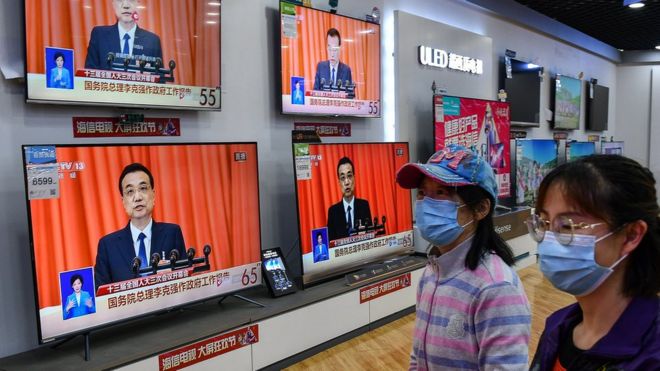
Image copyright AFP / GETTYImage caption Shoppers walking past a broadcast of Chinese Premier Li Keqiang delivering his speech at the opening of the NPC on Thursday
China’s ruling Communist Party has set in motion a controversial national security law for Hong Kong, a move seen as a major blow to the city’s freedoms.
The law to ban “treason, secession, sedition and subversion” could bypass Hong Kong’s lawmakers.
Critics say China is breaking its promise to allow Hong Kong freedoms not seen elsewhere in China.
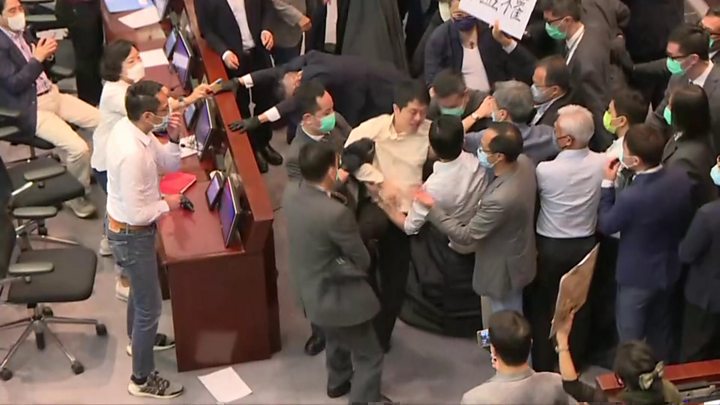
It is likely to fuel public anger and may even trigger fresh protests and demands for democratic reform.
The plan was submitted at the annual National People’s Congress (NPC), which largely rubber-stamps decisions already taken by the Communist leadership, but is still the most important political event of the year.
Hong Kong, a semi-autonomous region and an economic powerhouse, was always meant to have introduced such laws after the handover from British control to Chinese rule in 1997.
After last year’s wave of sustained and violent protest, Beijing is now attempting to push them through, arguing “law-based and forceful measures” must be taken to “prevent, stop and punish” such protests in the future.
On Friday, Hong Kong’s government said it would co-operate with Beijing to enact the law, adding it would not affect the city’s freedoms.
That article says Hong Kong “must improve” national security, before adding: “When needed, relevant national security organs of the Central People’s Government will set up agencies in Hong Kong to fulfil relevant duties to safeguard national security in accordance with the law.”
China could essentially place this law into Annex III of the Basic Law, which covers national laws that must be implemented in Hong Kong – either by legislation, or decree.
Addressing the congress, Premier Li Keqiang spoke of the economic impact of the coronavirus and on Hong Kong and Macau said: “We’ll establish sound legal systems and enforcement mechanisms for safeguarding national security in the two Special Administrative Regions.”
What do opponents say the dangers are?
Hong Kong is what is known as a “special administrative region” of China.
It has observed a “one country, two systems” policy since Britain returned sovereignty in 1997, which has allowed it certain freedoms the rest of China does not have.
Pro-democracy activists fear that China pushing through the law could mean “the end of Hong Kong” – that is, the effective end of its autonomy and these freedoms.
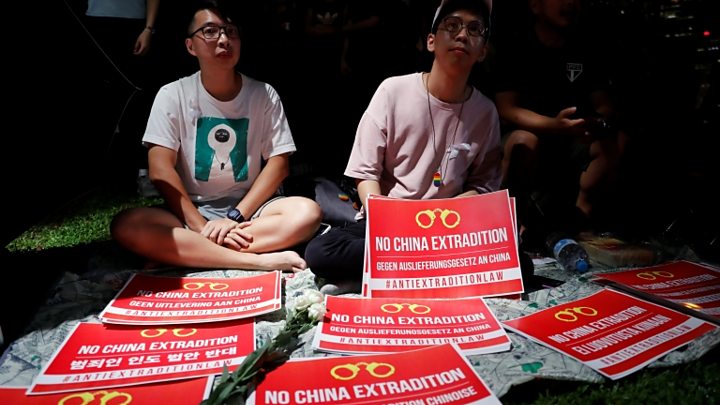
Last year’s mass protests in Hong Kong were sparked by a bill that would have allowed extraditions to mainland China.
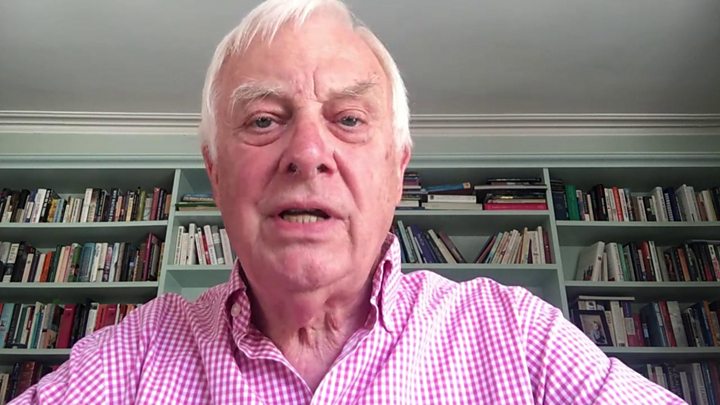
Media caption Former Hong Kong governor Chris Patten: “UK should tell China this is outrageous”
The bill was paused, then withdrawn – but the protests continued until the virus outbreak at the end of the year.
The US has also weighed in, with President Trump saying the US would react strongly if it went through – without giving details.
It is currently considering whether to extend Hong Kong’s preferential trading and investment privileges.
Why is China doing this?
Mr Wang said the security risks had become “increasingly notable” – a reference to last year’s protests.
“Considering Hong Kong’s situation at present, efforts must be made at the state-level to establish and improve the legal system and enforcement mechanisms,” he is quoted as saying in state media.
Media caption The BBC’s Helier Cheung on Hong Kong’s 2019 protests
Beijing may also fear September’s elections to Hong Kong’s legislature.
If last year’s success for pro-democracy parties in district elections is repeated, government bills could potentially be blocked.
What is Hong Kong’s legal situation?
Hong Kong was under British control for more than 150 years up to 1997.
The British and Chinese governments signed a treaty – the Sino-British Joint Declaration – that agreed Hong Kong would have “a high degree of autonomy, except in foreign and defence affairs”, for 50 years.
This was enshrined in the Basic Law, which runs out in 2047.
NEW DELHI (Reuters) – India’s government has stepped up the purchase of air purifiers over the last two years, taking the number of devices in ministries to protect against deteriorating air quality to nearly 300, government data seen by Reuters showed.
Six federal ministries – including the health, foreign and home affairs – bought at least 159 air purifiers during 2018-2019 at a cost of 5 million rupees ($70,353), according to previously unpublished data obtained under a Right to Information (RTI) law.
That compares with at least 140 air purifiers bought for $55,000 during 2014-2017 for the six ministries and Prime Minister Narendra Modi’s office, as previously reported by Reuters. The latest data on purchases for Modi’s office was not available. (reut.rs/2ppjyBj)
The purchases come as the federal and city governments faced criticism for failing to address the problem of worsening air pollution, especially in the winter, and drew criticism from one activist.
“It’s absolutely criminal to spend taxpayers’ money in buying air purifiers for government officials,” said environmentalist Vimlendu Jha, who is a member of a government panel tasked with solving Delhi’s pollution crisis.
In November, the level of pollution in the capital forced authorities to shut schools, restrict the use of cars and declare a public health emergency.
A senior official at the environment ministry, which bears the most responsibility for tackling pollution, said there was no particular drive to buy purifiers to protect civil servants.
“The government is not spending a fortune by buying air purifiers. And it’s not that officials don’t get to inhale toxic air by confining themselves to their offices,” said the ministry official.
The six ministries and Modi’s office did not respond to requests for comment.
Air purifiers can cost up to nearly $1,000 and are too expensive for most Indians.
Per capita income in New Delhi, a city of more than 20 million, is about $400 a month and thousands of homeless people endure the cold and the toxic air while sleeping on the streets.
Reuters requested for data using the RTI law from the six ministries as it had comparable numbers previously reported in 2018. These were the ministries of foreign affairs, tourism, agriculture, health, home affairs and the federal think-tank Niti Aayog.
(Graphic: Modi’s government purifer purchases 2018-2019 link: here).
Of the total of 159 devices bought by the ministries, the home affairs ministry topped the list with 103 of them in 2018 and 2019, the data showed.
“All the air purifiers have been installed in various offices/rooms of this ministry,” the ministry said in its RTI response, adding the amount spent was 3.1 million rupees ($43,619).
In October and November, when New Delhi saw some its worst air pollution last year, the foreign ministry bought 12 purifiers. Four of them – bought for the minister’s office – were priced at nearly $1,000 each.
The federal health ministry bought 23 air purifiers in the last two years, including 14 in 2019, its highest annual purchases since 2015, the data showed.
NEW DELHI (Reuters) – Violent clashes erupted in Delhi between police and hundreds of university students on Friday over the enactment of a new citizenship law that critics say undermines India’s secular foundations.
The unrest has already led Japanese Prime Minister Shinzo Abe to cancel a planned visit to India from Sunday.
The new law offers a way to Indian citizenship for six minority religious groups from neighbouring Bangladesh, Pakistan and Afghanistan including Hindus and Christians, but not Muslims.
RELATED COVERAGE
Explainer: What does India’s new citizenship law mean?
Clashes erupt in New Delhi between students, police over citizenship law
See more stories
Police fired tear gas and used baton charges to disperse scores of students demonstrating at Jamia Millia Islamia university in the heart of Delhi over the law.
Protesters attacked cars in the capital, and several people were injured and taken to hospital.
Zakir Riyaz, a PhD student in social work, said the new law made a mockery of India’s religious openness.
“It goes against the whole idea of a secular India,” he said, speaking by phone from the Holy Family Hospital in New Delhi where 15 of his fellow students were admitted after being injured in a police baton charge.
Police barricades were knocked down and streets were strewn with shoes and broken bricks. An official at the university dispensary said that more than 100 students had been brought in with injuries but all had been discharged.
Parvez Hashmi, a local politician who went to the protest site to speak to police, said about 50 students had been detained.
Students said it was meant to be a peaceful protest, with them trying to go from Jamia University to Parliament Street to show their opposition to the legislation. But police pushed them back, leading to clashes.
Critics of Prime Minister Narendra Modi’s government say it is promoting a Hindu-first agenda for India and that the citizenship law excluding Muslims showed a deep-seated bias against India’s 170 million Muslims.
Imran Chowdhury, a researcher, said “either give citizenship to refugees of all religions or none at all. The constitution is being tampered with in the name of religion.”
Modi’s ruling Bharatiya Janata Party denies any religious bias but says it is opposed to the appeasement of one community. It says the new law is meant to help minority groups facing persecution in the three nearby Muslim countries.
ABE CANCELS
The United Nations human rights office voiced concern that the new law is “fundamentally discriminatory in nature”, and called for it to be reviewed.
Two people were killed in India’s Assam state on Thursday when police opened fire on mobs torching buildings and attacking railway stations in protest at the new citizenship rules signed into law on Thursday.
Japan’s Prime Minister Shinzo Abe cancelled a trip to Assam for a summit with his Indian counterpart Narendra Modi that had been due to begin on Sunday.
Japan has stepped up infrastructure development work in Assam in recent years, which the two sides were expected to highlight during the summit. Abe had also planned to visit a memorial in the nearby state of Manipur where Japanese soldiers were killed in World War Two.
“With reference to the proposed visit of Japanese PM Abe Shinzo to India, both sides have decided to defer the visit to a mutually convenient date in the near future,” Indian foreign ministry spokesman Raveesh Kumar said in a tweet.
Japan’s Chief Cabinet Secretary Yoshihide Suga said both countries would decide on the appropriate timing for the visit although nothing has been decided yet.
A movement against immigrants from Bangladesh has raged in Assam for decades. Protesters there say granting Indian nationality to more people will further strain the state’s resources and lead to the marginalisation of indigenous communities.
SHANGHAI, Jan. 31 (Xinhua) — Shanghai’s municipal legislature on Thursday adopted a set of regulations on household garbage sorting and recycling, which will become effective on July 1.
In 2018, nearly 26,000 tonnes of house refuse needed to be disposed every day, with the total volume of household garbage surpassing 9 million tonnes.
“The growing demand of garbage disposal has imposed mounting pressure on Shanghai’s sustainable development,” Xiao Guiyu, deputy director of the Standing Committee of the Shanghai Municipal People’s Congress, told the lawmakers.
Shanghai will complete a sophisticated garbage disposal system including efforts in garbage sorting, collecting, transportation and recycling. Efforts will also be carried out in reducing the city’s total volume of house refuse.
The regulations also specify the legal responsibilities of individuals and units concerned, who shall take the responsibilities of sorting garbage according to the categories of recyclable, hazardous, wet, and dry waste.
According to the regulations, units will face fines up to 500,000 yuan (nearly 75,000 U.S. dollars) for violating the waste disposal rules, and individual will be fined 50 to 200 yuan for illegal activities.
In order to reduce the total waste volume, the city will introduce more environmentally-friendly packing materials and promote economical packaging standards against over-packaging.
The regulations also encourage going paperless at work especially in Party and government offices, as well as public institutions. Disposable dishware and chopsticks will also be discouraged in restaurants and during catering services.
Business players who disobey the rules will face fines ranging from 500 yuan to 5,000 yuan, said Ding Wei, a lawmaker in Shanghai.
Over 40 Chinese cities have set up pilot zones to promote garbage sorting and recycling, said Zhang Zhao’an, vice president of Shanghai Academy of Social Science.
Shanghai will also carry out stronger supervision and punishment of illegal activities, said Mayor Ying Yong at a press conference Thursday.
“Everyone should be a part of the campaign of garbage sorting,” Ying said.
BEIJING (Reuters) – China’s top prosecutor said on Thursday that two Canadians detained after Canada arrested a Chinese technology company executive had “without a doubt” violated the law.
Authorities in Beijing had previously said the two men, Michael Kovrig, a former diplomat and an adviser with the International Crisis Group (ICG) think-tank, and businessman Michael Spavor, were suspected of endangering state security.
“Without a doubt, these two Canadian citizens in China violated our country’s laws and regulations, and are currently undergoing investigation according to procedure,” Zhang Jun, China’s prosecutor general, said.
Zhang said the investigation process had been handled “strictly” according to law when asked by Reuters at a briefing when the two men might be charged. He did not elaborate.
The two were detained after Canadian police arrested Huawei Technologies Co Ltd’s chief financial officer Meng Wanzhou on Dec. 1 in Vancouver, at the request of the United States.
U.S. prosecutors have accused her of misleading banks about transactions linked to Iran, putting the banks at risk of violating sanctions.
The Chinese government has only given vague details about the detention of the two Canadians, and it has not drawn a direct link to Meng’s arrest. It has demanded that Canada free her and threatened unspecified consequences if it does not.
Canada has said several times it saw no explicit link between the arrest of Meng, the daughter of Huawei’s founder, and the detentions of Kovrig and Spavor.
But Beijing-based Western diplomats and former Canadian diplomats have said they have no doubt the cases are linked.
Canada has said the detentions are unacceptable and U.S. Secretary of State Mike Pompeo has said China should free the men.
Under Chinese criminal procedure law, special forms of detention and interrogation can be used for state security suspects.
China touts the rule of law, but its judicial system is tightly controlled by the ruling Communist Party.
Rights groups say conditions in Chinese detention facilities are often basic and can be harsh, with lack of legal representation and due process compounding worries about treatment.




 CHINDIA ALERT: You'll be living in their world, very soon