Archive for ‘lawmakers’

31/05/2020

Spotlight: Washington faces blast at home, abroad for “terminating” ties with WHO

BEIJING, May 31 (Xinhua) — The U.S. government has been slammed at home and abroad after announcing on Friday “terminating” its relationship with the World Health Organization (WHO).

U.S. health experts and lawmakers have expressed concern over the decision announced by President Donald Trump amid the COVID-19 outbreak.

Patrice Harris, president of the American Medical Association, described Trump’s move as a “senseless” action with “significant, harmful repercussions.”

“COVID-19 affects us all and does not respect borders; defeating it requires the entire world working together,” Harris was quoted by CNN as saying, urging Trump to reverse the course.

Lawrence Gostin, a professor of global health law and director of the O’Neill Institute for National and Global Health Law at Georgetown University, described the move as “foolish and arrogant” in his Twitter account.

“Trump’s action is an enormous disruption and distraction during an unprecedented health crisis,” said Gostin, also the director of the WHO collaborating center on national and global health law. “The President has made us less safe.”

Democratic Senator Joe Manchin of West Virginia said that “the United States cannot eliminate this virus on its own and to withdraw from the World Health Organization — the world’s leading public health body — is nothing short of reckless,” according to a CNN report.

Even within the Republican party, some Republicans also expressed their disagreement. Senate Health Committee Chairman Lamar Alexander reportedly said he disagreed with Trump’s decision, because, without U.S. funding, clinical trials to develop a COVID-19 vaccine might be hampered.

In addition, the European Union (EU) has urged the United States to reconsider its termination of ties with the WHO, warning that Trump’s move would erode global efforts to curb the spread of the virus.

“The WHO needs to continue being able to lead the international response to pandemics, current and future. For this, the participation and support of all is required and very much needed. In the face of this global threat, now is the time for enhanced cooperation and common solutions. Actions that weaken international results must be avoided,” Ursula von der Leyen, president of the European Commission, and Josep Borrell, the EU High Representative for Foreign Affairs and Security Policy, said in the statement on Saturday.

“In this context, we urge the U.S. to reconsider its announced decision,” the statement said.

German Health Minister Jens Spahn tweeted that Trump’s move was “a disappointing backlash for International Health.”

“The EU must take a leading role and engage more financially,” Spahn said, noting that this would be one of Germany’s priorities when it becomes the bloc’s rotating presidency on July 1.

British Prime Minister Boris Johnson’s spokesperson said earlier that Britain “has no plans to stop funding the WHO, which has an important role to play in leading the global health response.”

“Coronavirus is a global challenge and it is essential that countries work together to tackle this shared threat,” the spokesperson was quoted by The Guardian as saying.

Irish Minister for Health Simon Harris on Friday described Trump’s move as an “awful decision.”

“A global pandemic requires the world working together … We should unite in our fight against it (COVID-19) & not fight each other,” Harris tweeted.

Russian Foreign Ministry spokesperson Maria Zakharova told TASS news agency that Washington “dealt a blow” to the international framework for cooperation in healthcare at the moment when the world needed to join forces.

Source: Xinhua

28/05/2020

China’s Civil Code adopted at national legislature

BEIJING, May 28 (Xinhua) — Chinese lawmakers Thursday voted to adopt the country’s long-expected Civil Code at the third session of the 13th National People’s Congress, the top legislature.

The Civil Code will take effect on Jan. 1, 2021.

In addition to general provisions and supplementary provisions, the Civil Code, the world’s latest modern-day civil law, has six parts on real rights, contracts, personality rights, marriage and family, succession, and tort liabilities.

The personal rights, property rights and other lawful rights and interests of the parties to civil legal relations shall be protected by law and shall not be infringed upon by any organization or individual, reads the Civil Code in its opening chapter.

Lawmakers say the codification is not about formulating a new civil law but rather systematically incorporating existing civil laws and regulations, modifying and improving them to adapt to new situations while maintaining their consistency.

A major innovation of China’s Civil Code, jurists say, is embodied in the personality rights part. While some countries have related law provisions, few have a specific law book in civil code dedicated to protecting personality rights.

The personality rights part covers stipulations on a civil subject’s rights to his or her life, body, health, name, portrait, reputation and privacy, among others.

The personality rights part shows that China has reached a new height in protecting the dignity of people, said Chen Jingying, a national lawmaker and vice president of East China University of Political Science and Law.

The Civil Code is a milestone in developing the socialist legal system with Chinese characteristics, and will greatly boost the modernization of China’s system and capacity for governance, said Wang Yi, dean of the law school at Renmin University of China.

Source: Xinhua

01/05/2020

Australia accelerates decision on whether to lift COVID-19 restrictions

SYDNEY (Reuters) – The Australian government said on Friday it would meet a week ahead of schedule to decide whether to ease social distancing restrictions, as the numbers of new coronavirus infections dwindle and pressure mounts for business and schools to reopen.

Australia has reported about 6,700 cases of the new coronavirus and 93 deaths, well below the levels reported in the United States and Europe. Growth in new infections has slowed to less 0.5% a day, compared to 25% a month ago.

Prime Minister Scott Morrison said it was imperative to lift social distancing restrictions as early as possible as 1.5 million people were now on unemployment benefits and the government forecast the unemployment rate to top 10% within months.

“We need to restart our economy, we need to restart our society. We can’t keep Australia under the doona,” Morrison said, using an Australian word for quilt.

Morrison’s government has pledged spending of more than 10% of GDP to boost the economy but the central bank still warns the country is heading for its worst contraction since the 1930s.

With less than 20 new coronavirus cases discovered each day, Morrison said state and territory lawmakers would meet on May 8 – a week earlier than expected – to determine whether to lift restrictions.

“Australians deserve an early mark for the work that they have done,” Morrison told reporters in Canberra.

Australia attributes its success in slowing the spread of COVID-19 to social distancing restrictions imposed in April, including the forced closures of pubs, restaurants and limiting the size of indoor and outdoor gatherings.

Morrison said 3.5 million people had downloaded an app on their smartphones designed to help medics trace people potentially exposed to the virus, though the government is hoping for about 40% of the country’s 25.7 million population to sign up to ensure it is effective.

Cabinet will also decide next week how to restart sport across the country, the prime minister said.

The government says any resumption of sport should not compromise the public health, and recommends a staggered start beginning with small groups that play non-contact contact sport outdoors.

The recommendations suggests Australia’s National Rugby League (NRL) competition may not get permission to restart its competition as soon as many in the sports-mad country would like.

Source: Reuters

25/10/2019

Chinese survey ship involved in South China Sea stand-off with Vietnam back home, tracker says

  • Haiyang Dizhi 8 in waters close to Macau as of 4pm Friday, MarineTraffic reports
  • Vessel’s work in disputed waters ‘now complete’, foreign ministry says
The Haiyang Dizhi 8 was close to Macau as of Friday afternoon, according to the MarineTraffic maritime information service. Photo: Weibo
The Chinese survey ship that has been at the centre of a stand-off with Vietnam in the

South China Sea

was back in waters close to home on Friday afternoon, according to an online platform that provides information about maritime activity.

As of 4pm, the Haiyang Dizhi 8 (Marine Geology 8), which had been operating close to Vanguard Bank – a disputed reef in the Spratly Island chain claimed by both Beijing and Hanoi – was located just off Macau, the MarineTraffic service said.
China’s foreign ministry said on Thursday that the vessel had finished the work it had started “in Chinese-controlled waters in early July”.
“According to our understanding the work is now complete,” spokeswoman Hua Chunying told a regular press briefing, without elaborating.
The Japanese oil rig, Hakuryu 5, is reported to have completed its drilling mission near Vanguard Bank earlier this week. Photo: Japan Drilling Co
While in the Vanguard Reef area, the Haiyang Dizhi 8, escorted by heavily armed coastguard vessels, made multiple passes by an oil block operated by Russian energy company Rosneft.

Observers say the presence of the Chinese vessels in the region is part of Beijing’s efforts to prevent Hanoi from partnering with international energy firms to explore energy reserves in the disputed waterway. The latest activity triggered a months-long stand-off between the two countries.

The departure of the Haiyang Dizhi 8 came amid reports that the Japanese oil rig, Hakuryu 5, owned by Tokyo-based Japan Drilling Company and employed by Rosneft, had earlier this week completed a drilling mission it started in May near Vanguard Bank.

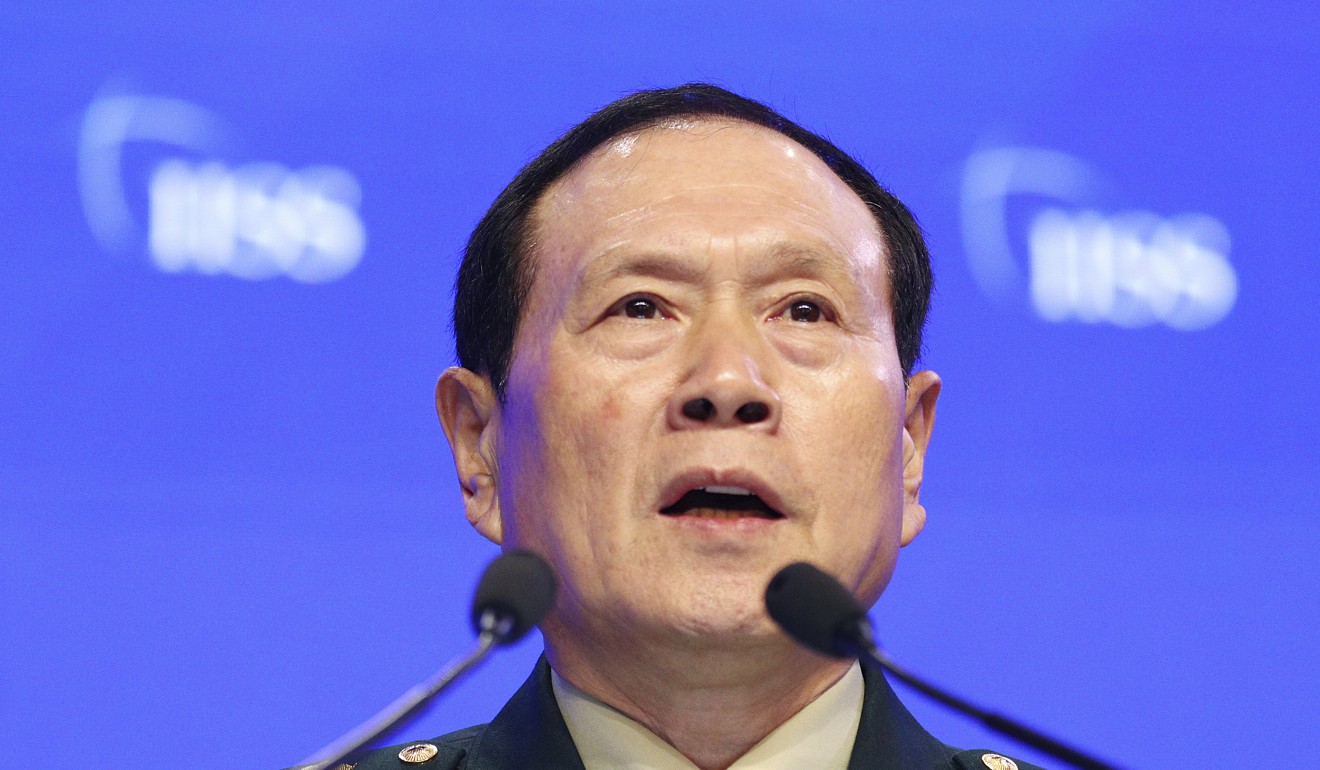
China’s Defence Minister Wei Fenghe told a regional security conference that the South China Sea was an inalienable part of China’s territory. Photo: AP

Although China and Vietnam have said they are looking for a diplomatic solution to prevent confrontations, neither has shown any signs of backing down and tensions have continued to rise.

On Monday, China’s Defence Minister Wei Fenghe told military and defence officials attending a regional security conference in Beijing that the South China Sea was an inalienable part of China’s territory.

“We will not allow even an inch of territory that our ancestors have left to us to be taken away,” he said in his opening speech at the Xiangshan Forum.

Also on Monday, Vietnamese Prime Minister Nguyen Xuan Phuc told lawmakers at the National Assembly that Hanoi would never give any territorial concessions.

“The situation in the South China Sea has become increasingly complicated,” he said. “Our party and state have consistently stated that what belongs to our independence, sovereignty and territorial integrity, we will never give up.”

Last week, Hanoi pulled DreamWorks’ animated film Abominable from theatres over a scene featuring a map that shows Beijing’s self-declared “nine-dash line” in the South China Sea. China uses the U-shaped line to claim sovereignty over more than 80 per cent of the resource-rich waterway, parts of which are also claimed by Vietnam, Malaysia, the Philippines and Brunei.

Ian Storey, a senior fellow at the ISEAS-Yusof Ishak Institute in Singapore, said that the withdrawal of the Haiyang Dizhi might only be “temporary”.

“China has made its point about drilling activities within the nine-dash line and expects Vietnam to suspend further exploration and production activities,” he said. “[But] of course Vietnam won’t.”

China, Malaysia seek to resolve South China Sea disputes with dialogue mechanism

Zhang Mingliang, a specialist in Southeast Asian affairs at Jinan University in the south China city of Guangzhou, said that the Chinese ship’s withdrawal was unlikely to have had anything to do with the comments made by Vietnam.

“I think the main reason is that it had finished its work,” he said. “But the withdrawal could also be seen as an attempt to ease the [China’s] tensions with the US.”

The significance for relations between Beijing and Hanoi was minimal, he said, as the two nations were engaged in one of the world’s most complicated territorial disputes.

“The impact on Sino-Vietnam relations will be limited because there have been too many disputes like this one,” he said.

Source: SCMP

06/09/2019

The solar-powered ‘tree’ that turns the sea into drinking water

  • Material that generates heat from sunlight could provide self-maintaining water supply on remote islands
An international research team used solar power to generate a supply of drinking water. Photo: Chinese Academy of Sciences

A Chinese-led international research team has created a “tree” that can generate clean drinking water.

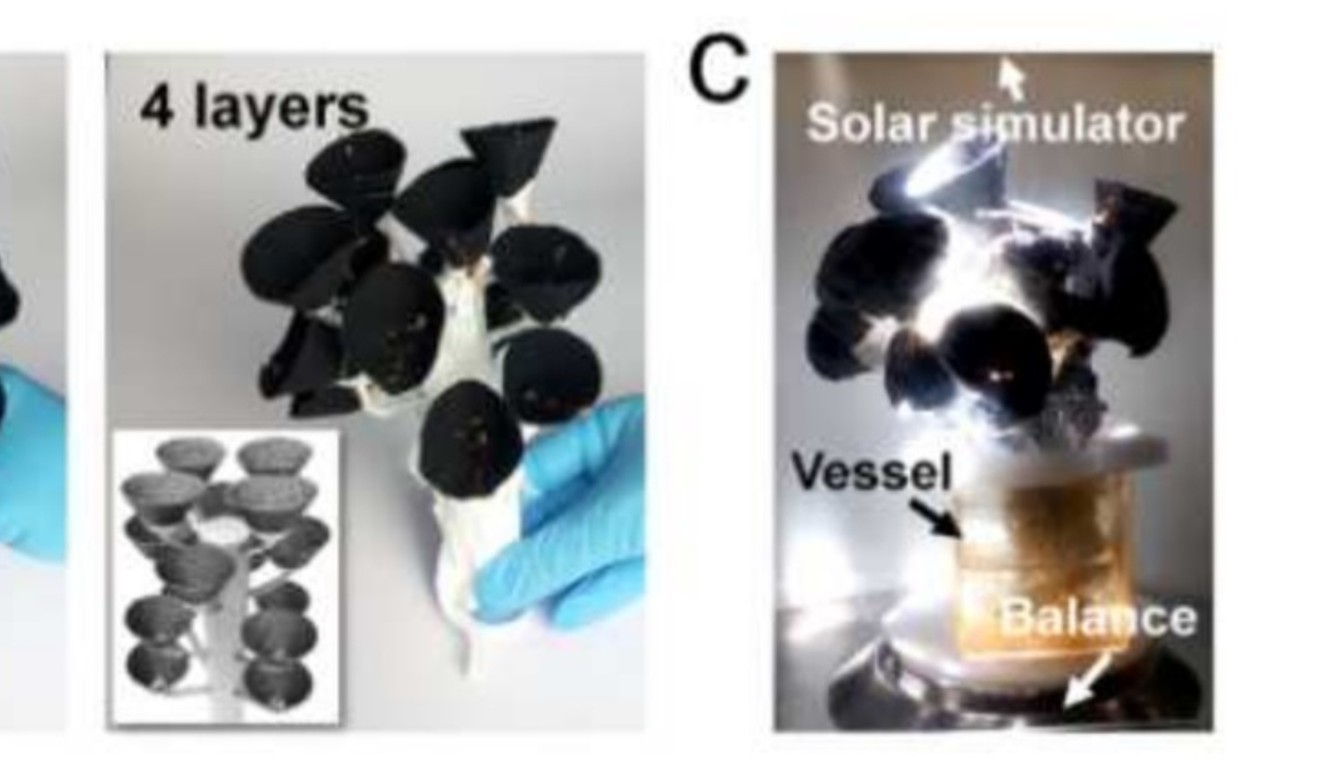
Drawing its energy entirely from the sun just like a real tree, the “water tree” has a root made of cotton fabric that can absorb water from its surroundings, such as from sand on a beach.

After water moves up the stem, it is vaporised by “leaves” made of black-carbon paper cones that convert light energy to heat, reaching nearly 50 degrees Celsius (122 Fahrenheit). The tree sits in a glass chamber with a relatively cool surface that collects the vapour.

Using standard cotton fabric and a new nanomaterial that can be cheaply mass-produced from charcoal, a paper cone with a surface area as large as 1 square metre would cost only US$2, according to the researchers.

The cones, which function like leaves, could be mass-produced cheaply, researchers say. Photo: Chinese Academy of Sciences

A cone that size can generate up to 3.4kg (7.5lbs) of condensed water per hour, faster than any other solar-powered desalination methods previously reported.

Even on a cloudy day, the total output in seven hours of sunlight can reach 5.4kg, or three times the amount the typical adult needs to stay hydrated.

One tree can have multiple layers of branches, each with several cones to increase the vapour-producing surface area.

The study, published this month in the journal Nano Energy, was led by Professor Chen Tao at the Chinese Academy of Sciences’ Ningbo Institute of Material Technology and Engineering in Zhejiang province, and also involved researchers from Singapore and Taiwan.

World’s thirst for fresh water is causing a big toxic problem

One of the paper’s co-authors, Dr Ouyang Jianyong, associate professor at the National University of Singapore’s department of materials science and engineering, told the South China Morning Post that the technology could be applied in remote places such as on islands in the South China Sea.

“It is particularly useful for isles far away without a stable drinking water supply,” Ouyang said. “These ‘trees’ may not be able to quench the thirst of a large city, but they can meet the critical demand of a small community, especially in emergencies.

“We are already in contact with some companies [to commercialise the technology],” he added.

The material used to make the cone has several advantages, according to Ouyang. The cones can absorb a wide spectrum of sunlight, maximising the amount of energy they can collect, and their porous structure allows them to release vapour quickly.

Lawmakers endorse plan for HK$7.7 billion desalination plant

When used to desalinate a supply of seawater, the trees would be self-cleaning at night, by water washing away salt residue without being vaporised as it would during sunlight hours.

The vapour-producing fabric is as thin and lightweight as a few sheets of paper. It can be folded and sewn into almost any shape, or cleaned in a washing machine, and can operate effectively for several years in a harsh environment, the researchers say.

The condensed water meets stringent safety standards for direct drinking set by the World Health Organisation, according to the researchers.

Source: SCMP

17/08/2019

‘Risks still too big’ for China to send in troops to quell Hong Kong unrest

  • Chinese government advisers say Beijing has not reached direct intervention point but that could change if the violence continues
  • Military action would trigger international backlash, observers say, as US expresses concern over reported paramilitary movements and ‘erosion of Hong Kong’s autonomy’
Footage of trucks from the paramilitary People’s Armed Police in Shenzhen has circulated online. Photo: Handout
The unrest in Hong Kong does not yet warrant direct intervention by Beijing despite hardening public sentiment and calls for tougher action in mainland China, according to Chinese government advisers.
Shi Yinhong, an international relations expert at Renmin University and an adviser to the State Council – China’s cabinet – said China would risk damaging its ties with the United States and other major foreign powers, upsetting its own development and losing Hong Kong’s special status if it took the matter directly into its hands.
“I don’t think we need to use troops. Hong Kong police will gradually escalate their action and they haven’t exhausted their means,” Shi said, expressing a view shared by other mainland government advisers and academics.
But he warned that if the violence and chaos continued, it “won’t be too far away from reaching that point”.

A US State Department spokeswoman said the United States was “deeply concerned” about reports of paramilitary movements along the Hong Kong border and reiterated a US call for all sides to refrain from violence.

She said it was important for the Hong Kong government to respect “freedoms of speech and peaceful assembly” and for Beijing to adhere to its commitments to allow a high degree of autonomy for Hong Kong.

She said the protests reflected “broad and legitimate concerns about the erosion of Hong Kong’s autonomy”.

“The continued erosion of Hong Kong’s autonomy puts at risk its long-established special status in international affairs,” she said.

It comes after massive anti-government protests at Hong Kong International Airport

brought the city’s air traffic to a halt and triggered a huge backlash on the mainland
, where the public feel they have been wrongly targeted by the increasingly violent protesters. Many demanded the central government take action to end the chaos.
The tension deepened after US President Donald Trump, citing intelligence sources,

tweeted that the Chinese government was moving troops

to the border with Hong Kong. Trump described the situation in the city as “tricky” and called on all sides to remain “calm and safe”.

Footage of trucks from the paramilitary People’s Armed Police rolling into Shenzhen began circulating online on Saturday.
Beijing ‘unlikely to intervene’ in Hong Kong as pressure mounts on police

But Shi and others said direct intervention would be too costly to China and would only be used when all other methods had been exhausted.

“As the trade war with the US goes on, Hong Kong’s importance to our financial system is getting bigger,” Shi said. “If Beijing intervenes with too much assertiveness, the US might revoke the preferential status of Hong Kong.”

He was referring to the US’ 1992 Hong Kong Policy Act which gives the city a special status. In June, American lawmakers introduced a bipartisan bill requiring the US government to examine Hong Kong’s autonomy annually to decide whether to extend the arrangement.

Losing that status could cripple the operations of many businesses based in Hong Kong, said Shen Dingli, a Shanghai-based international affairs expert.

A satellite image appears to show a close-up of Chinese military vehicles at Shenzhen Bay Sports Centre in Shenzhen. Photo: Maxar Technologies

Wang Yong, another specialist on international political economy with Peking University, agreed.

“There would be a lot of opposition from interest groups in the US. Hong Kong is the bridgehead for many multinational corporations and investors from Wall Street to get into the Chinese market,” said Wang, who also teaches at an academy affiliated with China’s Ministry of Foreign Affairs.

“Hong Kong and the Chinese government will need to handle this with extra care, so as not to give any ammunition to hawks in the United States.

“If Hong Kong is not handled properly, it could add tensions to the bilateral ties and ruin any prospect of a trade deal.”

China rejects requests for US warships to visit Hong Kong amid protests Pang Zhongying, an international relations specialist at Ocean University of China in Qingdao, said direct intervention could also damage China’s ties with other countries.

“The whole world is watching. Beijing has exercised restraint for two months and still hasn’t taken any clear action because this is not an easy choice,” said Pang, who is also a member of the Beijing-based Pangoal Institution, a think tank that advises several ministerial offices.

While some observers said Beijing was under political pressure to end the protests in Hong Kong before October 1 – the 70th anniversary of the founding of the People’s Republic, Shi said the central government would not lose patience so easily.

“National Day [on October 1] is an important time, but the Chinese government is not naive to believe there has to be peace under all heaven then,” he said.

“It’s only a bit more than a month from now, we can almost say for sure the trade war will still be on by then and a major turning point in Hong Kong is not likely to happen. But the celebration must go on.”

Source: SCMP

18/05/2019

Lawbreakers to lawmakers? The ‘criminal candidates’ standing in India’s election

NEW DELHI (Reuters) – The Bharatiya Janata Party (BJP) has one unwanted lead in this month’s general election race – according to data from an electoral watchdog it is fielding the most candidates among the major parties who are facing criminal charges. Its main rival, Congress, is just a step behind.

Election laws allow such candidates to run so long as they have not been convicted, on grounds both of fairness and because India’s criminal justice system moves so slowly that trials can take years, or even decades, to be resolved.

Still, the number of such candidates accused of offences ranging from murder to rioting has been rising with each election.

Analysts say political parties turn to them because they often have the deepest pockets in steadily costlier elections, and that some local strongmen are seen as having the best chance of winning.

Nearly one-in-five candidates running for parliament in the current election has an outstanding criminal case against them, inching up from 17% in the previous election and 15% in 2009, according to the Association for Democratic Reforms (ADR), a non-profit organisation that analysed candidates’ declarations.

The data shows that 40% candidates from Prime Minister Narendra Modi’s BJP face criminal charges, including crimes against women and murder, followed by the Congress party at 39%.

Among the smaller parties, the Communist Party of India (Marxist) has an even higher proportion, with 58 percent of its candidates embroiled in criminal cases.

Polls have suggested that the BJP and its allies lead the race to win the mammoth, staggered election that began last month and ends on Sunday. Votes will be counted on Thursday.

“Parties only think about winnability and they know that money power and muscle power of such candidates ensures that win,” said Anil Verma, head of the ADR.

With 240 cases against him, K Surendran of the BJP tops the list of candidates with the most outstanding criminal complaints that include rioting, criminal trespass and attempted murder.

He said most of the cases stem from his involvement in the BJP campaign to oppose the entry of women and girls of menstruating age into the Sabarimala temple in his home state of Kerala.

“I understand that an outsider might feel that I am a grave offender but, in reality, I am completely innocent of these charges,” he said. “It was all politically motivated.”

Dean Kuriakose from the Congress party has 204 criminal cases against him, the second highest, the data showed. Most of the cases were related to a political agitation against the ruling Communist Party in Kerala, which turned violent.

He was not available for comment. But a party spokesman said Kuriakose was innocent. “He was falsely charged by the police under influence from Kerala government,” the spokesman said.

Political analysts say that often people vote for candidates who face criminal charges because they are seen as best placed to deliver results. In some parts of India local strongmen mediate in disputes and dispense justice.

“Powerful people, even if criminals, offer a kind of parallel system of redressal,” said K.C. Suri, a professor of political science at the University of Hyderabad.

A separate ADR survey of more than 250,000 voters last year found 98% felt candidates with criminal backgrounds should not be in parliament, though 35% said they were willing to vote for such a candidate on caste grounds or if the candidate had done “good work” in the past.

Source: Reuters

15/03/2019

Profile: Farmer lawmaker’s fight for rural prosperity

BEIJING, March 14 (Xinhua) — Farmer Zhao Huijie, spiced with humor when speaking at panel discussions at the second session of the 13th National People’s Congress (NPC), China’s national legislature, has a clearer vision for the development of her village.

The 48-year-old woman from north China’s Inner Mongolia Autonomous Region has fought for fortune for her fellow villagers after she became the village Party chief in 2009, and now for the interest of more people in rural China now that she is a deputy to the NPC.

At the ongoing second session of the 13th NPC, Zhao submitted a suggestion on pollution control in animal husbandry and farming in rural areas.

“Random disposal of livestock waste has not only damaged the rural environment, but also polluted groundwater,” she said, advising the government to fund major livestock farms in harmless waste treatment.

She also suggested the government to subsidize farmers to use degradable plastic films to protect the environment.

Unlike legislators in the West who make a career of politics, NPC deputies are from all walks of life and work part-time. Of the nearly 3,000 national lawmakers, more than 15 percent are workers and farmers.

Zhao, an ethnic Manchu, is also one of the 400-plus ethnic minority deputies.

URBAN WOMAN’S RURAL LIFE

Born into a worker’s family, Zhao worked at a gold mine in the city of Chifeng, Inner Mongolia, where she got married in 1991.

“He was four years older than me. I think it was a perfect match considering I am talkative, while he is quiet,” Zhao said of her husband.

Their daughter was born in 1992. In the same year, the gold mine went bankrupt, forcing the couple back to her husband’s home in Xiaomiaozi Village.

Located between two mountains with a river traversing through, Xiaomiaozi was known for its poverty back then. Shabby houses, bumpy roads and barren farmland formed the major landscape, and the only crop villagers grew was corn.

To make ends meet, Zhao’s husband found a job in town, and she rented a small plot of farmland at home.

She had to learn how to farm from scratch, including driving a horse to plow in the field. When she was farming, she had to place her baby on the field ridge.

“I didn’t want to depend on my parents after getting married. If the other villagers could get used to the country life here, how could I not?” she said.

In 1995, she started teaching at the village elementary school. Four years later, she was assigned to take charge of family planning and women’s work in the village.

“I was familiar with every household — newborn babies, young brides marrying into our village, and the elderly,” Zhao said.

In 2009, she was elected unanimously as the village Party chief.

As soon as she took office, Zhao was asked to attend “a meeting” in the township.

“It turned out to be a training for Party chiefs of backward villages. That was shameful,” she said, determined to change the situation.

NEW ROAD, NEW LIFE

The first thing she decided to work on was to build a concrete road, as she found corn buyers were reluctant to come due to the bumpy roads. Higher transport costs even dragged down corn prices in the village.

For more than a year, Zhao visited door to door to persuade villagers to relocate to give way to the road. She talked so much that she was diagnosed with sphagitis, and had to undergo a surgery.

“I liked singing in the past, but after the surgery, I could never hold a high note,” she said.

After the road project was completed, Zhao had a bridge built, ending the days when villagers had to trek in waters to cross the river.

In 2013, when Zhao engaged herself in the bridge project, she broke her left arm and knee in a road accident.

“After work, I was riding my motorcycle in the dark when a donkey rushed on to the road. I was thrown away along with the vehicle,” she said.

Instead of lying in bed, Zhao insisted going to the construction site on crutches, touching the villagers and drawing more and more followers.

Li Yongbo, a villager who used to work in Beijing, was persuaded home and led the farmers to grow traditional Chinese medicine (TCM) such as balloon flower root, which secures three times the income of corn.

According to Li, the sandy soil, big day-and-night temperature difference and easy access to irrigation made the village an ideal place for TCM plantation.

The village has expanded the TCM plantation areas to more than 200 hectares now, producing more than 4,000 tonnes of TCM every year. A TCM processing workshop has been established, further doubling the income from mere TCM plantation.

The per capita income of the village reached 14,000 yuan (2,087 U.S. dollars) in 2018, 10,000 yuan more than the levels of 2010.

“As villagers get rich and spend more, my tiny store now can bring me more than 100,000 yuan of profit every year,” grocery runner You Junguang said.

Last year, Zhao was elected as a deputy to the 13th NPC. She suggested utilizing private investment in rural development.

“To my delight, the Ministry of Finance replied to me, accepting my suggestion and pledging to encourage private investors to contribute to revitalizing the rural areas.”

Zhao said they had registered “Xiaomiaozi Village” as a brand, and were talking to a tourism company on cooperation to entice tourists with the village’s Manchu and Mongolian ethnic cultures, as well as its beautiful landscape.

After graduating from college, Zhao’s daughter found a teaching job in Changsha City in central China in 2014. Her son is studying in a senior high school in Chifeng City. Zhao is too busy to visit them.

“I feel guilty because I have rarely taken care of my kids. But I hope I can set an example for them by trying my best to do everything, be it vital or trivial, and making positive contribution to the society,” she said.

Source: Xinhua

28/02/2019

Lawmakers brainstorm methods to seal victory over poverty

BEIJING, Feb. 27 (Xinhua) — Chinese lawmakers have met at a bimonthly legislative session to discuss a research report on poverty relief, and brainstormed methods to seal the country’s victory against poverty.

The report was based on the investigation led by three National People’s Congress (NPC) Standing Committee vice chairpersons into poverty alleviation efforts in 16 provinces and regions last year.

It was reviewed at the two-day committee session, which ended Wednesday.

Delivered at the session by Wu Weihua, vice chairperson of the NPC Standing Committee, the report said that “decisive progress” had been made in the anti-poverty fight but circumstances remained challenging.

Support for extremely impoverished regions should be continuously strengthened, according to Li Yuefeng, a member of the standing committee, who said that areas in abject poverty still posed the most difficult tasks in the battle against poverty, and called for consistent efforts to make sure they did not lag behind.

Fellow lawmaker Liu Yuankun believes the problems for extremely poor areas are rooted in their economy and society, and suggested poverty relief in such areas be integrated with local economic and social development.

“As soon as transportation works, everything will work,” he said, stressing the construction of infrastructure, which allows funds, talent and industries to flow into impoverished areas.

Another member Zheng Gongcheng said that only by building inner faith and hope could the endogenous power to defeat poverty be long-lasting, and suggested prioritizing efforts in education and employment to enhance the capacity of people in poverty.

In 2018, China lifted 13.86 million people in rural areas out of poverty, with the number of impoverished rural residents dropping from 98.99 million in late 2012 to 16.6 million by the end of last year.

The number is still high, however, and many of the impoverished are long suffering from illnesses, disabled, or elderly people with no family, according to the report.

“A long-term and effective mechanism to prevent people from falling back into poverty due to illness is significant,” said Li Xueyong, a member of the NPC Standing Committee, who asked for more measures to cut major illnesses at the root.

Source: Xinhua

Law of Unintended Consequences

continuously updated blog about China & India

ChiaHou's Book Reviews

continuously updated blog about China & India

What's wrong with the world; and its economy

continuously updated blog about China & India