Chindia Alert: You’ll be Living in their World Very Soon
aims to alert you to the threats and opportunities that China and India present. China and India require serious attention; case of ‘hidden dragon and crouching tiger’.
Without this attention, governments, businesses and, indeed, individuals may find themselves at a great disadvantage sooner rather than later.
The POSTs (front webpages) are mainly 'cuttings' from reliable sources, updated continuously.
The PAGEs (see Tabs, above) attempt to make the information more meaningful by putting some structure to the information we have researched and assembled since 2006.
Image copyright GETTY IMAGESImage caption The Chinese city of Wuhan recently lifted its strict quarantine measures
The Chinese city of Wuhan, where the coronavirus originated last year, has raised its official Covid-19 death toll by 50%, adding 1,290 fatalities.
Wuhan officials attributed the new figure to updated reporting and deaths outside hospitals. China has insisted there was no cover-up.
It has been accused of downplaying the severity of its virus outbreak.
Wuhan’s 11 million residents spent months in strict lockdown conditions, which have only recently been eased.
The latest official figures bring the death toll in the city in China’s central Hubei province to 3,869, increasing the national total to more than 4,600.
China has confirmed nearly 84,000 coronavirus infections, the seventh-highest globally, according to Johns Hopkins University data.
What’s China’s explanation for the rise in deaths?
In a statement released on Friday, officials in Wuhan said the revised figures were the result of new data received from multiple sources, including records kept by funeral homes and prisons.
Deaths linked to the virus outside hospitals, such as people who died at home, had not previously been recorded.
Media caption Learn how Wuhan dealt with the lockdown
The “statistical verification” followed efforts by authorities to “ensure that information on the city’s Covid-19 epidemic is open, transparent and the data [is] accurate”, the statement said.
It added that health systems were initially overwhelmed and cases were “mistakenly reported” – in some instances counted more than once and in others missed entirely.
A shortage of testing capacity in the early stages meant that many infected patients were not accounted for, it said.
A spokesman for China’s National Health Commission, Mi Feng, said the new death count came from a “comprehensive review” of epidemic data.
In its daily news conference, the foreign ministry said accusations of a cover-up, which have been made most stridently on the world stage by US President Donald Trump, were unsubstantiated. “We’ll never allow any concealment,” a spokesman said.
Why are there concerns over China’s figures?
Friday’s revised figures come amid growing international concern that deaths in China have been under-reported. Questions have also been raised about Beijing’s handling of the epidemic, particularly in its early stages.
In December 2019, Chinese authorities launched an investigation into a mysterious viral pneumonia after cases began circulating in Wuhan.
China reported the cases to the World Health Organization (WHO), the UN’s global health agency, on 31 December.
But WHO experts were only allowed to visit China and investigate the outbreak on 10 February, by which time the country had more than 40,000 cases.
The mayor of Wuhan has previously admitted there was a lack of action between the start of January – when about 100 cases had been confirmed – and 23 January, when city-wide restrictions were enacted.
Around that time, a doctor who tried to warn his colleagues about an outbreak of a Sars-like virus was silenced by the authorities. Dr Li Wenliang later died from Covid-19.
Wuhan’s death toll increase of almost exactly 50% has left some analysts wondering if this is all a bit too neat.
For months questions have been asked about the veracity of China’s official coronavirus statistics.
The inference has been that some Chinese officials may have deliberately under-reported deaths and infections to give the impression that cities and towns were successfully managing the emergency.
If that was the case, Chinese officials were not to know just how bad this crisis would get in other countries, making its own figures now seem implausibly small.
The authorities in Wuhan, where the first cluster of this disease was reported, said there had been no deliberate misrepresentation of data, rather that a stabilisation in the emergency had allowed them time to revisit the reported cases and to add any previously missed.
That the new death toll was released at the same time as a press conference announcing a total collapse in China’s economic growth figures has led some to wonder whether this was a deliberate attempt to bury one or other of these stories.
Then again, it could also be a complete coincidence.
China has been pushing back against US suggestions that the coronavirus came from a laboratory studying infectious diseases in Wuhan, the BBC’s Barbara Plett Usher in Washington DC reports.
US President Donald Trump and some of his officials have been flirting with the outlier theory in the midst of a propaganda war with China over the origin and handling of the pandemic, our correspondent says.
Mr Trump this week halted funding for the World Health Organization (WHO), accusing it of making deadly mistakes and overly trusting China.
“Do you really believe those numbers in this vast country called China, and that they have a certain number of cases and a certain number of deaths; does anybody really believe that?” Mr Trump said at the White House on Wednesday.
On Thursday, UK Foreign Secretary Dominic Raab said: “We’ll have to ask the hard questions about how [coronavirus] came about and how it couldn’t have been stopped earlier.”
But China has also been praised for its handling of the crisis and the unprecedented restrictions that it instituted to slow the spread of the virus.
Image copyright ANIImage caption People participating in the chariot-pulling festival
Indian officials have suspended a local magistrate and a police official for allowing large crowds to attend a chariot-pulling festival at a Hindu temple on Thursday morning.
A case has also been filed against the trustees of the temple and another 20 people, police told the BBC.
Pictures of the crowds caused outrage after they surfaced on social media.
It comes weeks after Covid-19 clusters were linked to a Muslim religious gathering in the capital, Delhi.
Revoor village, which is in the state’s Kalburagi district, has been sealed off and officials are rushing teams of medical personnel to set up fever clinics there, the deputy commissioner of the district, told the BBC.
Kalburagi recorded India’s first coronavirus-related death – it is also the first district to implement “containment areas”, which involves sealing off villages where infections are reported.
Revoor is also close to another village that has been sealed off after a two-year-old tested positive for coronavirus.
The festival was held despite temple trustees giving officials an undertaking that it would not go ahead, a state lawmaker, Priyank Kharge, told the BBC.
Officials say that the daily rituals were performed at the temple on Wednesday evening in the presence of a few priests and temple trustees.
But early the next morning, the chariot was brought out of the temple premises and was pulled by “hundreds of people,” according to one official. They estimate that under 1,000 devotees attended the event.
Around 200 Shincheonji Church of Jesus members continued to meet in the Chinese city amid rumours of virus, but ‘no one took [claims] seriously’ at first
Around half the Covid-19 cases in South Korea have been linked to members of the religious group
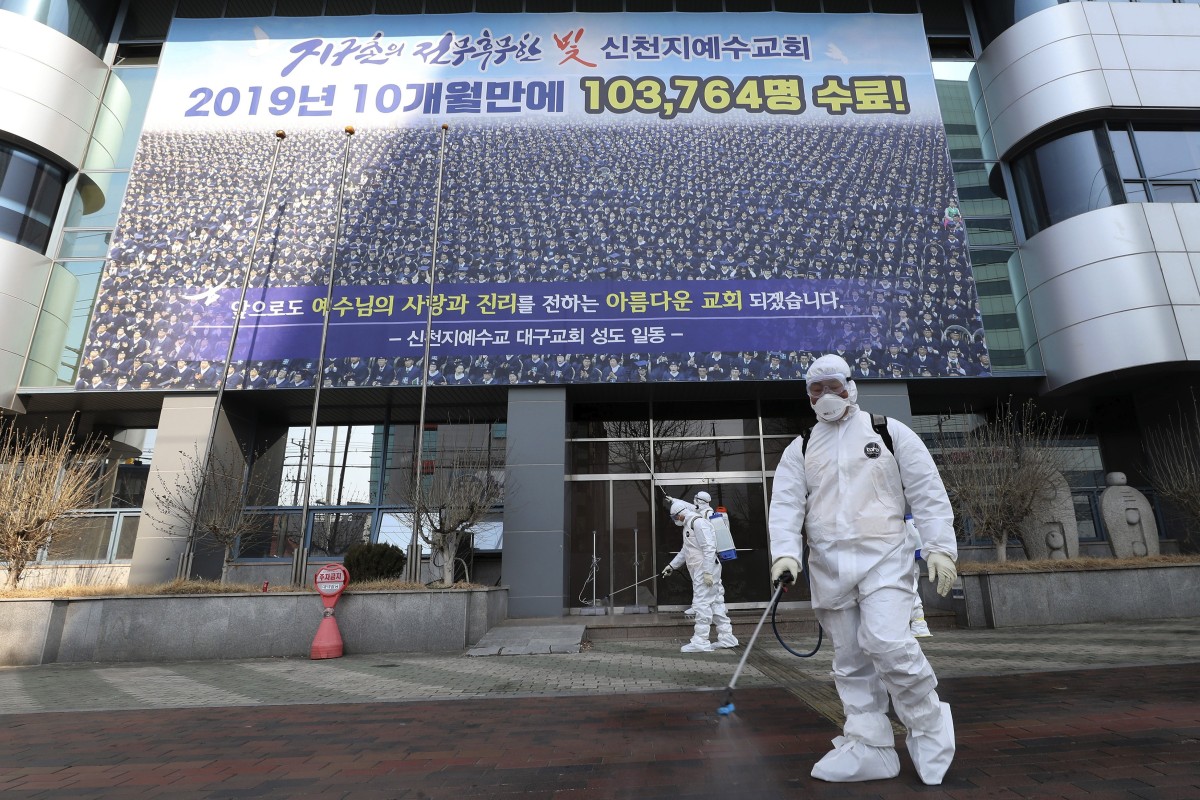
The Shincheonji church in Daegu has been linked to a cluster of infections. Photo: Yonhap via AP
Members of the Christian sect linked to a cluster of coronavirus cases in South Korea held meetings in Wuhan until December, only stopping when they realised that their community had been hit by Covid-19, the previously unknown disease caused by the virus.
The South China Morning Post has learned that the Shincheonji Church of Jesus in Wuhan, the Chinese city at the centre of the epidemic, has around 200 members, most of whom are currently under quarantine outside the city.
“Rumours about a virus began to circulate in November but no one took them seriously,” said one member, a 28-year-old kindergarten teacher.
“I was in Wuhan in December when our church suspended all gatherings as soon as we learned about [the coronavirus],” said the woman, who declined to be named because of the sensitivity of the matter.
She said the group was continuing to share sermons and teachings online, but most members had returned home at the start of the Lunar New Year holiday in late January.
The 250,000-member Shincheonji Church of Jesus is regarded by mainstream Christian groups as a secretive and unorthodox sect. Its founder, Lee Man-hee, has claimed that he is the second coming of Jesus Christ.
Around half the Covid-19 infections in South Korea have been linked to a branch of the church in Daegu.
Coronavirus spreads through Europe from Italy to Austria, Croatia, Tenerife
26 Feb 2020
According to the Korea Centres for Disease Control and Prevention, there were 977 confirmed cases as of Tuesday – the second highest number outside China – and 11 deaths.
Of the 84 new cases reported on Tuesday, over half were recorded in Daegu city.
Coronavirus: Churches on high alert as South Korea confirms huge rise in infections
A member of the church from Daegu reportedly visited China in January, and health officials in South Korea are investigating whether a cluster of infections in Cheongdo city is linked to a three-day funeral ceremony held at a local hospital.
Chinese sources said that the Shincheonji church has about 20,000 members in China – most of whom live in major cities such as Beijing, Shanghai, Dalian, Changchun and Shenyang.
One Christian pastor in Hubei province, who declined to be named, said that Shincheonji church members were hard-working and some continued to proselytise even during the outbreak.
Chinese cities quarantine travellers from South Korea amid spike in coronavirus cases
25 Feb 2020
The Wuhan kindergarten teacher said she was confident that the recent mass outbreaks in South Korea were not linked to Shincheonji church members from the city.
“I don’t think the virus came from us because none of our brothers and sisters in Wuhan have been infected. I don’t know about members in other places but at least we are clean. None of us have reported sick,” she said.
“There are so many Chinese travelling to South Korea, it’s quite unfair to pin [the disease] on us.”
Coronavirus: China reports 508 new Covid-19 cases, with only nine outside outbreak epicentre
She sidestepped questions on whether church members had travelled from Wuhan to South Korea after the outbreak.
The teacher said that in 2018 the Wuhan group’s “holy temple” in Hankou district had been raided by police “who branded us a cult”, but members continued to worship in small groups.
“We are aware of all the negative reporting out there after the outbreak in South Korea, but we do not want to defend ourselves in public because that will create trouble with the government,” she said. “We just want to get through the crisis first.”
Airfares from South Korea to China shoot up amid Covid-19 fears
25 Feb 2020
Bill Zhang, a 33-year-old Shanghai resident and a former missionary with Shincheonji, said the group’s secretive nature made it hard for the authorities to effectively crackdown on its activities.
He said the Shanghai branch held its main meetings on Wednesdays and Saturdays, attracting 300 to 400 people at a time.
“The Shincheonji church in Shanghai has been raided many times and police spoke to church leaders regularly.
“But the church members simply continued their meetings in smaller groups of eight-to-10 people and regrouped when the surveillance was relaxed.”
Zhang continued: “Shincheonji holds that it is the only real church that upholds the biblical truth and all other churches – mainstream or cults – are evil.”


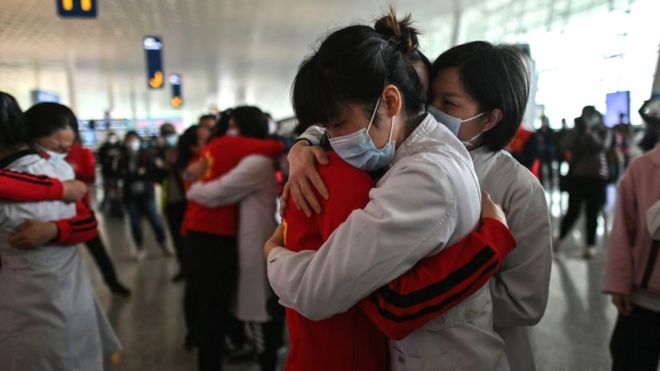 Image copyright GETTY IMAGES






 CHINDIA ALERT: You'll be living in their world, very soon