Archive for ‘live’

30/03/2020

Coronavirus: India’s pandemic lockdown turns into a human tragedy

Stranded workersImage copyright GETTY IMAGES
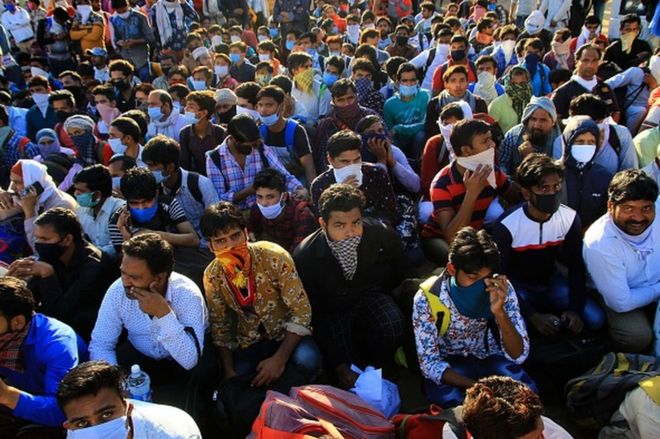
Image caption Millions are workers are defying a curfew and returning home

When I spoke to him on the phone, he had just returned home to his village in the northern state of Rajasthan from neighbouring Gujarat, where he worked as a mason.

In the rising heat, Goutam Lal Meena had walked on macadam in his sandals. He said he had survived on water and biscuits.

In Gujarat, Mr Meena earned up to 400 rupees ($5.34; £4.29) a day and sent most of his earnings home. Work and wages dried up after India declared a 21-day lockdown with four hours notice on the midnight of 24 March to prevent the spread of coronavirus. (India has reported more than 1,000 Covid-19 cases and 27 deaths so far.) The shutting down of all transport meant that he was forced to travel on foot.

“I walked through the day and I walked through the night. What option did I have? I had little money and almost no food,” Mr Meena told me, his voice raspy and strained.

He was not alone. All over India, millions of migrant workers are fleeing its shuttered cities and trekking home to their villages.

These informal workers are the backbone of the big city economy, constructing houses, cooking food, serving in eateries, delivering takeaways, cutting hair in salons, making automobiles, plumbing toilets and delivering newspapers, among other things. Escaping poverty in their villages, most of the estimated 100 million of them live in squalid housing in congested urban ghettos and aspire for upward mobility.
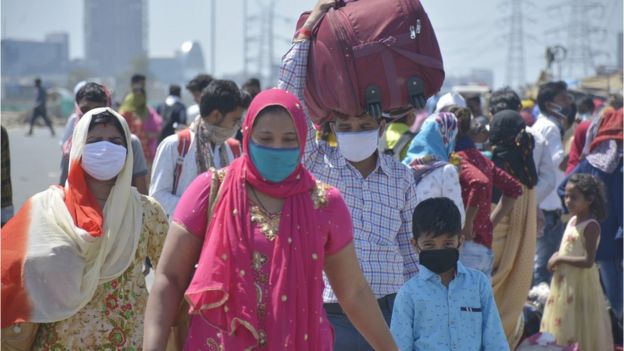
Migrant workers head home on Day 5 of the 21 day nationwide lockdown imposed by PM Narendra Modi to curb the spread of coronavirus, at NH9 road, near Vijay Nagar, on March 29, 2020 in Ghaziabad, IndiaImage copyright GETTY IMAGES
Image caption Informal workers are the backbone of India’s big city economies

Last week’s lockdown turned them into refugees overnight. Their workplaces were shut, and most employees and contractors who paid them vanished.

Sprawled together, men, women and children began their journeys at all hours of the day last week. They carried their paltry belongings – usually food, water and clothes – in cheap rexine and cloth bags. The young men carried tatty backpacks. When the children were too tired to walk, their parents carried them on their shoulders.

They walked under the sun and they walked under the stars. Most said they had run out of money and were afraid they would starve. “India is walking home,” headlined The Indian Express newspaper.

The staggering exodus was reminiscent of the flight of refugees during the bloody partition in 1947. Millions of bedraggled refugees had then trekked to east and west Pakistan, in a migration that displaced 15 million people.
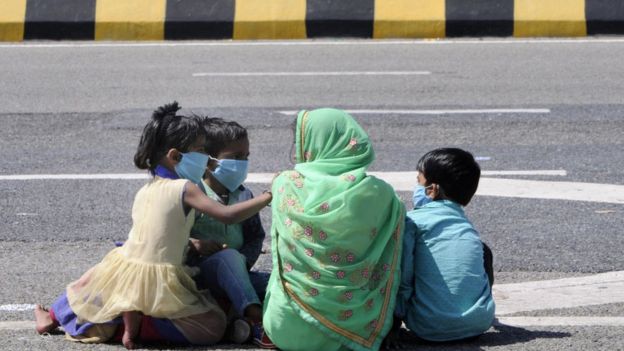
migrant worker with children headed back home pauses for break, on day 5 of the nationwide lockdown imposed by PM Narendra Modi to check the spread of coronavirus, at Yamuna expressway zero point, on March 29, 2020 in Noida, India. (Photo by Sunil Ghosh /Hindustan Times via Getty Images)Image copyright GETTY IMAGES
Image caption Migrant labourers feel they have more social security in their villages

This time, hundreds of thousands of migrant workers are desperately trying to return home in their own country. Battling hunger and fatigue, they are bound by a collective will to somehow get back to where they belong. Home in the village ensures food and the comfort of the family, they say.

Clearly, a lockdown to stave off a pandemic is turning into a humanitarian crisis.

Among the teeming refugees of the lockdown was a 90-year-old woman, whose family sold cheap toys at traffic lights in a suburb outside Delhi.

Kajodi was walking with her family to their native Rajasthan, some 100km (62 miles) away. They were eating biscuits and smoking beedis, – traditional hand-rolled cigarettes – to kill hunger. Leaning on a stick, she had been walking for three hours when journalist Salik Ahmed met her. The humiliating flight from the city had not robbed her off her pride. “She said she would have bought a ticket to go home if transport was available,” Mr Ahmed told me.

Others on the road included a five-year-old boy who was on a 700km (434 miles) journey by foot with his father, a construction worker, from Delhi to their home in Madhya Pradesh state in central India. “When the sun sets we will stop and sleep,” the father told journalist Barkha Dutt. Another woman walked with her husband and two-and-a-half year old daughter, her bag stuffed with food, clothes and water. “We had a place to stay but no money to buy food,” she said.

Then there was Rajneesh, a 26-year-old automobile worker who walking 250km (155 miles) to his village in neighbouring Uttar Pradesh. It would take him four days, he reckoned. “We will die walking before coronavirus hits us,” the man told Ms Dutt.

He was not exaggerating. Last week, a 39-year-old man on a 300km (186 miles) trek from Delhi to Madhya Pradesh complained of chest pain and exhaustion and died; and a 62-year-old man, returning from a hospital by foot in Gujarat, collapsed outside his house and died. Four other migrants, turned away at the borders on their way to Rajasthan from Gujarat, were mowed down by a truck on a dark highway.

As the crisis worsened, state governments scrambled to arrange transport, shelter and food.
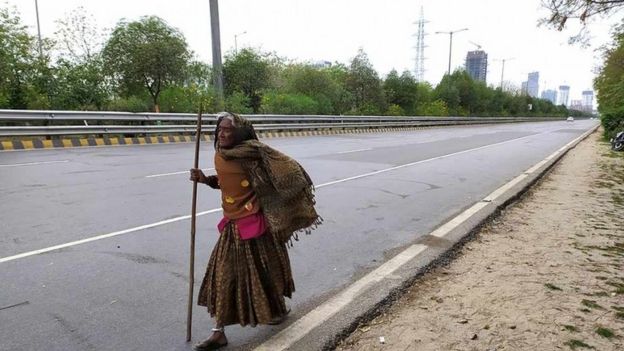
Kajodi DeviImage copyright SALIK AHMED/OUTLOOK
Image caption Ninety-year-old Kajodi Devi is walking from Delhi to her village

But trying to transport them to their villages quickly turned into another nightmare. Hundreds of thousands of workers were pressed against each other at a major bus terminal in Delhi as buses rolled in to pick them up.

Delhi chief minister Arvind Kejriwal implored the workers not to leave the capital. He asked them to “stay wherever you are, because in large gatherings, you are also at risk of being infected with the coronavirus.” He said his government would pay their rent, and announced the opening of 568 food distribution centres in the capital. Prime Minister Narendra Modi apologised for the lockdown “which has caused difficulties in your lives, especially the poor people”, adding these “tough measures were needed to win this battle.”

Whatever the reason, Mr Modi and state governments appeared to have bungled in not anticipating this exodus.

Mr Modi has been extremely responsive to the plight of Indian migrant workers stranded abroad: hundreds of them have been brought back home in special flights. But the plight of workers at home struck a jarring note.

“Wanting to go home in a crisis is natural. If Indian students, tourists, pilgrims stranded overseas want to return, so do labourers in big cities. They want to go home to their villages. We can’t be sending planes to bring home one lot, but leave the other to walk back home,” tweeted Shekhar Gupta, founder and editor of The Print.
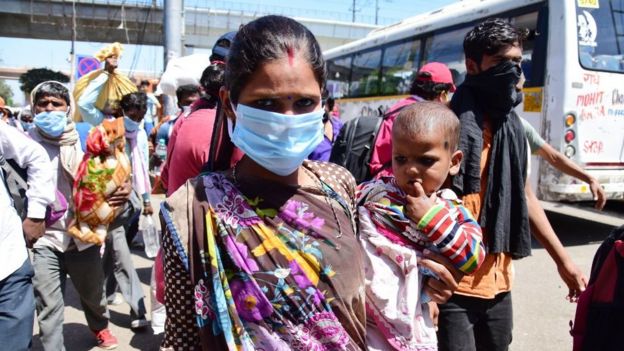
Migrant woman with a baby wearing a face mask as a preventive measure, at Anand vihar bus terminal during the nationwide lock downImage copyright GETTY IMAGES
Image caption There is a precedent for this kind of exodus during crisis

The city, says Chinmay Tumbe, author of India Moving: A History of Migration, offers economic security to the poor migrant, but their social security lies in their villages, where they have assured food and accommodation. “With work coming to a halt and jobs gone, they are now looking for social security and trying to return home,” he told me.

Also there’s plenty of precedent for the flight of migrant workers during a crisis – the 2005 floods in Mumbai witnessed many workers fleeing the city. Half of the city’s population, mostly migrants, had also fled the city – then Bombay – in the wake of the 1918 Spanish flu.

When plague broke out in western India in 1994 there was an “almost biblical exodus of hundreds of thousands of people from the industrial city of Surat [in Gujarat]”, recounts historian Frank Snowden in his book Epidemics and Society.

Half of Bombay’s population deserted the city, during a previous plague epidemic in 1896. The draconian anti-plague measures imposed by the British rulers, writes Dr Snowden, turned out to be a “blunt sledgehammer rather than a surgical instrument of precision”. They had helped Bombay to survive the epidemic, but “the fleeing residents carried the disease with them, thereby spreading it.”

More than a century later, that same fear haunts India today. Hundreds of thousands of the migrants will eventually reach home, either by foot, or in packed buses. There they will move into their joint family homes, often with ageing parents. Some 56 districts in nine Indian states account for half of inter-state migration of male workers, according to a government report. These could turn out to be potential hotspots as thousands of migrants return home.
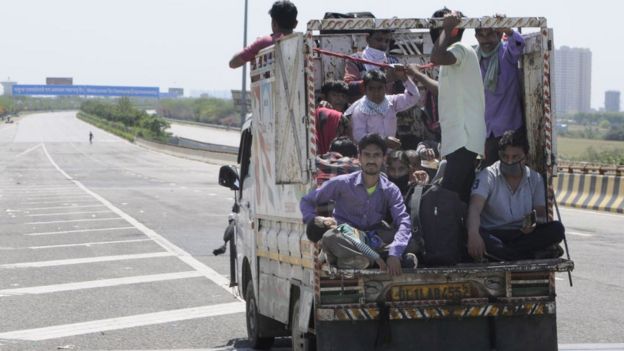
Migrant workers headed back to their towns and villages hitch a ride, on day 5 of the nationwide lockdown imposed by PM Narendra Modi to check the spread of coronavirus, at Yamuna expressway zero point, on March 29, 2020 in Noida, IndiaImage copyright GETTY IMAGES
Image caption The fleeing migrants could spread the disease all over the country

Partha Mukhopadhyay, a senior fellow at Delhi’s Centre for Policy Research, suggests that 35,000 village councils in these 56 potentially sensitive districts should be involved to test returning workers for the virus, and isolate infected people in local facilities.

In the end, India is facing daunting and predictable challenges in enforcing the lockdown and also making sure the poor and homeless are not fatally hurt. Much of it, Dr Snowden told me, will depend on whether the economic and living consequences of the lockdown strategy are carefully managed, and the consent of the people is won. “If not, there is a potential for very serious hardship, social tension and resistance.” India has already announced a $22bn relief package for those affected by the lockdown.

The next few days will determine whether the states are able to transport the workers home or keep them in the cities and provide them with food and money. “People are forgetting the big stakes amid the drama of the consequences of the lockdown: the risk of millions of people dying,” says Nitin Pai of Takshashila Institution, a prominent think tank.

“There too, likely the worst affected will be the poor.”

Source: The BBC

25/09/2019

China Focus: China completes world’s longest cross-sea road-rail bridge

CHINA-FUJIAN-CROSS-SEA ROAD-RAIL BRIDGE-COMPLETION (CN)

Aerial photo taken on Sept. 21, 2019 shows a steel girder being lifted by a crane at the construction site of the Pingtan Strait Road-rail Bridge in southeast China’s Fujian Province. China on Wednesday completed the main structure of the world’s longest cross-sea road-rail bridge in Fujian. The last steel girder, weighing 473 tonnes, was bolted on the Pingtan Strait Road-rail Bridge, another mega project in China, on Wednesday morning. With a staggering span of 16.34 km, the bridge connects Pingtan Island and four nearby islets to the mainland of Fujian Province. (Xinhua/Lin Shanchuan)

FUZHOU, Sept. 25 (Xinhua) — China on Wednesday completed the main structure of the world’s longest cross-sea road-rail bridge in its southeastern province of Fujian.

The last steel truss girder, weighing 473 tonnes, was bolted on the Pingtan Strait Road-rail Bridge, another mega project in China, on Wednesday morning.

Hundreds of bridge builders clad in orange overalls, as well as government officials, hailed the completion on the bridge deck, with several rounds of fireworks being set off to celebrate the moment.

With a staggering span of 16.34 km, the bridge connects Pingtan Island and four nearby islets to the mainland of Fujian Province.

The bridge, which is expected to open to traffic next year, can help shorten travel time from two hours to half an hour between Fuzhou, capital city of Fujian Province and Pingtan, a pilot zone set up to facilitate trade and cultural exchanges across the Taiwan Strait.

“Of all the bridges being built across the world, this is no doubt the most challenging,” said Wang Donghui, chief engineer of the project, adding that it is China’s first and the world’s longest cross-sea road-rail bridge.

The project has attracted worldwide attention from the start of construction in 2013 as it spans an area off the coast of southeast China long seen as a “no-go zone” for bridge-building.

The region has strong gales and high waves for most of the year and is known as one of the world’s three most perilous seas along with Bermuda and the Cape of Good Hope.

Workers had to battle the notoriously strong winds, choppy waters and rugged seabed in the region to drill 1,895 piles into the ocean.

MORE THAN MEGA PROJECT

The road-rail bridge has a six-lane highway on the top and a high-speed railway at the bottom, which is designed to support bullet trains traveling as fast as 200 km per hour. It is a part of the 88-km Fuzhou-Pingtan railway.

In the past, Pingtan was a backwater island of humble fisheries. It did not even have a bridge connecting it to the mainland until 2010 when the Strait Bridge began operating for cars only.

In 2010, China established the Pingtan Comprehensive Pilot Zone to facilitate cross-Strait exchange and cooperation, ramping up its efforts to improve the island’s infrastructure.

Today, skyscrapers are popping up all along the shoreline, with the glow of construction work filling the night sky. Meanwhile, thousands of Taiwan residents swarm into the booming island to live and start businesses.

The island has accommodated more than 1,000 shops and companies set up by Taiwan residents, according to government statistics.

Chen Chien-hsiang, a 29-year-old man who moved from Taiwan to Pingtan two years ago, believes that the new bridge will help attract more businesses to the island and further boost its economic development.

“The new bridge means more than a mere mega project,” Chen said. “It also promises a brighter future for people from Taiwan who chose to live and work here.”

INFRASTRUCTURE MANIAC

Huang Zhiwei, 22, found himself making history by lifting the last piece of the bridge girder from a ship about 80 meters below the bridge deck, an undertaking that he had never expected when he joined the project a year ago as an intern.

His parents, unhappy about their son’s career choice, felt relieved after several video chats during which their son showed them his working and living conditions at the construction site.

“With so many advanced technologies and safety measures, I am convinced that we will accomplish the mission, and I am very proud of my contribution,” said the young operator.

More than 1.24 million tonnes of steel have been used for the bridge, enough to build 190 Eiffel Towers, and 2.97 million cubic meters of cement, nine times the amount of cement used to build the Burj Khalifa towers in Dubai, the world’s tallest skyscraper.

“We could not possibly have realized the construction 15 years ago for lack of advanced construction technologies and equipment such as the drilling machine and ship cranes we have developed today,” said Xiao Shibo, an engineer of the China Railway Major Bridge Engineering Group Co., Ltd. The bridge has made history in many aspects, Xiao added.

China is dubbed as an “infrastructure maniac” for countless dazzling megaprojects, with the Chinese builders breaking their own world records.

China is home to the world’s highest bridge, longest cross-sea bridge and 90 out of the 100 highest bridges built this century.

From 2015 to 2020, China’s transportation investment is expected to exceed 15 trillion yuan (2.1 trillion U.S. dollars), with a substantial portion reserved for bridge construction.

Source: Xinhua

07/09/2019

Chandrayaan-2: Modi proud despite Moon landing setback

Indian Prime Minister Narendra Modi told his country’s space scientists he was proud of a programme that had come so near to putting a probe on the Moon.

Contact with Chandrayaan-2 was lost moments before its Vikram module was due to touch down at the lunar south pole.

The fate of the craft is not yet known, but Mr Modi said there would be further opportunities.

India would have been the fourth nation to make a soft landing on the Moon.

“The best is yet to come in our space programme. India is with you,” said Mr Modi.

The Chandrayaan-2 approached the Moon as normal until an error occurred about 2.1km (1.3 miles) from the surface, officials said.

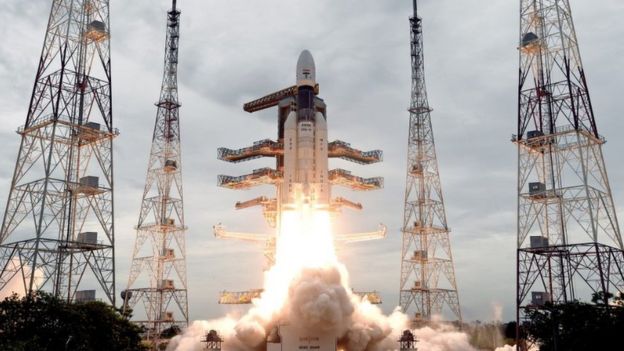
Chandrayaan-2 taking offImage copyright ISRO
Image caption The mission’s lift-off was broadcast live to an audience of hundreds of millions

India’s Space Research Organization (Isro) said it lost contact seconds before the ship was expected to land.

The country’s first Moon mission – Chandrayaan-1, in 2008 – carried out the first and most detailed search for water on the lunar surface using radars.

What happened?

Chandrayaan-2 entered the Moon’s orbit on 20 August and was due to make a controlled descent to the surface early on Saturday, Indian time, over a month after it first took off.

Staff at mission control were glued to the screens at Isro’s Bangalore space centre as the spacecraft made its descent towards the surface.

The control room burst into applause during the so-called rough breaking phase of the descent, with Prime Minister Modi watching the action from behind a glass screen.

Isro chairman Kailasavadivoo Sivan announced to staff that the ship’s initial descent had been “normal,” and that the mission’s data would be analysed.

Mr Sivan had earlier described the final descent as “15 minutes of terror”.

What was this mission all about?

Chandrayaan-2 (Moon vehicle 2) was the most complex mission ever attempted by India’s space agency, Isro. “It is the beginning of a historical journey,” Isro chief K Sivan said after launch in July.

The lander (named Vikram, after the founder of Isro) carried within its belly a 27kg Moon rover with instruments to analyse the lunar soil.

The rover (called Pragyan – wisdom in Sanskrit) had the capacity to travel 500m from the lander in its 14-day life span, and would have sent data and images back to Earth for analysis.

The mission would have focused on the lunar surface, searching for water and minerals and measuring moonquakes, among other things.

Why would it have been significant?

A soft landing on another planetary body – a feat achieved by just three other countries so far – would have been a huge technological achievement for Isro and India’s space ambitions, writes science writer Pallava Bagla.

He adds that it would also have paved the way for future Indian missions to land on Mars, and opened up the possibility of India sending astronauts into space.

For the first time in India’s space history, the interplanetary expedition was led by two women – project director Muthaya Vanitha and mission director Ritu Karidhal.

Media caption Is India a space superpower?

It is also a matter of national pride – the satellite’s lift-off in July was broadcast live on TV and Isro’s official social media accounts.

The mission has also made global headlines because it’s so cheap – the budget for Avengers: Endgame, for instance, was more than double at an estimated $356m. But this isn’t the first time Isro has been hailed for its thrift. Its 2014 Mars mission cost $74m, a tenth of the budget for the American Maven orbiter.

Source: The BBC

Law of Unintended Consequences

continuously updated blog about China & India

ChiaHou's Book Reviews

continuously updated blog about China & India

What's wrong with the world; and its economy

continuously updated blog about China & India